Longevity hack or healthcare trend? The answer may depend on who you ask, but investor interest in personalized nutrition is growing as consumers search for the next longevity hack. Now, Rem3dy Health, the UK company behind the 3D printed nutrition brand Nourished, has raised £14 million ($18.7 million) in new funding as it looks to expand internationally and scale what has become one of the most successful commercial applications of 3D printing in the consumer wellness market. The investment values the company at £84 million.
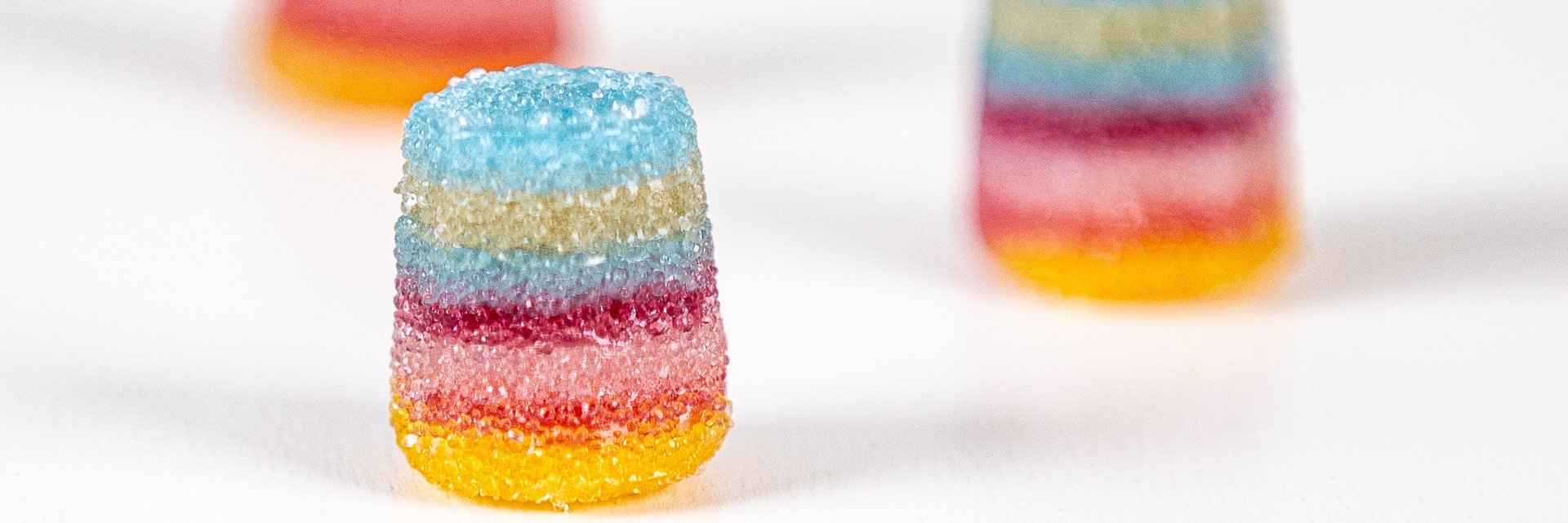
Nutrition brand Nourished sells its gummies in France. Image courtesy of Nourished.
The funding round was backed by several investors, including Suntory, Estrella Galicia, Apollo Hospitals, and French pharmaceutical company UPSA. The company said the capital will support expansion into the United States, India, the Middle East, and North Africa, as well as further investments in automation, artificial intelligence, and manufacturing.
For the additive manufacturing industry, the announcement represents another milestone for a company that has spent years trying to prove that 3D printing can be used not just for prototypes or specialty products, but for high-volume consumer goods.
Founded by entrepreneur and nutritionist Melissa Snover, Rem3dy Health developed a manufacturing platform capable of producing personalized vitamin gummies using proprietary 3D printing technology. The company’s Nourished products are built as seven-layer nutrient “stacks,” with formulations tailored to individual health goals. Customers complete an online questionnaire and receive a customized blend of vitamins, minerals, and supplements.
Since its launch, Nourished has become one of the most clear examples of food- and nutrition-related 3D printing. The company now sells through major UK retailers including Boots, Holland & Barrett, and Ocado, and also distributes products through thousands of pharmacies across Europe.
According to the company, its manufacturing operation currently produces approximately 500,000 personalized gummies per day. Rem3dy also reports holding 29 patents related to its technology and manufacturing processes.
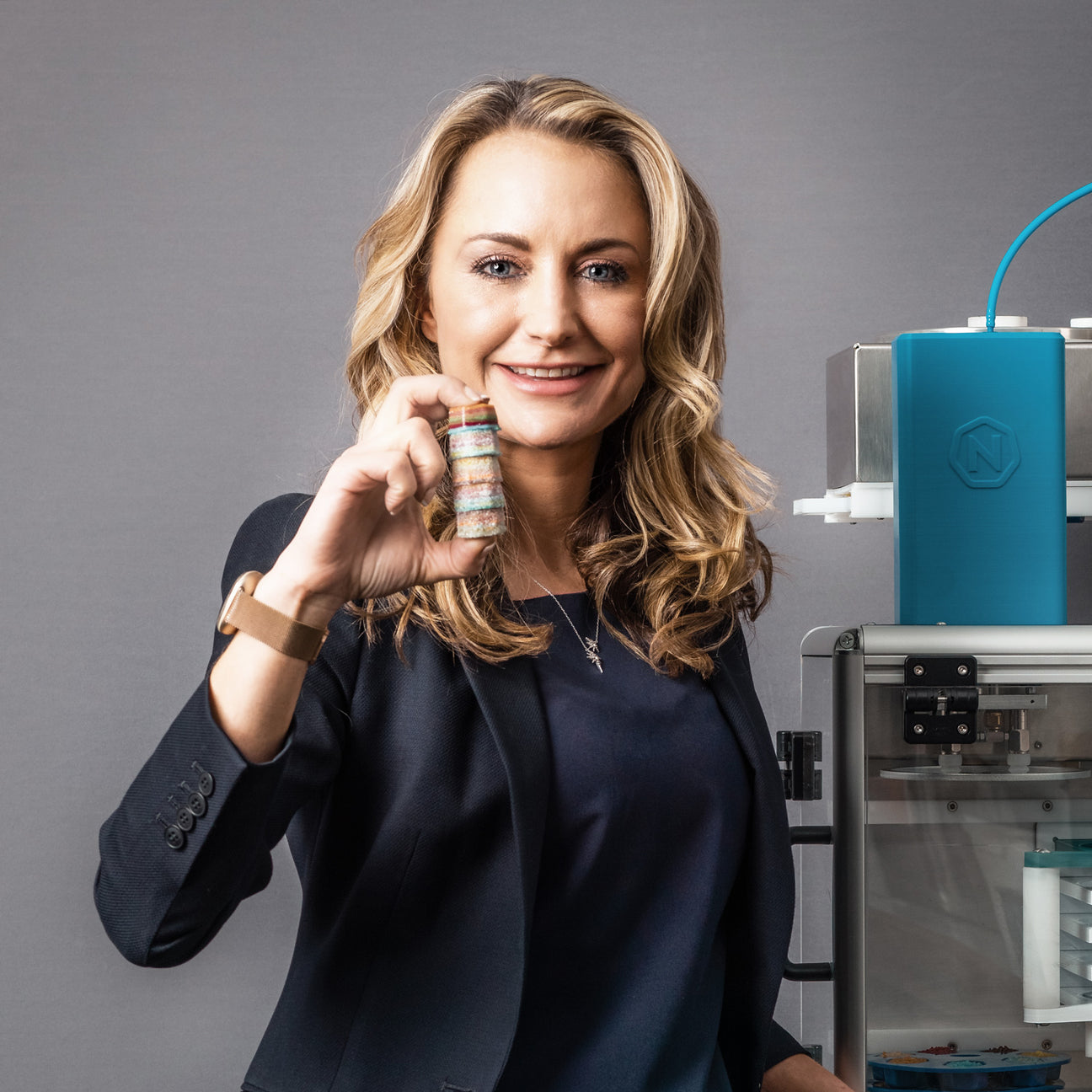
Melissa Snover, CEO and Founder of Nourished. Image courtesy of Nourished.
The funding comes after a year of growth for the company. Rem3dy reported more than £10 million in revenue in 2025, up about 61% from the previous year. The company also said it increased production and improved its manufacturing processes through greater automation and the use of artificial intelligence.
In the case of Nourished, instead of buying the same vitamins as everyone else, customers receive supplements designed around their own health goals, lifestyle, diet, and age. The concept attracted plenty of interest from people looking for more personalized ways to manage their health.
Even more so, investor interest in the sector continues to grow. Personalized nutrition is at the intersection of several major trends, including digital health, AI-driven recommendations, preventive healthcare, and what some consumers view as “longevity hacks,” or products and services that seek to extend healthspan and maintain quality of life as people age.
Rem3dy’s investors come from several sectors. Along with consumer brands Suntory and Estrella Galicia, the round included Apollo Hospitals, one of India’s largest healthcare providers. So, rather than relying only on traditional venture capital, the company seems to be building a network of strategic partners that could help accelerate entry into new markets.
Nourished products are available at retail chain Holland & Barrett. Image courtesy of Nourished.
The company is also planning to expand beyond human nutrition. Rem3dy said part of the funding will support the development of personalized health products for pets, another rapidly growing wellness category.
For the 3D printing industry, the funding is about more than nutrition. For years, companies have promoted the idea of 3D printed food and supplements. But turning that vision into a real business has proven much harder. While many projects never moved beyond demonstrations and pilot programs, Nourished has built a product that consumers can buy in retail stores and has grown its customer base. Now, backed by £14 million in new funding, Rem3dy is looking to take that model into new markets, and it may turn out to be one of the most interesting applications for personalized products in the 3D printing industry.
As I described in a recent PRO article, the bulk of global investment is currently premised on a bet that an AI infrastructure buildout can eventually result in a workable balance between the old economy and the economy of the future. It will be quite some time before the general outcome of that proposition can be gauged, but Japanese electronics giant TDK has just provided an example of the sort of deals we can expect to see more and more of as the overall landscape evolves.
Fabric8Labs, the San Diego-based company that leverages its proprietary Electrochemical Additive Manufacturing (ECAM) process to produce thermal management hardware for the data center and semiconductor industries, has entered into an agreement to be acquired by TDK, in an all-cash deal worth up to $400 million. Fabric8Labs will operate as a wholly owned subsidiary of TDK, and the total value of the transaction will depend upon Fabric8Labs’ ability to meet undisclosed performance milestones.
Through its venture arm, TDK has been an investor in Fabric8Labs since at least 2021, when the Japanese multinational invested in the startup’s Series A round worth nearly $20 million. Additionally, TDK participated in two subsequent funding rounds, each worth $50 million. With its process for printing liquid-cooling cold plates, Fabric8Labs is targeting a market that AM Research forecasts will see exponential growth through 2035, as one of the biggest long-term catalysts for AM demand expansion.
TDK’s journey from early investor in Fabric8Labs to parent company has proceeded in parallel to, and in alignment with, its Digital Transformation initiative, a plan to build the TDK enterprise AI business on a foundation of the company’s own internal AI adoption strategy. TDK’s acquisition of Fabric8Labs gives both companies the opportunity to use the buildout of TDK’s in-house data management transformation as a test run for a broader B2B scale-up in the future.
High-purity components. Image courtesy of Fabric8Labs.
In a press release about TDK’s acquisition of Fabric8Labs, the president and CEO of TDK, Noboro Saito, said, “This acquisition marks a pivotal step in accelerating TDK’s value creation. By harmonizing our technologies with Fabric8Labs’ innovative capabilities, we will be uniquely positioned to provide customers with innovative thermal management systems, high-efficiency power components, and advanced packaging techniques that define the next generation of data center performance.”
Jeff Herman, the CEO of Fabric8Labs, said, “Joining TDK group will give us the resources to scale our technology globally and to supply our current and future Tier 1 customers with the solutions they need with confidence in our ability to scale while we remain focused on our core mission.”
Moreover, TDK could ultimately leverage Fabric8Labs’ technology for data center thermal management in more ways than one, as the ECAM process is also a viable method for advanced packaging, and TDK has invested heavily in lowering the power consumption requirements for AI chips through advanced packaging. A two-pronged approach — lowering the power demand of the chips themselves while also minimizing the power demand requirements of the associated cooling hardware — could give TDK a serious edge in the biggest value differentiator in the AI infrastructure market, compute power efficiency.
I absolutely love this acquisition. In a PRO article published last year, I suggested that we’d start to see more examples of diagonal integration in 3D printing industry deals: integration in which the purchaser expands into a new market that’s synergistic with its existing business model. TDK’s Fabric8Labs acquisition is a textbook example of that, instantly accelerating its movement into providing AI infrastructure solutions.
It’s obvious that being part of a global brand like TDK will help Fabric8Labs scale up at the precise moment when it’s technologically capable of doing so. At the same time, Fabric8Labs can help its new parent corporation scale up its AI enterprise strategy at a time when this is difficult for everyone, even a giant like TDK. One of the main things delaying the AI buildout, especially in the US, is a shortage of the required power hardware and underinvestment in the value chain needed to address the shortage.
The other obstacle is public opposition. For something that hardly anyone seemed to think much about until quite recently, data centers have rapidly become one of the most polarizing topics for the communities aiming to attract investment, largely because of their enormous resource usage.
In order to proceed forward with as little friction as possible, AI infrastructure hopefuls must, at a bare minimum, incorporate comprehensive sustainability initiatives into their business plans from the start. TDK already understood that before there was even widespread awareness of an AI boom on the horizon. By acquiring Fabric8Labs, TDK is signaling its commitment to sticking to that vision.
We’re starting with some exciting news in today’s 3D Printing News Briefs: Stratasys just celebrated the opening of its new North American headquarters in Minnesota. Moving on, Nanoscribe is scaling manufacturing capabilities for some of its most popular 3D printing photoresins, and RIC Robotics is working to scale adoption of autonomous additive construction. We’ll end with news about 3D printed shoes.
Stratasys Holds Grand Opening Event for Americas Headquarters
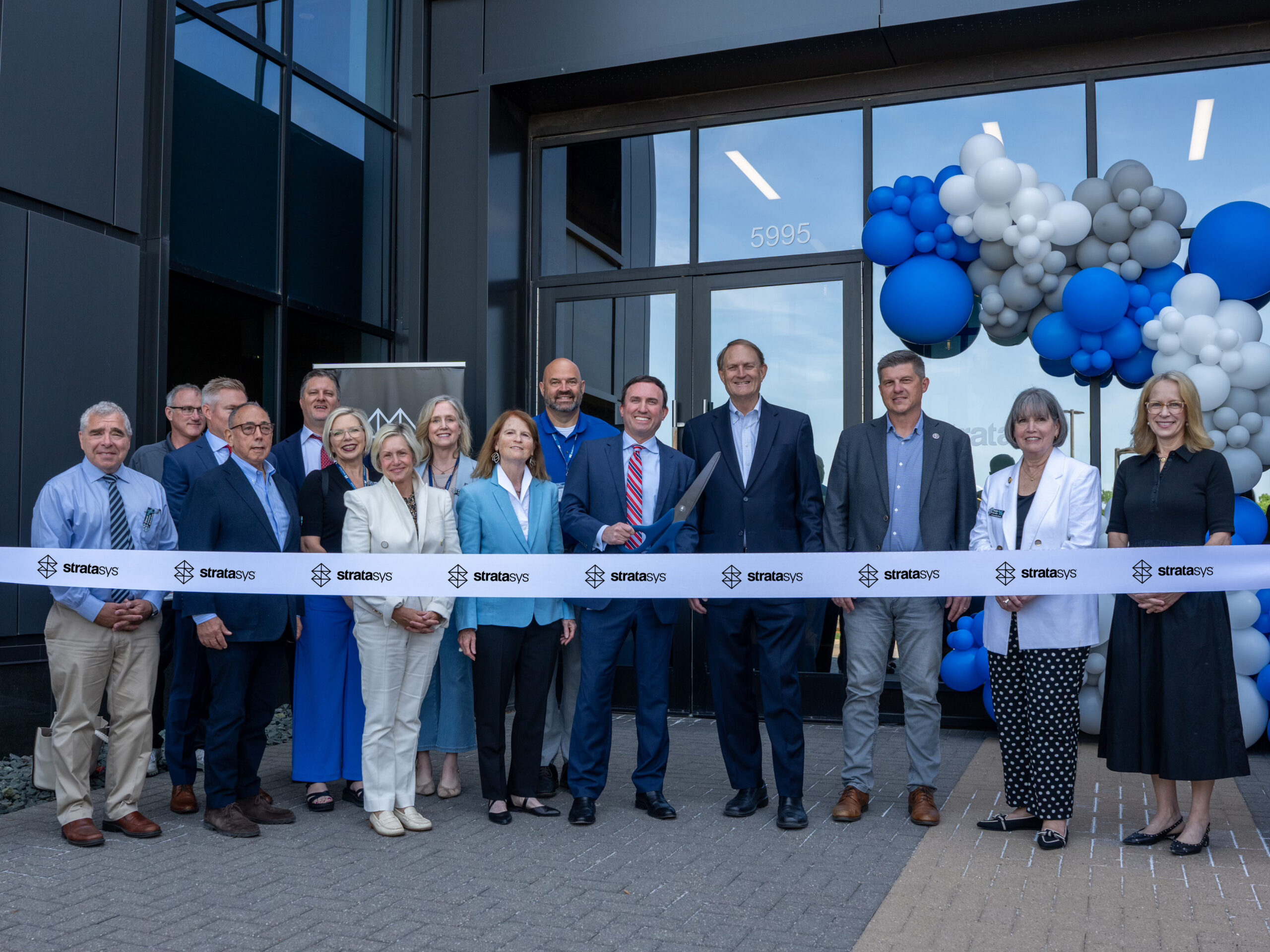
Ribbon-cutting ceremony at the grand opening of Stratasys’ Americas Regional Corporate Headquarters in Minnetonka, Minnesota, with Stratasys leaders, partners, and community guests, including Rich Garrity, Scott and Lisa Crump.
Days after announcing its acquisition of Markforged, 3D printing leader Stratasys celebrated the grand opening of its new Americas Regional Corporate Headquarters (ARCH) in Minnetonka, Minnesota. In addition to company leadership, partners, customers, and community stakeholders, several VIPs made the guest list, including United States Representative Betty McCollum, United States Representative Brad Finstad, United States Representative Kelly Morrison, EVP of the National Association of Manufacturers (NAM) Erin Streeter, and Stratasys Board Member Scott Crump, who invented fused deposition modeling (FDM), and his wife Lisa Crump, Stratasys Co-Founder. ARCH is a 200,000 square-foot facility, housing advanced R&D, applications expertise, engineering, customer collaboration capabilities, and on-demand manufacturing business Stratasys Direct. The opening comes after an independent audit of the company’s Environmental, Health, and Safety (EHS) management systems at the campus in Minnetonka; the audit confirmed alignment with ISO 14001 and ISO 45001 standards. ARCH drives home just how committed Stratasys is to the U.S. market.
“Bringing our teams together under one roof has a meaningful impact on how we operate, innovate, and serve our customers. ARCH gives us the scale and workspace to accelerate collaboration across engineering, manufacturing, and customer facing teams, enabling faster delivery of high-quality solutions,” said Rich Garrity, Chief Business Unit Officer of Stratasys and NAM Board Member.
Nanoscribe Invests in Expanding Manufacturing Capabilities for Key Photoresins
Selected high-demand photoresins, now manufactured with industrial-grade quality and available with batch-specific Certificates of Analysis (CoA).
High-precision 3D microfabrication market leader Nanoscribe is seeing increased industrial demand for its photoresins, and is meeting that demand by scaling up manufacturing capabilities for five of its requested materials. Early demand for its two-photon polymerization (2PP) and two-photon grayscale lithography (2GL) systems mostly came from academic research facilities, but last year, every third system the company sold went to industry, particularly in photonics packaging and optics manufacturing applications. So Nanoscribe has responded with extra manufacturing capabilities for IP-Dip2, IP-S, IPX-Q, IPX-S and IPX-Clear, though the names of the resins, their chemical composition, material handling, and print parameters will stay the same. Plus, for customers that need batch-specific traceability, Nanoscribe can provide Certificates of Analysis (CoA) on request. Measurements are taken by an independent external service provider, and the certificate acts as an extra record for batch-specific documentation, which can be helpful for purchasing, internal quality management, or incoming inspection.
“The five key photoresins are already used in a wide range of applications and markets,” explained Dr. Alexander Quick, Head of Materials at Nanoscribe. “Our investment in expanded manufacturing capacity supports industrial-grade material quality while maintaining material properties and established customer workflows. This benefits customers from both academia and industry.”
RIC Robotics Aims to Scale Additive Construction Adoption with RaaS Platform
RIC Robotics recently announced the launch of its Robotics as a Service (RaaS) ecosystem, in order to help scale adoption of autonomous construction. The company, which specializes in large-scale additive construction robotics and autonomous building technologies, has supported some major commercial projects, including 3D printed Walmart expansions. Its new RaaS offering is a flexible deployment model, meant to help contractors, developers, and construction firms efficiently integrate robotic construction into their real-world projects. The platform will expand access to the company’s proprietary mobile robotic construction systems and 3D concrete printing technologies, in order to make these technologies more accessible for both residential and commercial applications. In addition to its systems, RIC Robotics says it also offers clients hands-on training, project execution, material solutions, and implementation support, and that it’s investing in training infrastructure and workforce development to support long-term adoption of robotic construction.
“Construction is entering a period of significant technological transformation, but widespread adoption depends on making these technologies more accessible and operationally practical for real-world projects. Our Robotics as a Service platform is designed to lower barriers to adoption while giving developers and contractors the flexibility, support and deployment expertise needed to successfully integrate robotic construction systems into active projects,” said CEO of RIC Robotics Dr. Ryan Cox, who also served as COO of Alquist 3D, where he oversaw major 3D concrete printing projects, including the Walmart expansion developments.
Nike & Zellerfeld Rolled Out Version 2 of 3D Printed Air Max 1000
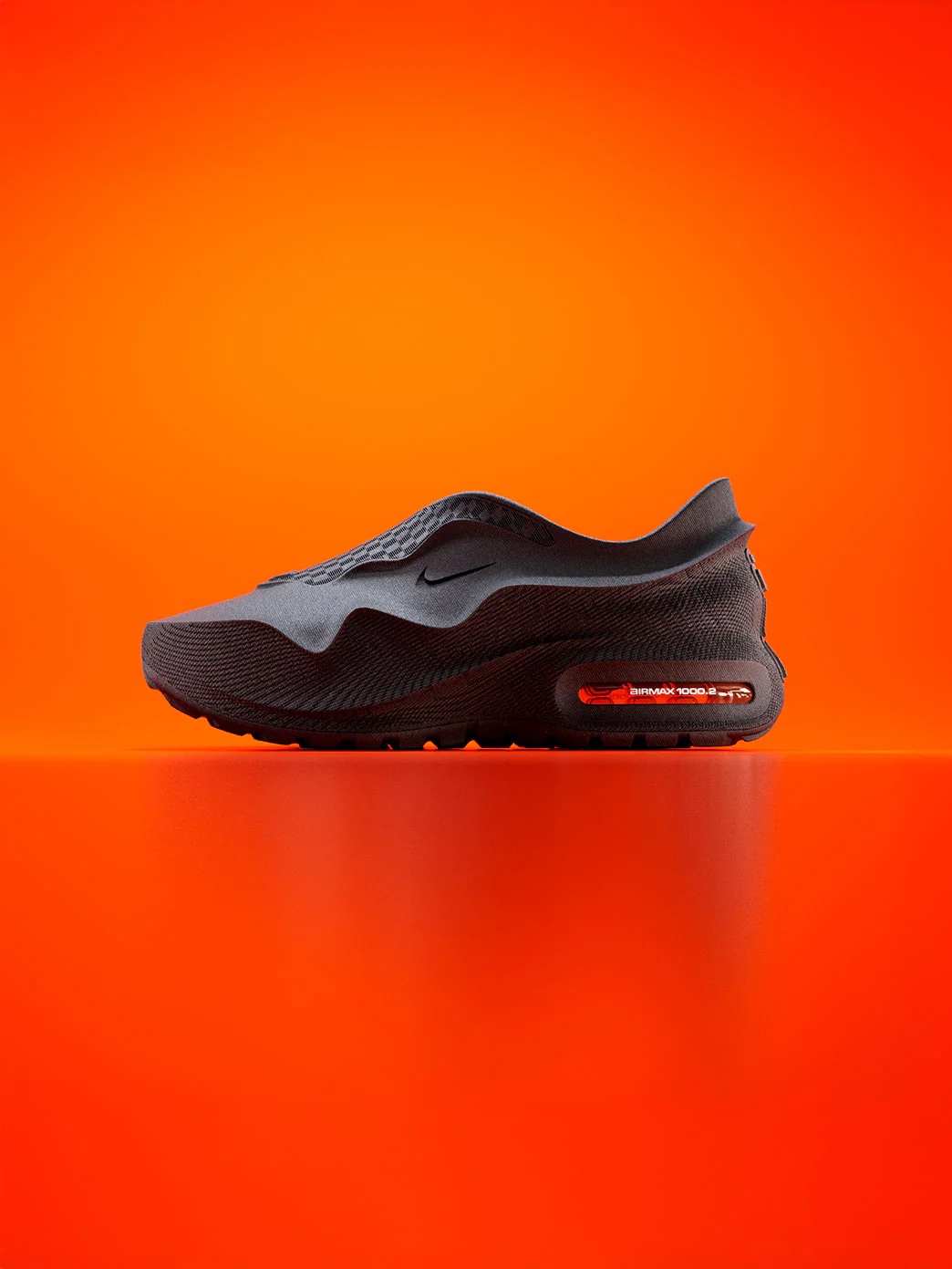
Image courtesy of Zellerfeld
Once again, Nike and Zellerfeld have teamed up for the 3D printed Air Max. There was the single-color Air Max 1000 in 2024, the Air Max 95000 last year, and the multicolor Air Max 1000 this winter. Last month, they dropped version 2: the Nike Air Max 1000.2 Black Hyper Crimson. Printed out of zellerFOAM TPU material, the shoe kept the triple-black upper from the first 1000.2, but added a Hyper Crimson red to the Air bubble in the heel. This makes the branding really stand out on the see-through window. The design of the shoe mostly stayed the same, but the geometry was refined, and the lugs and outsole of the Air Max 1000.2 Black Hyper Crimson were both reshaped, resulting in what Zellerfeld says is an “improved feel.” These changes made it faster to produce the one-piece 3D printed shoe, and also introduced new colorways to the market much sooner.
“What hasn’t changed is the soft, responsive design that blends a utilitarian build with plush support and one-of-a-kind looks,” the Zellerfeld website states. “Wavy patterns and textured tooling throughout the upper mimic the original Air Max 1 mudguard, creating depth and complexity. The laceless design makes it simple to slip into the familiar feeling of Max Air-infused bliss.”
Unfortunately, the $179 Nike Air Max 1000.2 Black Hyper Crimson was only available through an EQL raffle from Zellerfeld that ran from May 25-28, so the website says they’re sold out. But, you can visit the Zellerfeld website and subscribe to get access to exclusive products, new arrivals, and be among the first to know about future limited drops.
For decades, the nuclear industry has quietly experimented with and implemented additive. Bouyed by the likes of ORNL, companies such as Westinghouse have 3D printed components serially. We have an insightful podcast on the industry, and an overview article as well. A newer trend is that emerging nuclear energy startups are also using additive to accelerate their development.
A new crop of Small Modular Reactor companies, such as Oklo, Valar Atomics, Ulta Safe Nuclear Corporation, Moltex Energy, Radiant, Nano Nuclear Energy, TerraPower, and NuScale, aim to make a new generation of easier-to-build, easier-to-deploy, hopefully safer nuclear power plants. Small Modular Reactors are meant to consist mainly of transportable modular components that can be made in factories at scale, rather than custom large plants built at one particular location with cost overruns. Ideally, they have passive safety systems, which means that, whatever happens, the plant will shut down safely. These plants could be put in remote places more easily, so bases or remote communities could benefit.
One in this crop of startups is NX Atomics, which presumably uses Siemens NX’s Vela reactor—a liquid fuel, lead coolant small reactor meant for data centers and shipping. NX has now partnered with EBAM leader Sciaky to make components for their reactors.
NX Atomics CEO John Warden said,
“This is what bringing nuclear manufacturing into the modern era actually looks like, 3D printing opens up the potential for us to produce nuclear-qualified parts faster and at lower cost, where appropriate swap them out through life, and meaningfully reduce the unit cost of every small modular reactor we build.”
Sciaky CEO John Criso states,
“Sciaky has spent more than eight decades building the metal manufacturing technology that the world’s most demanding industries rely on. Our EBAM process produces parts that fly on commercial aircraft, sail on naval vessels, and orbit the earth. Bringing that capability into America’s clean energy infrastructure with NX Atomics is a natural next step, and we are proud that two Midwestern companies are leading this transition.”
The duo hopes to make low-cost nuclear parts quickly using an electron beam. They also say that some parts will be designed to be replaced rather than last forever, opening up an expanded reactor consumables market, presumably? Given the long lead times, traditional reactor economics is under threat. Costing decades and billions to build, traditional reactors are among the most daunting, massive, and complex engineering projects in existence. For the financial set, delays and cost overruns play havoc with business plans and the underlying economics of building nuclear plants. Famously in the UK, Hinckley Point C has cost more than double its initial estimate. This not only causes problems for banks but also for governments.
Making lots of small plants in factories therefore sounds like a dream. It seems so logical, kind of like doing precast concrete or factory-built houses. This does not mean that it will work, of course. There are only two Small Modular Nuclear reactors in operation, which are research units in Russia and China, and only a handful are actually under construction. Meanwhile, over 100 of these reactors are in a planning phase. The first to actually be operational will probably be made by the venerable Rolls-Royce.
In 3D printing, we often say that we have superior economics for first articles, prototypes, and small production runs. Ironically, NX is using additive to enable it to ameliorate the punishing economics of building its own factories. These nuclear reactor startups all have the same issue. They have a massive upfront cost in design, regulatory, planning, approval, testing, and building their factories. I also think that there is something else going on, which no one mentions. It’s all good to have a few 3D printing OEMs making machines that ultimately don’t work. It’s okay if we all have a Helios, Black Buffalo, or Sintratec printer to remind us of the hope and possibility of it all. But, what if you have a local nuclear power plant built by a startup that goes out of business?
Will one of these startups provide safe nuclear power at low cost? Sure. But, will all of them work? No. I can assure you that there will be bankruptcies. Many bankrupt 3D printing firms have been bought for IP, and others have been bought for parts, people, or printers. It’s relatively facile to make a calculation of supporting a printer that you didn’t design for a decade or more. It’s relatively easy to look at it and determine how it will strengthen your lineup, revenue, and channel. And the liability is usually OK. Now, of course, a metal LPBF system is going to be a bit more difficult to determine than a desktop printer. But, imagine a completely different design of nuclear reactor goes bankrupt. Imagine the liability. There are a lot of unknowns there. Do you trust their engineering, internal processes, and people? Will they stay with you? And would you assume the liability of something that has little to nothing in common with your architecture, design or production methods? The chance of you selling two different models of nuclear plants with different technologies and methods of production is effectively zero. It would be too much risk and too much extra cost to subsume. To what end? It would just make everything worse for you without it having any tangible benefit. Even if a company had patents or technology you want, you’d rather not take over the pilot plant.
These startups have raised tens of billions, with TerraPower raising 3 billion and several others raising hundreds of millions. But, given our particular track record, this doesn’t seem like a lot. We couldn’t make binder jet work for a billion dollars, and they have to make local safe nuclear power work for $100 million? Given Rolls-Royce’s experience, and that it is essentially the only valuable large industrial company in the UK, this market still looks like it’s Rolls-Royce’s to lose. There are an awful lot of people who don’t want nuclear power. There are many others who may want nuclear power, but not in their backyard. I’d venture there are almost no people who’d want a half-built nuclear power plant in their backyard, with a design so unique they never made it again. So that, to me, is the problem with the underlying excitement and economics of small modular nuclear power. But, if these people are to make their schedules and their timelines, then additive may very well help them get to where they can build a factory for nuclear power plants.
If 2026 has a theme in bioprinting, it may be blood vessels. Researchers can already print incredibly sophisticated tissues. The harder part is keeping those tissues alive. Without a network of blood vessels to deliver oxygen and nutrients, larger tissues quickly run into trouble. That challenge is at the center of a growing collaboration between the University of Notre Dame and Harvard Medical School.
In recent months, researchers led by Yanliang Zhang, an associate professor in the Department of Aerospace and Mechanical Engineering at the University of Notre Dame, and Yu Shrike Zhang, a professor at Harvard Medical School and associate bioengineer at Brigham and Women’s Hospital, have focused on one of regenerative medicine’s biggest obstacles: recreating the vascular networks that support living tissue. Their latest work, published in Nature Chemical Engineering, builds on a broader effort that also includes a recently announced National Institutes of Health (NIH)-funded project to advance organ engineering and tissue fabrication.
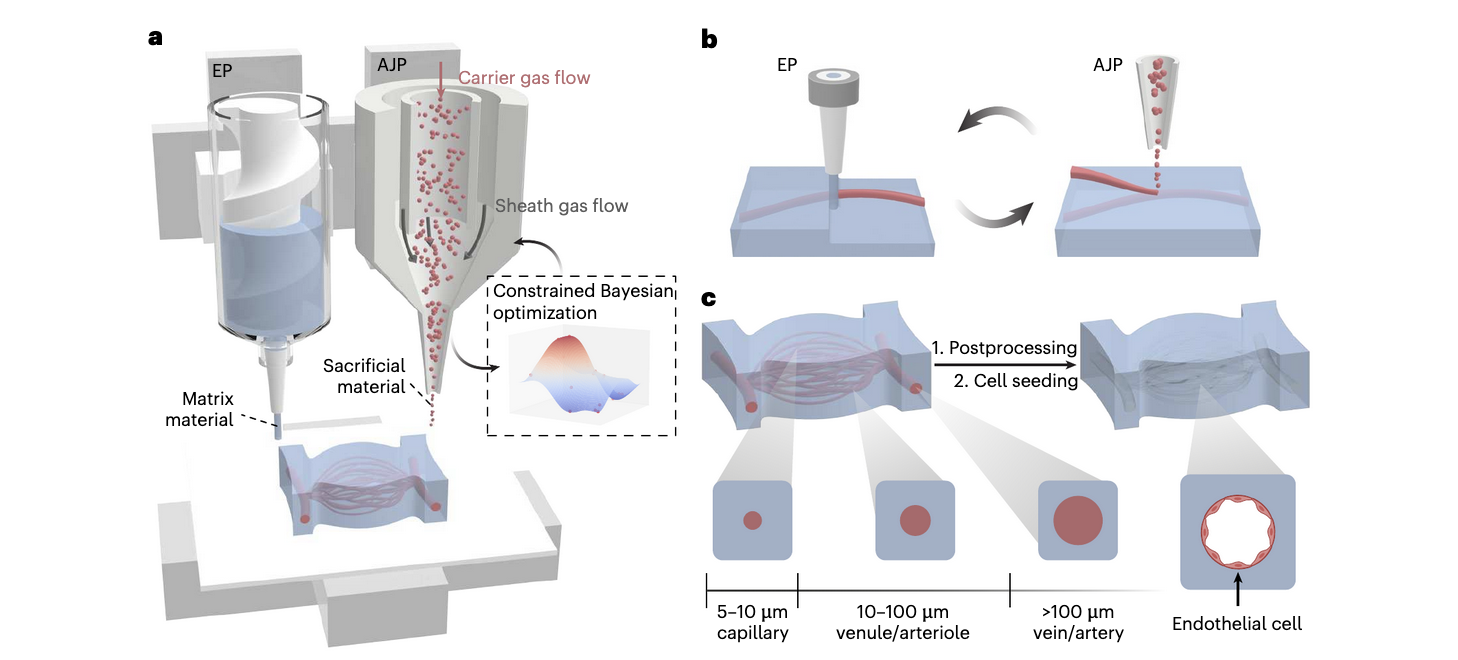
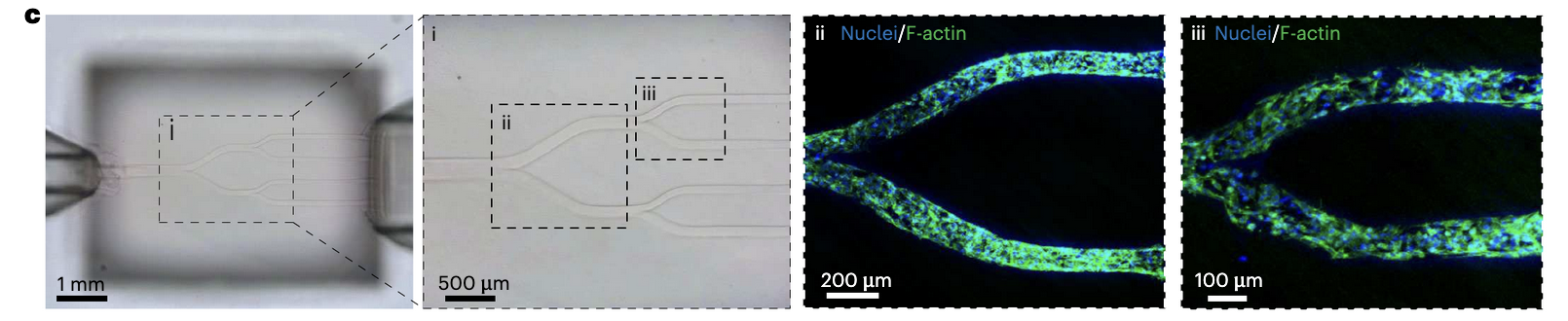
In the study, the researchers developed a new way to 3D print tiny blood vessel-like structures. The approach combines two printing methods, one for building larger tissue structures and another for creating extremely small channels that can later act like blood vessels. According to the study, titled Hybrid bioprinting of hierarchical vascular networks at capillary-scale resolution, the technique pairs conventional extrusion bioprinting for larger tissue structures with high-resolution aerosol jet printing, which creates tiny sacrificial channels that can later be converted into blood vessel-like networks. The system was built around a custom-designed hybrid printer developed by the research team, combining aerosol jet printing and extrusion printing into a single platform. So instead of relying on a commercial bioprinter, the researchers engineered a hybrid system that integrates two manufacturing technologies, one optimized for building larger tissue structures and another capable of producing capillary-scale features.
Machine learning-enhanced high-resolution hybrid bioprinting approach. Image courtesy of Yuxuan Liao et al., Nature Chemical Engineering (2026).
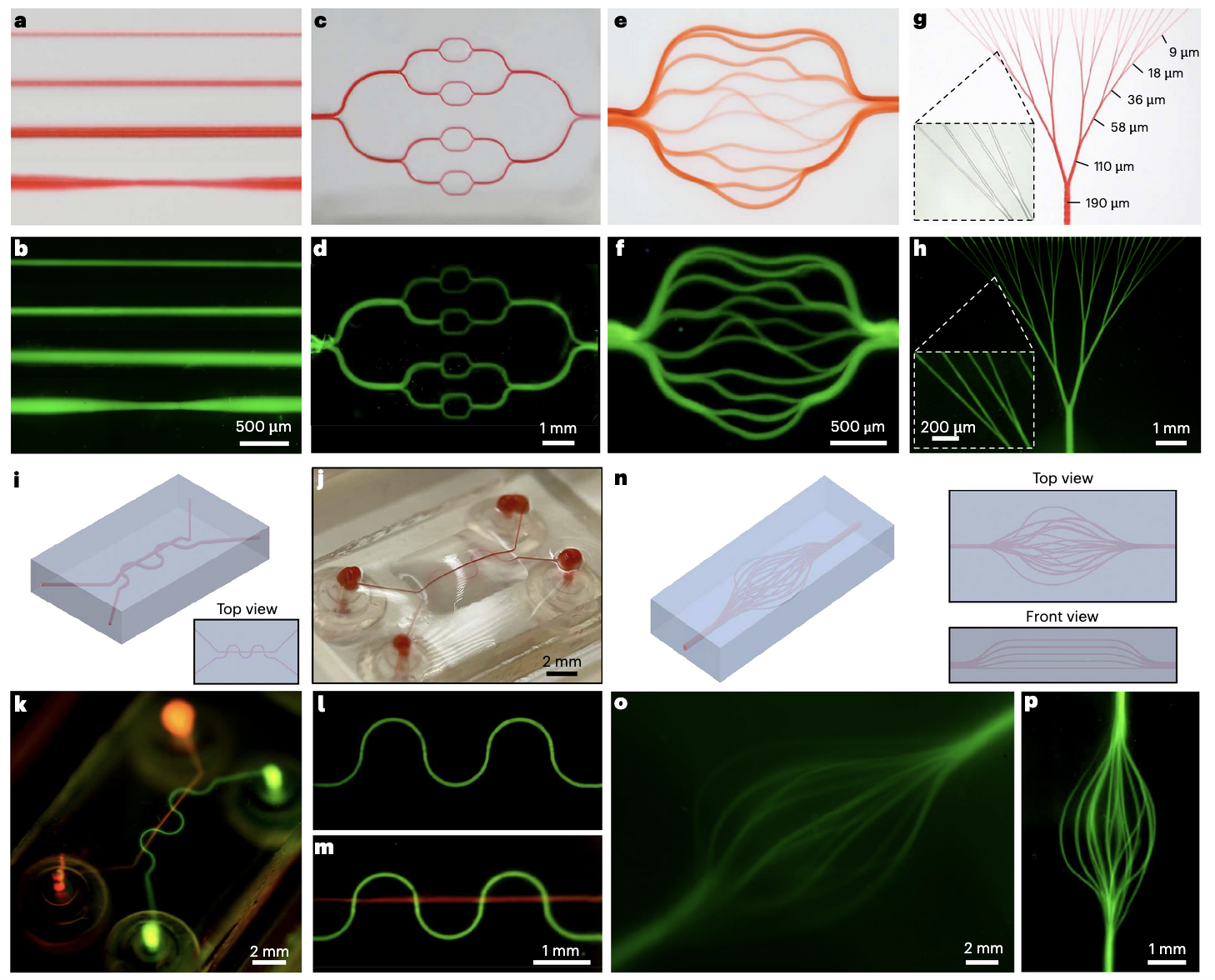
Using the technique, the team created channels smaller than 10 microns in diameter, close to the size of the body’s smallest blood vessels, known as capillaries. In some cases, the researchers produced channels approaching 5 to 6 microns in size. They explained that they can also adjust the size and shape of these channels as they print, so they can create more realistic vascular networks. It is important to note that the technology is not limited to a single vessel size. The team demonstrated networks that range from larger vessel-like channels down to capillary-scale structures, creating branching hierarchies that more closely resemble the body’s natural vascular system.
The system is also supported by machine learning. In particular, it uses Bayesian optimization, a method that helps researchers quickly find the best printing settings for creating blood vessel-like channels of specific sizes. That reduces the need for more time-consuming trial-and-error experiments and speeds up the development process. According to the study, the optimization system was typically able to identify the required printing parameters in about eight rounds of testing while maintaining high printing quality
In laboratory experiments, cells lining the channels formed continuous vessel-like layers and remained healthy as they grew, suggesting the approach could support the development of more realistic engineered tissues. The cells did more than survive. According to the paper, “they attached to the channel walls, spread throughout the structures, and formed linings that behaved more like those found in natural blood vessels.” That’s important because the goal is not just to print small tissue samples in the lab, but to help bioprinted tissues become larger, more stable, and more useful for medicine. As tissues grow, cells deeper inside need ways to receive oxygen and nutrients and remove waste. Without a way to support that exchange, larger engineered tissues can fail.
Bright-field and fluorescence images of printed 1D, 2D and 3D vascular networks. Image courtesy of Yuxuan Liao et al., Nature Chemical Engineering (2026).
The work is part of a broader NIH project announced earlier this year. The four-year, $2.6 million effort is focused on creating vascularized tissues, or tissues with the blood vessel networks needed to survive and function over time. The goal is to move beyond small laboratory tissue samples and toward larger, more clinically relevant engineered tissues.
The team says the combination of machine learning-assisted optimization, real-time control over vessel size, and capillary-scale resolution could make the technology useful for tissue engineering, regenerative medicine, and drug discovery.
According to the authors, the near-term impact could be in drug testing and disease modeling. More realistic vascularized tissues could give researchers better ways to study human disease and test therapies in the lab before moving into animal studies or clinical trials. In the longer term, the same work could help move the field closer to larger engineered tissues and, eventually, lab-grown organs.
To demonstrate the technology, the team printed simple channels, branching vascular trees, and more complex 3D vascular networks embedded within soft tissue-like materials. They also showed that fluids could flow through the networks, and that endothelial cells could successfully line the channels, an important step toward creating functional vasculature.
Endothelialization and cell seeding of the printed channels: 3D-printed branched-like structures with continuous channel width reduction from 200 µm to 120 µm and down to 80 µm. Image courtesy of Yuxuan Liao et al., Nature Chemical Engineering (2026).
One of the biggest challenges in bioprinting is keeping living tissue alive. Cells need a steady supply of oxygen and nutrients, which in the body are delivered through an enormous network of blood vessels. The Notre Dame-Harvard team believes its hybrid approach offers a path toward overcoming those limitations.
Scientists have been working on this problem for years. Researchers such as Jennifer Lewis, Mark Skylar-Scott, Adam Feinberg, and others have advanced methods for creating vascular structures inside engineered tissues. The latest work takes another step toward creating blood vessel networks that look and behave more like those found in the human body.
A previous Killer 3D Printing Applications article looks at tool voids and tool storage. With 3D printing, we can connect different sets and make cases to organize tools. We can have specific organizational systems for particular operations and find ways to speed up many operations and make them safer. But 3D printing, in hand with power tools, can go much further than just that.
The Market for High-End Power & Hand Tools
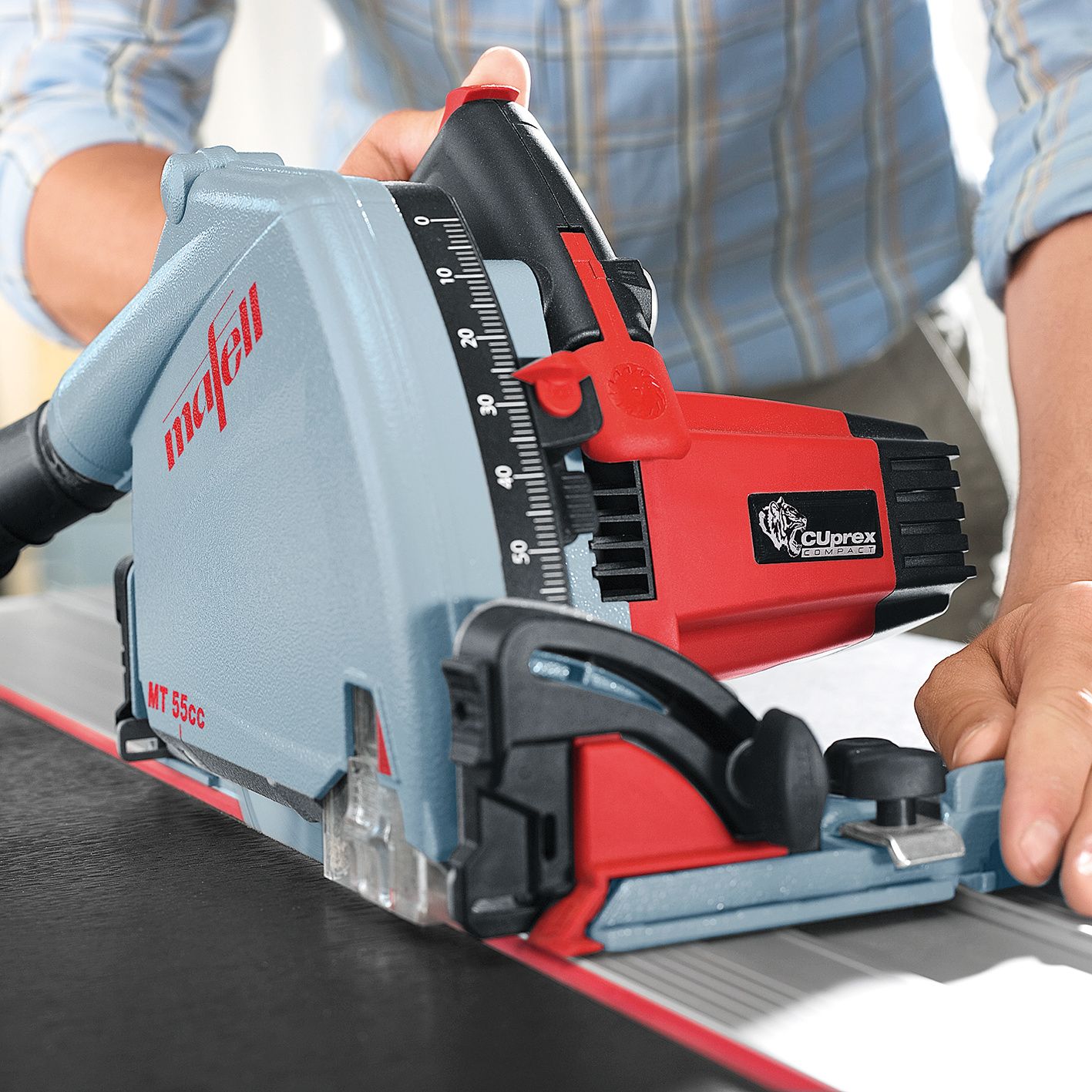
The Mafell MT 55 cc plunge-cut saw is regarded as one of the premium woodworking and construction saws on the market. Image courtesy of Mafell
If you need a plunge cut saw, you should probably get a Mafell MT 55 cc. It’s very well made in a factory in Germany that still makes nearly all of the components and tooling that go into the product. From that family-owned factory in Oberndorf am Neckar, Baden-Württemberg, come some of the best power tools in the world. Now you could opt for another family-owned brand, Festool, from Wendlingen. The individual Mafell tool is probably better, but Festool’s connected ecosystem of dust extraction, storage, and batteries makes owning just one more Festool a very good choice indeed. If you work with wood, either choice is good. But if you’re cutting wood to size at a construction site, you’ll probably go for Mafell, and if you make cabinets for a living, you’ll probably go for Festool.
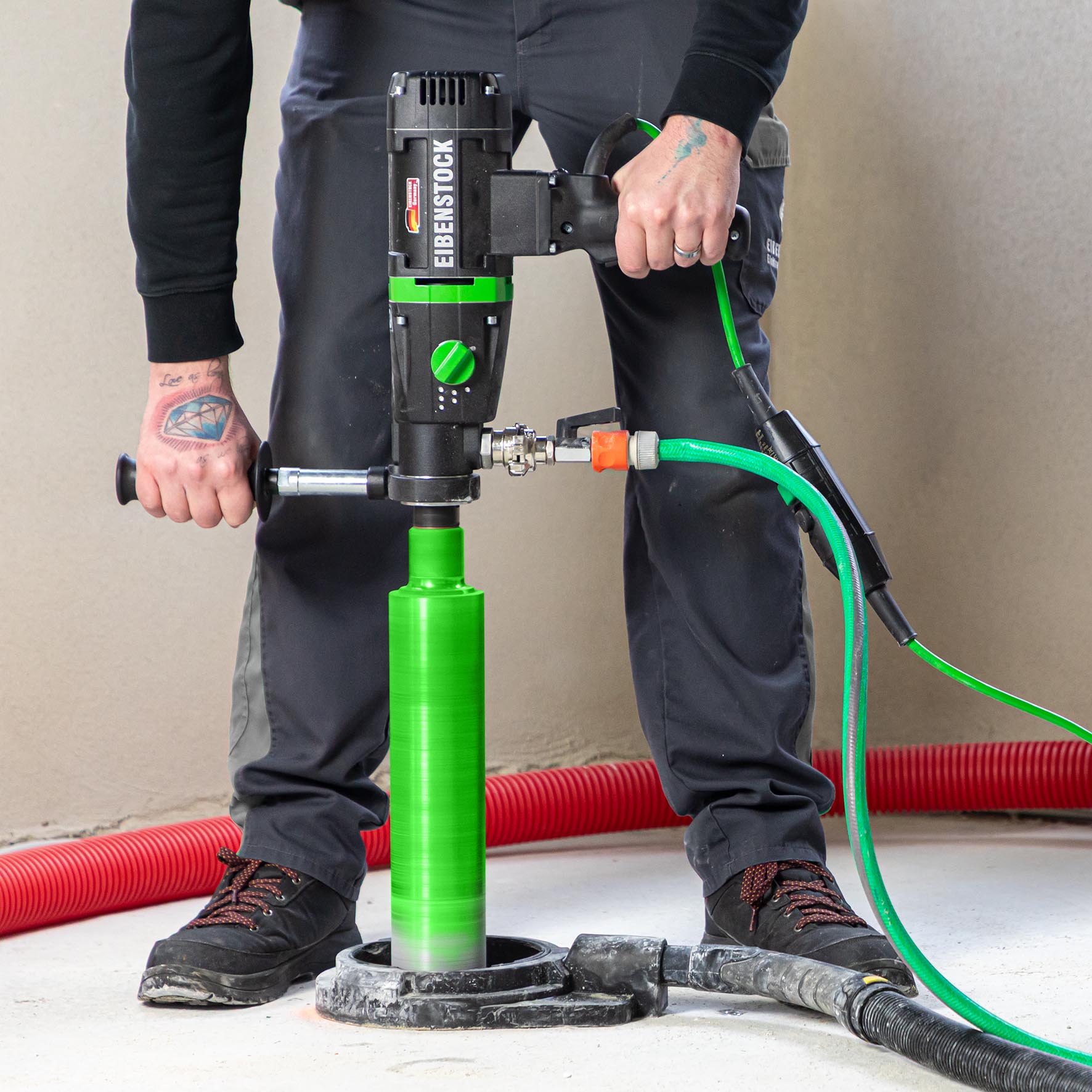
Eibenstock’s diamond core drilling systems are designed for heavy-duty professional construction work. The company is one of several European toolmakers highlighted in the article for its focus on durability and engineering quality. Image courtesy of Eibenstock.
In drilling, for example, Eibenstock, DUSS, Fein, and BDS Machines all compete with supremely well-engineered tools for specific user groups. DBS rules in magnetic drill presses, for example, Fein is best for metalwork while Eibenstock and DUSS compete in diamond core drills. Elbenstock is hilariously better than almost any other power tool that you’ve ever seen, while DUSS is even more durable. These tools are expensive, priced more than already well-made tools such as those from Makita. They’re true professional tools, not the delayed landfill you’re likely to find at your local big-box hardware store.
Hand Tools and Power Tools More Broadly
These companies are under threat from cheaper imports and more than that a more disposable mentality. But, with construction and manufacturing sorely needed, these firms could continue in their niches if they keep ahead of the curve. The reason is that in countries such as France, Germany, and the Netherlands, it would cost you around 50 to 100 euros per hour to hire a carpenter. Now, if everyone switched to a hobbyist who works without a contract, insurance, or taxes, that would be cheaper per hour but would rob society of the safety net and shared costs that make contemporary society possible. So the more law-abiding people pay taxes and work according to the rules, the more likely there will be a need for well-functioning, rugged, and reliable tools. The more people work illegally, the more likely the market for low-cost tools is to spread.
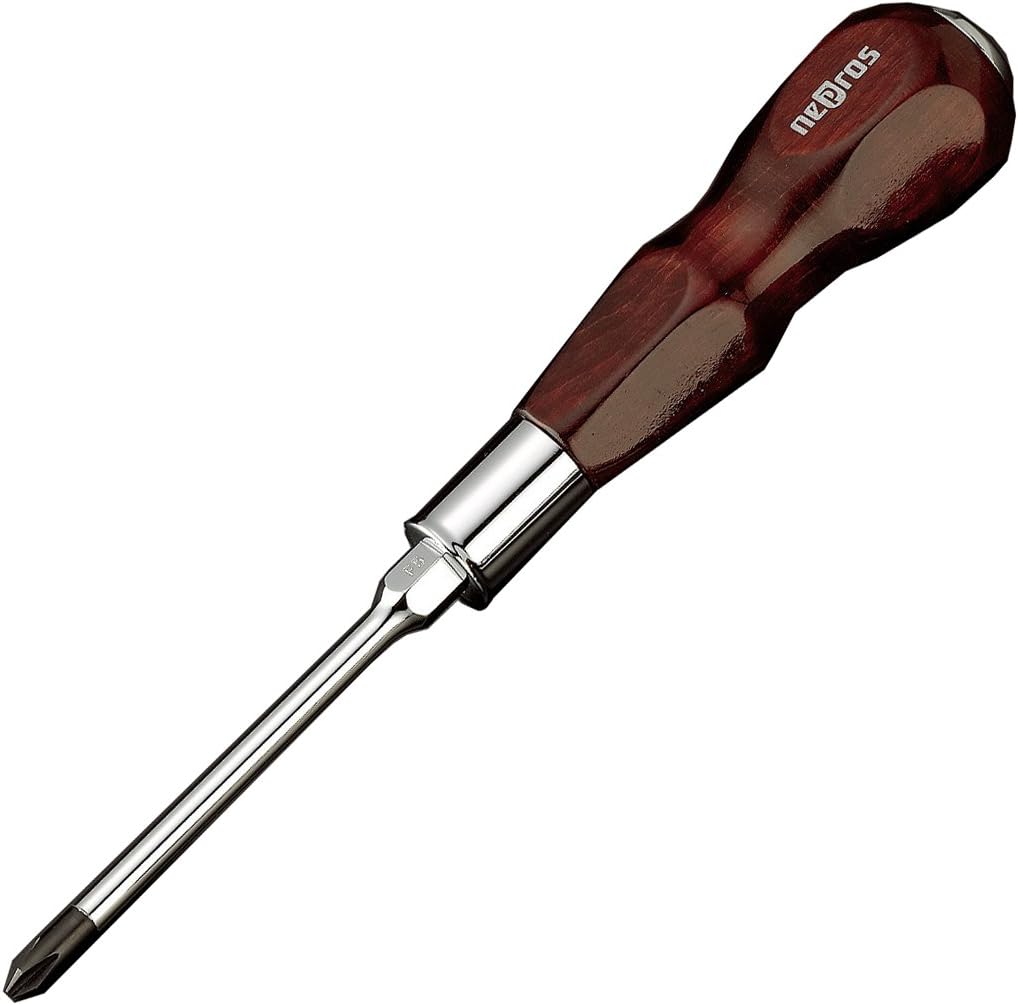
Japanese hand tool maker Nepros is known for premium precision tools and polished finishes. Image courtesy of Nepros.
Assuming, therefore, that the normal market continues to thrive, more reliable tools will become more in demand. At the same time, we would expect more competition from China in this category. In hand and power tools, there are a few global players, but many companies are entrenched regionally. And there are quality brands such as Vessel, Max, and KTC from Japan that are only now being used more widely beyond their shores. But KTC doesn’t even have a distributor in Europe, the Middle East, Australia, South America, or Africa, even though it’s been Japan’s biggest hand tool company for decades. Vessel was better for some Japanese electronics screws, and only because people wanted to disassemble Japanese-specific products did it gain popularity. Bosch is a good power tool choice in many places, while in Japan, Panasonic is a good choice. Gray tools are reportedly good hand tools in Canada, while JessEm and Veritas are good woodworking tools from there. Taiwan has King Tony and produces tools for others through companies like Kabo. Wera is very well known in many parts of the world, but hand tool brands typically are not as widely distributed as global power tool companies. This means that niches are local, sometimes standards are too, and everywhere there is a preference for the company that your Dad used. Generally, we can see a trend toward lower-quality tools being available in both big-box stores and local hardware stores. It’s quite difficult for me, for example, to find Felo, Wera, and Wiha hand tools in Valencia, Spain, while low-cost challenger brands that are good enough are becoming more widely available.
Now we see the emergence of shoddily made tool brands that use social media to sell. Consumer electronics companies are making more tools, and well, often badly. Indeed, it looks like the staid regional specialists are going to be in trouble.
Improved Sizing
Your DUSS drill may be the world´s best, but it’s probably not made for your hand. The most obvious thing toolmakers could do with 3D printing is to make many more different-sized hand grips for many different hands. This would cement their premium nature and make tools more comfortable and safer to use. You could also come up with a custom path for creating custom 3D printed handles that match your hand. This may be a good experience, but you’ll probably get 70% of the benefit from having 30 sizes instead of just one; there’s no need to make everything custom.
Improved Ergonomics
Overall, we can also conceive of customized tool handles, buttons, and setups. We can make tools for left-handed people, a completely overlooked market. We can also make tools for people who use them in a certain way. A particular grip, for example, or a particular stance could be optimized for. After all, people will be doing this for many hours a day. You could also take a nail gun and optimize it for two specific grips, morning and afternoon, allowing workers to use two different grips and save on fatigue. Tools can be optimized for frame sizes and optimized for the types of gloves people are wearing.
Grip
We can generally optimize grip and make tool handles optimized for wicking sweat. Here, too, grip can be optimized based on the gloves people are wearing. And you can make glove-and-tool handle combos to optimize their behavior. Special non-slip sections can be made. And special rougher sections can be made, so you know exactly where to put your hands. You can make grip surfaces that guide your hand to use them very specifically. Rather than just compound handles or handles that come in rubbery and rigid materials, many more densities can be used. Grips can be optimized to resist oil or resist a particular type of lubricant. Grips can be optimized specifically to resist plaster or work in dust-rich environments with particular gloves.
Energy Return and Absorption
With 3D printing, we can engineer energy absorption and return by creating highly specific structures. These structures could be tailored to the tool and operation. So a ratchet could be optimized for the part of the fingers that contact it. Or a screwdriver could be optimized for that action in the wrist to protect it. We can specifically absorb the energy coming off of a drill, and that structure would be completely different if it were a different type of drill or other power tool. We could absorb energy directed to the shoulder or other body parts, specifically where it would be most harmful.
Vibration Mitigation & Dampening
At the same time, we could add vibration mitigation to prevent the most harmful vibrations from reaching the body. We could precisely reduce the specific vibrations that cause trauma or long-term injuries where they matter. We could also dampen the drill itself with damping structures that would extend the tool’s life while reducing stresses on the body. Specific damping structures could be designed to improve tool accuracy or extend motor life. The microtraumas caused by the vibration of the drill could be reduced significantly. This would mean healthier, less injury-prone workers who are less fatigued. Overall, the tool life would be lengthened specifically.
Long-term Injury Mitigation
Septic forces from pushing a drill to the wall, kickback, and vibration could be targeted where and when they produce the most damage to the body. So a specific grip can be made to reduce Hand-Arm Vibration Syndrome (HAVS) and other nerve damage caused by power tools. That structure would be optimized for the tool in question, the forces it unleashes on the body, and how it is used. For a different drill, the structure would be different.
Vibration white finger could be reduced by providing several grips for a single tool, so that a worker on different days could grip it differently. We could look specifically at how this syndrome occurs and how it propagates, and design structures to reduce it. Tactile sensitivity reductions could also be specifically targeted by specific force-absorbing structures.
Carpal Tunnel syndrome could be reduced through making the grip give a little feedback, so it cushions just enough, but will feel waffly if you grip it too tightly, for example. Shock and vibration could be reduced specifically by 3D printed dampeners on the tools. Bone cysts and other syndromes have not been well documented, but could be averted nonetheless.
Torsion forces could be specifically mitigated to reduce injuries in the wrists and upper body. Strains and sprains would be specifically reduced. Rotational cuff injuries and pressure on joints can be specifically reduced as well. Better structures could make the tool more comfortable to hold with the hands, palms, and fingers. Grip surfaces could be specifically engineered so that a sharp tool is likely to fall or slip in a safer direction.
In a challenging, competitive landscape, 3D printing could be used to make tools more comfortable, reduce their vibration and other effects, and specifically reduce the harmful long-term effects from those tools. No one is currently doing this, and if someone does this specifically well, they could build an entirely new future for themselves.
I’d like to share my disappointment. When Formlabs teased that something big was coming, I really hoped the firm would finally get around to making CNC machines, as it always should have. I would have been happy with a lathe, frankly, or a simple desktop mill. Sadly, it’s just another 3D printer.
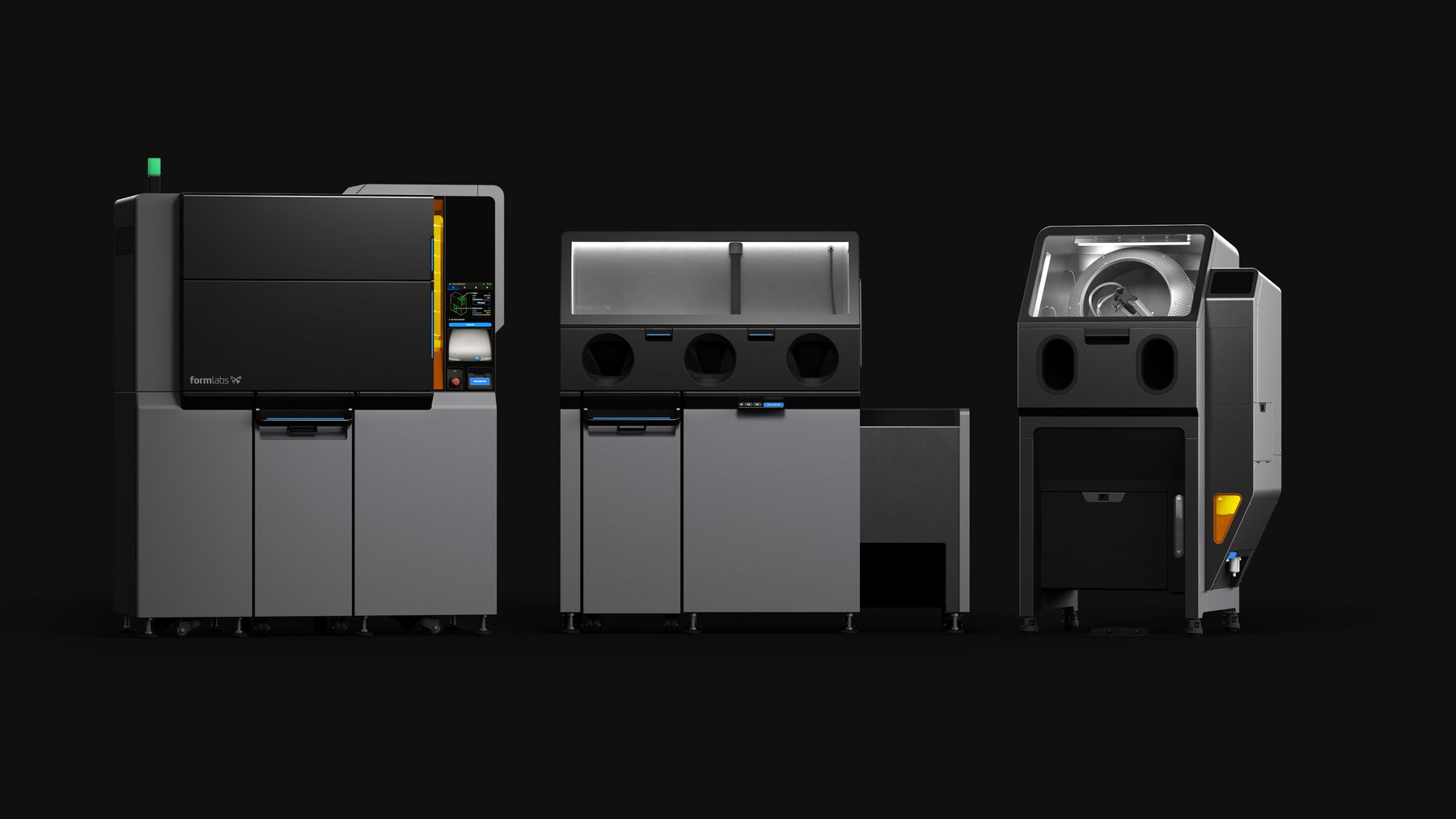
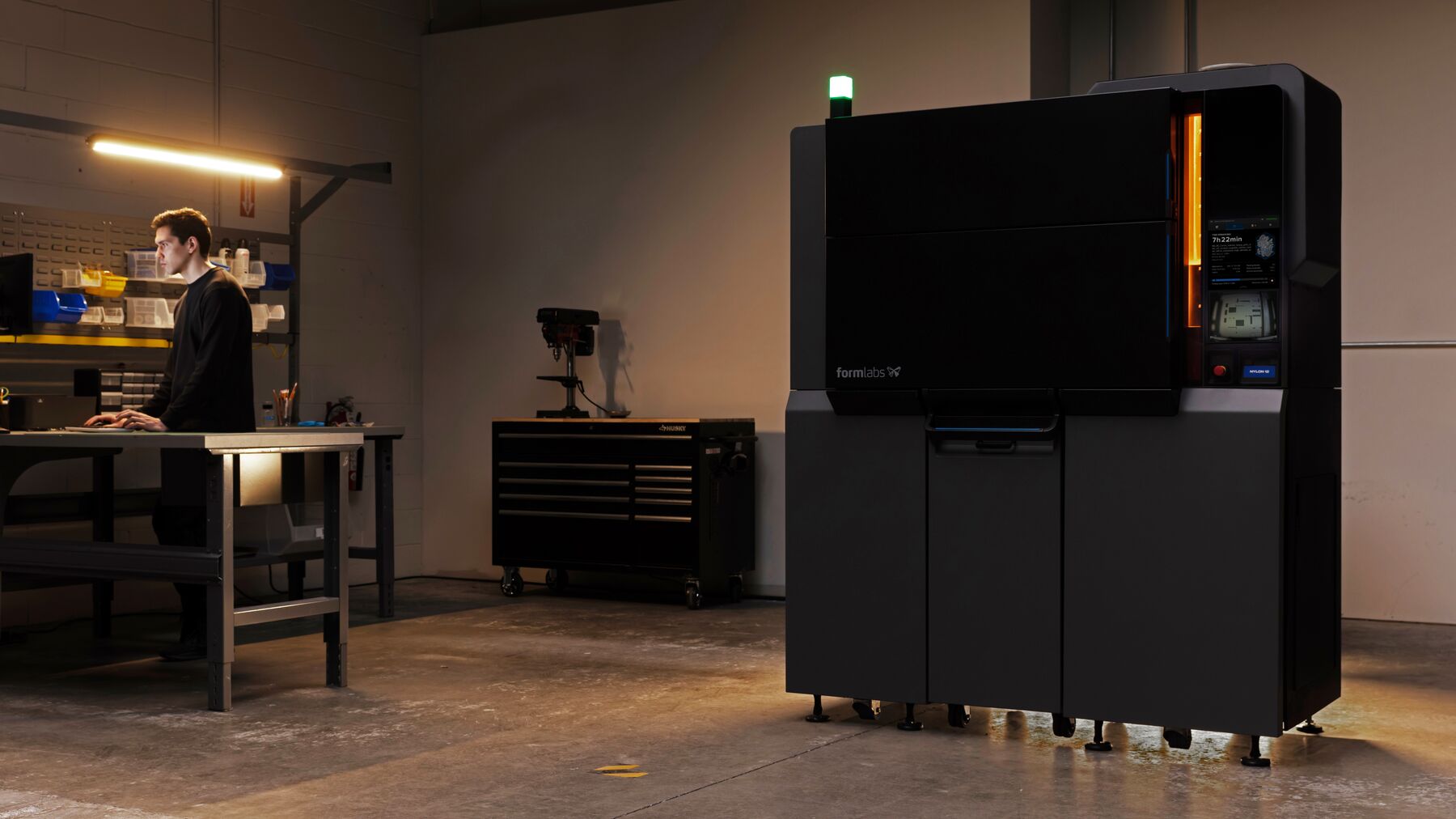
Formlabs has now launched the X1. This is a larger SLS system, available for $84,999, that can be bought towards the end of this year. The Fuse X1 is 330 × 330 × 565 mm, and the company says that the part cost will be half that of other powder bed fusion systems.
Positioning
Formlabs printers.
Whereas recently HP made a lower-cost machine and depowdering kit available for $60,000, that low-cost system was already aggressively reducing part costs and making powder bed fusion very accessible. Now Formlabs has placed its new X1 above the HP 1200, and its build volume is bigger than the 200 x 250 x 330 mm offered by the EOS P110. It’s also much bigger than the Sinterit Bianco2 system (130 x 180 x 330mm) and the Lisa X. The Formlabs system also undercuts systems from Farsoon as well as other Chinese vendors. The X1 is half or a third as expensive as the most common Farsoon units. This is amazing news and really heats competition in polymer Vat Polymerization. This should really grow that market.
Features
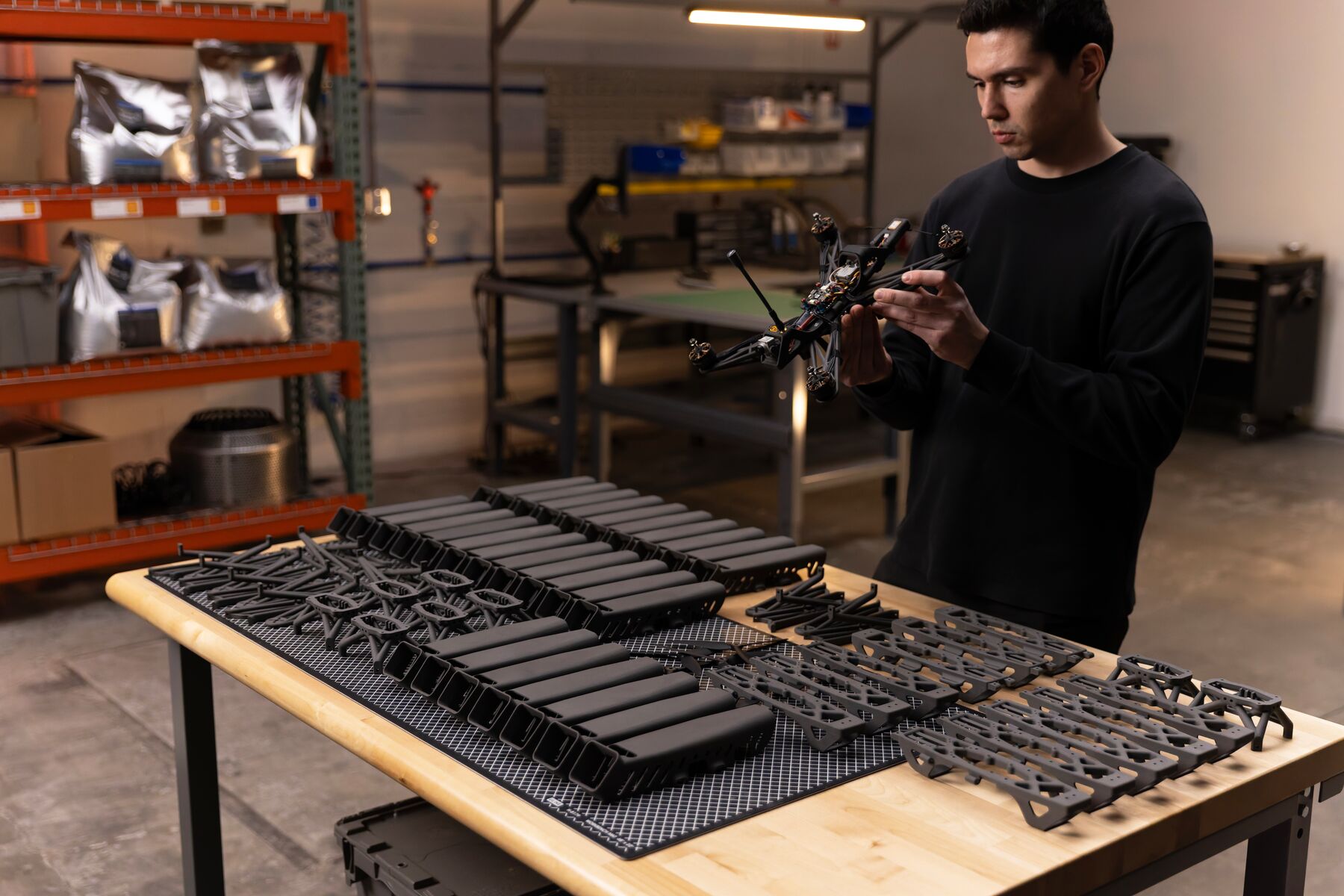
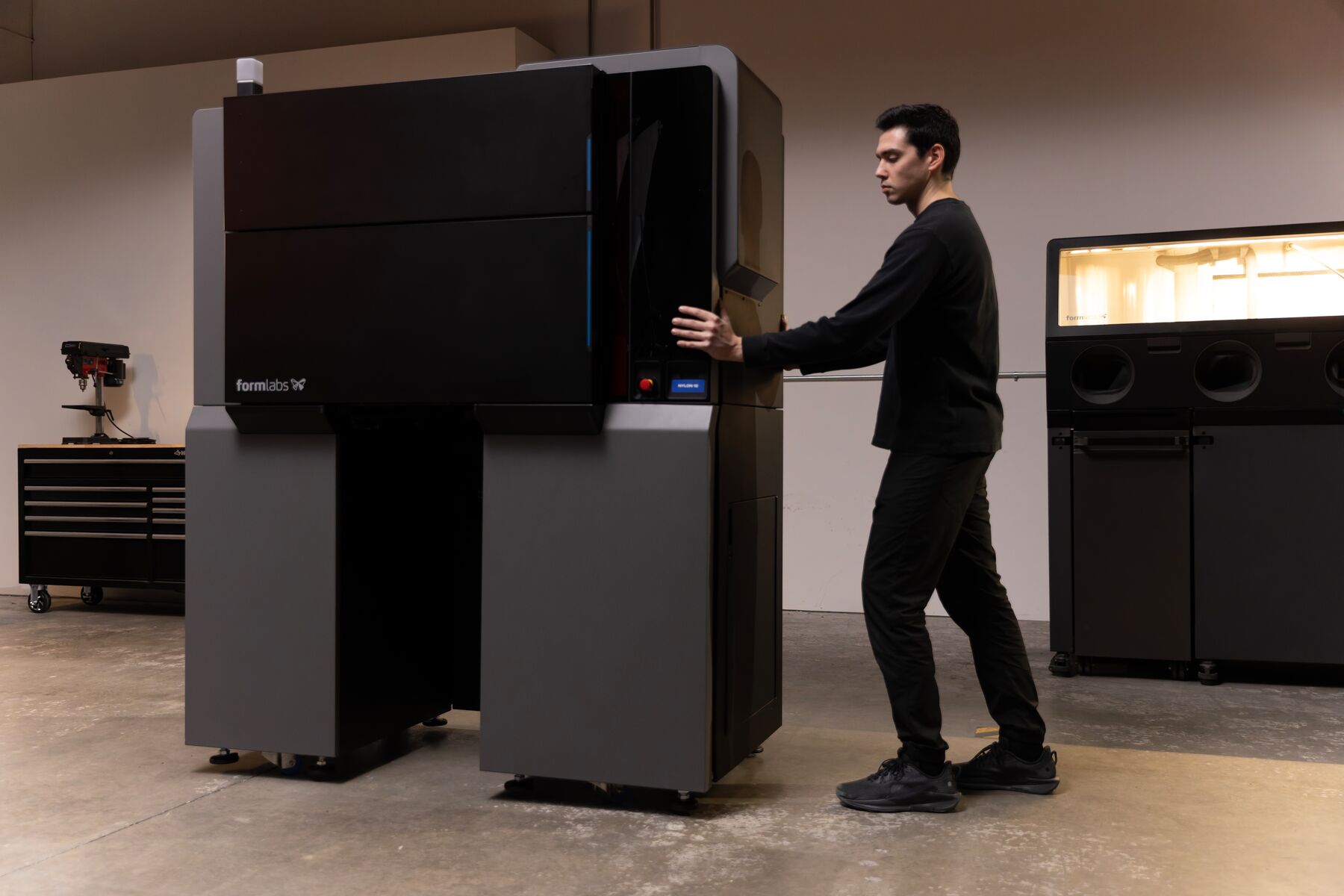
The X1 is squarely aimed at manufacturing in services, in-house production, prototyping labs in companies, and engineers. The company sees it as a manufacturing unit and says that it has three times the throughput of other units. Powder handling is mostly automated; the workflows are said to be intuitive, and the system is small enough to be loaded onto pallets and fit through doors, enabling it to be deployed widely.
They also say that you can install it in less than an hour, it only needs single-phase power, and no additional HVAC is needed. The system is half the size of comparable competitive units, which will make a lot of sense in high-end factories with high floor costs, cleanroom-type environments, or smaller offices. One very important thing is that the company says that builds can be changed over in five minutes. This will have a significant impact on costs and would be a major driver for people to explore getting this system.
One feature is Adaptive Thermal Control, where care has been taken for temperatures to be stable across the build. Sensors and software collect data, which is used to heat 13 different thermal zones across the build chamber. This could improve reliability and surface quality. At the same time, it could improve part quality overall, since temperature differences between the center and the edges of the build can change part sizes, surfaces, and performance significantly. There is also real-time layer monitoring, which includes an AI feature that automatically removes a failed part from the rest of the build as it is being built. a nifty feature!
There’s a Fuse Sift X1 powder module, a Fuse X1 Vacuum Conveyor f for powder, and a Fuse Blast. The system is modular with a modular build unit. Whereas the HP 1200 is $60,000 for the printer plus depowdering and conveyancing, here the $85,000 covers just the unit itself.
“Since the beginning, Formlabs has worked to build the tools that make it possible for anyone to bring their ideas to life. With Fuse X1, we’re bringing industrial-scale SLS printing to a much broader market, making it competitive with traditional mass manufacturing. Customers no longer need to spend half a million dollars or dedicate an entire facility to manufacturing production-grade parts quickly and reliably.”
A customer, Autotiv, has tested the system for its print service, and its CEO, Evan LaBelle, says,
“Thanks to about half the upfront cost and about double the throughput, you can get a return on investment extremely quickly.”
A Formlabs 3D Printing Service?
In one rather surprising announcement, Formlabs has launched its own 3D printing service, Form Now. This is great in that it lets you innovate and invent without an up-front investment. Then, once you’re up and running, you can buy Fuse systems. Or you could run your most popular part yourself and run a rare for your color or material via the service. Or you could start with the service, buy a machine, and then use the service for production at peak times. It’s a great way to grow a service business and a great way to let people test out parts. It may cause some service bureaus to be wary of Formlabs since the firm competes with them. Perhaps Formlabs can partner with all of the services that run its machines to offer the service? That would help them fill machines while letting customers use them with flexibility. So there is a bit of a risk there. Overall, however, I would recommend that everyone offer a service that lets people quickly try before they buy while making it easier to scale.
IPO?
Formlabs is clearly making itself up for a sale or IPO. This is a great move that could see the firm have a lot of potential growth. This is clearly marketed by the firm in telling us such gems as “Annual revenue surpassing $250 million in 2025″ and “Greater than 10% free cash flow margin while maintaining profitability for over 2 years.” This is the kind of investor/banker-speak that makes it 100% certain to me that the company will go public.
To me, the question is not if Formlabs will go public, but if it will do so in the United States or China. With Creality’s successful IPO, the groundwork has been laid for a Chinese IPO. Formlabs makes its systems in China and could opt for the significantly higher valuation it would get there, wedging its future to China. Formlabs was founded in 2011, and its VCs and other investors must be among the most patient in the world. With Creality doing well and the appetite of Chinese investors seeming healthy, it could opt to go public through an IPO in China. However, a lot of Chinese investors’ appetite is shored up by the belief that Chinese firms should dominate 3D printing and that 3D printing is important for China’s future. So Formlabs may not be Chinese enough to whet the appetites of as many investors as swarmed the 3,200-times-oversubscribed Creality offering.
“Formlabs’ own ecosystem approach differs from most FDM 3D printer startups who focus just on the machine and leave the software and materials to others. Less open, this more controlled approach does give reliable results. The company now is undertaking a huge challenge and this is to take their engineering prowess and deploy it to enable desktop laser sintering. Their $13,000 Fuse 1 3D printer could really define desktop SLS just like their SLA machines have made desktop SLA. SLS is much harder than SLA to implement, however, so the team could still have a tough time making it happen.”
There were indeed significant teething problems for Formlabs, but I think that we can see that the firm has indeed defined desktop SLS. Also, most of the other firms mentioned in the article have gone bankrupt. At the time, the desktop segment did not seem a direct threat to established players. Now it is. When the Fuse was finally released in 2021, we were as excited about the machine as we were by its subsequent improvements.
Existential Threat
Now, Formlabs will pose an existential threat to Sinterit, Farsoon’s polymer business, EOS’s polymer business, and HP’s polymer business. With Formlabs looming, companies could simply invest more in the metal segments they already have, eventually becoming metal-only 3D printing companies. Metals look so good now, and growth looks so extensive and defensible that firms could opt to become metal-only. They would simply let their polymer SLS businesses atrophy.
There is a moment now when EOS will have to consider whether it can enable large-scale manufacturing of polymer parts for tens of millions of units. Does the firm want to invest in this and offer, with partners, custom factories for drones, consumer electronics, and defense articles? Will it do so with its P1 or P3 platform, with something new, or by dropping a printer? For HP, it will be a question of defining how it views its current business, whether it is important to HP overall, and whether it is willing to shore it up, grow it with additional funds, or seek an exit. Other players in entry-level SLS and in entry-level industrial SLS will probably not survive this.
Openness Is the Key to Victory
Now, this all depends on one decision: will the new Formlabs system be open materials, and can people tweak parameters on it? If the system is open materials, then Formlabs will win. Coupled with its innovation and relentless focus, the firm will eke out a win in the end. If it keeps the ecosystem closed, then it will not win. If it waits too long to open it, it will get nice, high-margin powder sales but ultimately open the door to further competition from HP. Worse still, it will cause new Chinese entrants to compete with it. If parameters can’t be tweaked and external software can’t be used, it will limit the cutting-edge work that can be done.
In highly regulated areas such as aerospace and medical, Formlabs will find the going tough initially. Yes, it has a lot of dental materials and machines. But, for surgical guides and hospital 3D printers, it will need to learn new skills and new standards. It may find this slower than it thinks. But, if it also conquers in hospital 3D printing and surgical guides, it will be tough for others to survive. In defense, Formlabs’ machines can’t be used, and in some prototyping and production applications, people will not want to use their cloud infrastructure. This leaves some breathing room, but not much.
A Scalable Manufacturing As a Service
The total polymer AM market is worth around $9.79 billion at the moment. In this space, there is room for several billion-dollar revenue businesses. But, not many billion-dollar revenue businesses. If Formlabs were to take the battle to existing services, it would make it difficult for the existing players. But its biggest potential may lie in helping to start a new generation of low-cost polymer services worldwide. If it then also helps entrepreneurs and inventors scale with its solutions and work with Formlabs without having to know 3D printing, it will also grow the market.
So there is a scenario here where Formlabs extracts the long-term growth it needs to grow its market, makes its IPO work well, and does well as a public firm, while it leaves entrenched players be. This may seem complacent. But I think that, with its closed-ecosystem approach, a “manufacturing as a service” model where consulting, partners, and software help anyone print one part or a million will be the way to go. We’ve spent far too long watching each other and tweaking slightly different offerings. Instead, if Formlabs looked at what it would take for a single inventor to launch, prototype, produce, and scale up a DJI-like business that met her needs, it would find a future more profitable than the firm could ever have imagined.
California’s AB 2047, a bill aimed at stopping the use of 3D printers to make firearms and illegal firearm parts, has passed the state Assembly and is now headed to the Senate. The legislation has already gone through amended versions, but critics in the additive manufacturing (AM) community say the changes have not solved the core problem. For David Tobin, who serves as Executive Producer of Joel Telling’s 3D Printing Nerd channel and Executive Director of the Community Manufacturing Initiative, the issue is not whether illegal weapons are a concern. It is whether California is trying to solve that problem by regulating the wrong thing.
“The things they’re trying to make illegal are already illegal. You can’t make them more ‘illegaler’,” Tobin said in an interview with 3DPrint.com. “The focus should be on enforcing existing laws rather than creating regulations that affect everyone who uses a 3D printer.”
AB 2047, known as the California Firearm Printing Prevention Act, would require 3D printers sold or transferred in California to include firearm-blocking technology. Manufacturers would have to certify that their printer models comply with the state’s requirements, and California would publish a list of approved machines. Beginning in 2029, non-compliant printers could no longer be sold or transferred in California.
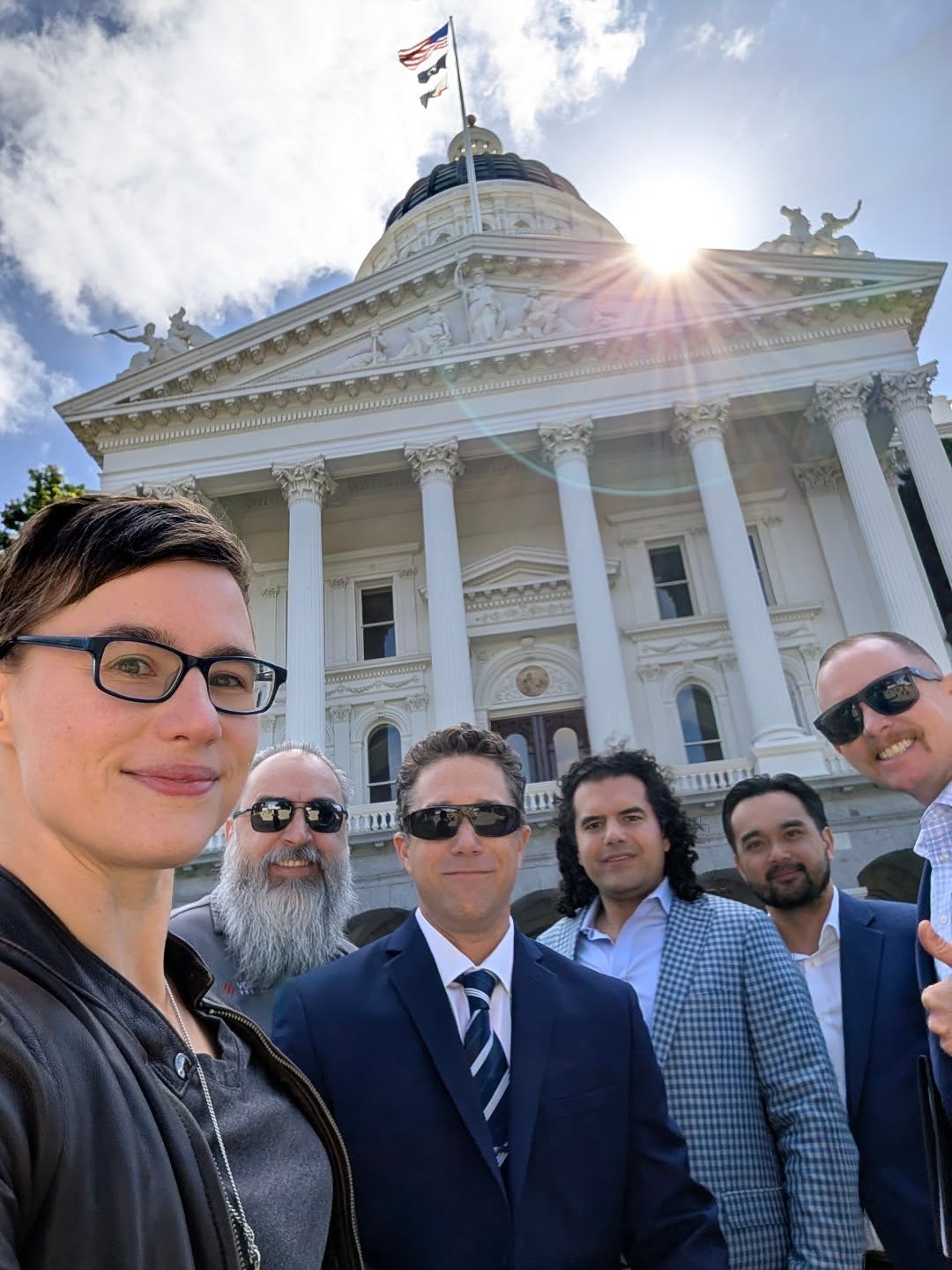
David Tobin (center) and supporters of the campaign against California’s AB 2047 gather at the California State Capitol. Image courtesy of David Tobin via Instagram.
Supporters of the bill say it is needed to address the rise of 3D printed firearms and illegal gun parts. And of course, over the years, 3DPrint.com has tracked arrests and investigations involving 3D printed firearms, including annual reviews of law enforcement cases across the United States. Police agencies in California and other states have reported arrests and seizures involving 3D printed weapons and components. Those incidents have become a growing focus for lawmakers seeking new ways to address illegal firearm production.
At the same time, many experts note that 3D printed firearms still represent a relatively small portion of the broader illegal firearms market, which continues to involve a wide range of traditionally manufactured weapons and illegally modified guns. Tobin said some of the numbers being cited lack important context. While he agrees illegal firearms are a real issue, he noted that “3D printed firearms” can refer to anything from a complete weapon to a single printed component.
“Words matter. When they say ‘3D printed firearms,’ they’re often referring to parts that could be used in a firearm, and those parts could be any shape,” explained Tobin. “The problem is AB 2047 focuses on the 3D printing machines themselves rather than the people committing crimes. This is not a gun issue. People need to look at the bill on its own merits and ask whether it is based on real technology, real science, and real-world manufacturing. As it is right now, the bill contradicts itself and is completely ineffective legislation.”
That point has become key. Tobin said he is trying to keep the conversation focused on the language of AB 2047, rather than on a broader political fight over guns. In his view, the bill should be judged on whether the proposed technology exists, whether it can work as described, and whether the law could affect people far beyond those making illegal weapons.
One concern is that “3D printers do not simply look at a file and understand what an object is. Printers follow instructions. Many users work with open-source software, modified firmware, custom toolpaths, and a range of materials and machines. The idea that a consumer printer can reliably identify and block firearm-related files is being presented too simply to lawmakers and the public. In addition, scary images have also shaped this debate. For example, media clips show a printer appearing to make a full gun, when the object shown was actually a prop. If that were possible, that would be very scary to me too. But it’s not,” said Tobin.
Tobin is not arguing that illegal firearms should be ignored. Instead, he says enforcement should focus on people who manufacture or possess illegal weapons, not on all 3D printer users. He compares 3D printers to other everyday tools that can be misused but are not widely restricted as a result.
“You’re regulating a tool instead of the crime,” Tobin said. “The bigger concern is the precedent. California is often viewed as a leader on technology issues, and if this becomes the model, other states could follow with similar legislation.”
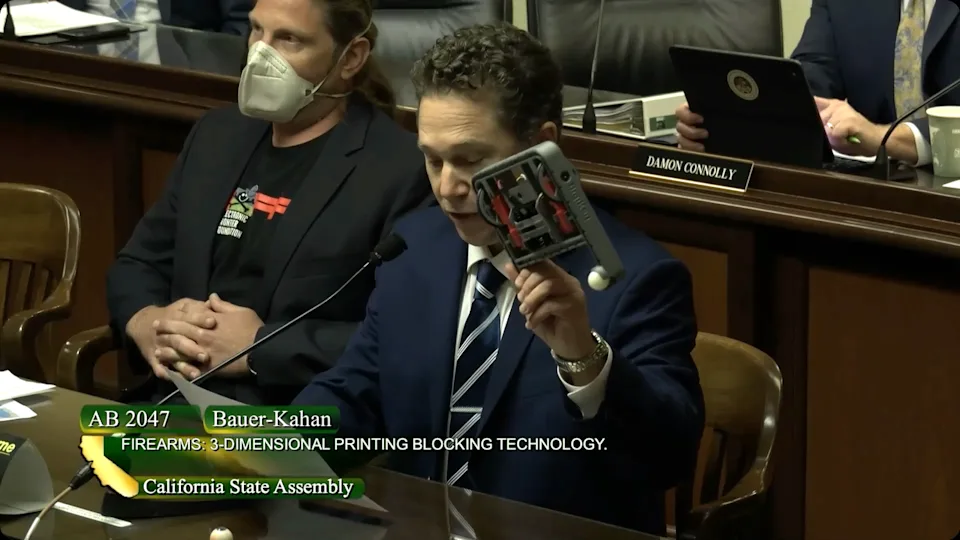
David Tobin speaks before California lawmakers during discussions surrounding AB 2047, the state’s proposed 3D printer regulation bill. Image courtesy of California State Assembly TV.
Tobin said he has been speaking with companies, academic institutions, makers, and advocacy groups to organize a response. He has also met with lawmakers’ offices and with representatives of Everytown for Gun Safety, the gun violence prevention group supporting the bill. However, he said the conversation should remain focused on the legislation itself rather than becoming a broader political debate.
That effort appears to be gaining traction. A “Letter From the Industry” has been posted on the AB 2047 resource website referenced by Tobin. The letter has already attracted support from organizations across the maker and desktop 3D printing community, including PRUSA Research, Printed Solid, MAKE Magazine, Maker Faire, West3D, Nikko Industries, VORON Design, 3D Printing Nerd, Cocoa Press, Greengate3D, and Sliceworx. Individual signatories include RepRap founder Dr. Adrian Bowyer, Prusa Research founder Josef Prusa, MAKE founder Dale Dougherty, Telling of 3D Printing Nerd, and several other prominent community members.
While the coalition does not represent the entire AM industry, it suggests that concerns about AB 2047 are extending beyond a small group of activists and attracting attention from established figures and organizations within the desktop 3D printing ecosystem.
“People need to look at what it actually says, how it would work, and what impact it could have on the broader 3D printing community. Above all, we need future-proof legislation. 3D printing is going to get better and better. We are going to have to address serious issues, but I don’t believe this is how we do it.”
That message is also intended for people in the 3D printing industry who may not see the bill as their problem. Tobin said many companies and organizations have been slow to respond, even though the legislation could affect manufacturers, schools, makerspaces, small businesses, hobbyists, and open-source developers, just to name a few.
“It has to be a community effort,” he said. “Whether you’re a kid just getting into 3D printing, or a parent, or an executive, or a teacher, or anyone who touches this industry in some capacity, we need to speak up.”
Tobin also pointed to the bill’s prop-making exemption as an example of what he sees as flaws in the legislation. He argues that the language does not reflect how 3D printers are actually used. According to Tobin, the exemption appears to apply only to printers used exclusively for prop making, even though most machines are used for many different purposes.
“That printer has to be California-approved,” he said. “And it has to be a printer that’s only for prop making. I don’t even know what that means in practice. Most prop makers use the same printers as everyone else. The same machine can make props, prototypes, replacement parts, or classroom projects. Actually, these aren’t just hobby machines anymore. They’re used in schools, small businesses, engineering labs, and product development. My concern is that regulations like this could affect a much broader part of the manufacturing ecosystem than lawmakers intend.”
In fact, the potential impact on businesses is also not fully clear.
“If the law passes, some manufacturers may decide it is easier not to sell certain printers in California rather than create a state-specific compliance system. Others may try to comply, but that could push the market toward locked-down systems and away from open development. I think the United States should expand access to manufacturing tools, not make them harder to use. If we want to compete, we need resources in America. We need a place where you have everything, like Shenzhen, in China. We need to pull the innovation and actually drive the innovation.”
David Tobin (left) and Joel Telling, founder of 3D Printing Nerd. Image courtesy of David Tobin via LinkedIn.
For now, Tobin is focused on the Senate. He said he is encouraging people in the AM community to contact California senators, share technical feedback, and explain how the bill could affect lawful users. He is also preparing to continue testifying and organizing through the Community Manufacturing Initiative.
“This is one of the most important industries. It is the next industrial revolution, and we have to take care of it,” concluded Tobin.
Korean 3D printed eyewear firm Breezm makes customized sunglasses using laser powder bed fusion (LPBF) 3D printing and its own app. I’ve tried out the app, and the process of scanning and measuring your face is surprisingly easy. The Breezm app is much more intuitive and easier to use than others I’ve tried, and works well.
Aside from this, the company usually has people come to their stores in New York or Seoul to get direct advice about the looks and different types of glasses. The staffer 3D scans you on site, and your scan is then used to extrapolate 1,200 data points, which are matched with their glasses models. You can then see the glasses virtually positioned on your face, and virtually try them on. This process as well really helps you find the right glasses for you. You can choose different colors, lenses, and finishes as well. The scan is then used to make a specific, unique-to-you frame.
Now, the firm has come up with the Breezm Motion collection. These are custom-fit, 3D printed glasses for sports and the ubiquitous (in marketing, perhaps not so much in life) active lifestyle. Sporty glasses for sporty people could fit you on the padel court, the beach, or walking to the ice cream store.
The case for active sunglasses that are custom-fit is a good one. An improved wraparound effect that closes off your brow is much better for boating and other aquatic high sunlight activities, for example. A tighter fit should stay on your face better during horseback riding or other jostling pursuits. And a better fit could be much more comfortable during hours of hiking or hitting a ball somewhere.
The Breezm Motion glasses are all wraparound. You can see that they’re made to clasp your ear precisely. Ear position is one thing that the app measures, so this could be a source of some comfort. The two available designs at the moment are the Forte and Brio. The Forte is “a bold, angular design defined by clean lines and a modern aesthetic, and Brio, a more fluid wraparound silhouette inspired by movement and speed,” as Breezm explained.
The company thinks that the glasses will have a “secure, slip-resistant fit informed by a precise 3D facial scan.” They feature “grip enhanced temples,” which should be more stable than alternatives. Breezm also says that the 3D printed sunglasses in its new Motion collection will be lightweight, durable, block peripheral light and dust, and can even be combined with prescription lenses. The current frames are available in the (in vogue at the moment) earth tone matte colors of Mocha, Deep Forest, and Charcoal.
You can go to the store or use the app to try them out. I think that for now they only work in North America and Korea, but can’t be sure. The glasses cost $238, but this includes prescription lenses. I really like what Breezm is doing. The company has a stellar app and its glasses wear well. Now it has to reach out, tweak its go-to market, and get people who recommend the product through its doors.
The company seems to have a good product, and now needs to push hard or find the right customers. To me, very specific glasses for very specific groups of people would be the most advantageous. I’d partner with padel players and get custom padel glasses, custom golf glasses with pro golfers, custom hunting glasses with gun brands, that kind of thing. To me, the key element here is to use the specificity of the design, and the unique low volume production technology of 3D printing, to offer the perfect glasses for one sport. Then, with the reach of a trusted person in that sport, you can develop and present the ideal glasses for that sport. That would be how I’d push Breezm forward.
It’s been busy for publicly traded 3D printing companies, with new stock offerings, dealmaking, and investor updates showing how companies are working to strengthen their financial positions.
Xometry raised $225 million through a public stock offering, while 3D Systems secured $50 million in fresh capital. And Nano Dimension, meanwhile, is moving quickly to simplify a business built through years of acquisitions.
Xometry Secures $225 Million
Xometry (Nasdaq: XMTR) brought in about $225 million by selling 2.6 million shares at $85 each. The North Bethesda, Maryland-based company said it plans to use the proceeds for working capital and general corporate purposes. The offering closed on June 3, 2026, and it was led by J.P. Morgan and Goldman Sachs, with William Blair, Citizens Capital Markets, and Cantor Fitzgerald also serving as book-running managers.
Raising $225 million is no small feat in today’s AM market. While many publicly traded 3D printing companies are still focused on cutting costs and improving profitability, Xometry was able to attract investor interest.
Of course, Xometry is not a pure 3D printing company, but AM is an important part of its digital manufacturing marketplace. Earlier this year, the company expanded its AM offerings with new materials aimed at aerospace, defense, medical, and automotive customers. In May, Xometry reported record first-quarter revenue and announced a partnership with Siemens focused on AI-driven supply chain tools. The company also expanded sourcing capabilities for data center infrastructure components.
3D Systems Prices $50 Million Offering
3D Systems (NYSE: DDD) also turned to investors for fresh capital, announcing a public stock offering expected to bring in about $50 million. The company sold roughly 16.4 million shares at $3.05 each and gave underwriters the option to purchase additional shares. Needham & Company and Craig-Hallum are acting as joint book-running managers.
The offering gives 3D Systems additional cash as it continues to focus on healthcare and industrial manufacturing, two areas the company sees as key growth opportunities. Like several AM companies, 3D Systems has spent the past few years reducing costs and working to improve profitability.
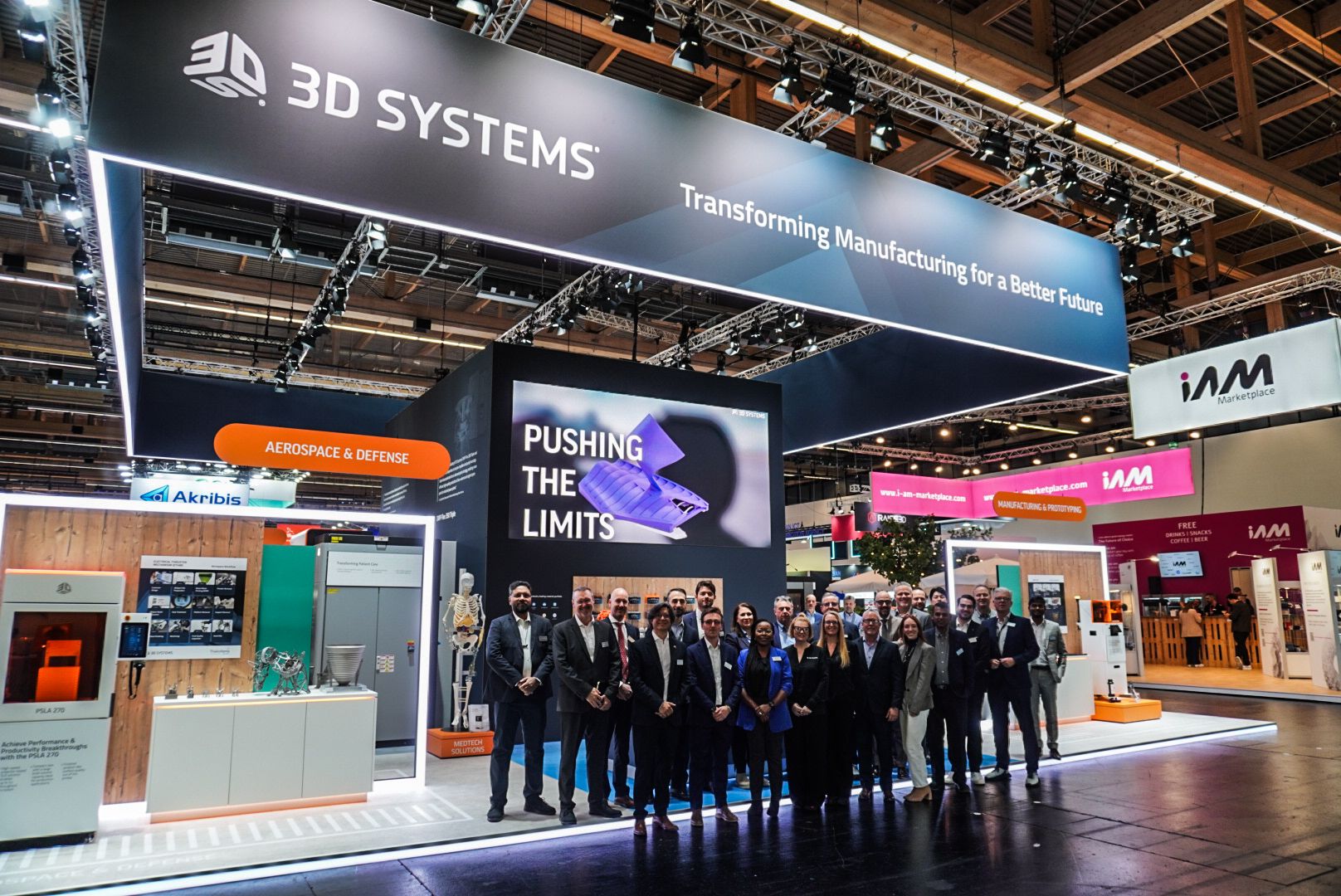
3D Systems booth at Formnext 2025. Image courtesy of 3D Systems.
Markforged had become part of Nano Dimension through its earlier acquisition strategy, but management now says it is moving to simplify the business. The sale is part of Nano’s three-phase strategic plan. The first phase focuses on cutting costs and reducing cash burn, followed by efforts to sell or monetize certain assets and product lines. The final phase involves evaluating strategic alternatives and determining the company’s longer-term direction.
According to Nano, the sale is expected to reduce annualized cash burn by about $15 million. The transaction is expected to close in the second half of 2026, subject to customary closing conditions and regulatory approvals.
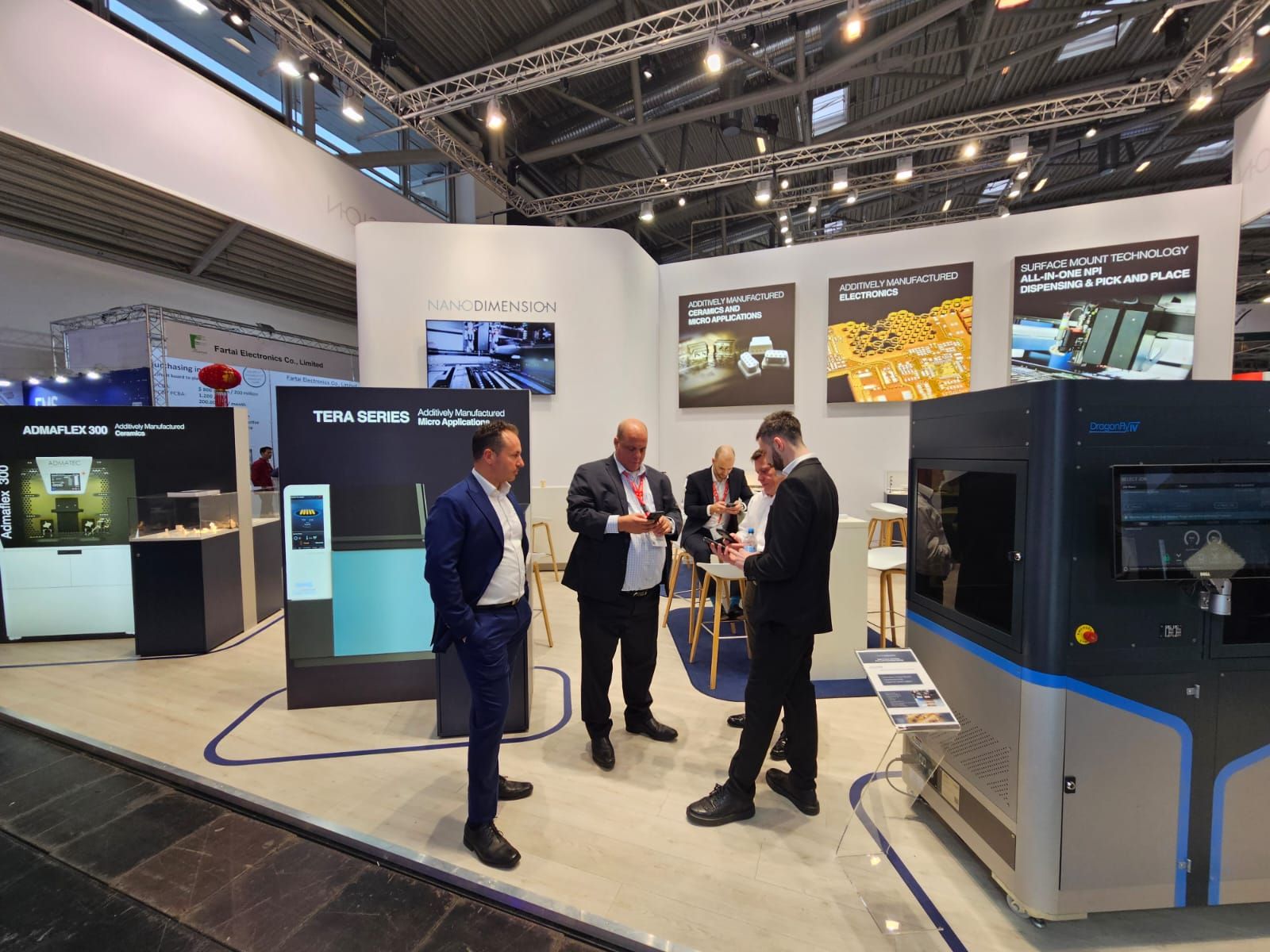
Nano Dimension booth at the Electronica Fair 2024 in Munich, Germany. Image courtesy of Nano Dimension via LinkedIn.
Shortly after announcing the deal, management offered more insight into its thinking. In a June 5 letter to shareholders, CEO David Stehlin said Nano Dimension’s prior acquisition strategy had left the company with product lines that were not integrated enough to support sustainable profitability at scale. He said some of the acquired businesses had strong technology and talented teams, but that the broader structure did not create enough operating leverage.
Stehlin also said some prior commitments required significant capital deployment in 2025 and that, looking back, those acquisitions were too expensive for the benefits gained.
According to Nano, standalone operating expenses fell about 22% year over year in the first quarter of 2026. The company also said operating cash burn has declined every quarter since the third quarter of 2025. Nano reported about $441.6 million in cash, cash equivalents, deposits, restricted deposits, and marketable equity securities as of March 31, 2026. Still, investors remain cautious. Traders Union reported that Nano shares recently traded at $1.63, down 1.21% on the day and below key moving averages.
Whether through capital raises, portfolio changes, or restructuring efforts, the latest announcements show that financial strategy remains a major focus across the AM industry. As companies navigate a challenging market, investors will be watching closely to see which approaches deliver results.