I think it’s safe to say that post-processing is no longer considered the “dirty little secret” of 3D printing that it once was, with users realizing that finishing is just as important to the workflow as the materials, software, machines, etc. But, that’s not to say it’s without its issues. Often, this portion of the workflow is still treated with less importance: systems not purpose-built for specific AM technologies, companies having to piece together post-processing solutions.
Rich Garrity, Chief Industrial Business Officer at Stratasys, told me that their customers care less about the printer itself, and more about the finished part, and total cost of ownership (TCO), as they move from prototyping to final production. That’s why Stratasys just launched a Post Processing Partnership Program to make AM workflows simpler, and improve the customer experience with regards to post-processing.
“We’ve been investing heavily in software and materials, and material partnerships and software partnerships as well,” Garrity told me in an interview. “Post-process is an area that for us, up until now, has not had that same level of attention. And in more recent times, our customers have become louder and louder about the cost of post-process as it relates to the total cost of ownership and the variability and manually post-processing parts. And they wanted to see from Stratasys a more complete end-to-end solution.”

Rich Garrity. Image courtesy of Stratasys via LinkedIn.
Garrity explained that customer feedback is what really drove the decision to create this. Under the program, Stratasys has put together an extensive validation process for third-party post-processing solutions. To really ensure that the solutions its program offers are up to snuff, the company even validates them itself.
“We looked at different vendors’ solutions and really validated them, not only with customers, but also with our own Stratasys Direct Manufacturing. We’ve been using, for example, PostProcess Technologies products in our own SDM for the past year. So we were able to see firsthand results and prove out that impact on total cost of ownership. So that’s important,” Garrity said. “And then we do everything else in terms of supplier quality, to make sure that what we’re representing, the partner will be there and can stand behind it the right way that they need to.”
The program is designed to make it easier for customers to access post-processing solutions that have been validated for Stratasys technology. As such, PostProcess Technologies is the first partner in the new program. Several of its solutions are guaranteed to work with Stratasys printers, making it a great first partner. It will expand Stratasys customer access to intelligent, automated, and validated post-print solutions across the FDM, SLA, PolyJet, and P3 platforms.
“Our solutions are widely used across prototyping and production environments where operator safety, consistency, and throughput are critical. As part complexity and volumes continue to grow, traditional tools and manual finishing methods do not scale. This agreement deepens our alignment with the clear industry leader, extending our commercial reach and making it easier for customers to deploy proven post-processing solutions as part of a unified additive manufacturing workflow,” Jeff Mize, PostProcess Technologies CEO, said in a Stratasys press release.

Stratasys Neo800+ 3D printer and PostProcess Technologies DEMI 4100 resin removal system
Garrity said that PostProcess was the “natural” choice to kick off this new partnership program, because the two companies have worked so well together already.
“We’ve really liked the products they have in terms of the predictability and reliability and how they’re going about that. And our aerospace customers, automotive customers, industrial customers have also been adopting those products, and at the same time have been saying, ‘Hey, we’d rather work with less vendors than having to work with several. And so, if Stratasys can be the integrator, so to speak, to the workflow, we’d prefer to work with you, Stratasys, and have more of that one-stop shop and ensure that you’re doing the validation and everything that we need to have the confidence to adopt it.’ So that’s what drove it, and that’s what drove PostProcess Technologies being the first partner.”
The key with PostProcess, as Garrity explained, is its industrial approach to post-printing technologies like resin and support removal and other finishing methods. All of these can be complicated, and add a lot of lead time, especially when customers are having to research multiple vendors, possibly make separate purchases, and cross their fingers that it all works well together. PostProcess offers a “software-driven workflow,” which equals validated recipes that help cut out the complexity.
“We see potential to link the software chain together from our GrabCAD to the PostProcess software in a way that further iterates that loop and helps customers upfront in the process. So those are the benefits that we saw,” Garrity said. “We felt that ultimately, a unified workflow is going to result in the customer cost of ownership going down.”
I asked him how ecosystems like this one can change adoption economics of additive. He explained that as customers move more into production use cases, many of them are still having the post-processing steps done manually, which opens the workflow up to unpredictability.
“So to have repeatability in performance, part after part after part after part after part, it’s very hard to do that manually, and also very hard to scale economically that way,” Garrity said.
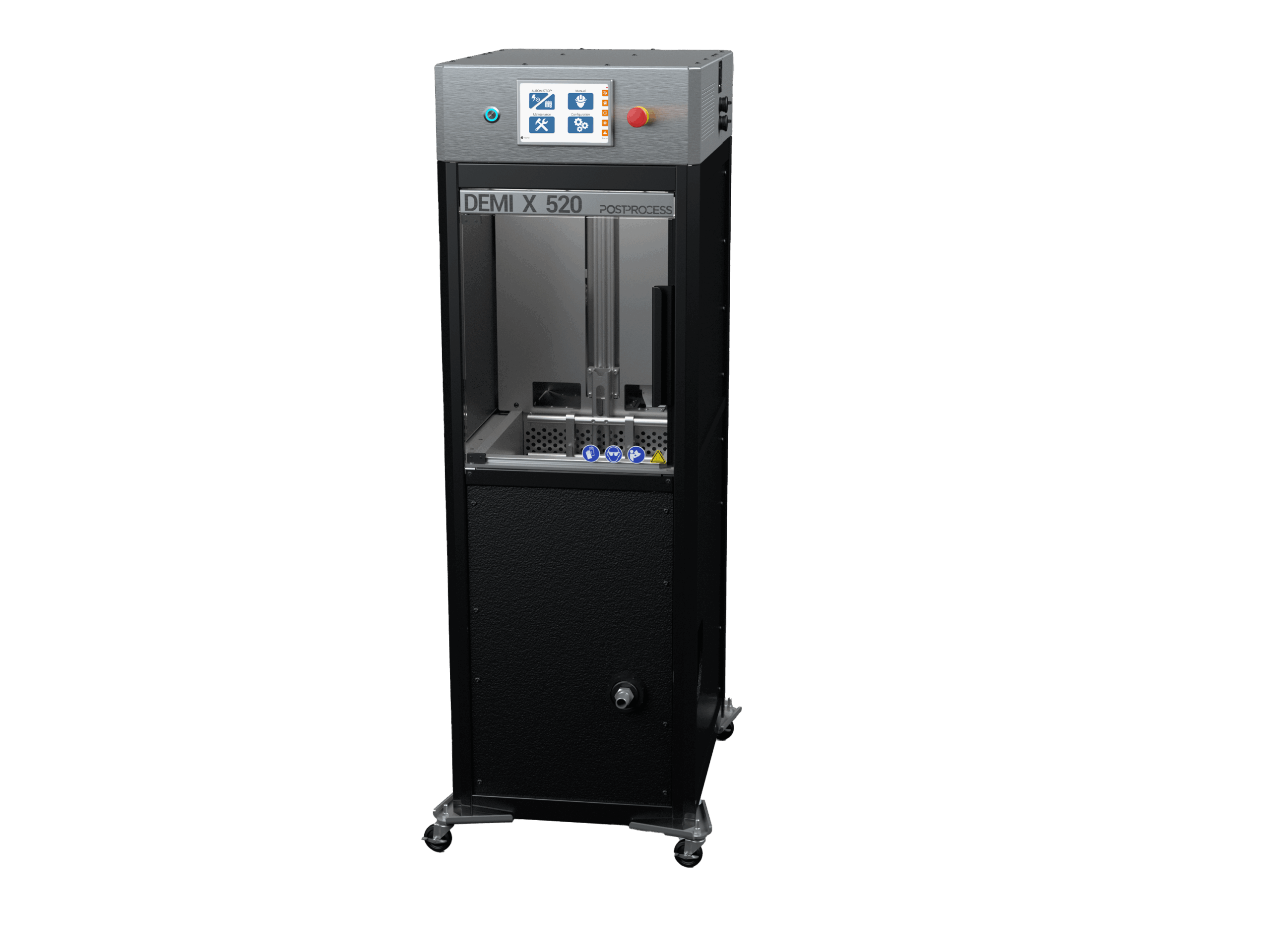
PostProcess Technologies DEMI X 520
Customers wanted automated post-processing solutions, and PostProcess Technologies is a leader in this. Removing manual labor through automation can significantly reduce the time it takes to complete post-processing, which can majorly impact the total cost of ownership.
“We saw it firsthand at Stratasys Direct Manufacturing, and that’s the reason we invested and put systems on site at different locations. And we’ve seen the ROI on that firsthand.”
Garrity said that, depending on the additive technology and the site, SDM has seen a 30-50% reduction in ROI, thanks to PostProcess and its automated solutions.
“This new program and PostProcess Technologies for us made sense given their purpose-built approach and overlap and synergy with the type of customers that we’re focused on. So for the customer, having a unified workflow over time is going to reduce the amount of time and labor in the process, which helps their TCO,” Garrity concluded. “Also, for our own partner reseller network, they’ll now be able to quote all of this in one place so the customer gets one quote, one invoice: again, a one-stop shop versus having to go navigate multiple vendors.”
Through its commercial agreement with PostProcess as part of this new partnership program, Stratasys will offer validated PostProcess solutions via its global sales channels. This way, customers can purchase printers and post-processing equipment under one Stratasys purchase order. PostProcess Technologies will provide installation, service, and ongoing support to ensure that its systems remain optimized for use with Stratasys platforms. All told, this program should reduce deployment time, procurement friction, and integration risk, making everything much more efficient.