• ORNL Continues Research Into Making Large Format Metal Parts by Combining AM and HIP

    This can’t be stressed enough: the US needs to secure its supply chains for energy and power generation components. And, while the US needs to prioritize that objective across the board, the current greatest risk of shortage arguably lies with large format, metal parts.

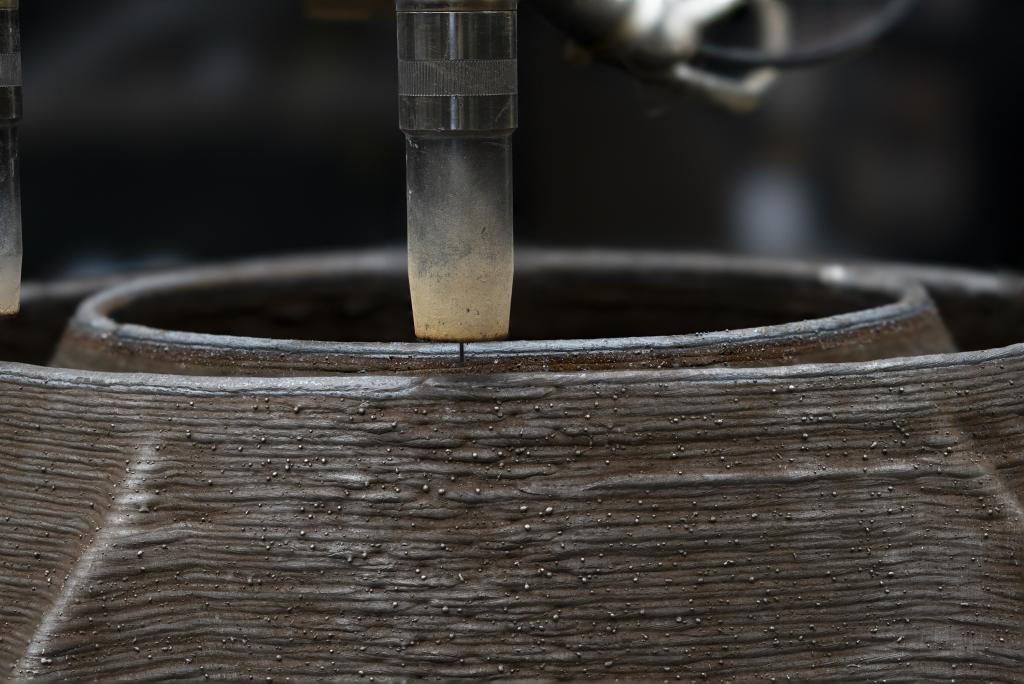
    There are few American organizations doing more to address this issue than Oak Ridge National Laboratory (ORNL). Moreover, ORNL is approaching the problem from a variety of different angles, exploring a broad range of advanced manufacturing techniques both individually and in concert with one another. Two years ago, for instance, the Knoxville-based institution announced it was developing a method to use wire-arc additive manufacturing (WAAM) to produce large vessels that could be used for powder metallurgical hot isostatic pressing (PM-HIP).

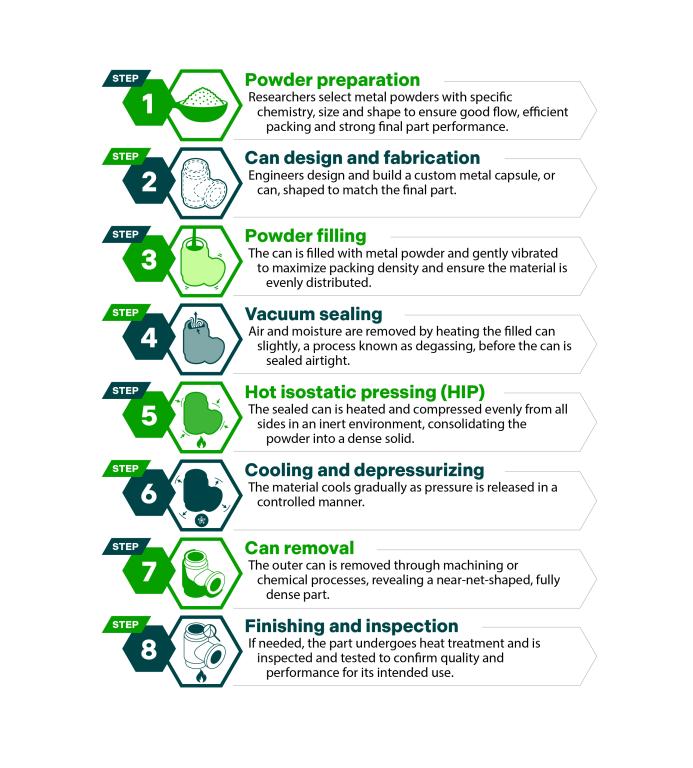
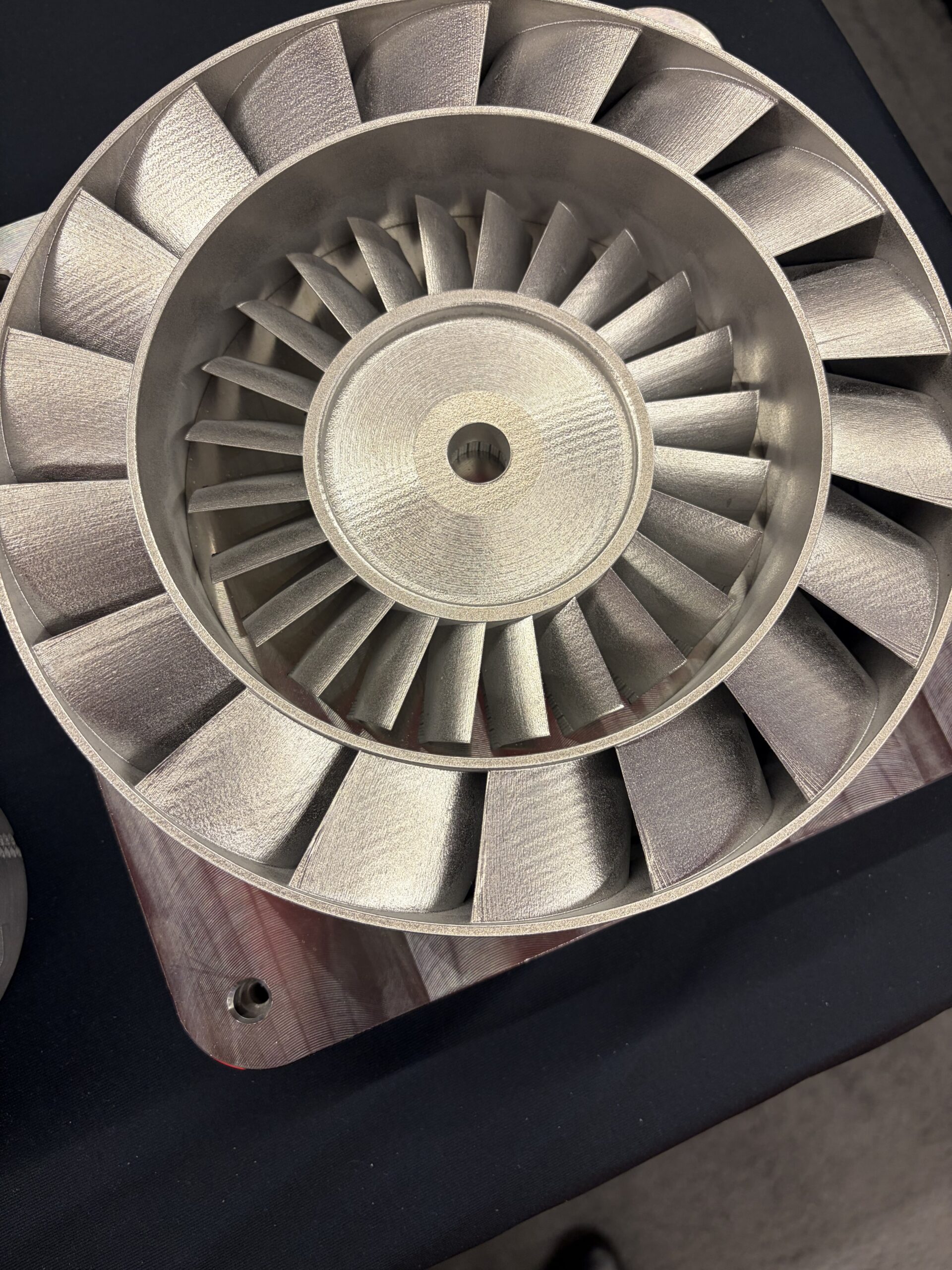
    PM-HIP is a method that utilizes pressure-sealed vessels and furnaces to form metal powder without melting. By making the PM-HIP molds with AM, ORNL was aiming to establish a process for making very large metal components without relying on casting and forging supply chains. Now, ORNL has announced an update on the project, with the researchers revealing that they’ve successfully made a component that appears to be a turbine blade by using a 2,000 pound canister made with multiple forms of 3D printing, which was subsequently incorporated into the standard PM-HIP process.

    In addition to enabling a bypassing of the US’s traditional domestic metal supply chains that have been gutted over the last several decades, the combination production method also unlocks the same geometric advantages associated with AM more generally. Additionally, the viability of using advanced alloys in PM-HIP gave ORNL the opportunity to draw from its wealth of materials science knowledge.

    In a press release about ORNL’s successful production of a large format PM-HIP component using a 3D printed mold,ORNL researcher Pavan Ajjarapu said, “This work lays the foundation for a transformative shift in the PM-HIP landscape for large-scale components. By harnessing the strengths of both additive manufacturing and hot isostatic pressing, we are paving the way for greater design freedom and expanded applications in hydropower and next-generation nuclear reactors.”

    ORNL’s Jason Mayeur said, “We further enhanced the effectiveness of PM-HIP technology by using a mechanics-based computational model to reduce developmental costs and lead times by eliminating trial-and-error approaches.”

    As with the vast majority of critical components that comprise US infrastructure, the US’s energy and power supply chains are existentially dependent on imports from China. It goes without saying how much leverage this gives China over the US, particularly given that the two nations are also at each other’s necks in an AI arms race (not to mention all the other arms races sustaining the tension between the two powers).

    The smartest thing the US could do right now is take half the defense budget and give it to the Department of Energy (DOE), but we would be silly to expect the US to do the smartest thing it could do. In lieu of that, then, it would be nice to see more companies like ARC form and partner with ORNL to help the lab commercialize its technology, at the same time as ORNL is helping expand access to high quality research.

    I do think that a vast wave of privatization is on the horizon for the US government, which is only surprising insofar as there is even still anything left to privatize. The Trump administration has already signaled that it wants to do this with NASA, continuing a pet project begun in the president’s first term.

    A final push to maximize privatization of US government services would likely change the entire appearance of how pure research is done in this country, although that already seems to have been happening regardless. Even in such a scenario, I would think that ORNL is one of the handful of entities that will endure no matter what. In any case, the US can’t afford to lose the contributions that the lab makes on a daily basis.

    Images courtesy of ORNL

  • Ford Uses Binder Jet 3D Printing to Make Boat Propellers for Sharrow Marine

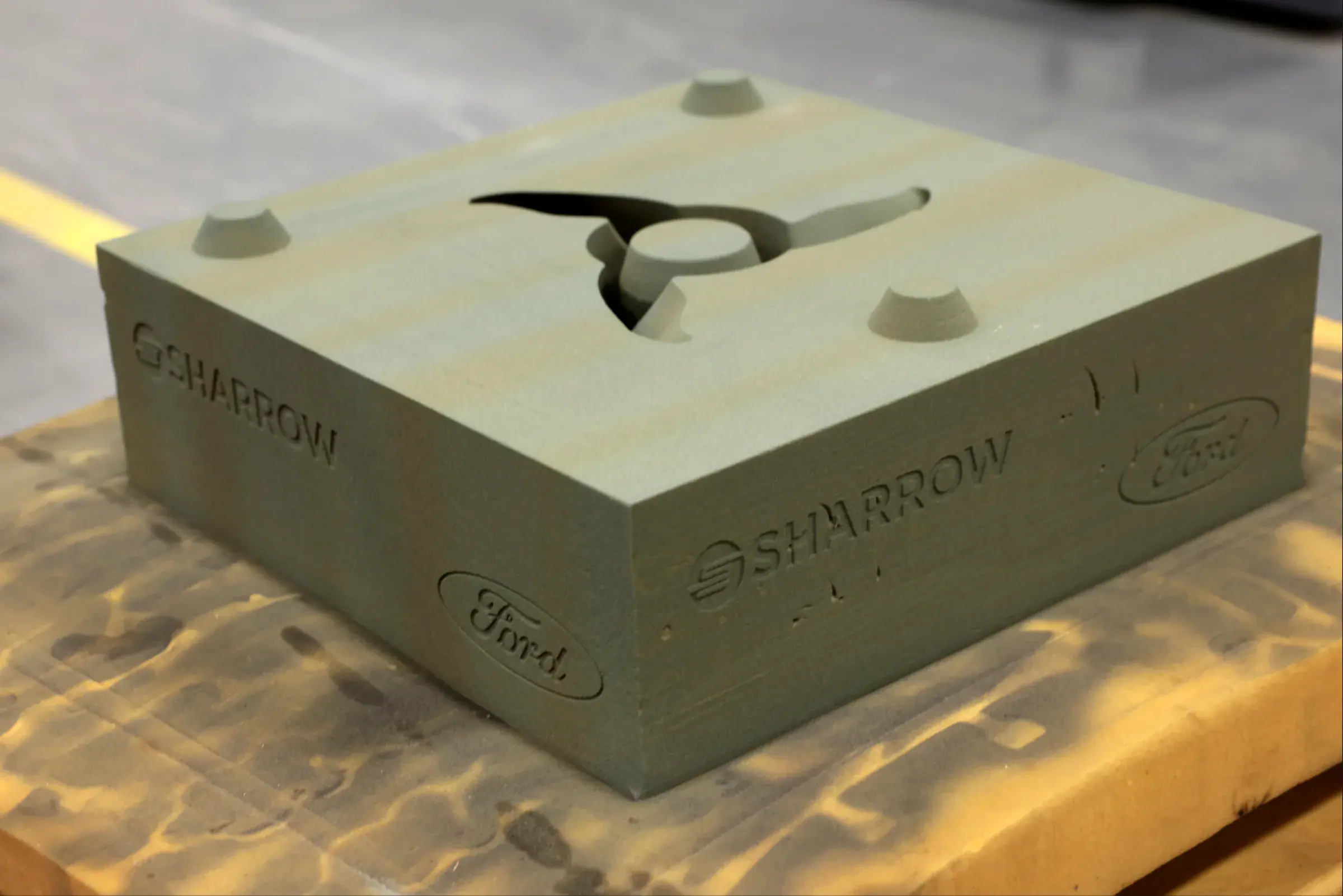
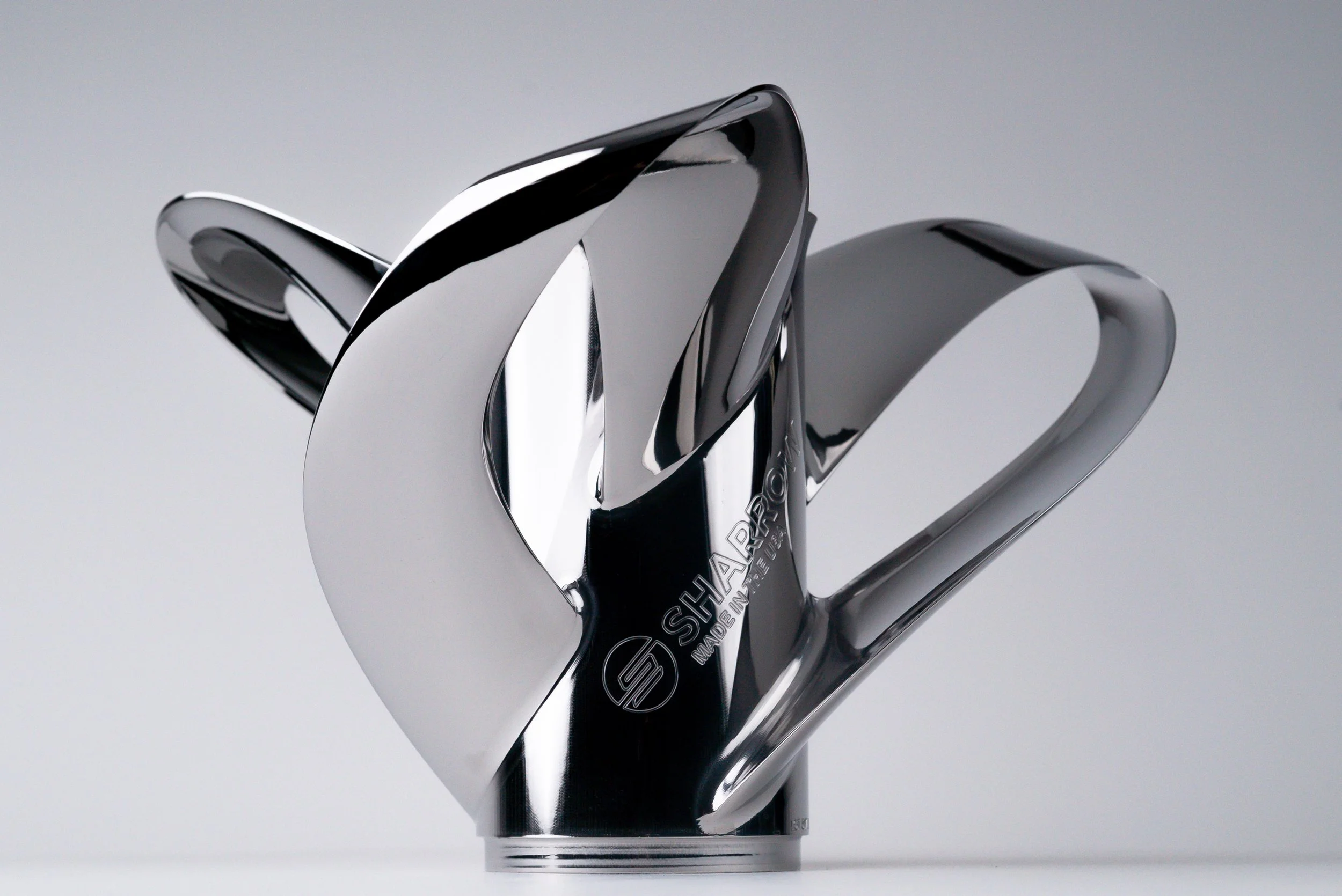
    Ford’s Advanced Industrial Technology and Platforms (ATP) group has helped Sharrow Marine make a boat propeller in two weeks rather than 130 days. Thanks to the Michigan Central program, Ford and Sharrow were brought together, with prototypes produced at Newlab Detroit. The proprietary propellers are now made using binder jetting, with a sand-banding jetting sand-casting solution, replacing older methods like lost-wax casting and slip casting, which previously created lead times of up to 130 days. Working with Ford and a local foundry, Sharrow can now produce the parts in a fortnight. Debuted in 2020, the Sharrow propeller is designed to lower noise while improving efficiency.

    Using Ford Motor Company’s Advanced Industrial Technology & Platforms team and advanced 3D sand-casting, what once took 130 days with traditional wax and ceramic casting can now be completed in about two weeks.

    Additive Manufacturing Operations Supervisor at Ford Dan Michalski said,

    “Ford has been at the leading edge of 3D sand-casting for more than 20 years, and it’s rewarding to use that expertise to help another Michigan company scale so quickly.”

    While Sharrow Marine CEO and Founder Greg Sharrow added,

    “Scaling production has been our biggest challenge, particularly getting high-quality castings fast enough to meet demand. I could not make them fast enough. Less than seven minutes into my first conversation with Ford, they told me they had the solution. This sand-casting collaboration has solved our scale problem in a big way.”

    Sharrow will use the process to expand its production and sell more propellers. It also hopes to expand the use of its products into new markets. The company sees potential in drones, fans, and pumps. Ford has Desktop Metal and ExOne systems, including an S-Max Pro and an X series. The company uses binder jet for sand-casting engine blocks and other automotive components. It has ExOne systems in Europe as well and is a big user of 3D printing for jigs and fixtures across the company. The company has also put end-use 3D printed parts on some niche vehicles, notably a Raptor version for the Chinese market and a set of brackets for the Shelby Mustang GT500. In 2019, the firm spent $45 million on an Advanced Manufacturing Center that brought together 23 systems from 10 firms in Michigan.

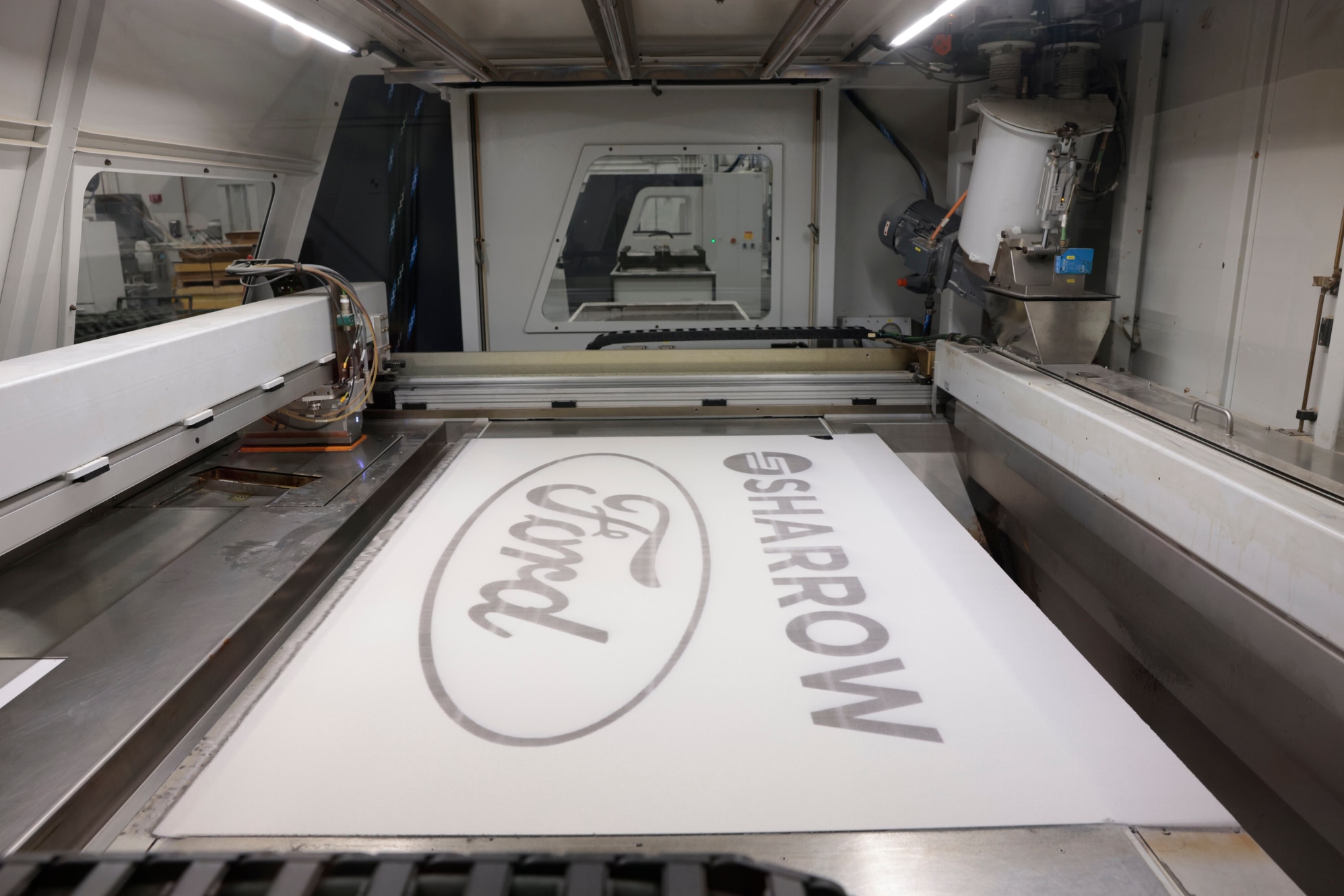
    Judging by the Furan sand and the images above, Ford used the ExOne S-Max to make Sharrow’s parts. Sand-casting is not often talked about in the 3D printing world, but for marine propulsion companies, engineering firms, energy firms, and car firms, the technology is a mainstay in some applications. One of the things it does extremely well is propellers. Faster, more flexible, and more accurate 3D printing for sand casting saves firms millions a year.

    Sharrow says that its propeller changes “how your boat accelerates, holds plane, grips in turns, docks, cruises, and sounds. It is not a small performance tweak. It changes the experience.” The unit could save as much a 20% in fuel costs. At a fast clip, a small speedboat could use 3 gallons an hour while a twin-engined offshore center console boat could use 50 gallons an hour. Daily fuel costs for many boaters are higher than $50 t0 $300 per day. Especially now, this will add up quite quickly. Reducing vibration could make your boat ride much more comfortable, while reducing noise could help as well. According to the firm, your boat can cruise at lower RPM and get to planning faster. The company also says that it handles better and is more maneuverable.

    The total amount of benefits, if true, is very compelling. Sharrow also offers six different versions of its propellers and would probably make more to better suit different vessels if it could. That can also strengthen the business case for 3D printing here. I don’t know if Ford is doing this for some kind of “hug Michigan” marketing thing or if there is a business logic behind it beyond PR. It could actually be interesting to build up capacity and do a kind of Amazon AWS play for manufacturing. If Ford invests and partners with companies to fill its machines more efficiently, the company could significantly improve machine utilization and lower part costs. This could be very powerful, and it could let a company outspend another in innovation while lowering overall costs. It would make even more sense, for example, if car sales were lower in the summer and boat sales higher. Ford used to make anti-submarine boats during the First World War and later on made marine engines. Currently, Ford makes marine engines with the inboard company INDMAR. So the work with Sharrow may yet be relevant to Ford in other ways. On the whole, this is a great story about how, through sand casting, 3D printing can accelerate time-to-market and make more products possible. More sand-casting business cases should be done, especially in Marine propulsion and engines, where we’re seeing more happening.

    Images courtesy of Ford

  • Printing Money Episode 38: Additive Manufacturing Deal Analysis with Rajeev Kulkarni

    Welcome to Printing Money Episode 38. Rajeev Kulkarni returns for this episode, and we find it hard to believe it’s been nearly two years since his first appearance. In the interim, one of Rajeev’s three focus-companies (Ackuretta) was acquired in a positive outcome and the other two (Axtra3D and Caracol) have experienced significant growth and fundraising.

    Episode 38 begins with a look at Rajeev’s career and current work. From there, Danny and Rajeev set the stage by reviewing last month’s RAPID event in Boston and highlighting certain trends there that are playing out in real-time in the 3DP/AM M&A and financing world.

    Did we say 3DP/AM M&A and financing? This episode tips the scales at just over one hour of 3DP/AM deals galore, so please enjoy all the nuggets of knowledge and analysis. Themes include private equity’s deepening embrace of the AM services business, notable transactions from publicly traded companies, ongoing developments in the Nano Dimension telenovela, validated speculation about EOS’ acquisition trail, and a number of impressive VC rounds and strategic investments.

    Please enjoy Episode 38 and check out our previous episodes too.

    This episode was recorded May 12, 2026.

    Timestamps:

    00:13 – Welcome to Episode 38, and welcome back to Rajeev Kulkarni

    00:38 – Rajeev’s career at 3D Systems (DDD) and his current work at Axtra3D, Caracol, and more

    05:48 – Workflow considerations for 3DP/AM business growth

    07:00 – RAPID 2026 review: Smaller, More focused, New leadership, Defense and Drones, LPBF dominance

    08:52 – Real market growth, not evenly distributed

    11:16 – For OEMs, it’s time to polarize your products

    14:15 – Bullish M&A trends for 3DP/AM

    14:47 – AFM acquires Incodema3D

    15:32 – BTX Precision subsidiary I3D acquires Burloak from Samuel (breaking news as of this recording date!)

    21:18 – Prodways (PWG.PA) sells its software business for EUR 35M

    25:12 – Materialise (MTLS) transferring its RapidFit business to management team

    30:56 – Nano Dimension (NNDM) sells its AM Electronics business for not very much, and to a co-founder of… Nano Dimension

    35:36 – What will come of what’s left at Nano Dimension?

    36:30 – Johnson Controls (JCI) acquiring Alloy Enterprises

    41:09 – EOS acquires Metalpine

    42:11 – Amnovis acquires Westconn

    44:37 – Tethon3D acquires Fortify3D IP

    48:33 – Freeform raises $67M Series B

    50:53 – Firestorm raises $82M Series B

    55:06 – Nanochon closes $4.1M Seed Round

    57:11 – Kureha invests in Z-Polymers

    59:57 – Velo3D (VELO) $50M private placement offering

    1:01:50 – Thanks again to Rajeev, and thanks to you for listening!

    Disclaimer:

    This content is for informational purposes only, you should not construe any such information or other material as legal, tax, investment, financial, or other advice. Nothing stated on this podcast constitutes a solicitation, recommendation, endorsement, or offer by the hosts, the organizer or any third-party service provider to buy or sell any securities or other financial instruments in this or in any other jurisdiction in which such solicitation or offer would be unlawful under the securities laws of such jurisdiction.  The information on this podcast is of a general nature that does not address the circumstances and risk profile of any individual or entity and should not constitute professional and/or financial advice. Referenced transactions are sourced from publicly available information.

    Danny Piper is a registered representative of Finalis Securities LLC, member FINRA/SIPC. This material has been prepared for information and educational purposes only, and it is not intended to provide, nor should it be relied on for tax, legal, or investment advice. Investors should consult with their own tax, legal, and financial professionals before investing. Real estate investments are generally highly risky. They can be volatile, unpredictable, illiquid, and are subject to ebbs and flows and market shifts. Investors also risk the loss of all principal investments.

  • 3D Printing Financials: 3D Systems Returns to Growth in Q1 2026

    3D Systems (NYSE: DDD) reported one of its strongest quarters in recent years, showing signs that the company may finally be moving past the tough slowdown that has weighed on the additive manufacturing (AM) industry. Growth in healthcare, dental, and aerospace helped increase revenue, while aggressive cost-cutting and new product launches helped improve profitability. In this quarter, management pointed out that demand for production-scale 3D printing is starting to return, especially in mission-critical industries like defense and medical devices.

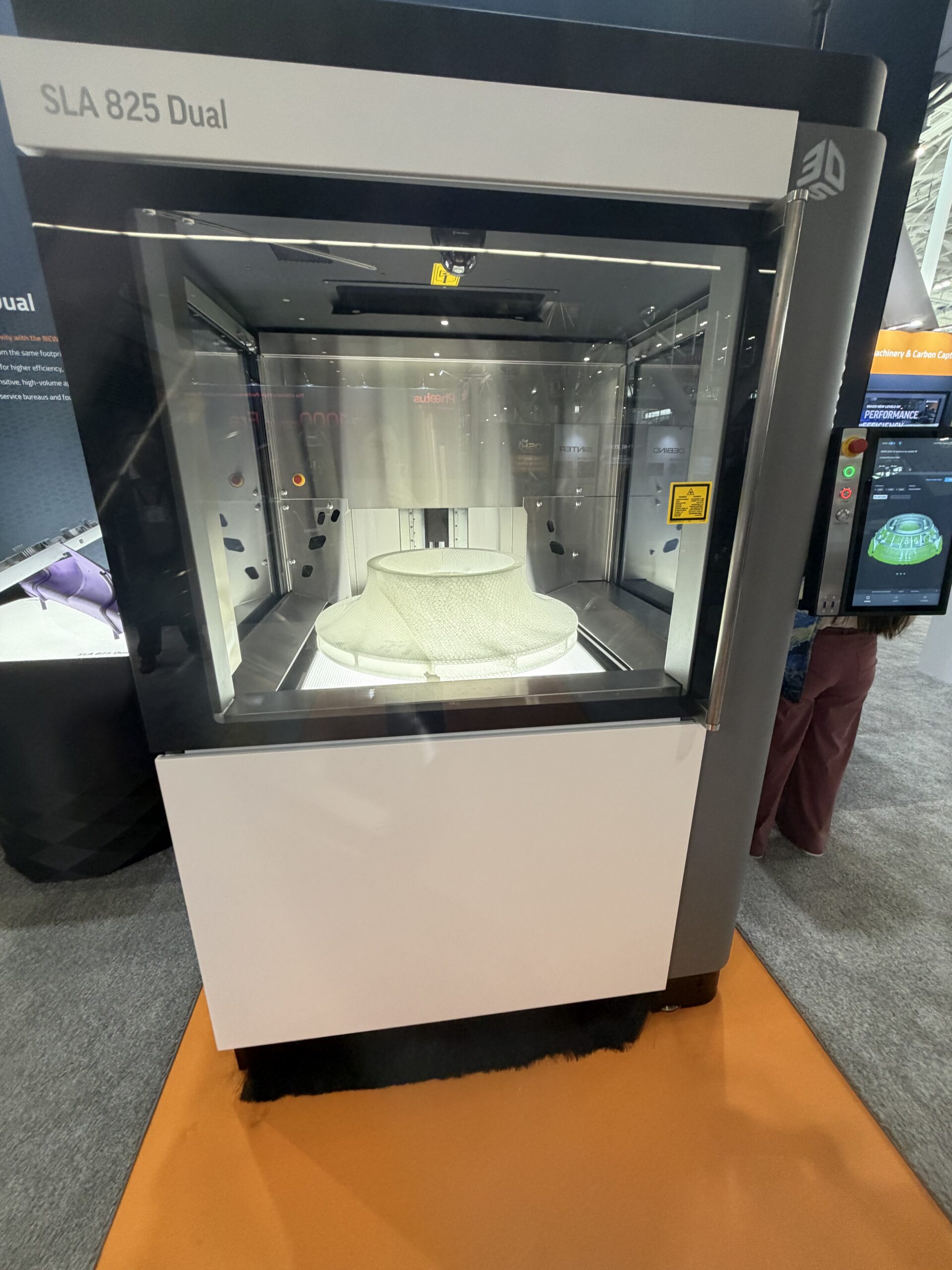
    SLA 825 Dual at 3D Systems’ RAPID+TCT 2026 booth. Image courtesy of 3DPrint.com.

    The company reported first-quarter 2026 revenue of $95.5 million, up 11% year-over-year. Its Healthcare Solutions division revenue grew 21% to $50.1 million, surpassing Industrial Solutions as the company’s largest segment during the quarter. Industrial Solutions revenue reached $45.4 million, up 1.6% year-over-year.

    Printer sales, material sales, and parts manufacturing all posted double-digit growth. Metal printing was a major contributor, especially in aerospace and medical applications. The company also reported improving profitability, with adjusted gross margin rising to 36.1% from roughly 30% a year earlier, after adjusting for divestitures. Meanwhile, adjusted EBITDA turned positive this quarter at $2.1 million, while net loss narrowed sharply to $4.4 million, improving by $32.6 million from the same period last year, thanks mainly to lower operating expenses, stronger sales, and a better product mix.

    CEO Jeffrey Graves told investors during an earnings call that the quarter is an important turning point for the company and the broader industry.

    “The additive manufacturing industry is now beginning to emerge from a multiyear trough, driven largely by global economic and geopolitical challenges that led customers to severely curtail capital spending,” Graves told investors. “It was a bet a few years back that we should hang on to our R&D spend and refresh our portfolio. And it turned out it was a good bet. We refreshed our entire product line in time for 3D printing to start regaining traction in the market.”

    Furthermore, Graves stressed that thanks to these moves, “no company in our industry can match this range of technologies nor the product performance that these systems can deliver. While it’s been a painful period, the results can now begin to be seen in our performance, and there’s much more excitement to come.”

    Much of the company’s momentum came from healthcare. Medical implant manufacturing, surgical planning services, and metal printer sales all grew strongly during the quarter. Titanium spinal implants and orthopedic implants were especially mentioned as strong demand areas. The company also highlighted growing demand for personalized surgical planning and oncology-related applications.

    NextDent 300. Image courtesy of 3D Systems.

    Dental was one of the company’s best-performing businesses. 3D Systems said demand grew for both aligner materials and prosthetic dental materials sold under its Vertex brand. Executives also pointed to strong early adoption of the company’s NextDent 300 Jetted Denture Solution, which launched in late 2025.

    Graves called the product launch “the most successful new product launch since my arrival at 3D Systems 5 years ago.”

    What’s more, the executive said dental labs and dentists have responded positively to the system, with ROE Dental Laboratory becoming the first major U.S. dental lab to deploy a large fleet of the printers across multiple locations. According to Graves, ROE has already expanded its purchases after the initial rollout, tripling its production capacity for high-precision dentures. He also said the product has quickly gained traction because of its faster workflows, easier integration into dental labs, and strong acceptance from dentists and patients. The company also recently secured European regulatory approval for the system ahead of schedule, expanding the market opportunity globally. 3D Systems said the platform now targets more than 60 million edentulous patients globally.

    Jeffrey Graves speaks at AMS 2025. Image courtesy of 3DPrint.com.

    Defense and aerospace also continued to gain importance for the company. 3D Systems expects aerospace and defense revenue to grow by more than 20% this year, reaching roughly $35 million in 2026. The company said demand is being driven by satellite components, turbine blades, propulsion systems, drones, and naval applications.

    To support that growth, 3D Systems is expanding its Littleton, Colorado, manufacturing site by 80,000 square feet, focused on metal parts production. The expansion is expected to open later this summer.

    Executives repeatedly stressed that the AM market still “remains volatile,” especially given ongoing geopolitical tensions and supply chain issues. However, Graves said he feels more optimistic than he has in years.

    “I feel good about things for the first time in a few years,” he told investors.

    For the second quarter, 3D Systems expects revenue between $93 million and $95 million, while forecasting an adjusted EBITDA loss of $2 million to $4 million, partly due to normal seasonal healthcare trends.

    Investors reacted positively to the results. Following the earnings announcement, 3D Systems shares jumped more than 20% in trading, going from around $2.47 before the report to roughly $2.51 afterward and rising even more three days later, reaching $3.28.

  • Ancient Rome Meets Modern Tech: How 3D Printing Recreated Trajan’s Column for the Saint Louis Art Museum

    When the Saint Louis Art Museum wanted to display the power and influence of the Roman Empire, it used 3D printing to bridge a 2,000 year gap. The museum’s current exhibit, Ancient Splendor: Roman Art in the Time of Trajan,” features unprecedented artifacts on loan from Italy. But one piece they could not pack in a shipping crate was Trajan’s Column, 38 meters of carved marble column still standing today in the Foro di Traiano, in Rome.

    The art museum wanted to bring the sights, sounds, and even smells of ancient Rome to their Midwestern America exhibit. Visitors can see sculptures of Trajan and his family, smell recreated gardens and foods, and listen to field recordings made at the Roman Baths in Bath, England. But a vital piece of Trajan’s legacy is the massive Trajan’s Column, erected by the Emperor himself to tell the story of his victory in the Dacian Wars. The column later became Trajan’s tomb.  

    Trajan’s Column tells a story in a series of 155 bas-relief scenes, each about a meter tall, that spiral around the column 23 times. The Saint Louis Art Museum replica is a life size reproduction of one scene. It was digitally captured by Flyover Zone, an education tech (edtech) company working to democratize world heritage sites and monuments.

    The Saint Louis Art Museum reached out to a local 3D printer company that specializes in large architectural pieces. Printerior, a St. Louis-based firm known for its large-scale 3D printing, makes its own recycled filament to craft furniture, wall panels, and sculptural light fixtures in massive scale. But this project needed a more delicate approach than could be achieved with a robot arm wielding an 8mm nozzle. Instead, Printerior deployed its Bambu Lab FDM print farm, and spread the work across 30 H2S printers simultaneously.


    View this post on Instagram


    A post shared by Printerior (@printerior.designs)

    “Working with the Saint Louis Art Museum on the Trajan exhibit was a perfect example of how modern technology can serve ancient storytelling,” said Trent Esser, Co-Founder and CEO of Printerior. “This is a structure that has stood as one of the greatest achievements of Roman art for nearly two thousand years, and we were able to recreate it at full scale in just a few days of print time.

    “We approached this project by rethinking scale and speed from the ground up. Instead of relying on a single production line, we distributed the build across 30 FDM printers running simultaneously, allowing us to compress what would traditionally take nearly two months of print time into just a few days.”

    Once the segments were completed, the team hand-finished the prints and applied a bronze treatment meant to give museum visitors a true glimpse of the past. Today’s tourists may see the ruins of Rome in pale marble, but when this monument was new, it would have been vividly colored. Historians can’t agree if it was brightly painted, or colored bronze to mimic the statue of the Emperor Trajan mounted on top of the column. But they do know it was originally adorned with tiny bronze swords, lances, and armor.

    The replica depicts the Roman army on a river bank loading goods onto ships. Emperor Trajan is standing off to the side in his traveling clothes, speaking to soldiers. The background shows an amphitheater outside the city walls, with a temple and triumphal arches. 

    Esser is proud to say his team produced a true piece of museum-quality, 3D printed art. The finished piece is part of the exhibit’s finale, with visitors able to touch and feel the column segment. They are then invited to make drawings of their own life to add to a St. Louis column on a nearby wall.

    This replica is a great example of how 3D printing can make art and history more accessible to the public.

    “Ancient Splendor: Roman Art in the Time of Trajan” runs through August 16, 2026, at the Saint Louis Art Museum.

  • Ceramic 3D Printing Applications on Display at Ceramics Expo USA

    There’s a lot of crossover between ceramics and additive manufacturing (AM). Now, we just need to get the two industries to talk to each other more. It was nice to see this happening at the recent Ceramics Expo in Cleveland, Ohio.

    Presentations and Panel Discussions

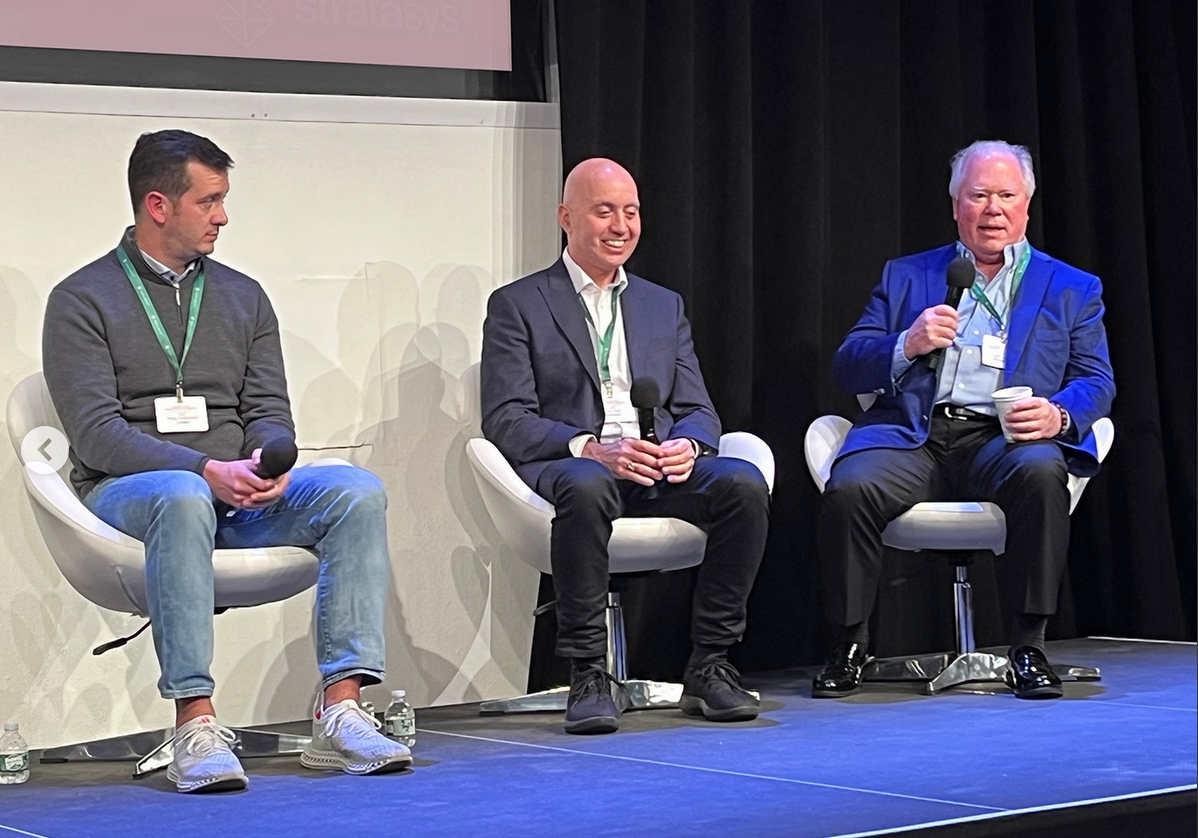
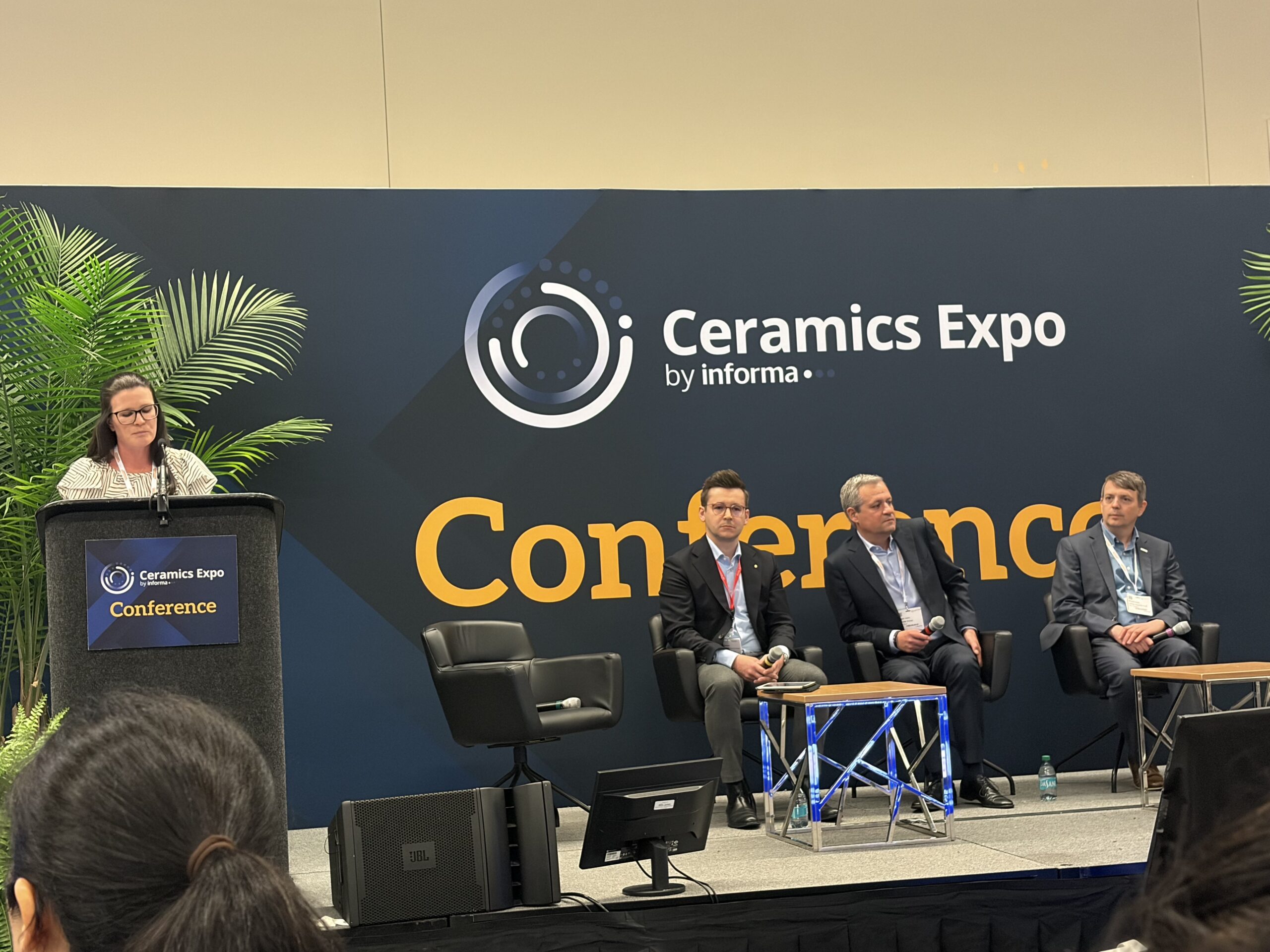
    Ceramics have an obvious home in commercial and artistic applications, but these brittle materials are also corrosion- and heat-resistant, which means they can be used in more extreme environments, like fuel cells and hypersonics. At the event, there was a panel discussion on this very topic, moderated by Sinto Advanced Ceramics USA Business Development Manager Dave Diegel.
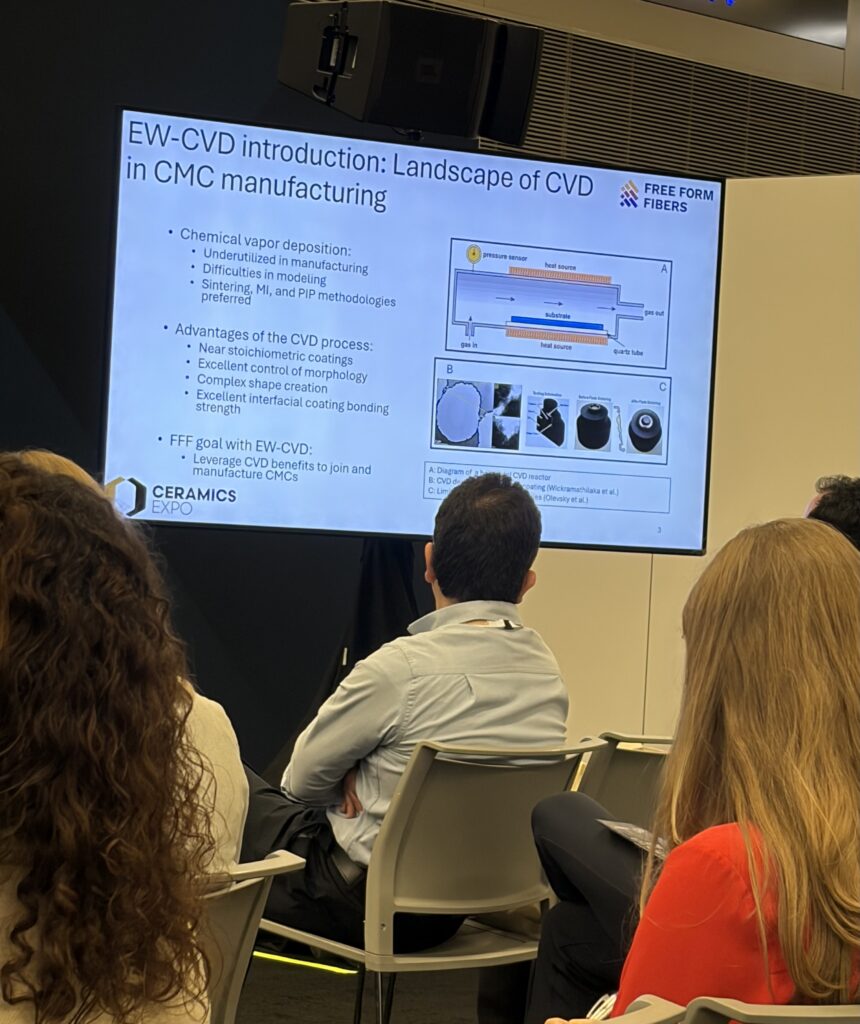
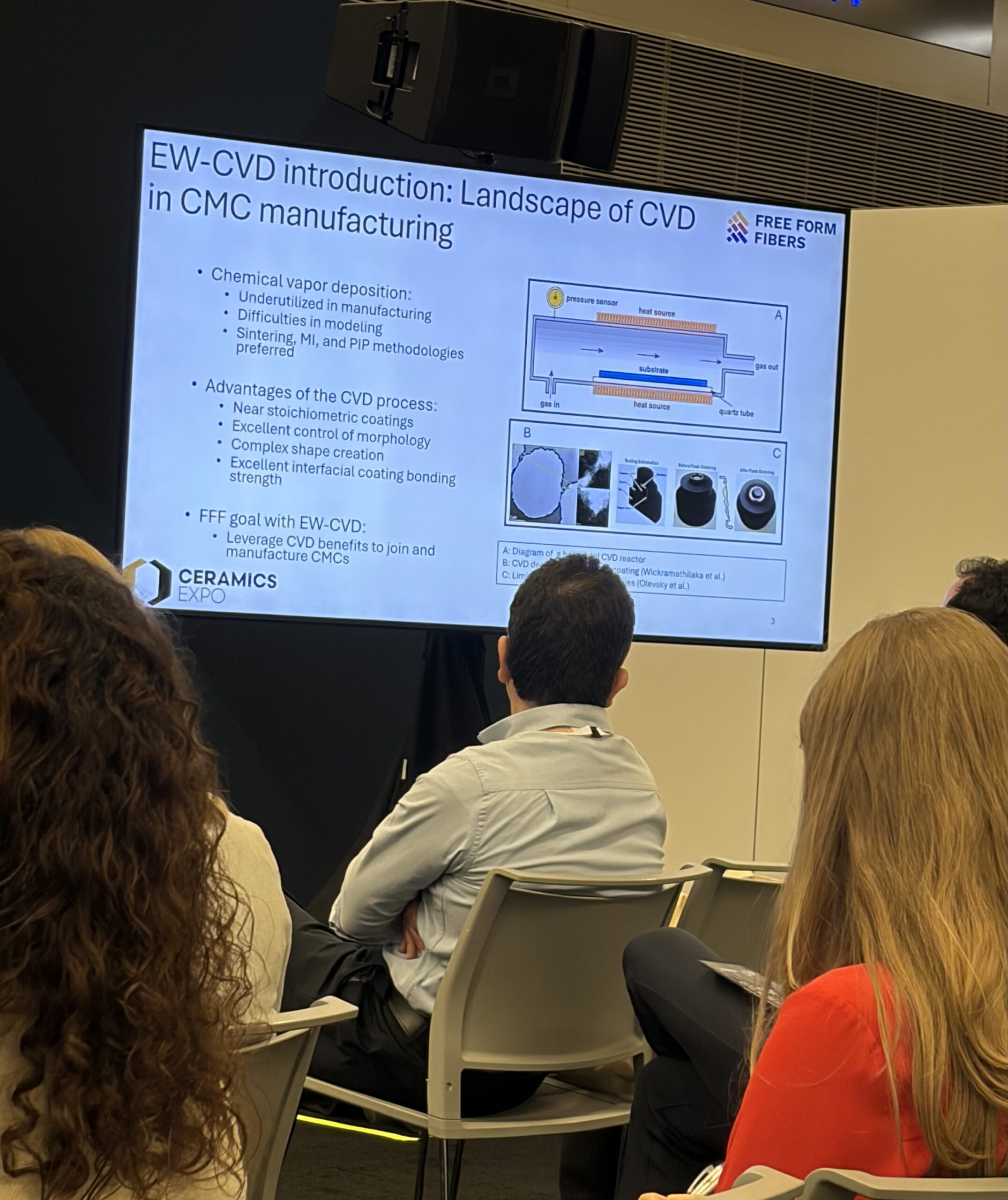
    Seth Shuster, a research scientist at Free Form Fibers, explained the company’s chemical vapor deposition (CVD) process, which received government funding last year for semiconductor production with its ceramic matrix composites. The other panelist was Jonathan Volk, Director of Advanced Materials Applications at Starlab Space, which is working on a Low Earth Orbit (LEO) space station to eventually replace the ISS. Volk shared some examples of ceramics manufacturing in space, like Redwire 3D printing ceramic single-piece turbine blisks.

    Diegel asked the two what role AM will play for their specific applications, and Volk made the very good point that “volume is precious in space. You’ll save a lot of weight and room if you have a printer in space, so you can make what you need on-demand, as opposed to having to send up a lot of different parts.

    “What I’m most impressed about by 3D printing of non-oxide ceramics is the tolerance of shapes people can make in such a short time,” Shuster said. “When we need to join things that need a higher degree of conformity or unique tolerances, 3D printing is definitely an option. I definitely think it will be useful, and the combination of different manufacturing practices will be integral to the bigger picture.”

    I was pleased that there was also a panel specifically about AM in ceramics. Moderator Jamie Scaglione, Market Development Manager at materials science consultancy Lucideon, shared about the UK’s AMRICC Centre, a full end-to-end ceramics processing pilot-scale facility. Using AM technologies like robocasting and vat polymerization, the center helps manufacturers with paste formulation, sintering, and debinding. It’s also home to the Ceramic Hybrid Additive Manufacturing Platform, or CHAMP, from Hydra Manufacturing.

    Nikolai Sauer, CTO of Sinto Advanced Ceramics, explained that the contract manufacturer, which was previously part of Bosch, is focused on series production for industries like medical devices and semiconductors. Sauer shared a few use cases Sinto has worked on, like a laser cap with integrated extraction channels for automated laser welding in battery manufacturing, and a high-precision insulating sleeve for medical devices.
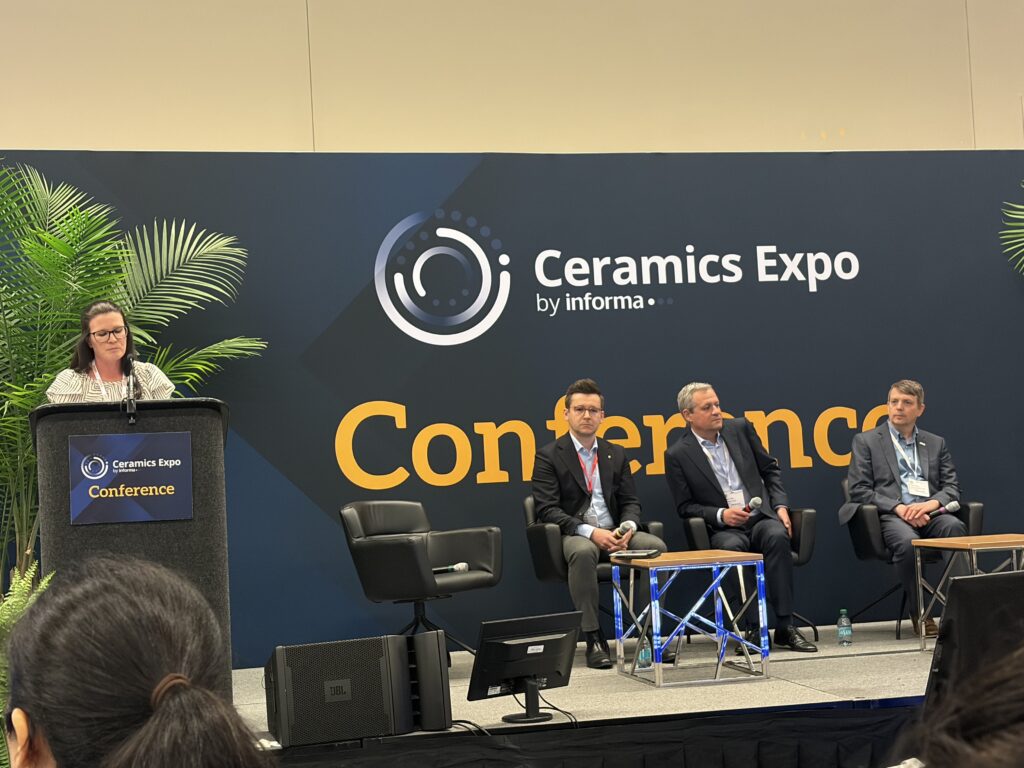
    L-R: Jamie Scaglione, Lucideon; Nikolai Sauer, Sinto Advanced Ceramics; Srdan Vasic, Exentis Group; Shawn Allan, Lithoz America

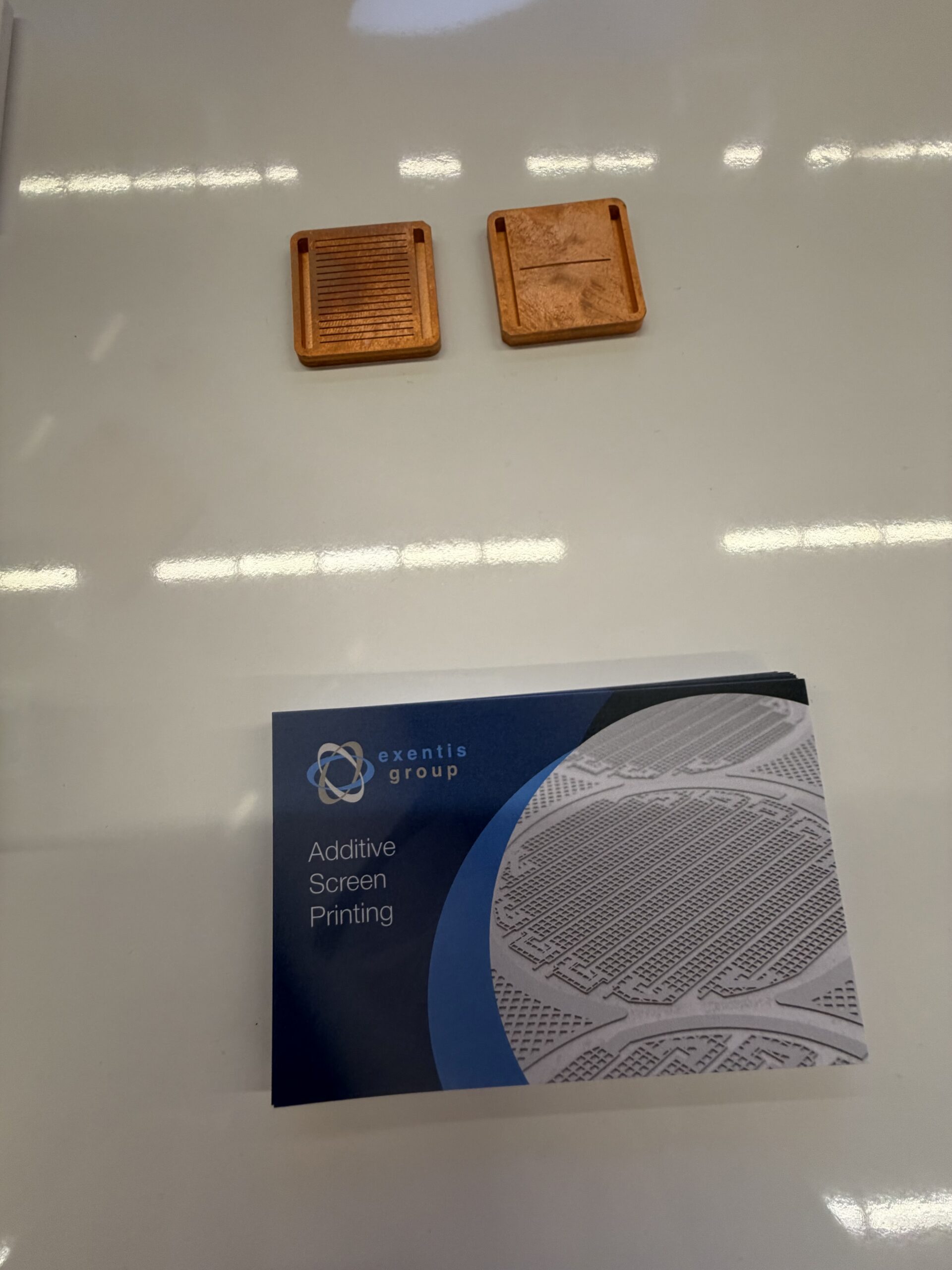
    Exentis Group offers an industrial additive screen printing process with a very high build rate, low post-processing requirements, and lower costs. As CCO/CPO Srdan Vasic explained, the technology enables 3D printing of fine-structured ceramics for medtech, cooling structures, and semiconductors. He also said the company can process a variety of materials in the same system, including copper alloys, titanium, Inconel, and ceramics like alumina nitride, silicone carbide, and zirconia.

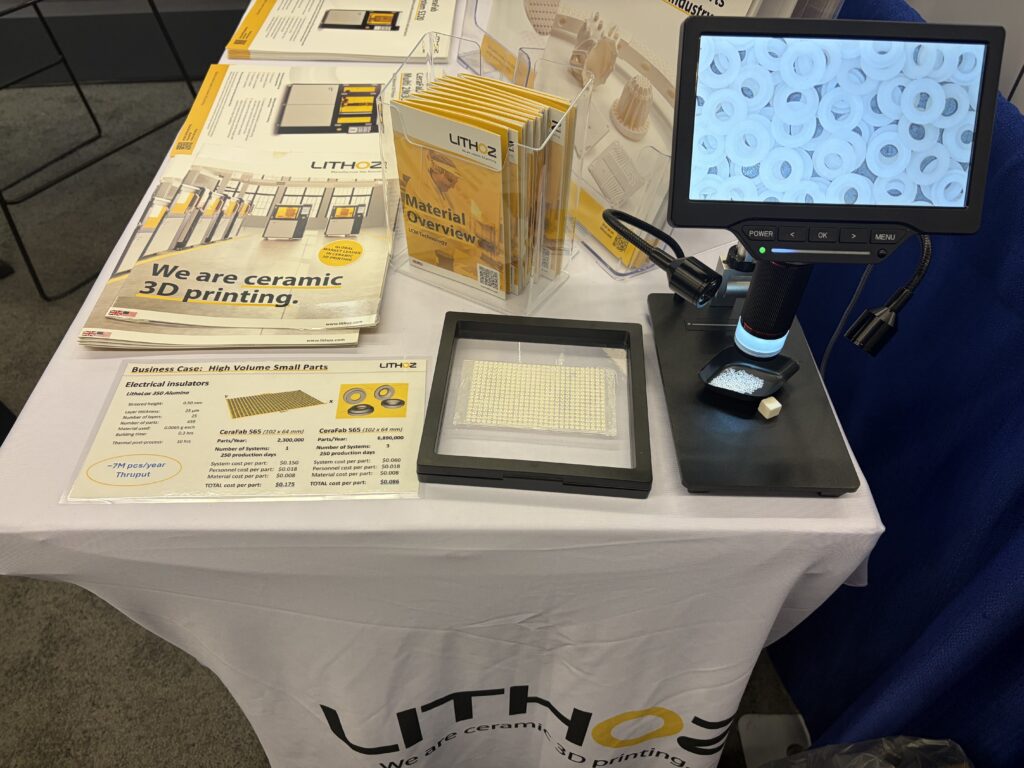
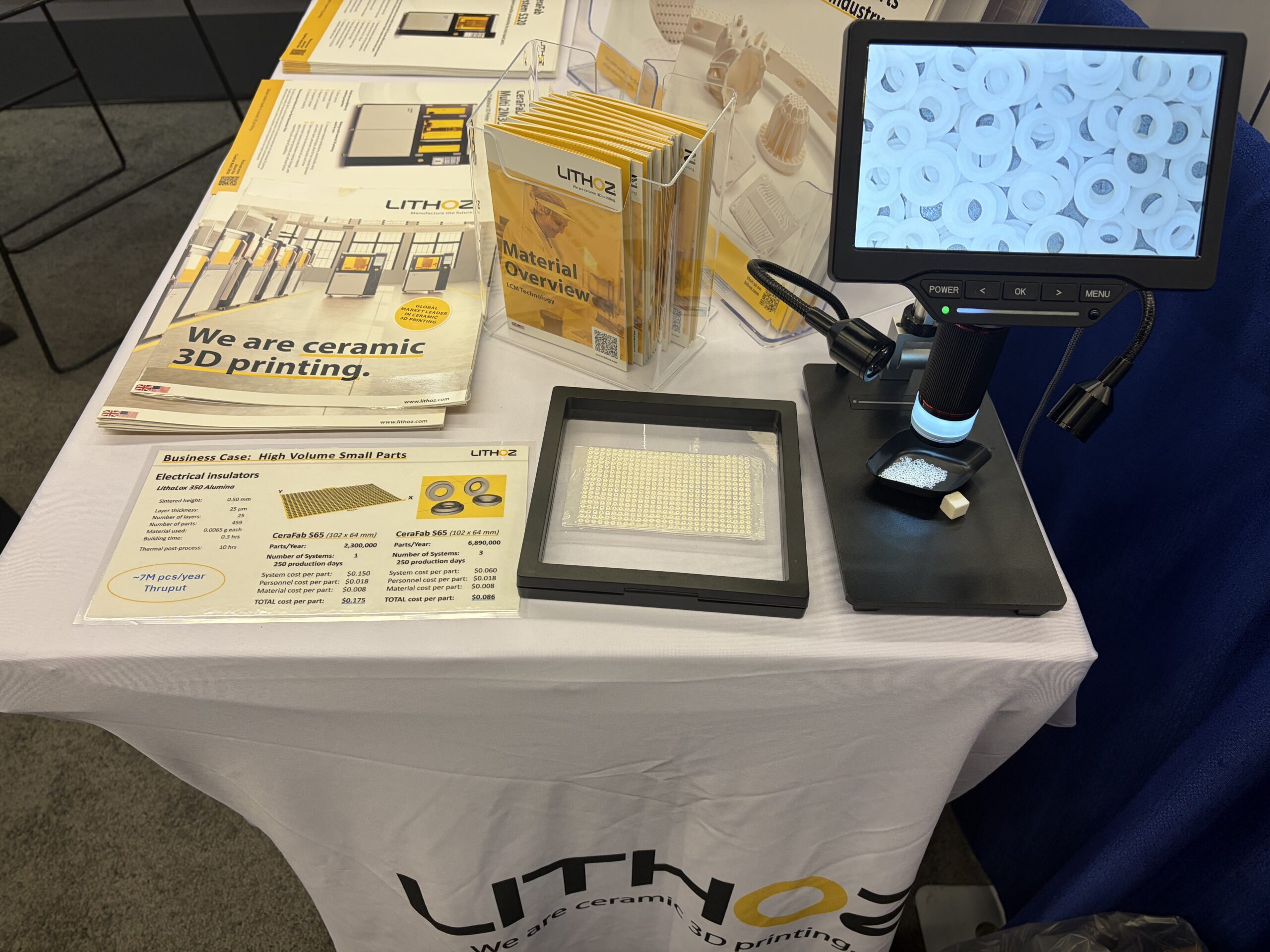
    Shawn Allan, Vice President of Lithoz America, said their lithography-based printers are used for a range of applications, like aerospace and aviation, medical and dental, electronics and semiconductors, and R&D. He explained that people often turn to ceramics when other materials have failed, and that 3D printing can help you achieve “fast iteration cycles, efficient material use, and hopefully the final part you need.”

    “It’s not a solution for everything, but you can use a lot of great design tools to support making useful geometries and accessing things we can’t do with traditional manufacturing,” Allan said.

    When asked about the future of ceramics AM in five years, the panelists all agreed that costs need to come down.

    “We’re working intensely towards bringing the cost down, both with process chain and raw materials,” Sauer said. “We’re limited in terms of what quantities make sense.”

    Allan also said Lithoz has seen many more applications and use cases being commercialized over the past five years, and believes this will continue.
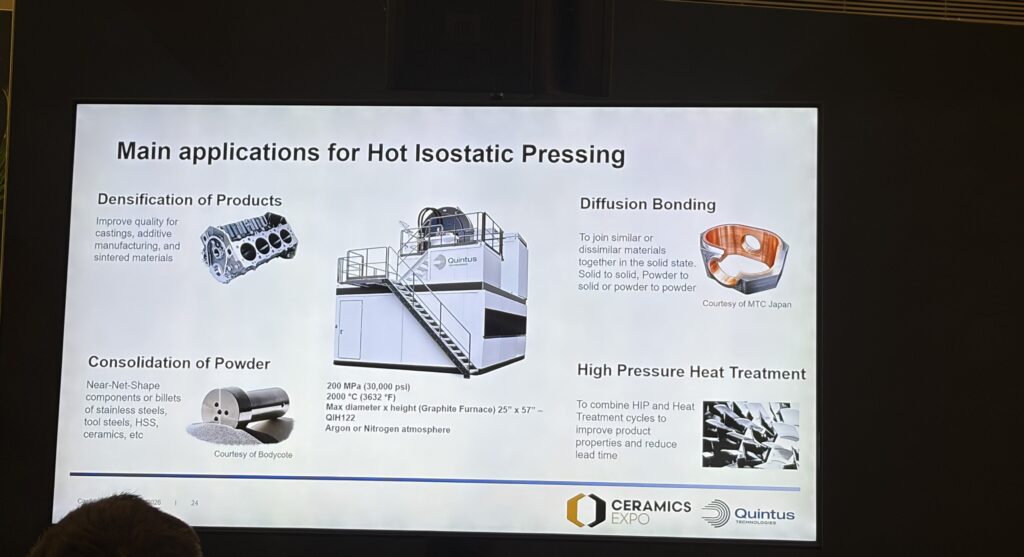
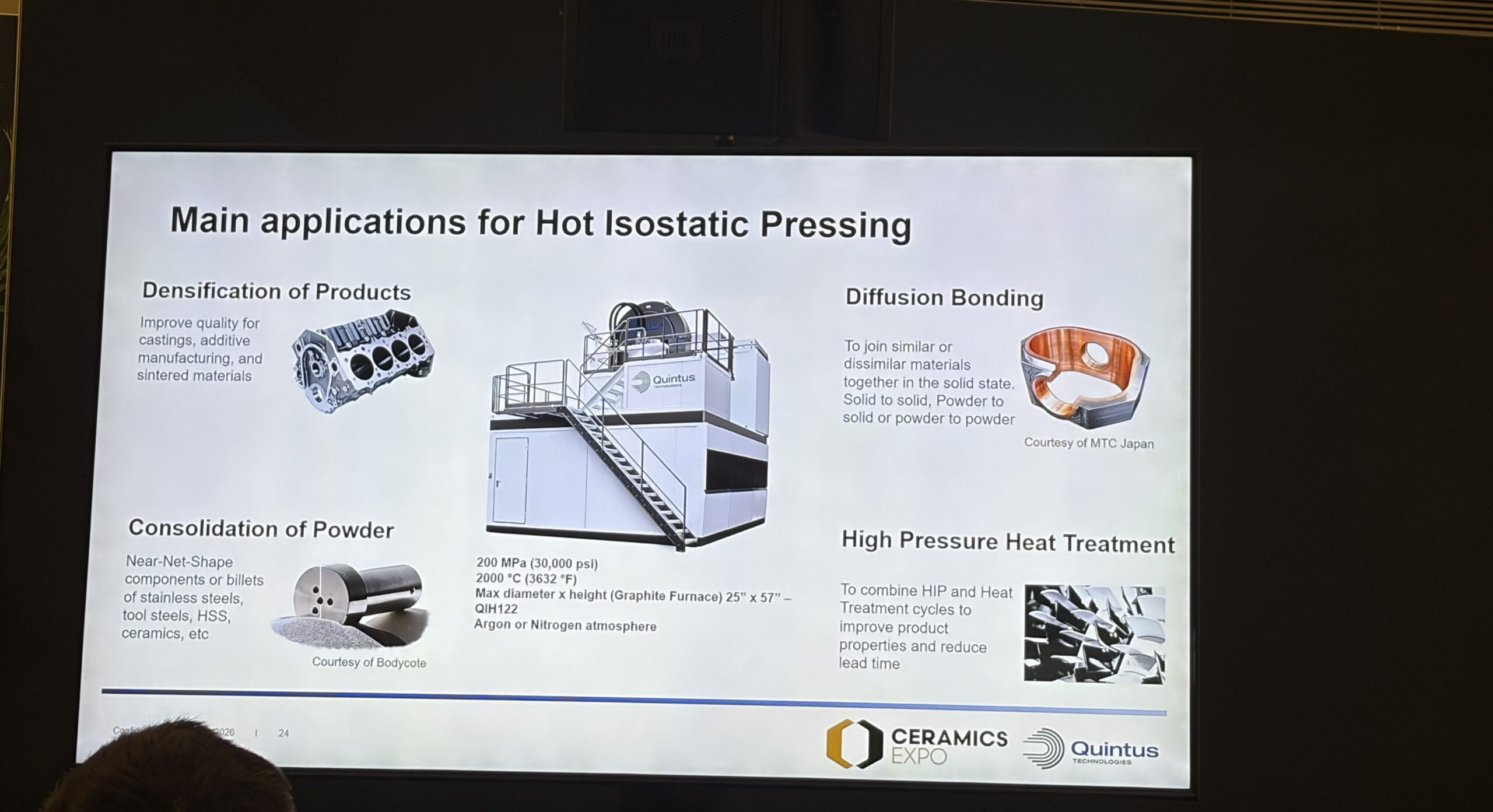
    Chad Beamer’s presentation on hot isostatic pressing (HIP) at Quintus Technologies

    There were many other panels and presentations as well. Alloy Enterprises presented about manufacturing 3D microchannel cold plates at scale for chips, Fabric8Labs and Fabrisonic each shared about their respective AM technologies, and Quintus Technologies discussed the latest capabilities in hot isostatic pressing (HIP). We heard a keynote presentation from America Makes, the opening panel on the second was about geopolitical forces reshaping the global supply chain, and the closing panel focused on addressing real world challenges in high-performance ceramic material. It was definitely a good mix of topics.

    Booth Visits

    Ceramics Expo was co-located with the Thermal Management Expo, and I visited a few booths on each side.

    Walking down one of the aisles, I saw the classic silhouette of a desktop 3D printer, and like a moth to the flame, I was immediately drawn to an active Bambu Lab P1S.
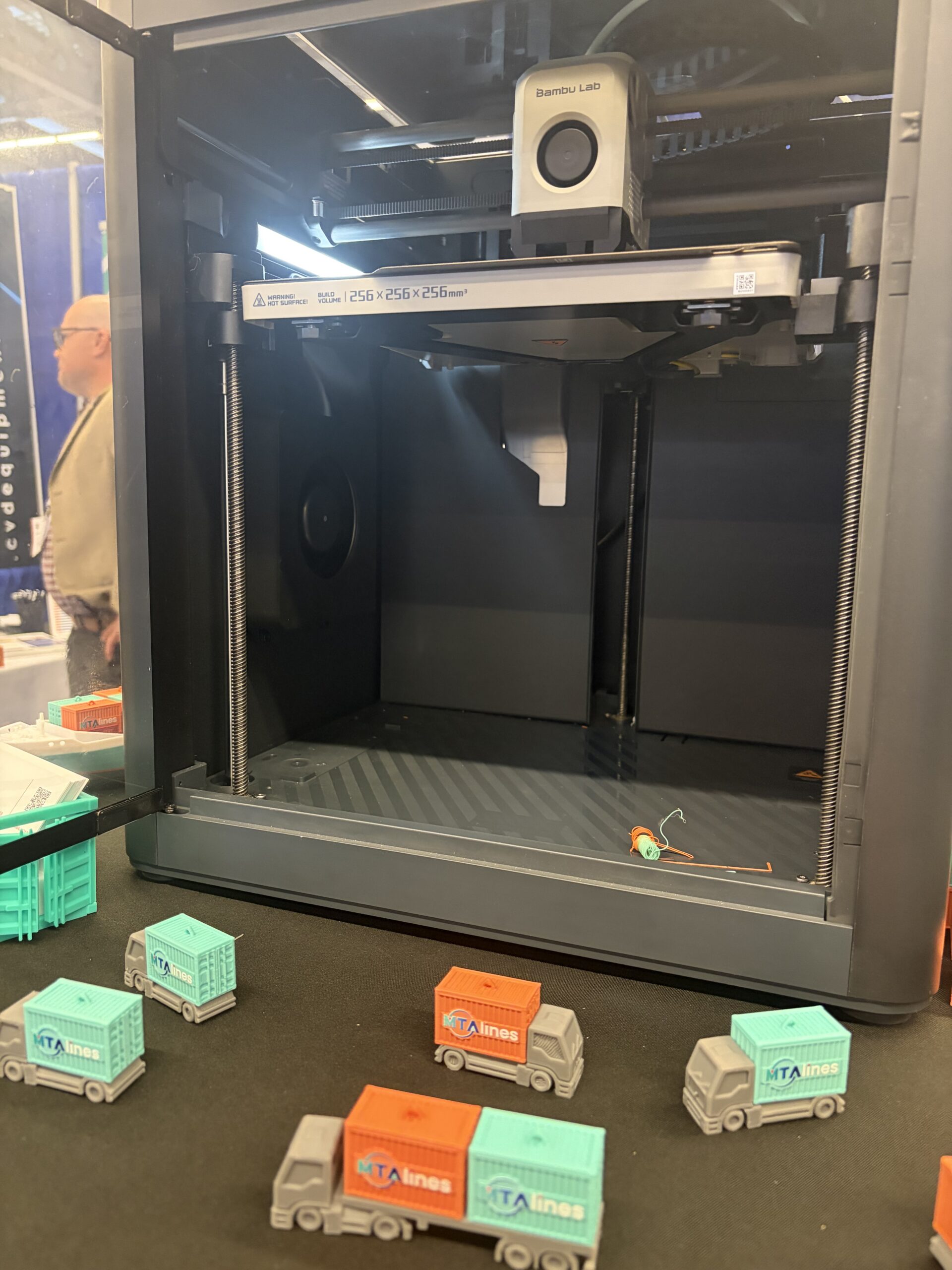
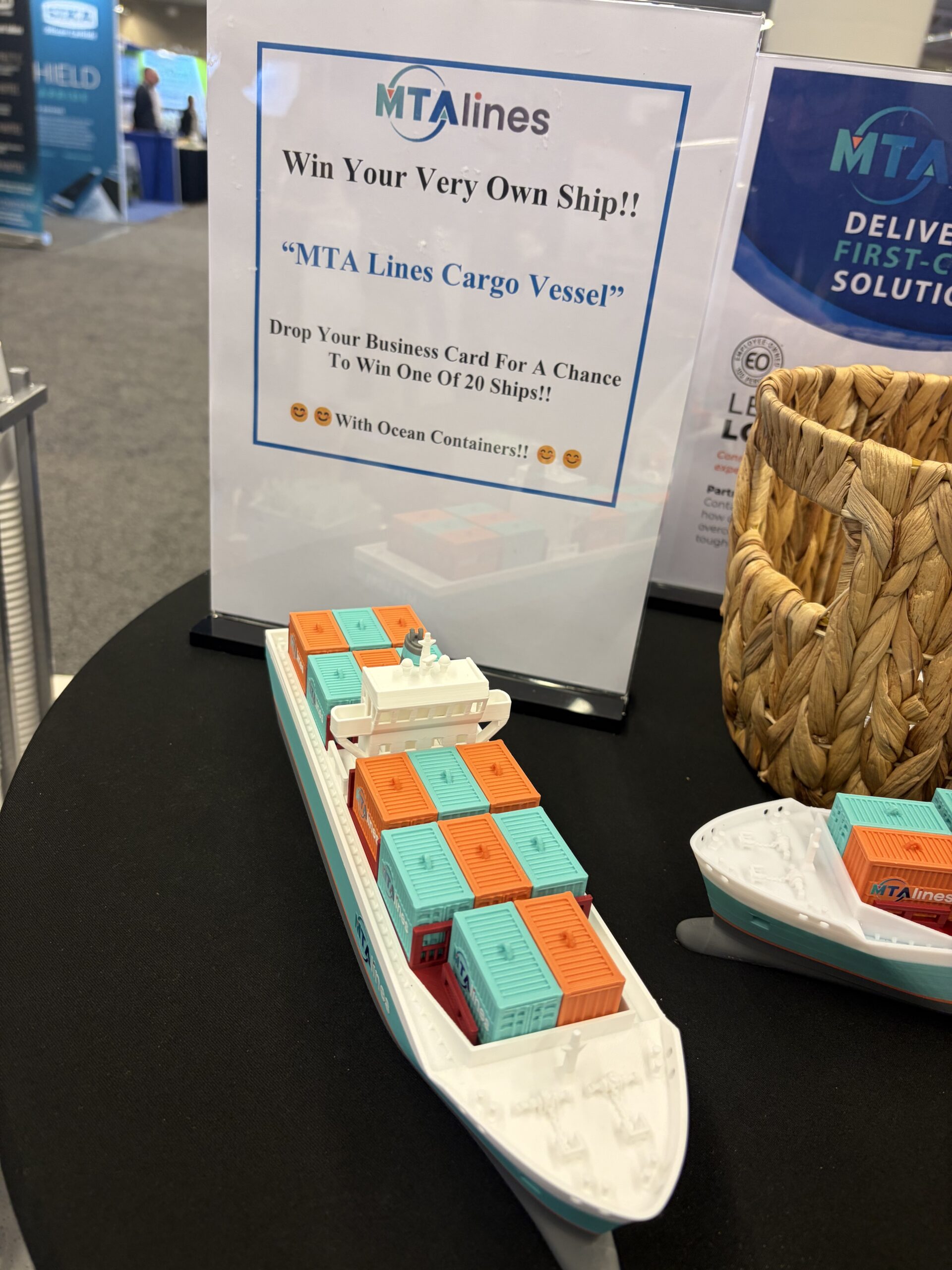
    The booth was MTA Lines (Midwest Transatlantic Lines), an Ohio-based logistics and freight forwarding services firm, and not a 3D printing company. But an employee had wisely brought his printer to the event, and the Bambu P1S was busily cranking out freight trucks every time I walked past. In a stroke of very random good luck, I also won a cargo vessel, complete with two levels of ocean containers, that was printed on the P1S.

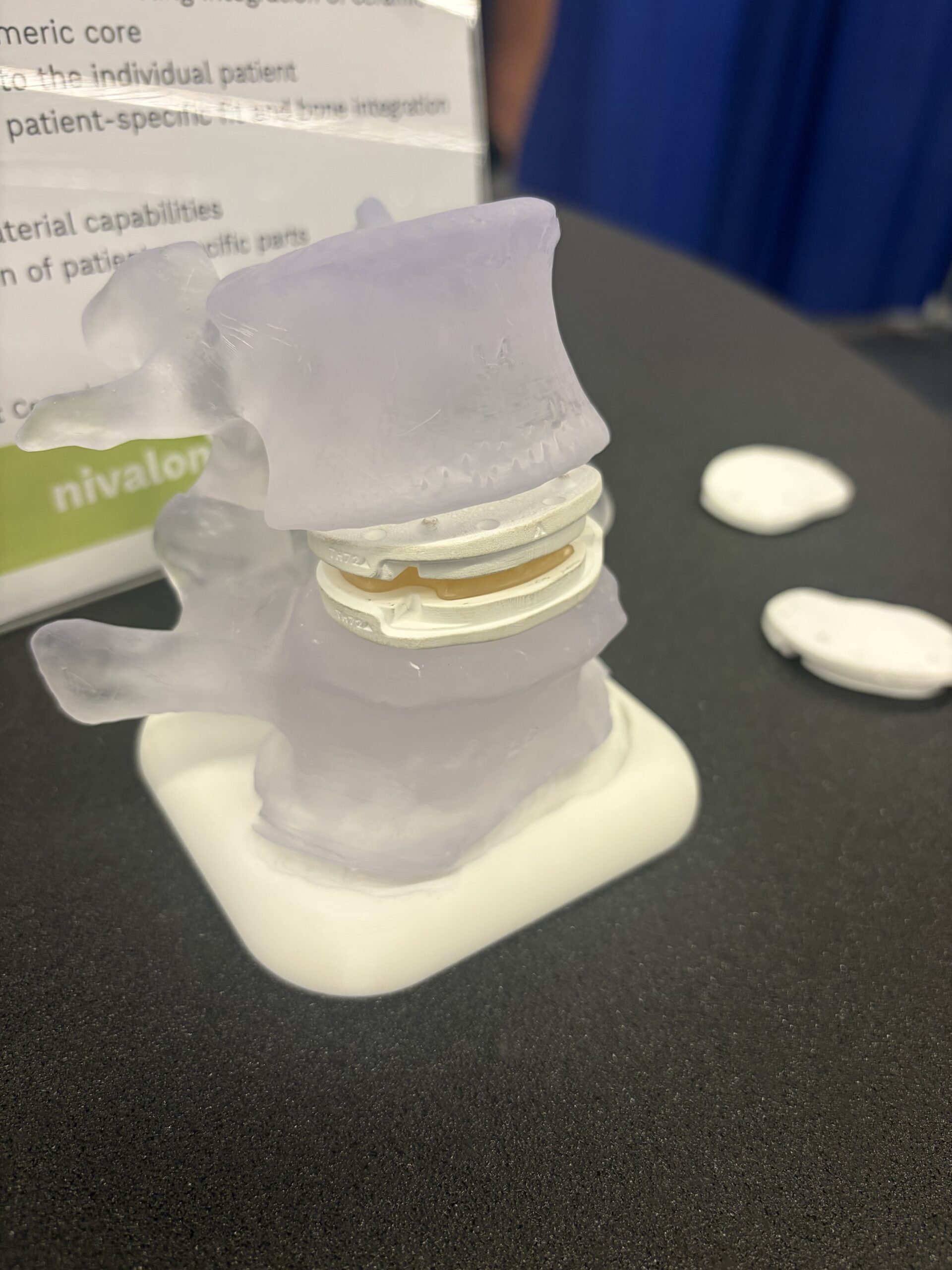
    I did also visit several booths that were more involved with the 3D printing industry, starting with the Youngstown Business Incubator (YBI). Applications Engineer Dylan Negro told me about an interesting project they’re working on with XJet and Nivalon Medical: an AI-generated, metal-free spinal implant 3D printed out of Zirconia-toughened Alumina. Another thing that makes this ceramic implant unique, as Negro explained, is that it’s actually inserted through an incision in the front of the body and slides in to fit between the specific vertebrae. It’s still under development, but has the potential to be far less invasive than opening up a patient’s back.
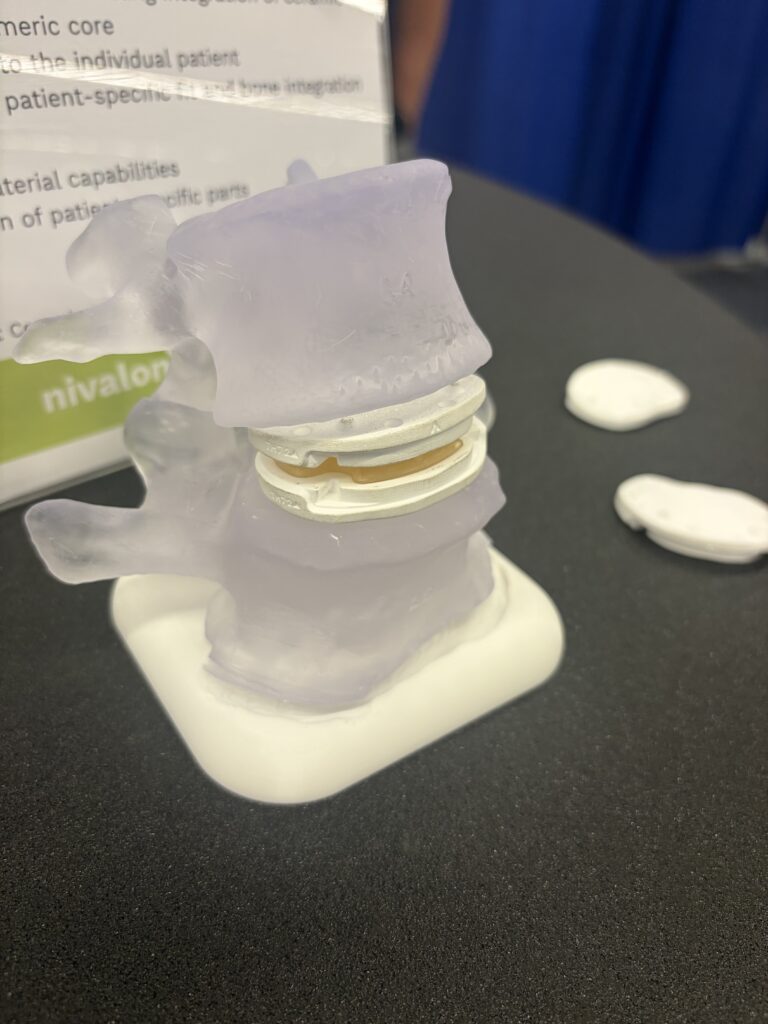
    In addition to incubating Nivalon through its tech program and helping it find medical industry expertise to develop the product further, Negro said YBI is also responsible for 3D printing the end plates for the implant, using XJet’s technology; the flexible material between the plates is injection molded. 22 plates can be printed in one build on the XJet Carmel 1400 C.

    “They’re still doing a significant amount of testing, but the founder of Nivalon is planning to be patient #1 for this implant,” Negro told me.

    The implants will be patient-specific, using CT scans to perfectly match the top of the 3D printed implant to the person’s spine.
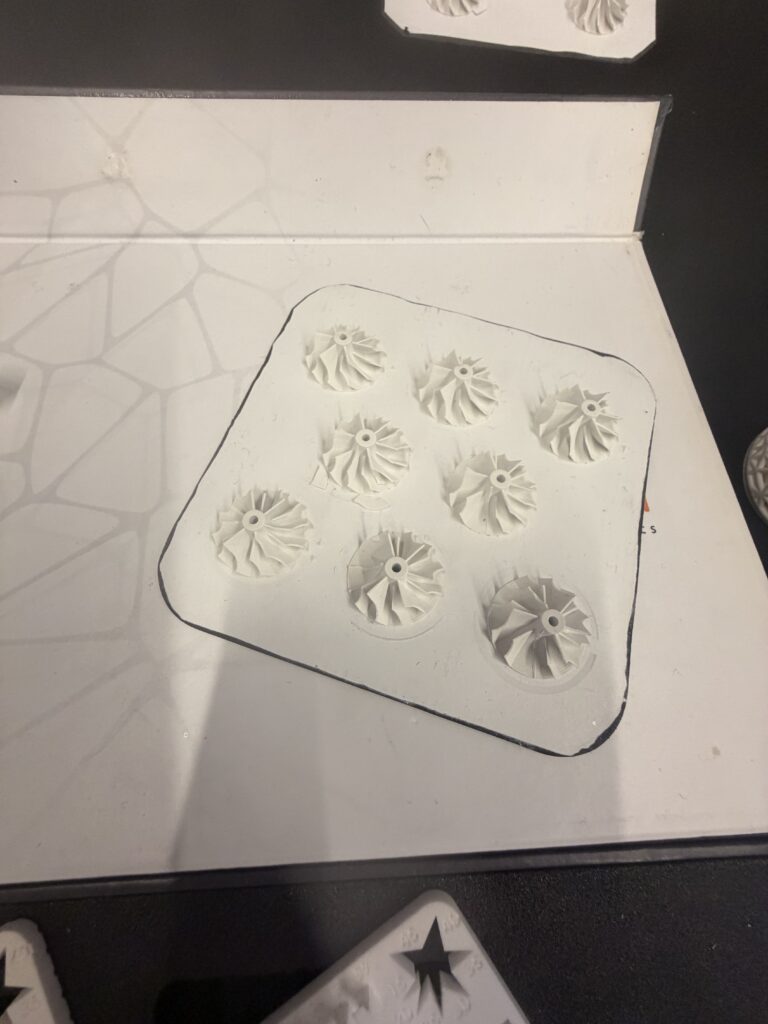
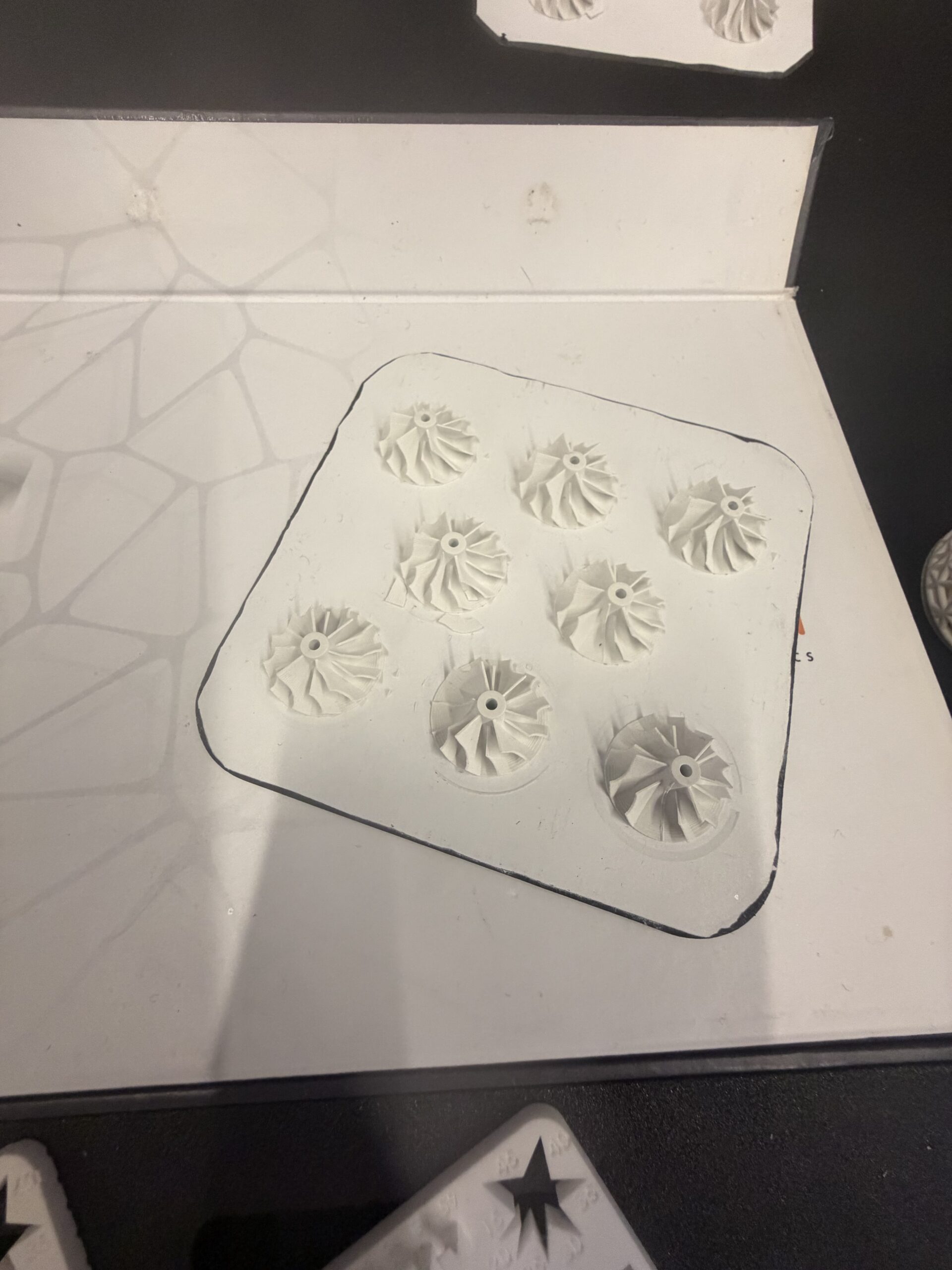
    Green impellers at the Sinto Advanced Ceramics USA booth

    The Sinto Advanced Ceramics USA booth had a variety of prints on display, like heat exchangers, a hip cup, washer retaining clips, and even some zirconia jewelry.

    “A lot of people have skin allergies to materials like nickel, stainless steel, or silver, so going with zirconia, you guarantee they’re not going to have allergies,” Project and Applications Engineer Sean Bradley told me.

    Bradley also showed me a Fraunhofer part for embedding wires.

    “You’ve got electrical connectors built into the part,” he explained. “Alumina is pretty good for thermal conductivity, and really bad for electrical conductivity, so you can have your circuit printed directly onto the heat sink. That way you’re pulling out heat without having to have a thermal interface, and you’re at no risk of shorting out your electronics.”
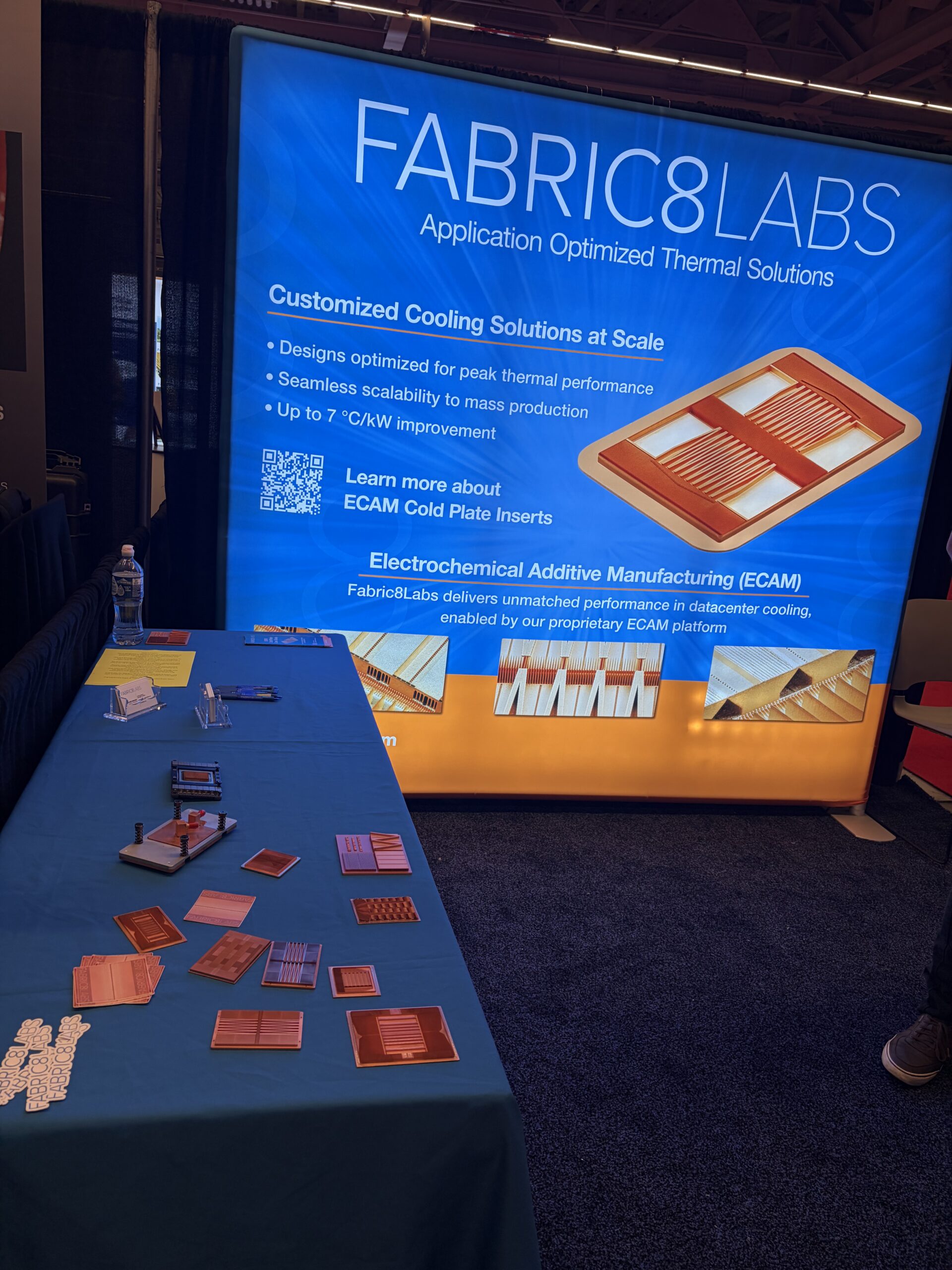
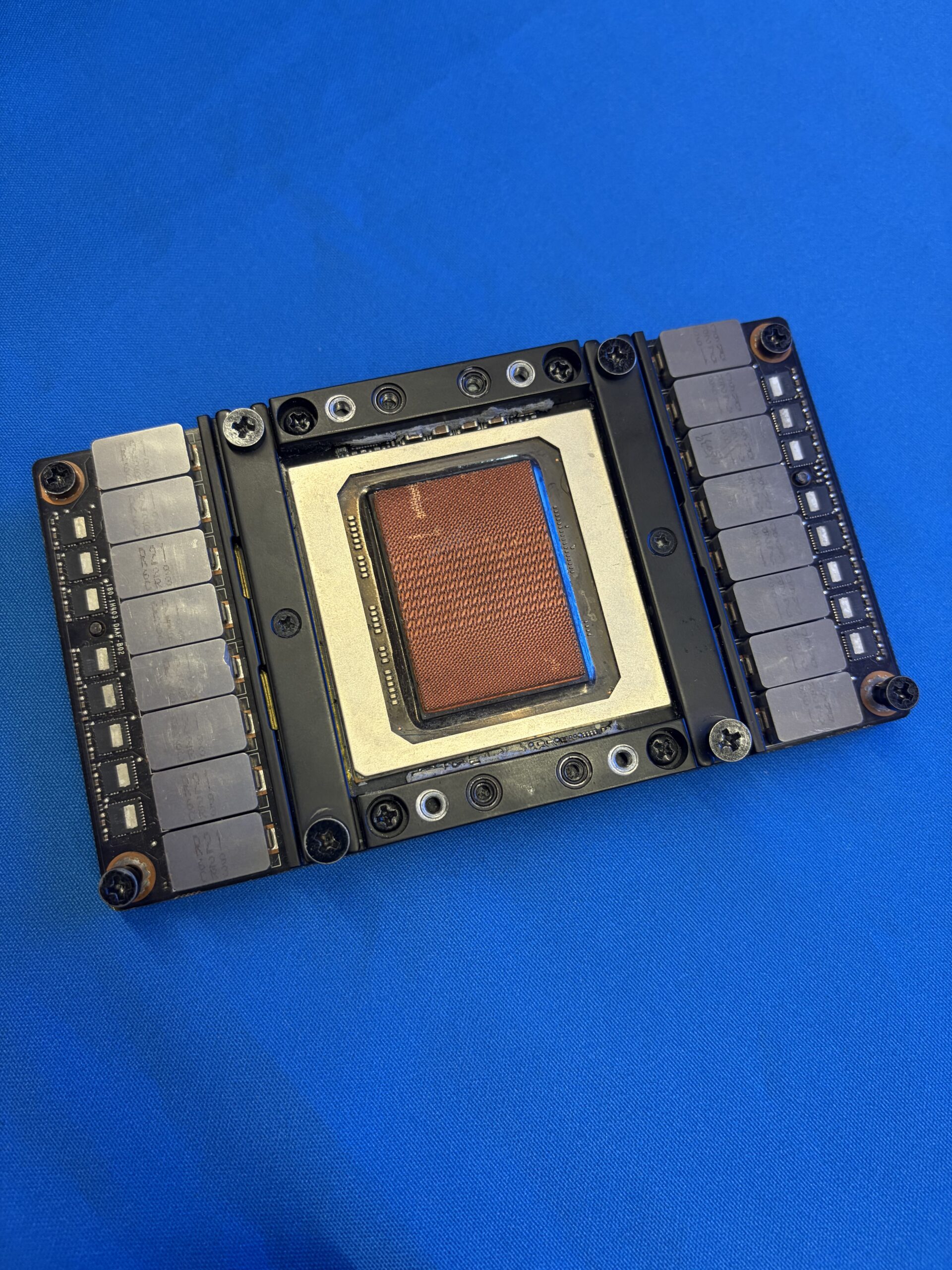
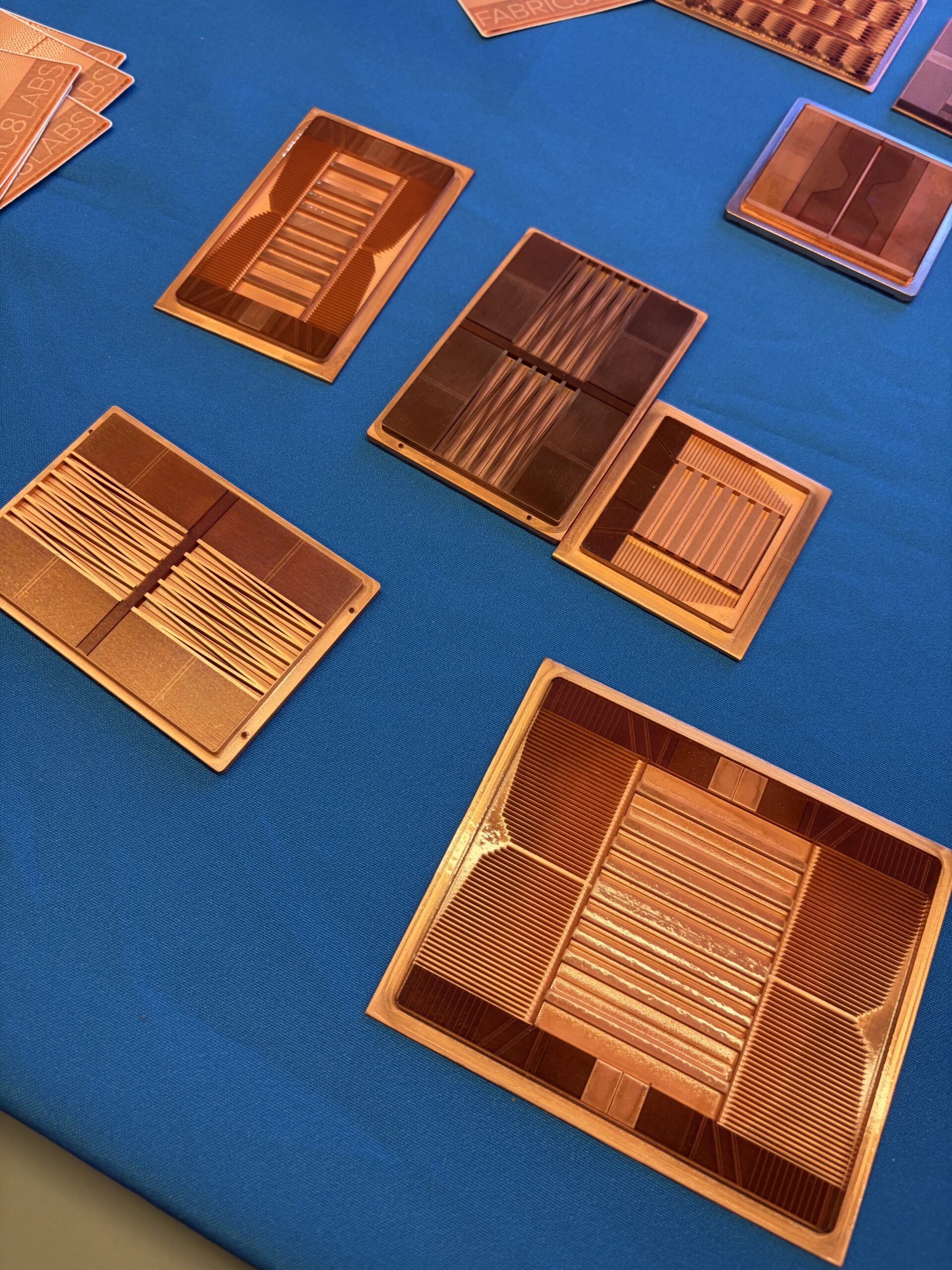
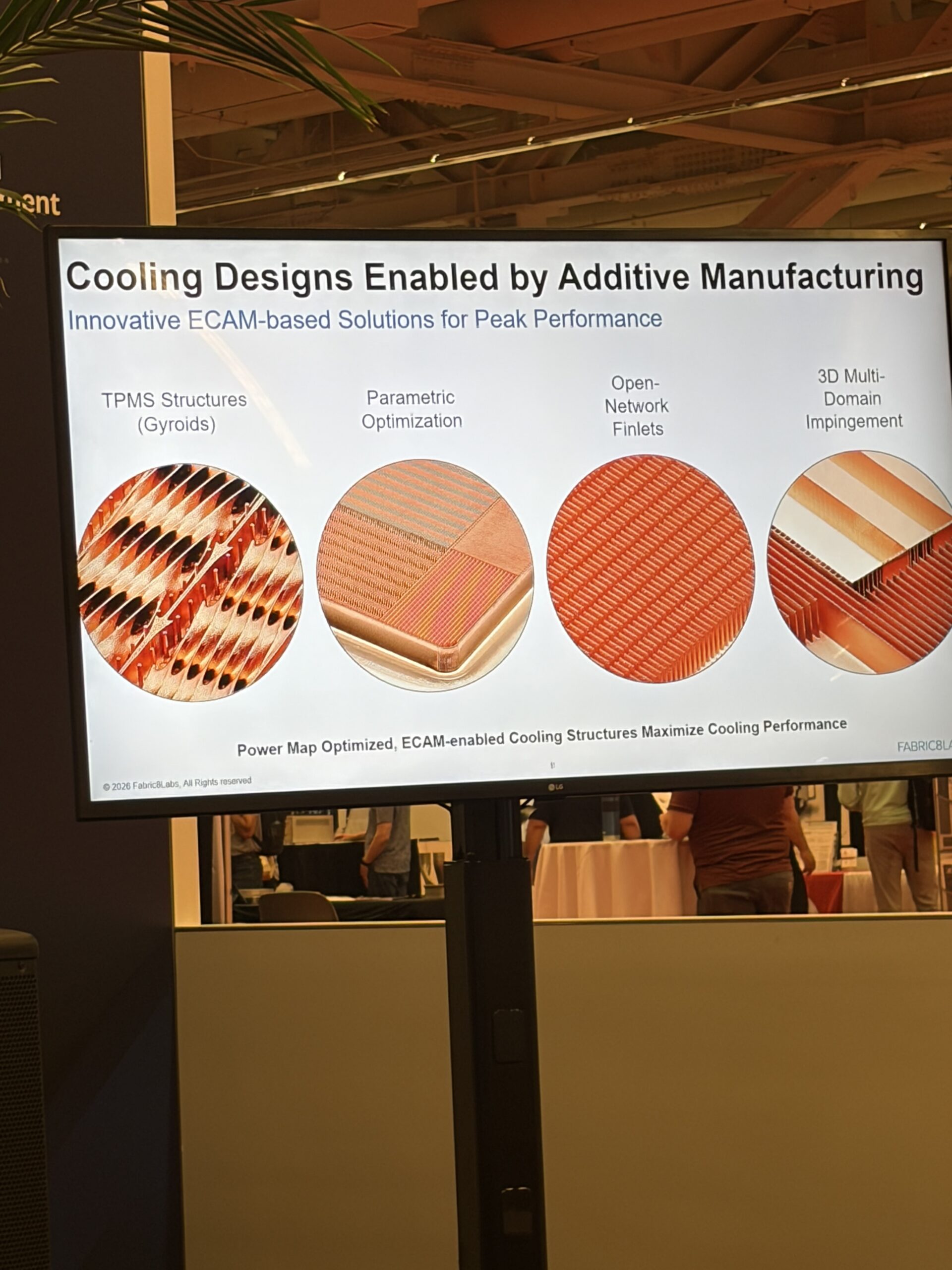
    At the Fabric8Labs booth, Marketing Coordinator Tanner Immonen showed me a variety of copper cold plates, including single-phase and multi-domain (with parallel flow), made with the company’s electrochemical additive manufacturing (ECAM). ECAM uses liquid metals, similar to the electroplating chemistries you’d see in semiconductor and PCB manufacturing. The printhead is a micro-electrode array that builds at the atomic level, enabling micron-scale feature resolution and the complex internal features you need for these cold plates.

    At the booth was one of these plates that had been printed directly on silicone, and Immonen told that this is the direction the company is moving towards.
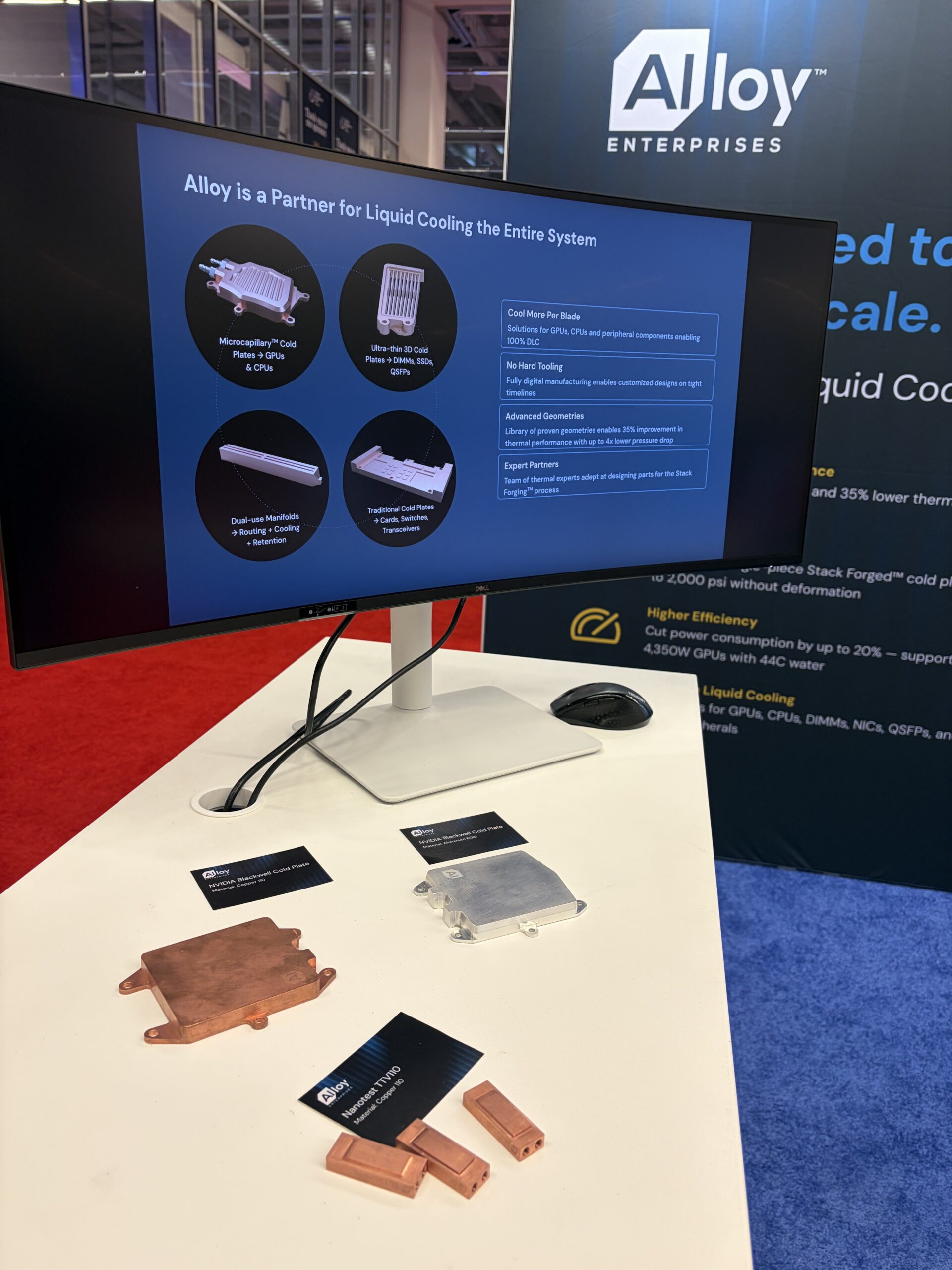
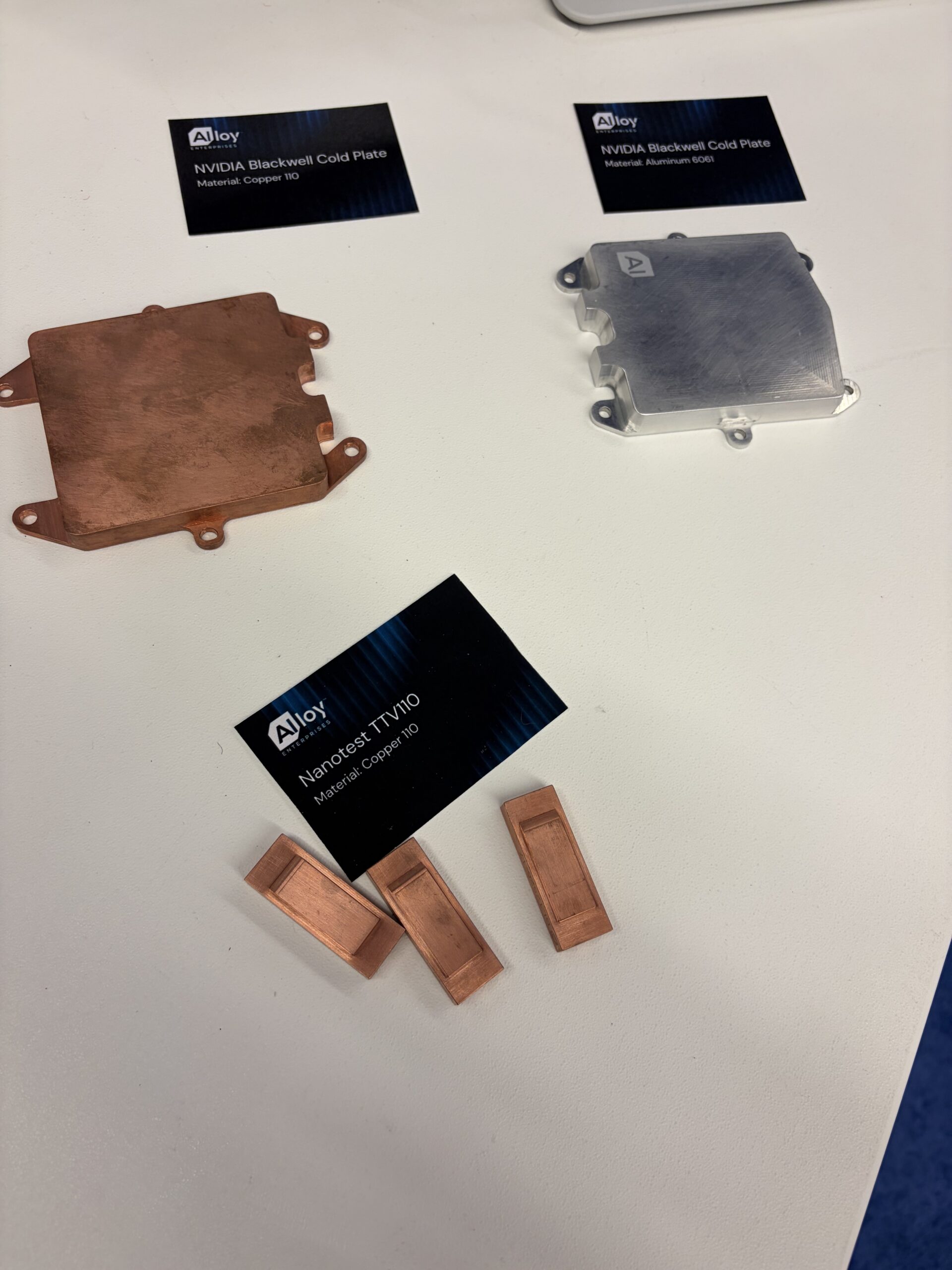
    Barrett Gruner, Senior Thermal Solutions Engineer for Alloy Enterprises, and I discussed the importance of designing for specific applications, and not just building a printer to build one.

    “A lot of additive companies are always targeting the same slice of the pie, because they’re always chasing the big, loudest application. There’s a lot of overlap, so it can be kind of difficult to break out,” he said.

    Ryan O’Hara, previously the VP of Business Development at Alloy and now Technical Sales Executive for Johnson Controls, reminded me that Alloy is not an additive company per se, but a thermal management company enabled by advanced manufacturing, which includes AM.

    “We definitely found that our Stack Forging is very pre-disposed for handling liquid solutions, specifically thermal management,” Gruner said. “This is inherently good at thermal solutions.”

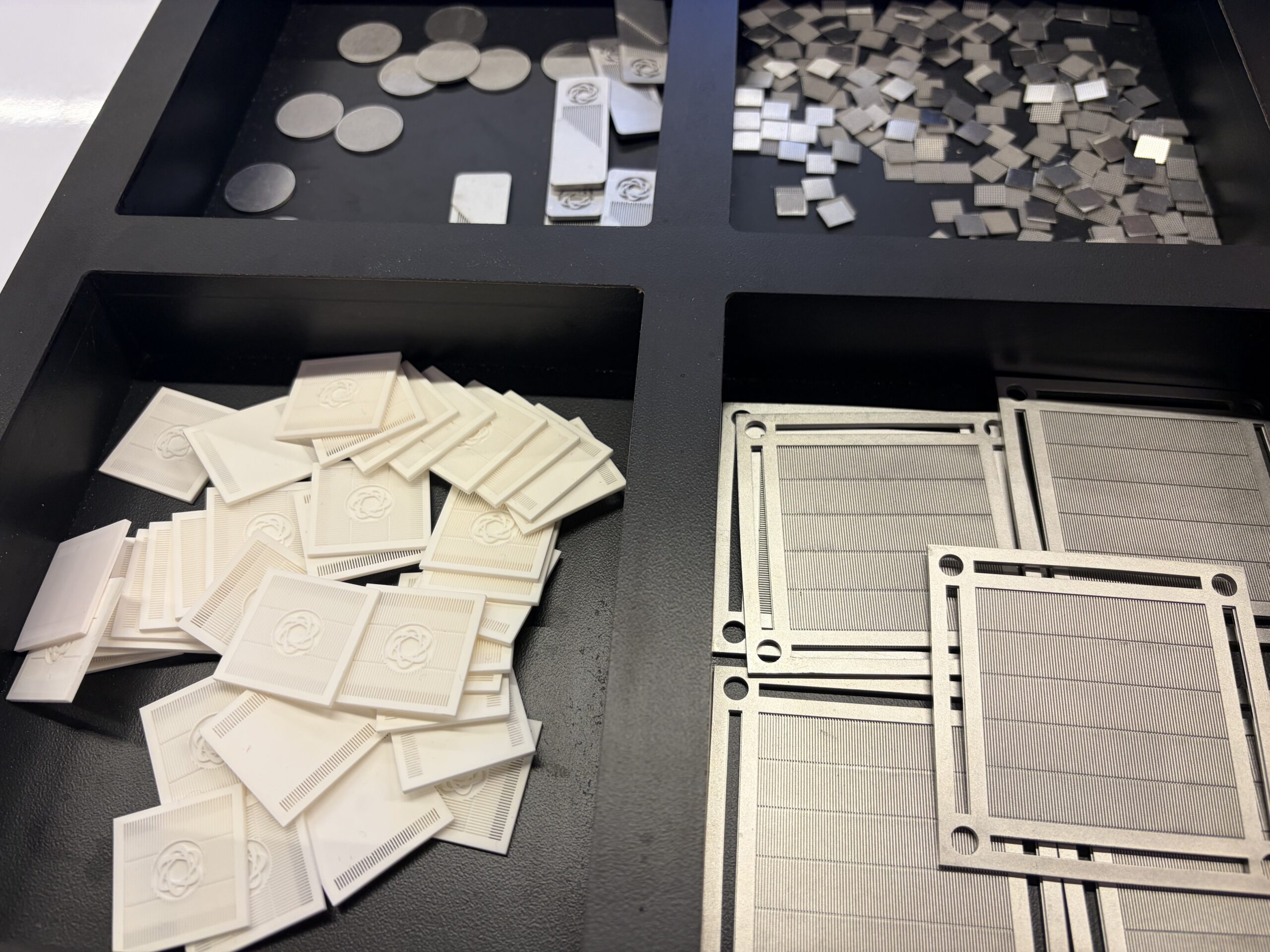
    This proprietary process combines, as Vanesa Listek put it, “traditional manufacturing, additive, and some clever engineering.” Stack forging entails thin sheets of metal that are laser cut into complex stencils, inhibited in specific areas, stacked together, and diffusion-bonded together. This results in a block packed with parts that are fully dense, and can achieve very thin channels.

    “We don’t have to worry about powder evacuation, which makes production a lot easier,” Gruner said.
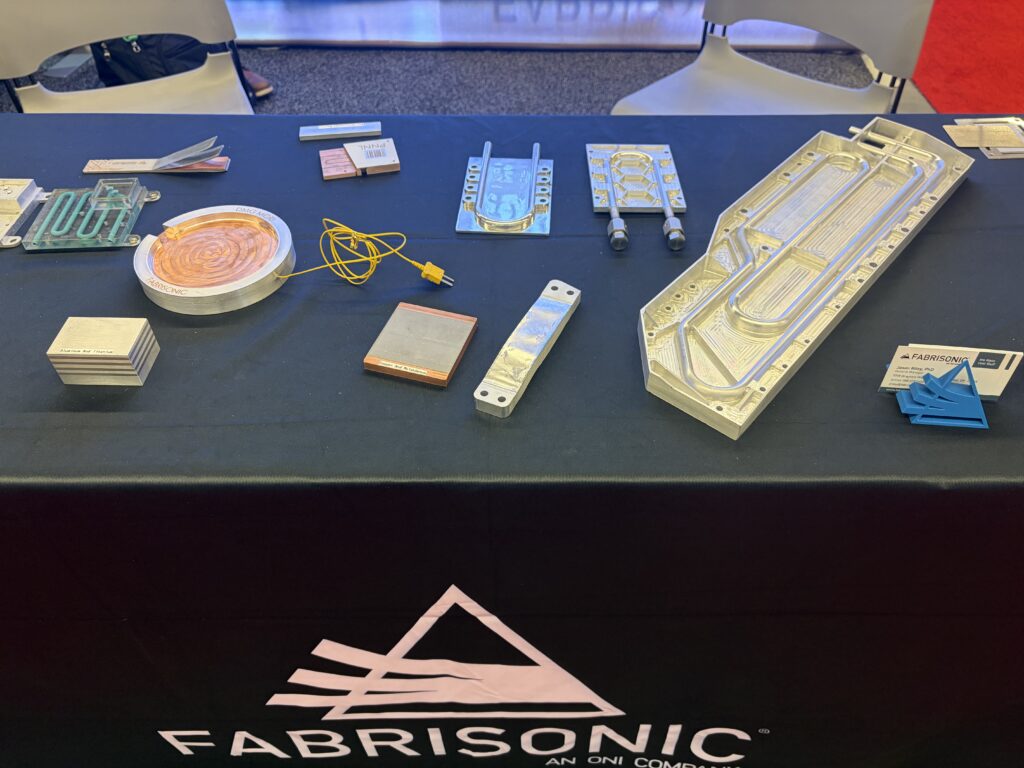
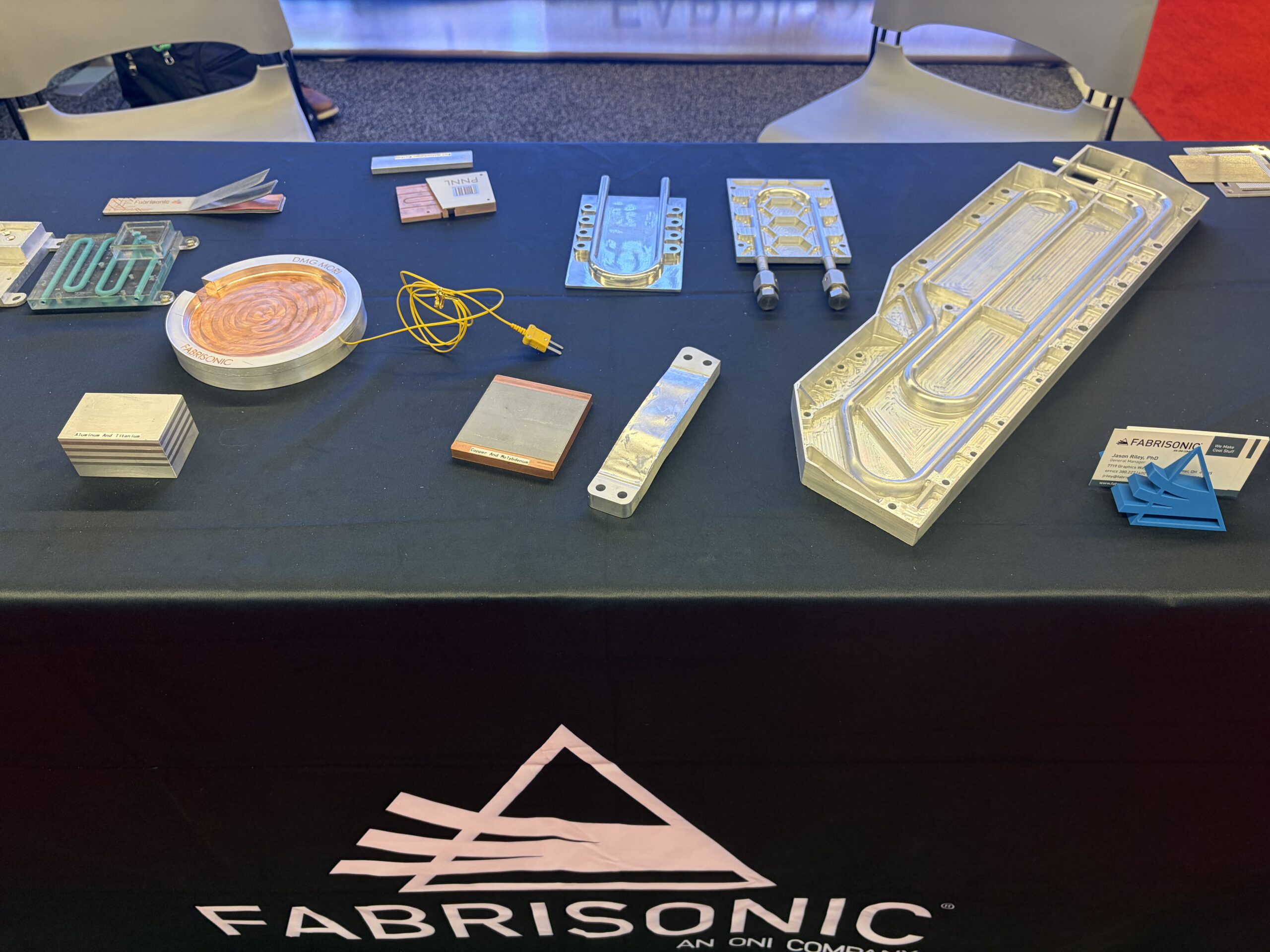
    In 2025, Fabrisonic was purchased by metal services company United Performance Metals, an O’Neal Industries subsidiary. As Maureen Coffey, Inside Sales, told me at Ceramics Expo, this gave the company plenty of needed financial support for “some of the development things we’ve never really been able to do.” One example is contracting with a thermal engineer who helps evaluate things so the company can better collaborate with its customers.

    “For example, how much copper do I need to add to improve thermal performance? What’s the throughput for the fluid?” Coffey said.

    Fabrisonic also acquired a new inspection machine, so they can improve part accuracy and ensure everything meets customer specs.
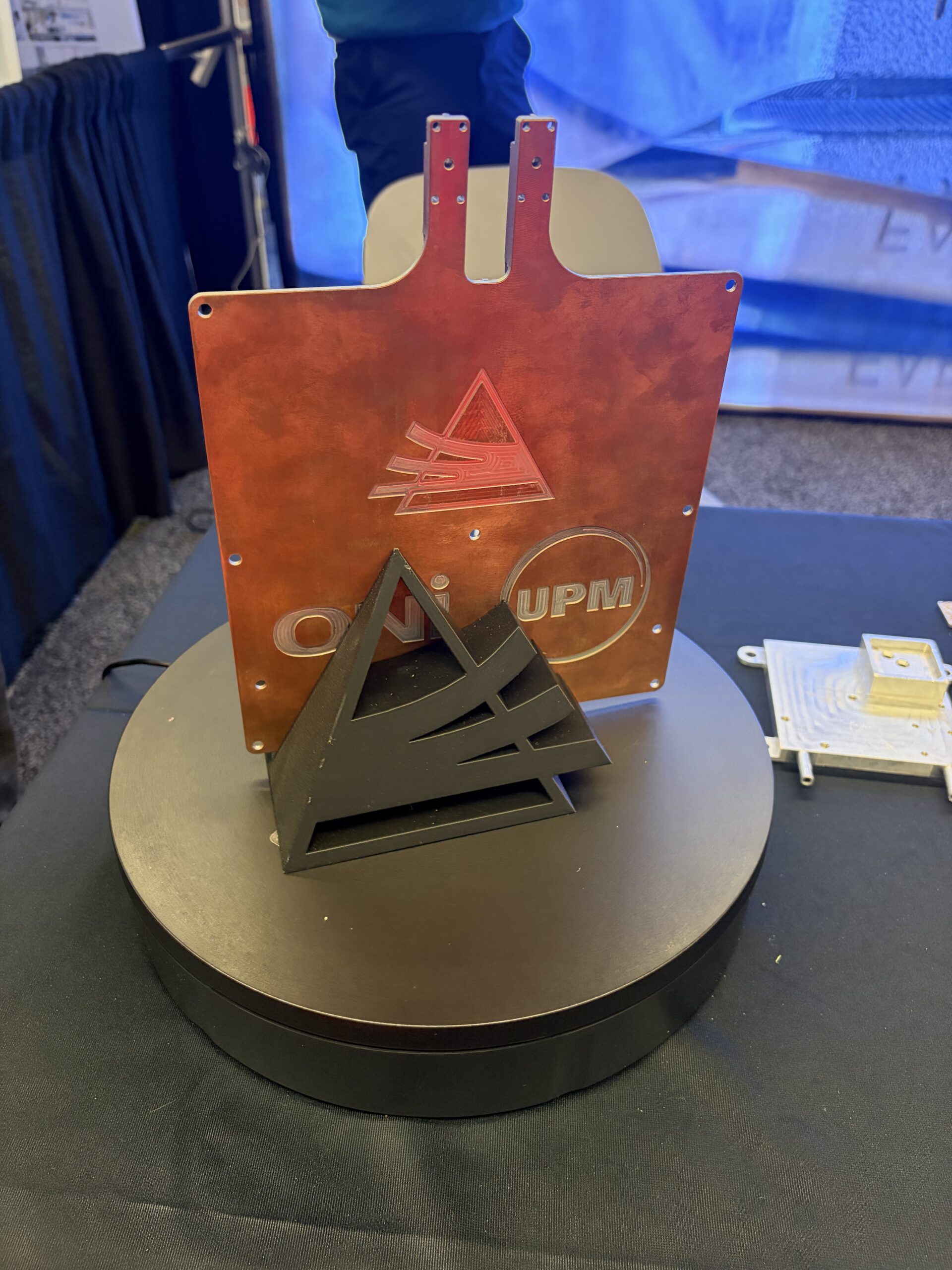
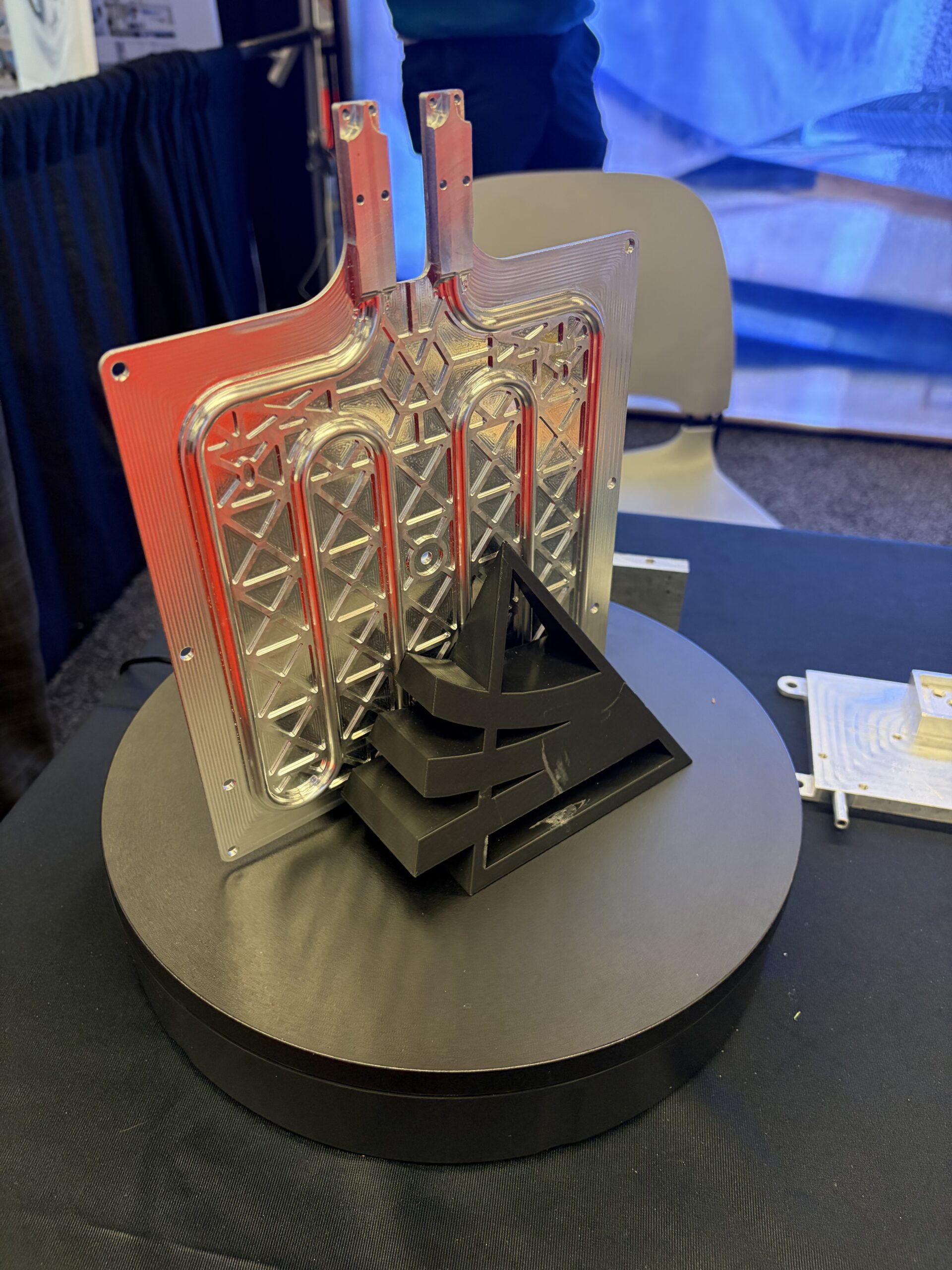
    The Ohio-based company specializes in ultrasonic AM, which uses vibrations to weld layers of dissimilar metal foil together to build up a solid metal part. Because it occurs at lower temperatures, the process avoids extreme thermal conditions and offers distinct material properties.
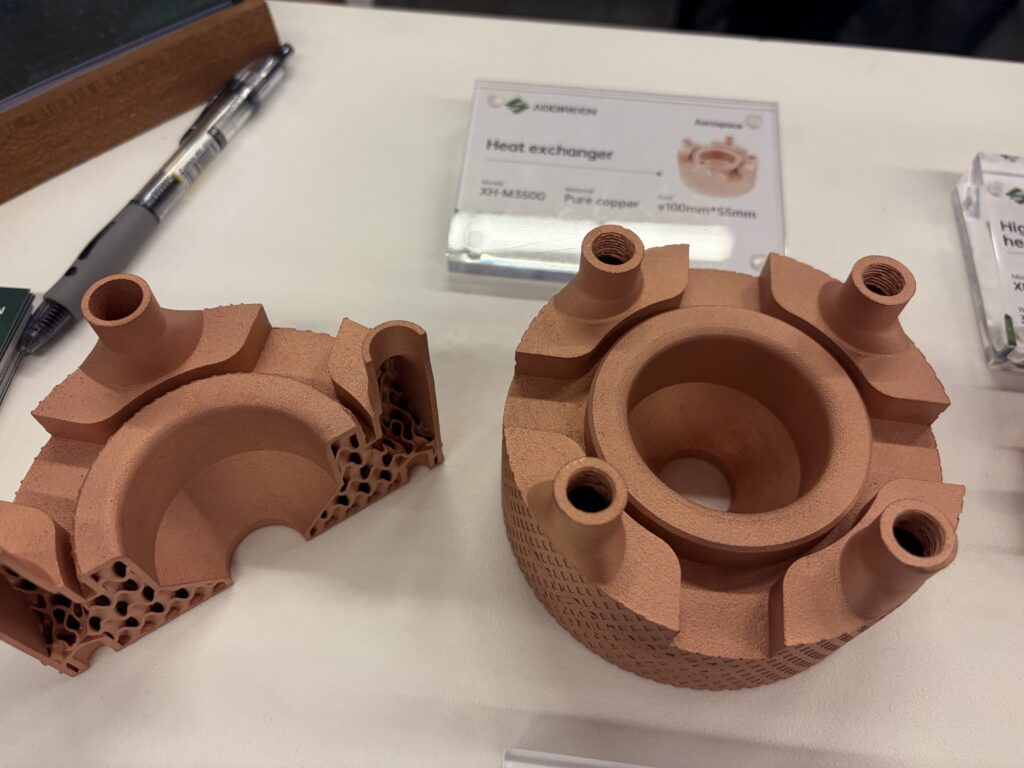
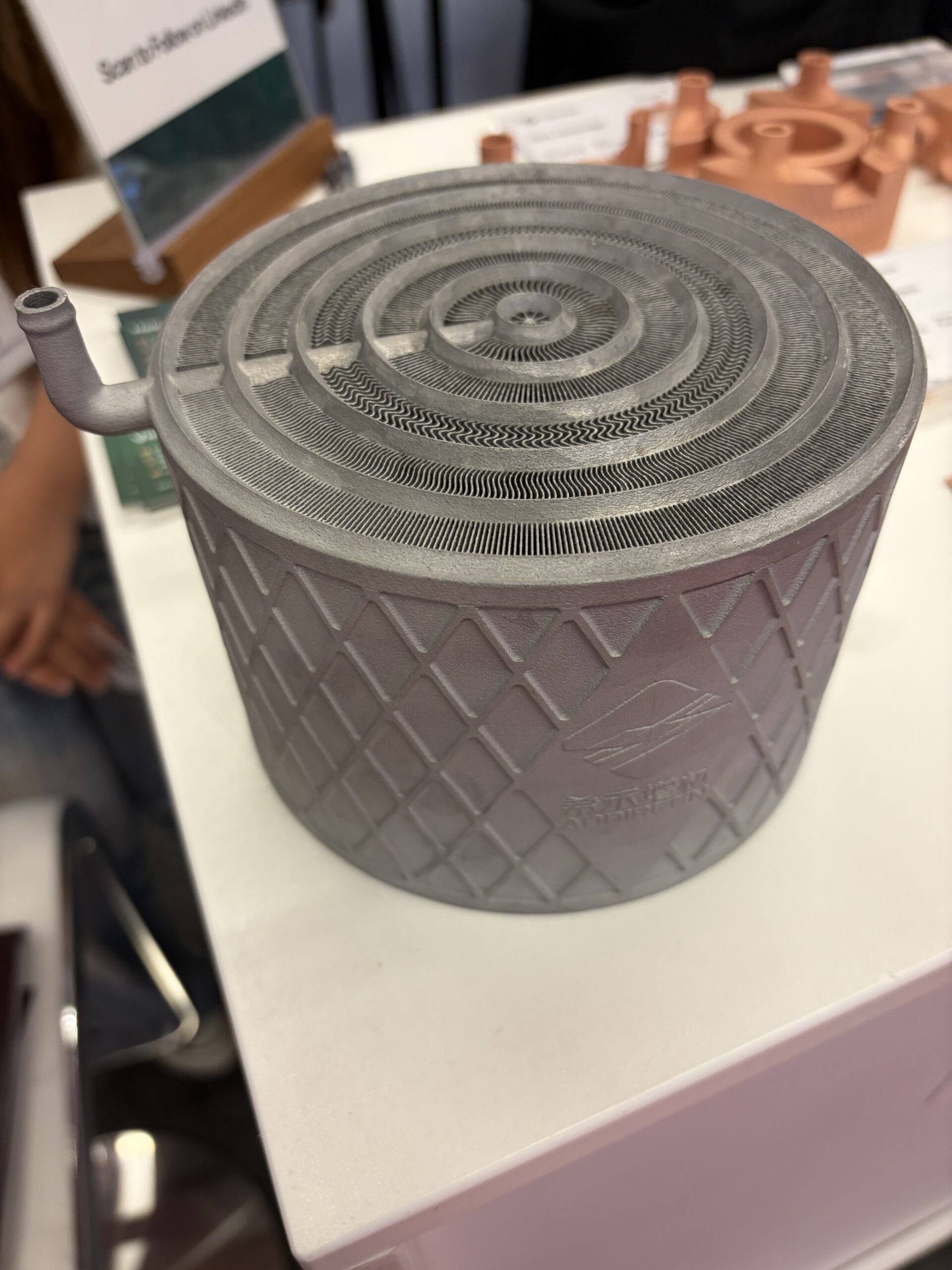
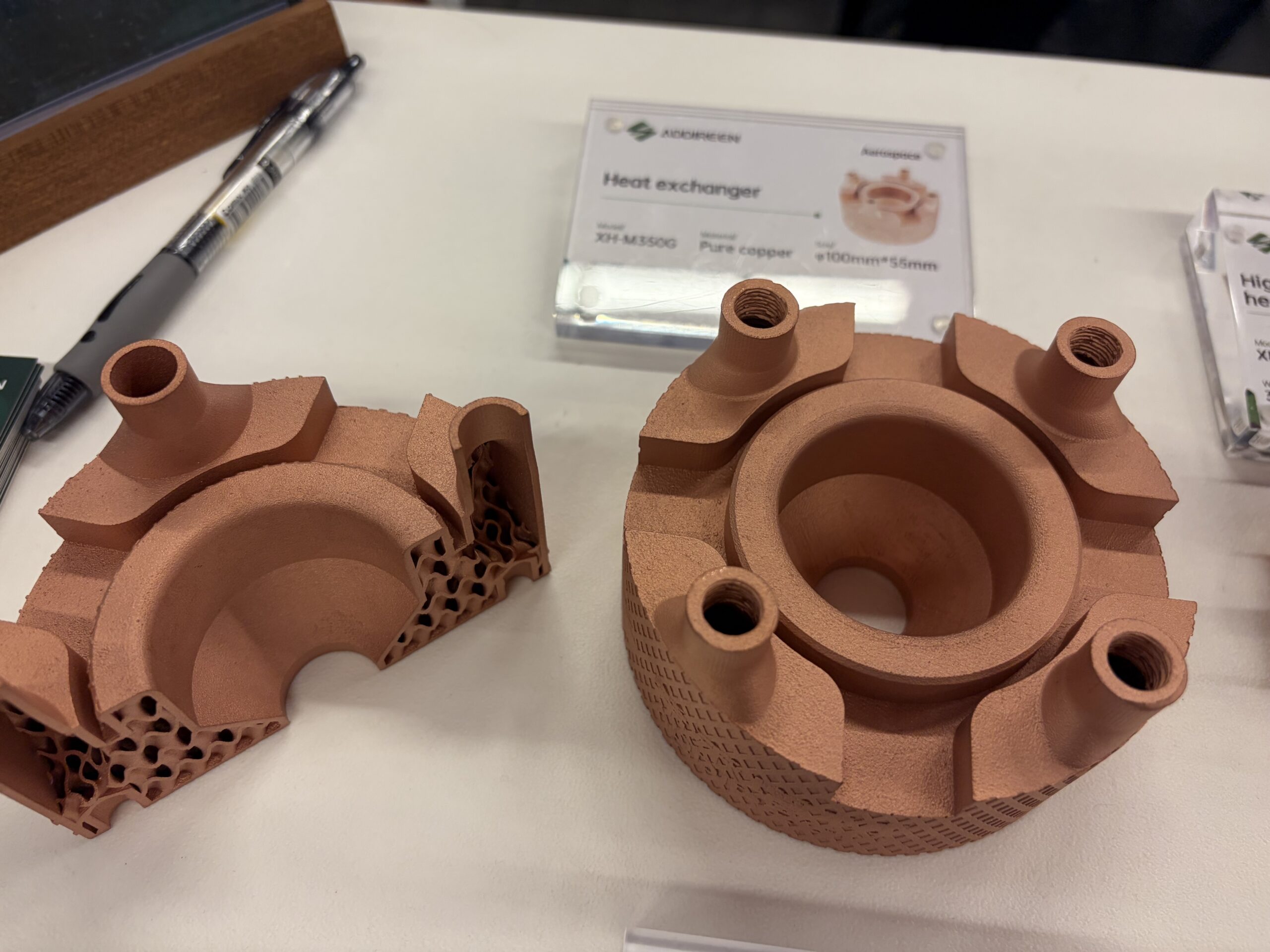
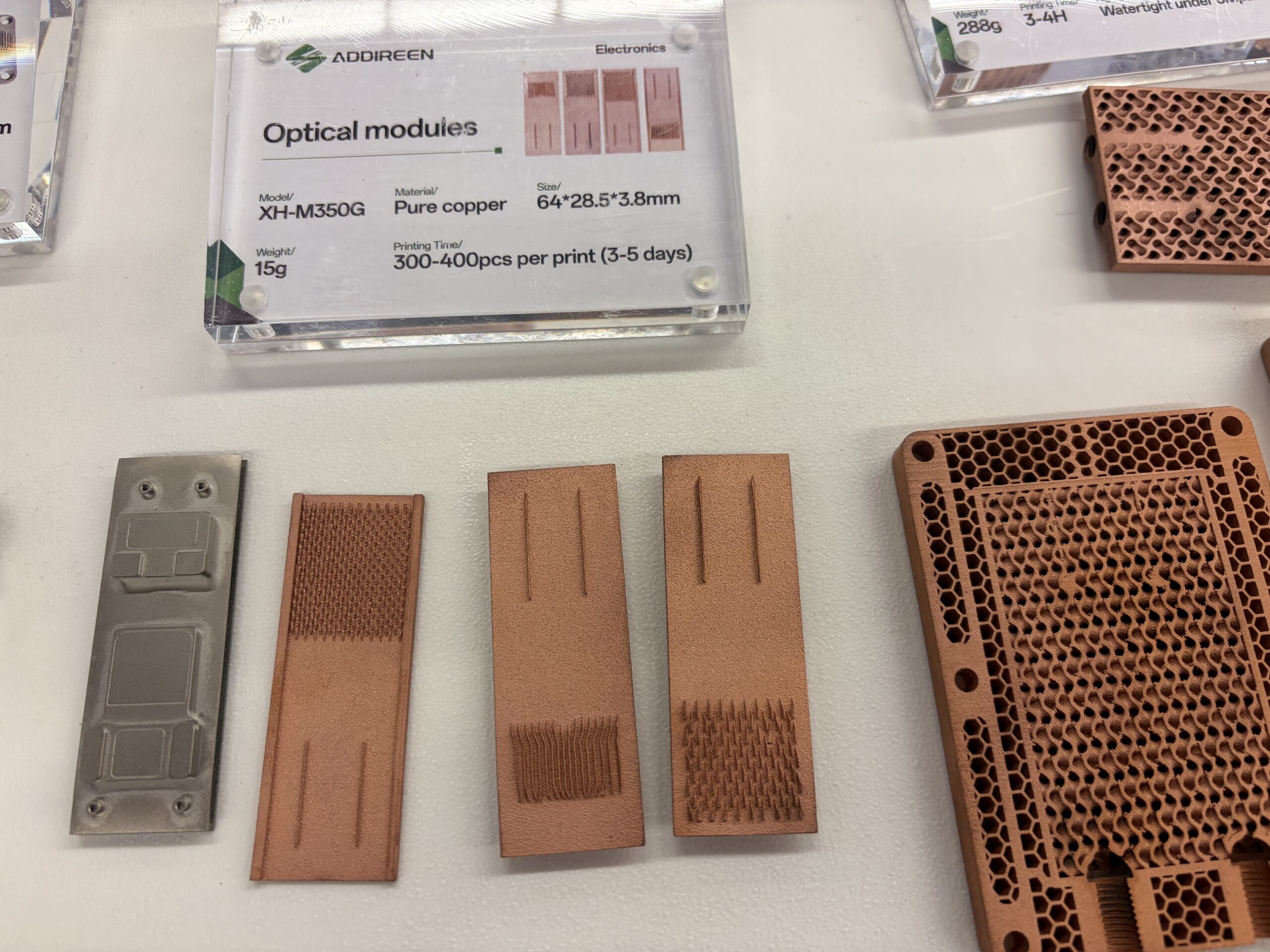
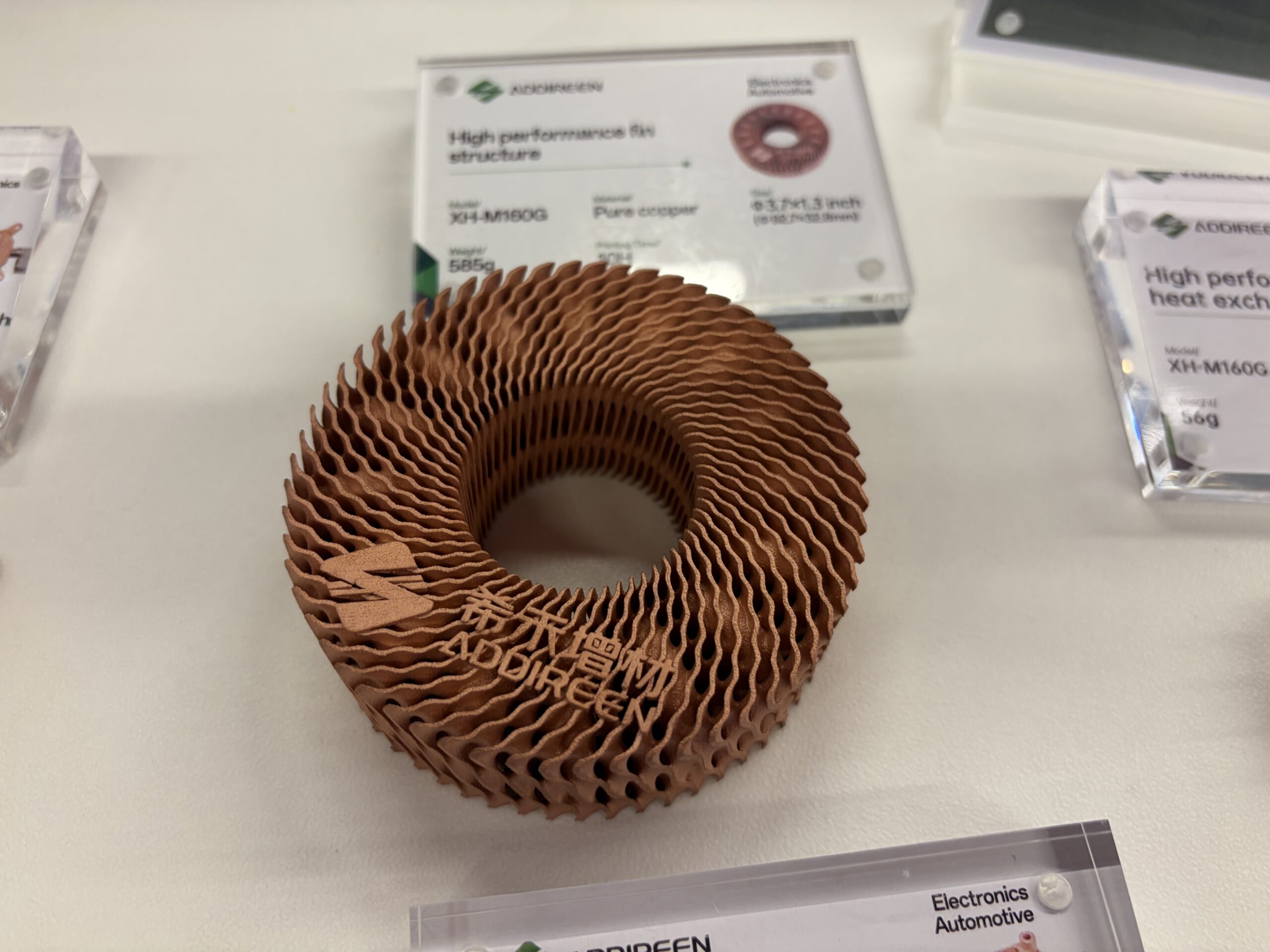
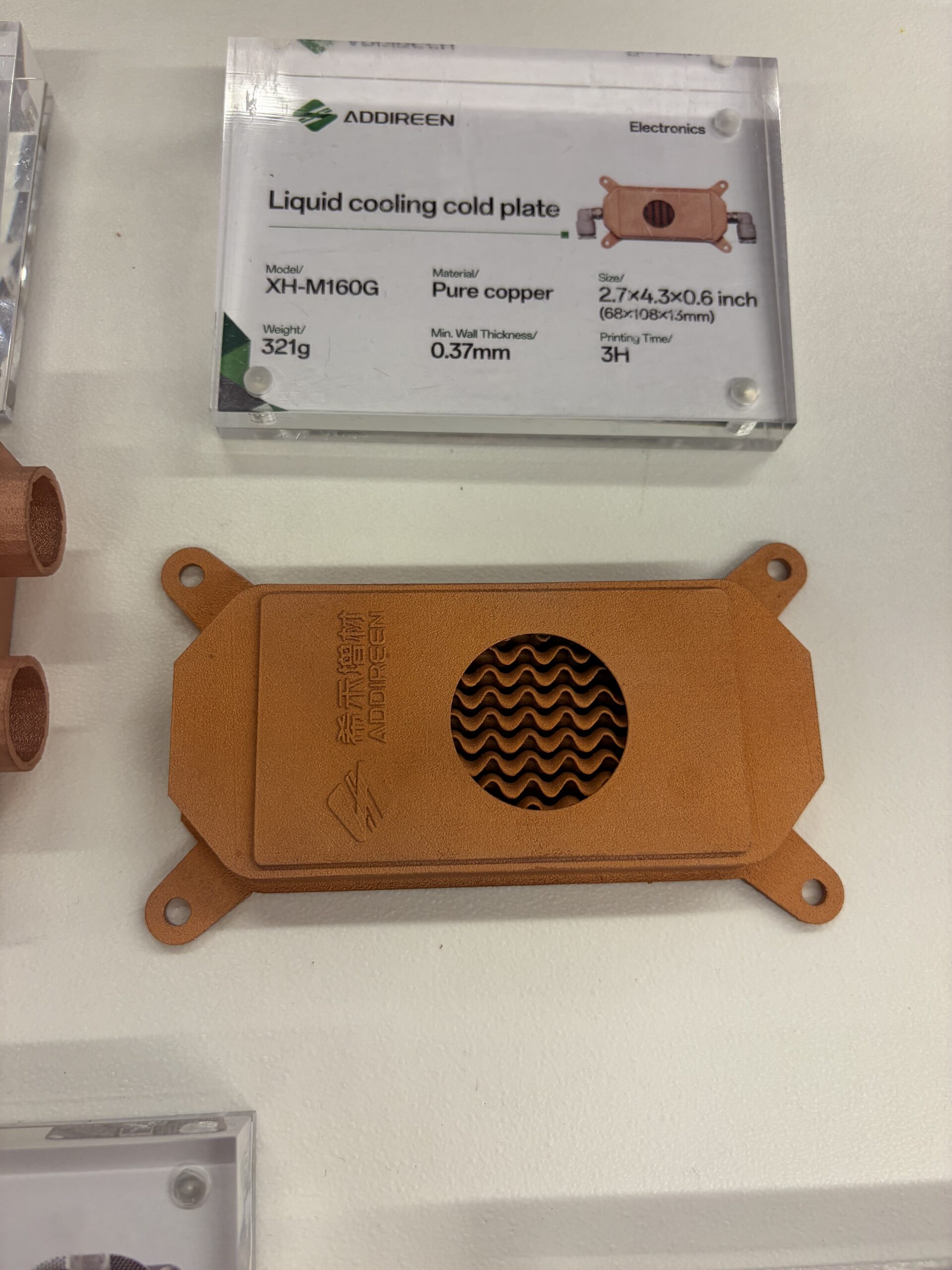
    Chinese startup Shenzhen Addireen Technologies offers green-laser copper 3D printing. They’ve vertically integrated the green-laser PBF stack, developing the laser source, optical system, and 3D printer in-house, along with CNC machining. The startup has an in-house thermal engineering team, and showed off several applications at Ceramics Expo, like optical modules, heat exchangers, and nickel-plated liquid cooling cold plates.
    Exentis Group’s Srdan Vasic, whom I’d seen on a panel earlier, told me that the company uses paste in its additive screen printing process “to build up green bodies which then get sintered.”
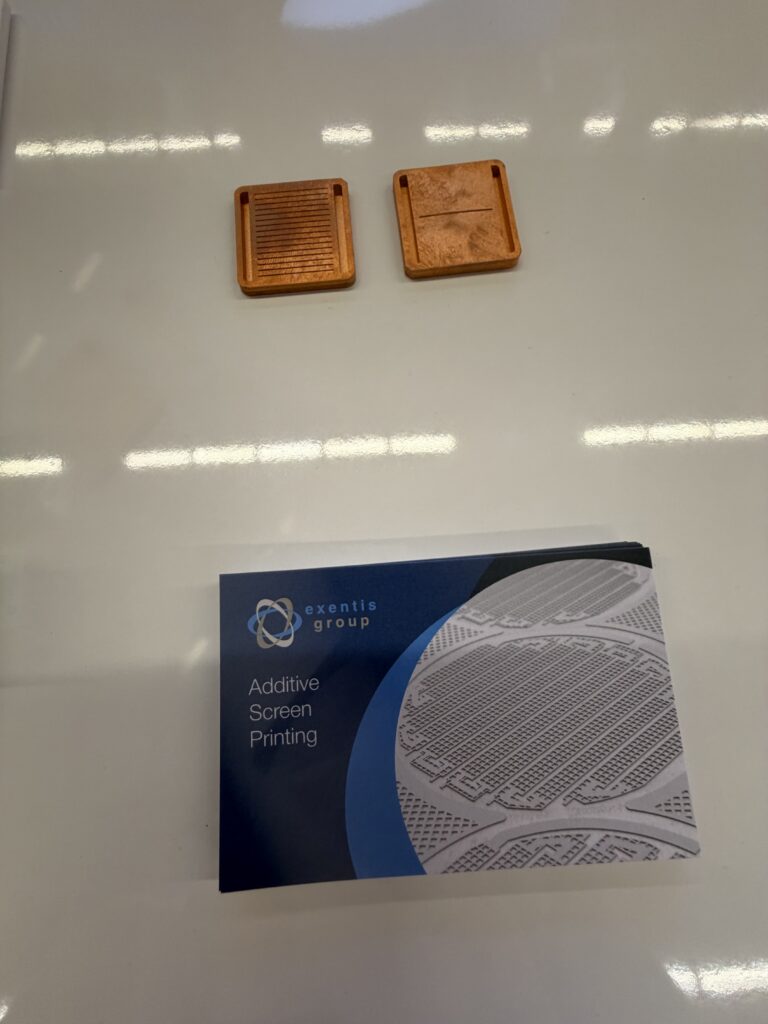
    He also said the company’s parts don’t require supports while printing, or post-processing steps like polishing to get a good surface finish, and that they can achieve wall thickness of 75 microns.
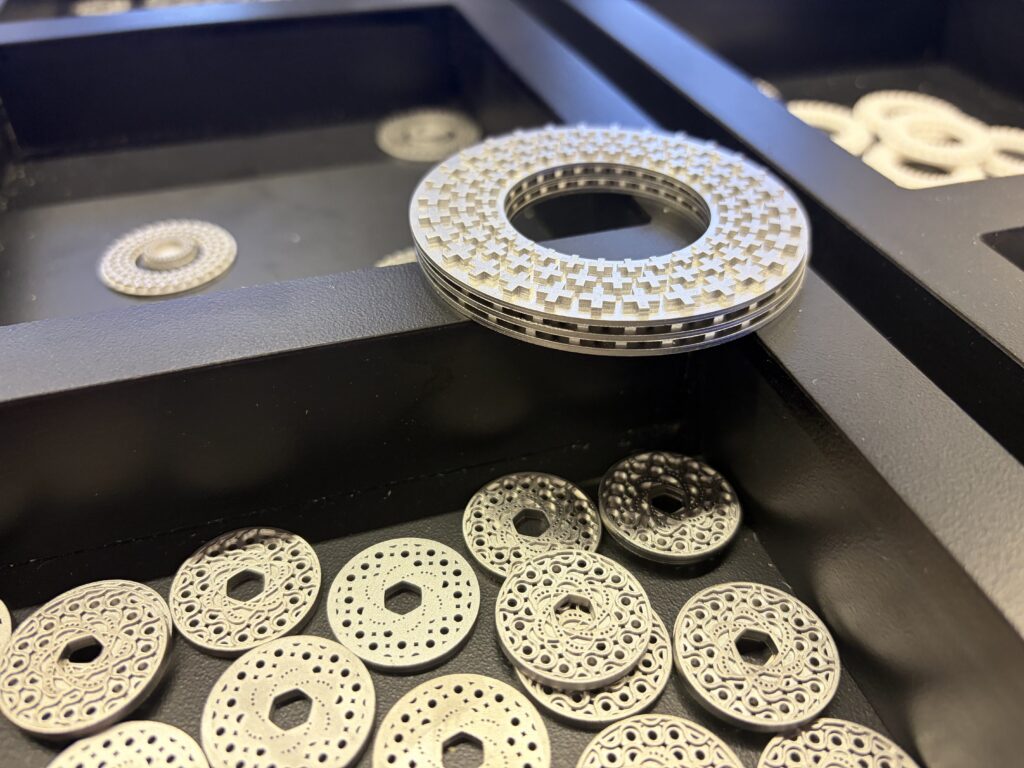
    Some of the major applications for Exentis include filtering technologies, feedthroughs for wires in pacemakers, cooling structures, automotive, fuel cells, and even delicate consumer goods like watch dials and sound transducers for headphones.
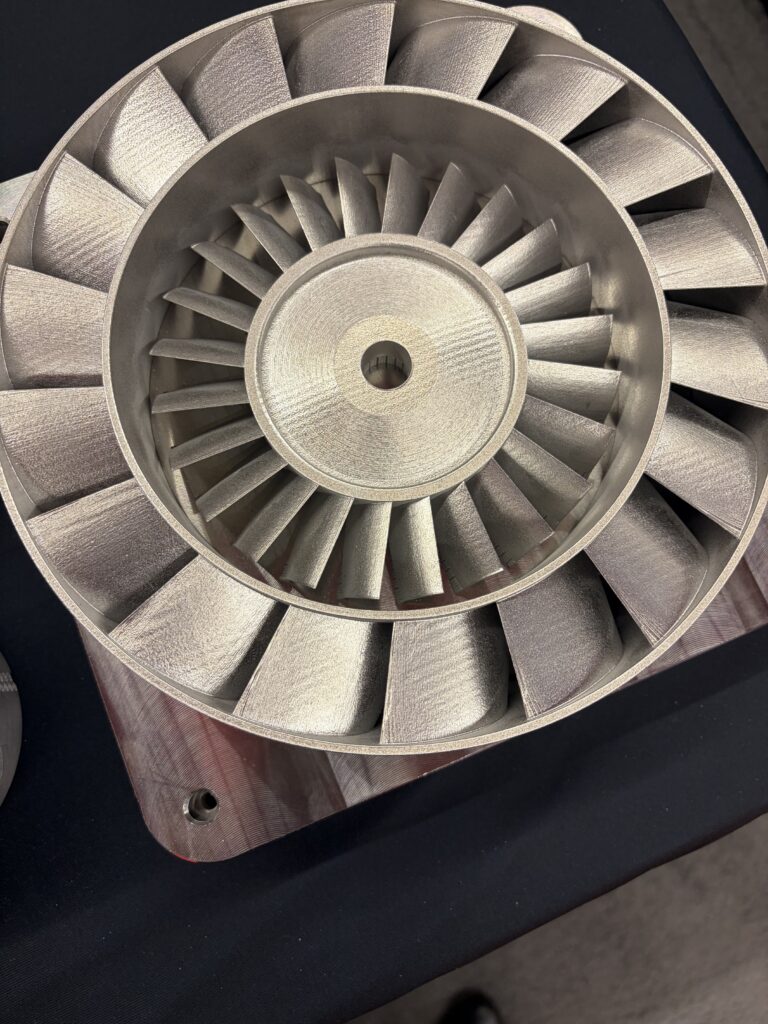
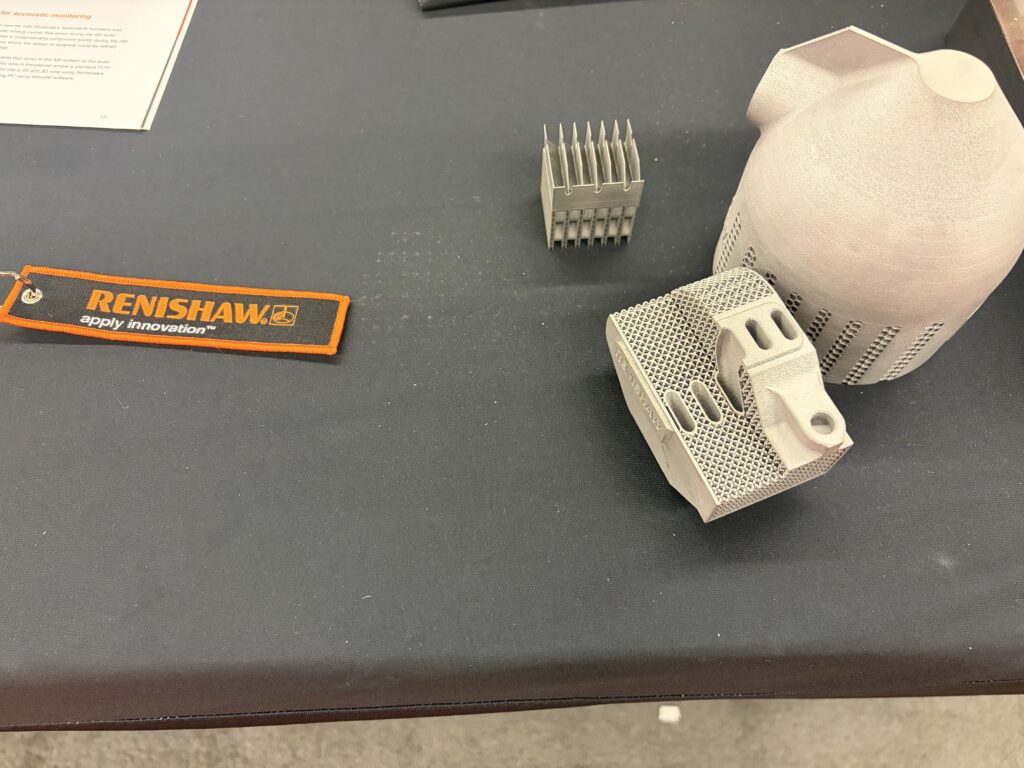
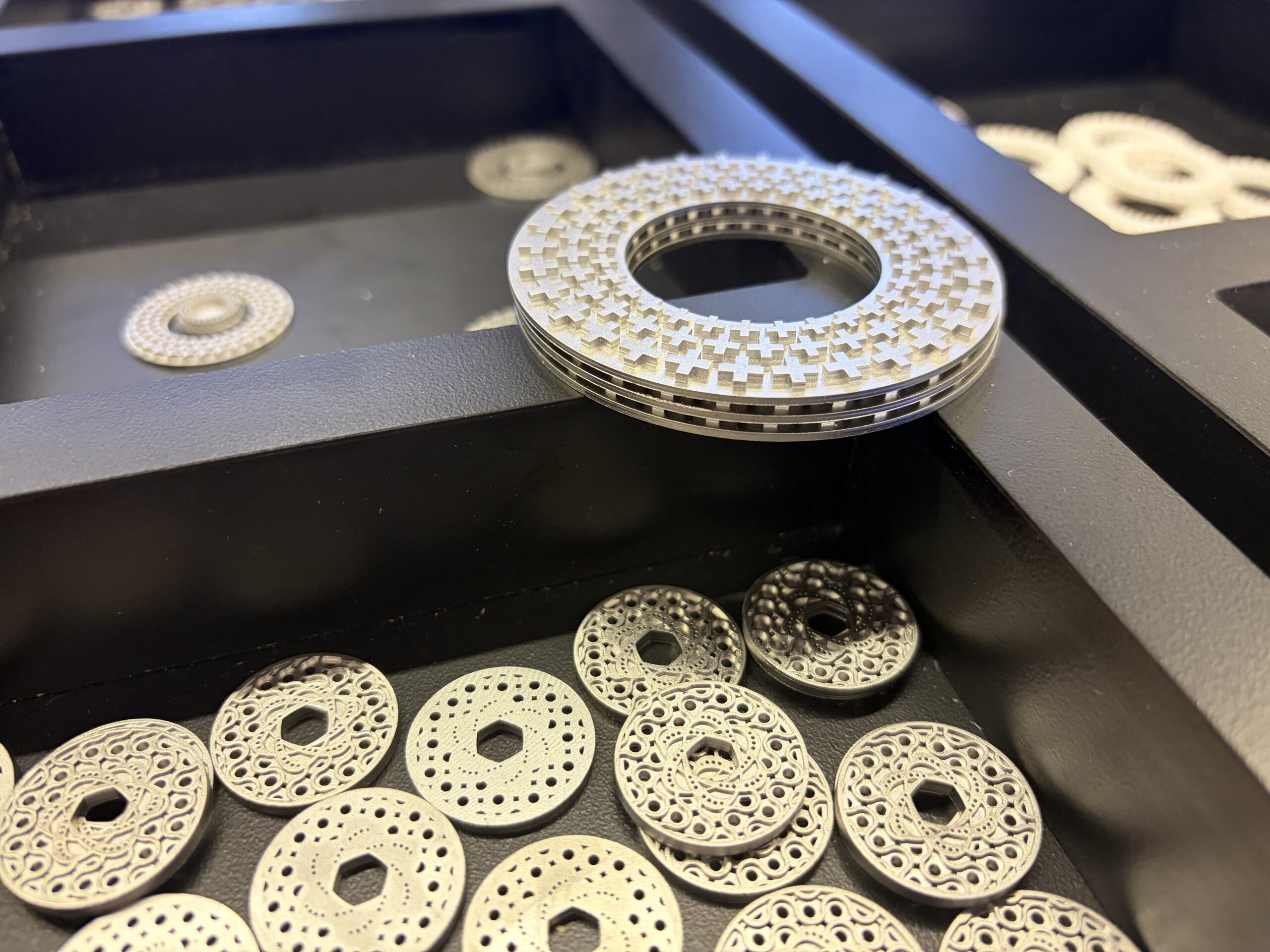
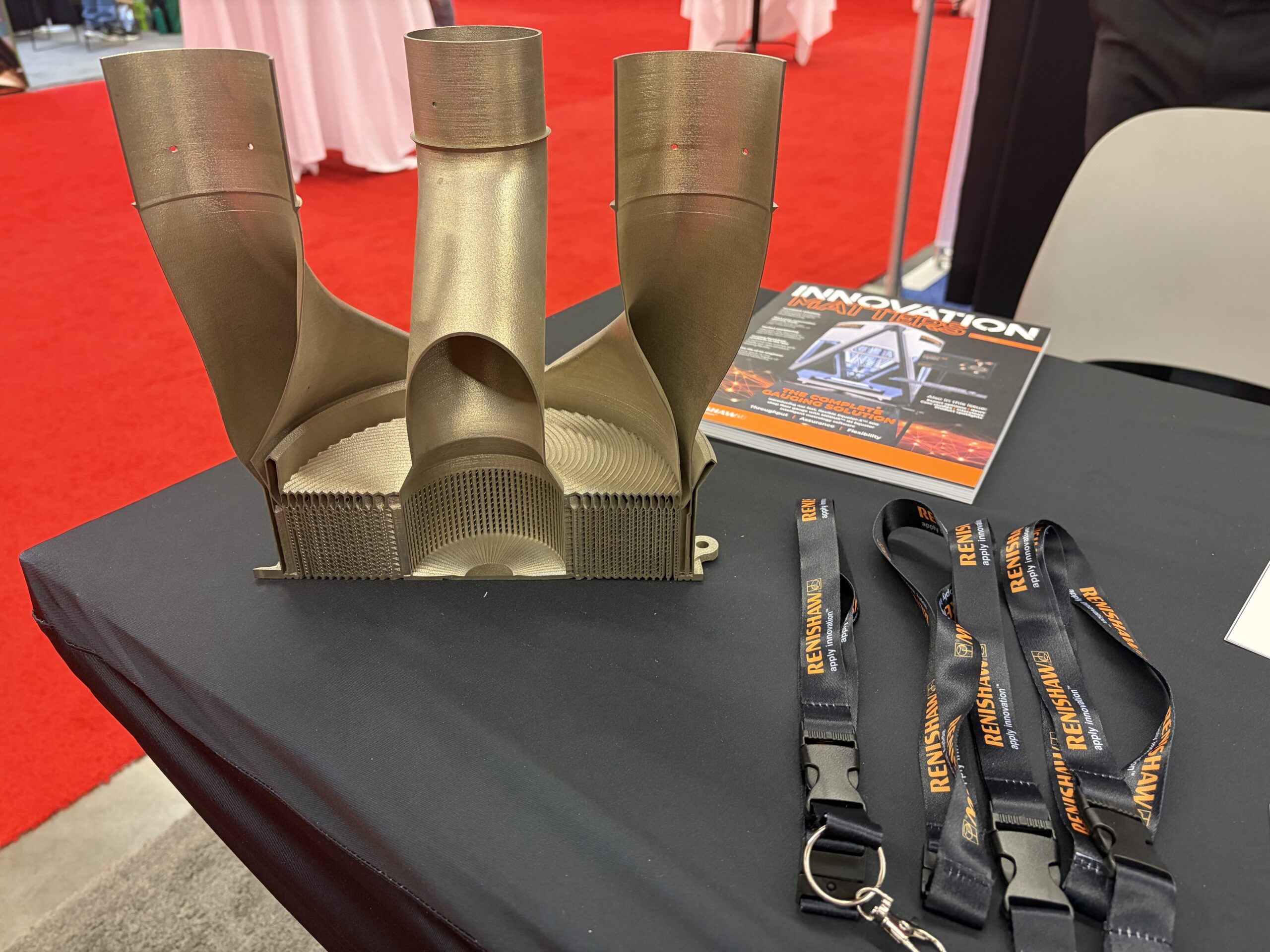
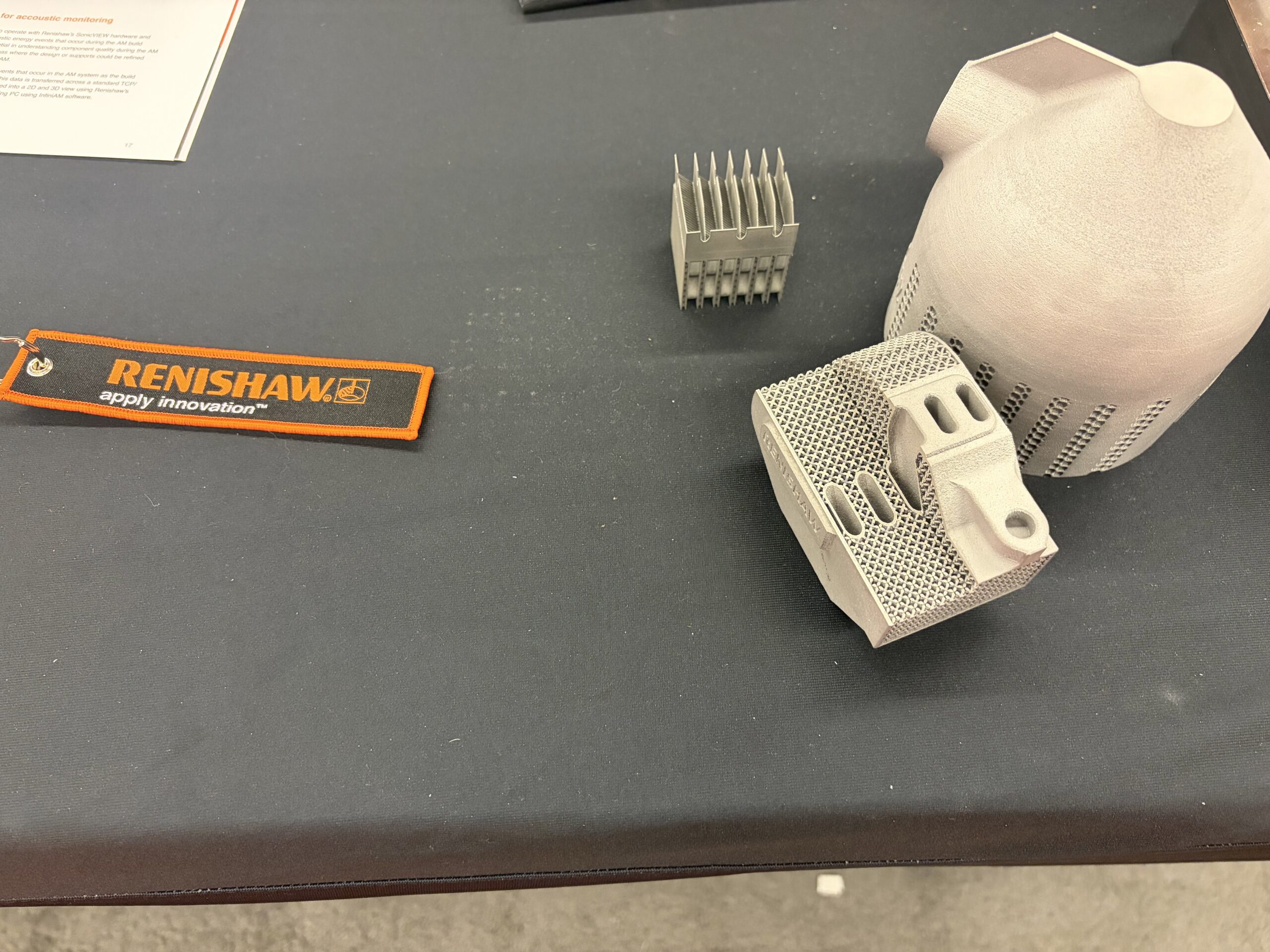
    Renishaw part printed without supports

    At the Renishaw booth on the Thermal Expo side, Keith Brady, National Sales Manager for the company’s Additive Manufacturing Group (AMG), took me quickly through the product line: single, dual, and quad-laser printers, “which is all a matter of throughput.” The company’s TEMPUS technology, built into Renishaw’s AM process, offers 25% improvement in print speeds.

    He explained that the company has “always taken parameters and applied them uniformly per layer,” so they’re able to “execute on parts” like the one in the below image. Additionally, by using TEMPUS to achieve printing without supports, Renishaw customers can be more productive and waste less material.
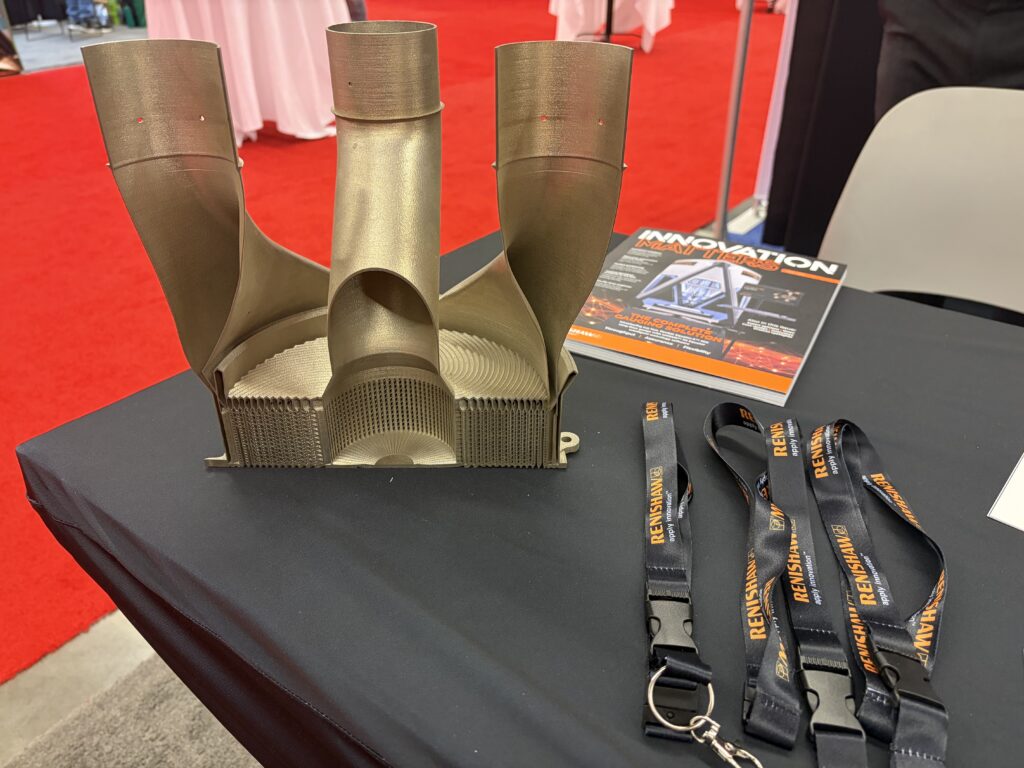
    “We’re bringing this to market as part of the machine’s behavior, not something we’re trying to monetize on the software side for us,” Brady explained. “It’s faster, better, and cheaper.”

    The other nice thing about TEMPUS is that it can be retrofitted onto older machines, so customers who purchased their Renishaw printer before the technology was released won’t miss out.

    Conclusion

    During a panel on emerging materials, someone asked if you could 3D print diamonds with sintering technology. One of the panelists said it might be possible, but that the hard material might destroy the nozzle. Someone else suggested a boron carbide nozzle. I shared this conversation with others, which sparked more debate—would binder jetting perhaps work better than sintering?

    I certainly don’t know the answer, but I do think it’s questions like this that show how important it is to attend more shows that aren’t just AM-specific events, like the echo chambers of RAPID and Formnext. We already know what additive is capable of; we need to tell everyone else.

    Here are some more of my pictures from Ceramics Expo USA:
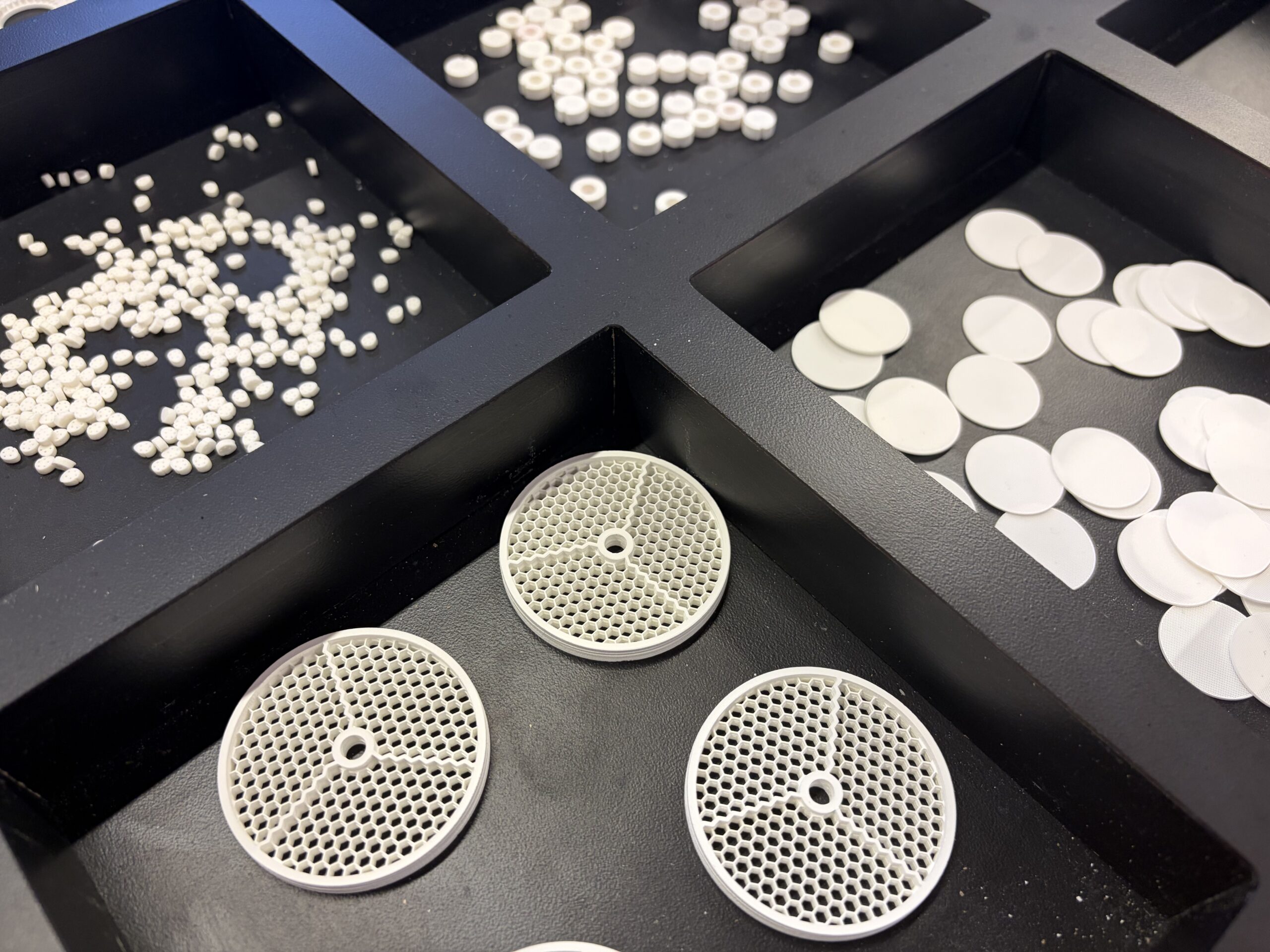
    Lithoz booth
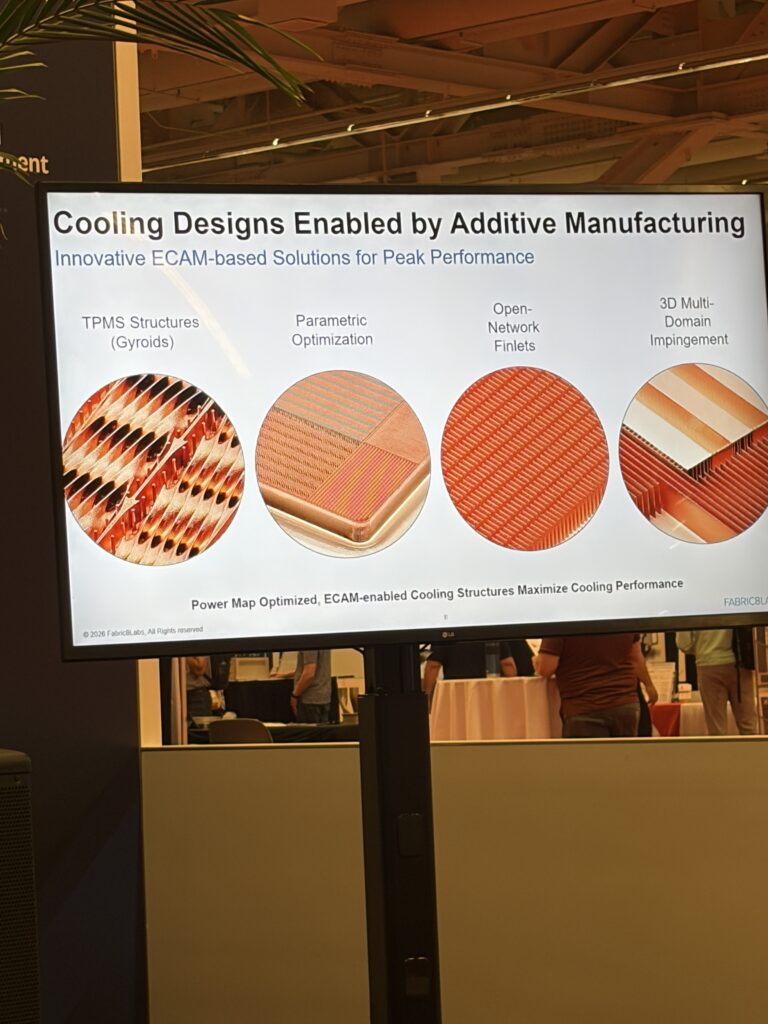
    Fabric8Labs presentation
    Renishaw booth
  • The Additive Chicken Coop, Part IV: Lemmings

    If we look at our past, we can see how making custom machines, incessantly watching ourselves, and our inability to rescope shaped our industry. We have also looked at the banana industry. There, we see that an incredible genetic diversity, variety, and global adaptation of many different banana cultivars have gone to waste. Instead, a global industry with the same practices exists, selling to very few large supermarket customers at volume in a price band, to end customers who expect the same result all the time, no matter the season. The commodity banana is a clone, and all the large banana firms are clones of one another.

    The large fruit companies, such as Dole, Chiquita, and Del Monte, are therefore stuck between a few big customers with one single product. They can consistently produce profits, but are always beholden to the few immense supermarket groups. They have to adopt a clone-based system to maintain their economy and consistency before a consumer expects a single taste of banana everywhere, all the time. They all push advertising, invest in new farms, and negotiate, but they’re in essence stuck. Now, competition in this market is limited as well, so it may be a nice place to get stuck. And this may be a success for some, but it also exposes them to inordinate risk.

    Banana Like

    I’d maintain that we are in effect building a banana-like market for ourselves in industrial 3D printers. We’re seeing a degree of strategic replication in production solutions for New Space and defense that is alarming. The same systems are sold to the same few customers. And all are tied to US government funding for additive and money available for new space. This means that running afoul of a single official or getting caught out by a single budget rule could cripple companies. The same types of systems with the same high cost structures are emerging as well. Shaped by the same types of customers, production solutions are emerging that are customized in methodology and overall design to these customers.

    Polymer & Metal

    In polymer and metal lower-cost systems, from sub-$500,000 to $15,000, we can see an awful lot of replication as well. Everyone is focusing on defense, national markets, or a particular workflow solution. These people may excel at targeting this customer group, but overall, economics will be constrained. Furthermore, your performance will be tied to the additive’s growth in this segment. We’ve seen how risky this has been before. At one point, metal additive was growing quickly in the dental field. Overinvestment and a move towards trendy non-3D printed zirconia crowns crippled the industry and led to its collapse. It turned out that everyone was making the same parts for the same few customers, and this was a house of cards. This may happen again.

    There is also a lot of regulatory risk. With a lot of focus on 3D printing in medicine, much of the imagined profitability of our industry would come from a small set of rules made by a small group of people governing the use of 3D printers in hospitals and the printing of implants. At the same time, a major public issue with a 3D printed medical implant would shatter many people’s futures. With the Australian track bike breaking publicly, we almost had a moment where a whole industry wouldn’t ever trust us again. Such a scenario could happen again, but much more disastrously.

    On vat polymerization, by and large, everyone is either making super low-cost systems or small, productive dental/industrial ones. There’s very little in resin development that most people undertake. Formlabs’ focus on resin and software has made them, in effect, unsassailable (so far). Other big players have abandoned their total control approach in favor of a “we’re open kind of” approach, which means it won’t be the perfect solution for you, but at least it will be more expensive. On desktop Material Extrusion, everyone is still trying to be Bambu Lab. Bambu-like machines are emerging from all serious competitors, and by and large, the strategy is about the same. This will ensure that we have one or two winners on the desktop. At the same time, no one is focusing on cheaper machines, more rugged ones, or ones that work very differently.

    All Markets

    Across all markets, we can see companies specializing in niches. But an awful lot of effort has gone into the under-the-weather/under-the-water automotive industry in the West, medical, or defense. So even firms that appear diversified tend to face the same risks as larger firms. Paradoxically, large firms with diversified machine offerings, large firms with end-to-end manufacturing solutions, small niche firms, and firms that make custom machines are all selling to the same limited customer base.

    There are only a limited number of approaches to the market, and the focus is on workflow for only a small set of people. There are only a handful of companies specializing in marine 3D printing. One or two firms specialize in energy markets. There’s no remote infrastructure solution for 3D printing polymers, metals, or concrete (save the Fieldmade solution). There are 3D printing boat companies, but no 3D printing boat interior companies. There’s no website where I can submit a requirement and have them print a large-format metal or polymer part. No one offers a complete plastic-to-filament recycling solution. There’s still no CAD for kids, save for TinkerCAD.

    Same Same but Same

    It seems that we’re all trying to target the same customers, in the same way, with similar products. What can you do to be different? What multi-billion dollar market has no one touched? Would you like to be the 3D Printing service or consultancy specialized in nuclear energy? Yes, yes, you completely would, and I’ll wager that it’s a much better business than the one you’re in. Maybe you can become a specialized consultancy for polymer marine parts? Or for underwater vehicles? Or you could just be a leader in subsea generally? Or maybe you can specialize in repairing metal energy infrastructure? Or you could specialize in 3D printing concrete in the ocean. There is just so much out there that is far more solid, profitable, and long-lasting than the fleeting opportunities everyone is chasing in tandem.

    Strategically, it is my fear that we are seeing a lemming-like 3D printing market developing, where strategic replication and an incessant focus on ourselves are making us brittle and locking us into a world where only a few companies are set to dominate. This is unnecessary and wasteful. Many players would be much better off targeting new multi-billion-dollar markets that tolerate margin, where trust matters, with an established need, where they would have no competitors. Summing it up like that makes a lot of what is happening sound silly, leaning towards the suicidal.

  • i3D Manufacturing Expands Metal 3D Printing Capacity with Burloak Technologies Acquisition

    The Canadian economy may be one of the most difficult to forecast right now. This is largely the result of the fact that the nation is attempting to thread a needle between sharing a border with a country led by Donald Trump, while simultaneously cultivating a trade relationship with China in hopes of carving out a place in the global economy that is truly its own.

    One would imagine that with such a rare combination of natural resource wealth and technological sophistication, Canada will be just fine, if you can ignore all the noise; but, there is indeed a great deal of noise. Nonetheless, no matter the specifics for Canada’s economic fate, considering the nation’s mix of a sparsely distributed population, world class education system, and heavy exposure to strategically critical sectors, it seems like a safe bet that advanced manufacturing will play an increasingly prominent role in the Canadian future. i3D Manufacturing, a metal additive manufacturing (AM) specialist based in Oregon, is making that bet, having just acquired Burloak Technologies of Ontario.

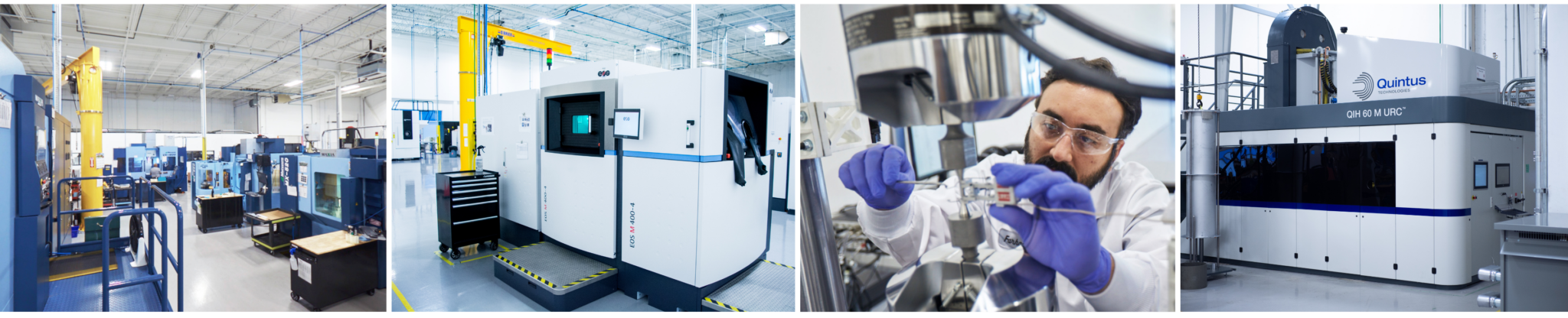
    Burloak Technologies has extensive metal AM capabilities as well, although the company also works with polymer AM, along with a variety of other manufacturing technologies including CNC machining and Hot Isostatic Pressing (HIP). A parallel between i3D and Burloak that makes the acquisition a particularly good fit is their shared familiarity with EOS systems: Burloak operates both polymer and metal EOS machines, while i3D runs a fleet of 30 EOS metal printers, including a single purchase of a dozen in 2024, which President of EOS North America Glynn Fletcher referred to at the time as “one of the single largest metal AM investments ever in North America.”

    Previously, Burloak was a subsidiary of Samuel, Son & Co., a leading Canadian supplier of metal components, while i3D is itself a part of Illinois-based advanced manufacturing network BTX Precision. Private equity firm NewCap Partners, where Danny Piper, host of the Printing Money podcast, is a managing partner, represented Samuel in the deal.

    In a press release about i3D Manufacturing’s acquisition of Burloak Technologies, Erin Mastroni, the President of i3D Manufacturing, said,“Burloak has built a world-class reputation in metal additive manufacturing and materials science. Bringing Burloak into i3D expands our technical depth and gives us additional resources to better support customers developing next-generation, high-performance components.”

    Jason Ball, VP and General Manager of Burloak, said,“Burloak’s team, technology, and expertise make this a natural fit. We will continue operating as the organization our customers trust today, now with greater support and investment to accelerate growth and innovation.”

    In the present global business environment, an interesting angle regarding i3D is that it’s a supplier of Ursa Major, the high-growth defense/space startup that’s closely linked to EOS. Joris Peels noted in his 2024 post on i3D’s acquisition of 12 EOS printers that “…[Ursa Major’s] success alone could have prompted this purchase.”

    With the US military now in need of an accelerated ramp-up of missile production from its suppliers, it’s conceivable that the same thing could be said about i3D’s acquisition of Burloak. It’s also worth noting here that Canada is well ahead of schedule on achieving its goal of raising defense spending to meet the 2% of GDP threshold targeted by NATO members.

    In any case, defense is far from the only Canadian sector in need of additional domestic manufacturing capacity, and almost certainly isn’t even the one with the greatest such need. For instance, despite the fact that Canadian oil producers have said they’re not going to jump right into new capex spending even in light of the windfall profits from the Iran-induced price premium, the industry’s long-term growth depends on new capex spending.

    Above all, Canada needs new pipeline infrastructure to support increased fossil fuel exports. Conventional manufacturing will be required for the bulk of that work, but there are also countless small components like valves, gaskets, etc. AM could be an indispensable tool for addressing supply gaps for those sorts of parts.

    Along those lines, if the oil & gas industry in Canada can credibly position itself as a stimulus for building up low-carbon manufacturing capacity, that could serve as an olive branch between the Canadian federal government and the Alberta-based drillers with whom Ottawa has such a contentious relationship.

    Images courtesy of i3D & Burloak Technologies

  • China Becomes Latest Space Power to Demonstrate Metal 3D Printing in Orbit

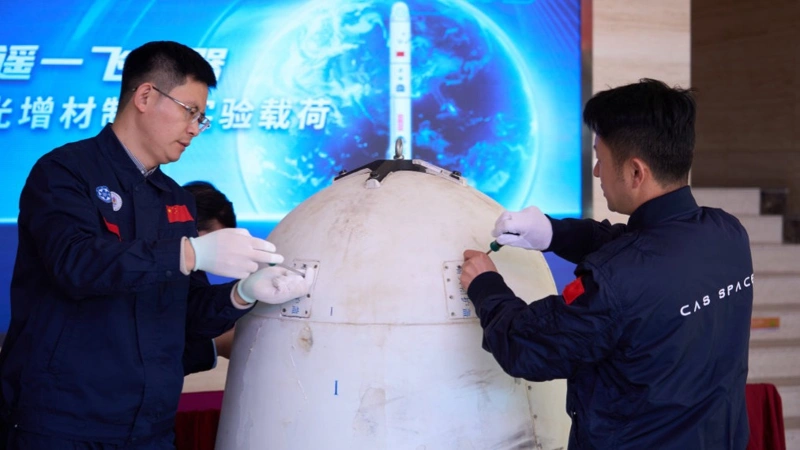
    China has demonstrated metal 3D printing in space as part of its plan to develop manufacturing technologies for future space missions, including Moon construction. The experiment took place aboard the Qingzhou cargo spacecraft and was developed by researchers from the Chinese Academy of Sciences and its Institute of Mechanics.

    Chinese scientists have completed the country’s first space-based laser wire-fed metal AM experiment under microgravity conditions, conducting the work during a suborbital flight and achieving a breakthrough. Image courtesy of CAS Space.

    Aboard the uncrewed Qingzhou spacecraft, the team used a laser-based system that melts metal wire and deposits it layer by layer in microgravity. Researchers said the equipment operated autonomously, using commands sent from Earth, and was able to start and stop remotely multiple times during the test.

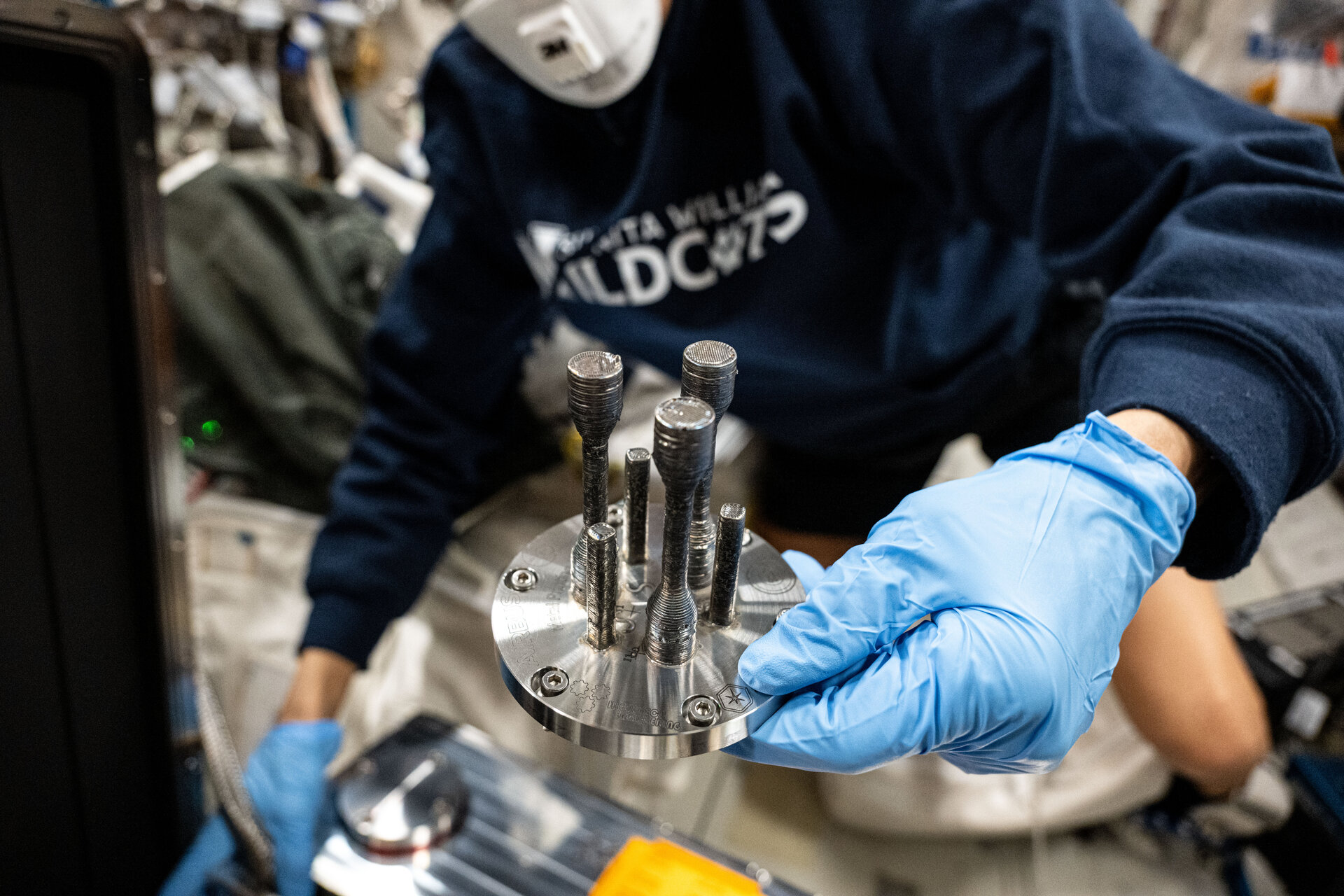
    First metal part 3D printed in space. Image courtesy of ESA/Jeanette Epps.

    This is not the first time metal 3D printing has been demonstrated in space. In 2024, the European Space Agency (ESA) installed the first metal 3D printer aboard the International Space Station (ISS), successfully producing the first metal part ever made in space. But China’s latest experiment shows that the country is now developing its own in-space manufacturing capabilities as interest grows in producing tools, spare parts, and structures directly in orbit and, eventually, on the Moon.

    Metal printing in space is far more difficult than plastic printing because molten metal behaves differently in microgravity. On Earth, gravity helps control how molten metal flows and settles during printing. In space, there is almost no gravity, so the liquid metal can float, form unstable droplets, or cool unevenly. That makes it much harder to control the shape and quality of the printed part.

    Chinese researchers said they had to solve several problems before the system could work well in orbit. One was controlling how molten metal droplets move in microgravity. Another was keeping the melt pool stable enough to print evenly layer by layer.

    The system also had to survive launch vibrations, operate safely inside a spacecraft, and work autonomously, following commands sent from Earth. Since astronauts were not onboard, the printer needed to manage the process largely on its own once activated.

    The development is important for China because future space missions may not be able to carry every single tool or spare part from Earth. Instead, astronauts could eventually make parts in space as they need them, including tools, replacement components, and maybe even parts of future habitats during long missions.

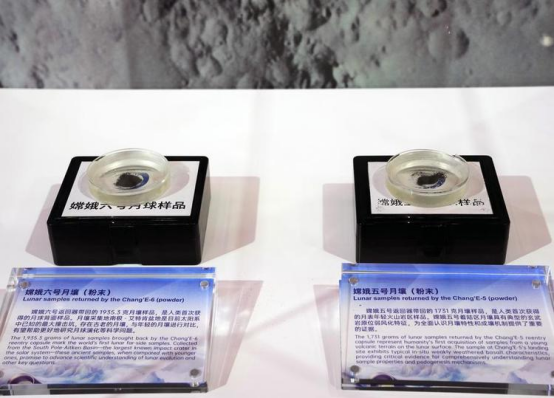
    Chinese scientists have made a breakthrough in lunar science by analyzing samples returned by the Chang’e-6 mission, providing a crucial scientific basis for lunar research, according to the China National Space Administration. Image courtesy of China National Space Administration.

    China has been expanding its work in space-based 3D printing over the last few years as part of its lunar ambitions. Through its Chang’e program, the country has already landed robotic missions on the Moon and returned lunar samples to Earth. Plans include building a long-term lunar research base and eventually sending astronauts to the Moon around 2030.

    One of the best examples is the planned Chang’e 8 mission, expected later this decade, which aims to test technologies for building structures on the Moon using lunar soil. Chinese researchers and universities have also been experimenting with lunar regolith printing systems, robotic construction concepts, and brick-making technologies designed for harsh lunar environments. Some concepts involve autonomous robots assembling printed blocks into dome-shaped habitats for future lunar missions that could eventually help with long-term human presence on the Moon.

    The work is part of China’s push to expand its space program, including the Tiangong space station and future lunar bases. Under the country’s Tiangong Kaiwu roadmap — unveiled in 2023 by China Aerospace Science and Technology Corporation (CASC) — manufacturing and resource extraction are expected to play a major role in future space operations. In fact, researchers have described this latest suborbital metal 3D printing test as a key step away from laboratory work toward real manufacturing experiments in space.

  • AMPulse Asia: APAC 3D Printing Market Roundup

    Key Takeaways

    • Coverage window: April 27 to May 10, 2026. Roughly 30 additive manufacturing (AM)-relevant announcements were tracked across eight Asia-Pacific countries.
    • Largest disclosures: Farsoon Technologies (688433.SH) filing a RMB 3.91 billion (~$540 million) private placement plan; Creality cleared its HKEX hearing ahead of a planned May main-board listing; AML3D‘s portable ARCEMY DED system is now operational at the US Navy’s AM Center of Excellence, and India-based Ethereal Machines raised $28.5M in a Series B round led by Avataar Venture Partners.
    • New strategic investors on Chinese AM cap tables in the window: Meituan (via DragonBall Capital, Elegoo lead) and Huawei (via Hubble Investment, Moxin Technology). Meituan affiliates also invested in Smart派 (Intelligent Pai).

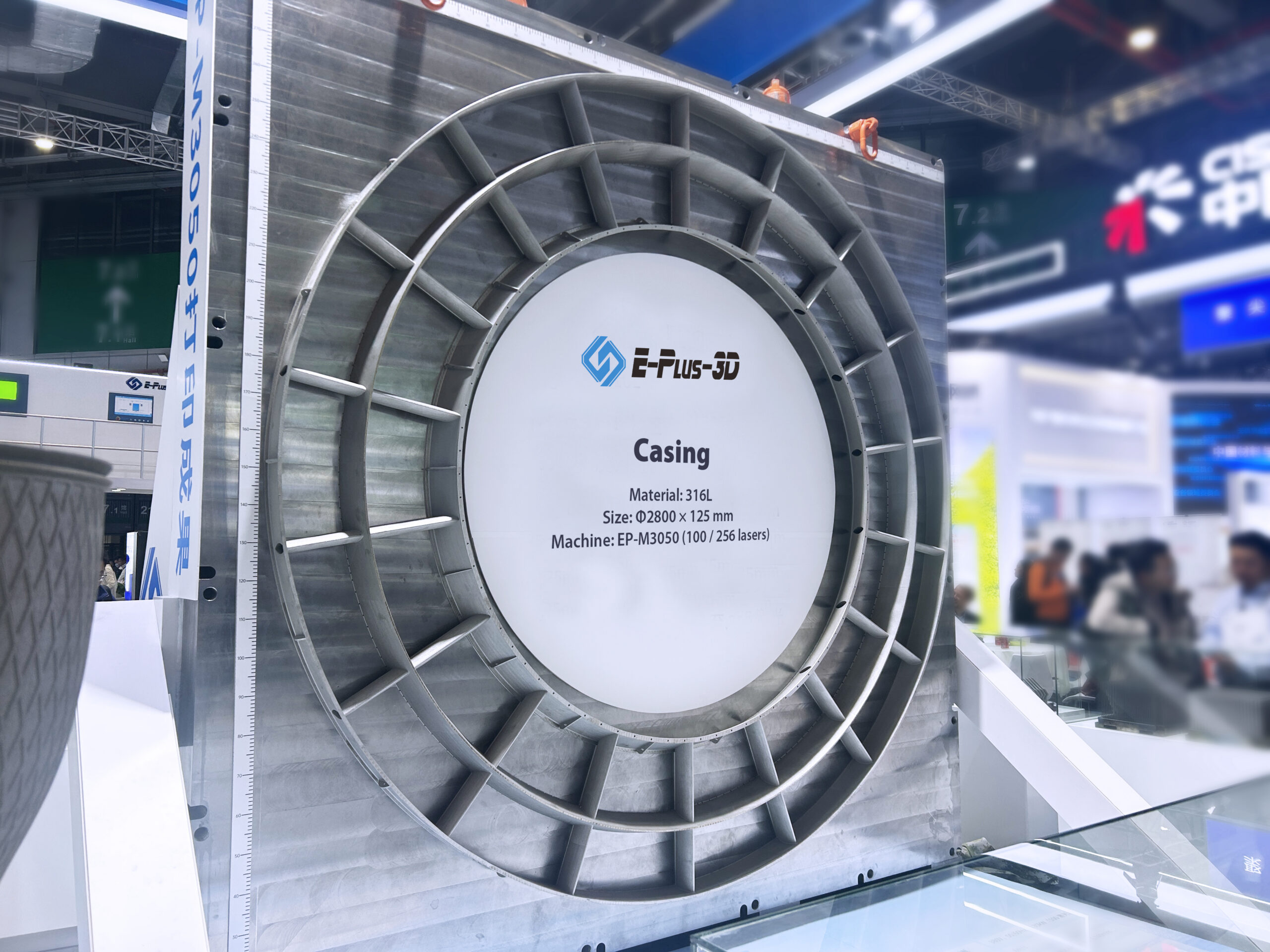
    A 2.8-meter casing printed by EP-M3050. Image courtesy of Eplus3D.

    Funding and Investment

    Farsoon Technologies (688433.SH) filed plans on April 28 for a private placement of up to RMB 3.91 billion (~$540 million). Stated uses include expanding AM equipment capacity, establishing an R&D headquarters and an industrialization application center, and establishing an AM technology innovation institute in Shanghai. The filing was disclosed alongside 2025 results: RMB 715 million revenue (+45% YoY), RMB 69 million net profit, and 1,400+ cumulative system shipments (more than 800 metal LPBF units). On April 22, Farsoon appointed Emlogic as the exclusive distributor for Australia and New Zealand.

    Creality 3D cleared its hearing at the Hong Kong Stock Exchange the week of May 8. The PIPE launched on May 12. CICC is the sole sponsor. Per the March 2026 prospectus, revenue grew from RMB 1.35 billion in 2022 to RMB 3.13 billion in 2025 (32.4% CAGR). The same prospectus discloses that Bambu Lab captured 29% of annual consumer FDM shipments in 2024, against Creality’s 16.9%.

    Ethereal Machines (Bengaluru) closed a $28.5 million Series B on April 25. Avataar Venture Partners led with Rs 199.55 crore (~$21.5M). Existing investors Peak XV Partners and Novellus Systems participated. Post-round shareholdings: Avataar ~13.7%, Peak XV ~16.4%. The round is priced at a 4x premium to the 2024 Series A.

    Additional Chinese rounds in the window:
    • Elegoo: ~$70 million Series B+ (RMB 500 million+) led by Meituan’s DragonBall Capital, six months after a DJI-backed Series B.
    • Makera (造物时代): hundreds of millions RMB Series A for the Z1 desktop CNC, after a $10.25 million Kickstarter.
    • StellarStack (叠序宇宙科技): tens of millions of RMB in an angel round for industrial SLM.
    • Shenzhen Guangyi Precision: angel round from Qichuang VC and Leaguer Capital. Founded in November 2025; no shipped product yet.
    • Moxin Technology (魔芯科技), an AI-software-for-AM developer: capital increase with Huawei’s Hubble Investment as a new shareholder.
    • Smart派 (Intelligent Pai): capital from Meituan affiliates; registered capital lifted to RMB 7.31 million.

    Meituan (via DragonBall Capital and affiliates), DJI (in an earlier round into Elegoo), and Huawei (via Hubble Investment) have all appeared on Chinese AM cap tables in the past 12 months.

    Hardware and Materials

    Eplus3D introduced the EP-M3050, an LPBF system with a 3.05 m build height and up to 256 lasers, for large-format aerospace and energy parts. Eplus3D also disclosed that its EP-M300 fleet has produced 100,000 tire-mold sipes for Hankook Precision Works across two systems.

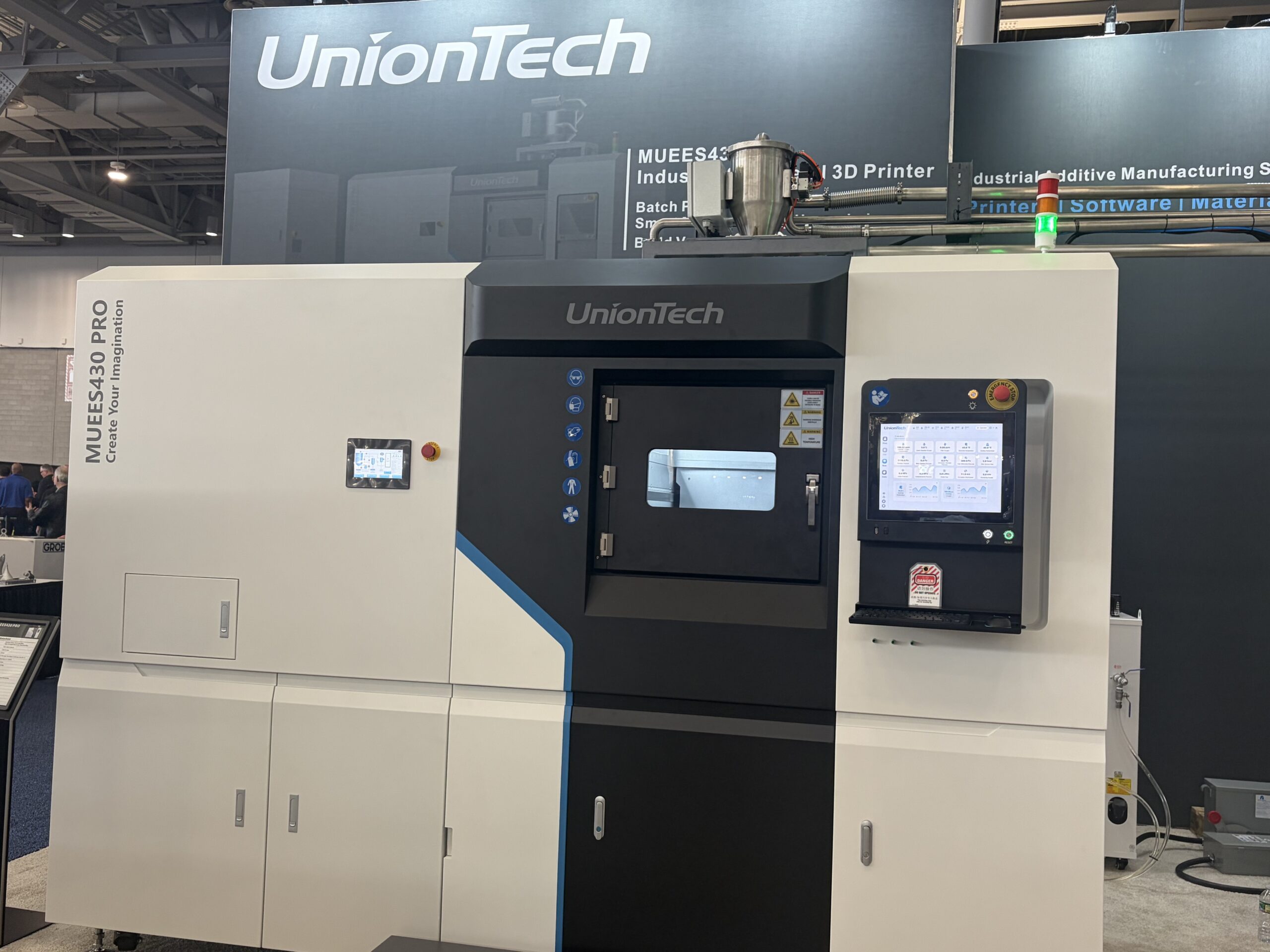
    At RAPID + TCT 2026, UnionTech (联泰科技) launched the MUEES430 PRO, a 430 x 340 x 330 mm quad-500W-laser SLM platform, and entered the North American market. Japan’s DMG Mori demonstrated the LASERTEC DED hybrid 6-in-1 process at the same show.

    UnionTech MUES 430 PRO printer at RAPID + TCT. Image courtesy of Sarah Saunders/3DPrint.com.

    Materials and platform announcements:
    • Hasen-Vite (哈森唯特): TPR titanium powder produced via plasma atomization of scrap, with a stated cost target of parity with stainless steel for AM and MIM. Qualification data not disclosed.
    • Addireen: launched Addireen Now, an instant-quote platform for industrial copper LPBF parts via Green Laser PBF, for thermal management and defense buyers.
    • Guangsu Yigou: opened a serial-production elastomer 3D printing line.
    Addireen, Addireen Technologies, Green Laser Metal 3D Printing_3D Printing Systems

    Addireen’s green-laser AM technology. Image courtesy of Addireen.

    Aerospace and Defense

    AML3D delivered its first containerized portable ARCEMY DED system to the US Navy AM Center of Excellence in Danville, Virginia. The system is operational and is the third AML3D system at the facility (two larger ARCEMY-X units already serve Austal USA). The containerized form factor reduces relocation servicing from 2-3 weeks to 1-2 days. Order value: AU$1.2 million. AML3D separately disclosed a $29 million US defense order book and a capacity-expansion plan.

    VF Space (Korea) confirmed that a kill-switch component printed with its Gaia 1 Wire Laser Additive Manufacturing (WLAM) system will fly on a KAIST CubeSat aboard the fifth Nuri (KSLV-II) launch, scheduled for August 2026. The launch has not yet occurred. Earlier coverage that described this as a “successful flight test of a rocket engine” was incorrect on both scope (a CubeSat component, not an engine) and timing (a planned launch, not a completed one).

    Korean partnerships and government activity in the window:

    The Chinese Academy of Sciences conducted an in-orbit demonstration of metal 3D printing on the Qingzhou test spacecraft using laser-wire DED.

    India context (not strictly AM but in the same window): Sigma Advanced Systems signed a £300 million, 7-year agreement with Rolls-Royce for aerospace components. Sigma operates metal AM hardware through its UK Nasmyth subsidiary.

    Medical

    Rokit Healthcare Accelerates Trials of World's First AI Cartilage Regeneration Platform - Seoul Economic Daily

    Rokit Healthcare cartilage regeneration bioprinting clinical trial: 100+ patients across 13 hospitals. Image courtesy of Rokit Healthcare.

    Rokit Healthcare (Seoul) launched a multi-center clinical trial for its AI-powered bioprinting platform for cartilage regeneration. The trial enrolls 100+ patients across 13 hospitals.

    South Korea’s Ministry of Health (via NECA) recognized 3D printed titanium mesh-guided bone regeneration as a New Medical Technology, opening the reimbursement pathway for patient-specific metal cranio-maxillofacial implants.

    China’s Ak Medical (爱康医疗): 2025 revenue RMB 1.482 billion (+10.1% YoY), net profit +23.8%. Growth attributed to overseas expansion and surgical-robot integration.

    Construction

    Singapore Leads the Way with its First 3D-Printed Concrete Pedestrian Bridge - Travel And Tour World

    Singapore’s first 3D-printed concrete pedestrian bridge, measuring 10 m x 5 m, is under construction in Jurong West and is targeted for completion in 2028. Image courtesy of Witteveen+Bos.

    Singapore’s Land Transport Authority, NTU’s Center for 3D Printing, engineering consultancy Witteveen+Bos, and CES Innovfab will build Singapore’s first 3D-printed concrete pedestrian bridge: 10 m long and 5 m wide, located in Jurong West, targeted for completion in 2028. Project R&D started in January 2023 at a cost of ~$1.4 million. The team cites a 50% reduction in workforce and a four-hour-per-segment production time for bridge segments.

    China’s Guanli Technology 3D printed a 432 m² villa in Dubai using a 24 m gantry printer.

    Partnerships

    • BLT and Siemens: digital-factory cooperation formalized at TCT Asia 2026.
    • Bambu Lab and HuiNa Technology: RMB 22.3M order for 15,000 FDM printers, for what HuiNa describes as China’s first ultra-large 3D printing factory.
    • Eplus3D, Rosswag, and qualloy: MOU for an eight-laser EP-M550 installation in Europe.
    • Azad Engineering and Baker Hughes: A 7,600 m² lean manufacturing facility opened in Hyderabad for Baker Hughes precision components.

    What to Watch

    Three open questions for the next six weeks.

    1. Creality listing date and first-day price. The prospectus shows Bambu Lab at 29% of 2024 consumer FDM shipments, versus Creality at 16.9%. First-day pricing will set the tone for how public-market investors assess that share trajectory.
    2. Farsoon placement timeline. The RMB 3.91 billion placement is subject to shareholder and regulatory approval. The breakdown of equipment capacity, R&D, and the AM service platform component has not been provided in detail.
    3. India follow-through. Three Indian announcements landed in the same week (Ethereal Machines’ $28.5 million Series B, Sigma’s £300 million Rolls-Royce contract, and Azad-Baker Hughes’ facility opening). Whether they convert to recurring orders or remain isolated events is the open question.

    Prepared by AMPulse | www.ampulse.online