• 3D Printed Airport Building Shows Where Construction AM Really Makes Sense

    At Milan Bergamo Airport, WASP has helped 3D print a new airport services structure. The small building, named Ol Casél, serves as a rest and relaxation area for customs staff. With toilets and a seating area, it is designed to give them a place to chill. Developed for airport operator SACBO by construction firm EDILCO in collaboration with WASP, the building was completed in 19 days. Doors, windows, and the roof were added after printing. The 3D printed walls incorporated oclusions and areas to easily integrate wiring and other components. 
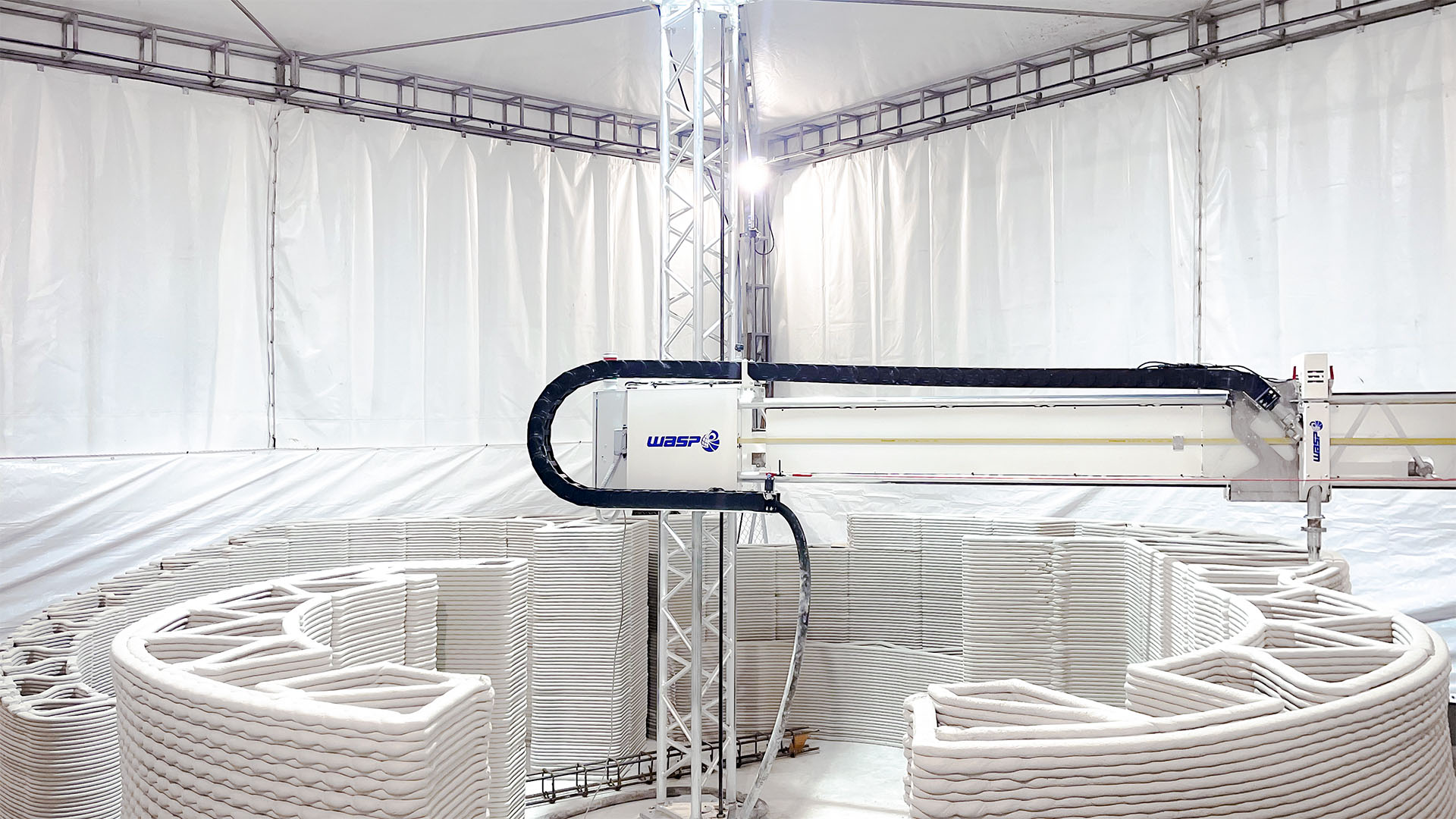
    The Crane WASP at Bergamo Airport.

    Seven days of the 19 were taken up by the 3D printing process. As previous WASP projects have, this one used the Crane WASP. The Crane has a build volume of 8,200 mm by 3,200 mm and could print up to 200 mm/s. Weighing in at over 700 kilos and over five meters in height, this massive machine comes with a pumping system and a twin screw extruder. 

    3D printed service building at Bergamo Airport.

    Introduced in 2018, the WASP Crane has been used to print buildings in Japan using soil, an earth-based sustainable home in Italy, and a Dubai Dior concept store. WASP is unique because it really wants to save the world and use 3D printing to do so. On top of this strong, idealistic basis, the company makes machines that print many more materials than just concrete.
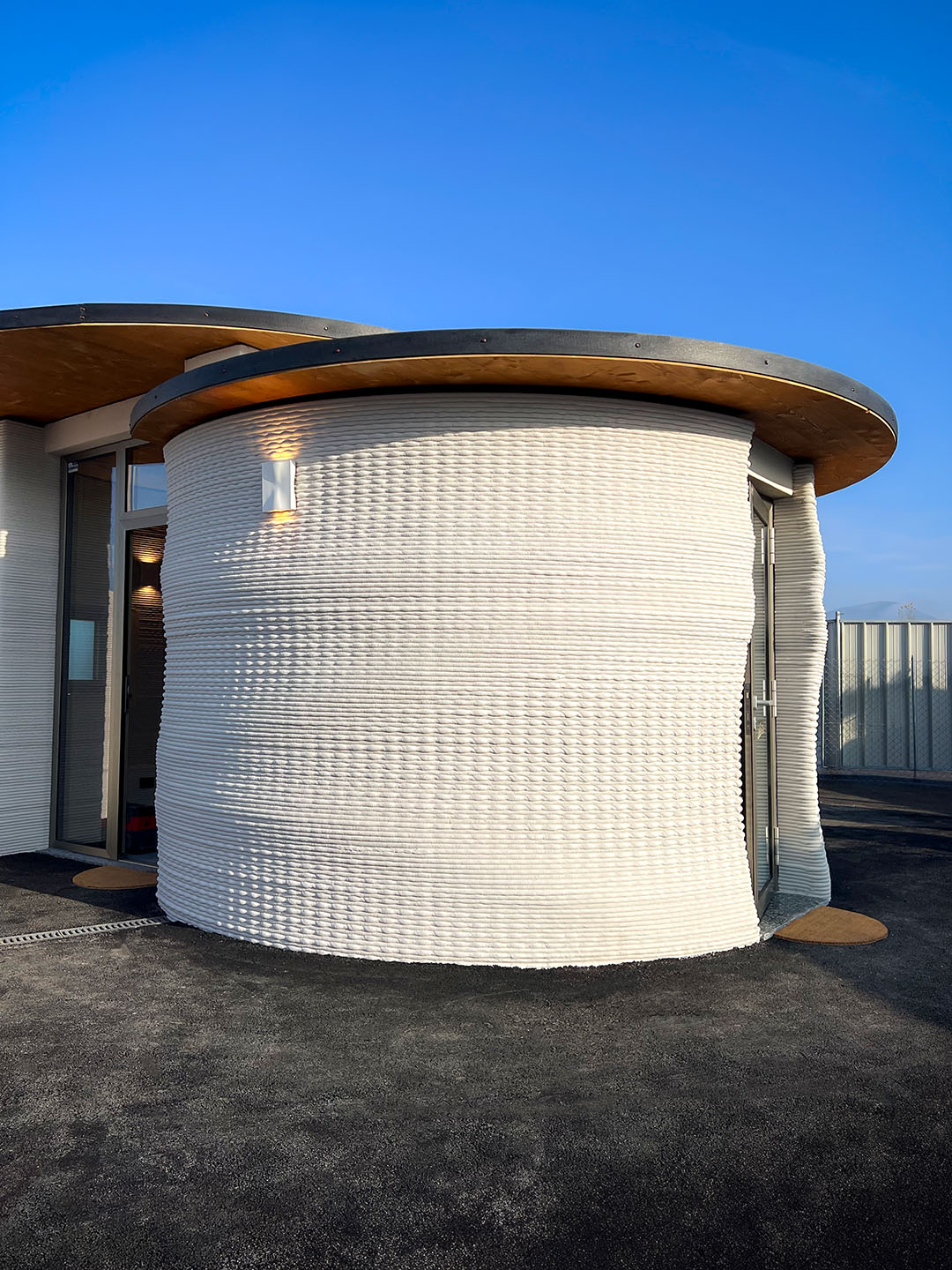
    3D printed certified service building at Bergamo Airport.

    The lime-based mortar was used in place of regular cement to save on emissions. Whereas a lot of the attention on 3D printing for construction is on houses, I’m more enthused by this kind of thing. In infrastructure, remote infrastructure, or difficult-to-access infrastructure, 3D printing makes a lot of sense. Whereas a quicker 3D printed house is nice and may be more affordable, not closing down a part of an airport for a few days adds additional savings. Not having to close down a runway, not having to use lots of security people to guard an area of the airport where people need to come and go, not having to make changes to roads/gates and access procedures for longer than necessary, not having to spend time monitoring cameras of a certain area under construction, the general risk of lots of new people milling around your site, extra searches and acess control all adds up. In such a place, a shorter construction time saves much more than just the construction cost of the structure itself. At airports and in some military or energy facilities, the exit, entry, and monitoring costs for temporary site visitors alone can eclipse the cost of the structure. The risk to the facility of anyone who should not gain access to this site also brings a financial cost that could eclipse any built-in costs of itself.

    If we’re dealing with a large site like a nuclear plant, an integrated petrochemical facility, or an airport, any downtime of the main activity is also super costly. The difference between having cement trucks traversing your site three days instead of five could be considerable. And with every trip, the risk of an accident increases. If a runway had to be closed off for even an hour for some kind of construction activity, the costs could be enormous. Imagine also the unquantifiable stuff. Imagine managing Heathrow or something, and someone telling you that you need a crane at your site. I know nothing about managing airports, but I’d be rather allergic to that and would try to minimize time on site for this. In the case of large plants, processes can make thousands of tonnes of material an hour. So there is a per-minute cost if this is interrupted. But there could also be significant energy or other costs in ending and starting up processes. Speed could also end up saving on interruptions in uptime to ancillary processes, also. At remote sites such as Arctic bases, personnel are limited, so having someone feed, supervise, and help visiting construction crews is something that has to be minimized.

    Yes, 3D printed houses are cool. But I love this project because it is an example of something potentially much more profitable and effective. 3D printed construction in denied, high-value, high-criticality, and secure environments is the one area that I’m the most excited about in 3D printed construction. Let’s hope that we see more examples of this in the wild.
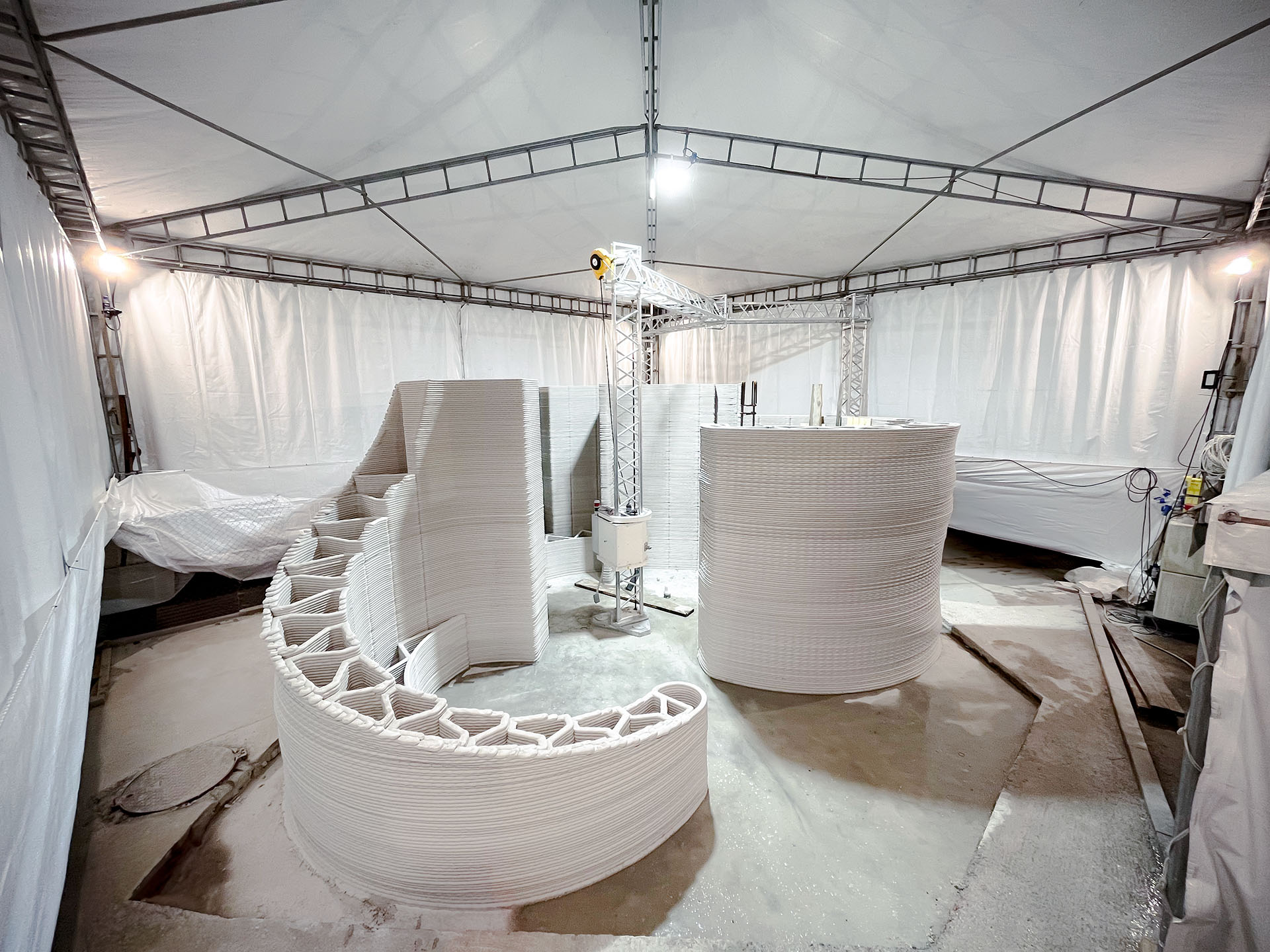
    WASP’s Crane construction 3D printer at Bergamo Airport.

    Images courtesy of WASP

  • 3D Printing News Briefs, March 19, 2026: 3D Printing Waste, Technical Ceramics, & More

    In today’s 3D Printing News Briefs, Meltio announced an official sales partner for Ireland and Northern Ireland, Roboze received an investment from a U.S. venture capital firm, and Future Form added 3D printing services. Ter Hoek adopted XJet’s Carmel 1400C to expand into technical ceramics 3D printing. Finally, CEAD is shredding its 3D printing waste, and investigating how to recycle it to create new materials.

    Meltio Announces Official Sales Partner for Ireland & Northern Ireland

    L-R: Johannes Werner and James Wall, 3D Technology Ltd.

    Meltio, which specializes in wire laser metal deposition, announced that 3D Technology Ltd. is its newest official sales and services partner, and will help boost metal AM market growth for Ireland and Northern Ireland. A leading Irish provider of AM hardware, materials, and technical support, 3D Technology Ltd. has offices in Belfast, Galway, and Meath, so can certainly spread the word about Meltio’s process, which is centered around safe, affordable, and clean welding wire. The company will help build a strong and supportive ecosystem in the Irish territory for Meltio’s technology, and provide customers with local support, such as consultation, solution design, installation, maintenance, training, and application development. This partnership between Meltio and 3D Technology Ltd. will allow Irish manufacturers to achieve supply chain independence by adopting cost-effective, reliable metal AM solutions for repair, production, tooling, and hybrid manufacturing.

    “We are incredibly excited to partner with Meltio and bring their world-class metal additive manufacturing technology to Ireland and Northern Ireland,” said James Wall, Managing Director at 3D Technology Ltd. “Meltio’s wire-LMD systems are transforming how companies think about metal production, repair, and hybrid manufacturing. This partnership aligns perfectly with our mission to deliver innovative, reliable, and accessible advanced manufacturing solutions to our customers. We look forward to supporting Irish industry as it embraces the next generation of metal AM.”

    Roboze Gets Venture Capital Investment to Speed up Distributed Manufacturing

    Roboze has been on the move as of late, holding an open house at its Houston location earlier this week and celebrating the grand opening of its Aerospace and Defence HQ in California tomorrow. The company also announced an investment from U.S. venture capital firm Rule 1 Ventures, which focuses on defense and national security technologies designed to strengthen operational readiness. The investment will support the global expansion of Roboze’s AI-driven distributed manufacturing platform, combining materials science, AM systems, software-driven process intelligence, and embedded Physical AI. The platform is focused on reliable, localized, on-demand production of complex, mission-critical parts for strategic sectors like aerospace, defense, and energy. Roboze’s funding round also included participation from some existing shareholders, like microprocessor inventor Federico Faggin, and investors experienced in the government affairs, defense, and global industrial markets, like Privcorp Ventures and Gary Ang, former Temasek operating partner and Singaporean Air Force official.

    “We are proud to welcome Rule 1 Ventures and this exceptional group of investors to Roboze. Modern industrial resilience requires more than machines — it requires a complete manufacturing platform that combines hardware, materials science and intelligent software. Our mission is to build the infrastructure that allows critical industries to produce advanced components wherever they are needed,” said Roboze Founder and CEO Alessio Lorusso.

    Future Form Adds 3D Printing Services for Prototyping & Low-to-Mid Volume Production

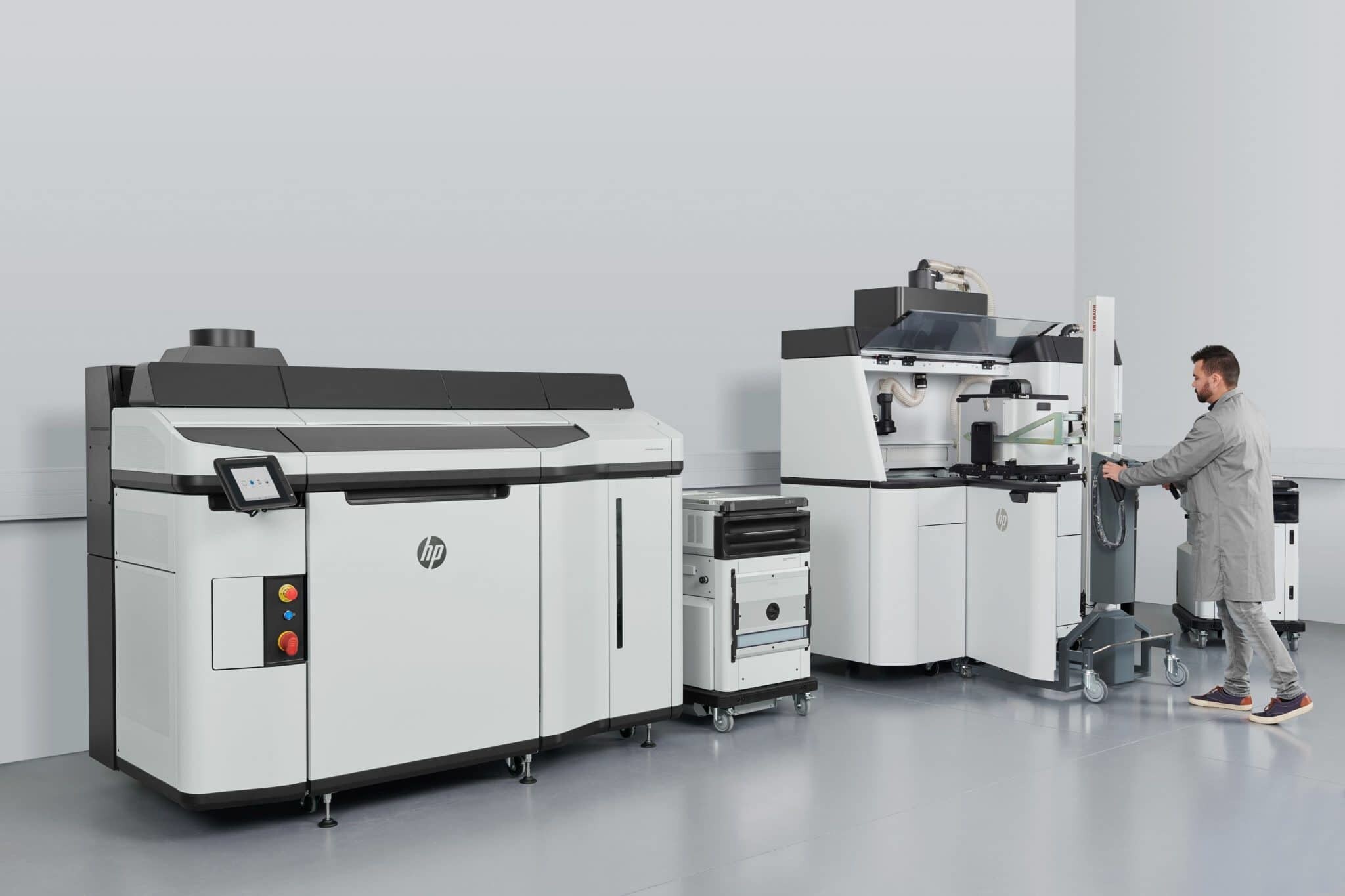
    Future Form is now using this HP Multi-Jet Fusion (MJF) 3D printing system, a cutting-edge scalable platform that supports functional prototyping to final part production.

    High-volume manufacturing solutions provider Future Form recently added 3D printing services to its portfolio. The company specializes in plastic AM, and its new service will use HP Multi Jet Fusion (MJF) technology to enable prototyping and low-to-mid volume part production for the aerospace, medical, and data center industries. 3D printing growth has been especially pronounced in these sectors, like for making flight-certified parts and constructing data centers. Reasons for its increased popularity include everything from supply chain resilience and the ability to deliver complex geometries to improved sustainability. With its new services, Future Form will use MJF to print functional, high-quality parts for these sectors with great surface finish and cost efficiency, and improved turnaround times. This addition to its portfolio shows that the company really has a forward-looking approach to manufacturing.

    “For low- to mid-volume production and/or prototyping, plastic 3D printing is quickly becoming a smarter alternative to traditional manufacturing methods,” said Ben Thomas, CEO of Future Form.

    “By adding these services, we’re ensuring we can deliver high-quality parts to our customers when they need them without costly transportation fees or exorbitant mark-ups.”

    Ter Hoek Expands into Technical Ceramics with XJet’s NPJ Technology

    XJet 1400C Alumina system installed at Ter Hoek facility in Rijssen, The Netherlands

    Dutch precision manufacturing specialist Ter Hoek recently adopted the XJet Carmel 1400C ceramic 3D printing system, expanding its expertise from precision metal manufacturing to technical ceramics. This decision will diversify the company’s existing material portfolio, and also upgrade its production process into a digital, automated workflow. Additionally, the collaboration will bring XJet’s proprietary NanoParticle Jetting (NPJ) technology to the Netherlands—one of the most demanding precision manufacturing environments in Europe—and increase both companies’ ability to offer ceramic solutions to high-tech industries, such as semiconductor, medical, aerospace, and aviation. The Carmel 1400C system was designed to handle prototyping as well as production-scale manufacturing, which meshes well with Ter Hoek’s service model. At next week’s Ceramitec 2026 in Munich, XJet and Ter Hoek will demonstrate NPJ technology together at Booth 206, Hall A6.

    “In the future of manufacturing, sustained success will hinge on continuous differentiation and innovation in an increasingly competitive landscape. With our solid expertise in precision manufacturing, we have constantly sought the next opportunity to better serve our customers. By entering the world of technical ceramics with XJet’s digital production platform, we’re not just adding a new material – we’re embracing a fundamentally new way of manufacturing that offers unprecedented design freedom, faster iteration cycles, and the ability to produce parts that were simply impossible before. This positions us at the forefront of the next generation of precision manufacturing,” said Gerrit Ter Hoek, Founder and Technical Director at Ter Hoek.

    CEAD Uses WEIMA Shredding Technology to Recycle 3D Printing Waste

    Large-format additive manufacturing cells at CEAD – © Weima

    In another story out of the Netherlands, CEAD is combining its large-format additive manufacturing with the circular economy. The Delft-based company develops LFAM systems for the composite, construction, and marine industries. Its pellet extrusion process uses fiber-reinforced thermoplastic composites (FRP) to print full-scale components, like complex molds, prototypes, and even boats. Unfortunately, the discarded parts and prototype structures made of glass- or carbon-fiber reinforced polymers can add up fast. Plus, CEAD’s leftover prints can weigh up to several hundred kilograms, so it’s not sustainable or efficient to dispose of them. CEAD is now using a material recycling solution from German mechanical engineering company WEIMA. CEAD installed a WEIMA WLK 4 single-shaft shredder, which is able to easily convert reinforced thermoplastic waste components into uniform flakes about 10 mm in size. These flakes are a great intermediate material for reprocessing and upcycling, and CEAD is now working with several Dutch R&D companies to investigate how the shredded waste material can be re-pelletized to create new 3D printing material.

    “WEIMA for me is reliable, easy to operate, and a trustworthy partner. We’ve been using the shredder frequently without any breakdowns, and it performs perfectly in an industrial environment,” said Mark Muilwijk, Material and Process Specialist at CEAD.

  • BMF Turns Up the Speed with microArch S150 Series

    Boston Micro Fabrication (BMF) is releasing the microArch S150 Series. This series comprises two compact desktop systems. There’s a speedy microArch S150 Ultra and a more lab- or experiment-oriented microArch S150. The company thinks that the PµSL printers will be used for “microfluidics, fiber optics, biomedical devices, electronics, and advanced research.”

    The Ultra is nine times faster than the regular S150, and could be used for “rapid prototyping, iterative design, and low-volume production of finely detailed parts such as microneedles, channels, nozzles, and chips.” The systems have 25 µm optical resolution, 10–100 µm layer heights, and a ±3 µm positional accuracy. Each layer takes between 4 and 12 seconds to print. There’s a HEPA13 filter, while a UV-C (253.7nm) sterilization system sanitized the build chamber after print runs. For some materials, the open printer has presets, and resin tanks can be heated to 60℃. The printer prints at 405nm, and the build volume is 80mm x 48mm x 50mm.

    Both systems have been made to be easy to use and deploy. Automatic calibration, automated leveling, automated setup, touchscreens, and better material handling are some of the optimized features of these systems.

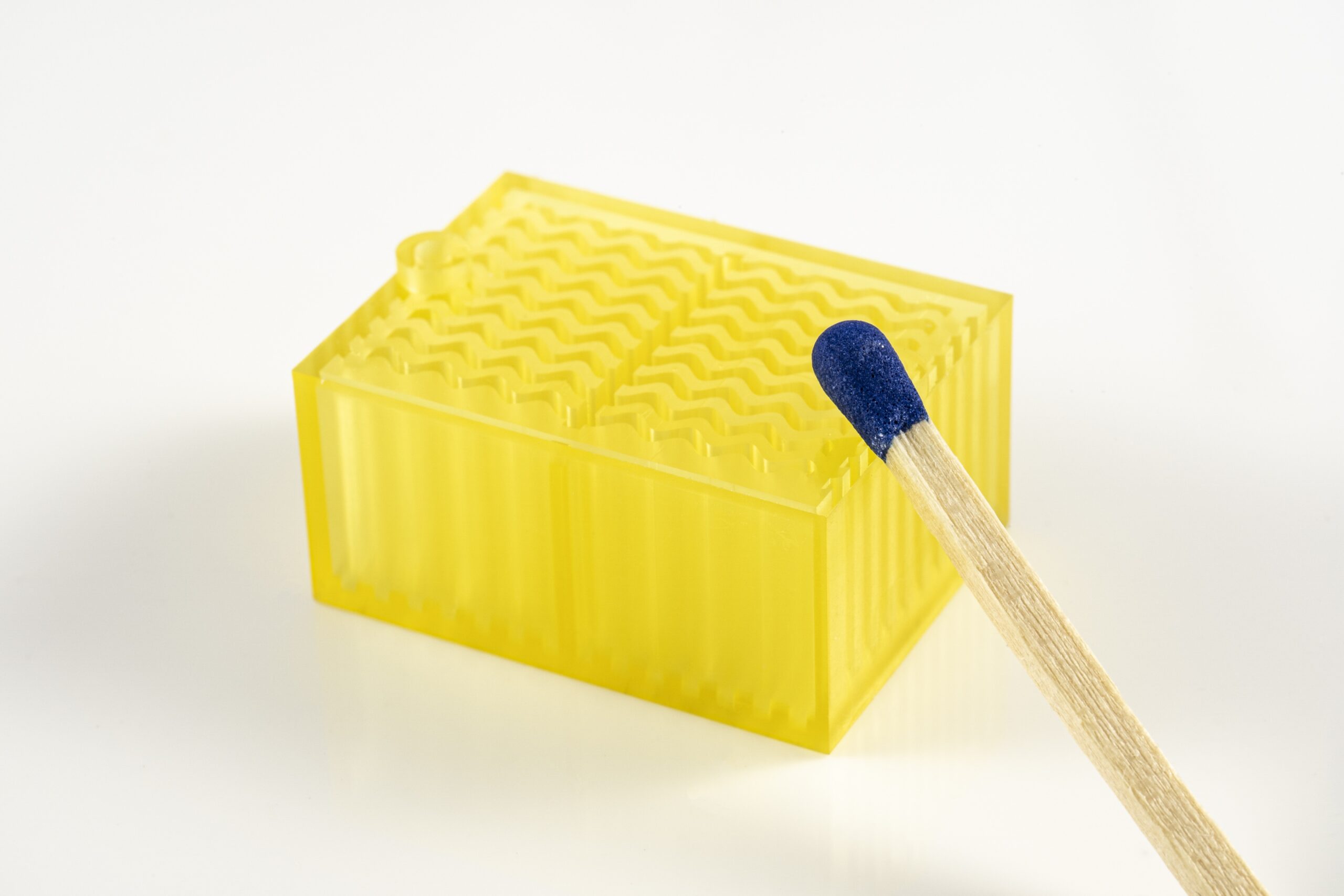
    Housing with 130 Em features, 3D printed on S150 Ultra in 39 minutes.

    BMF CEO John Kawola said,

    “Our mission is to make micro-precision 3D printing a more accessible technology for innovators across multiple industries and the microArch® S150 Series is a true game-changer in enabling us to achieve that. Designed to directly support customers seeking to accelerate their research and development without sacrificing quality, these systems remove long-standing barriers and make true micro-precision 3D printing genuinely accessible. By introducing this series, we are empowering users to easily and successfully create high-resolution parts with the speed and efficiency required for today’s fast-paced development cycles.”

    Heat Exchanger for Blood Cooling, 3D printed on the S150 in 1 hour, 18 min.

    BMF will be at Rapid TCT showing off the systems, and they should be for sale at the beginning of Q2. BMF got a Series D round in 2023. The company has released more systems, such as a dual resolution system, and new resins, such as an SR (Sacrificial Resin) and a High Temperature material. Aside from these expected advances, the company is also moving ahead with deeper dives into applications. In both veneers and organ-on-a-chip, the company is pioneering its own solutions. Rather than just come up with a thin veneer material and offer it to customers, BMF is providing the whole solution and selling veneers.

    The company, of course, has to balance these efforts. If its own applications are seen as competitive or a threat, it may scare off customers. But, if it strikes the right balance between offering open machines to anyone and developing its own products, it may have found a golden opportunity. The machines can be used for any and all research, anywhere. This could ensure it penetrates new markets and becomes the product used as new industries are invented. If it then has the pipeline of devices needed to industrialize this research process, it can benefit from people doing research and those rare examples that make it into production.

    Meanwhile, in other areas, it can capture the full value of an application by developing, manufacturing, and selling it in-house. Traditionally, machine businesses, service businesses, and product companies are very different organizations. Companies trying to do several things at once often struggle to do anything right. A lack of focus or too much activity in poorly understood areas could also lead to disasters. Worse, these issues could arise from a lack of understanding of what needs to be understood. So it’s not the palm-sweaty, hip-swaying of a tightrope walker, but the blundering off a cliff, unseen, kind of mistake that becomes more likely to happen. Often, product people struggle to align with more process-oriented device people, and neither understands service folks. Culturally, therefore, the company will have to take care as well. But if it gets these things right, then the company could have two very different revenue streams. A shotgun-like device revenue stream dominated by growth in research funding around PµSL and its applications in one stream, while direct cash from applications in another. That could be a financially very attractive place for the firm to find itself.

    Images courtesy of BMF

  • Sintavia Taps NVIDIA Blackwell for AI-Driven Additive Manufacturing Pipeline

    Investors have become increasingly anxious about the sustainability of NVIDIA‘s growth trajectory, which is a rather natural outcome when a stock goes up infinity percent or so over the course of a decade. Meanwhile, this healthy skepticism has left the company’s share price at levels that recently led Bloomberg to say it now “looks like a value stock,” and CEO Jensen Huang just declared that the chipmaker anticipates at least $1 trillion in revenue through the end of next year.

    Of course, in order to remain optimistic about the AI boom’s longevity, it’s not enough to factor in NVIDIA’s own projections: what’s perhaps even more critical at this point is the revenue that NVIDIA’s customers are bringing in thanks to adoption of the company’s tech. Moreover, those customers can’t just be hyperscalers; NVIDIA has to prove that its chips are stimulating growth across the economy as a whole, for small businesses in addition to giants. Thus, Sintavia, the Florida-based, additive manufacturing (AM)-enabled contract manufacturer, is signaling quite a milestone with its announcement that it has used NVIDIA’s RTX Pro 6000 Blackwell Workstation Edition GPU to drastically reduce the design and validation timeline for an aerospace heat exchanger.

    After designing the part at an accelerated pace, Sintavia ran “over 300 iterations” of a heat transfer simulation in just seven minutes with the Blackwell, a phase of the process which the company notes would’ve taken 11x longer with advanced CPUs. Sintavia used Siemens’ Simcenter STAR-CCM+ CFD software and nTop implicit modeling to design the part, which resulted in a combined 30 percent weight reduction and 20 percent increase in thermal efficiency.

    All in all, Sintavia shortened a process that would typically take months into a production schedule of about two weeks.

    Scooped version of the representative heat exchanger.

    Notably, beyond the performance achievement, Sintavia also scored a big PR win by landing a spot on NVIDIA’s website as a customer success story. This is warranted hype: Sintavia managed to weave together a number of relevant economic themes that are poised to continue gaining in relevance in the current geopolitical environment.

    In an interview I did with Cisco’s VP of Product Management for IoT Industrial Networking, published earlier this week, I discussed why I think that infrastructure investments, including expanded edge computing capacity, are a necessary precursor to the AM’s next scaling phase. And in another post from this week, I wrote about how the US-Israel war in Iran is likely to lead to the disruption of supply chains far beyond oil & gas.

    As evidenced by the company’s GPU competencies, Sintavia is clearly positioned to utilize edge computing to handle the greater networking capacity required for operational growth. As for the supply chain disruptions, while the company didn’t say what the heat exchanger was made from, there are plenty of metal supply chains dependent on the Strait of Hormuz, including aluminum, one of the most common metals used for heat exchangers. The Bahrainian aluminum giant Alba, which operates the world’s single largest aluminum smelting facility, has already cut production by 19 percent in response to the shutdown of shipping through Hormuz.

    This obviously has a negative impact on suppliers of aluminum parts as a whole by raising prices, but the persistence of the disruptions could ultimately catalyze greater demand from manufacturers using AM, especially from the addressable market closest to the point of supply. You may pay more for the printed part, but if delivery within a reasonable timeframe is guaranteed, the higher cost might be justified. And lower shipping costs compared to parts from overseas could start to make a dent in the premium.

    Finally, although Sintavia’s use-case is an aerospace heat exchanger, NVIDIA’s involvement naturally made me think of heat exchangers for data centers. Digital manufacturing is already an indispensable proof-of-concept for NVIDIA’s long-term business model, for the reasons mentioned at the beginning of this post. If NVIDIA starts eating its own dog food by using a combination of AI and AM to help build up the domestic data center hardware ecosystem, AM will become strategically critical infrastructure for the linchpin of the global market.

    Images courtesy of Sintavia

  • SWISSto12 Extends Swiss Factory

    Swiss Omega Speedmaster watches went to space and the moon with the Apollo program. While the watches were Swiss, virtually all of the other equipment was made in the US, except, of course, the Swiss Mettler scales, sieves by Aigle AG, DJEVA synthetic rubies, Mikron AG-made gears for the lander, and a Swiss experiment carried by the crew. The Swiss may be looking to maximize their role in space even more this time through Swissto12.
    The company has opened a 1,000-square-meter cleanroom in Renens to make HummingSat. This augments an existing 5,500m² space.
    SWISSto12 CEO Emile de Rijk stated,
    “Bringing this integration capability for our advanced satellite payloads and HummingSat in-house is central to our strategy to reduce the time and cost of building our products. This agility brings value to our customers who need cutting edge products and innovation delivered at speed.”
    The space is needed for the HummingSat. The HummingSat is a GEO satellite optimized for compactness and broadband connectivity. The HummingSat is also a relatively affordable option for sovereign communications, intelligence, and secure communications. For wealthy countries, a sovereign communications capability is more important in a more fractious world. Previously, doing a proprietary program was cost-prohibitive and available only to China, the US, Russia, and France. Now, more countries could use HummingSat as a springboard to their own sovereign communications.

    HummingSat is a geostationary telecommunications satellite. Image courtesy of SWISSto12.

    Swissto12 also aims to build HummingSat in two to three years, much faster than bus-sized older platforms. For now, 4 satellites have been ordered. They’re expected to have a lifespan of 15 years and weigh a ton, with a 200 kg payload. The company aims to offer them at 10 times the price of the satellites it aims to replace. Intelsat 45 is the first, and it’s a Ku-band FSS/BSS replacement satellite. This is a Broadcasting Satellite Service, which transmits, for example, TV to many, and a Fixed-Satellite Service, which transmits to one particular area. The next three satellites are intended for Inmarsat/Viasat. These are Viasat/Inmarsat I-8 satellites. They are meant for its L-band (1 to 2 gigahertz) network, a secure emergency services network. After this, further communications satellites for general use or specific satellites for countries like Norway are in the offing.

    SwissTo12 is ambitious, that’s for sure. The company is also working to grow its RF components business. The company makes 3D printed filters, antennas, waveguides, and more for the likes of Thales, Northrop Grumman, and Lockheed Martin. The company is also expanding into AESAs (Active Electronically Steered Antennas), AESA terminals, and even a dielectric material analyzer.

    Through the use of additive, SwissTo12 is growing in satellite components and entire satellites. And we’re all stuck trying to sell parts to car companies. SwissTo12 is really showing how to dominate in individual application areas and leverage that into a fast-growing business. SwissTo12 doesn’t sell printers; instead, it designs, optimizes, and makes complete assemblies that use 3D printing to outperform. This allows the firm to capture a lot of the resulting value and lead in a fast-growing market. RF components and satellites are ideal for optimization, weight savings, component reduction, and better flow. If we can optimize all of these qualities at the same time, we can get an industry-leading device that combines excellent RF performance with superior economics. In the constrained space of satellites, a more optimized shape can enable them to do more or last longer. Weight savings reduce costs, while a supremely optimized component combines all the other advantages. More companies should follow in SwissTo12’s footsteps and apply additive to space.

  • Manufacturing Has a Data Bottleneck, So OpenBOM and AMC Bridge Are Helping Systems Work Together

    As manufacturing becomes more distributed and product development more complex, companies are under more pressure than ever to connect data across design, engineering, and production. The idea of a “digital thread,” this continuous flow of product data across systems, is no longer just a long-term goal, but something many organizations are actively pushing to implement.

    A recent collaboration between OpenBOM and AMC Bridge points to exactly that shift. And for additive manufacturing (AM) in particular, connecting data across systems is critical to moving from design to production.

    The partnership focuses on improving how product data moves between systems, particularly in environments where multiple CAD tools are used. This is common. Many manufacturers, suppliers, and engineering teams do not rely on a single design platform; instead, they operate across a mix of tools shaped by internal needs, legacy systems, and external partners.

    A Growing Need for Integration

    For many engineering organizations, the issue is not a lack of software, but how hard it is to keep data consistent across systems that were never designed to work together. As teams adopt a mix of desktop and cloud tools, this becomes even harder.

    Here, integration is less about convenience and more about keeping workflows running. This plays out across a wide range of industries.

    For example, global automotive companies like BMW or Volkswagen typically rely on platforms like CATIA, a widely used design and engineering software from Dassault Systèmes, for core design work, while suppliers contributing parts often use a range of other tools, including SolidWorks or PTC Creo. In these cases, product data has to move between companies, often without a shared system.

    In aerospace, companies such as Airbus and Boeing operate highly distributed supply chains, where different partners use different design tools and product lifecycle management systems (PLMs). A single aircraft program can involve hundreds of suppliers, each using different data formats, making integration key to keeping everything consistent and easy to track.

    This is also true for contract manufacturers like Flex or Jabil, which build products for different customers using different software. Some, like Jabil, also use AM as part of their production workflows, adding another layer of complexity to how data is managed across systems.

    Even in smaller or fast-growing companies, mixed software setups are common. Many teams start with cloud-based tools like Onshape or Autodesk Fusion, then add more advanced systems as they grow. Over time, this can lead to setups where older and newer tools need to work together.

    In electronics and hardware development, tools like Altium Designer are used alongside mechanical CAD systems, requiring close coordination between electrical and mechanical design teams. Keeping these systems aligned is critical to avoiding design errors and delays, a well-known challenge in hardware development.

    Now, if we take AM workflows into account, that adds a whole other layer of complexity. For example, a part might be designed in one CAD system, then adjusted in another, and finally prepared for printing using machine-specific tools. Companies like GE Aerospace or Siemens Energy use AM in production, where workflows typically involve multiple tools and systems.

    So, across all of these scenarios, the challenge is the same: data is created in one system but needs to be used in many others. Without good integration, teams end up doing things manually, working with different versions of the same file, and facing delays.

    Why This Matters

    This is where the OpenBOM and AMC Bridge collaboration fits in. While the partnership is not new, their continued work points to the growing demand for better integration.

    OpenBOM helps companies manage product data in the cloud, from parts lists to engineering changes. AMC Bridge makes that system work with design tools like SolidWorks, Autodesk Fusion, and PTC Creo.

    Together, the companies are working to connect traditionally separate systems, allowing data to move more easily between design environments and downstream processes like manufacturing and supply chain management.

    For the AM industry, these developments are quite interesting.

    Additive workflows are digital, but they pull data from many different places, like design, simulation, and production. When these systems aren’t well-connected, scaling production and keeping things consistent becomes harder. That’s why better integration and smoother data flow are becoming essential for using AM in production.

    create a BOM today from Autodesk and get Bill of Materials with images that can be easily shared downstream in your company. Image courtesy of OpenBOM.

    From Demonstrations to Deployment

    The collaboration between OpenBOM and AMC Bridge was recently shown at Autodesk University 2025, where the companies demonstrated how their tools can connect design, data management, and business systems.

    While this kind of demo isn’t new, what’s changing is how far things have progressed. More companies are moving past early testing and looking for solutions that are stable and ready for real production use.

    That shift shows in this partnership, which focuses on reliability, performance, and long-term support rather than just technical features.

    As manufacturing workflows become more complex, the need to connect systems and keep data consistent is becoming harder to ignore. The OpenBOM and AMC Bridge collaboration is one example of how companies are trying to deal with that challenge, as integration moves from a “nice to have” to something required for real production.

  • 3D Printing Market Trends 2025: AM Research to Break Down Data in March Webinar

    As the additive manufacturing industry moves into a more results-driven phase, understanding what actually happened in 2025 is becoming very important.

    On March 24, 2026, Additive Manufacturing Research (AM Research) will host a free webinar aimed at answering exactly that. The session, titled 3DP/AM Market Insights: 2025 Review and 2026 Preview,” will present a detailed look at the latest market data, along with expectations for the year ahead.

    The webinar builds on AM Research’s recent findings, including new analysis showing that the value of parts produced with additive manufacturing could reach $110 billion annually by 2034. During the session, these projections will be explained and put into a broader market context.

    Looking Beyond Headlines

    The webinar will be led by Scott Dunham, Executive Vice President of Research at AM Research, who has spent years tracking the additive manufacturing industry across multiple technologies and sectors.

    The session will take a closer look at how different parts of the market are performing, based on detailed data collected over time.

    AM Research tracks the industry on a quarterly basis, covering hardware, materials, and services across technologies such as powder bed fusion, binder jetting, directed energy deposition, and material extrusion. This approach allows the firm to follow market changes as they happen, instead of relying only on annual or quarterly data.

    What Changed in 2025?

    The past year has been a transitional one for additive manufacturing. Especially as many companies have shifted their focus toward profitability and more targeted applications. At the same time, areas like defense, dental, and industrial production have continued to evolve, creating a more complex picture of growth.

    The webinar will explore where expansion actually occurred in 2025, and where it may have slowed down. It will also look at how different technologies are positioned going into 2026, and whether certain segments are beginning to separate from the rest of the market.

    Scott Dunham during the AMS 2026 Market Data Outlook presentation. Image courtesy of 3DPrint.com.

    One of the key themes expected in the session is the growing importance of applications.

    Recent AM Research data has shown that looking at part production, not just equipment sales, provides a better understanding of how additive manufacturing is being used in practice.

    By connecting application-level insights with broader market data, the webinar looks to highlight where additive manufacturing is delivering real value today, and where future opportunities may lie.

    From AMS to a Broader Audience

    For those who attended Additive Manufacturing Strategies (AMS 2026) , the webinar will expand on topics already introduced earlier this year. At the event, Dunham shared early insights into application trends and market forecasts. The March session will build on that foundation with finalized data and a more detailed outlook.

    As additive manufacturing continues to mature, access to reliable data is becoming more important than ever.

    Companies need to show what they’re investing in, what they’re getting back, and where the technology makes sense. At the same time, the market is pushing toward more targeted, real-world applications. So if we take into account that context, then understanding what actually happened in 2025 (and what may happen next) is key.

    The AM Research webinar provides a direct look at those trends, along with insight into how the data is being interpreted.

    Registration for the free webinar is open here.

  • Stratasys Shares the Capabilities of its 3D Printed Monolithic, Polychromatic Dentures

    According to a report by Additive Manufacturing Research, the dental 3D printing market could reach $9.6 billion in revenue by the year 2033. It is one of the most mainstream applications of AM across the entire medical industry, with plenty of industry leaders, like Stratasys, putting a great deal of focus on the dental sector. In fact, Stratasys has such confidence in its TrueDent technology that the company offered complimentary 3D printed dentures to Team USA hockey star and Olympic gold medalist Jack Hughes, who lost multiple teeth at the recent 2026 Winter Olympics in Milan. I spoke to Chris Kabot, Vice President and Global Head of Dental for Stratasys, to learn more.

    Kabot is a long-time industry veteran who previously worked at EnvisionTEC as the Dental Applications Manager. In a Stratasys press release, he said that 3D printing was built for “delivering real, customized solutions for real people, fast.” He also noted that “while we can all appreciate the grit of his now infamous grin,” Stratasys believes Hughes “deserves to celebrate with a great smile.”

    Chris Kabot, Vice President and Global Head of Dental for Stratasys

    During the third period of the gold medal hockey game, Hughes, a forward for Team USA, took a high stick to the mouth from Team Canada’s Sam Bennett. The hit caused significant bleeding and knocked out a few of the athlete’s teeth. But Hughes chose to stay in the game and, in a moment that will likely be immortalized in a movie, later scored the winning goal in overtime. This was Team USA’s first Olympic gold medal in men’s hockey since 1980, so it was all very exciting.

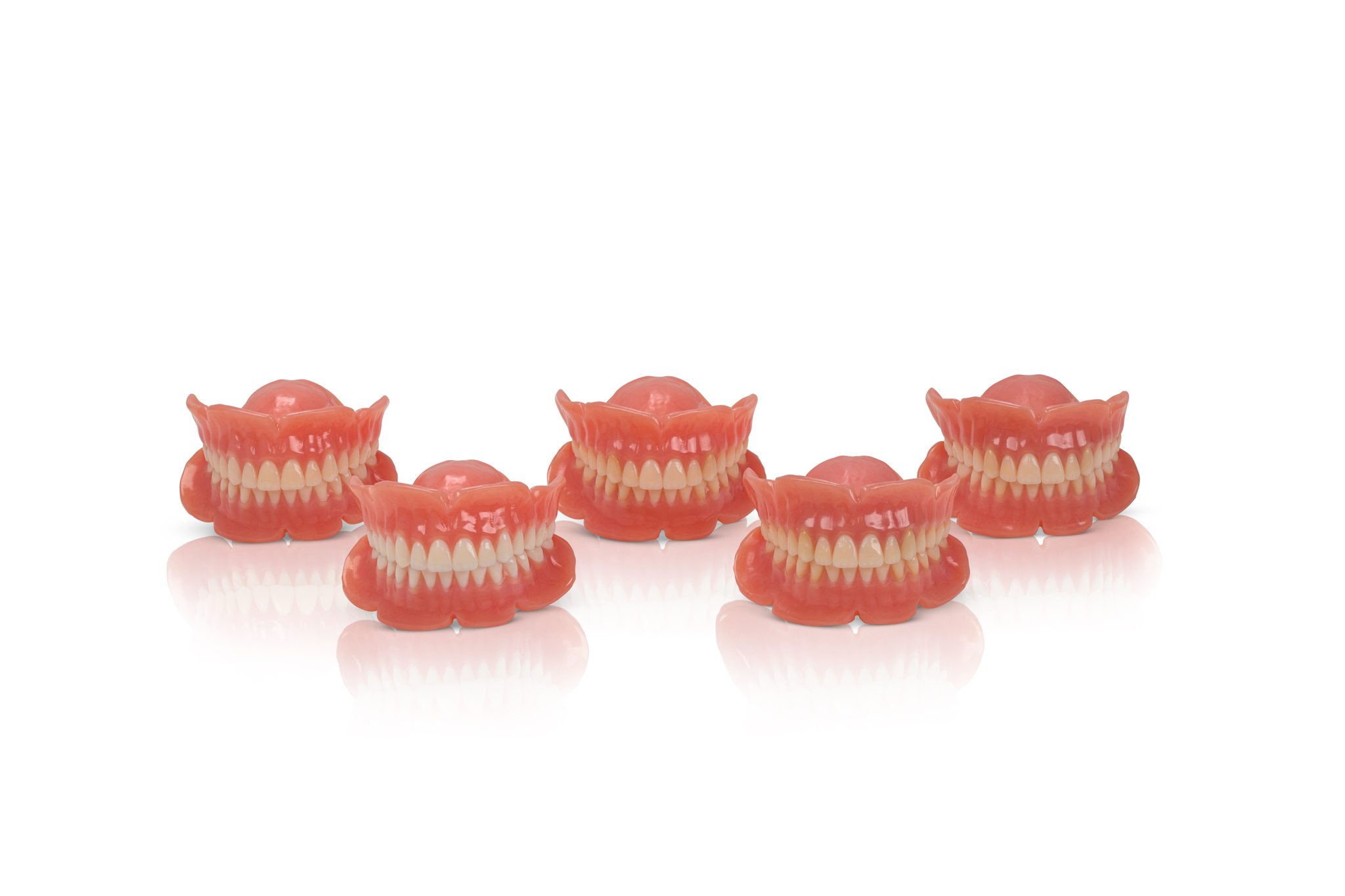
    If you’ve watched a lot of hockey, you’ll know that tooth loss is not uncommon. Younger players often go with removable dentures rather than permanent implants, because they know the chances are high that they’ll lose more teeth over the course of their career. What’s changed is that we can now quickly 3D print full-color dentures for patients. And Stratasys TrueDent can do one better: printing monolithic, multicolor, lifelike dentures that match the look of a person’s existing teeth.

    “Stratasys was the first to have a polychromatic 3D printed denture that solves all of the issues that we’ve had with the other digital solutions that have been out there,” Kabot said.

    Kabot explained that when the dental industry first began transitioning to digital solutions, the aesthetics that could be achieved with analog workflows just weren’t there yet, which “held a lot of providers back from leveraging the digital applications that were out there.” He says Stratasys was the first to have a polychromatic, FDA-cleared material that can match existing teeth shades and blend right in with a patient’s smile.

    “If you look at what happened to Jack specifically in the game when he had his front tooth knocked out, if you were going to use any other digital workflow to replace that tooth, it wouldn’t match because they’re monochromatic, right? You can’t print multiple colors in a DLP tooth,” he said. “We’re the only solution on the market that has the opportunity to do that.”

    Kabot said that partial dentures are essentially a “band-aid” for hockey players during the season, but noted that when they’re made the “old-fashioned way,” a lot of labor is required. However, he also told me that “we’re in a full-blown labor crisis of people who could actually make this stuff” with traditional technologies.

    “60% of Americans that are 60 years of age or older are candidates for tooth replacement,” he explained. “But we’ve experienced a 20% decline in dental technicians over the last 20 years. Prior to the pandemic, we had 50+ dental technology programs that you could go to and become a certified dental technician in the United States. Today we only have 15. So you put all that together and you’ve got a full blown labor crisis of actually of being able to leverage people that can make this stuff, which is why the digital applications are so sought after for these dental laboratories because they just can’t find people to make this stuff anymore.”

    This crisis, paired with our on-demand culture, is why so many dental labs are turning to digital technologies, like intraoral scanners and, of course, 3D printers.

    “A lot of the labs would love to opt for a digital solution, and we’re the only digital solution you could use to actually match that existing dentition that he [Hughes] has,” Kabot said. “It was a unique opportunity for us to reach out and show the benefits of the technology.”

    It is important to mention here that Hughes did not actually take Stratasys up on its offer of a free set of 3D printed dentures. But to me, that’s not the most important part of this story. While it would have been really cool if he had accepted, the fact that the company has this much confidence in its technology that it’s comfortable offering it to someone on such a global stage is the bigger headline.

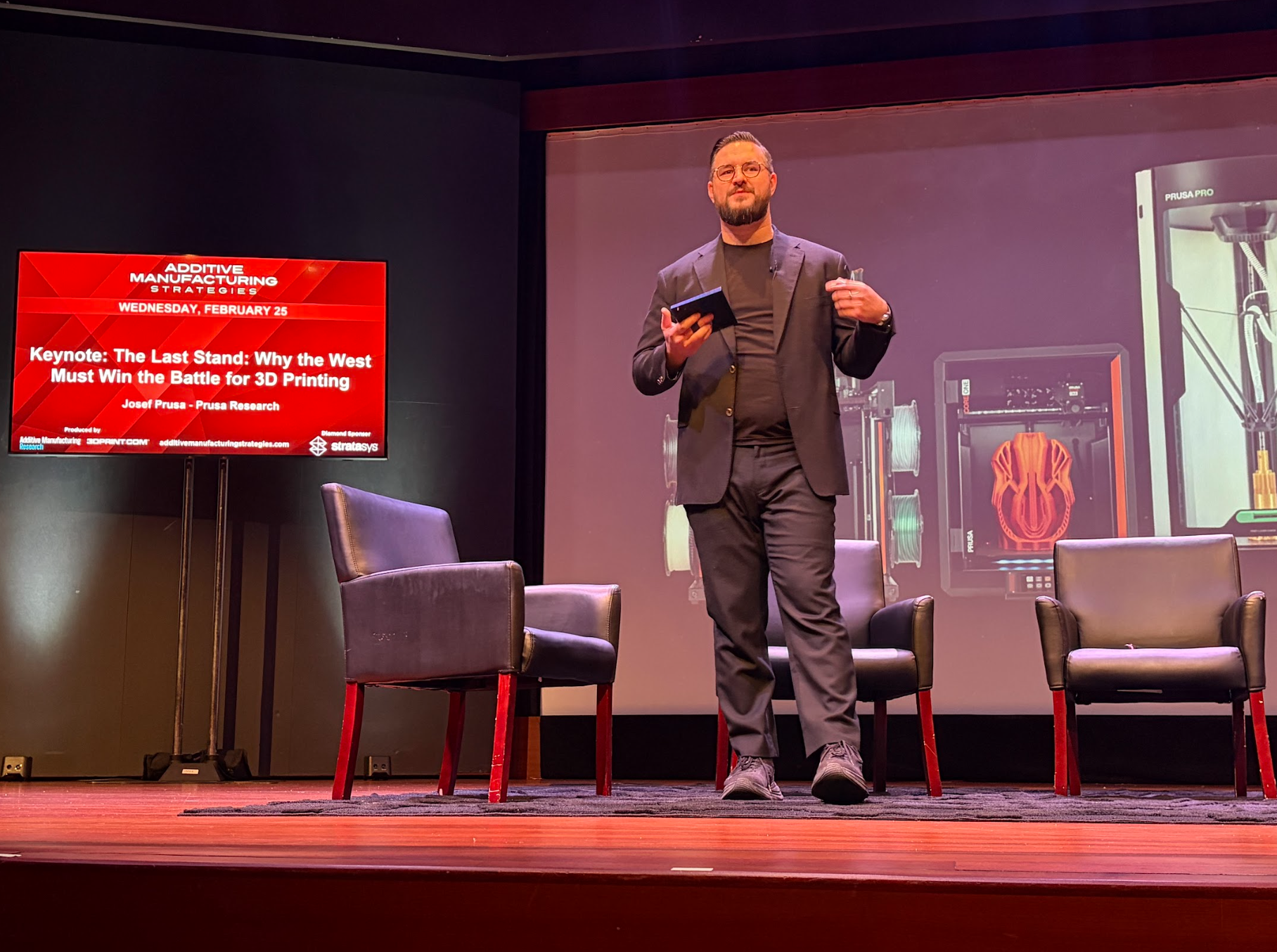
    Josef Prusa, CEO and Founder of Prusa Research. Image courtesy of 3DPrint.com.

    This makes me think about what Josef Prusa, CEO and Founder of Prusa Research, said during the recent Additive Manufacturing Strategies (AMS 2026) event in New York: we need to talk to more people outside of our industry and tell them about what the technology is truly capable of delivering. Prusa said the AM industry is “living in a huge bubble” and that we need to leave it more often to get the rest of the world excited about additive.

    That’s exactly what Stratasys did in this situation. They saw an opportunity to highlight what their technology could do, and they took it.

    “We were all inspired, I think, by the performance of the men’s and the women’s teams, and not just of what they did on the ice, but also their camaraderie,” Kabot said. “So yeah, I think it was opportunistic for us to reach out and highlight the benefits of the technology.”

    So what can TrueDent do? First of all, it leverages Stratasys PolyJet printing, and it’s a multicolor, or polychromatic, approach.

    “So you can imagine, a denture tooth isn’t just all white, right? There is incisal translucency, and it’s darker as you get more to the apical of the prosthetic,” Kabot explained.

    “All of the other solutions, whether it’s DLP or SLA, those are all really monochromatic solutions where you can only print one color throughout the entire tooth. So that’s what gives us the advantage. It’s by far the most aesthetic way of manufacturing a denture today. It actually now finally allows us to compete with the aesthetics you can get in the analog world, but you still get the benefits of digital, which is being able to customize, being able to match a patient’s existing morphology.”

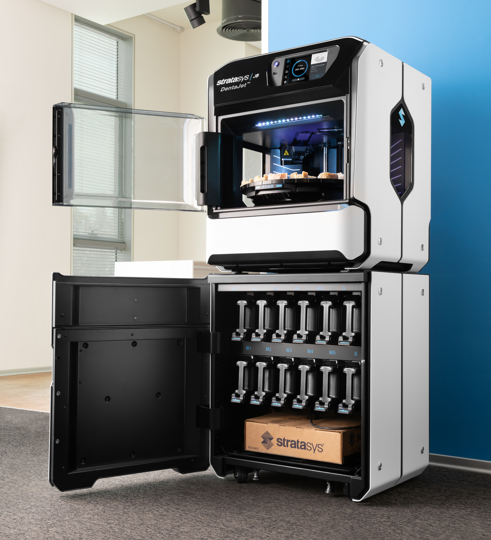
    Stratasys J5 DentaJet

    TrueDent is a tooth replacement therapy that uses the compact Stratasys J5 DentaJet platform. Kabot said the turnaround time for the company’s 3D printed dentures is less than a week.

    “The best dental techs in the world can make one in about two hours,” he told me. “We can print 40 in 10 hours. We just have more throughput.”

    The technology has already received FDA clearances and recently achieved Class IIa approval in Europe. Additionally, at LMT Lab Day in Chicago last month, Stratasys launched a new voxel-based solution to achieve “the highest end aesthetic.” So it seems like things are only going to keep improving for a dental solution that already sounds pretty close to perfect.

    “We’re finally deviating from indirect prints and from models,” Kabot said. “TrueDent is one of the first that’s a direct print application that can compete with analog materials.”

    Just like Stratasys, we all need to be shouting from the rooftops exactly what 3D printing can do.

    Images courtesy of Stratasys unless otherwise noted.

  • Please Localize Your Supply Chains

    Resilience is starting to feel like the only economic metric that matters, which is noteworthy, for one, because there is no defined metric that I know of that actually measures resilience. But there are plenty of measurements that can serve as indicators of a lack of/threat to resilience.

    Energy prices that seem to spike out of nowhere are an excellent example of that, though not the only example. Water scarcity is another example: again, though, not the only other example. While there are countless such examples that the world is currently facing simultaneously, they all essentially revolve around the fact that demand is in one area of the world, and supply is somewhere else, often very far away.

    The US Energy Secretary, Chris Wright, formerly a CEO of a fracking company, recently told CBS News that there isn’t a problem with oil supply, just a problem with logistics, which is the same thing as saying there is a problem with oil supply. I acknowledge the distinction between a shortage of viable extraction and a shortage of ways to get adequate supply to sites that need it, but as I understand it, being able to get that supply to where demand is happens to be a very important part of the process.

    As I noted in a recent post about a potential Taiwan crisis that’s lurking not too far behind the Hormuz crisis, looking at war as a business opportunity, no matter how popular it is these days, is monstrous. Thus, despite the fact that all of the preceding has been a lead-up to what I’ll point out now — that supply chain localization has become an absolute imperative, indeed an emergency — that’s not meant as an observation of an opportunity; it’s a warning about the requirements for economic survival.

    The tariffs that were imposed almost exactly a year ago, which the entire world effectively wasted the better part of that year deliberating over, were, of course, struck down about a month ago, suggesting that the whole international order spent nearly a year’s worth of effort on busywork. As it turns out, however, whether this was accidental or part of the design (the line between geopolitical analysis and conspiracy theory is very blurry), the chaos sparked by the tariffs did at least stimulate many industries to start rethinking their supply chains, even if reshoring to the US hasn’t been a major beneficiary of that process.

    The Trump administration has erred in its approach to industrial policy (or bungled it intentionally for some reason, whatever the case may be), so much so that permanent damage may have been done to the very idea that localizing manufacturing supply chains would be a good thing. On the other hand, a recent survey by accounting and consulting giant KPMG of 300 US-based C-suite professionals found that 14 percent of organizations are planning to invest in supply chain resilience/diversification with any potential tariff refunds, the highest percentage for any answer. Moreover, another 24 percent combined said they plan to reinvest refunds in R&D/product innovation and capital expenditures, both of which could align with supply chain resilience objectives.

    Now, those sorts of investments were likely to start increasing anyway, given that the One Big Beautiful Bill reinstated the first-year 100% tax deduction for R&D-related capital equipment, a rule that had been defunct between 2022 and 2024 owing to the original Trump tax cuts. The key angles to the KPMG survey’s findings are 1) the signaling of a double down on investing in new manufacturing hardware that can enable supply chain localization with the “found money” of tariff refunds; and 2) they reinforce that decision makers have internalized supply chain resilience as a long-term objective of future capital investment.

    That focus matters because businesses are now being thrown into a situation where their primary concerns will no longer be protecting margins but ensuring that they’re able to remain operational at all. Energy products are the most immediate challenge to address, a challenge that hits every business at once. In that context, the production-on-demand model enabled by 3D printing can potentially help alleviate the costs associated with the energy costs of storing inventory associated with the status quo. There is also the possibility of offsetting higher shipping costs by moving production nearer to the point-of-need.

    It’s not going to be limited to energy, though. Critical metals, batteries, pharmaceuticals, food, electronics, etc., are all shipped through the Strait of Hormuz. And one certainly shouldn’t assume there will be no ripple effect in other areas of global trade. I would, in fact, very much expect that to be the case, and President Trump has already pushed back his meeting with Xi on trade matters by a month, originally scheduled for the end of March.

    All of this is leading up to a November deadline for a pause on rare-earth export disputes. If trade dynamics continue to be subject to geopolitical chaos until then, everyone can expect an entirely new international order to emerge in the aftermath. Nations need to be preparing for self-sufficiency. 3D printing can help to some extent, but only if it’s incorporated into a broader resilience strategy. Get to strategizing.

    Images courtesy of KPMG

  • 3D Printing Moves Deeper Into Production as Parts Near $110B by 2034

    A new report takes a closer look at how much 3D printing is actually being used in real production. The numbers point to a market that is already growing at scale and still expanding.

    According to Additive Manufacturing Research (AM Research), the global value of parts produced using 3D printing could reach $110 billion annually by 2034. The findings point to a steady expansion of additive manufacturing across multiple industries, driven not just by experimentation, but by real production use.

    The report, titled “AM Applications Analysis: Parts Produced 2025–2034,” focuses on something that is less frequently the focus of market reports: the actual parts. Instead of looking only at printer sales or materials revenue, the analysis tracks how many parts are being made, where they are used, and how much value they represent.

    Based on AM Research’s data, parts produced with additive manufacturing are expected to generate around $24.5 billion in 2025, with consistent growth projected over the following decade.

    High-Value Applications Still Lead

    In metal AM, aerospace remains one of the most important sectors, particularly in terms of value. In fact, the report estimates that aerospace applications account for roughly one-fifth of global metal AM part value, reflecting the continued use of 3D printing for complex, performance-critical components. These include parts for aircraft engines, space systems, and advanced defense platforms, where weight reduction and design flexibility offer clear advantages.

    Ongoing investment in both commercial aerospace and space programs continues to support this segment, reinforcing its role as a key driver of high-value applications.

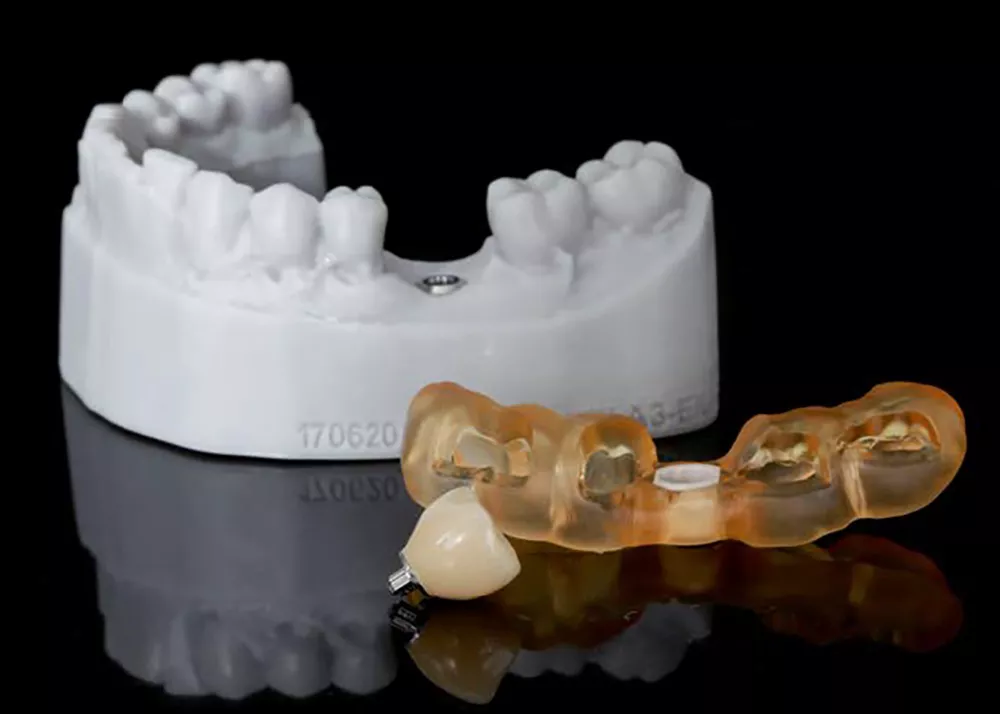
    Implant prosthetics. Image courtesy of youTooth by Straumann.

    While aerospace leads in value, the picture looks different when measured by volume. That’s because healthcare (and especially dental manufacturing) represents one of the largest sources of printed metal parts today. Millions of components are produced each year, including patient-specific dental restorations and medical implants.

    These applications are well suited to AM because they require customization at scale, something traditional manufacturing struggles to deliver efficiently. Dental manufacturing is a clear example, with tens of millions of patient-specific parts produced annually using 3D printing.

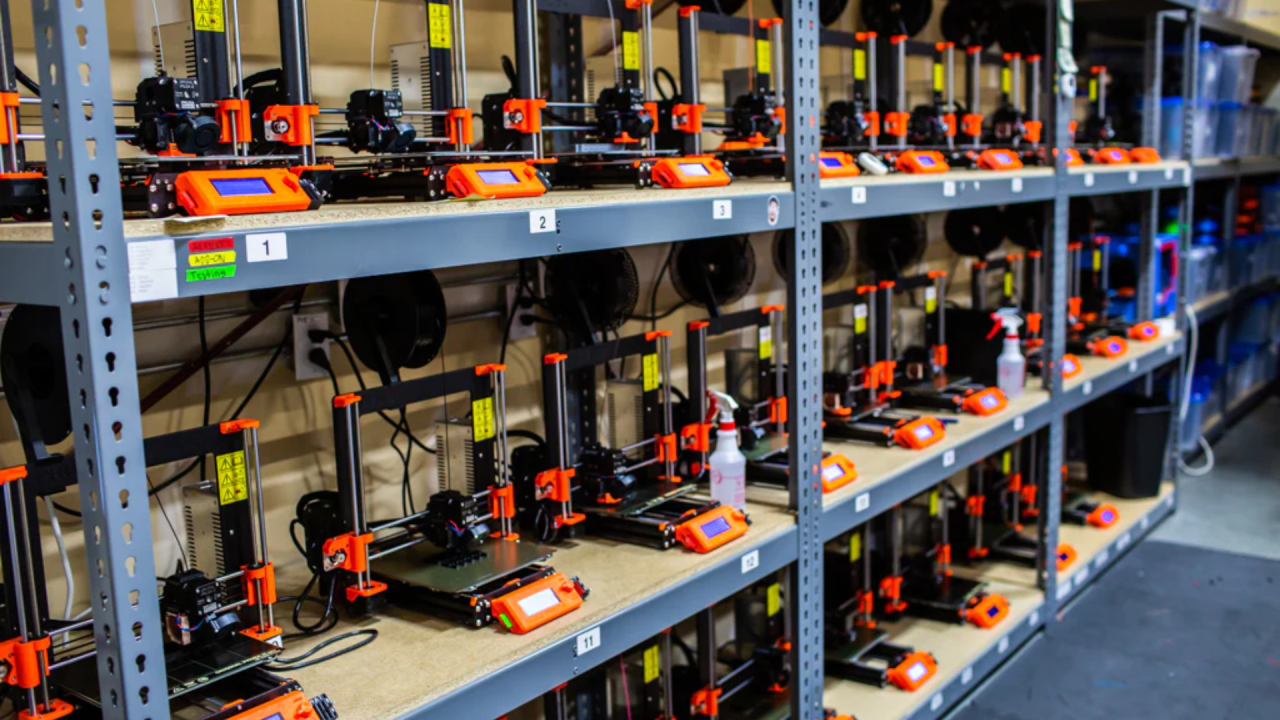
    Unlocking the Full Potential of Prusa i3. Image courtesy of Prusa.

    Growth is also accelerating on the polymer side, though for different reasons. Rather than high-value components, polymer 3D printing is being driven by volume and accessibility. The wider availability of lower-cost and desktop material extrusion systems, along with the rise of print farms, has made it possible to produce large quantities of functional parts at relatively low cost.

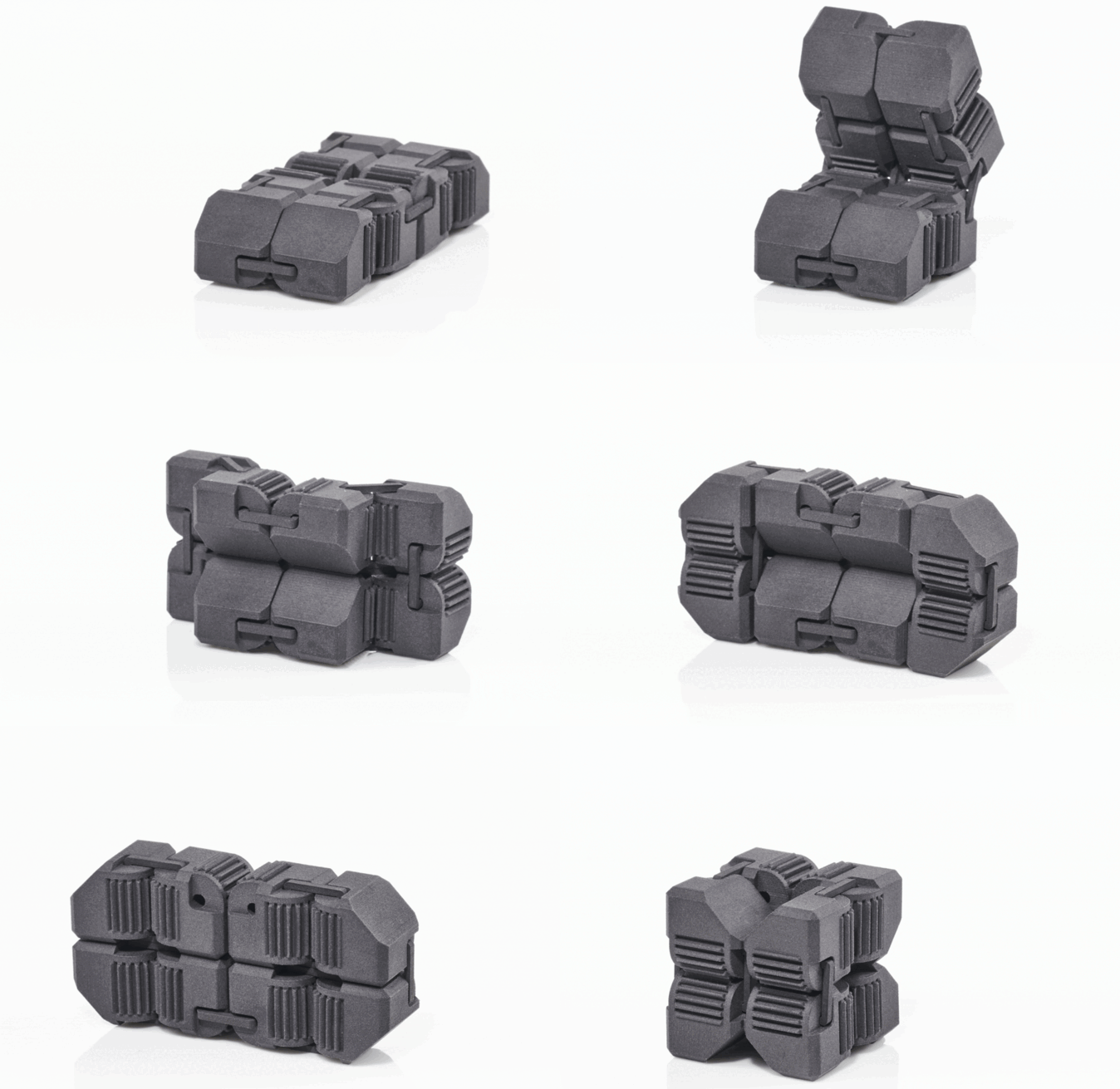
    These parts range from industrial components to consumer products, contributing significantly to overall market growth even when individual part value is lower.

    3D printed polymer component. Image courtesy of Basso.

    A More Mature Phase for AM

    Overall, the data shows an industry that is becoming more focused on real-world use. So instead of focusing on what the technology could do, companies are using AM where it clearly adds value, whether through design flexibility, supply chain benefits, or customization.

    This change is happening at different speeds across industries, but the direction is clearly that additive manufacturing is no longer just about prototyping. It is gradually becoming a production tool in specific, high-value applications.

    Additive Manufacturing Research Executive Vice President of Research Scott Dunham at the AMS event.

    For manufacturers, investors, and suppliers, understanding where AM is actually working is becoming more important than broad market projections.

    By looking at part production across industries, AM Research’s report gives a clearer view of where adoption is already happening, and where it may grow next.

    These findings will be discussed in more detail during an upcoming AM Research webinar later this month, where the firm will share finalized 2025 data and its outlook for 2026.

    The full Applications Analysis report is available through AM Research.

    Scott Dunham, the report’s author and Executive Vice President of Research at AMR, recently shared some of these findings at the Additive Manufacturing Strategies (AMS) conference in New York. He will continue the discussion in an upcoming AM Research webinar, where he’ll take a closer look at 2025 market data and what to expect in 2026.