• Death Spiral (or The End of the Fairchild Republic)

    Previously, I wrote about the disruption of US military power. Since then, events have required a reassessment. The US is clearly in decline, and a death spiral is occurring that will leave the country without the means to project power overseas. The US will remain a military power, but despite its elevated spending, it will not be a meaningful one. This is not some attempt at rage bait but an analysis of what I think is happening to US military power. It all started when a plane designed in the 1970s crashed in Iran in 2026.

    Now, with the US effectively alienating Europe, no one in Europe believes that the US is a dependable ally that will, in any meaningful way, come to its aid. When the recent ceasefire in Iran led to continued attacks on the Gulf States while the US turned away from the conflict, no one in the Arab world can really believe that the US is a dependable ally, either. With oil prices soaring, despite their importance to the US economy, the US acted independently of its allies’ concerns. At the same time, no provisions were made to defend major oil and gas sites or refineries. That oversight means that many Arab nations will now look to themselves for defense. An arms race may be underway, with major Arab nations looking to acquire nuclear weapons and a sovereign defense capability. It may lead to some US equipment being acquired, but the US’s repeated denial of satellite and intelligence access to its ally Ukraine, as well as the withholding of weapons at key moments, and the eventual abandoning of Ukraine, means that no one can reasonably base their national defense on the US as a key ally or weapons supplier. It is important to note that Ukraine has a treaty with the US that guarantees Ukraine´s independence and states that the US will come to its defense. The US has not honored this treaty.

    Logically, Europe is doing what it can to move away from US defense goods. Canada is doing the same, and Japan and Korea cannot expect the US to meaningfully aid them. US arms sales overseas may decline, pushing up unit costs for taxpayers. It is important to recognize that this shift has already happened. The damage has been done. This does not mean that the Arab world, the US’s Asian allies, or Europe will distrust only the current administration. No, they will never trust the US again. Being a US ally is pointless. I’m more than a little shocked that this thinking hasn’t reached the US. But what would you do if you were in anyone else’s shoes?

    Stalemate

    Using low-cost craft. Iran has blockaded the Strait of Hormuz for over a month now. With an arsenal of 50,000 low-cost Shahed drones and thousands of low-cost missiles and boats, Iran has the US in a stalemate. Yes, precision strikes took out much of its leadership, illustrating the US’s signint, guidance, and high-tech fighter and missile prowess. Yes, somehow the US has a tool that can find someone’s heartbeat over 60 kilometers away. But a wild swing to optimism by leadership over an incredibly complex mission to rescue a single pilot illustrates the US’s plight. Probably no other country could have come close to executing that pilot rescue mission. But many countries would have never tried.

    The War on Terror cost the US $8 trillion and over 7,000 lives across the US armed services. The wars in total cost over 4.5 million lives. The US can strike anyone with impunity, but everyone knows they won’t stick around for a real war. Just hang in there ten years, and they’ll leave. The Iran-Iraq war cost 500,000 casualties among soldiers from both sides. Earlier this year, the Iranian government massacred anywhere between 3,600 and 36,000 of its own people. In 1983, 241 US personnel were killed in a barracks bombing in Beirut. The US subsequently abandoned serious involvement in the Middle East for decades. These bombings were done at the behest of Iran. It is politically unacceptable for the US to lose soldiers. It is politically acceptable for civilians overseas to lose their lives. But the US public will not be able to tolerate losses of men overseas, especially if many die at once. And any conflict will bore a US public after a while leading to a US withdrawal. 

    Drone War

    Meanwhile, Ukraine has inflicted over a million casualties on the invading Russian forces. Most are inflicted by low-cost drones, often made with 3D printing. Now, Ukraine intercepts hundreds to a thousand Shahed drones per day on some days. Ukraine is developing its drone capability faster than anything ever seen in warfare. And it’s clear that drones will be key to any new conflict.

    If we look at cost per kill, it costs Ukraine less than $500 to kill an individual Russian soldier or destroy a vehicle, and around $5,000 to down a ballistic missile or a Shahed drone. The US government couldn´t make a coffee overseas for $500. US anti-missile and vehicle defense systems are significantly more expensive. In 2013, it was estimated that the US was spending $2.1 million per year per soldier in Afghanistan. Against ballistic missiles and drones, the Ukrainian approach is a factor of 100 to 1000 cheaper than other NATO arsenal solutions. The future of War is being developed in Ukraine, and the US looks hopelessly out of step.

    US unguided munitions like the AT4 cost $3,000 & M72A7 costs $2,500, and an M3 MAAWS costs $3,000 per round. So individual rounds of unguided munitions in the US arsenal are over 15 times the cost of FPV drones made by Ukraine. Dumb US rounds cost half as much as Ukrainian interceptor drones. Meanwhile, TOW missiles cost from $50,000, and the Javelin costs over $200,000. The US Switchblade 600 is $60,000, the Spike is over $200,000, and a Hellfire is over $150,000. Clearly, the US is overpaying per unit cost and paying far too much for munitions. Meanwhile, drones are replacing all of these systems in combat. And drones replace many of the launchers and vehicles that carry these systems into battle, as well as the troops who man them.

    High Costs

    The US’s gleaming, multi-million-dollar solutions and billion-dollar programs are ineffective and too expensive. In Operation Rough Rider, the US lost 2 FA-18s and 7 Reaper drones. The costs of this operation may be over a billion in munitions. The US had a total of around 280 Reaper drones, so losing so many is significant, especially since the conflict was relatively minor. The cost of the Reapers alone is over $210 million. The unintentionally funny-named earlier 2023 anti-Houthi operation, “Prosperity Guardian,” exemplifies this inefficiency, with operational costs of approximately $1.6 billion and an additional $2.4 billion spent on munitions. This does not include soldier salaries, overall maintenance costs for all vehicles, pensions, development costs, etc. The true number will be far higher.

    The US lost two F-18s during Prosperity Guardian. Neither operation did anything to degrade the Houthis’ capabilities or their threat to shipping. Neither had any meaningful military impact. The first 100 hours of the US’s latest operation against Iran cost $3.7 billion, while daily costs are estimated at around $890 million. At that rate, total costs could easily exceed $32 billion over the course of the operation. The US has lost over 39 aircraft in Epic Fury so far. $32,040,000,000 — that’s around the estimated cost to build a permanent moon base, or roughly NASA’s annual budget, or the entire operating budget for the Department of Justice. It is also around half of Ukraine’s total annual defense spending. The idea that the US could fight a long war with China, or even sustain an intense year-long overseas conflict, is a fantasy.

    Guys in Caves

    The US lost interest in Afghanistan and Iraq and abandoned its allies. The US abandoned the Kurds in Iraq in 1991, abandoned the Kurds in Syria in 2019, and again in 2026. The US abandoning Ukraine is nothing new; it is part of a consistent pattern going back decades. For rebel forces, believing in the US is something to do at your peril. At the same time, the US could not win a long conflict against the Taliban, nor could it keep the conquered Iraq pacified or free from Iranian influence. So it can strike with precision, but it can not occupy. The Iranian leadership, therefore, knows that some of its leaders will die, but the system they have built will survive no matter what. They know they’ll always take casualties, but they will never lose. And who will rise along with the US, knowing that they will probably be abandoned by it?

    A US Air Force A-10C Thunderbolt II aircraft assigned to the 75th Expeditionary Fighter Squadron prepares to land at a base in the US Central Command area of responsibility, Jan. 29, 2026. Image courtesy of US Air Force/Staff Sgt. Tylin Rust.

    The US, meanwhile, is running out of missiles, is depleting combat drones, and bleeding cash. By failing to secure and free up a small body of water after 30 days, the US has proved itself impotent. If you have long-distance drones, subs, and surface craft, and are dug in, the US can bring its full might to bear on you and not dislodge you. Three carrier strike groups of the US’s 11 are up against Iran, and they have been unable to open the Strait, nor can they protect the Gulf States from Shaheds. Of the US’s other carriers, 5 are undergoing maintenance, and 1 is scheduled for decommissioning. It is clear that drone swarms and low cost kit is winning. It is also clear that against a technologically more advanced enemy, the US struggles to maintain air assets. China, with long-range missiles, would keep carriers out of the conflict or further away.

    Death Spiral

    The United States must rethink and rearm in a new low-cost paradigm. The US can project power and conduct precision strikes, but it cannot sustain a prolonged conflict. Politically and financially, the US would not be able to sustain a war. The current generation of US kit is simply too expensive for it to project power in any meaningful way. By abandoning its allies, it has reduced the number of places where it can fly over or use their bases. This will make it more expensive and difficult to prosecute war. What’s more, by abandoning its allies, it has increased its costs and reduced the overseas revenue from future US weapons programs. The US has essentially painted itself into a corner.

    A downward demand spiral, or death spiral, results when fixed costs and overhead are spread across a declining volume of products. Fewer items will be less cost-competitive, and eventually their volume will further reduce until they are unable to keep the company afloat. The US is a government and not a company, so this works a bit differently. But this is how the US military death spiral is happening today. More money is going to ineffective products that cannot perform their tasks. More of these products will be used to compensate for this. Bigger programs will be needed to replace these ineffectual products. These will be more complex, likelier to overrun, and cost more than intended. This will lead to more of these products or more of the ones they’re meant to be made at, increasingly at unsustainable levels. Inventories will be depleted ever more quickly. The system will innovate less quickly because each cycle will be more expensive and longer. The US is therefore spending more and more to do less and less. Simultaneously, other countries increase their capabilities until the US is unable to wage war in any meaningful way.

    A US Airman A-10C Thunderbolt II aircraft pilot assigned to the 75th Expeditionary Fighter Squadron sits in an A-10 at a base in the US Central Command area of responsibility, Feb. 1, 2026. Image courtesy of US Air Force/Staff Sgt. Tylin Rust.

    Again, I’m not saying the US won’t be powerful or able to kill a pigeon with a satellite based laser, just that it won’t be able to meaningfully threaten anyone determined to achieve long-term victory. Sure they can kill me, but my country will never lose. Guys in caves, large countries, near peers, they´ll all win. Or indeed will anyone able to suddenly inflict heavy casualties on US military personnel. This is why Chinese hypersonics and anti-ship missiles are doubly important. They are not only a threat but one that could make further war untenable.

    Imagine you’re an English lord whose Grandfather owned all of Jamaica, and you have the biggest country house in Derbyshire, with 800 acres of land. There are old masters on the wall, and you can’t pay the heating bill. This is the problem that the US has. Objectively, the Lord is more powerful and wealthier than nearly all. But practically, the cost structure he has, all the things he has, and all the things he must protect keep him practically poor. He has few options but many assets. But an accountant down the road with a cottage and good savings may have more disposable income and more agility. A captive of its cost structure, the US is unable to properly mete out any long-term power.

    Thunderbolt

    The US is quietly waking up to this reality. Those who know, know. And the US is trying to address this. But this should be a bright thunderbolt at night, not something most US citizens don’t realize. It’s surreal, but not as surreal as being an A-10 Warthog pilot flying over Iran in 2026. Developed by Fairchild Republic between 1966 and 1976. Based on lessons learned from the Vietnam War, the A-10 Warthog was first produced in 1977 and remained in production until 1984. Meant to take out Russian tanks swarming through Germany, the plane is popular with ground troops and some commanders. Heavily armored and equipped with a large munitions load, it can loiter far longer than newer jets while resisting machine-gun and other fire from below better than other aircraft. It’s also very cheap to fly per hour. I remember being a schoolkid in 1991, and my teacher’s husband, a Warthog pilot, coming to our class. He conceded that it wasn’t a modern plane, but it was useful. In 1991.

    Built around a 30 mm Gatling autocannon firing 600 gram 29 centimeter depleted Uranium shells at a rate of 2900 per minute, the plane has been effective. Remarkably few were lost in Desert Storm, with over 70 getting hit and six airframes lost out of 4,000 sorties. Some returned to base after getting hit over 150 times. In the second Iraq conflict, five were lost, and in total, 122 of 719 airframes were lost over 50 years of service. Now in Iran, one was lost, having extracted an F-15 pilot. For that mission, it’s still the best plane. What’s more, in combating low-cost Iranian surface vessels, the Warthog’s maneuverability, stall speed, and time over target enable it to perform a mission that none of America’s newer craft can. Indeed, the US is unable to clear the Strait of Hormuz because it does not have the capacity to combat small surface vessels, even though everyone knew that these vessels would be Iran´s response to the US and these same vessels have been annoying US surface vessels for decades. Indeed in 2002 the US conducted a $250 million war game, Millennium Challenge, where the US lost a conflict against a Persian Gulf adversary equipped with swarms of cheap speed boats. It is now clear to all that the US has not been able to develop a suitable response to the Millennium Challenge in 23 years and trillions of spending. If only the US had more Warthogs!

    US Air Force A-10C Thunderbolt II aircraft dispense flares over an undisclosed location within the US Central Command area of responsibility, Jan. 5, 2026. The A-10 conducts operations across the AOR to provide close air support and combat airpower as necessary. Image courtesy of US Air Force/Airman 1st Class Travis Knauss.

    37 years ago, in 1988, the US began transitioning away from the Warthog towards the CAS variant of the  F-16, only to abandon that plan after Desert Storm. The newer, flashier kit was newer and shinier but couldn’t do the mission. Now imagine you’re an aviator with two clipboards strapped to your knees, looking at analog instruments and an honest-to-god mirror flying over a country with modern SAMs and reportedly one of the world’s most extensive air defense networks in something that is probably older than you are, made during the times of Saturday Night Fever, the Bee Gees, and Jimmy Carter. You’re circling, looking for a fellow pilot downed over the world’s preeminent torture kingdom. There is bravery there that I caught a glimpse of when a pilot spoke to our class 34 years ago. But still, it defies belief to do such a thing. It beggars belief that you would send that person out there, in that situation, in that plane.

    It also beggars belief that, given the real needs of the Iran conflict, this plane has not been replaced. It’s wild that there is no other craft that can do this. It has been well known for decades that Iran, in a conflict, would menace shipping and enemies alike with inexpensive, fast attack boats, cut price ICBMs and drones. But, there has been no adequate modern solution developed in all this time. And with all the billions spent over the decades, it has not developed better capabilities for close air support or for taking or covering large areas of terrain inexpensively. With ever-diminishing relative capability, the US is confined to spending ever more in every conflict. And if the new kit can’t even adequately replace the functionality of the old stuff, alarm bells should ring because bravery alone will not be enough to face the future.

    Images courtesy of CENTCOM
  • Digital SEA: Austal USA Launches Secure 3D Printing Platform Hosted by US Navy

    So far in 2026, the most significant shift in the additive manufacturing (AM) industry is also the subtlest: after years in which various enterprises, organizations, and government agencies have trended in this direction, we’re finally starting to see the emergence of fully-fledged, digitally-enabled industrial networks that include AM as a centerpiece. This is AM in the context of a genuine industrial internet of things (IIoT) buildout.
    Given the US Navy’s exuberance for accelerating the development of digital manufacturing processes, it should probably come as no surprise that Austal USA, one of the Navy’s key partners in its industrial base efforts, is playing a leadership role in this buildout. Austal USA has just announced the official launch of the Digital SEA (Secure Exchange for Additive) software platform, which was first announced last November.

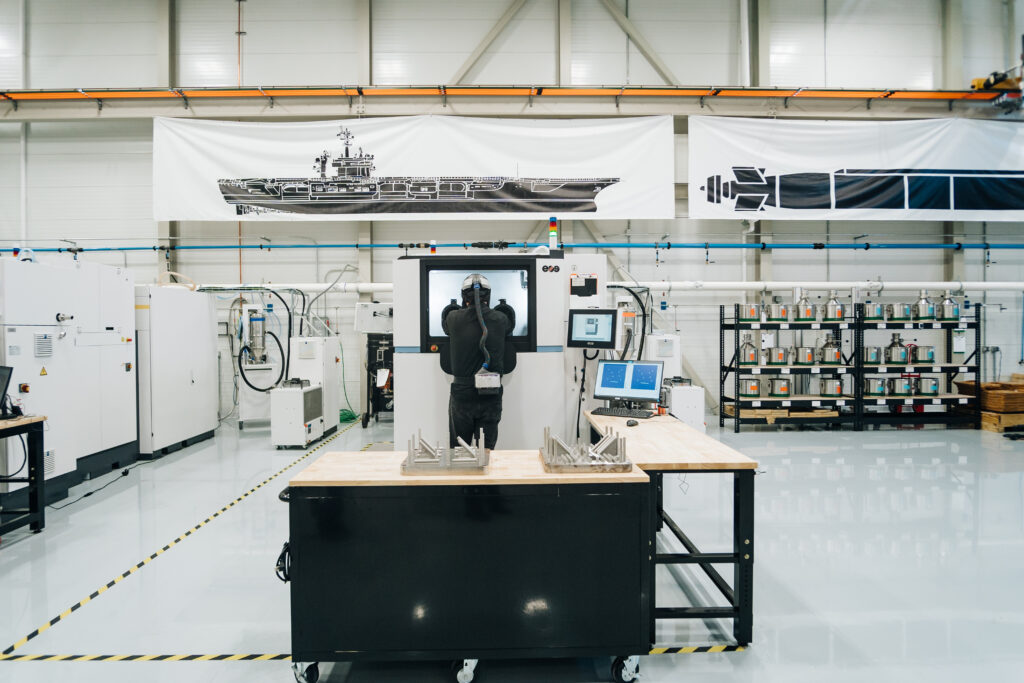
    Austal USA has approached the revamp of US domestic maritime defense manufacturing capacity from multiple directions, by forming relationships with new, untraditional suppliers, expanding its own operations, and helping the Navy build an AM CoE in Virginia that the shipbuilding giant operates. The launch of Digital SEA can be viewed as something of a finishing touch on that initial phase of activity, providing a digital clearinghouse that unifies all of the progress Austal USA and the Navy have made thus far, and enabling future additions to the Navy’s industrial base programs to benefit from that progress as well.

    According to Austal USA, the company has already helped the Navy use AM to develop over 70 parts scheduled for fleet installation, but the launch of Digital SEA should help that catalog expand even faster. Reinforcing that the platform’s launch is part of a broader shift driving the whole SaaS-for-manufacturing market, Austal USA developed Digital SEA in partnership with leading software service enterprises, including Sabel Systems, C3 AI, and EdgeTI. Attendees of Sea-Air-Space 2026 this week can learn more about the new platform at Austal USA’s booth #1717.

    In a press release about Austal USA’s launch of Digital SEA, Austal USA’s interim president, Gene Miller, said, “The development and implementation of Digital SEA is a breakthrough for the maritime industrial base’s [AM] objectives and directly supports the Navy’s submarine fleet. It reflects our commitment to advancing the submarine industrial base — not only through [AM] leadership, but also through our role in building modules for both Virginia- and Columbia-class submarines at our Mobile facility.”

    Madeleine Locke, Program Manager at Austal USA, said, “Without an efficient way to share data and collaborate across the industrial base, we lose two of [AM’s] greatest advantages — speed of delivery and a distributed, redundant production capability. By closing those gaps, and by bringing together a strong team of industry and technology partners, we can directly enhance production capacity and ensure the Navy’s submarine and surface programs are supported with greater agility and resilience.”

    Whether it’s for surface vessels or submarines, shipbuilding seems to be just about the most difficult capability for a nation to rebuild. That has presented the US Navy with a virtually unprecedented challenge in its industrial base acceleration campaign. But, if there’s one thing that the branch has gotten right, it’s its diagnosis that the problem is primarily one of achieving change management across an international ecosystem of organizations.

    Thus, while it has taken years for the Navy, Austal USA, and all the rest of the relevant players to get to the present point, the consensus that the public-private partnership has successfully cultivated means that there’s now a living, breathing example of what can happen when the majority of an entire sector is all on the same page surrounding large-format AM. The most important lessons for everyone else aren’t even technological, so much as organizational and cultural.

    At the same time, from a more purely technological perspective, Digital SEA will be an indispensable test for the feasibility of keeping supply chains secure, even as they’re being made more accessible. Demonstrating that this is a viable option in the realm of critical national security infrastructure could permanently reshape how AM is viewed by the stakeholders responsible for managing major economic pillars.

    The most exciting part is that, if the endeavor proves successful, the Navy (and Austal USA, etc.) will have created a model that can be duplicated much more easily than it was created in the first place. Companies like Austal USA could then find themselves in a position where branching out from their core areas of expertise into offering more general digital technology integration services starts to look like a realistic possibility.

    Images courtesy of Austal USA

  • Rice Researchers Use Microwaves to 3D Print Electronics

    Rice University researchers have found a way to 3D print using focused microwaves. Published in Science Advances, Professor Yong Lin Kong and his team believe the technology could be used to 3D print electronics through heating inks without damaging substrates. By focusing the heating area precisely, only the electronic ink can be heated at one particular location.

    Until now, this has been one of the biggest challenges in 3D printing electronics: the heat needed to make the ink functional often damages the material underneath it.

    Professor Kong said,

    “The ability to selectively heat the printed materials enables us to spatially program the ink’s functional properties, even when surrounded by temperature-sensitive material. This allows us to integrate freeform electronics onto a broad range of substrates, including biopolymers and living biological tissue, all within a desktop-size printer without the needs of complex facilities or labor-intensive manual processes.”

    They call their process near-field microwave 3D printing (NFP). The process builds on the Meta-NFS device developed in conjunction with National University of Singapore researcher John Ho. This is a metamaterial device that creates directed near-field microwave energy. The system can focus that energy into a heating zone as small as the width of a human hair, allowing very precise control during printing.

    Coupled with the microextrusion of nanoinks, local microstructure can be controlled, leading to programmable properties in circuits. Ceramics, thermosets, metals, or other doped inks can therefore be made either on the surface or selectively hardened within other structures. Particular sections can be annealed, and different materials can be joined selectively. Layers could also be joined more thoroughly. This also means different materials and functions can be built directly into the same structure during printing, rather than assembled later.

    The team hopes that a desktop unit will now be able to make entire circuits at scale. Unlike traditional electronics manufacturing, which often relies on centralized facilities and complex assembly, this approach could simplify how electronic devices are made.

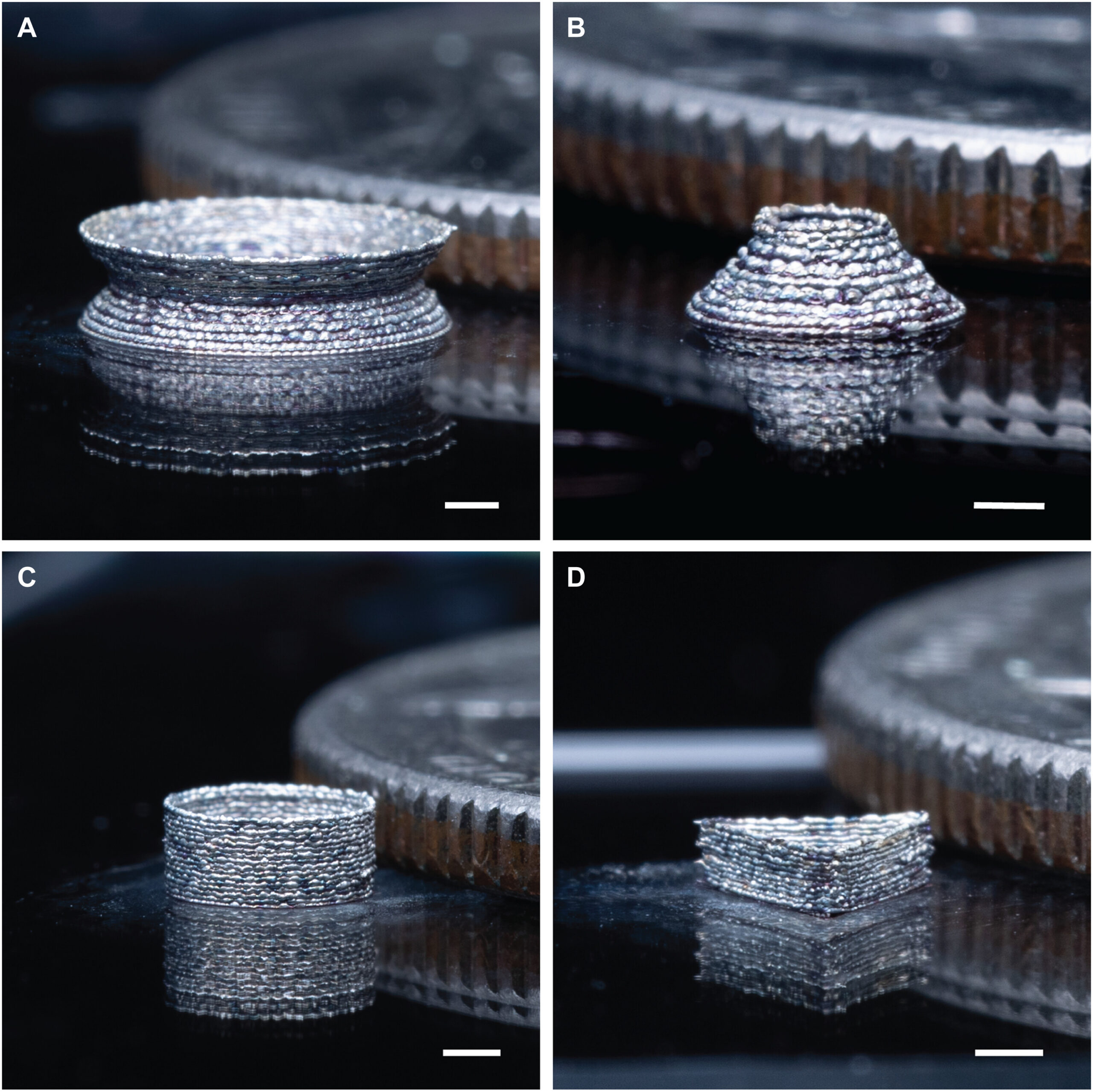
    Photograph of 3D architectures printed by the layer-by-layer deposition approach using Meta-NFS. Image courtesy of Rice University.

    As a test, strain sensors made from ultrahigh-molecular-weight polyethylene were printed to form a circuit that can be used in the body. They’re also working on sensors that can be eaten, soft robots, and complex devices. Meta-NFS 3D printing is now a core foundation for Kong’s group in developing fundamentally new classes of electronic devices for a broad range of applications that did not exist before. For instance, the group is developing ingestible electronic systems for personalized diagnostics and treatment, designing bionic devices that interface with biological organs, and creating next-generation 3D printed soft robots and drones with highly integrated electronic functionality.

    Highly selective and rapid volumetric heating of 3D printed materials with a Meta-NFS. Image courtesy of Rice University.

    Kong says that,

    “Meta-NFS 3D printing enables us to develop new classes of hybrid electronic devices that could not have been built — or even envisioned — with previous manufacturing approaches, providing us with a new capability to address unmet societal needs.”

    As this allows for volumetric heating and the volumetric construction of new structures, made of annealed inks, this gives us a truly new capability. This could be a very advantageous process for enclosed 3D printing of sensors and complex devices. The body 3D printing sensor market could be considerable. This could also be used to make compact wearables for skin use. Glucose and health monitoring alone are a significant market there. Perhaps this could be used to make circuits at scale at much lower cost than alternatives. Our houses, lamp posts, and bridges are almost all dumb; resilient, enclosed circuits could make them monitor themselves or people in general. This is therefore a notable step forward in 3D printing that could lead to the democratization of enclosed-sensor 3D printing.

  • 3D Printed Weapons Keep Showing Up in Crime

    In the past few weeks, activity around 3D printed weapons in the U.S. has increased across several fronts. States including California, Colorado, New York, and Washington are moving forward with new laws, courts are deciding how digital gun files can be regulated, and law enforcement continues to report arrests tied to 3D printed firearms and other dangerous uses. While making firearms can be legal in some cases, much of the recent activity is focused on how 3D printed guns and their files are regulated, shared, and handled by law enforcement. Because so much is happening with laws and arrests, some of the more unusual cases stand out more. 

    States Push New Laws

    Several states are trying to tighten the rules around 3D printed guns, an issue that has been building for months as lawmakers look for ways to deal with untraceable “ghost guns” made outside of the traditional channels. Officials say many of these weapons are difficult to track and have shown up in criminal cases, which is driving much of the recent push. The focus is not just on the weapons themselves, but also on the digital files that make these guns possible.

    In Colorado, lawmakers are pushing a bill to limit 3D printed ghost guns, as part of a broader effort to address untraceable firearms that officials say have become harder to track and regulate, including requirements for serialization and restrictions on how these weapons can be made and assembled. However, they are still debating how strict the proposal should be.

    In New York, Governor Kathy Hochul and Manhattan District Attorney Alvin Bragg have been pushing for stricter rules after a series of high-profile cases involving ghost guns. Their focus has been on limiting access to online files used to produce these weapons and increasing penalties that are tied to their use.

    Washington State, meanwhile, has passed a law targeting 3D printed firearms, 3D printed gun parts, and the digital files used to make them, adding restrictions on both the production of these weapons and the distribution of the files used to make them.

    California is taking a different approach, filing lawsuits against websites that host these types of files, and arguing that they make it easier to produce guns outside the existing rules and should be held responsible for their distribution.

    Glock designed its civilian-purchased pistols to be easily modified. Image courtesy of the City of Chicago.

    Courts are also starting to play a larger role. In a recent decision, a federal appeals court found that regulating the distribution of 3D printed gun files may not violate the Constitution. This could give states more room to control how these files are shared online.

    At the same time, California has filed lawsuits against websites that host 3D printed gun files, arguing that they enable unlawful manufacturing. These cases could help set boundaries for how digital designs are treated going forward.

    Federal agencies have also been paying close attention in the last few years. The Bureau of Alcohol, Tobacco, Firearms and Explosives (ATF), for one, has been warning about the danger of machine gun conversion devices (MCD) since at least 2024.  Easy to manufacture and illegal for decades, MCDs can turn a semi-automatic firearm into a fully automatic weapon—delivering hundreds of rounds with a single pull of the trigger. also known as “switches” or “auto sears,” are small components—usually made from metal or plastic—that can be easily attached to a handgun or rifle to convert it from semi-automatic to fully automatic. While possessing or manufacturing MCDs is illegal in the U.S., their production has exploded in the last two years, largely because it is very easy to create them with 3D printers, and they are often sold online or printed at home. 

    Recently, WKRN news talked to the ATF field office in Nashville about the growing use of 3D printers to create conversion devices, like Glock switches. Officials have said these items are increasingly showing up in investigations and are difficult to trace, which is driving concern, especially if they end up in the hands of violent offenders or serial shooters.

    Enforcement and Arrests Continue

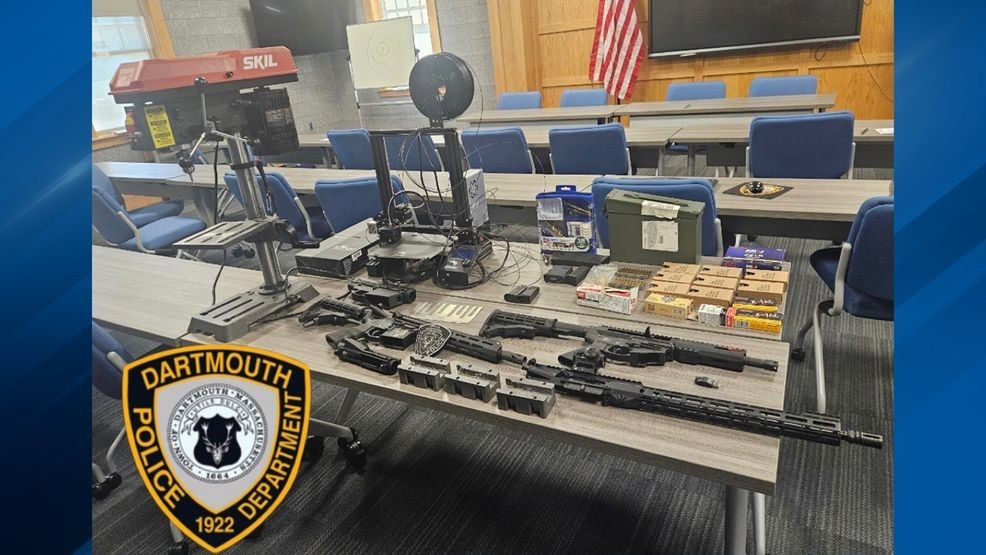
    At the same time, police continue to report cases involving 3D printed guns. For example, in Massachusetts, police in Dartmouth seized ghost guns and a 3D printer after arresting a man who was not allowed to own firearms. Officers said they found rifles without serial numbers, a 3D printer used to make parts, and digital files tied to gun production. 

    Dartmouth police said they seized ghost guns and a 3D printer after a man was arrested. Image courtesy of the Dartmouth Police Department.

    In Louisiana, a man in Breaux Bridge was arrested for using a 3D printer to make illegal switches. Authorities pointed out that manufacturing or possessing devices that convert firearms into fully automatic weapons without proper federal registration is illegal under both state and federal law. However, these devices are increasingly being made and shared.

    Also, in Pennsylvania, police in Sunbury reported finding close to two dozen 3D printed gun switches along with other weapons, including grenades, during an investigation. Authorities said the case involved a mix of firearms, drugs, and equipment tied to making gun components. 

    Similar cases have been reported outside the U.S., as usual. In the U.K., police in the West Midlands made six arrests after seizing a 3D printed gun during a raid, in what they described as a serious case involving illegal firearms production. The bust was part of Operation Target, a 24/7 mission to tackle serious and organized crime across the region.

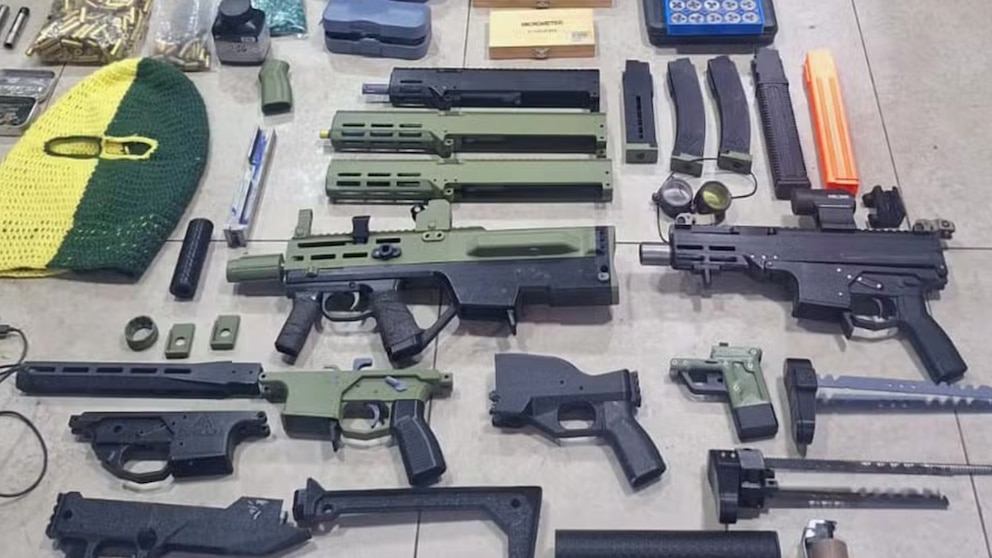
    Brazilian authorities, led by the Brazilian Federal Police, dismantled a major global 3D printed weapons network under Operation Shadowgun, arresting a figure known as “Zé Carioca,” a young engineering student who was also a key developer and distributor tied to open-source gun designs and online communities. Investigators say the group operated across borders, using encrypted platforms, VPNs, and cryptocurrencies like Monero to fund and distribute files and parts that were tied to ghost guns. The raid not only removed one of the most influential figures in the 3D printed weapons scene in South America, but also exposed how decentralized and international these networks have become, local law enforcement said. Ultimately, it led to panic now that users realized they could, in fact, be tracked.

    Material seized during Operation Shadowgun, including Zé Carioca’s balaclava. Image courtesy of the Brazilian Federal Police.

    Overall, these cases show how 3D printing is increasingly being used in illegal and criminal situations. It’s undeniable that the technology itself has countless positive and legitimate uses, but when it comes to 3D printed weapons, a lot of the attention focuses on how it can be misused to make untraceable firearms and parts that end up in the hands of criminals, being used outside the law. To law enforcement, that is becoming a real and growing problem. 

  • UltiMaker to be Exclusive North and South American Distributor for Tectonic 3D Filament

    UItiMaker will be the exclusive distributor of Tectonic3D filament in North and South America. Tectonic makes high-performance materials for defense available on desktop 3D printers. It has been working with UltiMaker for a number of years, and already has ten print profiles available on UltiMaker systems.

    UltiMaker President of the Americas Jim Franz said,

    “Tectonic-3D’s commitment to advanced material innovation perfectly complements our mission to provide a reliable, industrial-grade production platform. By becoming the exclusive U.S. distributor, we are giving our customers direct access to the most advanced filaments on the market, backed by the seamless integration and support they expect from UltiMaker.”

    Tectonic 3D CEO Ken Kempinski stated,

    “We look forward to building upon our partnership with UltiMaker. Our materials are designed to push the boundaries of what is possible in additive manufacturing. We are extremely excited to expand our collaborations with Ultimaker on their S and Factor series printers.”

    Tectonic has high-performance materials for rail, aerospace, and industrial applications. Some of the strongest desktop 3D printer materials available are made by the firm. It also has high-temperature materials for high-temperature systems such as the miniFactory. But, in desktop materials that pack a punch, the company is ascendant.

    Whether for MRO or applications such as drones, Tectonic’s filaments are being used close to the point of need to make high-performance parts with desktop systems. The company’s materials have high stiffness and Continuous Service Temperature PET, PA, and PP materials with Carbon and Glass Fiber in them. They also make a specific family of lightweight drone materials. Meanwhile, its Vulcan series of PEKK, PEI, and PPSU are used for high heat applications. They also have specialized materials such as TPC.

    Tectonic seems to be well. Furthermore, with all of the movement towards manufacturing at the edge and making at the point of need, its materials will be in much higher demand in the coming months, especially in the US. Plus, Ukraine is showing that desktop 3D printers can be war winners. If I were Tectonic, I would have worked with Philips Federal to distribute my product to the government. I may have given them exclusivity if they demanded it. But, if I could have, I would have gotten them and Dynamism or MatterHackers, for example.

    Tectonic Signing an Agreement with the Dutch Ministry of Defense

    I’m not sure what the UltiMaker distributorship is going to achieve, and why Tectonic gave it to them. Prusa Research is ramping up 3D printer manufacturing in the US and finding more and more defense customers. Wouldn’t that have made more sense? I love UltiMaker, and I used to work there way back when. But, the firm looks like it’s in dire straits. A defense-centric strategy for them makes sense. Indeed, defense and medical are the only real avenues open for the firm. And I do hope that they do well in the US defense market, and in Europe as well. UltiMaker traditionally has good machines that work well and last a long time. They’ve made a lot of quality systems, and I hope that there is a place for them in the marketplace. The Netherlands is to spend up to $300m making drones for Ukraine, perhaps this link up means that the two companies, both with Dutch arms will end up printing a lot of these?

    And a filament and printer tie-in really may make sense for some projects and customers. But, perhaps this may alienate other manufacturers. If it doesn’t, it may be easy for them to get UltiMaker to distribute the material, and that may work for them. If Tectonic is loyal and kind, that would be great as well. And perhaps this could be the beginning of a path towards high-quality desktop printers for defense from UltiMaker?

  • HP’s MJF 1200 Targets Entry-Level AM — And Could Shift the Competitive Landscape

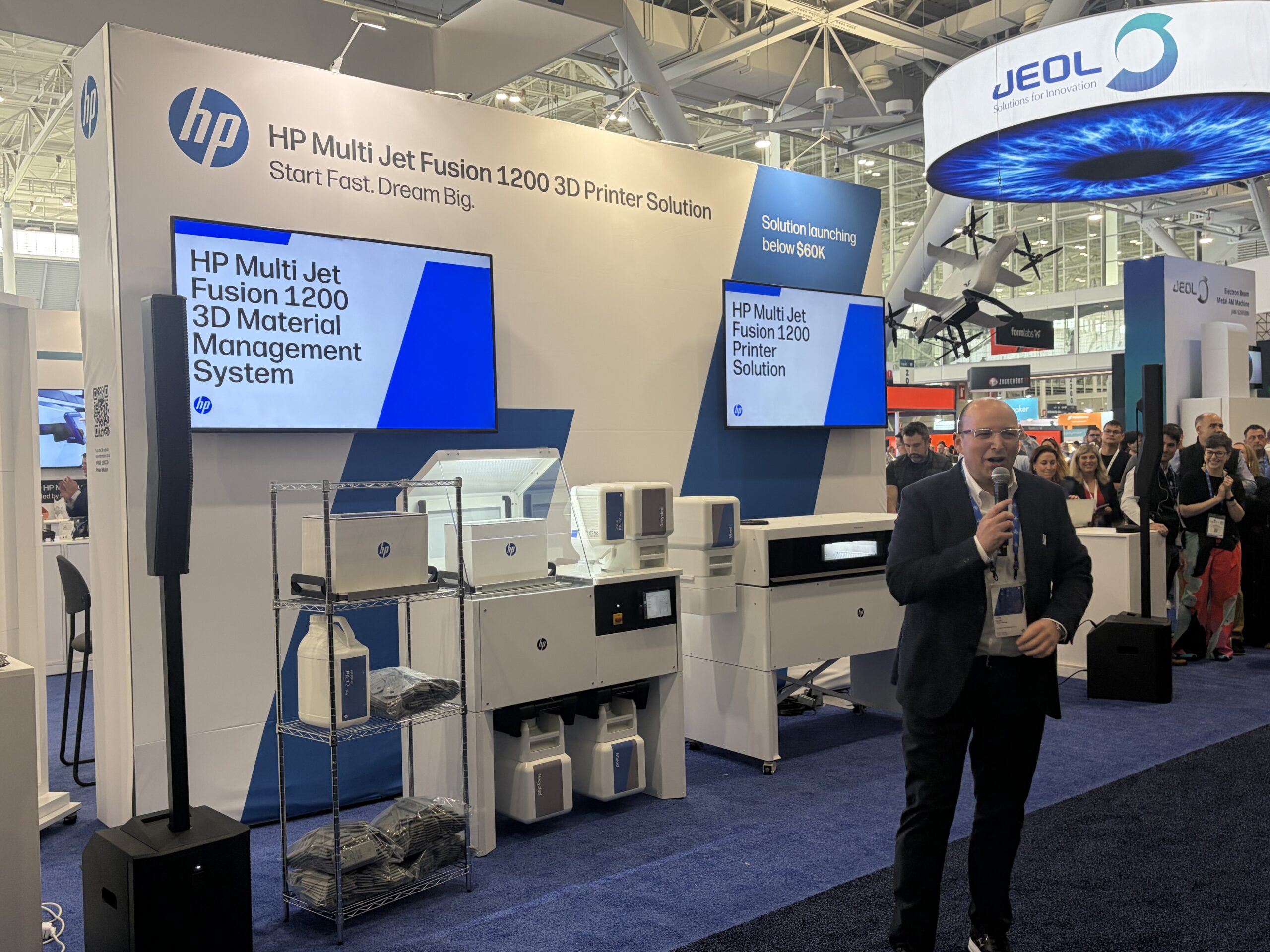
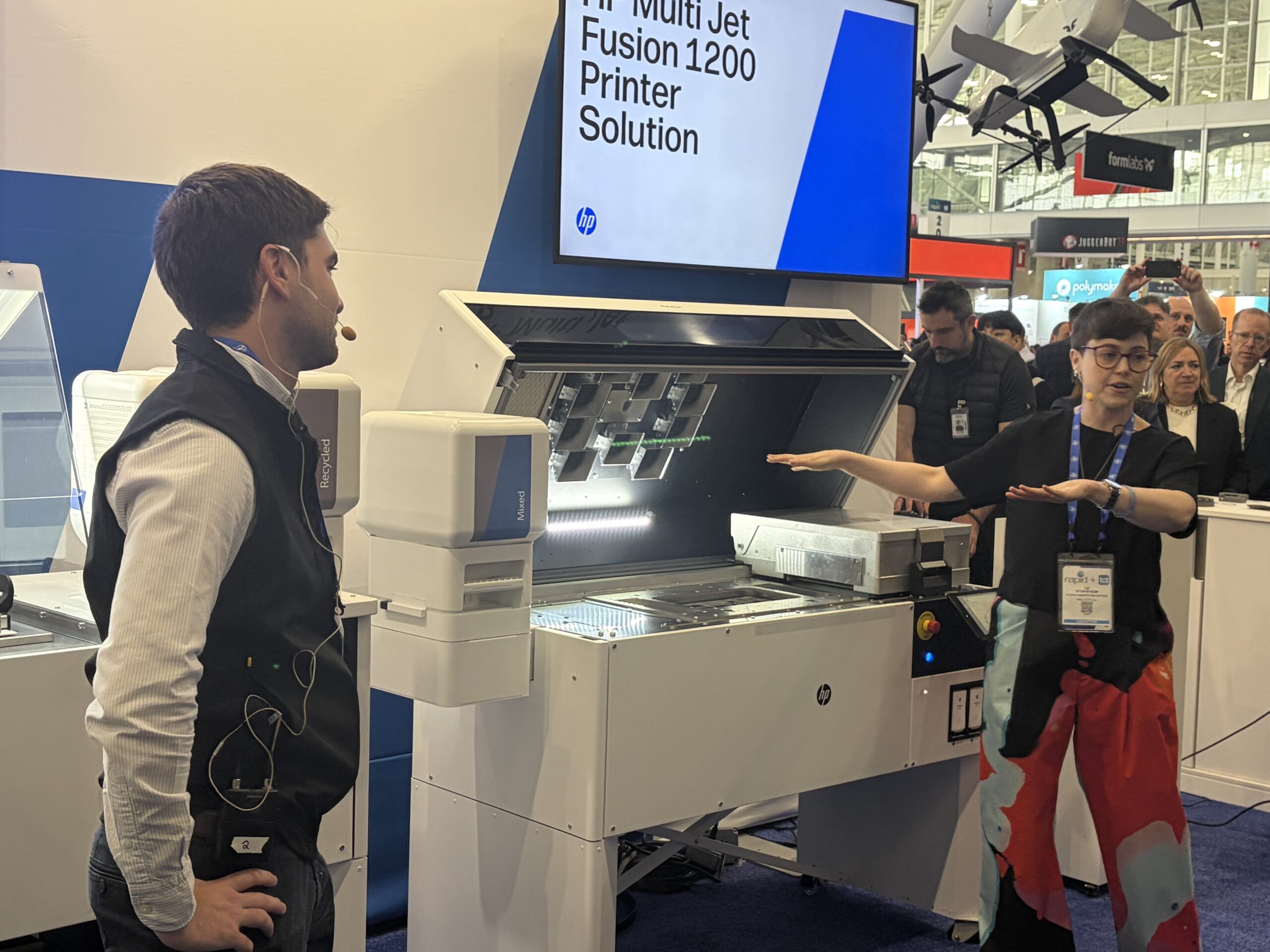
    HP has launched an entry-level MJF solution, the HP Multi Jet Fusion 1200 3D Printer Solution, which will be available in 2027. What is the 1200 exactly? What does it mean for the market, and what will it do for HP?

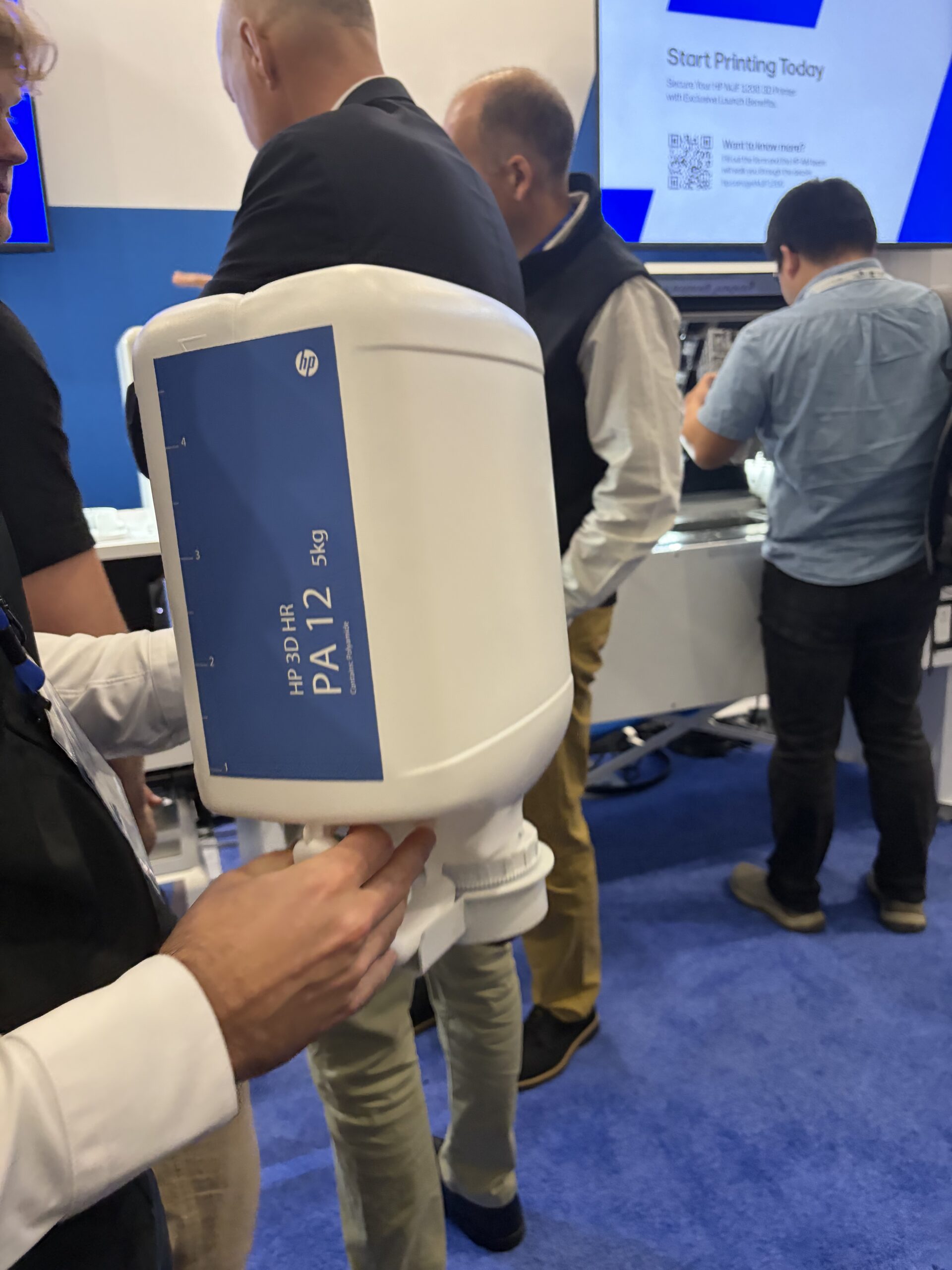
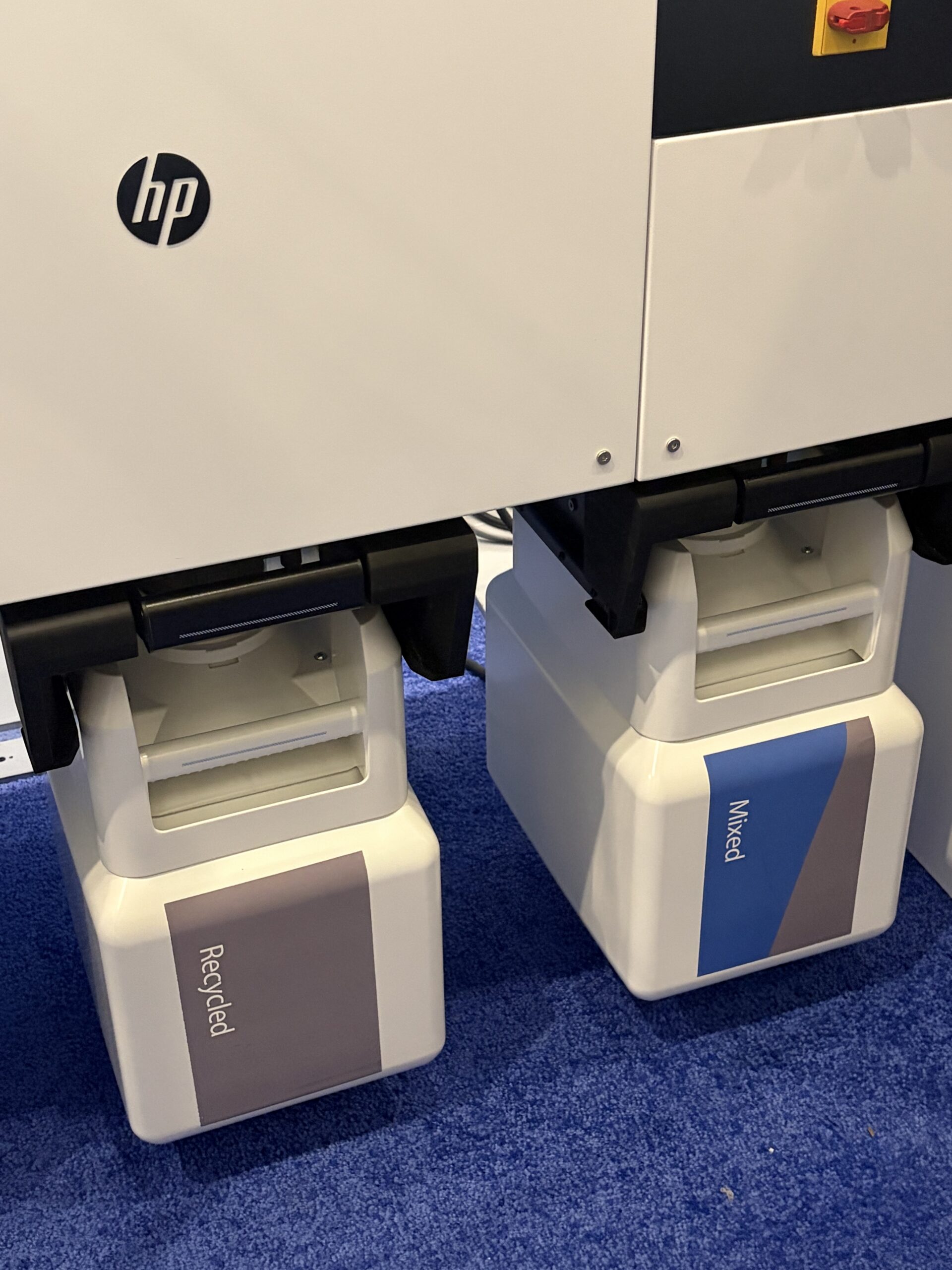
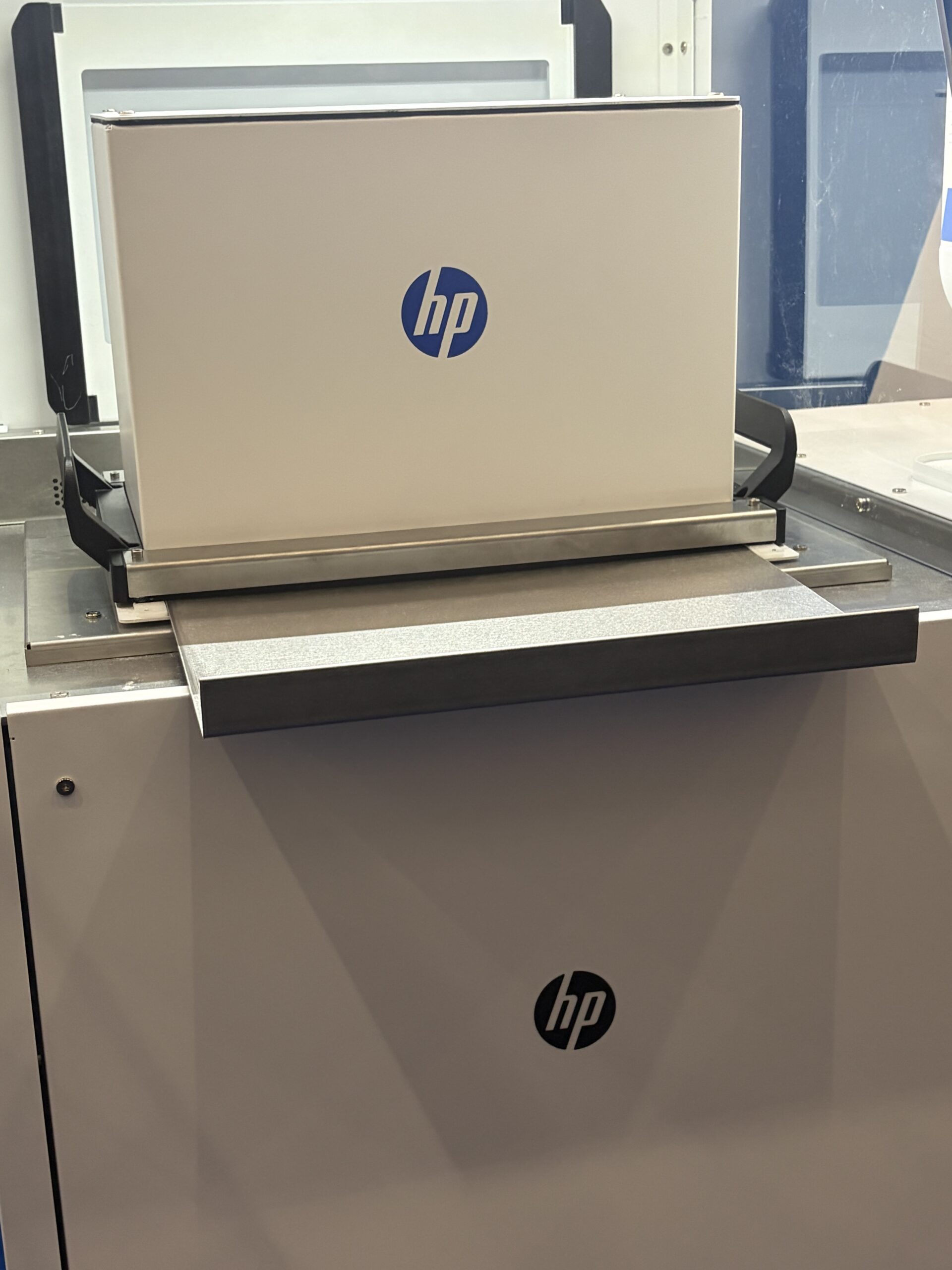
    The 1200 is a sub-$60,000 PA12-centric 12-liter MJF system with a build volume of 12 liters, officially unveiled live at RAPID + TCT 2026. Not just a printer, it comes with an unpacking station, Magics Print for HP by Materialize, and a live viewer tool. The system is meant to work without extra gas or other requirements for the site and on standard electrical outlets. Initially, it launches with HP 3D High Reusability PA 12, “enabled by Evonik,” a great material with strong economics. That material can reuse up to 80% of surplus powder. The material costs around $100 per kilo. The overall economics of the material should be better than most on offer. The powder can lead to strong, well-defined parts and should suit most applications. Some PA 11 would be nice, but perhaps this will follow. It’s unclear whether Evonik is somehow sponsoring this system to get an exclusive powder on board, or if HP just went with a popular powder with good business economics.

    A genius feature of this printer is that it comes with a service contract that costs about 10% of the system’s value. This is, of course, a goldmine for HP, and I’ve been telling vendors in the space to offer service contracts with next-day replacement for years, as it turns the boring economics of box selling into a lucrative business. 10% sounds like a lot, actually, so I hope that’s not off-putting to some. HP has designed many components to be user-replaceable, and in the main markets says replacement parts can be delivered the next day while service people arrive within three business days. The latter sounds a bit slow, but if they can ship parts the next day, that can solve my issue. This will work well for most.

    Alex Moñino, the GM of HP Additive Manufacturing Solutions, said that the company’s focus is “on bringing industrial-grade capabilities closer to where ideas take place.”

    By lowering cost per part and simplifying workflows, we are making it easier for customers to adopt additive manufacturing and scale it across new applications. This commitment to innovation and lowering TCO.”

    Alex Moñino, Senior VP and General Manager, HP Additive Manufacturing Solutions, as HP debuts new 3D printing products at RAPID + TCT 2026. 

    Indeed, lowering cost per part has been a consistent HP focus for many years now, with Alex and Francois echoing the need to continue doing this to drive the market forward. The company says that the workflow is easy, while unpacking and mixing can be automated. The Magic’s tools should let nesting and build prep go well. This focus on simplicity should make adoption easier and let more people in the office use the system.

    What is the 1200?

    So what is the 1200? It’s something that will make entry-level LPBF much more attainable and accessible for companies, especially those that trust and work with HP. It enlarges the entry-level LPBF market. If it works as advertised, it can bring more new users into the HP system. At the same time, small labs, designers, machine shops, and university departments could use this system without being able to afford a larger one. In this sense, it could enlarge the overall market. The 1200 is also a very definite shot across the bow of Formlabs. Priced similarly, it is clearly targeting the Fuse 1. If a healthy competition ensues between the two, then the 1200 suggests the overall market could grow well off the back of a competent duo duking it out with well-functioning systems.

    HP unveils the Fusion 1200 printer on the RAPID + TCT 2026 show floor. 

    What is the 1200 for HP?

    The 1200 shows that, ten years into HP, it is still committed to additive. The 1200 shows that the company is serious about expanding its additive business and growing its installed base. This kind of product can get a kid in college interested in LPBF, have her try it out in her first job on a larger system, and then use the smaller system to go into production with her own startup years later. It is significant because it can get people into MJF at a lower price point and also lets people consider it as a system for different sites. So for the main production site, we use larger systems, but at this overseas location, we just put in a 1200. It also makes it much more likely that designers and inventors will use MJF to commercialize inventions and take them to market. MJF can now be a solution where your prototype can be the same file as your first series. Later, if you should scale, you can outsource it and expect the same performance and part to come out, even though your partner uses bigger systems. Then, later, you can produce some parts in-house again with your fleet of 1200s before scaling up to larger systems in-house. Importantly, this system forestalls competition from below from Formlabs either through people opting for many smaller systems or through Formlabs eventually growing in capacity and capability.

    This system could be a real winner for HP if it performs well and delivers good process economics. We know this is why MJF wins in many service bureaus. It’s just the most profitable process for most. If people leave MJF, it’s because of material needs, a particular material or part that works better elsewhere, or because HP’s ancillary costs are simply too burdensome. This could therefore be a good system for HP’s revenues, but also a good system to grow MJF and HP’s overall offering.

    What does the 1200 mean for Competitors?

    The news is not great for Sinterit, whose SUZY model is well regarded, but it is now the relatively unknown entrant amid two more prominent firms. The SUZY could remain open and accessible, making it a more logical choice for universities and research. But, design agencies and manufacturers may be swayed by the name and ease of use of the HP system.

    Formlabs has a fight on its hands. The Boston-based firm is formidable and delivers well-functioning, integrated software, materials, and system offerings. The firm’s positioning has been stellar, with it pioneering the PRO desktop segment and then putting the Fuse at the right price point between small systems and larger full units. This excellent positioning means it has pioneered within its own offering. So essentially, it has built its own market with its own value proposition, defining and building out a new category. Formlabs has never had to play defense, and didn’t face a horde of Chinese competitors. It has been able to build its own business, its own way. This also means that the firm has never had to play defense. We saw at EOS that a shift towards meeting a new player is very difficult to do organizationally and culturally. Good farmers don’t always make good hunters. This may therefore be difficult for Formlabs. The joint battle should be good for everyone else, though.

    For Chinese firms on the desktop, this makes it less likely that they’ll enter polymer LPBF right now, right? The space looks more crowded, but there’s not enough growth to make them all pile in. With people making $10,000 kit metal LPBF machines and that market seeming to grow to the moon, it’s more likely they will play there than in polymer.

    For Farsoon, this may represent a real threat from below. The company is winning on flexibility, open materials, and cost. For some players, a few 1200’s may be more sensible than an entry-level Flight system. This is a particular threat to the 252P and may deter people from entering into business with Farsoon. An early choice for HP may let people remain there. It’s unclear if Farsoon will come up with something to counter the 1200. The company seems content to try to dislodge EOS from some customers and open up some industrial use cases with larger machines. Even though Farsoon is not close to the Chinese government, it is still Chinese. This means it can’t rely on industrial largesse as much as BLT or Avimetal, but it is still barred from certain markets. And the Chinese market is currently squarely focused on industrial production. With services currently driving each other out of business in China, it’s unlikely any entrepreneur will seriously consider buying an entry-level system there. A lot of parts can be had at below cost, so why invest?

    Farsoon, therefore, seems very production-focused and is leaning more towards the metal side of the business than before. By using many parts and architectures across both metal and polymer systems, the company is likely to stick to architectures that support both. Especially because metal printing guys seem a bit allergic to the $10K systems from MetalBase and ScrapLabs. This may cause it to focus less on entry-level and more on the 403-sized systems.

    What does this mean for the market?

    This is a great thing for the market. I can really see this system and Formlabs breaking open an untapped segment of the 3D printing market. Entrepreneurs, businesses, and products made locally and iterated quickly could be easily scaled with this tool. If the 1200 works as advertised, the system could be a boon for small businesses and departments alike. There are hundreds of thousands of machine shops and factories that could benefit from well-working LPBF as a capability. How many will convert at what price point is not yet known. But for machine builders, factories, industrial automation professionals, inventors, and entrepreneurs, this could really open new avenues for growth. Something like a glasses business done locally or in a hospital, 3D printing with SLS for guides is much more accessible now. This could also work really well for some Orthotics and Prosthetics applications, as well as assistive devices. I really like it for sporting goods as well, and think this may enable people to start businesses making custom tennis racket handles, thumb splints, and the like. I really like this as a development, and it stands a chance of really enlarging our market.

    Featured image courtesy of HP. All other images courtesy of Sarah Saunders for 3DPrint.com.

  • RAPID 2026 in Pictures: The Coolest & Craziest Things on the Show Floor

    Last week, North America’s premier 3D printing trade show, RAPID+TCT 2026, came to Boston. I spent two days trekking the show floor, trying to see as much as I could, from new machine releases and software integrations to partnership announcements and more. I’ll break down more of my discussions later, but for today, I wanted to quickly share some of the coolest, and the craziest, things I saw at RAPID.

    3D printed foosball at the 3D Systems booth

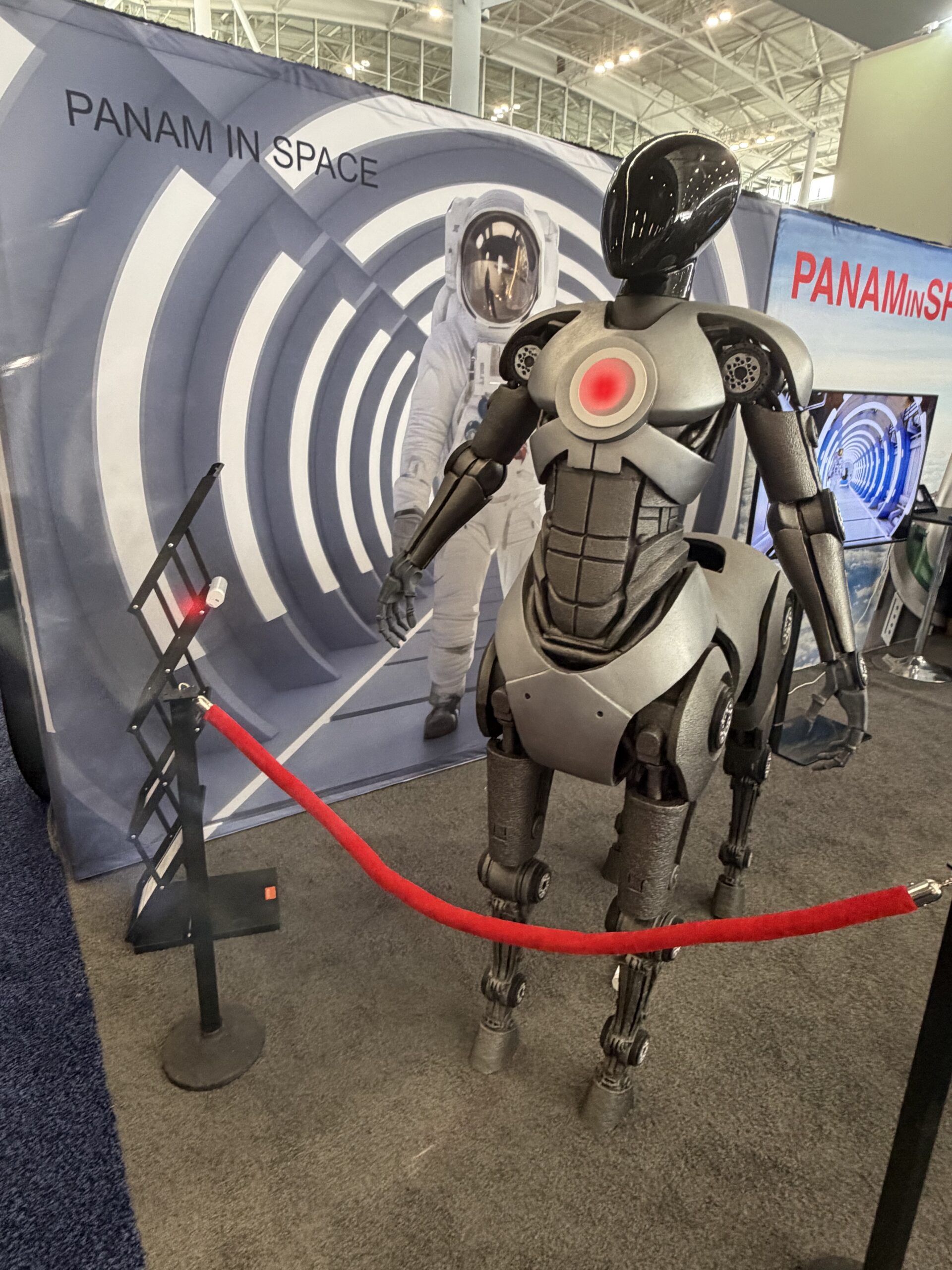
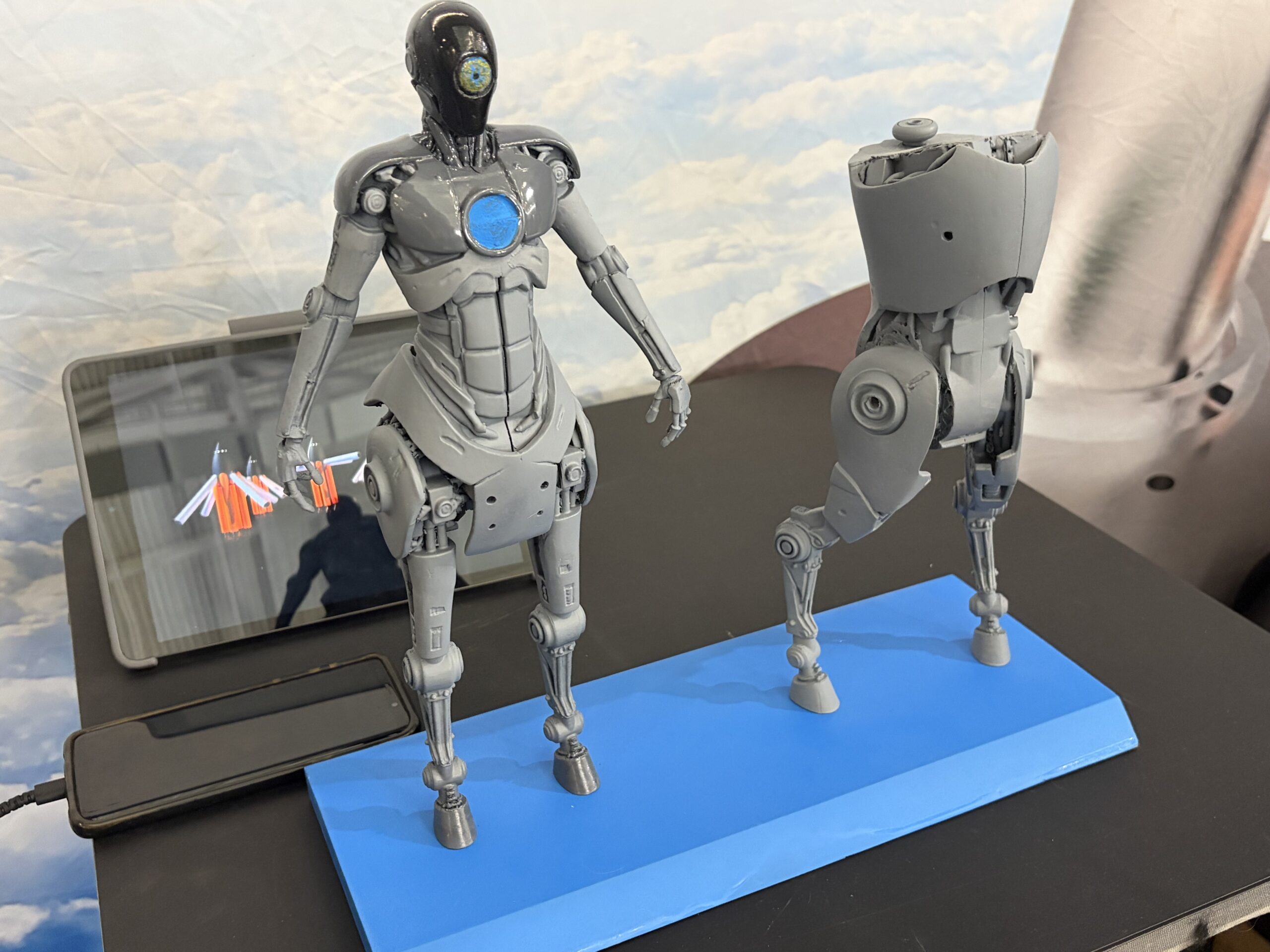
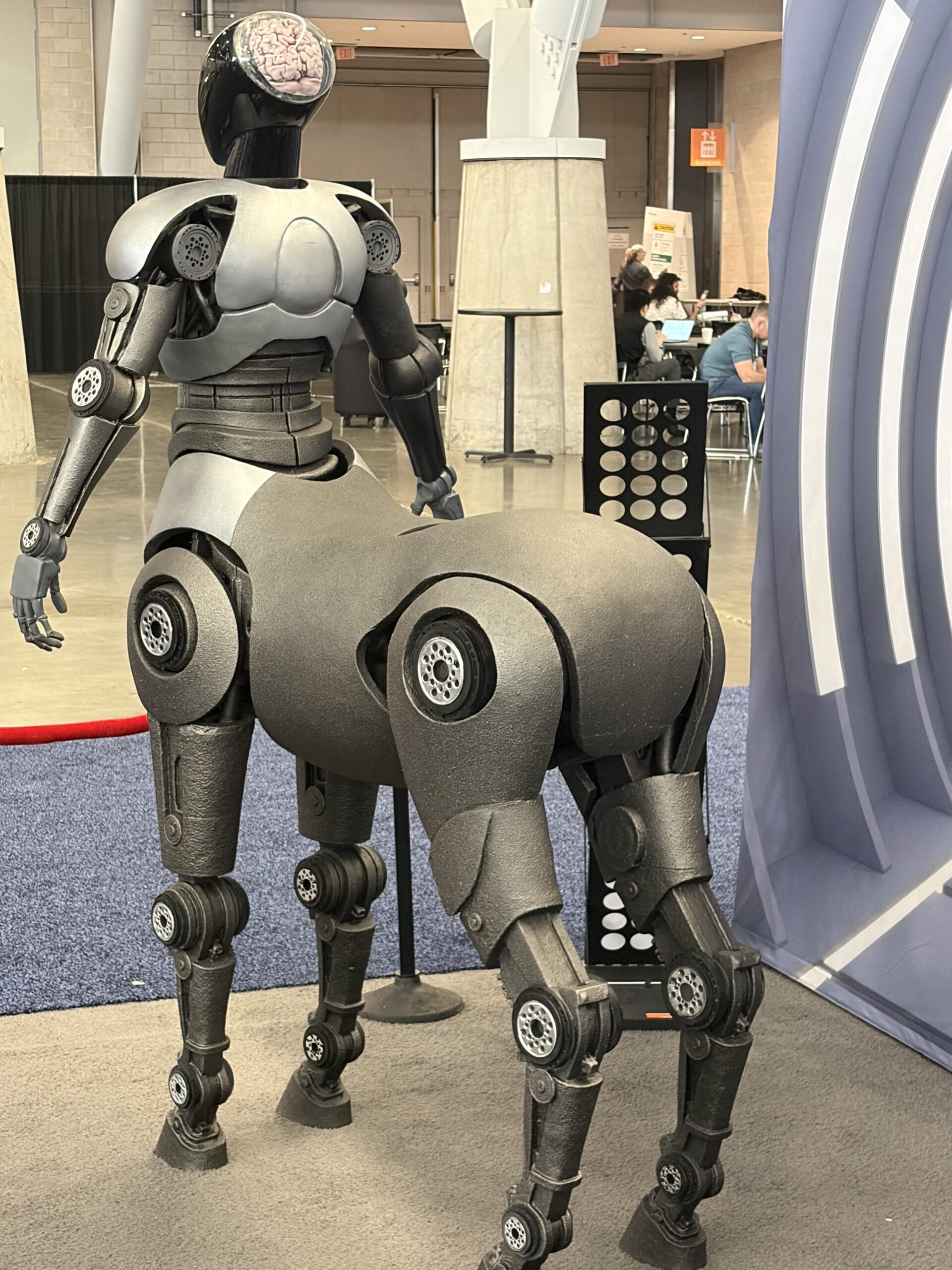
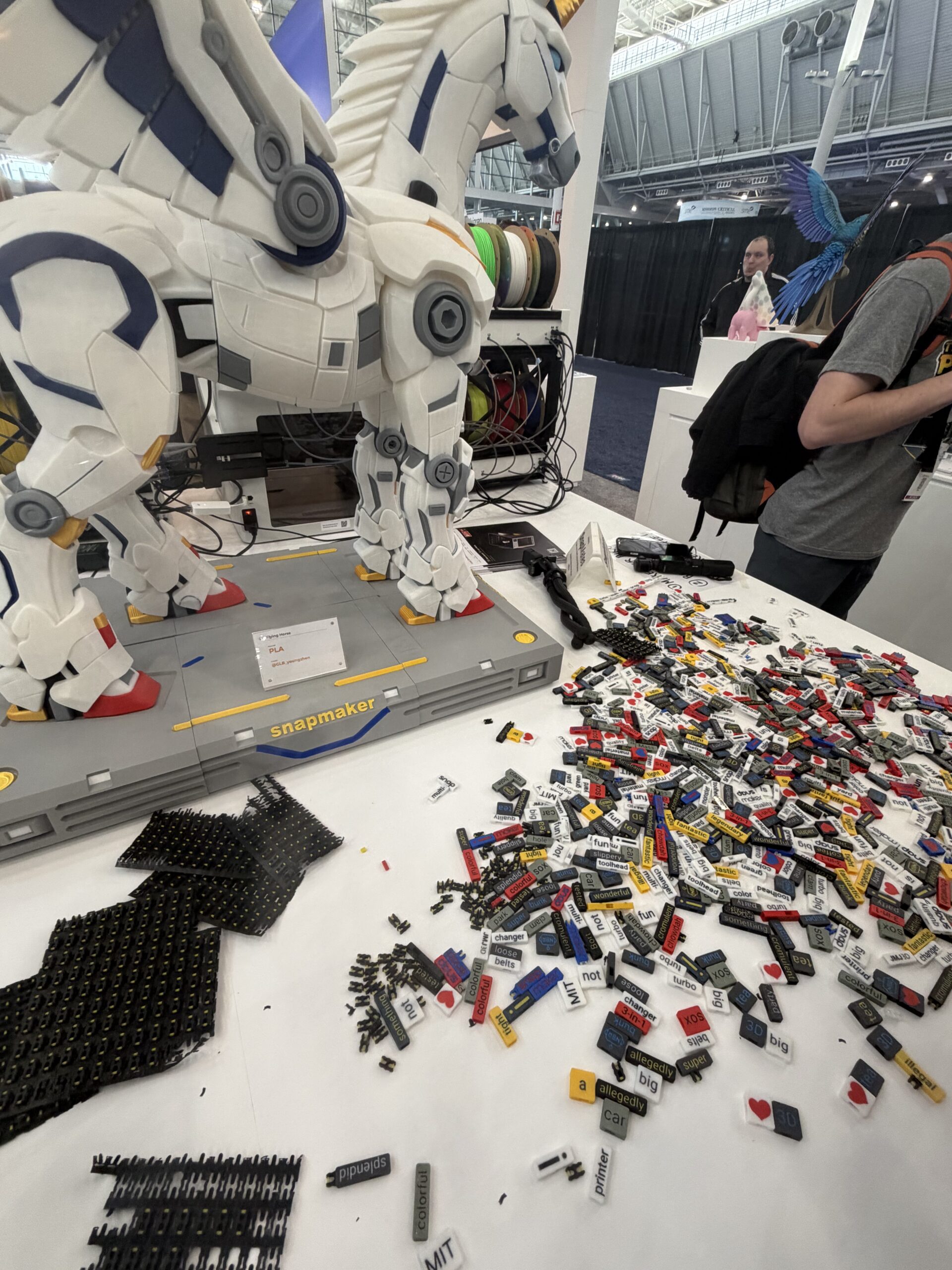
    Modular Quadruped Centaur

    We’ll start with a little nightmare fuel—the modular quadruped Centaur by PANAM in Space, though I prefer to call him a next-generation Horseman of the Apocalypse.

    Please tell me this isn’t the freakiest thing you’ve ever seen on four legs. But wait! It also comes apart to form two two-legged demon robots! The back end is the Centaur’s power supply, so if it’s running low on charge, you can just detach that part, and add a different one to the front end, so you don’t have to stop what it’s doing.

    The team told me that four legs will make this much sturdier than any bipedal robots. The Centaur could cover more ground, and different types of terrain, than robots on wheels or two legs are able to handle.

    “A quadruped with some AI training will be able to cover a lot more complicated ground.”

    The idea is that the Centaur would be AI-powered, so it would be self-sufficient. The version at the booth was 3D printed out of plastic filament, but they are looking into printing a metal version some day.

    The company’s real focus is a polar coordinate metal 3D printing system for building modular, stackable rocket modules to form the basis of a city in space; they’re also developing a smaller electron beam-powder bed fusion (EB-PBF) system for the commercial market as well.

    I asked about the possible applications for something like this, and learned that due to its size, the Centaur could theoretically carry medical-grade lasers into areas where it wouldn’t be as easy for a human medical professional to traverse.  But really, it could be used to complete whatever labor you wanted it to, like filling a warehouse with goods…until, of course, the robots rise up, take over the planet, and follow the Centaur as their leader.

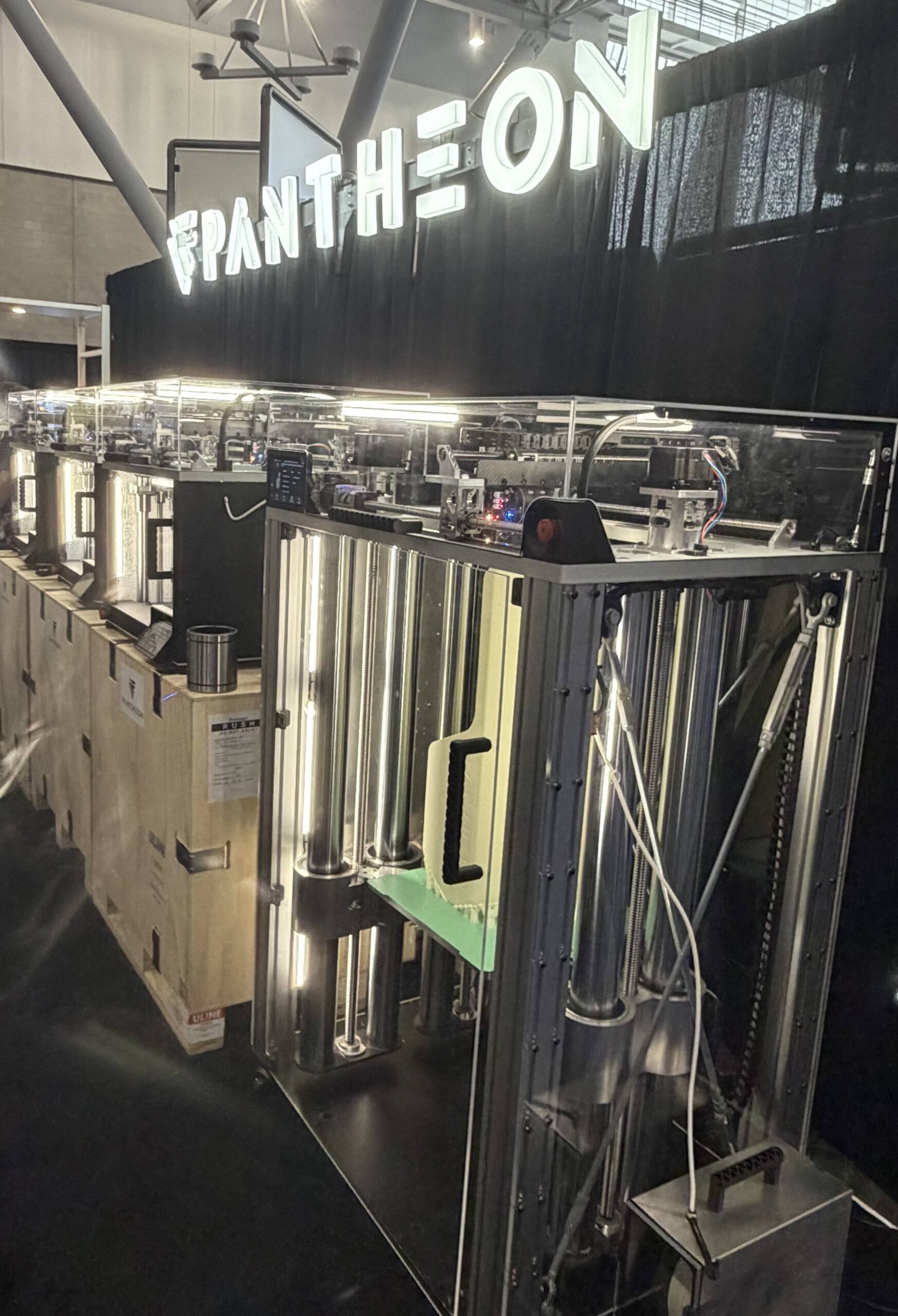
    Pantheon’s Motorcycles

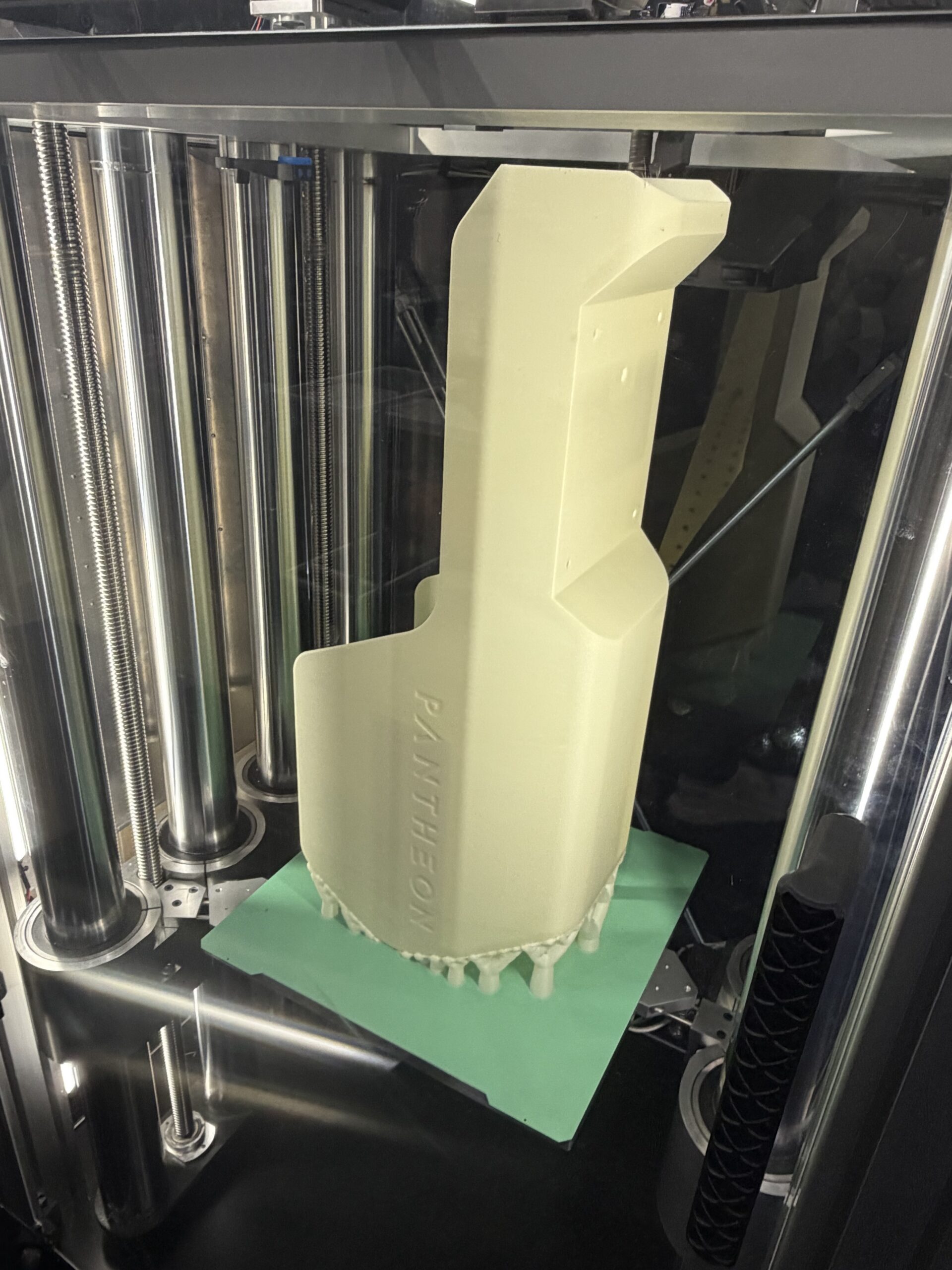
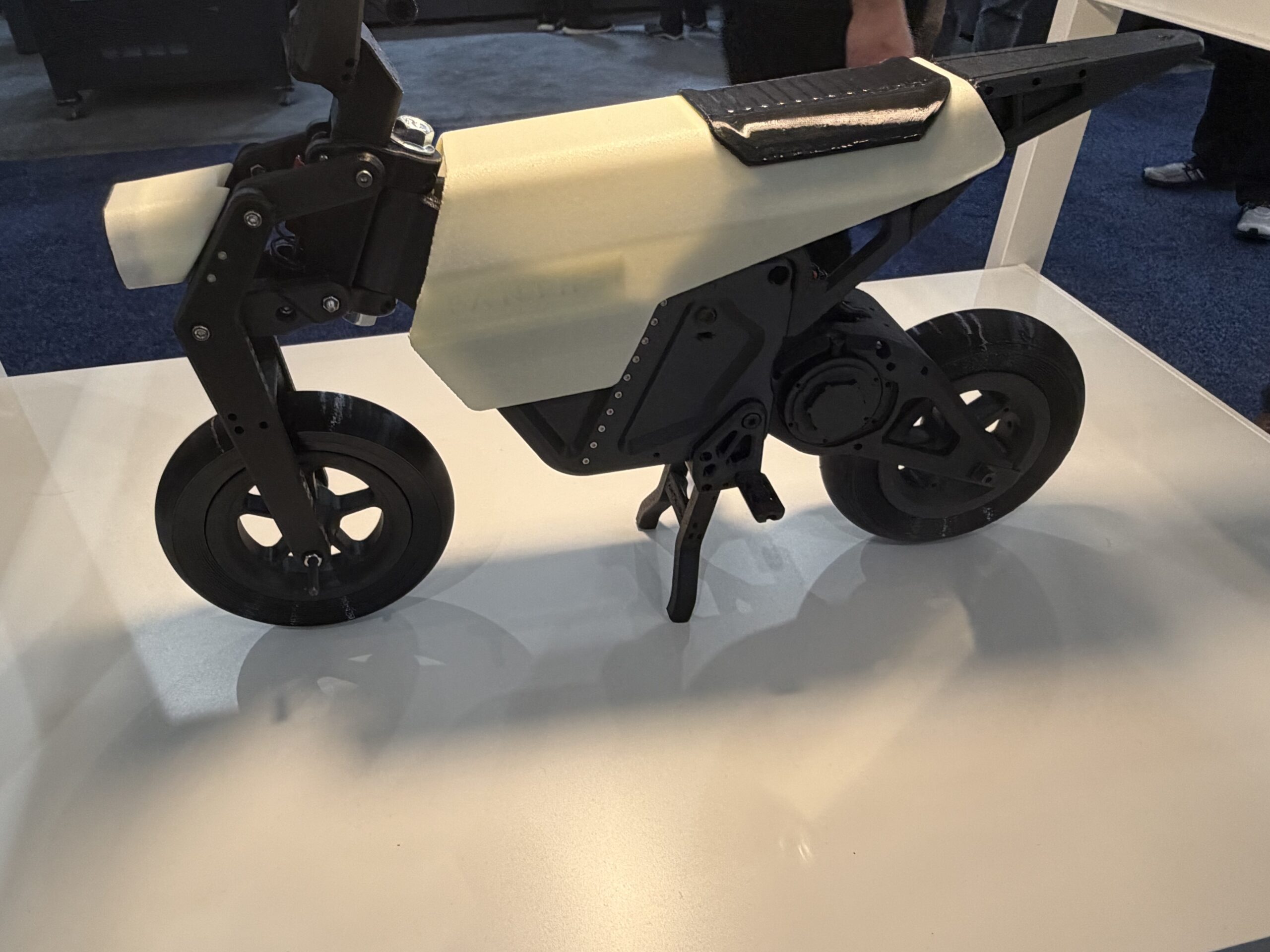
    From four legs to two wheels! According to its website, Canadian company Pantheon Design loves “the idea of 3D printing a motorcycle in one day that they could go race the next.”

    The company says that its HS-Pro, featuring a 400 x 400 x 300 mm print bed, can fabricate a motorcycle frame in one week, offering “2kg per day of productivity in Carbon Reinforced Polymers.” The printer can process PA-CF, PA-GF, PETG-CF, and 95A Flex materials, and also features an active 60°C chamber temperature, a patent-pending nozzle contact probing strain gauge, and a 7″ HD touchscreen.

    “Pantheon parts can replace aluminum components in many cases,” the company wrote on its website.

    “We designed a functional equivalent for additives and printed them in various processes.”

    I think this looks more like a dirt bike than a motorcycle, but it’s still cool.

    Mobility Devices for Kids

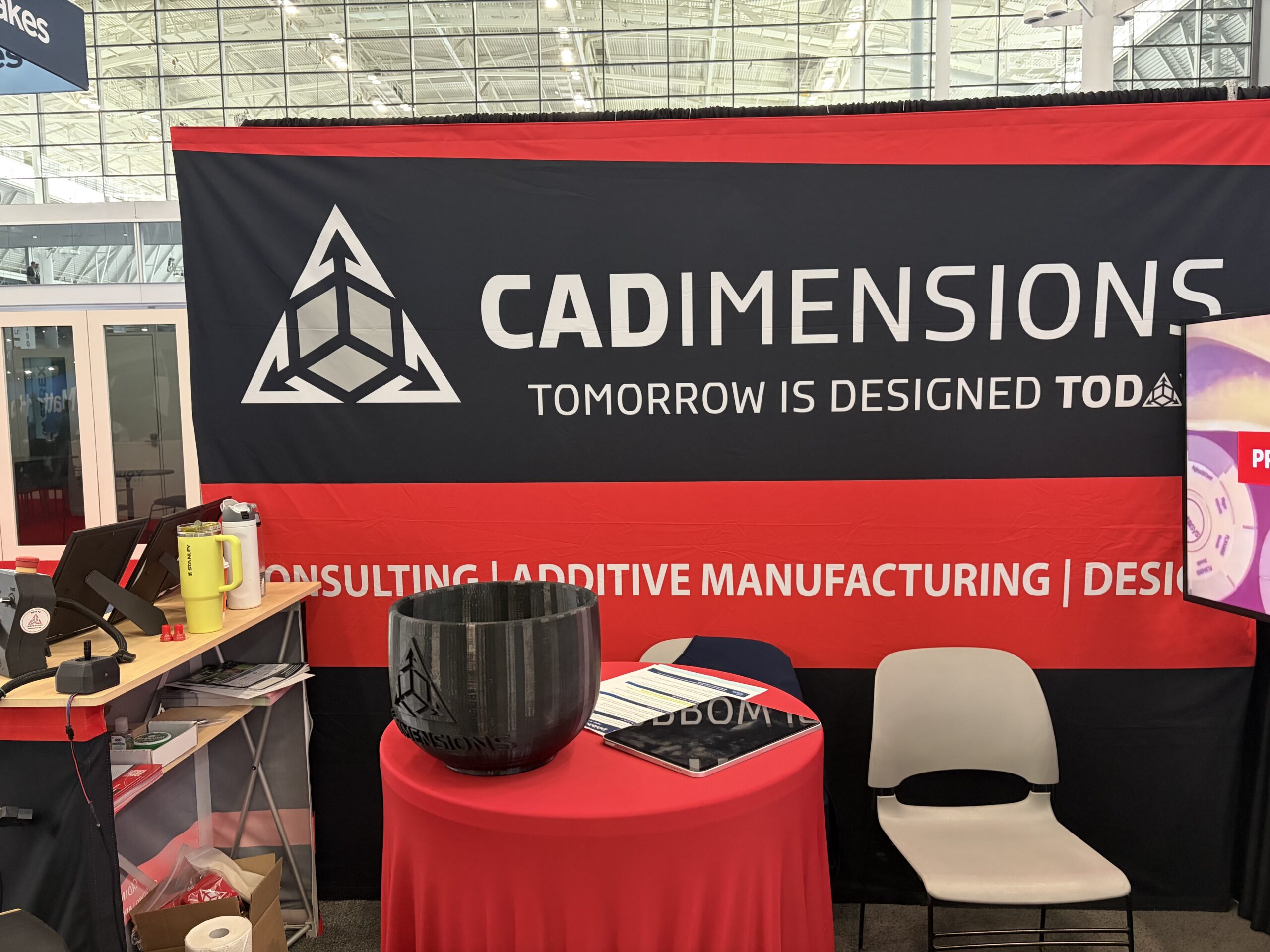
    New York-based Stratasys reseller CADimensions offers industrial design, simulation, training, manufacturing, and 3D printing services. The company also partners with non-profit ARISE, which provides support and services for people with developmental disabilities and their families.

    According to a sign at the CADimensions booth, ARISE offers a wide range of programs, from housing services and equine therapy to the Adaptive Design Program (ADP). This program uses everyday materials to create custom, practical, low-cost solutions, like adaptive equipment and assistive technology, and provides them to children and adults who may not otherwise have access.

    “Each week, a group of community members with different backgrounds come together to design and build tools to help people with disabilities participate in everyday life,” the website states.

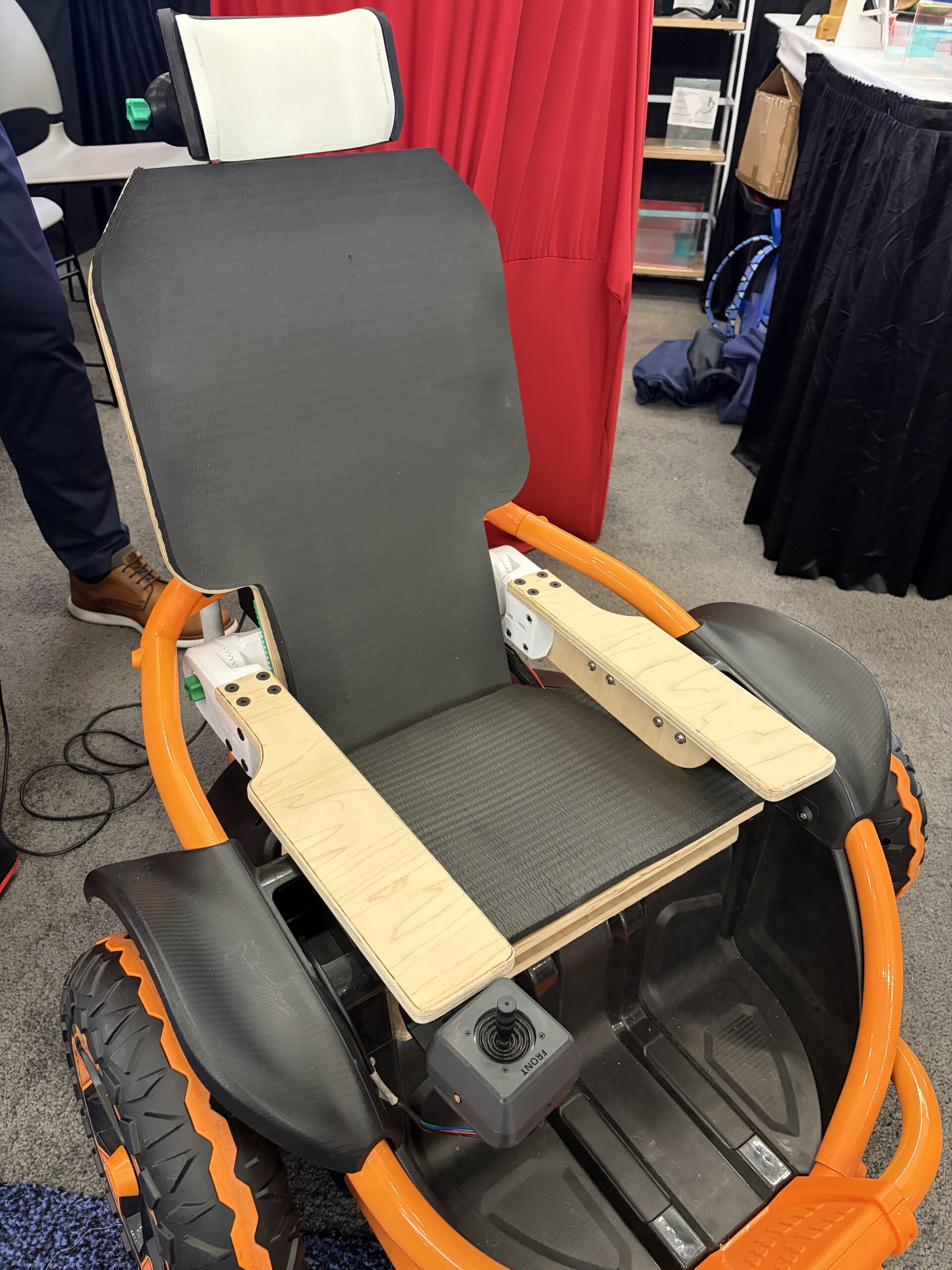
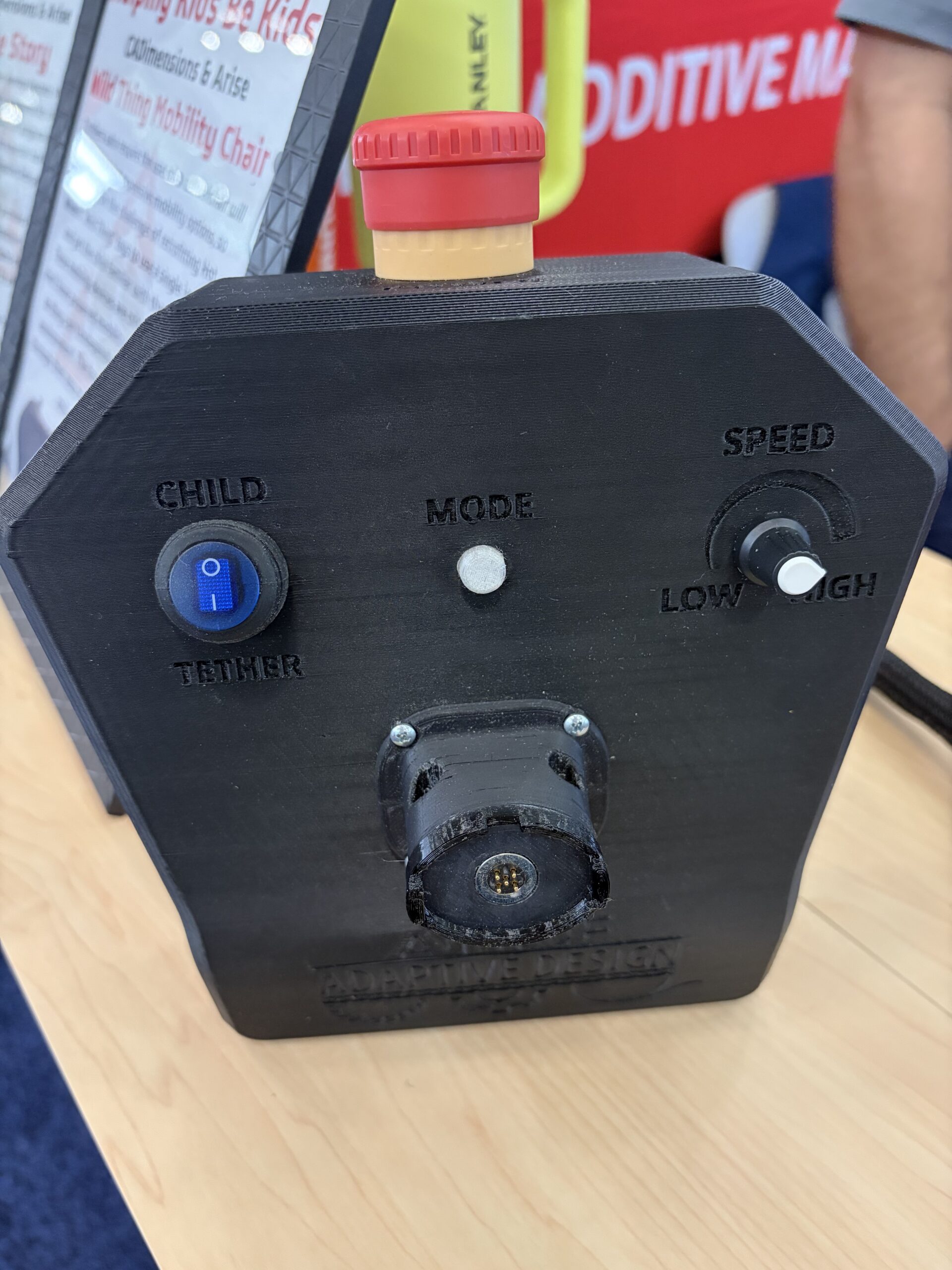
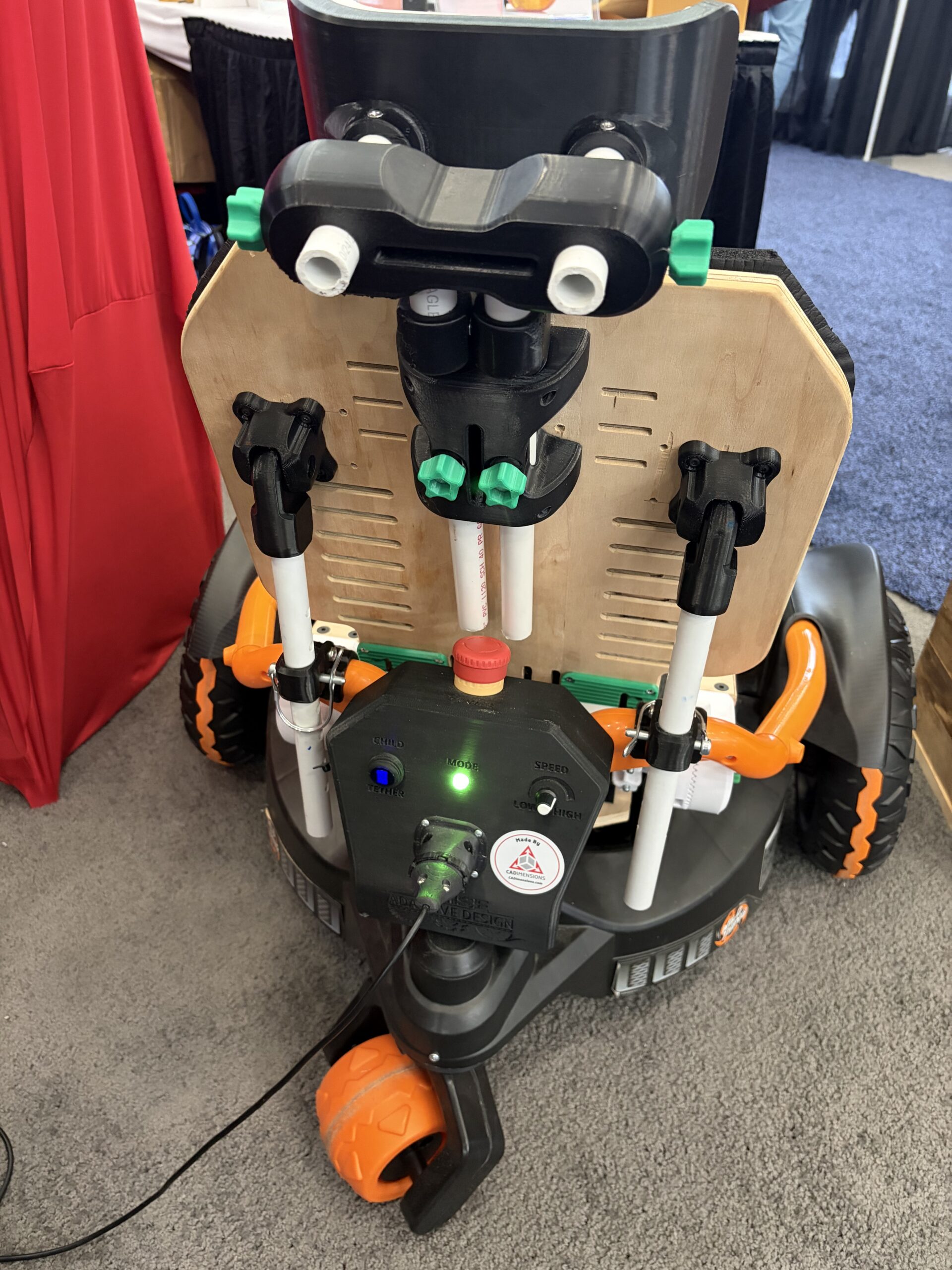
    CADimensions is an official supporter of ARISE, offering design and assembly assistance, as well as 3D printed parts. The example the company had at its booth was the Wild Thing Mobility Chair for young children.

    It can get expensive trying to keep kids in wheelchairs and other mobility devices that fit, because they grow so fast. To solve this challenge, ARISE decided to retrofit Hot Wheels Wild Thing battery-powered vehicles for kids under 5 with mobility issues. CADimensions provided some of the 3D printed parts for the powered mobility devices

    “The freedom these children enjoy through their new mobility tools is enough to put a smile on anyone’s face,” the sign at the CADimensions booth declared.

    3D Printed Snare Drums

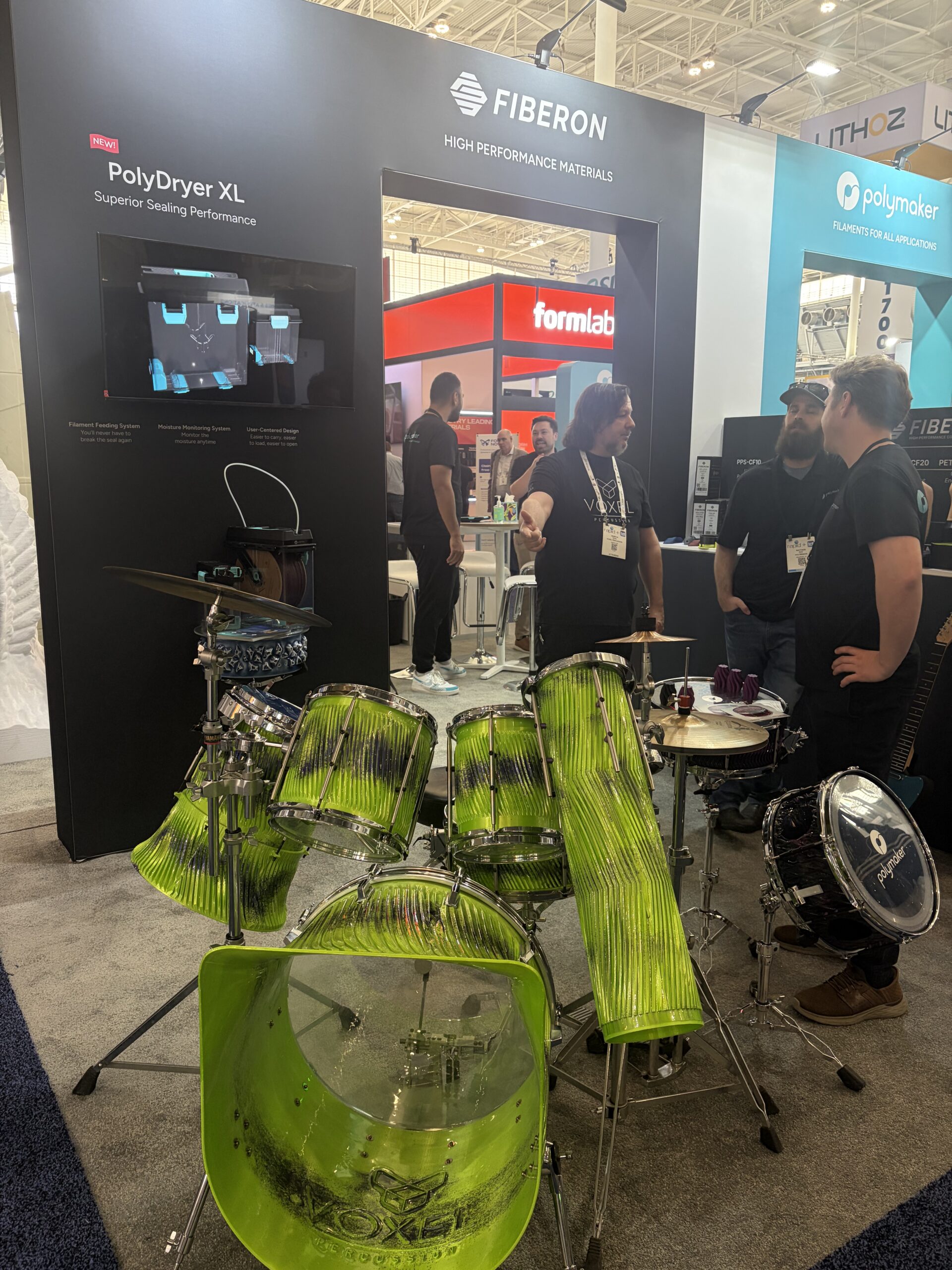
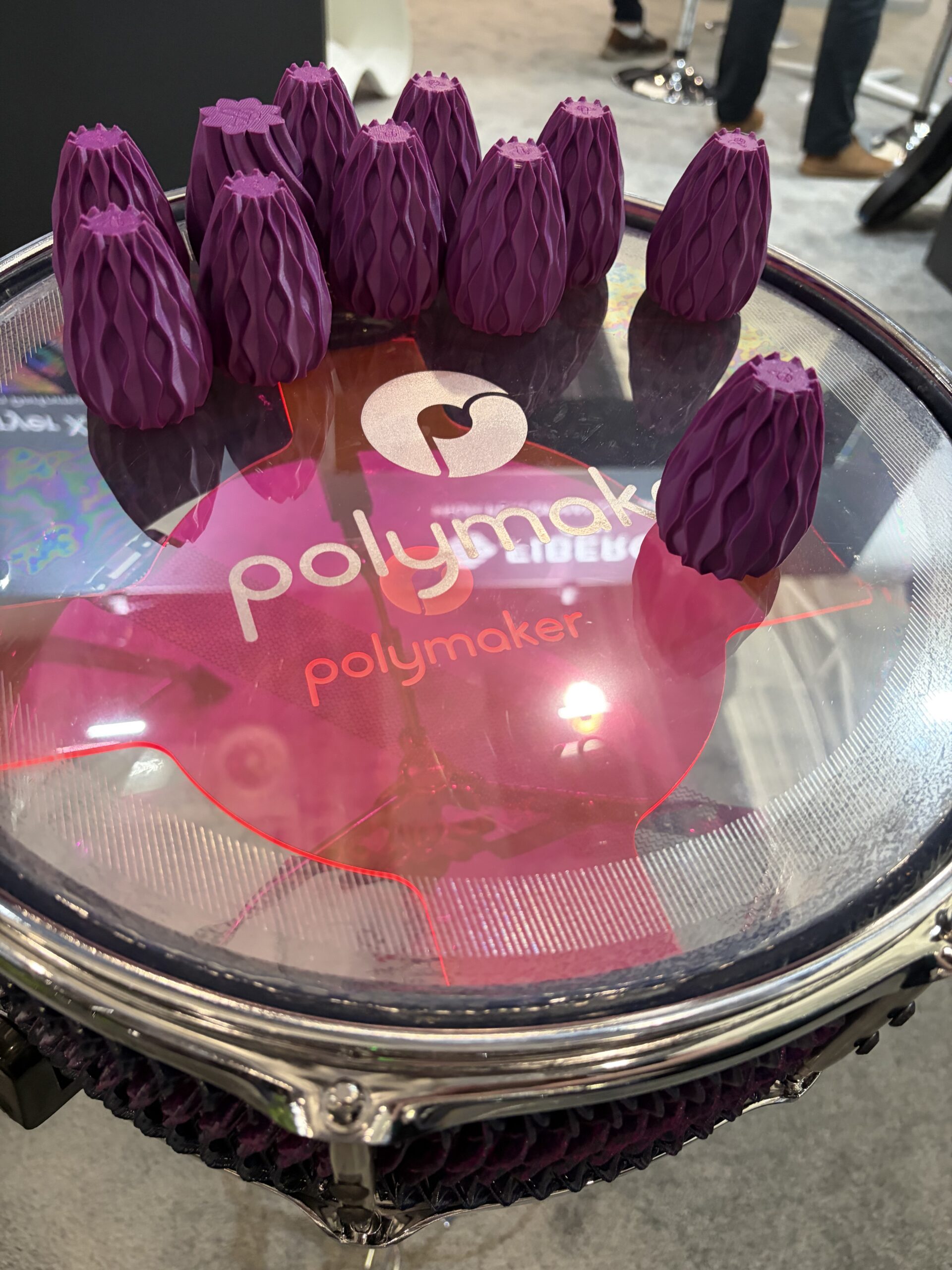
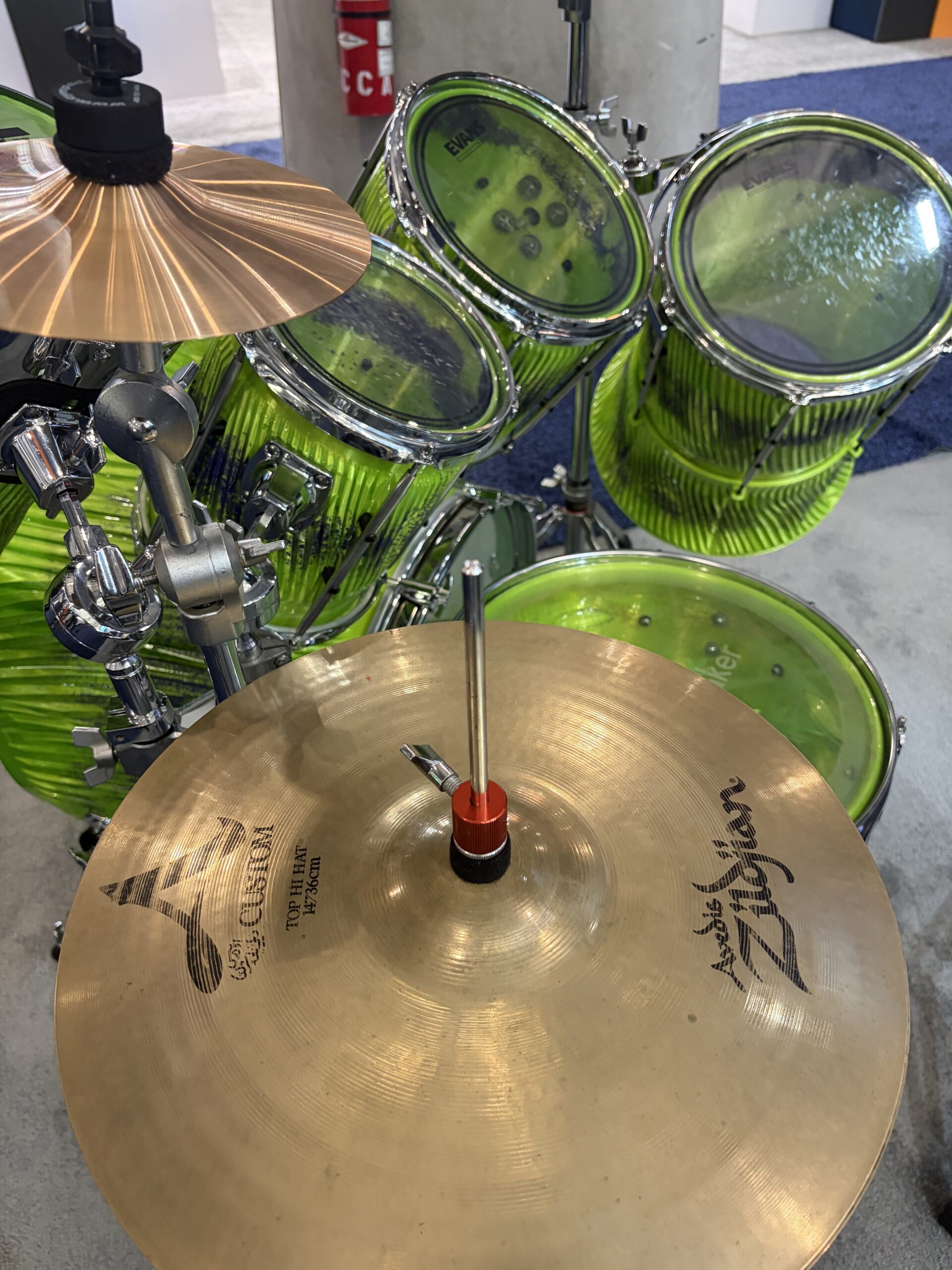
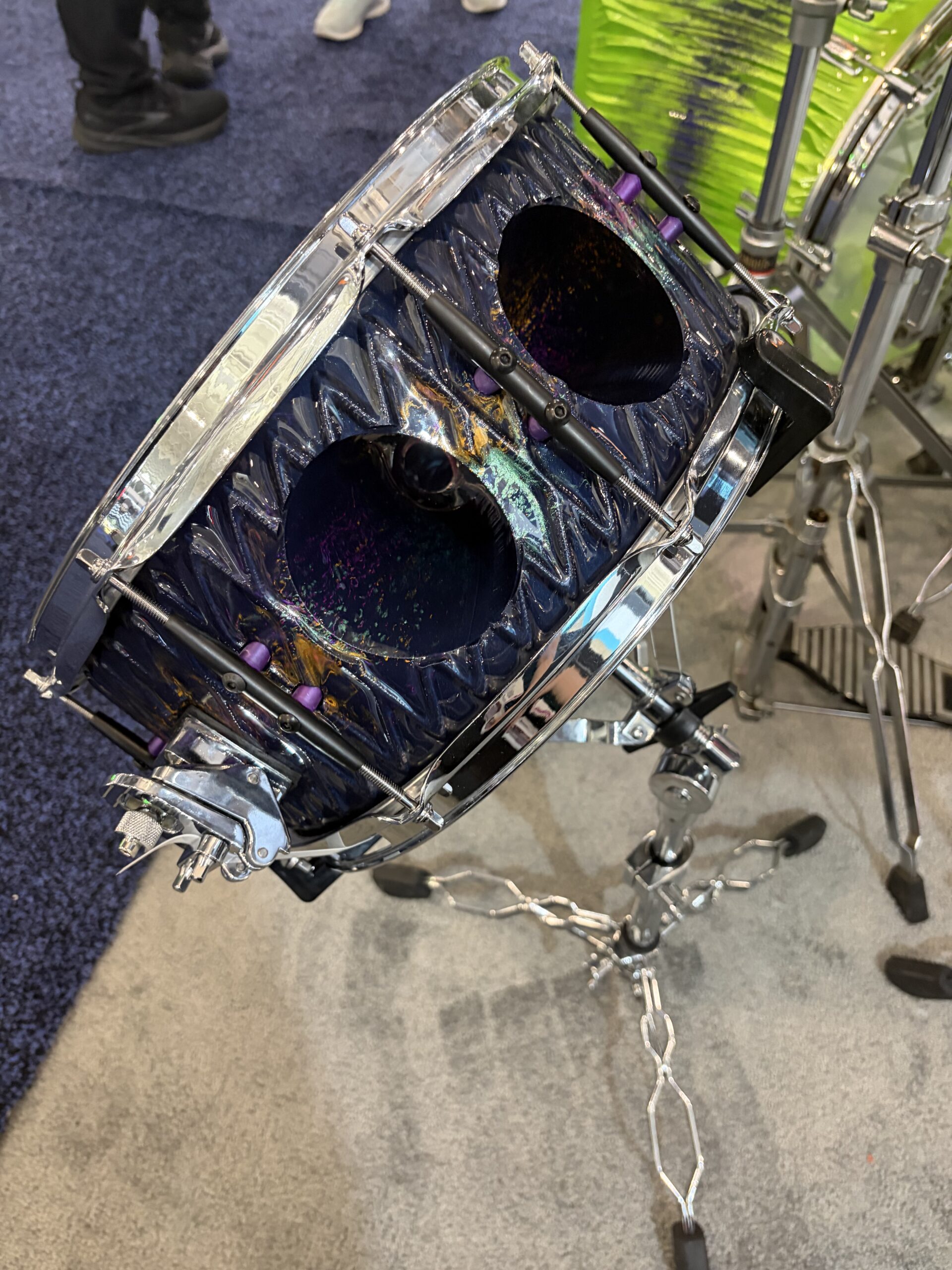
    The Polymaker booth featured something pretty unique: a set of snare drums by Voxel Percussion.

    Based in Akron, in my home state of Ohio, Voxel Percussion uses 3D printing, laser cutting, and post-processing to give its drums their unique look. Each one is customized, featuring complex geometries and intricate textures. According to the website, the bespoke, epoxy-strengthened drum shells can be printed in just about any color you want.

    Voxel Percussion also makes custom laser cut drum inserts, which can be used to give your drum a unique tone. Additionally, the company also offers 3D printed shakers, and “Groove Buddies,” which are “small gestures that can be mounted to your cymbal wingnut.”

    These drums were neat to see, but depending on where you were in relation to the Polymaker booth, they often made it hard to hear. If someone put a pair of sticks in my hand and told me to go to town on the kit, I probably would have too. But the first time I heard them being played, I was so startled that I almost fell off of my chair.

    Drones, Drones, & More Drones

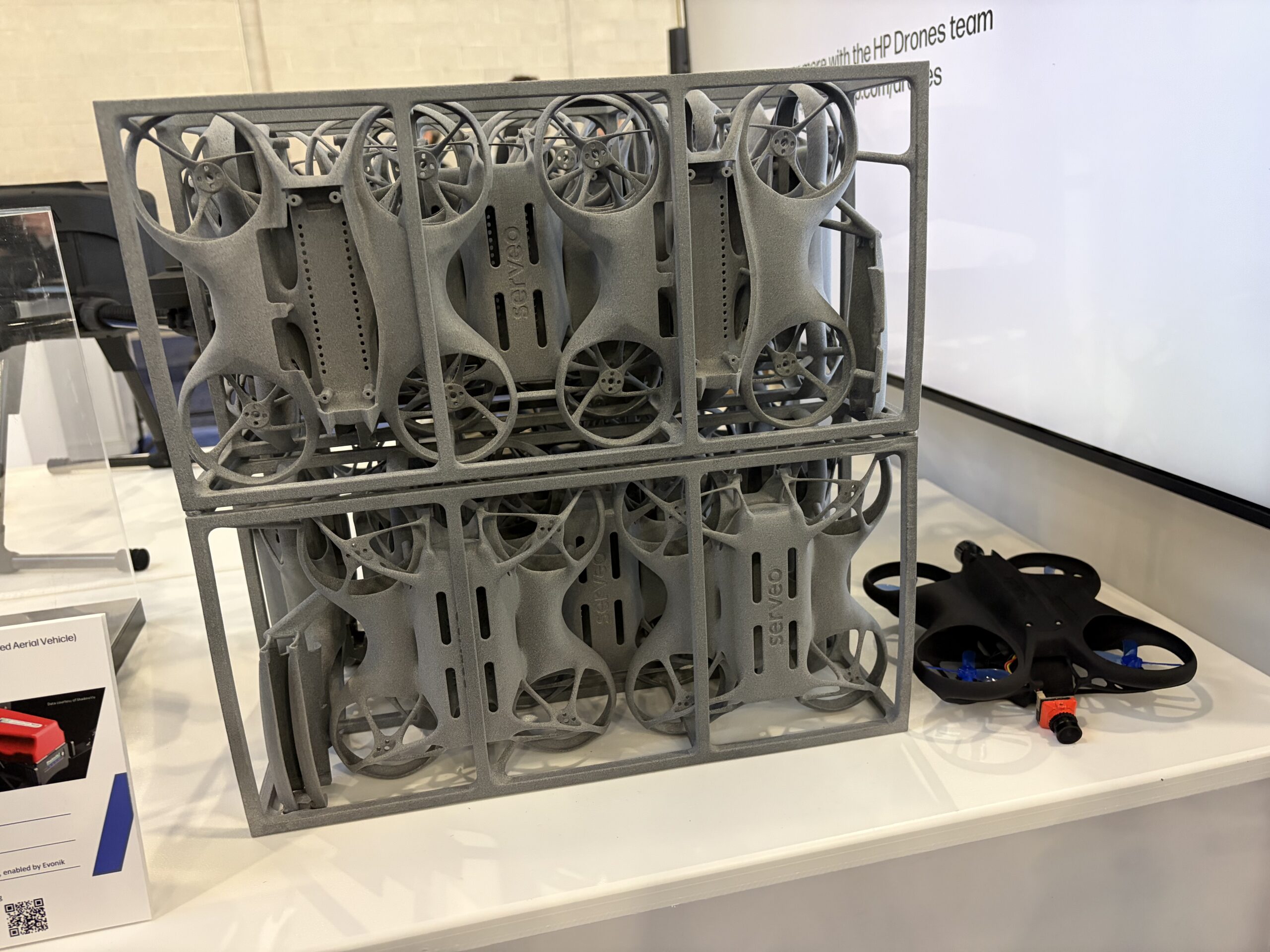
    Something you saw all over RAPID this year were 3D printed drones.

    At the Impossible Objects booth, the company had a wall of 3D drones on display, which were printed on its incredibly fast CBAM 25 system. As you can see, Impossible Objects claims that it can print 10,000 drones a month with its composite-based AM technology.

    Drones at HP booth

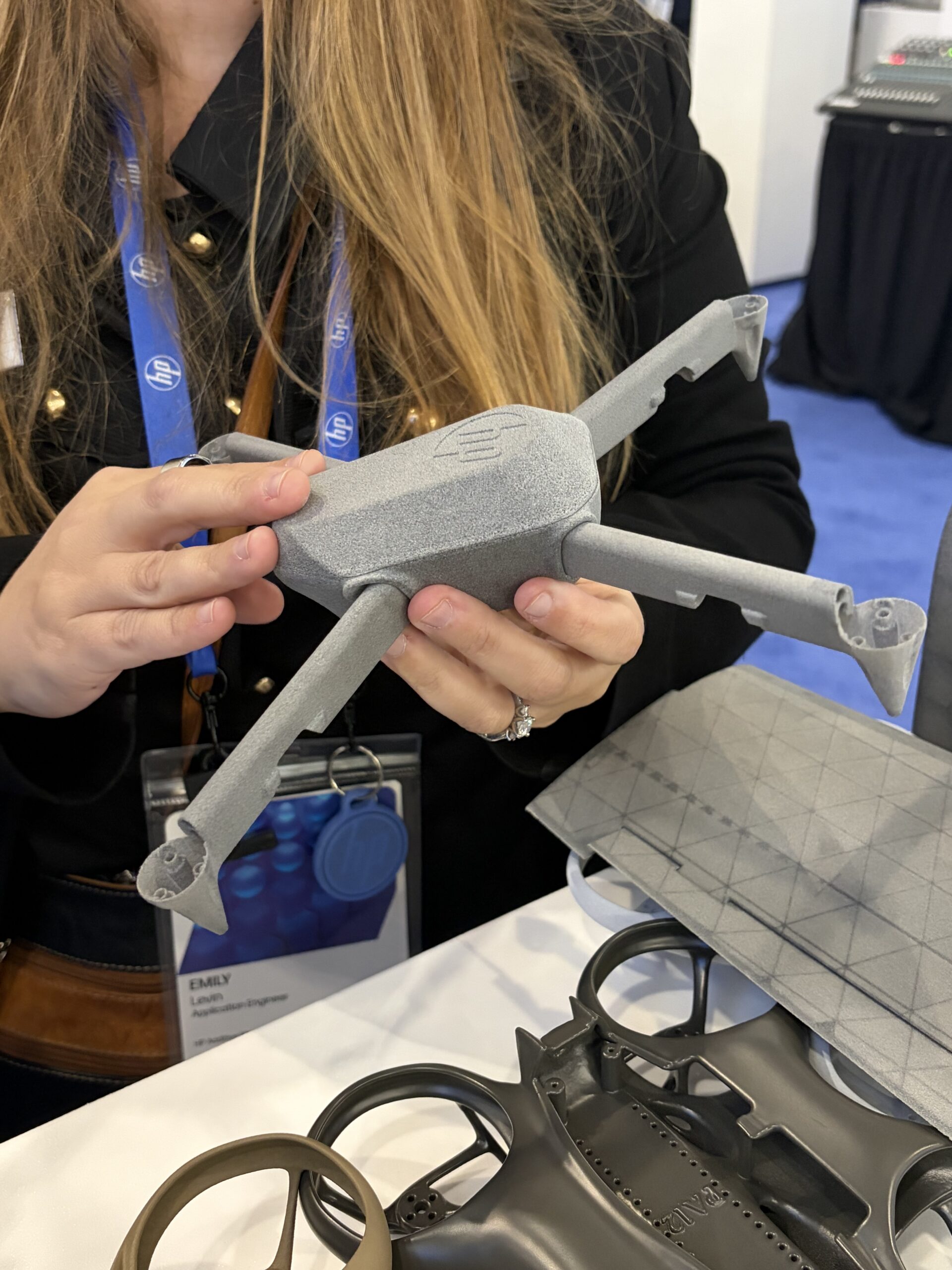
    HP also had plenty of drones at its RAPID booth. Applications Engineer Emily Levin said “there’s a couple value propositions of Multi Jet that are super important” when it comes making drones, such as the ability to create complex geometries and ultra-thin walls. Because they were seeing so much adoption of MJF for this particular application, the company now has a dedicated drones team.

    “At HP, we’re not selling drones, it’s not designed to be a product, it’s designed for us to understand what our customers need from us,” Levin said, noting that every design iteration helps inform the team so it can better meet customer needs.

    She said that, depending on the design, HP can print up to 140 small drones in one build, “so it’s extremely scalable.”

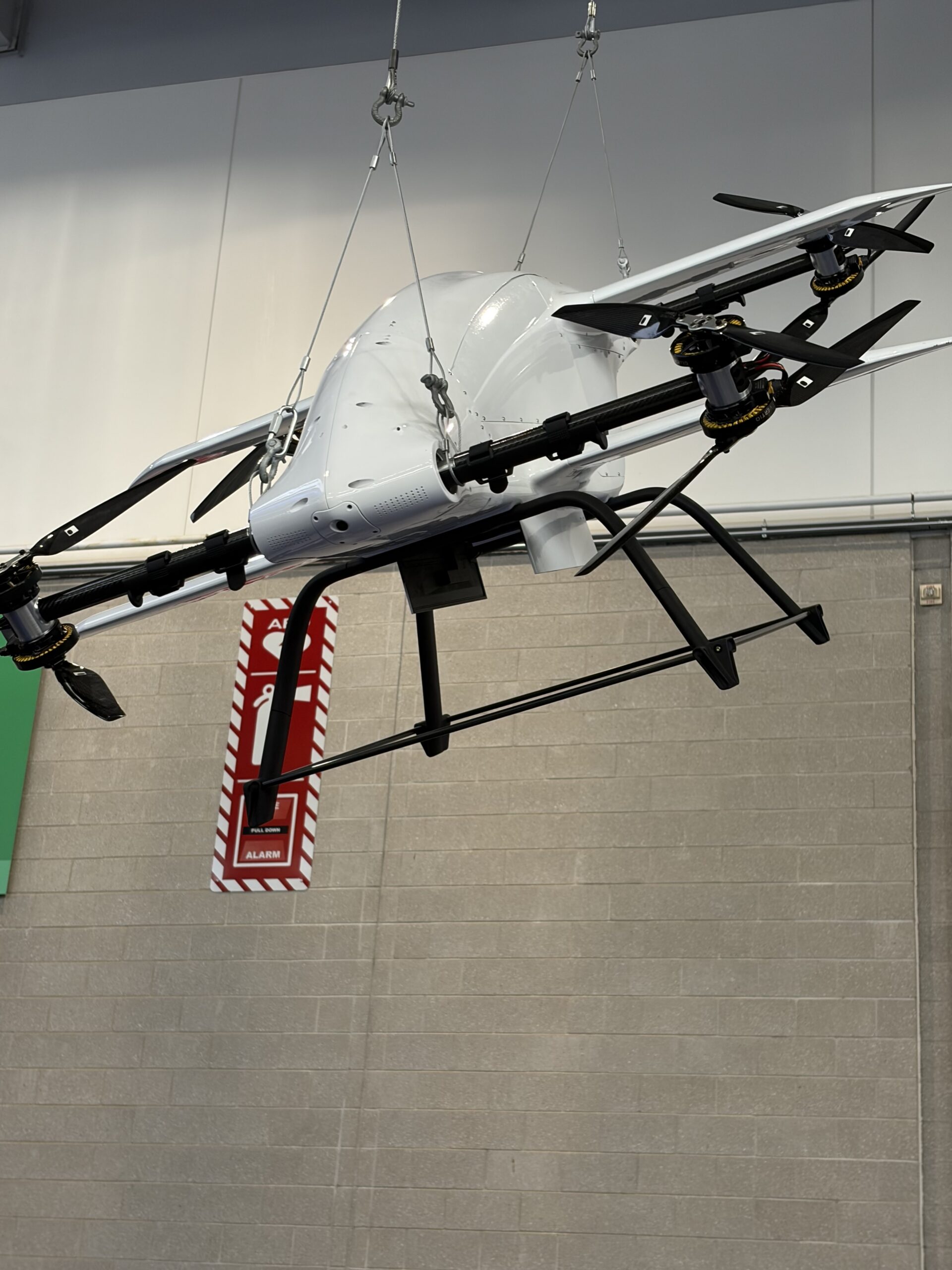
    We also saw a Blueflite “last mile delivery” drone hanging above the booth. Its wings, landing gear, and body panels were all 3D printed with MJF technology.

    “The interior of the wings are all latticed, so it has extremely lightweight properties but is also extremely strong.”

    Blueflite drone

    If you’re interested in drone 3D printing, you should attend our UAS Additive Strategies online event on “The Future of Drone Manufacturing.” It’s coming to a computer screen near you on June 30th!

    HP’s Dual Tone Technology

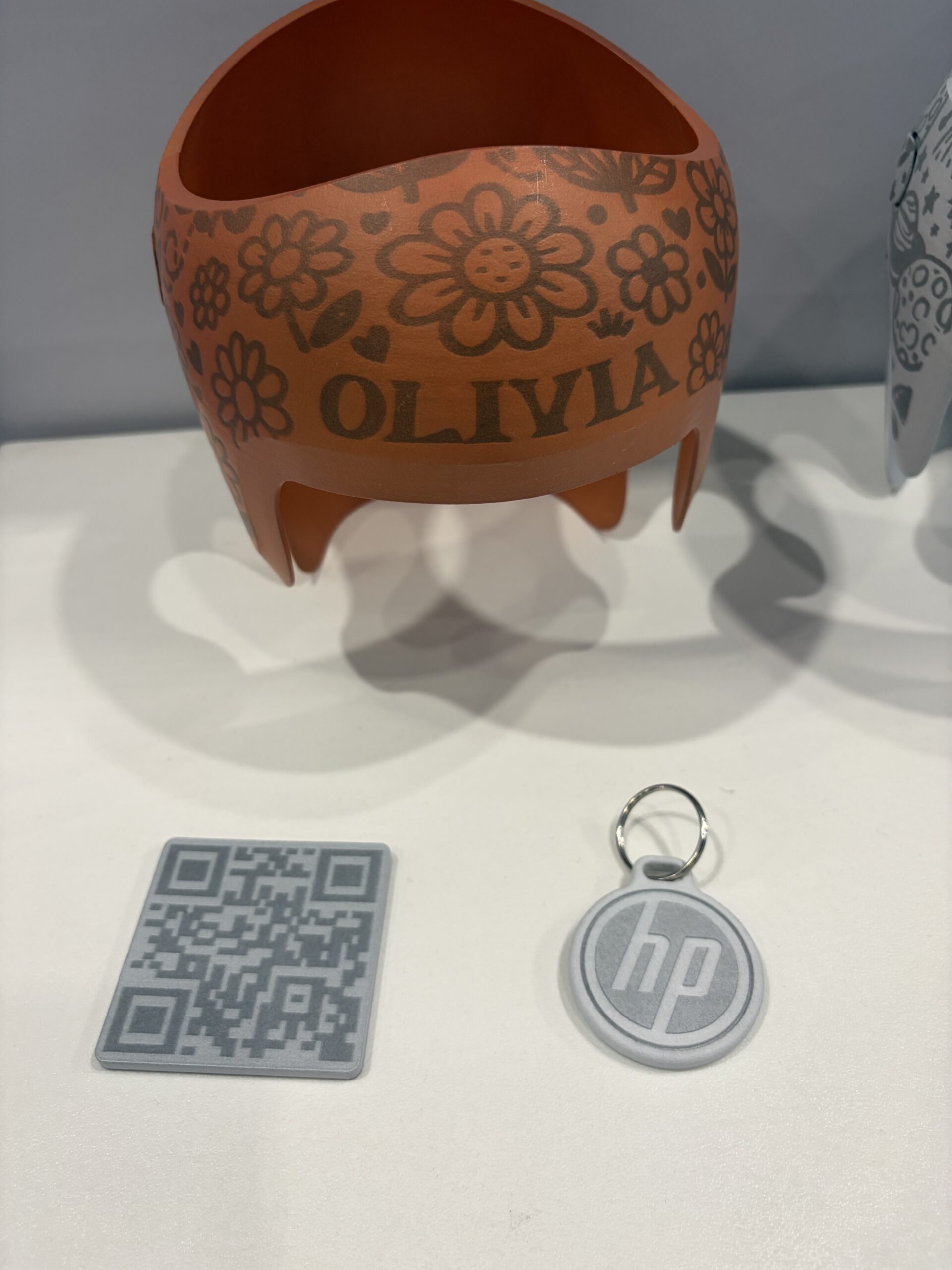
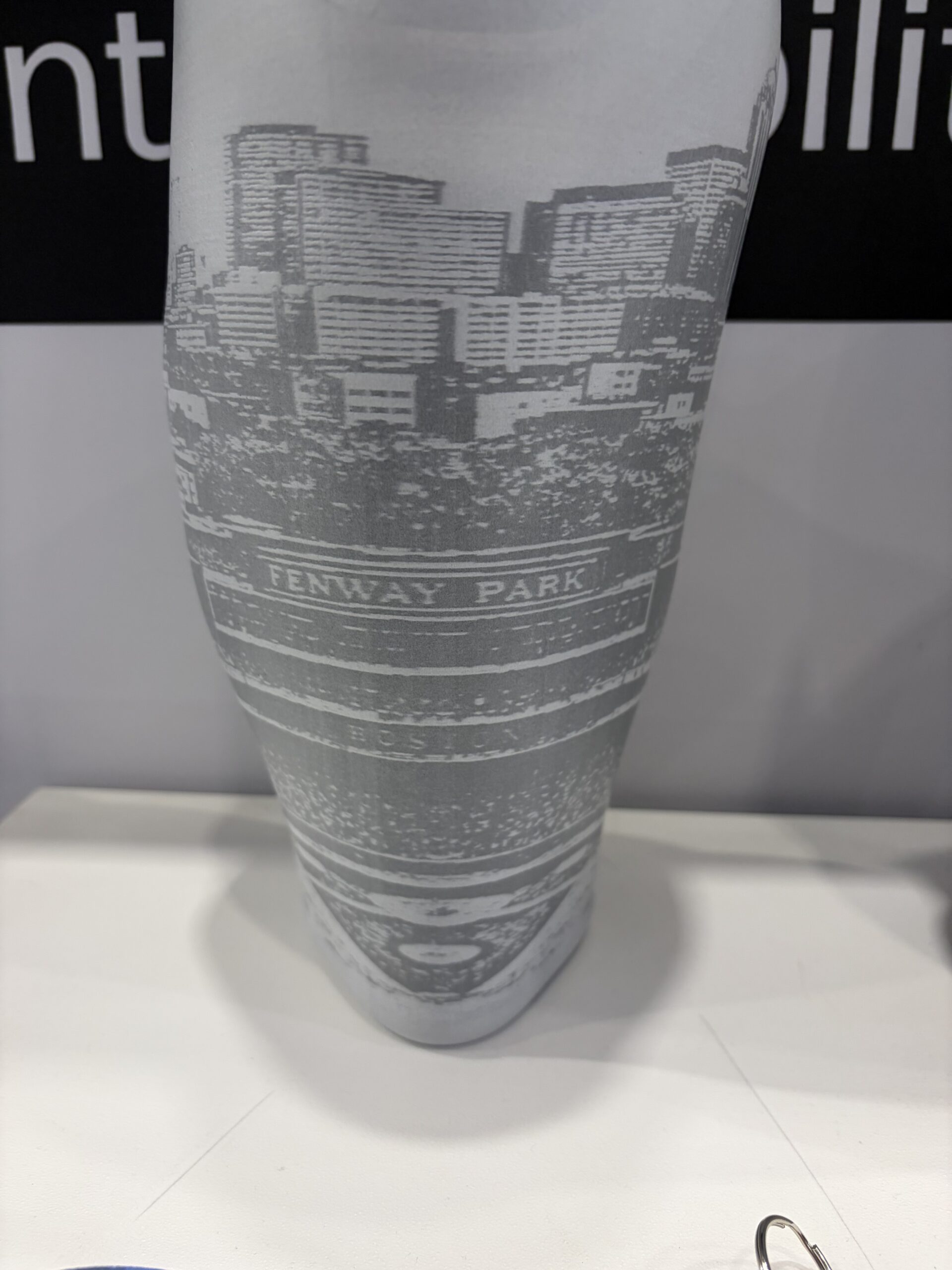
    Speaking of HP, I also think its new Dual Tone technology is cool. It’s historically meant extra work, and even extra money, to add logos, text, or visual cues like QR codes to 3D prints. Dual Tone is a new capability that enables parts to appear in distinct white and dark gray tones right off the printer.

    “Walking around here [RAPID], any industrial printer you see, what do they have in common? They all come out one color,” said Brian Ingold, Head of Applications and Business Development at HP Additive. “What we are doing with this technology is printing visualizations on parts.”

    Ingold explained that HP has “two agents” in their machines, and to enable Dual Tone, they just add more detailing agent wherever they want the visualization to go. This is especially helpful for adding QR codes to parts, which usually has to be done with engraving or some kind of post-processing.

    “You can also do individual part numbers,” Ingold said. “So from a traceability perspective, you can have serialized production and have an individualized part number right on the part.”

    Using Dual Tone for MJF, HP can embed personalization, information, and contrast right onto the printed part. You can also really get creative with AI use here; Ingold said while designing a prosthetic socket, he added the Boston city skyline to the part just by typing that request into the software.

    “We don’t want to launch a process that’s hard to do. We want to make it very accessible, so a patient, or a consumer going into a service bureau, can add it on really easily.”

    This is obviously just a small sampling of some of the great 3D printing innovations I saw on the show floor at RAPID this past week. Stay tuned for more!

    Images courtesy of Sarah Saunders

  • 3D Printing News Briefs, April 18, 2026: Educational Grants, Bambu X1, & More

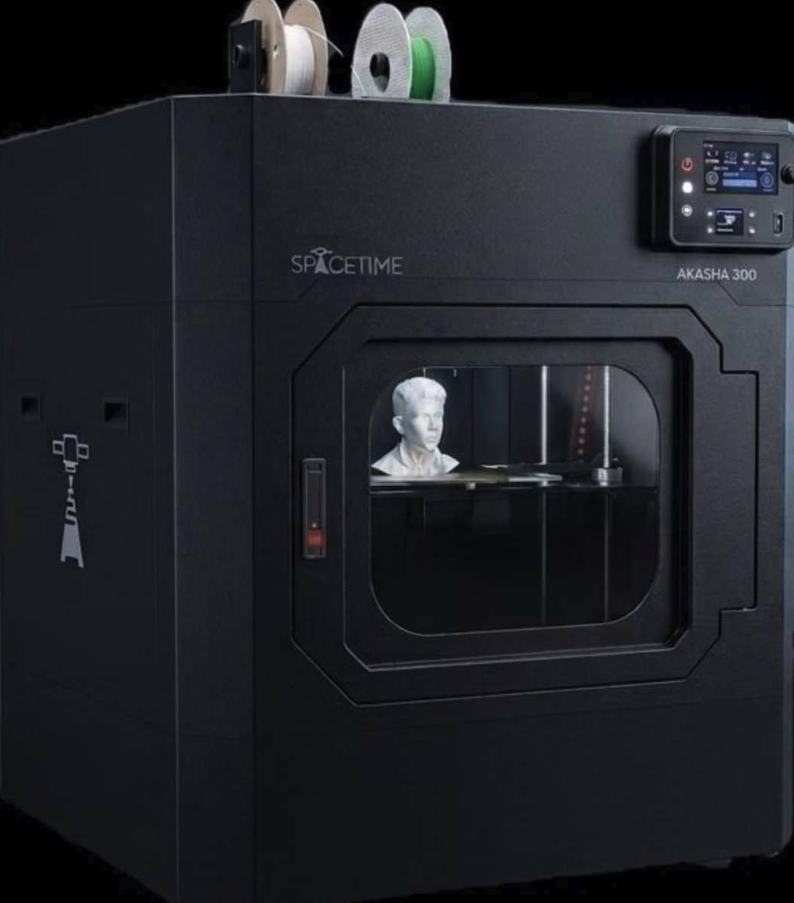
    In today’s 3D Printing News Briefs, SPE announced a collaboration to expand 3D printing education through its equipment grant program. Bambu Lab has retired its X1 Series of FFF 3D printers, and ISRO acquired a Spacetime 4D Akasha300 3D printer.

    SPE Collaborating with 3DSHQ to Expand Educational Grant Program

    Image: SPE Foundation

    The Society of Plastics Engineers (SPE), a division of the Plastics Industry Association (PLASTICS), is collaborating with U.S. based 3D Supply Headquarters (3DSHQ), which offers 3D printing hardware, materials, services, professional development, and technical support to businesses, consumers, and educational institutions around the country. Together, the two will work to expand the SPE Foundation‘s 3D Printer Grant Program for educational systems, which is open to educational institutions at all levels. 3DSHQ will provide FlashForge Adventurer 5M Pro 3D printers, materials, logistics support, and technical assistance to the winning schools. The organization also develops instructional videos to guide educators on the setup, operation, and maintenance of 3D printers, and these will also be made available to grant recipients. By pairing 3DSHQ’s technical expertise with the SPE Foundation’s plastics education leadership, the program will offer educators and their students hands-on experience in 3D printing. The first grant recipient to benefit from this new collaboration is Akron Public Schools (APS), in my home state of Ohio. They will receive eight new 3D printers to replace outdated equipment and expand STEM learning, providing instruction in CAD, plastics manufacturing, and prototyping.

    “This partnership represents a meaningful step forward in our commitment to plastics education. By working with 3DSHQ, we’re increasing access to advanced manufacturing tools while ensuring educators and students have the support needed to use them effectively from day one,” said Eve Vitale, SPE Foundation Executive Director.

    Bambu Lab Officially Retires X1 Series of FFF 3D Printers

    Image: Bambu Lab

    In 2022, Chinese 3D printer OEM Bambu Lab launched a Kickstarter campaign for the X1 3D printer, promising an affordable price, 20,000 mm/s² acceleration, 500 mm/s speed, automatic calibration, built-in camera, a dedicated neural processing unit, and a multi-color printing system that supported four filament spools. While it may have seemed too good to be true, the campaign ended up being the third most successful Kickstarter ever for 3D printing hardware. Since then, the company has continued its meteoric rise, and recently announced the retirement of its X1 Series, including the X1, X1 Carbon, and X1E. Manufacturing of these systems has already ended, and the replacement is the P Series, consisting of the $599 P2S and $399 P1S. However, the company has promised that software and firmware bug fixes will be available through May of 2027, security patches will continue into 2029, and spare parts and service for the X1 Series will be available under best-effort terms for five more years.

    “The EOL of the X1, X1 Carbon and X1E marks the end of a chapter – but not the story. Machines already in users’ hands will keep working, supported until March 31, 2031 – spare parts, security updates, technical support included,” Bambu Lab wrote. “During the 5-year service period, related spare parts will remain available through our Online Store and in authorised service centers. However, some parts may sell out earlier, so we recommend purchasing replacements in a timely manner.”

    Spacetime 4D’s Akasha300 Supporting Prototyping & Materials Research

    The Akasha300 3D printer is a high-temperature, multi-material extrusion system developed by Spacetime 4D for aerospace and industrial applications / Spacetime 4D

    Kerala, India-based additive manufacturing startup Spacetime 4D recently delivered its Akasha300 3D printer to the Indian Space Research Organisation (ISRO), specifically its Liquid Propulsion Systems Centre (LPSC). The addition of the industrial-grade, high-temperature system will strengthen ISRO’s in-house capacity for 3D printing complex aerospace components, which fits in with India’s self-reliance objectives. The LPSC will use the printer to support both advanced materials research and rapid prototyping for aerospace and space applications. The multi-material Akasha300 is a material extrusion printer, centered around a dual-extrusion architecture that’s said to operate at nozzle temperatures of up to 350°C; Spacetime 4D has plans to upgrade this to 550°C. The system also features a heated build platform that gets up to 110°C, and an enclosed, temperature-controlled build chamber that maintains up to 80°C. All together, these features should make it a good printer for the demanding requirements—both structural and thermal—of aerospace components made with materials like PEEK, PEKK, and carbon fiber-reinforced composites.

    Showcasing the increasing synergy between startups, academia, and government institutions in India’s space technology sector, the Space Technology Innovation and Incubation Centre (STIIC) at the Indian Institute of Space Science and Technology (IIST) and the Kerala Startup Mission (KSUM) supported Spacetime 4D’s development of the Akasha300 system. The high-temperature printer is positioned as a research platform rather than a tool for the typical production line, and ISRO, which previously acquired AddUp’s Magic 800 DED system, will use the Akasha300 to experiment with next-generation materials and complex part designs. This will enable the scientists and engineers at ISRO to achieve rapid design iteration of propulsion system components and satellite hardware with materials that match flight-grade standards. On a broader scale, this shows how India’s deep-tech ecosystem is being positioned next to other, more established international organizations.

  • RAPID Roundup 2026: New Machines and Market Moves

    RAPID + TCT 2026 wrapped up yesterday, but the show floor proved there’s a lot happening across the additive manufacturing (AM) space, especially when it comes to new hardware and partnerships.

    From large-format systems to new metal machines and fresh collaborations, companies used the event to show where they’re headed next, and in many cases, to make a push into new markets.

    New Machines Across the Board

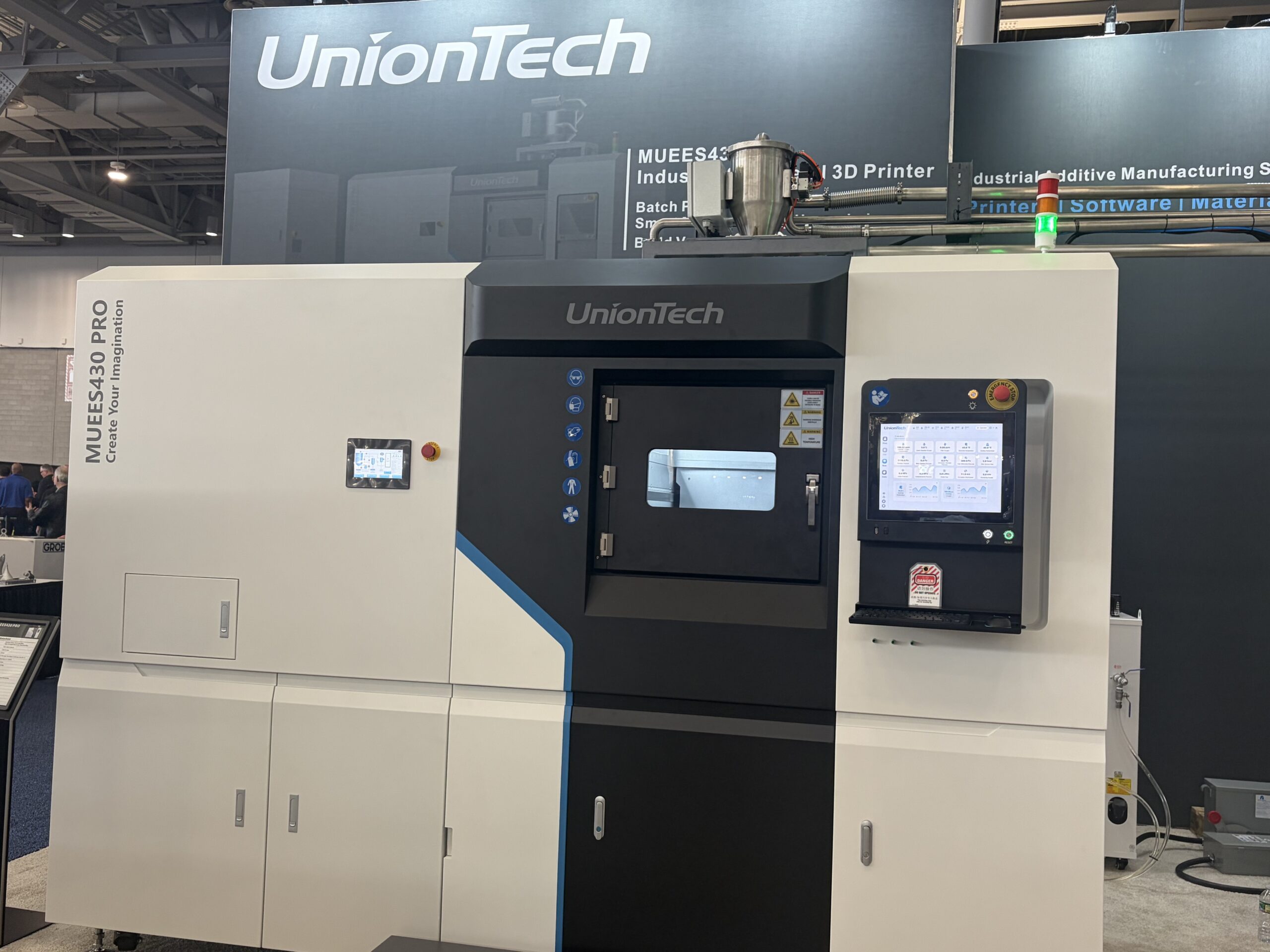
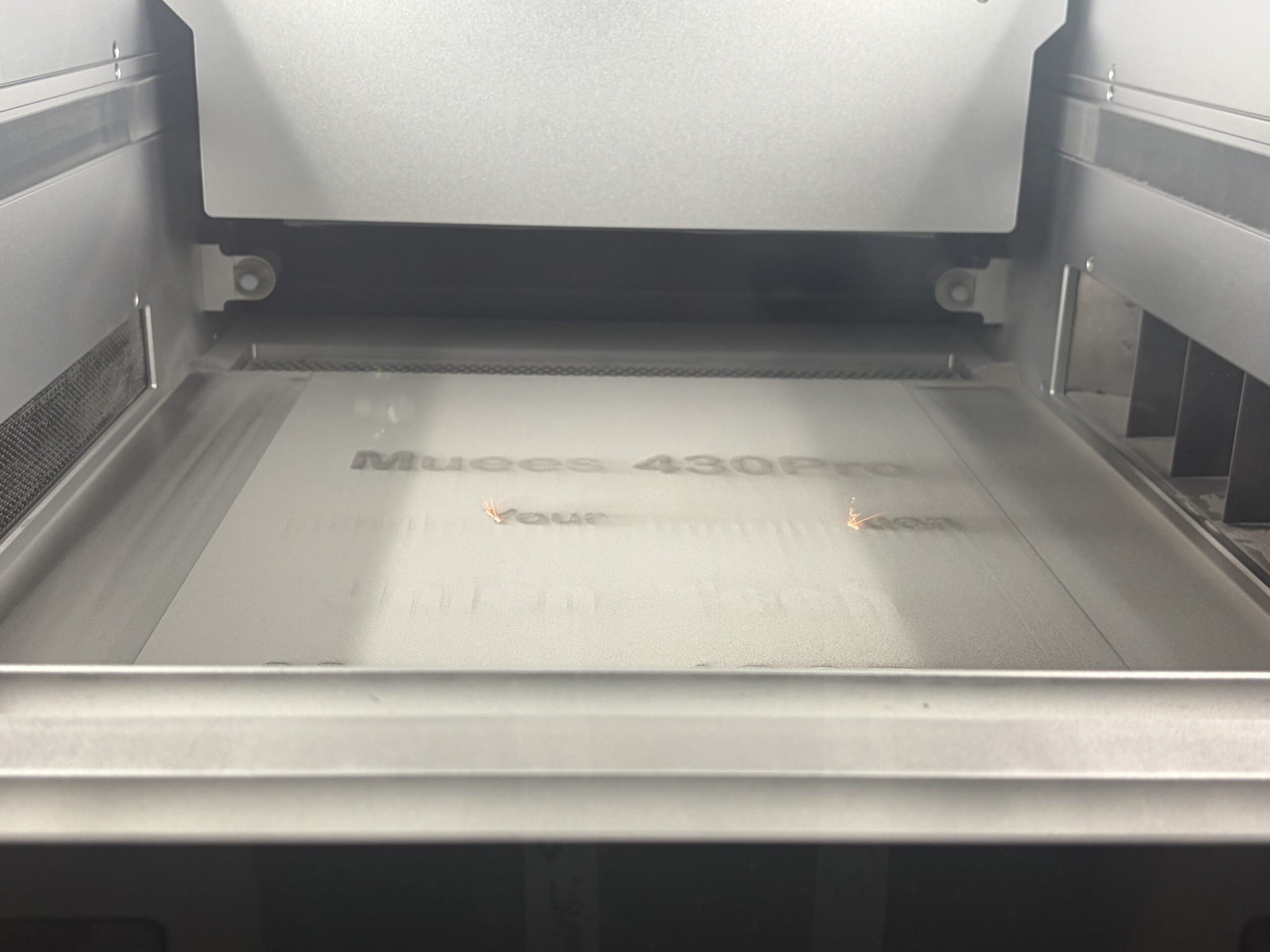
    One of the more interesting debuts came from UnionTech, which introduced its MUEES430 PRO, a new metal AM system. The move shows that Chinese OEMs are continuing to expand their global presence, especially in the metal sector.

    UnionTech booth at RAPID + TCT.

    The system is designed for larger, industrial parts, with a build size that puts it closer to production-focused machines rather than entry-level metal printers. It also supports multi-laser configurations, which can help speed up production and improve throughput. In simple terms, it’s built for companies that want to move beyond prototyping and into making real parts at scale.

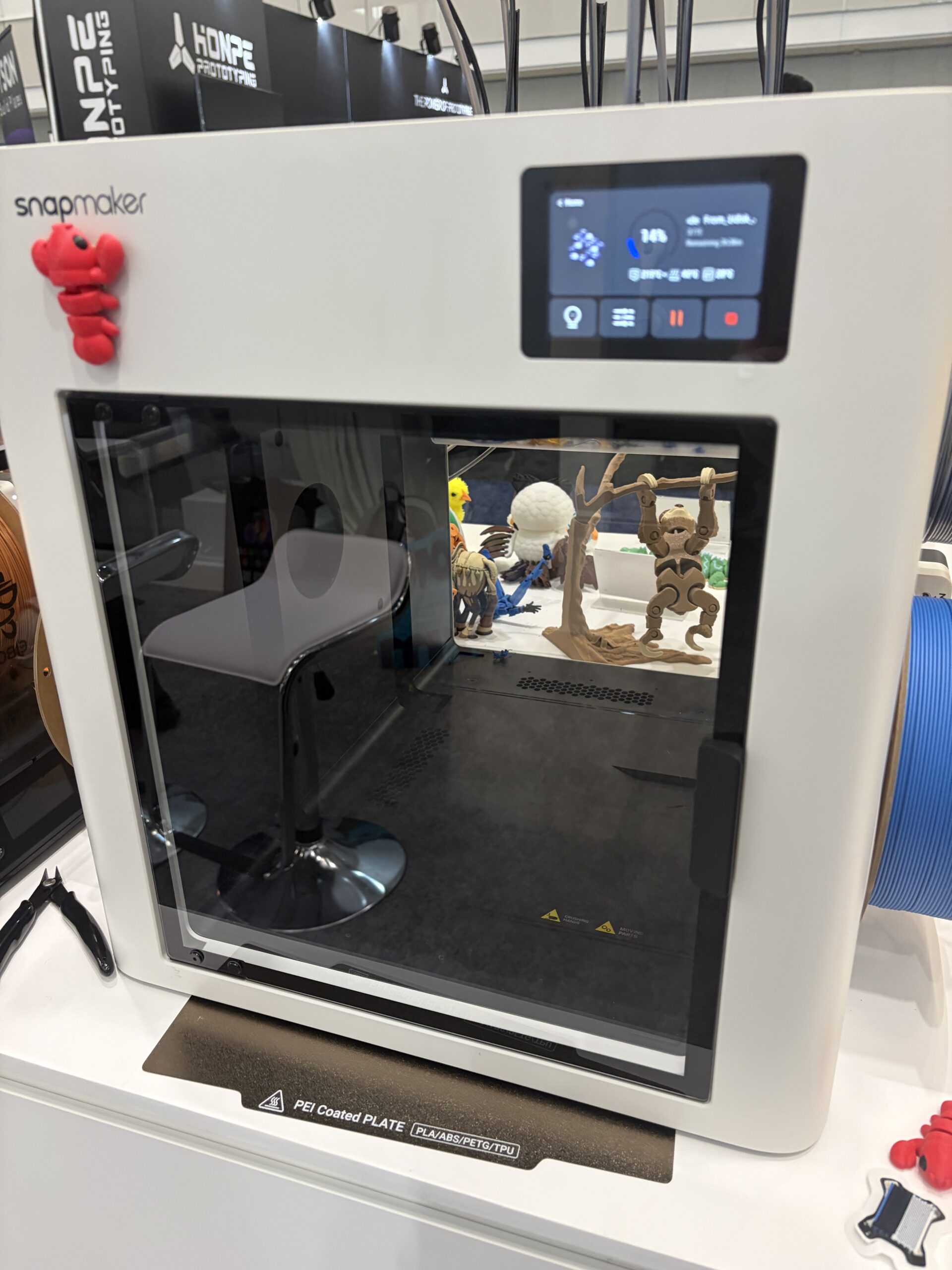
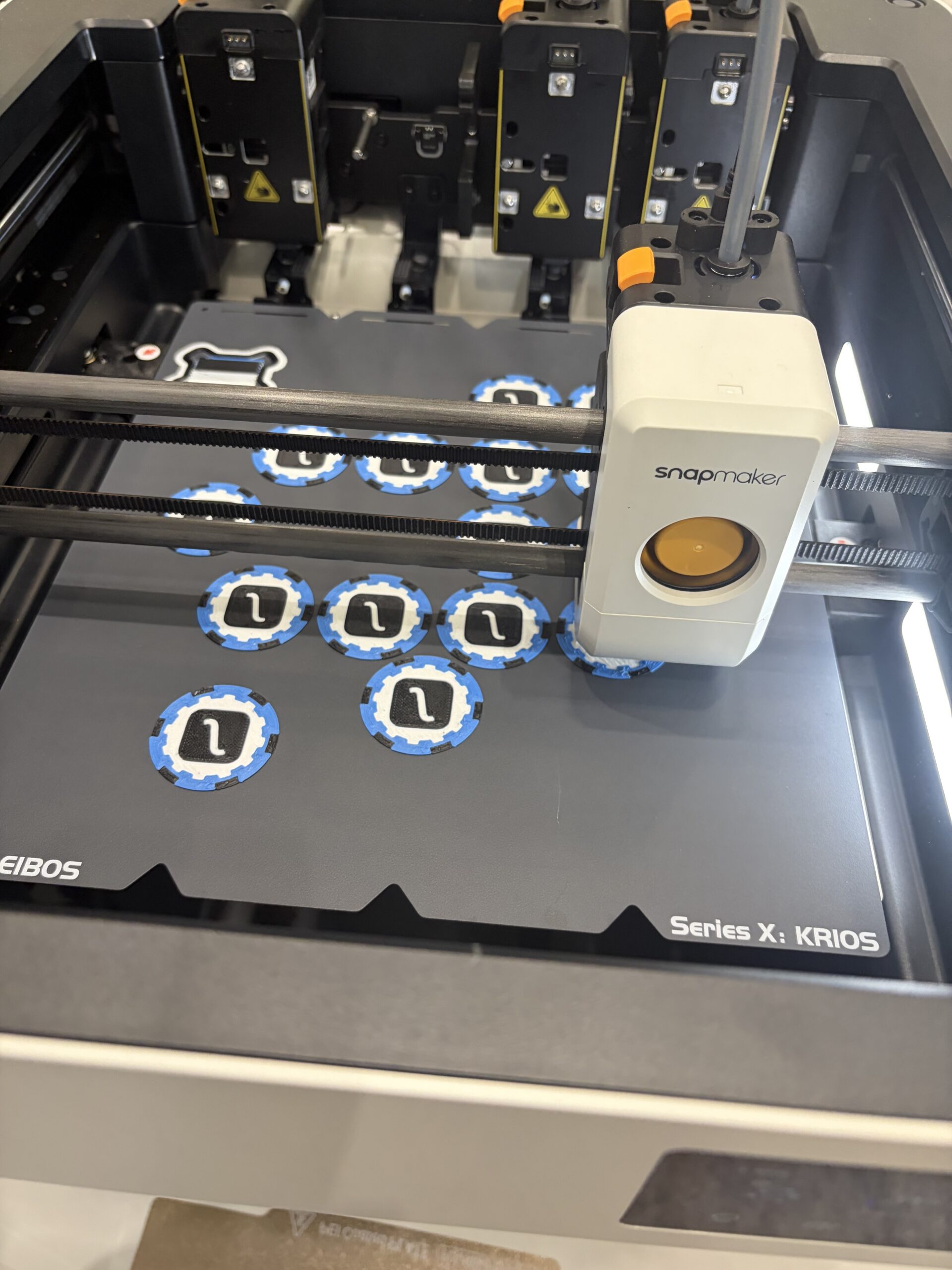
    Across the show floor, several other Chinese manufacturers were introducing new systems across different categories. Snapmaker presented the U1, pushing further into more capable, multi-use machines. The company has built its name on modular systems that combine 3D printing, CNC, and laser engraving, and the U1 continues that approach with a more industrial feel, aimed at users who want flexibility in a single platform rather than separate machines.

    Chinese firms SUNLU and Inslogic also announced the FilaDC I10, a system that blends filament printing with more industrial-style capabilities. The machine is designed to push beyond standard desktop FDM, with a focus on stronger materials and more consistent output, closer to what users would expect from entry-level industrial systems. Which basically means it sits somewhere between a typical desktop printer and a more production-oriented machine, showing how hybrid approaches are starting to fill that gap.

    SUNLU and Inslogic Team Up to Announce the FilaDC i10 at RAPID + TCT in Boston. Image courtesy of SUNLU.

    One of the hardest printers to miss was BigRep’s large-format ONE.5X, a system designed for industrial-scale parts. While the machine was announced ahead of RAPID, seeing it in person made it clear BigRep is leaning into bigger, more production-ready applications. The ONE.5X is built for large components and continuous output, aimed at industries that need size and throughput more than fine detail. In simple terms, it’s about making big parts reliably at a scale beyond prototyping.

    BigRep showcased its ONE.5X printer at RAPID + TCT.

    Creality also had a booth at RAPID this year, showcasing two machines that came out ahead of the event but were nonetheless exciting to see in person. In addition to its K2 Pro Combo printer, Sermoon P1 3D scanner, and Falcon T1 laser engraver, the company also had its relatively new SPARKX i7 and CFS (Color Filament System). Also seen at TCT Asia last month, the printer and its combined CFS are said to reduce filament waste by 50%.

    Creality SPARKXi7 printing live at RAPID+TCT 2026.

    Speaking of cutting down on material waste, Creality also showcased its Filament Maker M1 and Shredder R1, which were launched just weeks ago. The R1 processes prepared 3D printing waste into reusable material, and the M1 mixes, extrudes, and spools filament. This is said to be the first desktop system for users to recycle and make their own filament.

    Partnerships and Market Moves

    While the machines usually steal the show, partnerships were also a big part of the AM ecosystem at RAPID.

    Inkbit announced a collaboration with Stratasys Direct as it moves into wider industrial use. Inkbit develops its own polymer 3D printing systems, using a vision-controlled process that relies on cameras and software to monitor and correct each layer in real time. This approach helps improve accuracy and consistency, making it better suited for repeatable production rather than one-off prints.

    Stratasys booth at RAPID+TCT 2026.

    The partnership with Stratasys Direct is about getting that technology into real manufacturing environments. By working with an established service provider, Inkbit gains access to customers and applications that go beyond testing and into actual part production.

    Prusa booth at RAPID + TCT.

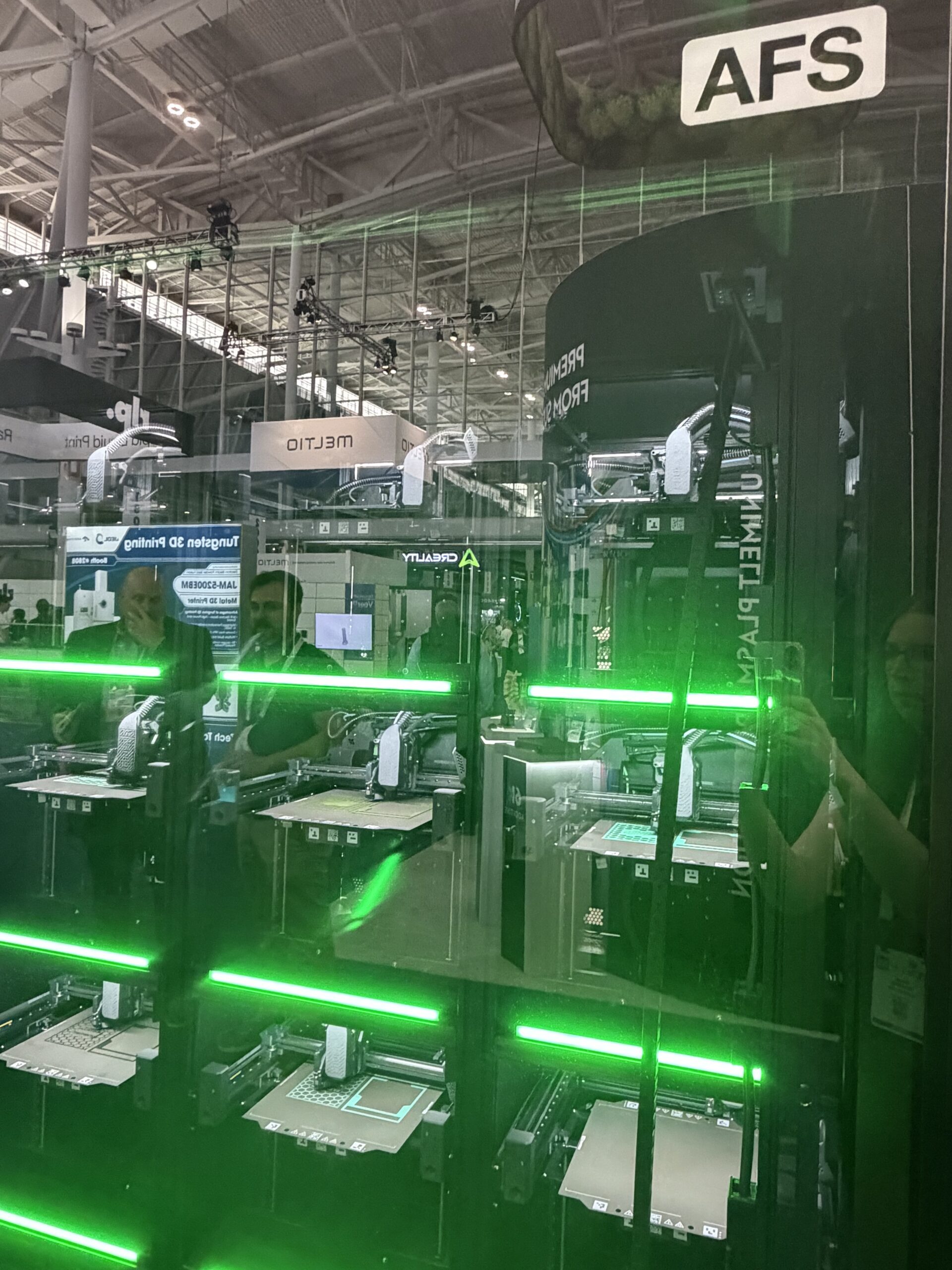
    Meanwhile, Prusa Research brought its Pro SLX and AFS systems to the U.S. for the first time. Best known for its desktop printers, the company is now pushing further into more industrial applications. The Pro SLX is designed for higher-end resin printing, while the AFS system focuses on automated farm-style production with multiple machines working together. Together, they show how Prusa is trying to move beyond individual machines and into more complete production setups. RAPID gave the company a chance to show that shift more clearly.


    There’s still a push to make 3D printing easier to use, through lower-cost systems, simpler workflows, and machines that don’t need complicated setups.

    At the same time, scale keeps coming up. Large-format printers, bigger resin systems, and new metal machines are all targeting the same goal: making parts that aren’t just prototypes, but actually usable at size.

    And partnerships are playing a bigger role, too. Instead of doing everything themselves, companies are working with service providers and local partners to get their technology into real production environments and really fast.

    Images courtesy of Sarah Saunders for 3DPrint.com unless otherwise noted.

  • Bryson DeChambeau Moving Forward and Backward With 3D Printed Clubs

    In 2024, we wrote about golfer Bryson DeChambeau, who turned to 3D printing to make custom clubs for himself. Rather than find a big-name sponsor (he was temporarily without), he made his own. That was great news for Avoda Golf. Its owner, Tom Bailey, got DeChambeau to test his clubs. Bryson liked them so much that he had them customized for his US Open Win. His performance at the Masters was less stellar, but he still managed to get all eyes to look at him. The talk was about his club length and his play. He finished outside the top 50 one day.

    Bryson then turned to 3D printing, noting that print time is 8 hours, with an additional 4 hours for post-processing. The Athletic. quoted him saying that, there is “a robot that measures a club’s geometry and material properties, making sure they comply with the USGA’s standards.” The idea back then was that the clubs were much more forgiving to mishits. He still liked the clubs positively, saying that they gave him a great second shot. He also complained about the USGA process needed to make the clubs conform.

    He reportedly used a 3D-printed five-iron at the Masters. He also took wedges with a bubble form on them and more weight. He mentioned that the clubs are now ready. He went on to say that,

    “There’s this nature that I have about myself where innovation is a habit of mine, and I really find and take pride in that ability to learn — even through failure, even through making a bad decision or a good decision — what I can get from that,”

    It seemed before the event that Bryson was teasing his 3D printed clubs. Bit by bit, he let information leak out, seeming to prime his audience for new public availability. Now, however, with a disappointing performance, this seems to be out of the question. Indeed, some may even blame the 3D printed clubs for his lower-than-expected performance.

    Bryson DeChambeau and his “caddy,” actor Kevin Hart, at the 2026 Masters Tournament. Image courtesy of Bryson DeChambeau via Instagram.

    If Bryson launched his own 3D printed golf club brand, it would be a really important moment in sports. On the one hand, it would be a boost for 3D printing to have the input of a Pro lead directly into his own brand of clubs. But, beyond this, Bryson is trying to build his own brand. Now, this is actually kind of a blast from the past. Lacoste, for example, was a die-hard, tenacious player with the nickname the Crocodile. That led to his eponymous Lacoste brand. Over the past decades, however, even the biggest athletes in the world have chosen Nike’s money over having their own brands. Christiano Ronaldo and Steph Curry have big company-enabled sub-brands, but going it alone entirely is really not attempted anymore.

    If Bryson succeeds, this could open the floodgates for more athletes to truly build their own brands. Here we have a branding hiccup and a failure to launch. This is exactly the kind of thing that would not happen if Bryson were with Adidas or another brand. They would take care of slick launches. There’s something endearing about Bryson’s approach here and the way he’s doing it. There is clearly a learning curve. And it isn’t working now. But if Bryson manages to get the narrative on track, he may yet launch a very valuable 3D printed brand of clubs.

    Bryson DeChambeau after winning the 2024 US Open. Image courtesy of Bryson DeChambeau.

    His own input and experience make this a very authentic experience. And it may lead to an excellent set up clubs as well. His winnings give him the financial independence to continue this development. If he does so and it gives him an edge, it could propel the clubs to success. We know that with additive, you can enlarge a sweet spot, you can reduce vibration, improve balance, change the way the club head moves in the air, change the impact point of the ball on the club, change how the ball spins, and much more. The possibilities point to huge advantages for whoever unlocks them. But, will “the scientist” get it right? We don’t know. But Bryson would be wise to study the story of Lacoste. Lacoste didn’t always win, but he always went for it 100%, and this endearing quality made him beloved and enabled him to leverage his fame into a brand. Perhaps the Scientist should therefore lean more into that.

    Images from Bryson’s Instagram.