• Blue Origin’s New Glenn Explosion Comes During Major Manufacturing Push

    Blue Origin‘s orbital New Glenn rocket exploded during a hot-fire test at Launch Complex 36 in Cape Canaveral on May 29, setting back the company’s launch ambitions at a time when it is investing heavily to expand its manufacturing footprint. Videos shared online showed a large fireball and thick smoke rising above the launch complex. No injuries were reported, though the explosion may have damaged parts of the launch facility.

    The incident occurred just days after Blue Origin announced plans to spend approximately $600 million on a major expansion near Florida’s Space Coast. The project will add more than 800,000 square feet of manufacturing and logistics space and create hundreds of jobs as the company works to increase production of its New Glenn launch vehicle.

    New Glenn rocket. Image courtesy of Blue Origin.

    The setback also comes as Blue Origin takes on a larger role in NASA’s lunar plans. Earlier this month, NASA selected the company for additional moon-related missions as part of its broader Artemis program, which aims to return astronauts to the Moon and establish a long-term lunar presence. New Glenn is expected to play an important role in those efforts, including future launches connected to Blue Origin’s Blue Moon lander program. NASA has since said it is assessing whether the explosion could affect upcoming schedules and mission planning.

    The investment is part of Blue Origin’s effort to increase the number of New Glenn launches. The company has positioned the rocket as a competitor to other heavy-lift launch vehicles serving commercial, government, and lunar missions (particularly SpaceX’s alternatives), making production capacity increasingly important as demand for launches grows.

    While the cause of the explosion is still under investigation, the incident comes as Blue Origin is trying to increase production of its large New Glenn rocket. Like other space companies, Blue Origin is now facing the challenge of turning a rocket program into a production program. And that challenge is tied to additive manufacturing (AM).

    Over the past decade, 3D printing has become a core production technology within aerospace. Today, many launch providers rely on additively manufactured components in engines, propulsion systems, and spacecraft hardware. Blue Origin is one of them. The company has used metal additive manufacturing in its propulsion programs for years, particularly in the development and production of the BE-4 engine. The engine contains additively manufactured components and is produced at Blue Origin’s engine factory in Huntsville, Alabama.

    The company has also backed research aimed at advancing aerospace applications for additive manufacturing. Last year, Blue Origin partnered with Auburn University’s National Center for Additive Manufacturing Excellence (NCAME) to improve the 3D printing of copper alloys used in aerospace applications. These materials are often used in rocket engine components because they can withstand, and help manage, extreme temperatures.

    New Glenn rocket. Image courtesy of Blue Origin.

    While details about the incident are limited, the event comes at a time when launch providers are under a lot of pressure to increase production. That has helped drive adoption of additive manufacturing, which allows companies to use 3D printing to make engine parts and other hardware faster and with fewer pieces.

    Companies including SpaceX, Rocket Lab, Relativity Space, and Blue Origin have all incorporated additive manufacturing into their rocket programs. One reason is that 3D printing can simplify complex hardware. Parts that once had to be assembled from dozens of individual components can now be produced as a single piece. For rocket manufacturers, that can mean fewer assembly steps and a simpler production process, not to mention lower costs.

    What remains unclear is how much the explosion will affect Blue Origin’s schedule. Reports indicate the incident may have damaged launch infrastructure at Cape Canaveral, and NASA has said it is assessing the impact on upcoming programs. At the same time, there has been no indication that Blue Origin’s planned manufacturing expansion will change. Before the explosion, Blue Origin had been working to increase New Glenn launch frequency while supporting future NASA and commercial missions. Whether the incident results in weeks or months of delays is still not clear, but the company’s manufacturing expansion is expected to continue as planned.

  • Killer 3D Printing Applications: Tool Voids and The Hidden Opportunity in Tool Storage

    Sometimes, nothing is the product. Hand tools, electric tools, factory tools, surgical tools, gardening tools, hobbyist tools, firefighter tools, and many other specialized tools can be found all over the world. Storing and organizing these tools could be a significant opportunity for the 3D printing market. As the working population ages and many countries can not find enough workers, efficiency, ergonomics, organization, and speed will become more important.

    Shadow Boards
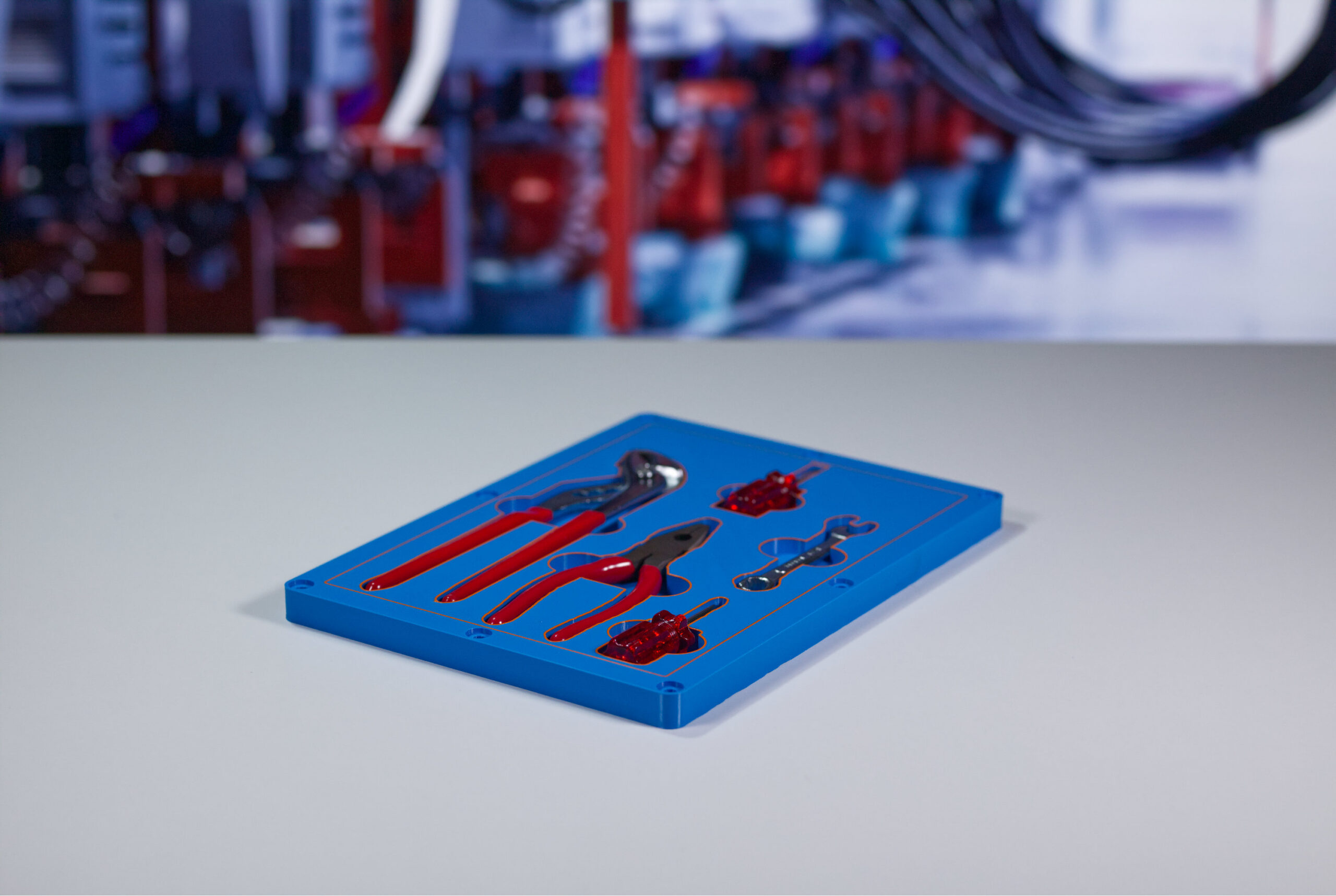
    Custom shadow board insert designed to organize and track hand tools in a workshop environment. Image courtesy of Trickle.

    Trickle offers a tool that will turn images of tools into shadow boards. That is a handy and quick way to make your own foam board. Foam boards or shadow boards are places where you can specifically place tools in a place made for them. You can have a shadow board on a wall, in a drawer, in a case, or more. Workplaces could be fitted out with them, or workers could have different boards for different operations. Some could be cut from foam with a box cutter, while others could be made with laser cutting or 3D printing.

    With 3D printing, you can easily make shadow boards just like the regular kind. High-quality tool brand Gedore has a foam configurator; indeed, many of the industry- or task-specific kits they make come prepackaged in the foam that you can use to place them in a bigger tray or cabinet. The company is a proponent of the 5S method, which promotes organized and tidy workshops. Beyond saving time and preventing tool loss, this is also a critical safety practice. In any workshop, you can knock over a tool that falls on you or trip over something. And in aerospace and other areas, you absolutely can not leave a tool behind. So these foam boards and inserts are not just pleasing on the eye, they’re important. They can also lock people into your tool system and promote sales generally.
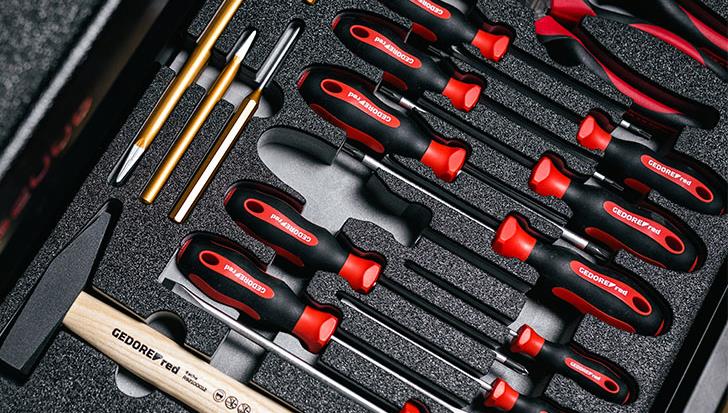
    Foam tool insert system from Gedore designed for organization, safety, and fast tool access. Image courtesy of Gedore.

    Kits and Cases
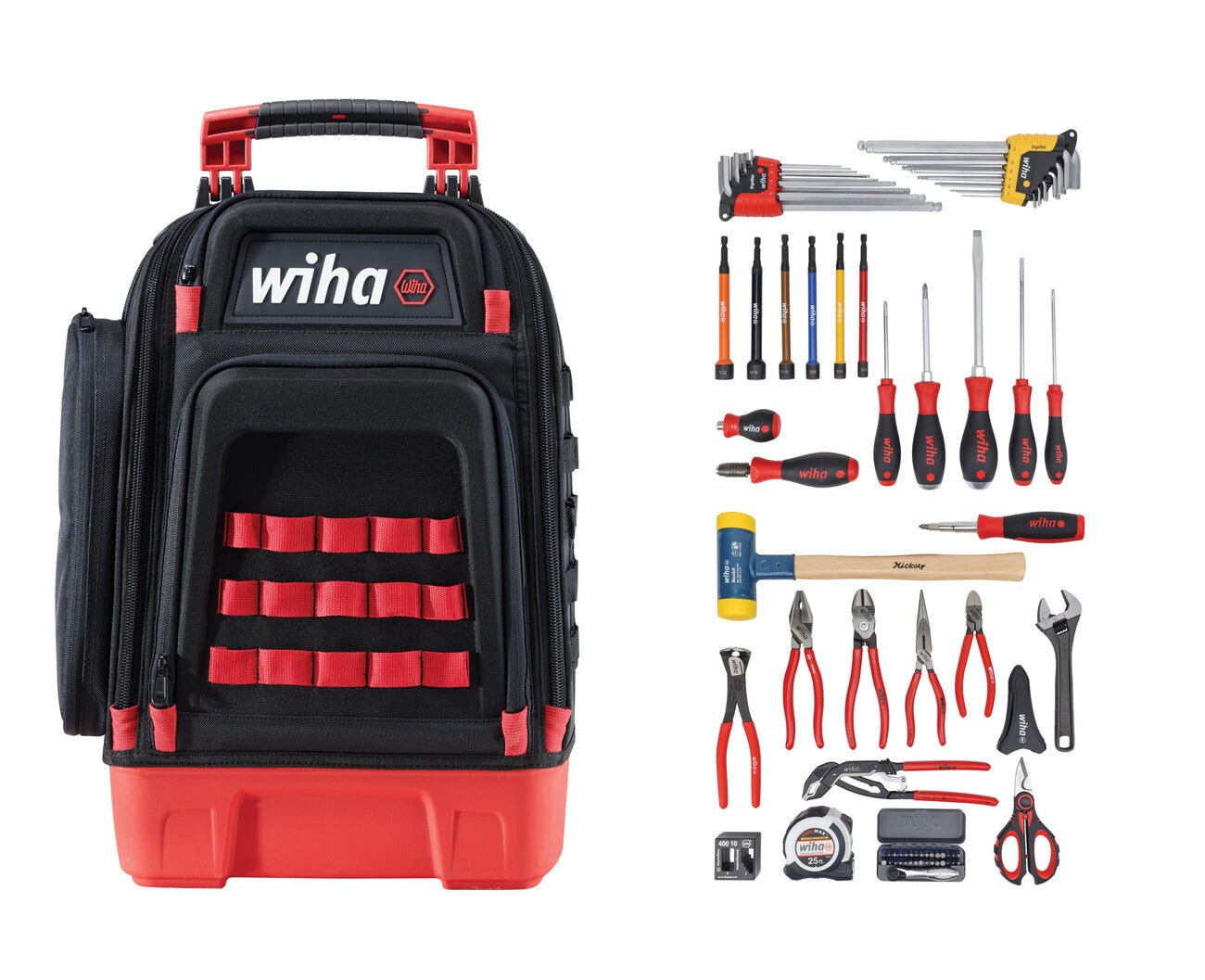
    Wiha electrician toolkit and backpack system designed for mobile repair and industrial work. Image courtesy of Wiha.

    But you can do more: you can make custom boards that you can take to the job site, the car, or a specific operation. Now it’s important to note that storage is already a big part of the tool business. People pay thousands for fancy Snap-On tool drawers, for example. New electricians or plumbers often buy kits like this one from Stahlwille or this e-mobility kit from Knipex. An apprentice, student, or new graduate can start their professional career with a case stocked with the most common tools they need. A wonderful gift, a good investment, and for Stahlwille, a great way to make someone a lifelong fan.

    Wiha offers excellent backpacks and pouches for electricians and industrial MRO, as well as specific ones for installing electric vehicle chargers. Wera sells super handy kits that are perfect for work in the home or as a repair person, giving you the most common tools for bathrooms or heating systems, for example. Hazet has tool sets for things like hybrid and electric vehicles. Wera also has the excellent ToolCheck, a case with a mini ratchet and screwdriver paired with bits and sockets. Cimco probably makes the world’s best electrical equipment and has cases centered on these tools.

    Explosive Ordnance Teams have extensive kits for the different bombs they deal with. There are tool kits for wind turbine inspectors or specific operations in a car mechanics shop. For dentists and oral surgeons, kits for particular operations let you have everything in one place. Complex surgeries can come with kits that contain tools, guides, and implants. Some kits have a strong poke yoke element, letting you see all the tools in order, step by step, along with the guides and implants in order as well.
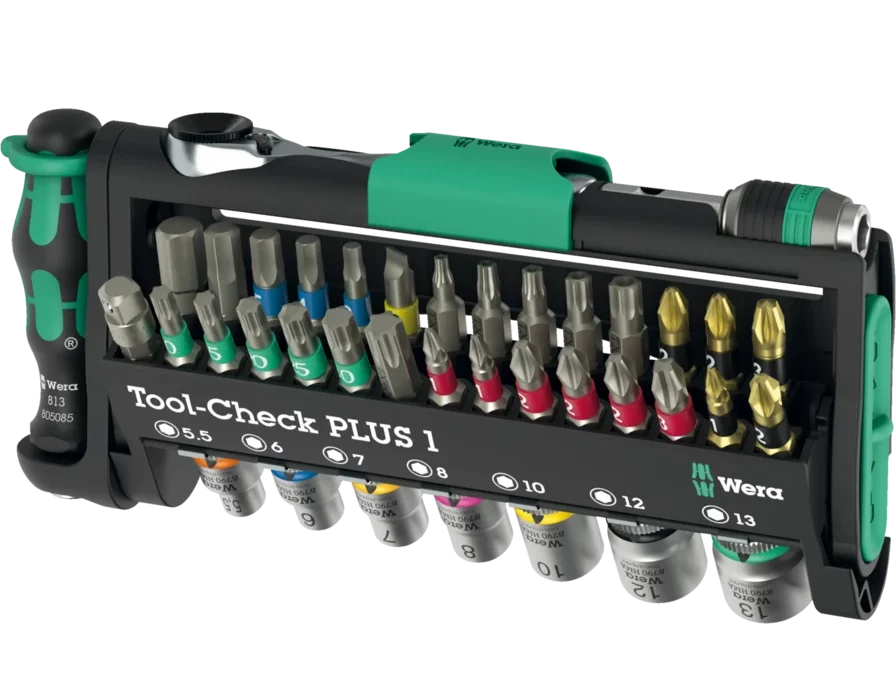
    Wera Tool-Check compact ratchet and bit kit designed for portable repair and maintenance work. Image courtesy of Wera.

    Power Tools

    But whereas in the hand tool market there is a profusion of kits, electronic tool companies have made kits a central part of their businesses. I’m pretty sure that it all began with Festool. The German wood-centric manufacturer of high-quality tools was always about making workers safe and saving them time. Something that unites other high-quality companies such as Fein, Bosch, Hilti, and Makita. If you care about safety, worker time, and ergonomics, you’re going to make the drill safer. And then you’ll look beyond the drill to the dust workers breathe in and how they store their kits.
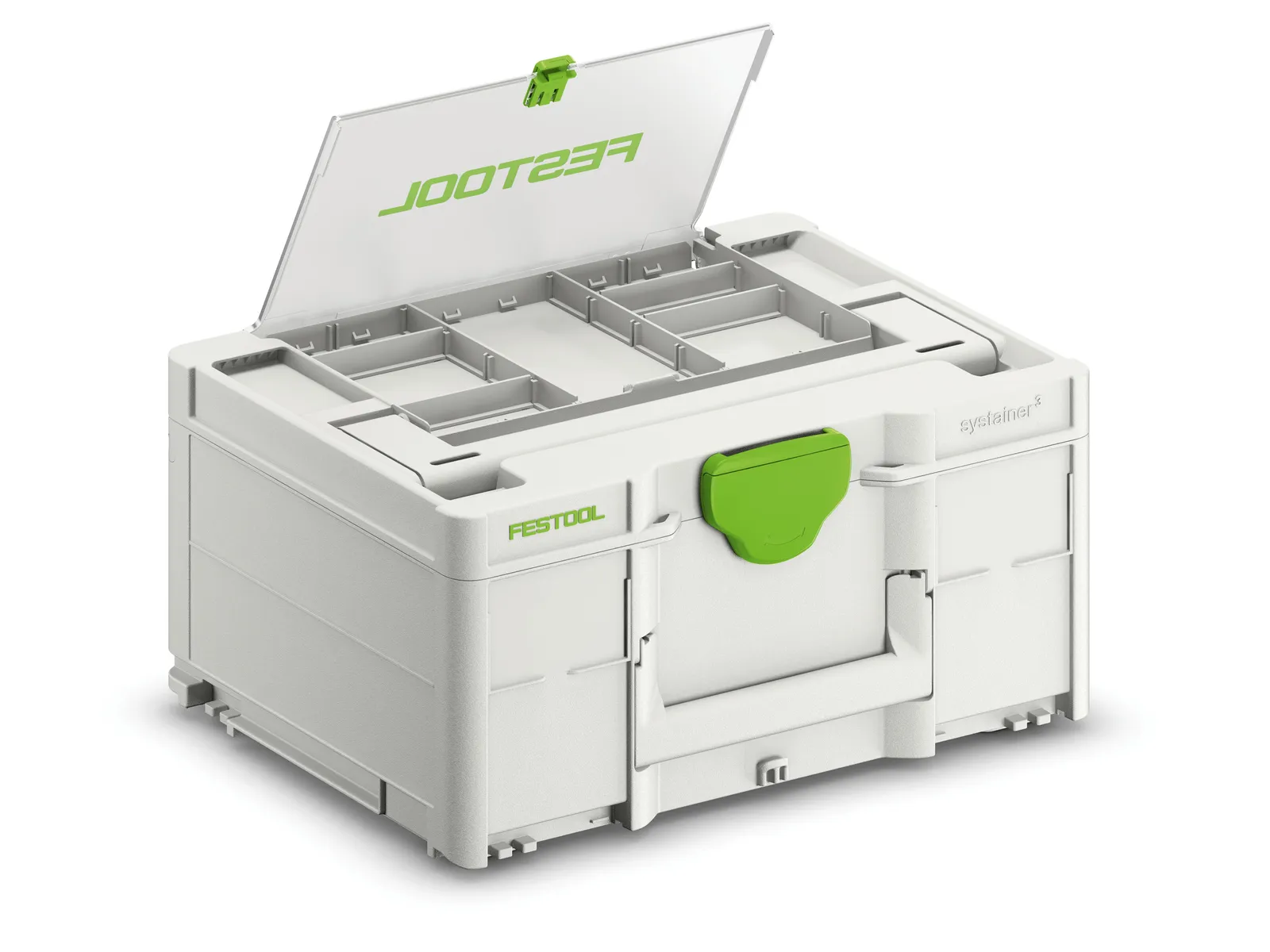
    Festool Systainer storage box system used to organize tools, accessories and job-site workflows. Image courtesy of Festool.

    Festool’s Systainer system family, made by a dedicated subsidiary of the same family-holding company, is a massive part of the firm’s offering. I guess that, on one level, the company found that people who like making cabinets also like organized storage, but there are myriad ergonomic and time benefits, as well as longer tool life and increased safety. The Systainer lets you click together vacuums, toolboxes, and more into one deployable unit. The high-quality boxes are relatively affordable (some of the hand tool brands sell similar boxes for twice as much). In addition to enabling easy storage, the system makes it easy to carry the firm’s dust extraction system parts to where you need to work, helping you work more safely. Since many of Festool’s tools come with integrated dust extraction, this compounds a key advantage the company has long pursued. So the tool container becomes a key part of making the worker safer and building on strengths to compound Festool’s specific advantages.

    Standards (kind of)
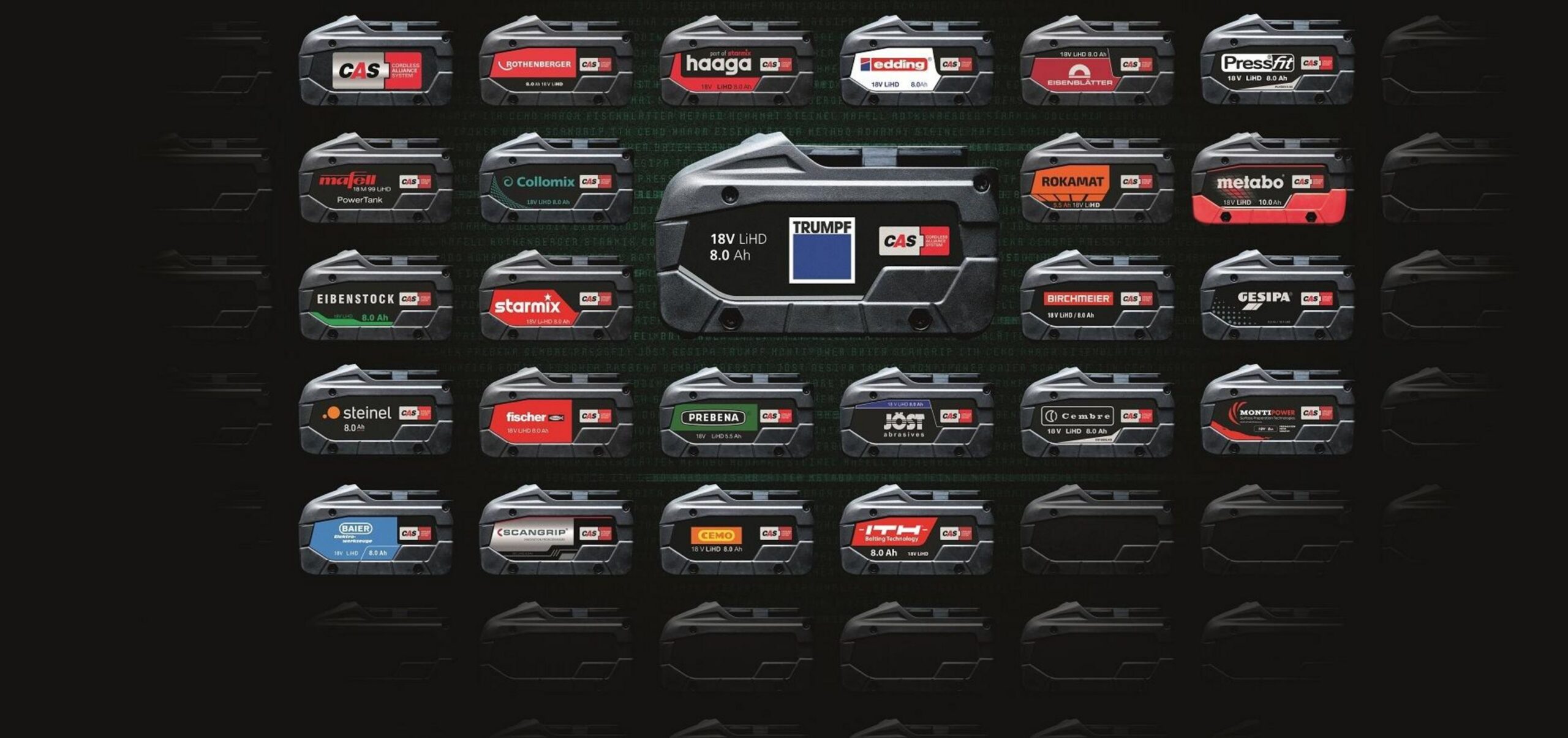
    The Cordless Alliance System (CAS) battery platform connects tools from multiple industrial brands through a shared battery ecosystem. Image courtesy of CAS / Metabo.

    As soon as the advantages of Festool’s strategy became apparent, everyone fell over themselves to work on better box systems. Bosch, the huge car components firm, turned to making electric tools to save itself in a downturn a 100 years ago. The spark plug and electronic systems giant is now also a huge maker of power tools. It partnered with van organization firm Sortino to create the L-Boxx a box standard used by Bosch, Fein, Wera, Wiha, Gedore, Knipex and other smaller more specialized firms.
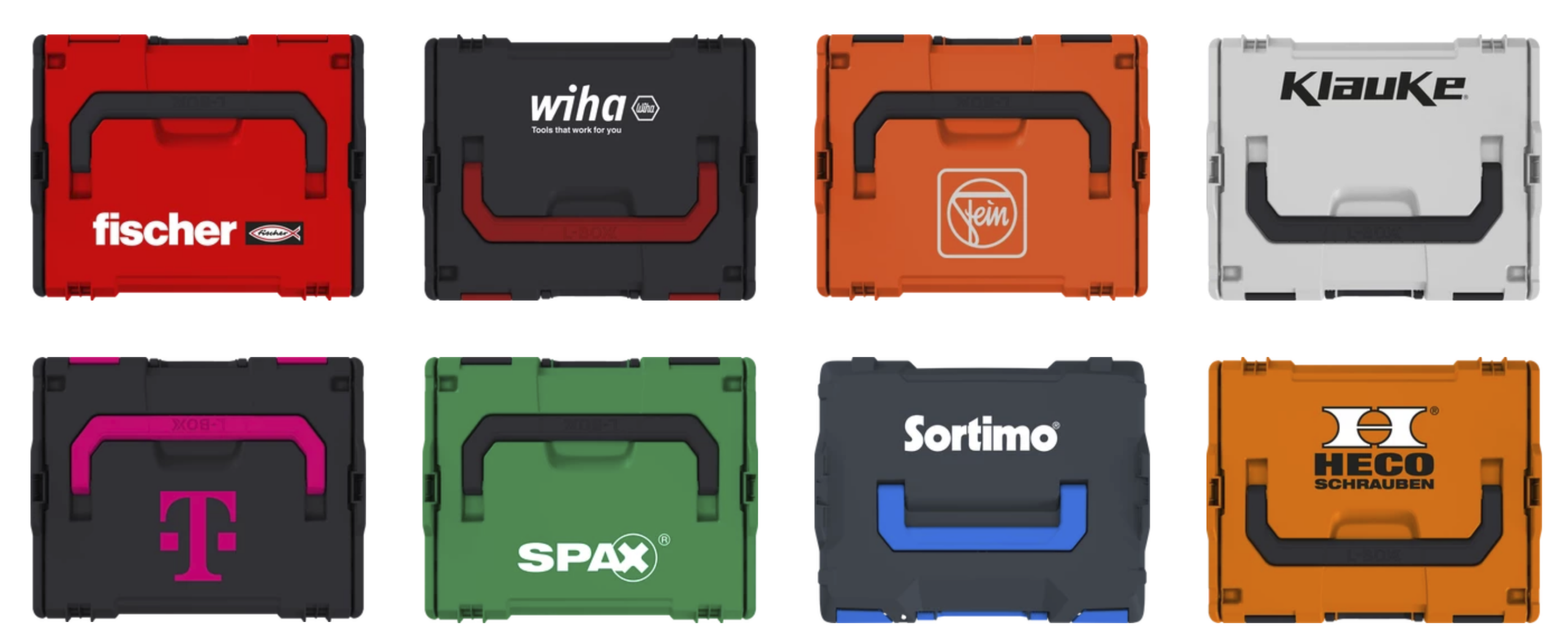
    Different tool brands use the shared L-BOXX storage system developed by Sortimo and Bosch. Image courtesy of Sortimo.

    This allows these firms to use a standard to make their tools interoperable with others. Similarly, many power tool companies compete on a battery platform. Investing in one platform means you’re more likely to buy new tools from that platform, so you don’t have to buy all-new batteries or carry lots of different batteries and adaptors everywhere. Makita and Ryobi have had 20- and 30-years of backward compatibility with batteries, which has built loyalty to these quality workman and entry-level home-use brands, respectively.

    The CAS battery alliance, created by Metabo, unites companies such as the specialized Swiss cleaning tool company and Eibenstock a high-quality manufacturer of diamond core drills as well as drywall power tool specialists Mafell and rather unexpectedly erstwhile 3D printing firm and industrial laser and cutting giant Trumpf. I had no idea that they made power tools. An incompatible battery alliance, AMPshare, unites a lot of the same firms and is powered by Bosch, while another incompatible one, also powered by Bosch, is Power for All.

    I like Bosch’s power tools, but the company has changed its batteries numerous times, and the idea of being involved in multiple alliances is just silly. Sillier still is Stanley Black & Decker, which has the Craftsman, DeWalt, and Black & Decker brands, whose batteries are often incompatible even when the tools are very similar. Milwaukee has multiple incompatible battery standards within its own brand, while its owner, TTI, only offers incompatible batteries from Ryobi, Milwaukee, and Rigid. Here, as well, old Milwaukee designs are used for Rigid and Ryobi tools, but the resulting batteries are incompatible. Again, the batteries are meant to engender loyalty and keep you inside one system with expanding tools, so this kind of stuff is crucial to the market dynamics of the tool business.

    Screwing

    Now, at this point, you’re probably thinking, Joris, thank you so much for this deep dive into tool brands and the surprising pseudo-standards they operate under. It may be the right moment for me to disclose a slight obsession with tools. But know that this is nothing like the obsession tool firms have with real and pseudo standards. Imagine always having to make your screwdriver meet the standards, yet still work better than other screwdrivers. Imagine always dealing with bolts that are slightly better than competitors’, so you don’t round them — and then wondering if you should make your bits for everything, just your screwdrivers, just one family of screwdrivers, just wood, or also for electric drills and other people’s systems? There are pitfalls and opportunities everywhere.

    Many firms, therefore, ultimately decide to lock customers into their own ecosystems as well as the fasteners. But there are companies such as Makita that seem to consistently act to favor customers. On the whole, the tool shed is a confusing mix of standards and incompatibilities.

    Tool Time

    What we can do with 3D printing is use it as a universal connector set for all tools. We can make connectors, adaptors, and other tools that connect different tool systems. Now, please don’t do this for the batteries; this seems like a recipe for disaster. Aside from this, we can make many connectors to link bits and different systems.
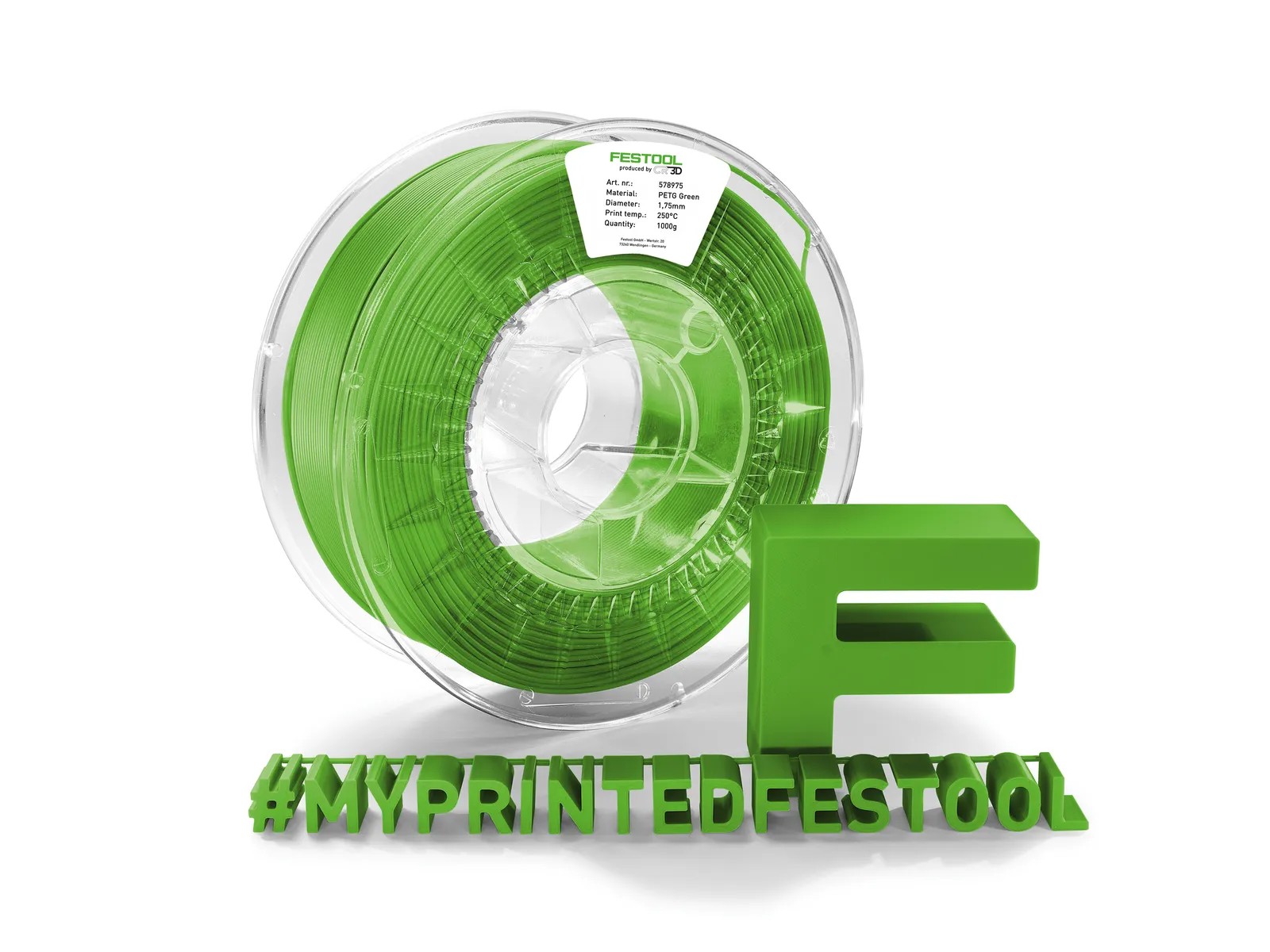
    Festool-branded 3D printing filament promoted through the company’s “#MyPrintedFestool” initiative. Image courtesy of Festool.

    At the same time, we can make tool cases, tool inserts, shadow boards, and case insets for custom tool sets. Toolkits for the tools you have, regardless of the system or manufacturer. We can also make inserts for particular cases. So if you have a call out for HVAC repair or a junction box problem, you can have the right tool insert ready to go. Or you can take the empty insert and use it to collect all the necessary tools so you don’t forget one.

    For bomb disposal teams or firefighters, we can give them cases for very specific events, uniting very different power and hand tools. We can also make cases optimized to keep tools safe in demanding environments. We can let you put your Festool drill in with your Wera hand tools, just like you want. We can include specific fasteners or organize the tools in the order that you use them.

    A case could be all the screwdrivers, in order of use, for dismantling the MacBook Pro, or all the tools, in order, for opening and closing a junction box. Two inserts could ensure you take everything for that job. One insert could track the tools from beginning to end, while reversing the order helps you close everything up again.

    If you’re an elevator mechanic servicing six main elevators, you could have six sets of bolts and bits for each elevator. On a ship, you can have inserts specific to servicing a particular engine or system. You can work with installation firms to make cases for HVAC technicians or boiler repair teams. You can make custom kits for one specific solar farm and another for the next one over.

    If you always use the same drill, chuck, and bit, the enclosure might be optimized for that setup. Whatever tool journey you’re on, whatever you need, 3D printing the voids, inserts, and cases for the tools will suit your needs. We can organize your tools for life in the lab, in the shop, at home, or on the road.


  • ORNL Improves Error Mitigation in Large Polymer Parts

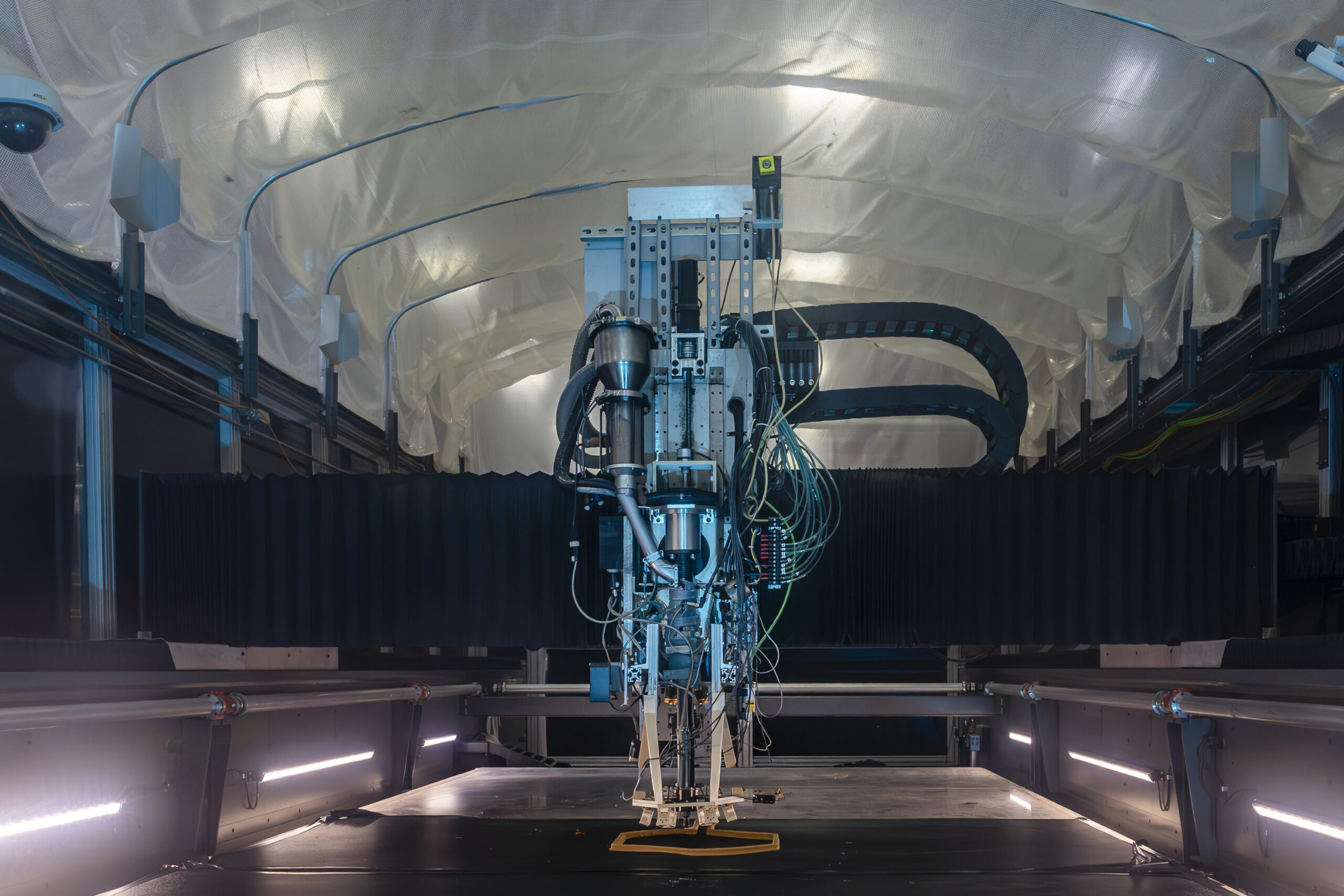
    Oak Ridge National Laboratory (ORNL) has commercialized a number of large-format 3D printing technologies. Now, scientists are working on error mitigation in large parts. ORNL is using six thermal cameras to analyze the deposition, hardening, and cooling behavior of the beads as they are deposited. Computer vision is then used to adjust the temperature and extrusion parameters in response to defects. The parameters can also be optimized to increase intra-layer bonding. I first saw this approach at Aibuild many years ago. The team there, at the time, just two people strong, pioneered adjusting parameters in real time to reduce and even correct errors.

    A test object is 3D-printed using a new system that monitors for errors and corrects them automatically during the manufacturing of large plastic composite items. Image courtesy of Carlos Jones/ORNL, US Dept. of Energy.

    The ORNL team says that they can do things like adjust when, “material that was about 30% too cool when the next layer was applied. Upon detecting this, the controller automatically increased the print speed to maintain the optimal temperature for layers to fuse correctly, demonstrating real-time correction in action.” The control unit can adjust temperature variants to a few degrees. The AI model does not have to be trained on new parts per se, but it should work for any printable part. In 2024, ORNL published a paper looking at this approach and later made it so that the system could adjust within seconds. Now the correction happens in real time.

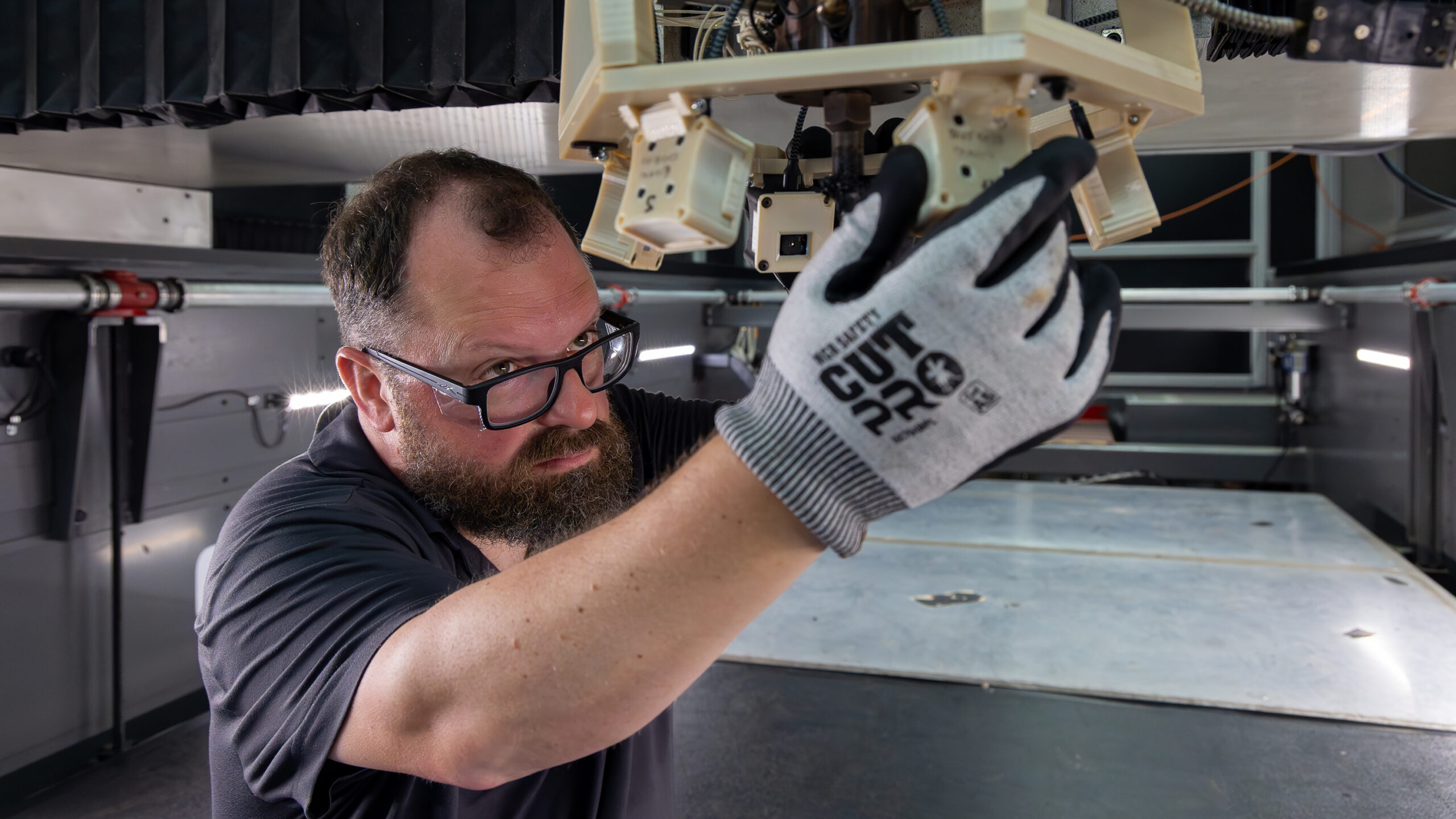
    ORNL’s Kris Villez adjusts thermal cameras incorporated into a big-area 3D printer before testing a new technology for error recognition and correction. Image courtesy of Alonda Hines/ORNL, US Dept. of Energy.

    Lead Researcher Kris Villez explained,

    “There is a vast opportunity space to make these machines more intelligent and more responsive. In the end, we’d love this to work like baking bread: You set the oven temperature, put in your dough, and return when the timer goes off to see if it’s done. You don’t have to monitor the oven temperature in real time throughout the baking.”

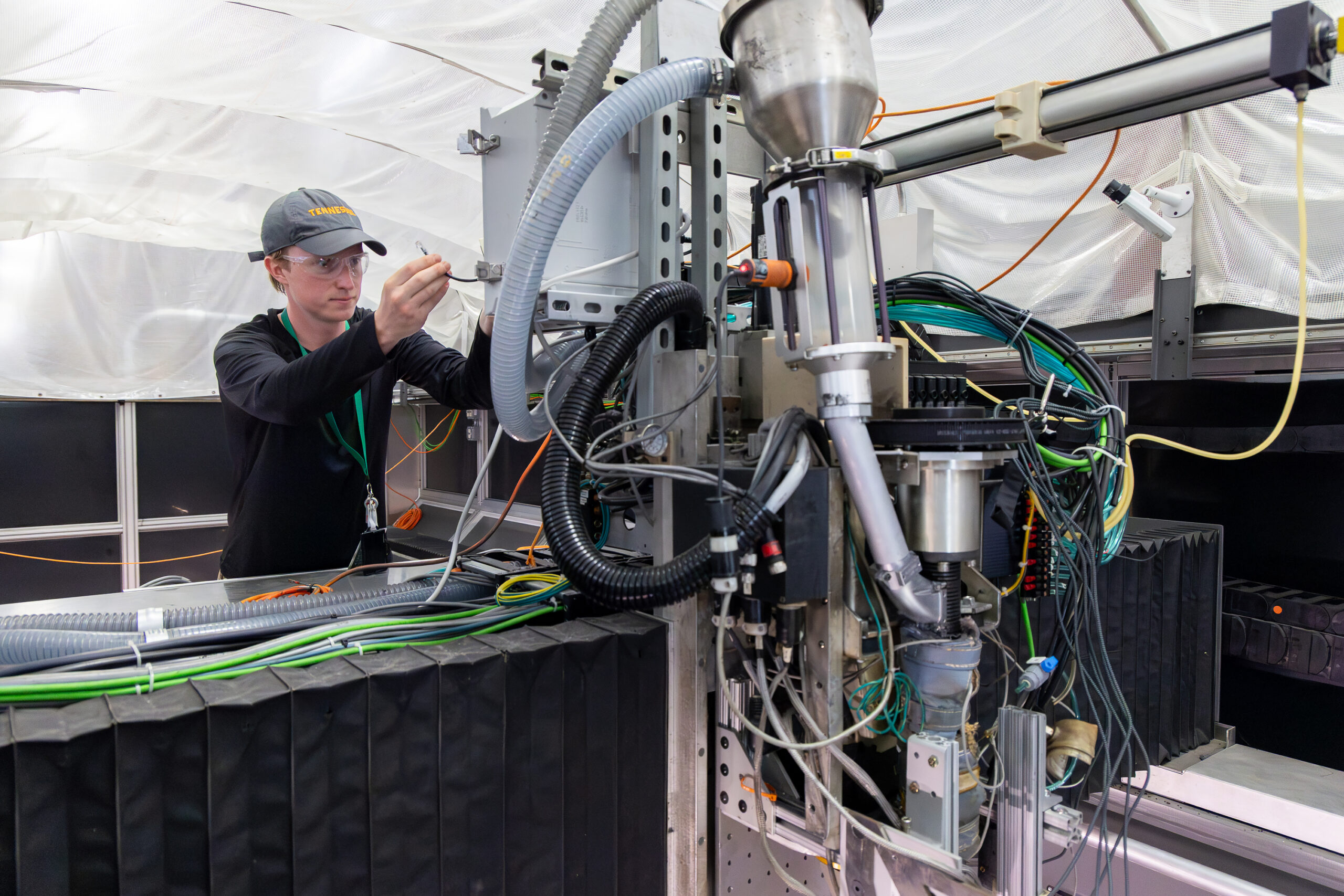
    University of Tennessee graduate student Chris O’Brien sets up the 3D-printing apparatus at ORNL to test a new sensing and control technology for creating large objects with plastic composite. Image courtesy of Alonda Hines/ORNL, US Dept. of Energy.

    Large-format polymer 3D printing has been important to the US for decades now. On the one hand, it can be used for formwork for construction. But it can also be used to make many boats very quickly and at much lower cost than is done now. In 2021, we said that,

    “The U.S. is almighty on the sea, but automated construction of autonomous sea vehicles can negate American marine power. The U.S. has hundreds of billions tied up in its carriers, and a fleet of polymer UUVs or surface vehicles could negate this force. In the Persian Gulf, Iran already routinely menaces much more sophisticated U.S. ships with its polymer gunboats.”

    We looked in May of 2022 at the potential and importance of 3D printed drone boats, and we said then that this capability being offered to Ukraine,

    “A curiosity in a laundry list of weapons given to Ukraine, this may seem like small beans compared to Howitzers and other weapons. However, this is an incredibly significant move. Russia should have near-unrestricted access and dominion over the Black Sea. However, due to the specter of these drones, it does not. It would take many millions of dollars in funds and thousands of individuals on conventional ships to make Russia worry about its position in the Black Sea. It would also take many months of training for Ukrainian sailors to learn to operate the high-tech Christmas trees that are contemporary frigates and other warships. It would take many years to build new surface ships as well. With conventional weapons, there is no solution or path to a solution whereby Ukraine would be a credible threat to the Russian Navy. But, with these new expendable drones, it is.”

    The first Russian ship was sunk in October of that year, and now Ukraine has disabled around a third of the Russian Black Sea fleet with these drones. Ukraine, a country without a meaningful Navy, has come close to neutralizing the once mighty Russian fleet in the Black Sea with these drones. So 3D printed drone boats are not a luxury or a cool science project, but a war-winning weapon. And as we argue in the Hilux for the Seas post recently, the US could and indeed must turn to 3D printing to develop these drone boats at scale.

    At the same time, 3D printing of formwork for energy installations, as well as for missiles and hypersonics, is very important. A lot of the roads towards a functioning US military go through 3D printing, and getting large-format polymer right seems more important every day.

    The growing connection between drones, defense, and additive manufacturing will be a major focus of the Additive Manufacturing Strategies UAS: The Present and Future of Drone Manufacturing event on June 30, 2026, where industry leaders will discuss how 3D printing is reshaping drone production and deployment.

  • UAS Additive Strategies: Register by June 30 to Learn About the Hottest Topic in 3D Printing

    Last week, drone stocks surged on news that the Trump administration is considering a massive investment in the US unmanned aerial vehicle (UAV) industry. Earlier in 2026, the release of the US FY 2027 defense budget request revealed that the Defense Autonomous Working Group (DAWG), a unit launched last year to accelerate adoption of all things drone-related for the DoD, could be in line to receive the largest single-year increase in funding of any defense program in US history.

    Meanwhile, in 2025, Ukraine reportedly produced 4 million combat drones, an absurd increase of over a thousandfold from the first year of the Russian invasion. This is not only the largest military drone production capacity possessed by any nation globally; it is more drone production capacity than all of the NATO countries combined.

    Even beyond the additive manufacturing (AM) industry, the discourse surrounding the topic has started to catch up to the fact that 3D printing is already an irreplaceable element within the drone supply chain. Yet all indicators seem to be signaling that the story of AM for the drones market has only just begun to be written.

    Nevertheless, despite the fact that this market boom is still in the early stages, the situation is expanding and evolving so quickly that it seems virtually impossible to stay up-to-date. That’s why 3DPrint.com and AM Research are presenting UAS Additive Strategies: The Present and Future of Drone Manufacturing, a live webcast that will take place on June 30 from 11 AM to 2:30 PM EST. Register before June 18 to gain access for only $49; after that, the price goes up to $89.

    UAS Additive Strategies 2026

    Sponsored by EOS and HP, two of the most important industrial AM OEMs in the UAV space, the webinar features a combination of talks and panel discussions from AM experts across the drone value chain. In addition to a keynote from EOS’s Business Development Manager for Polymer, Dave Krzeminski, and market insights from AM Research’s Scott Dunham and Joris Peels, as well as from myself, panelists include prominent industry professionals such as Steve Fournier from General Atomics Aeronautical Systems Inc. (GA-ASI) and Ian Muceus, CTO of Firestorm Labs.

    While I began by talking about government funding and wartime learning on-the-fly, it’s important to keep in mind that public spending and combat mobilization may be the factors most responsible for sustaining the 3D printed drone boom now. However, the broad-sweeping technological and economic structural shifts in play suggest that the private sector hasn’t even scratched the surface concerning the purely commercial civilian applications that should someday be just as vital to driving both UAV production and AM — and the combination of both — in the future.

    The landscape is overwhelming, but it’s just going to get more daunting, so there’s no better time to start than right now, and 3DPrint and AM Research are here to simplify the learning curve. Register today!

  • Himed and Adva Cera to Work on Bioceramic Medical Devices

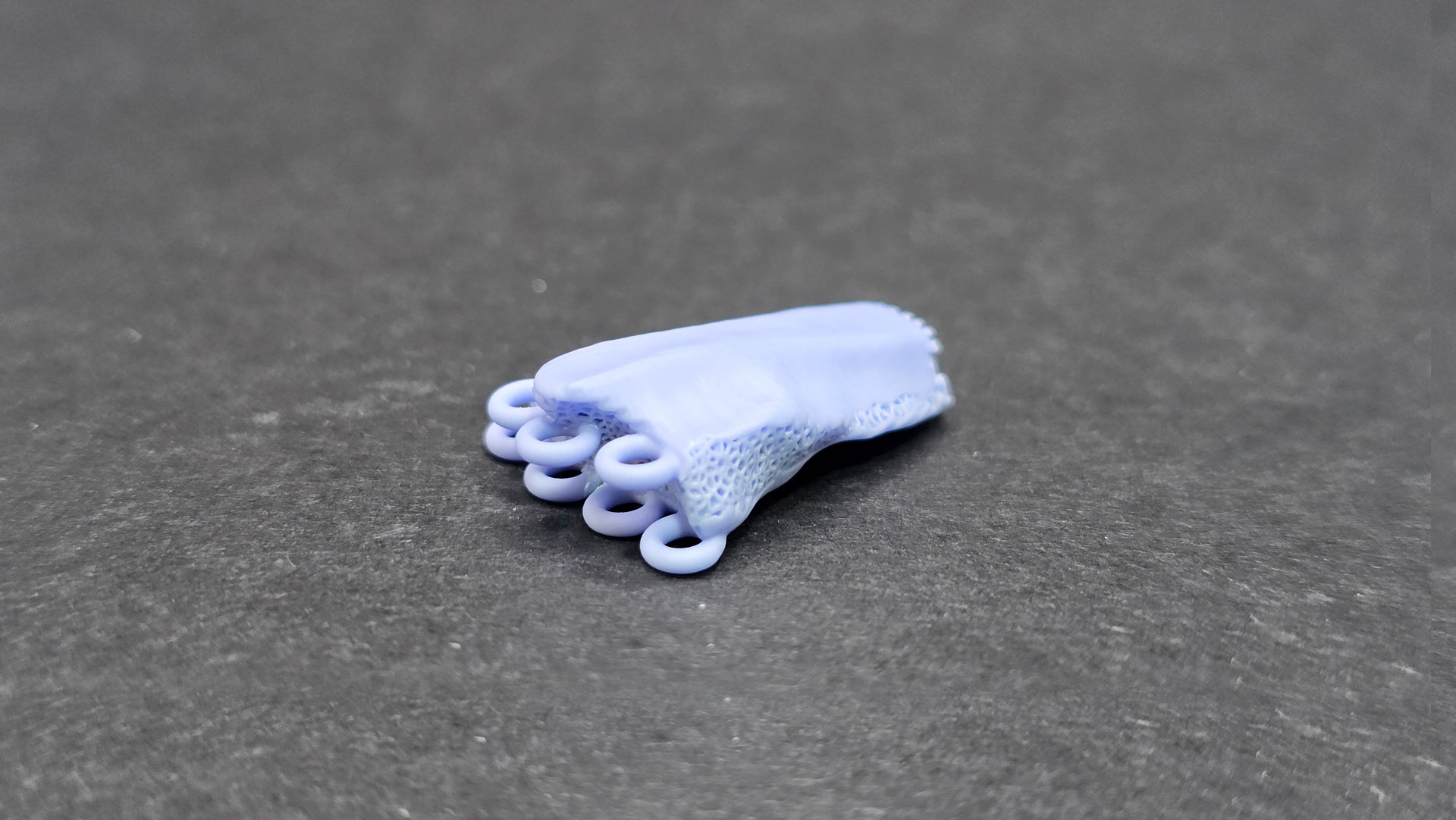
    Himed, a provider of calcium phosphate and hydroxyapatite, has partnered with Adva Cera. Adva Cera is not a spell to make you stop moving in the Harry Potter universe, but rather a 3D service that uses equipment from Lithoz and Prodways Ceram to produce ceramic parts. The two firms will work on calcium phosphate spine, orthopedic, and dental implants.

    Himed and Adva Cera from idea to implant using Himed’s Bioceramics Center of Excellence and Adva’s 3D printing capabilities. This kind of setup could be very beneficial since it lets people quickly lean on existing expertise in medical device manufacturing using additive. Amnovis does a similar thing for metal additive, and this can mean that a lone inventor could get her device made by one partner. 

    The companies think that this approach will be faster and make going from initial articles to production implant easier. This kind of approach also fits into an asset-light model whereby, instead of building up a lot of 3D printing expertise and investing in machines, small and lean firms instead focus on inventing, funding, and marketing a device. This concentrates the needs of an implant firm and allows them to excel where they need to be rather than trying to be a mini DeDuy.

    The duo hopes that they can make calcium phosphate implants that bond to bone. The company believes that “ceramic additive manufacturing has now matured to the point where complex internal geometries with controlled porosity and intricate lattice structures can be printed reliably, and the market is responding.”

    A 3D printed bioceramic implant manufactured using calcium phosphate materials. Image courtesy of Himed and Adva Cera.

    Himed President Craig Rosenblum stated,

    “Customers who come to the Bioceramics Center of Excellence now have a clear production pathway. Partnering with Adva Cera means two leading companies can move customers from a fully optimized 3D-printed implant design into qualified, production-scale ceramic additive manufacturing with the regulatory rigor that goes with it. Their serial production capabilities will allow our customers to bring an exciting new generation of implants to patients.”

    In addition, Adva Cera President Hugh Roberts explained that,

    “Himed has built something immensely valuable for the medtech industry: a center where customers can develop bioceramic technologies with the help of a highly specialized team of material scientists. We’re excited to be the scale partner for that work. Our team is set up for serial production of advanced ceramic components, and our near-net-shape capabilities mean parts go quickly from the build plate to finished components. Partnering with Himed is a natural fit.”

    This is a good development for the industry. More systems integrators, facilitators, and platforms for scaling will all be force multipliers for our industry. Only a very few companies can afford to adopt additive entirely on their own. For some firms, going solo is worth the effort, as it would let them stay ahead of the competition in rocket engines or speed up time to market in the long run. But for other firms, the money and time spent learning additive would be better spent elsewhere. For these firms, good partners that can help them qualify, industrialize, and scale are a godsend. And for the rest of the industry, these firms can bring in more money, approvals, and parts than many people working on their own. It would be smart for firms to explore being a similar partner for defense, marine, energy, and medical firms.

    Ceramics is a growing area. There are many possibilities enabled by hard, light-resistant ceramic materials. And calcium phosphate and hydroxyapatite are materials that are familiar to the body. Bone or near-bone implants, or some kind of regenerative, cell seeding, or permanent implant, could very well work better in these materials. Matching the strength and elasticity of bone, in all its different forms, is difficult, of course. But Cerhums’ 3D printed grafts show that an awful lot is possible. As we saw at the Ceramitec show, recent progress by Sinto Ceram, Lithoz, and others is pointing to an expanding and growing number of applications in medical implants. Himed and Adva Cera could be well placed to capitalize on these in the years to come.

  • amsight & toolcraft Improve AM Quality Control for the Semicap Market

    As it is in the habit of doing at least once per generation, the semiconductor capital equipment (semicap) market is currently in the process of reinventing itself. This is too complex a process to delve into here with any real detail, but the relevant point is that the additive manufacturing (AM) industry has more than one way to benefit from that transition.

    Perhaps the primary factor involved is the uncertainty surrounding relative demand strength for the most expensive equipment (e.g., High NA EUV from ASML) versus the older generations of systems (DUV, a market that ASML also dominates, but doesn’t exclusively control). It’s highly likely that a much larger proportion of DUV machines will be in the mix for far longer than was anticipated at the beginning of the decade, which is a blindspot that should work to the advantage of AM companies. For instance, as I anticipated in my 2024 AM Research report, “3D Printing for Semiconductors,” the market for refurbished lithography machines continues to grow rapidly, which incentivizes semicap suppliers to turn more towards AM for replacement components that are more difficult to source than they used to be.

    The main challenge there is that the semicap market demands a level of precision unmatched by virtually any other industry, so it’s no easy task to bring new suppliers into the fold. The German company amsight, a software provider that spun-out of Fraunhofer and specializes in comprehensive, automated QC solutions for PBF users, is in a unique position to accelerate the onboarding of new suppliers for the semicap market.

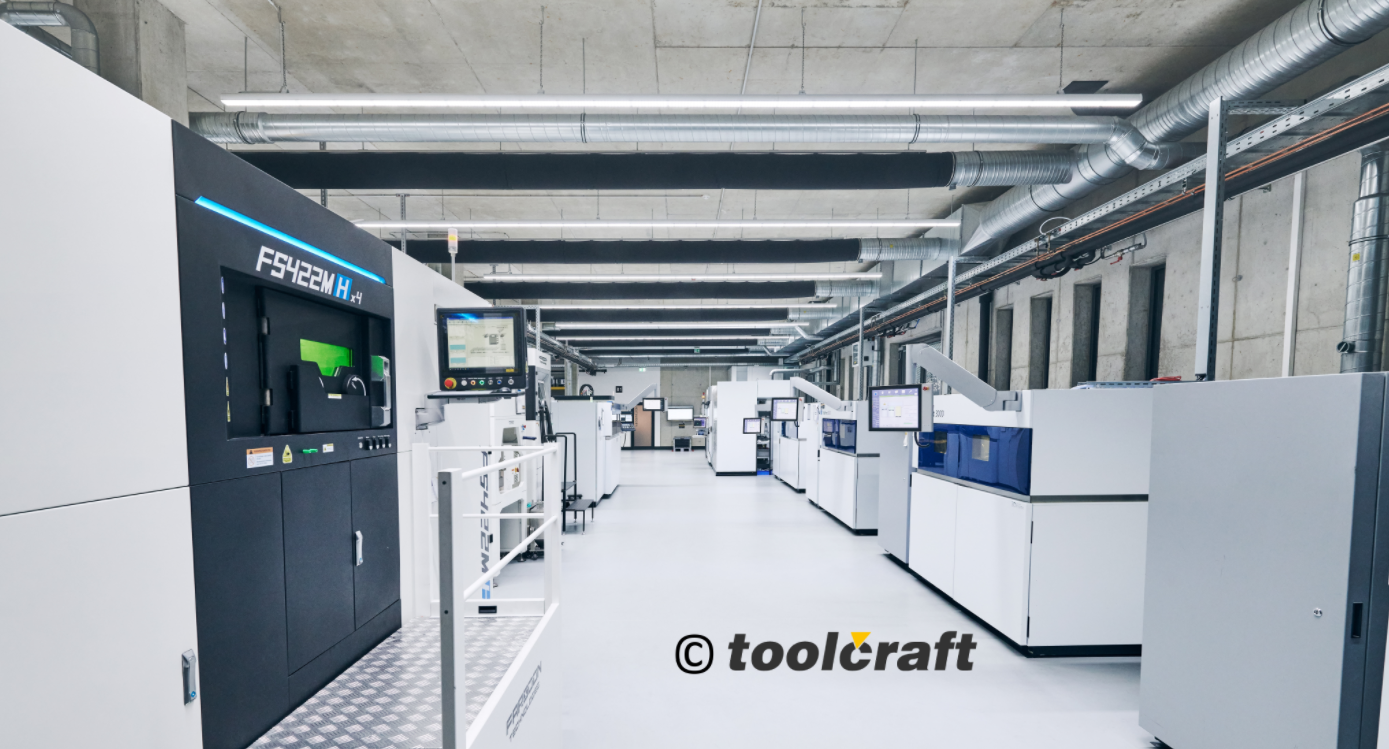
    amsight demonstrated that earlier this year via a case study on its work with Melotte, a Dutch service bureau, surrounding efforts to reduce the company’s need for CT scanning in its PBF workflow. And amsight just announced similar work for the German digital manufacturing specialist toolcraft. While Melotte and toolcraft aren’t new to semicap, the fact that amsight is streamlining the production processes for companies with existing backgrounds in the market illustrates its potential to help newcomers start from scratch on the right footing.

    By cohering all of toolcraft’s AM work into a truly unified digital ecosystem, amsight enables toolcraft to stay ahead of any potential trouble spots. With such demanding customers, manufacturers like toolcraft can’t afford to choose between maintaining quality and scaling up capacity. The incorporation of amsight’s platform prevents them from having to make that choice.

    Industrial Additive Manufacturing at toolcraft AG. Image courtesy of toolcraft.

    In a press release about toolcraft’s adoption of amsight’s QC platform, Christopher Hauck, Executive Board Member for Technology and Sales at toolcraft said, “Semiconductor-related manufacturing environments demand extremely high levels of consistency, documentation, and process understanding. We see amsight as a partner that understands the realities of industrial AM production and the importance of connecting quality data in a meaningful and scalable way.”

    Tim Wischeropp, the CEO of amsight, noted, As AM scales into highly regulated and precision-critical sectors, quality management can no longer remain fragmented across spreadsheets and disconnected systems. This collaboration with toolcraft demonstrates how manufacturers are moving toward integrated, data-driven quality strategies that support both operational efficiency and long-term scalability. It also shows toolcraft’s commitment to strengthen its leading position as a reliable contract manufacturer for regulated industries.”

    Obviously, toolcraft’s opportunity to benefit from its amsight adoption isn’t limited to the semicap market. We’re living in a resurgent era of ‘national champion‘ dominance, and the EU, while technically not a nation, desperately needs to ensure the success of what might be called ‘common market champions’ (Airbus is the original example of this).

    If there’s one thing European industry is good at, it’s making precision machinery. The continent would do well to cultivate a bunch of mini-ASMLs from its leading machine tool OEMs.

    If amsight can automate the QC processes involved in manufacturing high-level semicap parts, there’s no reason it can’t do the same for the machine tool industry broadly. They even have an excellent opportunity to help the AM industry eat its own dog food by providing PBF parts for industrial 3D printers.

    In this world of realpolitik-on-steroids, exploiting the pressure points of technological leverage is the best form of self-defense.

  • Bambu Launches A2L: What the New Printer Reveals About Its Strategy

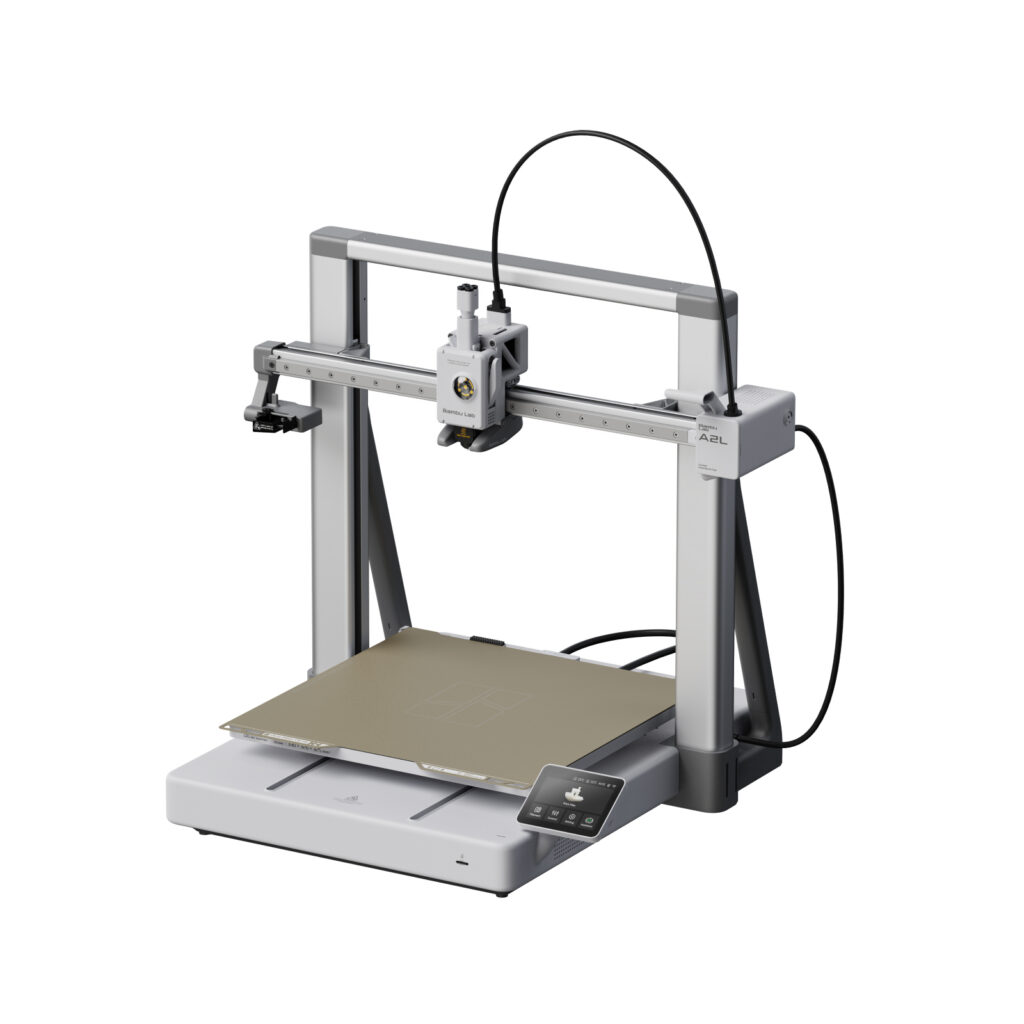
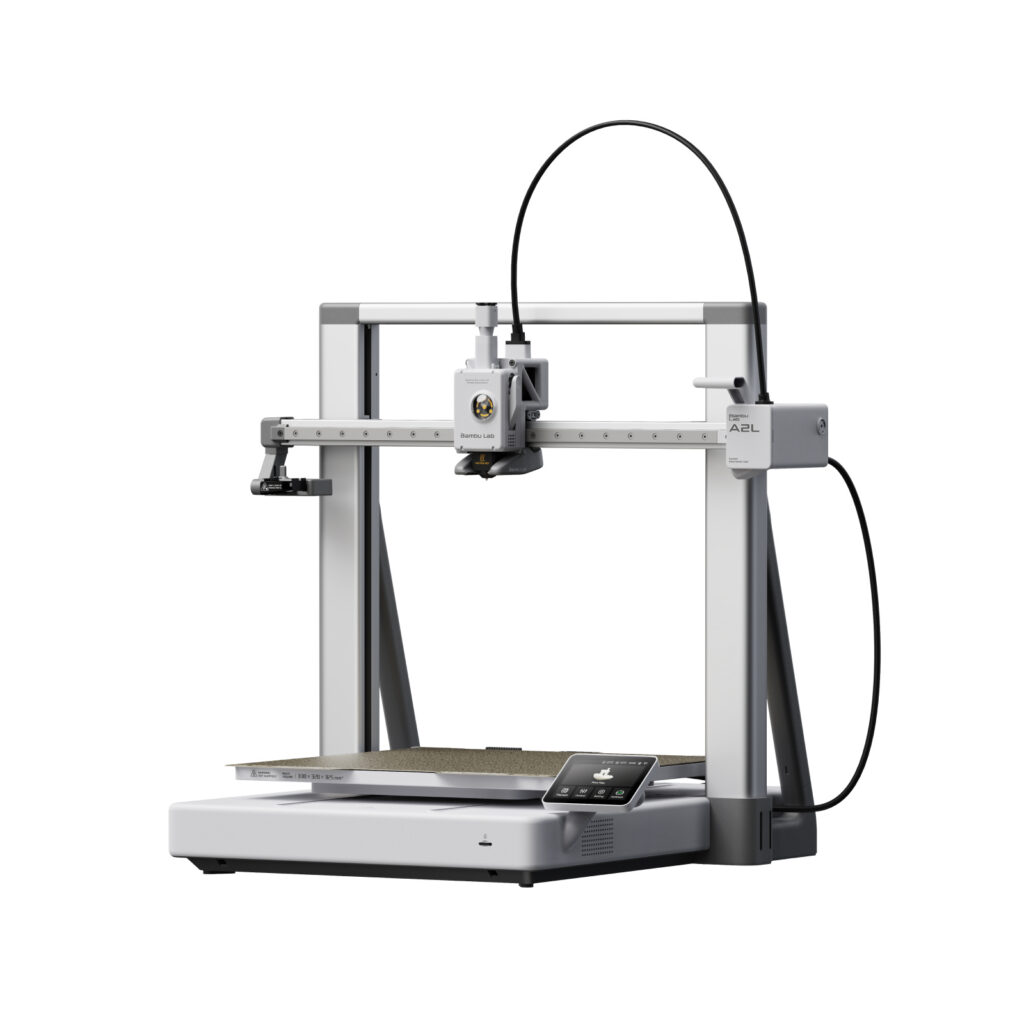
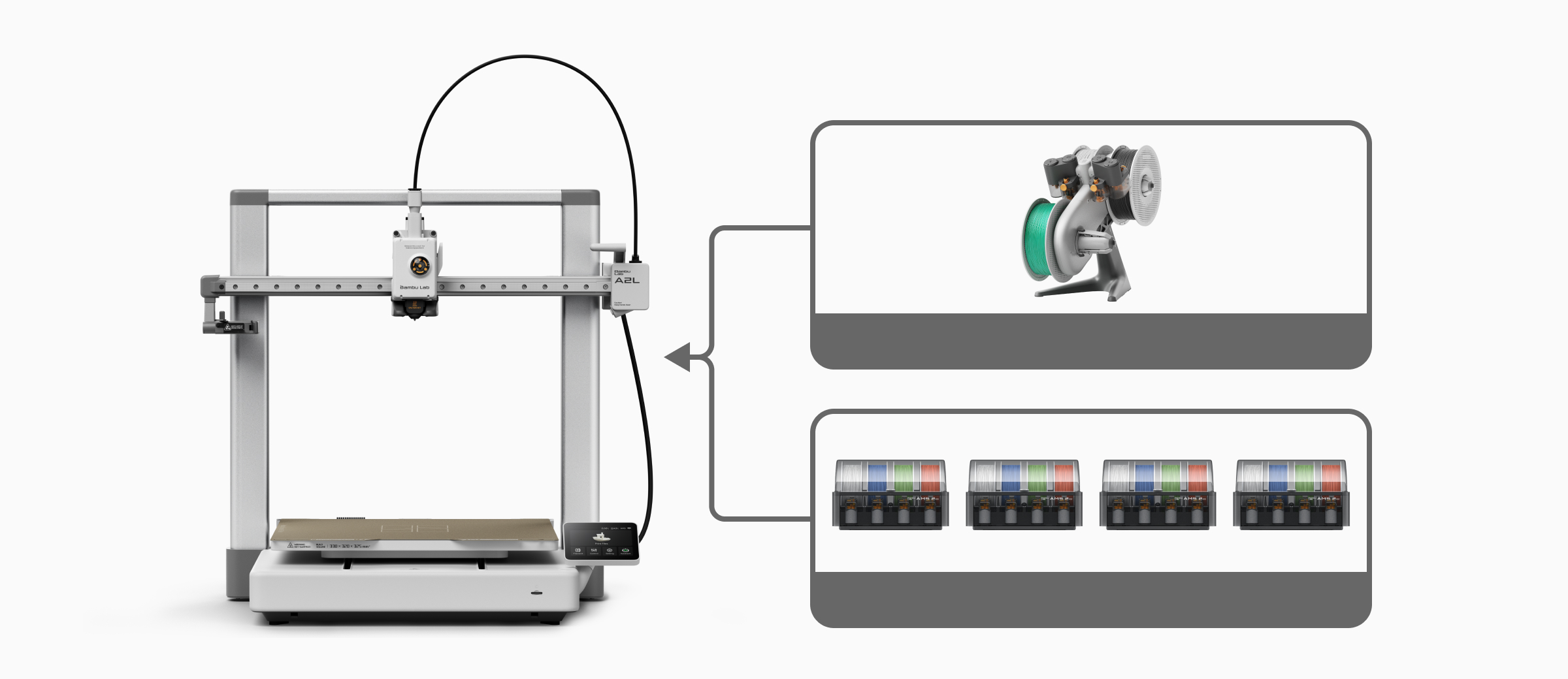
    Bambu Lab continues its relentless march for 3D printing domination with the launch of the A2L. The 330 × 320 × 325 mm printer will have a nozzle temperature of 300°C and a bed temperature of 80°C. Print speed will be up to 500 mm/sec, and it’s designed for PLA, PETG, and similar materials. Users can connect up to four Bambu Automatic Material System (AMS) units and one AMS Lite unit, allowing multi-color and multi-material printing. The printer also comes with plotting and cutting modes.

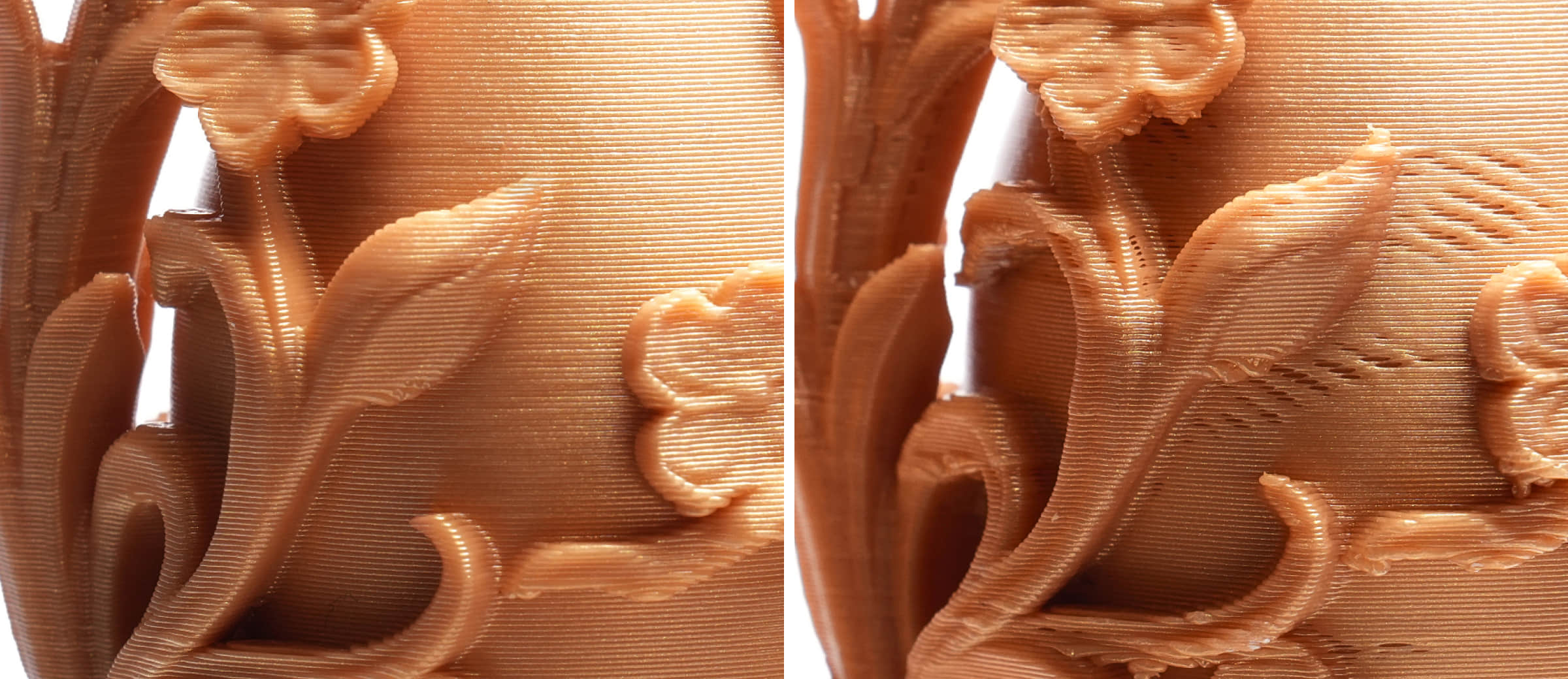
    It has Bambu’s PMSM (Permanent Magnet Synchronous Motor) servo extruder, along with vibration compensation, as well as two granular dampening units built into the chassis. This means the machine combines software-based compensation with mechanical dampening to reduce resonance. This should also reduce moiré patterns and other surface artifacts. The printer by itself costs $489 in the US and €379 in Europe, while a bundle with an AMS Lite costs $569 and €489, respectively.

    What Bambu is doing here is significant because of the steps forward in dampening. Resonance from the motors, frames, vibration, and other effects is detrimental to smooth surfaces, and Bambu is trying to eliminate them. By staying ahead in software and sensor-driven compensation while working on better mechanical dampening, the company opens up two fronts where it can compete.

    Having said that, this printer is aimed at hobbyists, so it could significantly expand the market while also finding use in print farms. To make a kid printer that could also work in the classroom, as your first cosplay printer or as your print farm standard unit, would be quite the coup for the company. The company sees this as an “H2S lite,” but it will probably be most confounding for those set on buying the P2S. What do you go for? Whereas other companies have continually feared cannibalizing existing sales or models, Bambu competes with everyone, including itself.

    This is unsettling for me because it does seem inefficient. But the least efficient thing is not to sell any printers at all. The worst thing would be to fail to cover a niche. We still don’t know if the Model T Ford of this market that will sell hundreds of millions of units is the A1, the Canon, or the H2, so why not try another hybrid to see if this fills the gap? This kind of competitive drive is what makes the company so difficult to compete with.

    A close-up comparison showing the effect of the A2L’s vibration compensation and dampening technologies on print quality. Image courtesy of Bambu Lab.

    We’re also again seeing Bambu port its latest technologies to entry-level systems. This actually decreases the costs of each feature while spreading across the Bambu lineup. The more printers that have a feature, the cheaper this feature can become. Many firms are constantly tailoring their offering. Some firms make crappy entry-level products to make other products shine. Some offer tiers of upgraded features to eke out more profit. Bambu is continuously tweaking its go-to-market strategy and will then spread its features and key components across the entire lineup. Then the firm will win in all categories across the board. Rather than trying to make a good Golf and Passat, or to iteratively improve the Accord each year, it is trying to find the right product-market fit across all lines and to continuously advance. The Bambu will cover the whole field and blot out the sky.

    The new printer has new features as well, showing that their strategy is to release new features in top models; the firm is releasing cutting-edge stuff in lower-priced printers. This time, it includes improvements to the “multi-point calibration and load adaptation, eliminating ghosting and ringing artifacts when printing tall, heavy models by dynamically adapting vibration compensation parameters.” Frankly, I thought they were doing this to some extent before. The company thinks that these improvements, along with the dampeners, should see a “Bed Slinger printer to achieve Core-XY level print quality.”

    The A2L can connect to multiple AMS units, enabling multi-color and multi-material printing. Image courtesy of Bambu Lab.

    The printer also has runout, clog, spool-tangle, blob, and extrusion-force detection. There’s also a silent mode. I really like this idea because it gives you a semblance of psychological control over your 3D printer’s noise levels. The work of Singer and Glass in the 70’s showed that if you ask people to perform a task and give them the option to reduce external sound levels through pressing a button, they will concentrate better. But the cool thing is that just having that button there reduces stress and increases concentration, irrespective of whether you press it. So please let’s all have silent mode buttons, they don’t even have to work. Here, Bambu says that the printer can work at 49 dB. 

    Another new feature is that the printer can now take expansion modules. You could buy a Blade Cutting Upgrade Kit if you wanted to cut patterns, for example. So if you’d like to print and make stickers or decals, you could pay for this, while others do not have to. I think this has a lot of potential. Bambu could make a lot of revenue from successive upgrade kits, especially if they are spread out over tens of millions of printers and are reverse-compatible. 

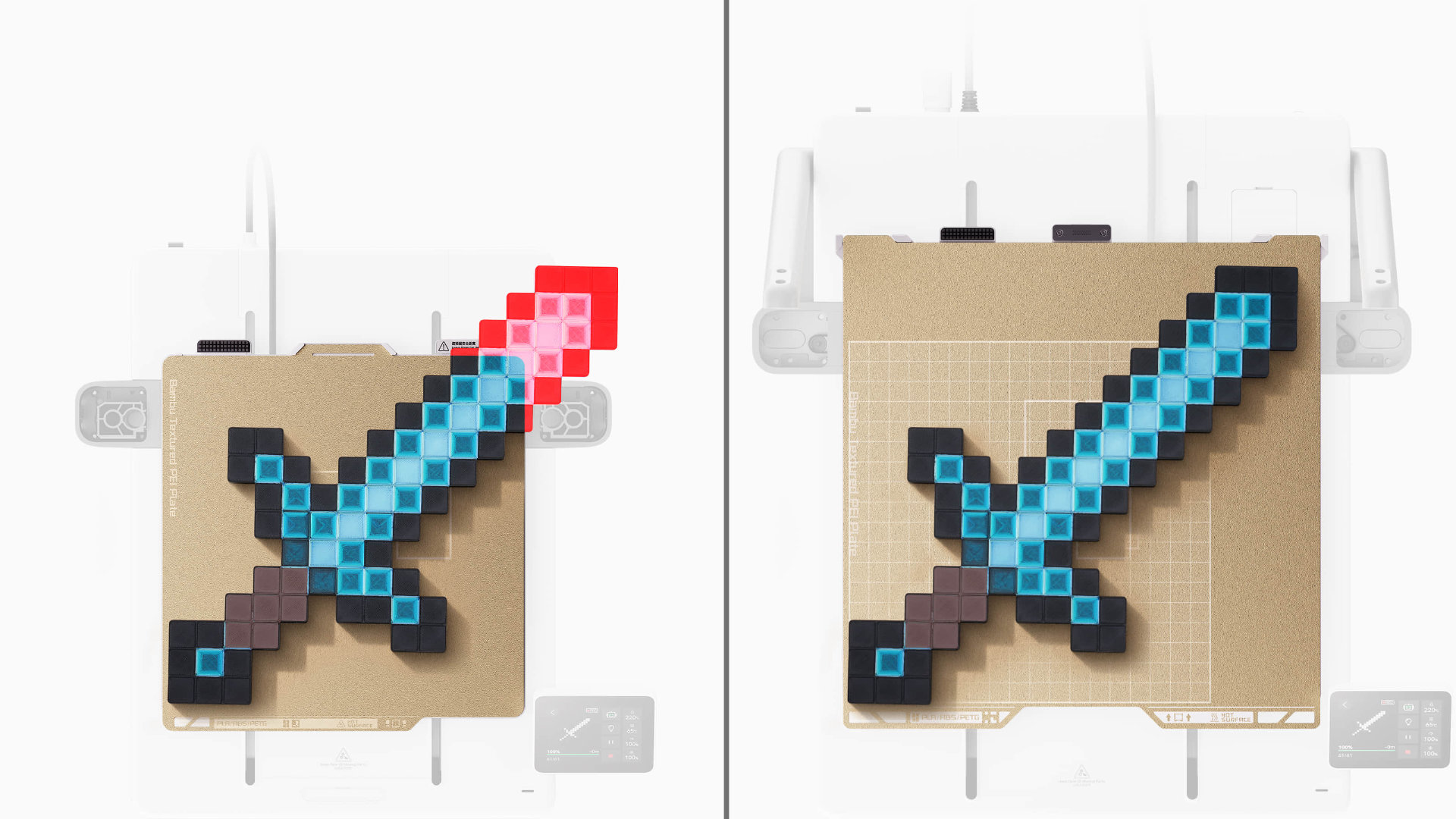
    The A2L’s larger build area allows users to print bigger objects in a single job. Image courtesy of Bambu Lab.

    Bambu is currently under fire from powerful YouTubers and open source advocates for playing fast and loose with OpenGL and the core slicing capability at the heart of its offering. This may very well alienate a lot of the core 3D printing community. Meanwhile, the firm continues its relentless march onward. By introducing new features on inexpensive systems, cannibalizing its own sales, and searching for new markets and models, the company is blocking out the sunlight for its competitors. Bambu grows quickly everywhere, making it hard for others to compete with it.

  • Stratasys Dental’s Negar Movahed Says They’re “Open for Partnerships”

    According to “3D Printing for Dentistry 2025: Market Study and Forecast” by AM Research, the dental 3D printing market generated $5.2 billion in revenue in 2024—that’s nearly one third of the total additive manufacturing (AM) market. That number is expected to nearly double by 2033, to $9.6 billion. So if you hadn’t already realized, this is a major application for our industry.

    At RAPID+TCT 2026, I spoke to Negar Movahed, Global Director of Product Lines – Dental at Stratasys, to discuss the company’s leading AM dental solution. Stratasys Dental’s flagship product is its monolithic, polychromatic TrueDent 3D printed denture solution, which she told me is the company’s “first Class IIa medical device.”

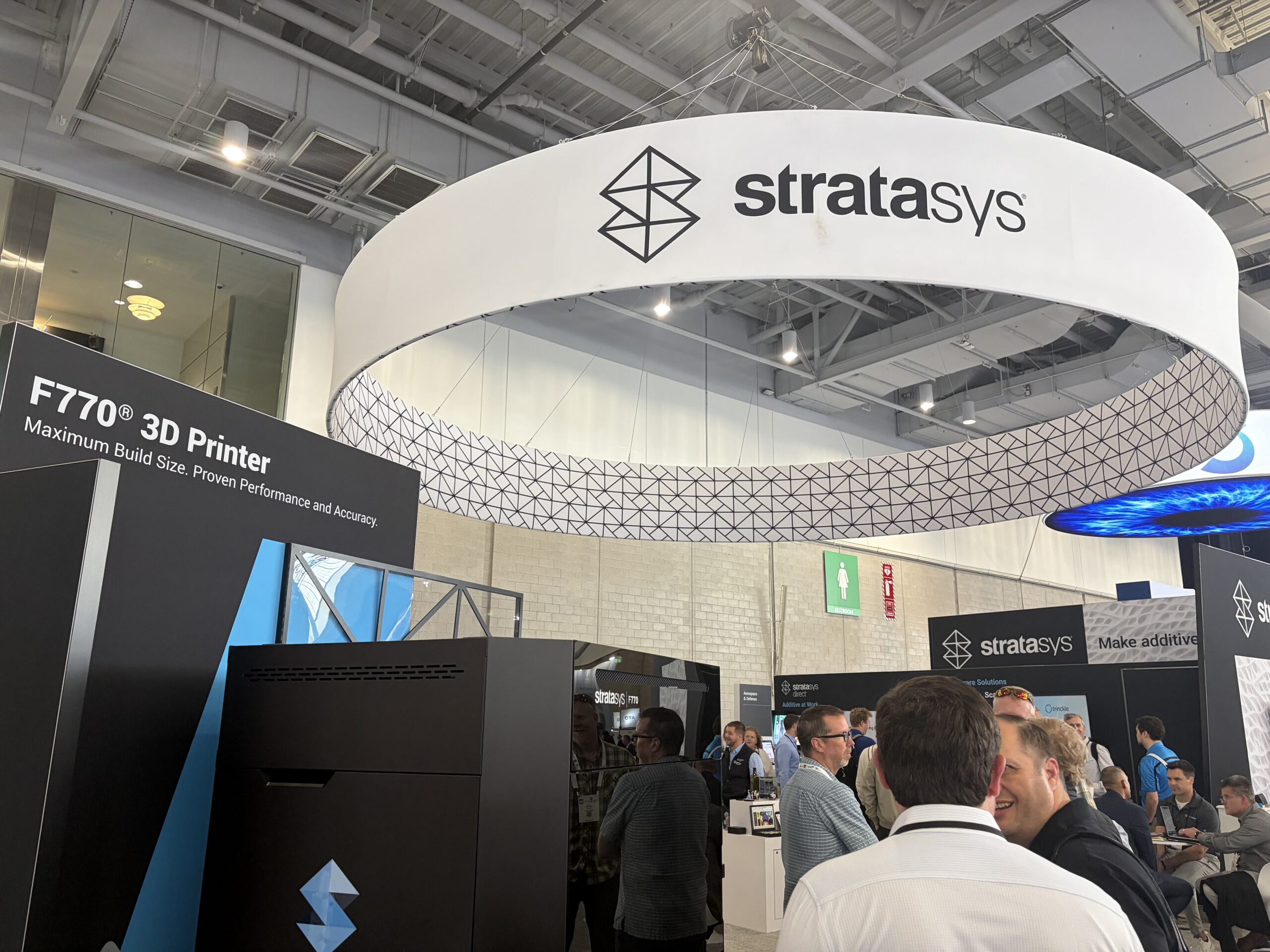
    Stratasys booth at RAPID+TCT 2026.

    TrueDent, PolyJet, & GrabCAD

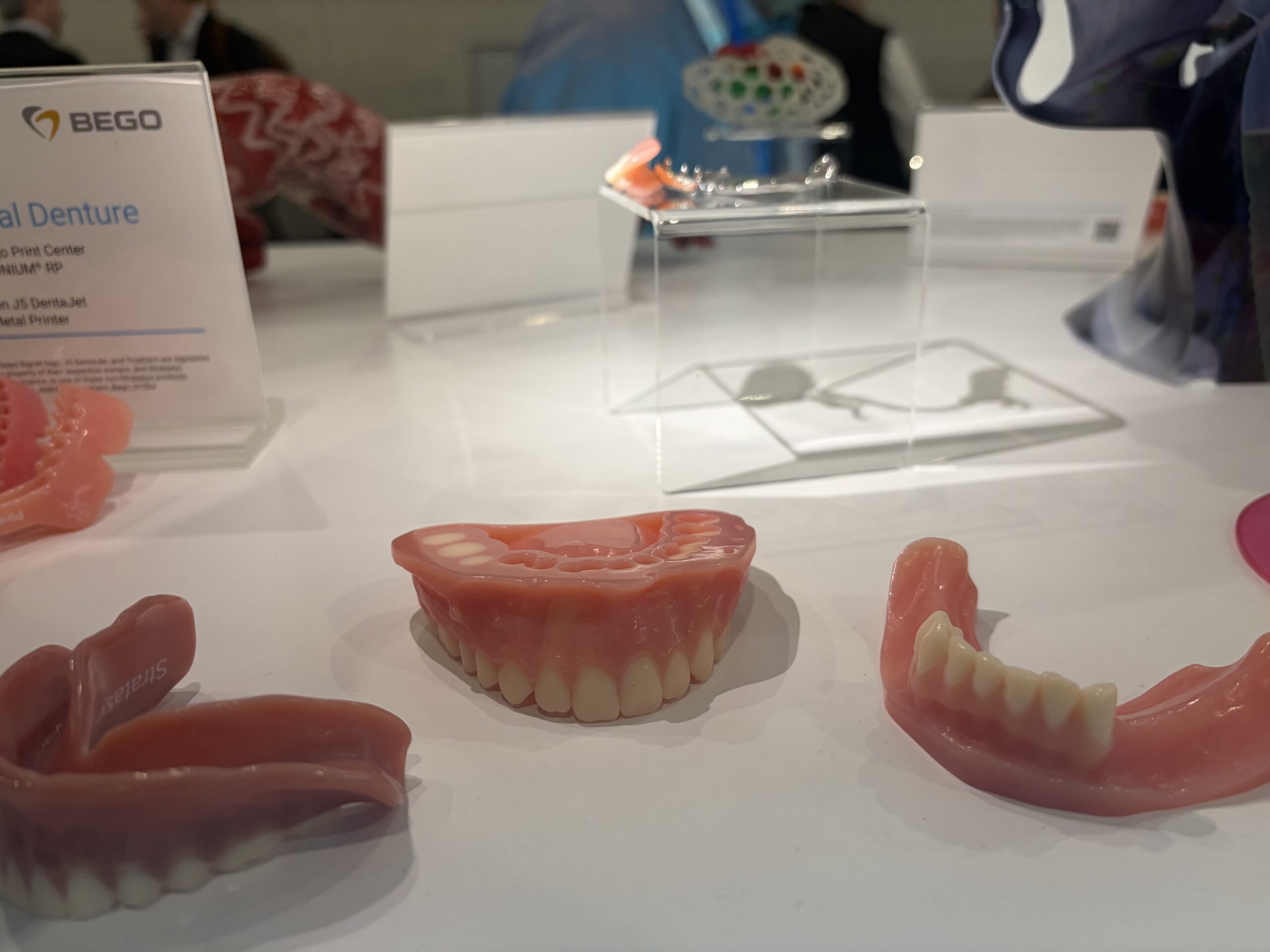
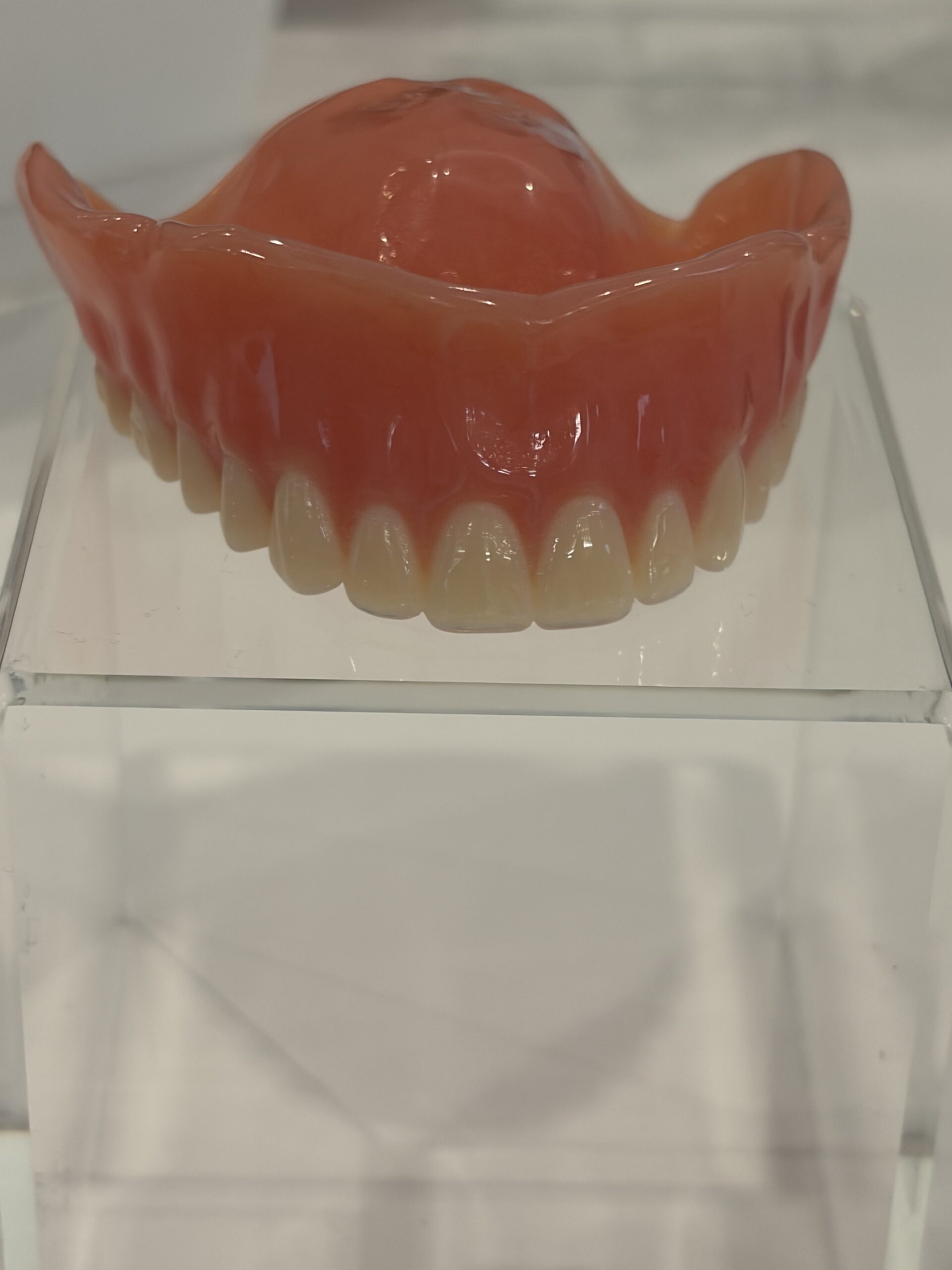
    Traditional dentures come in two parts: the base, or gingiva, and the teeth, and the process to make them is “quite labor intensive.” Lab technicians use an adhesive to adhere the teeth to the base and often have to perform manual characterization of the dentures, so there’s a “little artistry” involved as well. When dental technicians started using vat 3D printing to make dentures, it wasn’t an immediate fix, because, as Movahed explained, “it’s still limited to spot color.”

    “In traditional and DLP workflows, the base and teeth are produced separately, often in different materials and single shades, and then they are bonded together,” she told me. “What you get with TrueDent is one resin, in multiple shades of Cyan, Magenta, Yellow, and White. The shade variation and internal structures are created digitally. The gingiva and teeth print together in a single build as a unified structure, which removes the bonding interface, a common failure point in conventional dentures. Under functional load, like biting into something hard, those bonded teeth can de-bond over time. With a monolithic print, you eliminate that concern.”

    I’d say this makes PolyJet and TrueDent worth their weight in gold…teeth.

    Stratasys booth at RAPID+TCT 2026.

    We talked a little about GrabCAD, which Movahed said is much more than a slicing software. Not only does it enable users to automatically nest their parts and manage their full 3D printer fleets, but they can also automatically add “characterization to the TrueDent denture” in the software as well. The newest capability is TrueVoxel, “our next-generation aesthetics” for bringing lifelike 3D printed dentures to the market.

    As the adorable orphans in Annie sing, you’re never fully dressed without a smile, but what if it’s not fully your smile? When you wear partial dentures, your other existing teeth are still visible, and if the dentures don’t match, it can make people self-conscious.

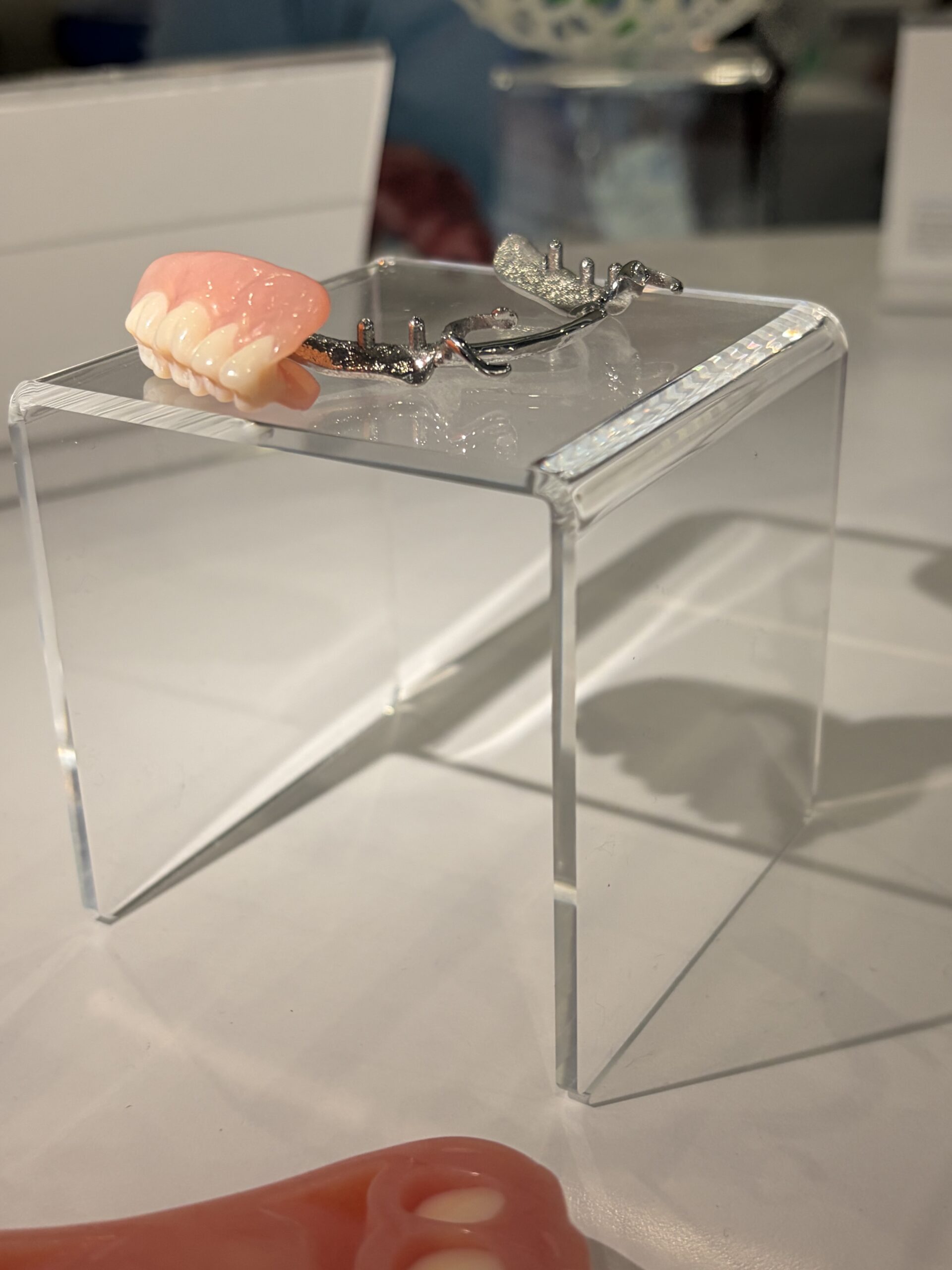
    “With TrueDent, you can very naturally match the adjacent dentition,” Movahed explained. “Also, thanks to the accuracy and consistency of the technology, the denture also integrates very well with the metal framework in partial applications, resulting in a more stable and durable final prosthesis.”

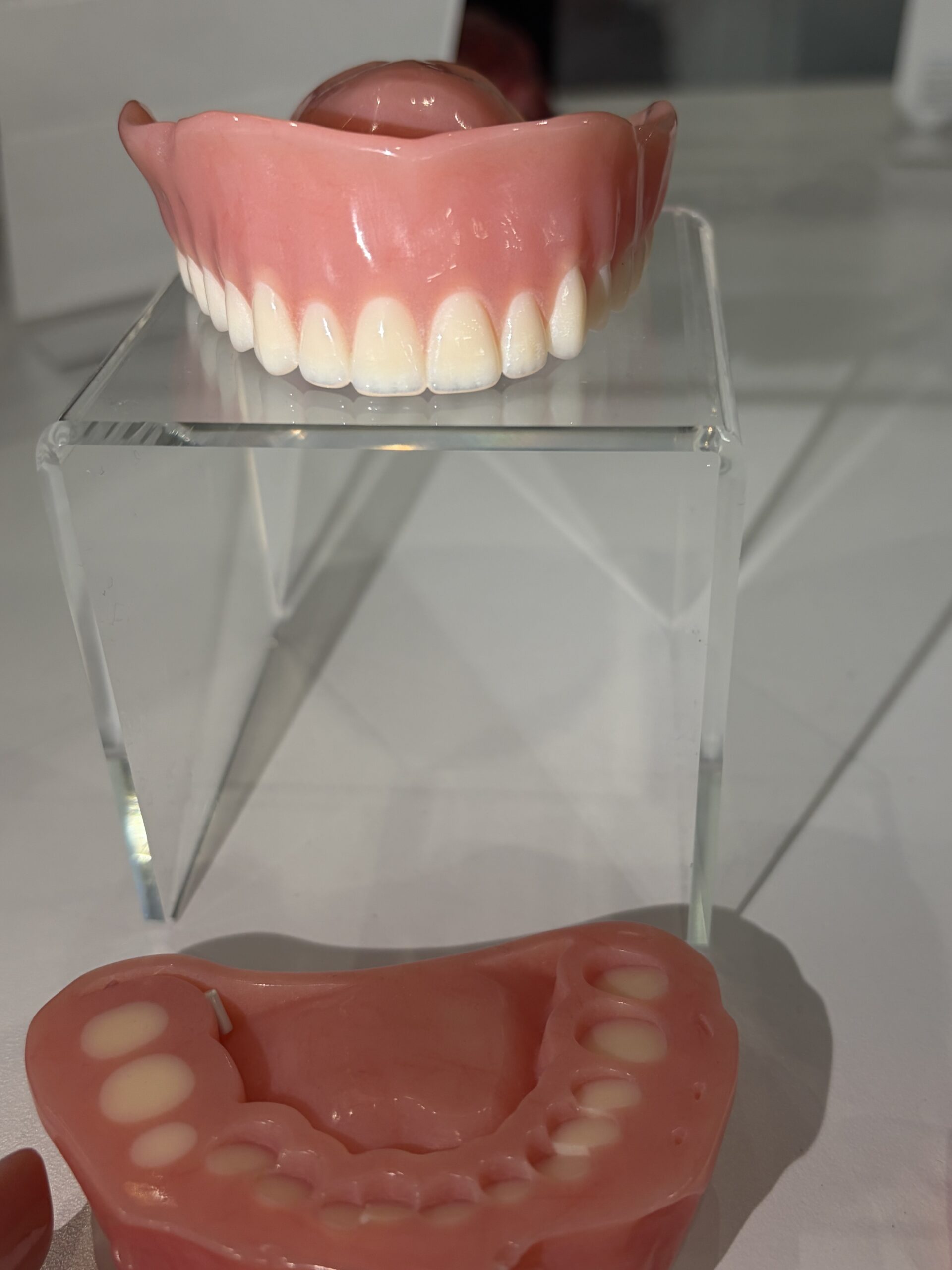
    TrueDent dentures with metal frame at Stratasys RAPID+TCT 2026 booth.

    Stratasys Dental Workflow

    Movahed said that DLP printers can print, at max, around 15-20 denture bases, and of course in a separate build than the teeth. Then the techs still have to do all the manual labor to post process, characterize, and assemble. In terms of scaling the workflow, she said that “PolyJet really shines, because you can print 32 complete multi-shade arches in one build.”

    “So, you design everything in exocad or 3Shape software, and it gets imported into GrabCAD. From there, you digitally select shade and characterization for each case, then you send it to print. 32 dentures are printed, you take off the support material with an automated waterjet, and then you follow up with the validated workflow. And then it goes into polishing and done.”

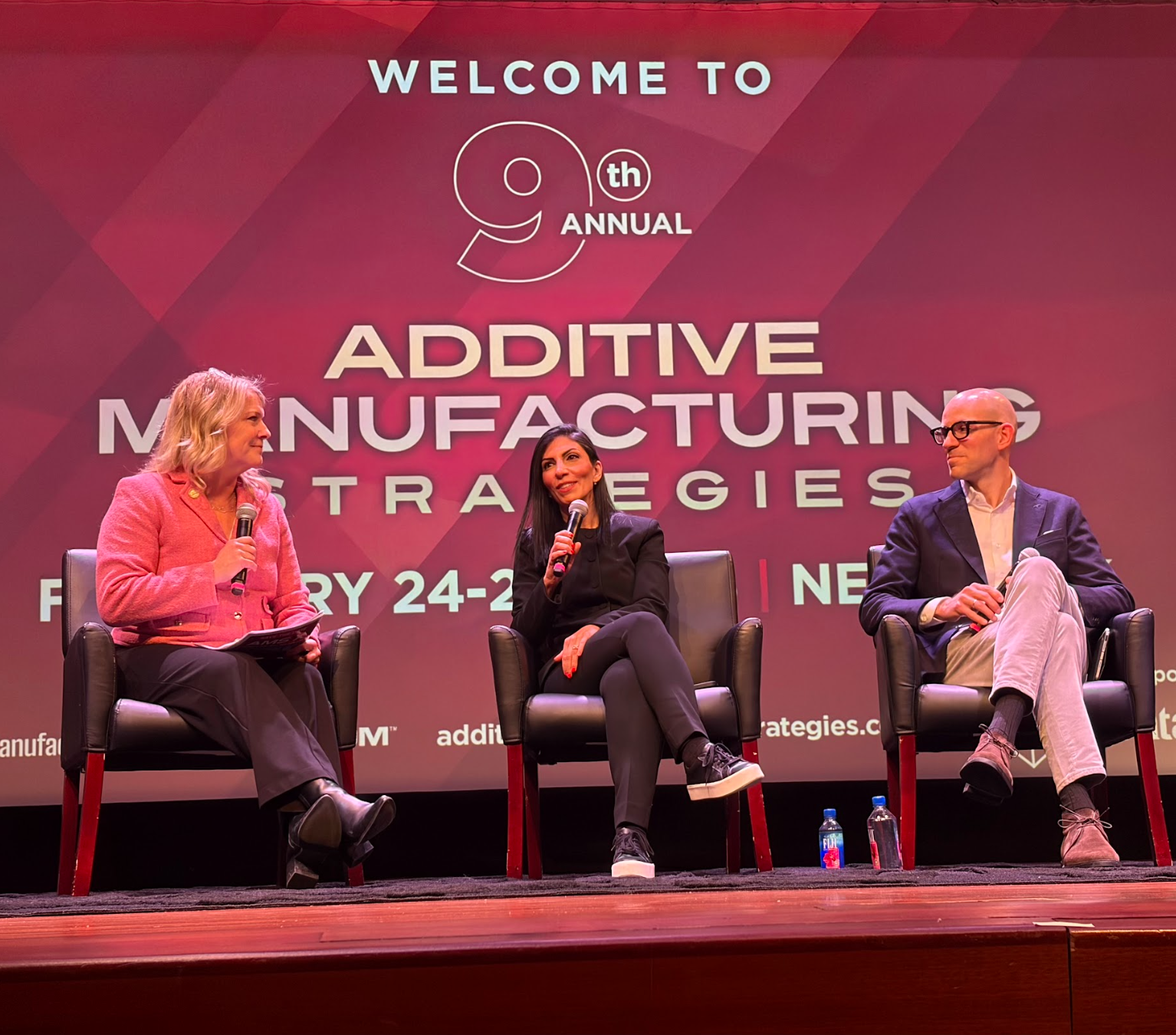
    L-R: Debbie Holton, Negar Movahed, Matthias Himmelsbach at AMS 2026.

    Movahed said that Stratasys is building automation “into every step of the process,” with additional software capabilities coming in the next year that will support this direction. This is really important, given the current labor shortage in the dental market.

    “With our solution, our goal is to bridge that labor shortage shortage. But in addition to that, we’re making more improvements and advancements to help labs scale,” she said.

    It’s just like she said on our “3D Printing for Dentistry” panel at AMS 2026: automation is required when you’re scaling

    Stratasys Dental serves everyone from “mom and pop labs that just cannot hire new talent” to huge labs automating everything with robots.

    “I think what really sets us apart versus other solutions that are out there is the level of aesthetics PolyJet delivers,” Movahed said.

    She also told me that the company is actively working on an interesting launch for 2027, “which is also going to contribute to the aesthetics value proposition that we offer.”

    Safety First

    TrueDent is the company’s first Class IIa medical device, which, as Movahed explained, means “more rigorous audits and third party evaluation of our technical file.”

    “One of the things that I always talk about is Stratasys being a 3D printing company in the medical device world, so we are very conservative,” she said. “We don’t just choose the top three biocompatibility tests. When the toxicologist gives us a list of biocompatibility tests, we don’t even think about the price. We say, yes, we’re going to do them. We care about the patient’s safety. So we want to make sure that we’re addressing all of those issues, especially with photopolymers going into patients’ mouths.”

    Stratasys booth at RAPID+TCT 2026.

    Movahed also told me that one of the company’s surgical guide materials for PolyJet 3D printing, MED610-DSG, is a Class 1 medical device that is now also a TPO-free material. Since all Stratasys resins come in a closed cartridge that is loaded into the printer material bay, this is just an added safety feature.

    “So that’s another difference compared to DLP workflows,” she told me. “The user never actually handles uncured resin, as our parts are considered fully cured during the print.”

    Partnerships

    I mentioned that I’d visited the PostProcess Technologies booth at RAPID earlier, and had spoken with PostProcess CEO Jeff Mize about the company’s post-processing partnership with Stratasys. Movahed told me that through its Post-Processing Partnership Program, Stratasys is now “open to validating post-processing as part of our validated workflow.”

    “More automation will be an integral part of our launches next year,” she said. “Partnering with automation companies as it comes to post-processing, or auto polishing. And when I say we validate every single step of the workflow, that’s exactly what I mean.”

    Additionally, Stratasys is opening up its PolyJet dental 3D printing platforms to strategic partnerships with resin manufacturers, which is a very new thing for the company.

    “It’s not just everybody on the market, but trusted companies that really know photopolymers, and really know medical devices,” Movahed explained.

    Stratasys already has a few partners that it’s working with on the next applications.

    Final Thoughts

    It sounds like there will be a lot of exciting things happening for Stratasys in the near future. Movahed said the company has been “very active in global registrations” and is working to expand into APAC and Latin America.” There are also a lot of software updates coming to enable dental production across our platforms, and the next generation of TrueDent.

    “As we’re developing our next generation of TrueDent, we’re confident that we will capture a sizable portion of the market, by solving real user pain points from aesthetics to mechanical performance,” she said. “We already meet the fundamental accuracy requirement, delivering dentures with a highly consistent fit directly out of the printer. In traditional and DLP workflows, additional clinical or lab adjustments are often required, which can introduce variability. With PolyJet, material is deposited drop by drop, enabling very high resolution and repeatability. This helps reduce the need for downstream adjustment steps and supports a more controlled, consistent outcome.”

    Stratasys booth at RAPID+TCT 2026.

    Movahed told me that when Stratasys launched TrueDent three years ago, the company “took the denture market to the next level.” Now, the message Stratasys is sending to the market is that they’re open for partnerships, and that they’re working on the next generation.

    “Looking ahead, we believe our solution will be very difficult to match end-to-end.”

    Featured image courtesy of Negar Movahed, Stratasys. All other images courtesy of Sarah Saunders, 3DPrint.com.

  • 3D Printing Financials: XTPL Adds New Semiconductor and Defense Customers in Q1 2026

    Polish microprinting company XTPL (WSE: XTP) reported first-quarter 2026 revenue of PLN 1.6 million (roughly $441,000) as the company expands into the semiconductor and advanced electronics markets, while also launching a new business line aimed at defense and small-scale electronics production.

    The Warsaw-listed company said product and service sales accounted for PLN 1.2 million (roughly $331,000) of total revenue during the quarter. The results were driven by deliveries of its Delta Printing System (DPS) and Ultra-Precise Dispensing (UPD) modules, as well as early commercial traction for its newly launched ODRA systems business.

    The Warsaw-listed company said product and service sales accounted for PLN 1.2 million (roughly $331,000) of total revenue during the quarter. The results were driven by deliveries of its Delta Printing System (DPS) and Ultra-Precise Dispensing (UPD) modules, as well as early sales tied to a new manufacturing platform.

    That new platform, called ODRA, is designed for low-volume industrial production. XTPL secured its first order from a Silicon Valley customer working in semiconductor advanced packaging and cooperating with the defense industry. The company said it expects additional ODRA orders as early as 2026, with deliveries planned for late this year or 2027.

    XTPL develops precision printing technology capable of creating conductive structures as small as one micrometer. Its systems target semiconductor manufacturing, advanced displays, printed electronics, biosensors, and other high-tech applications.

    Filip Granek, CEO of XTPL. Image courtesy of XTPL.

    CEO Filip Granek said the quarter marked an important step in executing the company’s 2026–2028 growth strategy: “The results for the reporting period do not yet fully reflect the potential we have built in recent periods, but the decisions we have taken support the company’s growth in the years ahead.”

    Granek said XTPL is working to secure a larger second order from one of China’s biggest display makers after successfully completing the first stage of the project. The company is also testing its technology with several other potential customers.

    “The UPD modules we delivered are now operating on an industrial production line, confirming the successful completion of the ‘from lab to fab’ pathway, through which XTPL has established global credibility among the world’s leading advanced electronics manufacturers,” he said.

    For XTPL, the project marks a major commercial step. Instead of being tested in a lab environment, the company’s printing modules are now being used inside an active production line at a major display manufacturer in China.

    Another UPD module was also delivered to a Nasdaq-100-listed U.S. customer involved in semiconductor production equipment and advanced display technologies. The shipment is part of an ongoing technology evaluation process.

    A major focus during the quarter was funding. XTPL raised nearly PLN 30 million ($8.3 million) through a public share offering and support from Poland’s National Centre for Research and Development (NCBR).

    According to CFO Jacek Olszański, the capital will help fund several commercialization efforts at the same time, including additional UPD deployments, ODRA development, and continued sales expansion for DPS systems and materials.

    XTPL ended the quarter with PLN 2.1 million ($579,000) in cash and reported an EBITDA loss of PLN 3.9 million ($1.1 million). The company said capital raised through its March share offering will appear in second-quarter results.

    XTPL goes public on the Warsaw Stock Exchange (WSE). Image courtesy of XTPL.

    XTPL now has four commercial product lines: UPD industrial modules, DPS prototyping systems, High Performance Materials, and its newer ODRA platform. Management sees ODRA as a potentially important growth business because the systems are designed for real production environments, not just research labs. XTPL said ODRA systems sell for more than twice the price of DPS units and could lead to repeat orders from customers in defense and semiconductor manufacturing.

    The company is also continuing several advanced customer evaluations, including ongoing talks around additional UPD orders in China and new ODRA opportunities tied to the U.S. defense sector.

  • 3DPOD 301: Jay Rogers on Haddy’s Robotic 3D Printed Manufacturing, and a Lot More

    Jay Rogers was in the Marine Corps, consulting, and sailed around the world. He first came to additive through his company, Local Motors. He talks us through that firm’s promise and development. We also talk about his new venture, medium and large-format 3D printing firm Haddy. We also talk more broadly about entrepreneurship, companies, venture capital, additive manufacturing, and business.

    This episode of the 3DPOD is brought to you by Alexander Daniels Global, specialists in talent solutions for the additive manufacturing and advanced engineering sectors. From the production line to the C-suite, ADG delivers confidential hiring, supports rapid scale-up phases, and secures critical leadership appointments, helping industry 4.0 businesses buld teams that need to perform, innovate, and lead.