• Medical, Electronics, & Semiconductors: Detailed 3D Prints at RAPID 2026 with Boston Micro Fabrication & Lithoz

    They say that good things come in small packages, and that’s certainly the case when it comes to Boston Micro Fabrication (BMF). A leader in micro-precision additive manufacturing, the company uses its proprietary PμSL (Projection Micro Stereolithography) technology to power its range of 3D printers. I spoke to CEO John Kawola at RAPID+TCT 2026 to learn more about the company’s latest innovations.

    BMF booth at RAPID+TCT 2026.

    BMF’s place in the industry is for “very, very high precision” parts, with small features and high tolerances, “typically the types of tolerances that are beyond the reach of Formlabs or 3D Systems or others.”

    “Typically, because of that level of precision, it also means generally smaller parts, where people need very fine features or holes or need to hold tolerances in the tens of microns type of size,” Kawola explained.

    Just last month, the company launched its microArch S150 Series of 3D printers. Kawola told me that the two compact, 25 µm systems in the series are “much more benchtop, simpler to set up and use.”

    “The main purpose of this is it’s much easier to use, much easier to calibrate, with more consistent results,” Kawola told me.
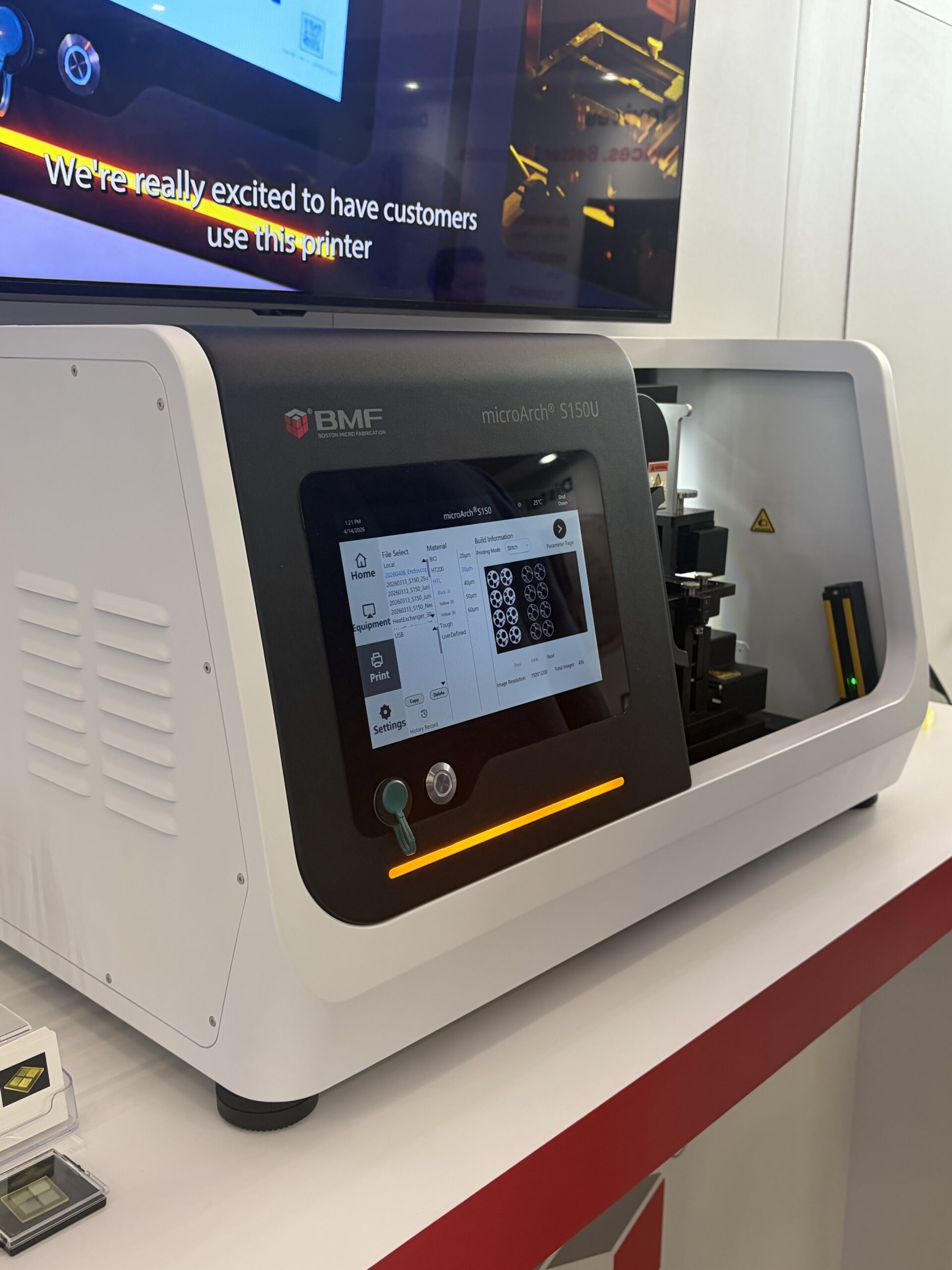
    BMF’s microArch S150 at RAPID+TCT 2026.

    There are two versions of the desktop microArch S150 3D printer. The S150 works with BMF’s normal range of materials, while the S150 Ultra has a more limited material range, but operates nine times faster than the S150.

    Kawola explained that with many DLP technologies, the speed of the printer is “driven by how thick the resin is.”

    “If the resin is thick, it takes a longer time to refill and recoat. So that slows things down,” he said. “If the resin is thin, it goes faster.”

    BMF booth at RAPID+TCT 2026.

    There aren’t many discernible differences between the microArch S150 and S150 Ultra, but BMF customers know what they want, and can request the Ultra if they need that extra speed.

    “Depending on what they care about the most, whether it’s higher throughput of a number of parts, or they need more parts per week or per day, they might opt for the faster one,” Kawola said. “It also depends on what they’re going to do with the parts, if they’re prototyping or doing more long-range testing.”

    The new S150 series is available in the $50,000-$60,000 range, “depending on which one you choose.”

    Other features include:

    • 80 x 48 x 50 mm build volume
    • 10–100 µm layer height
    • 25 µm optical resolution
    • ±3 µm positional accuracy
    • Automated calibration & leveling
    • CE-certified
    • HEPA13 filter

    Medical device applications at BMF’s RAPID+TCT 2026 booth.

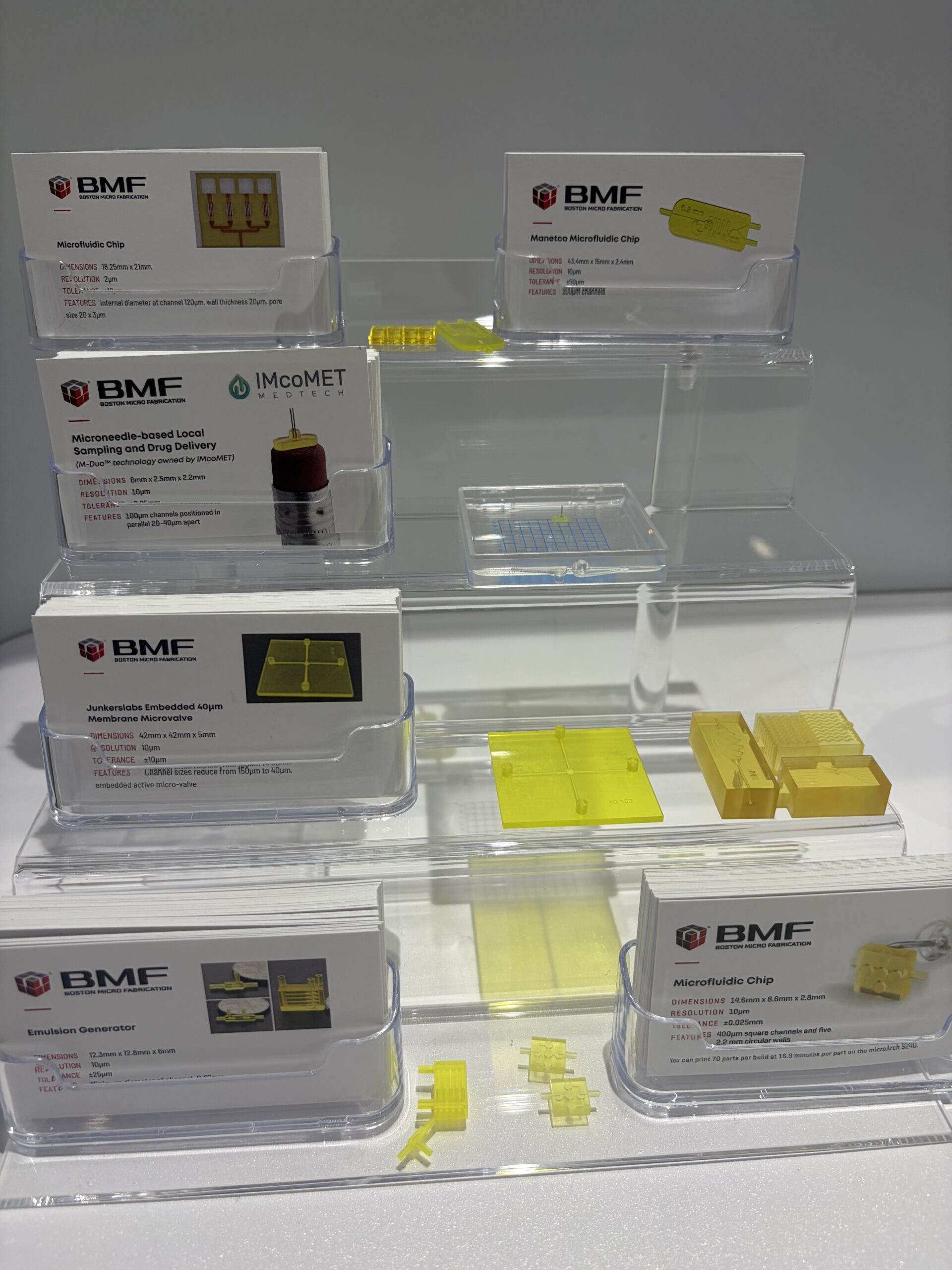
    There are two main applications for BMF’s printers, and especially the new S150 series, one of which is medical devices. BMF prints a lot of drug delivery devices, sensors, and medical tools. One example is a distal tip, which is a disposable item that goes on the end of an endoscope and is thrown away once once the endoscopy is complete.

    Microfluidic devices for drug screening and testing, as well as liquid connectors, are some other examples.

    “We can do very thin channels, down to 50 µm diameter, which is valuable,” Kawola said. “We have a whole range of customers that are doing devices, and the tool to insert the devices, for the eye, the ear, and also in some cases, neurosurgery.”

    No matter which one of these devices customers are working on, the main point is “they want these things to be small,” so they’re less invasive, and the recovery time is faster.
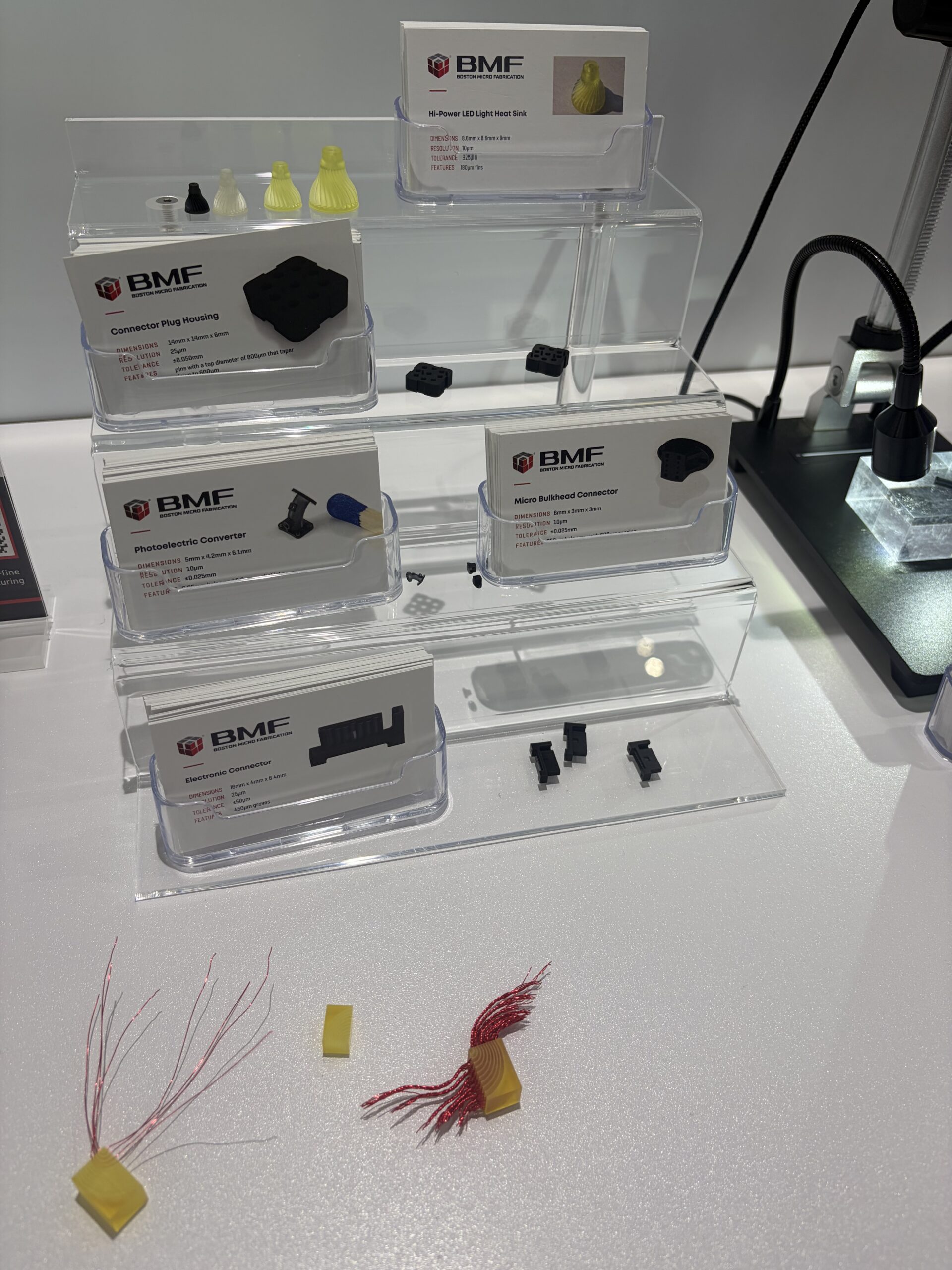
    Electronics applications at BMF’s RAPID+TCT 2026 booth.

    On the opposite side of the booth were examples of the company’s other main application: electronics. Kawola showed me tiny parts like electrical connectors, housings, and chip sockets for “a whole range of customers in the electronics area.”

    “Again the theme is, things are getting smaller,” he said. “Or, if the end device is not getting smaller, there’s more stuff in it. There’s more connectors, there’s more memory, there’s more chips.”

    Kawola said that while most of BMF’s work is in resins, “trying to approximate plastic,” the company also has a whole range of applications in ceramic materials, like alumina ceramic and zirconia ceramic, for highly abrasive or high-temperature parts. He showed me a chip with a 100 µm diameter and 20 µm wall thickness, which is “very difficult to do in other ways.”

    BMF doesn’t offer metal 3D printing, but it can metallize parts by plating them with materials like copper or nickel. Since the company doesn’t have this capability in-house, Kawola said they generally use a Maryland company called RePliForm to plate 3D printed parts.

    BMF Clear is an optically transparent photopolymer resin delivering 90% light transmission and micron level accuracy for complex, internally structured micro scale devices. Image courtesy of Boston Micro Fabrication.

    Speaking of materials, the company also launched its new BMF Clear just before RAPID. It’s a biocompatible, optically transparent resin capable of 10 µm layer heights, and a great choice for optics, photonics, sensors, microfluidics, biomedical devices, and more.

    It’s historically been very challenging to achieve full transparency in 3D printing, especially at the micro level, because of material absorptivity and surface roughness, which causes light to diffract. But BMF says its new resin offers greater than 90% light transmittance, which means that there will be opportunities for scalable manufacturing with applications like complex micro-scale devices and integrated optical features.
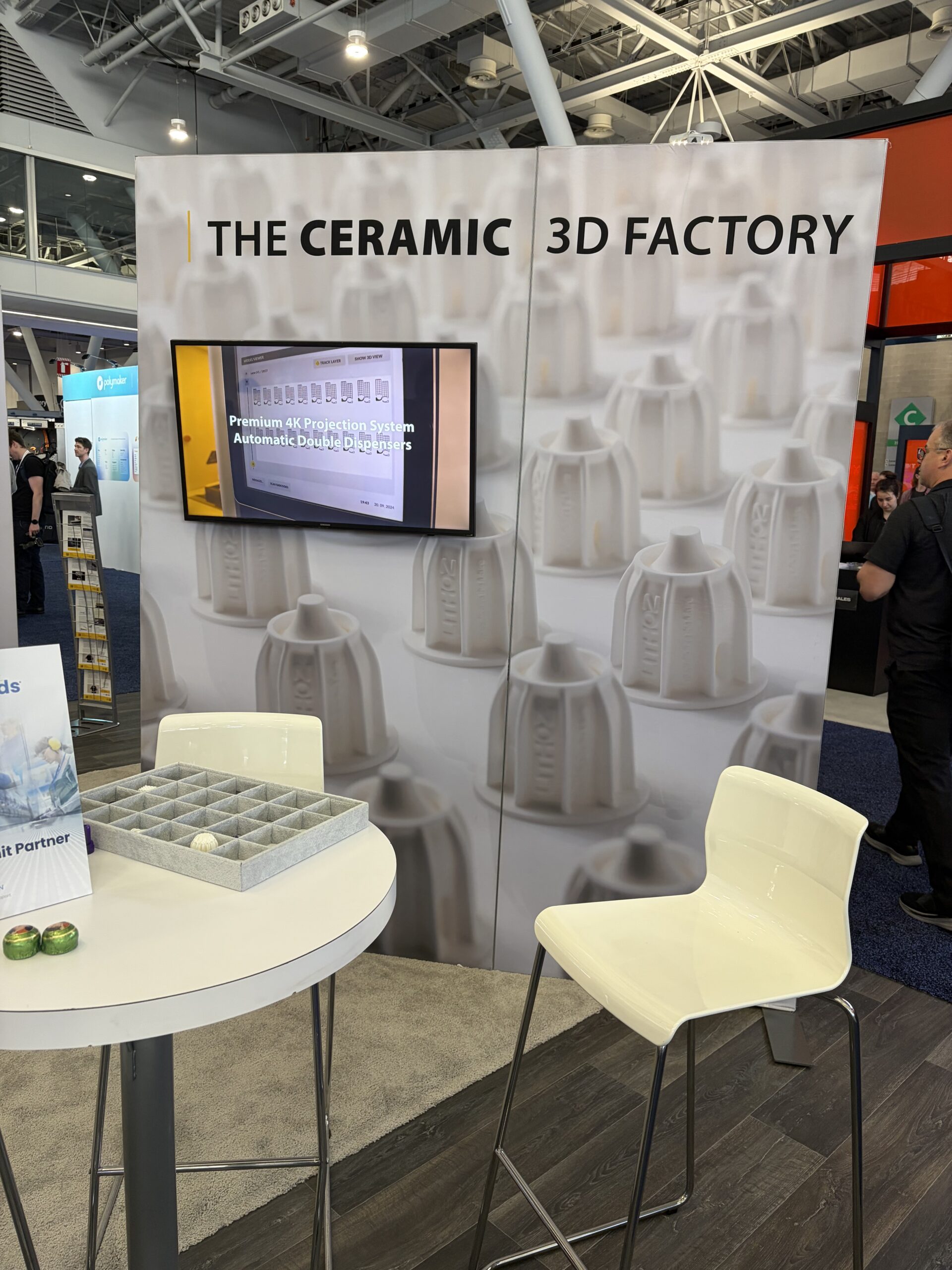
    Lithoz booth at RAPID+TCT 2026.

    While ceramics 3D printing is just one material option with BMF, it’s the main focus at Lithoz, a leader in ceramics 3D printing based in Austria and the U.S. Norbert Gall, Head of Marketing and Public Relations for Lithoz, showed me some of the applications on display at the RAPID booth.
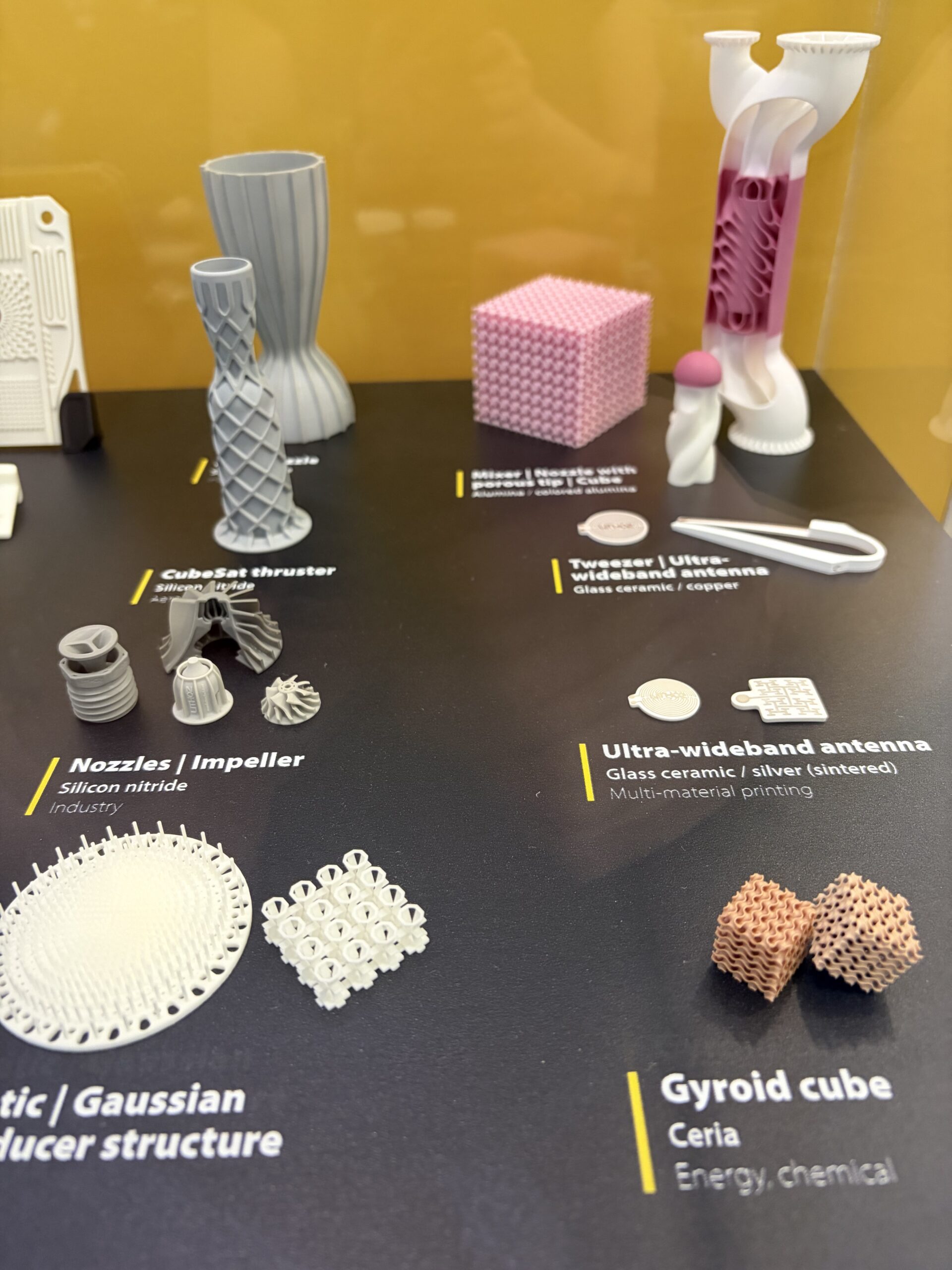
    Lithoz booth at RAPID+TCT 2026.

    Several of the parts are for the medical sector, such as bioresorbable implants. This included a very tiny 3D printed implant for one of the three ear bones (auditory ossicles).

    “All of these are used in case the body is not able to recreate itself on its own,” Gall said about the company’s implants. “Surgeons talk about critical size defects, which means that if it’s too large, the body cannot make sure that it can grow by itself. So we have to bridge it with this type of bone-like structure, so the body has a support, like a ladder that it can climb along. The human tissue can grow through it, and will replace the actual implant.”
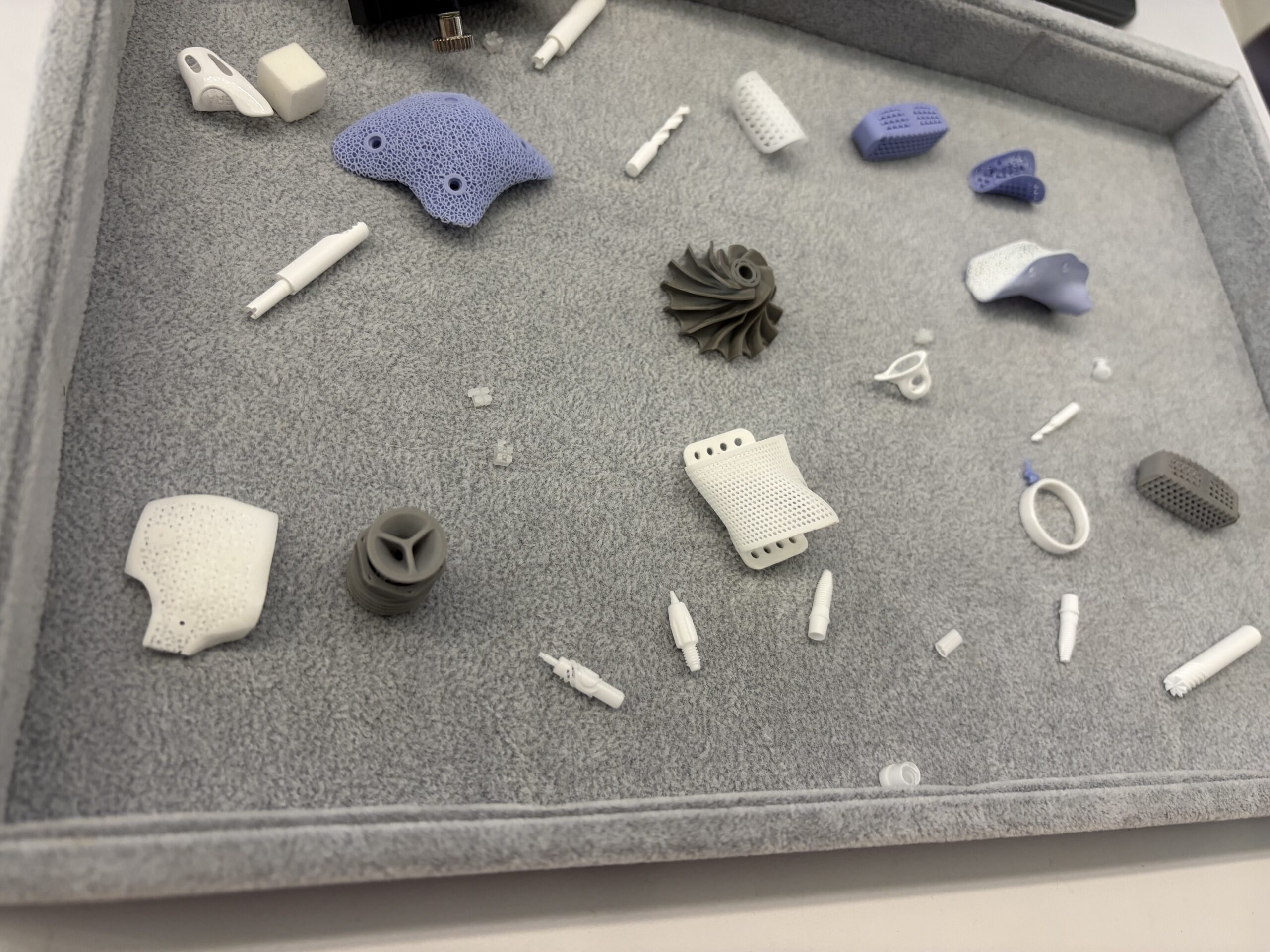
    Ceramic 3D prints at the Lithoz RAPID+TCT 2026 booth.

    He explained that the structures of these implants can be designed in such a way that you can control the speed of healing. This makes a big difference, especially when it comes to the age of a patient. Because children grow so quickly, a surgeon would likely want a faster healing process to quickly close the defect, while elderly patients can take more time healing because their bones are no longer growing.

    Another positive about bioresorbable implants is that they naturally dissolve in the body. So patients only need one surgery to actually get the implant, and then that’s it, they don’t need to have the implant removed later.

    “In the case of a five-year-old child, you would probably have to replace your titanium implants a couple times. And you can imagine the traumatization,” Gall said. “Those children suffer lots, and they will remember their whole life.”
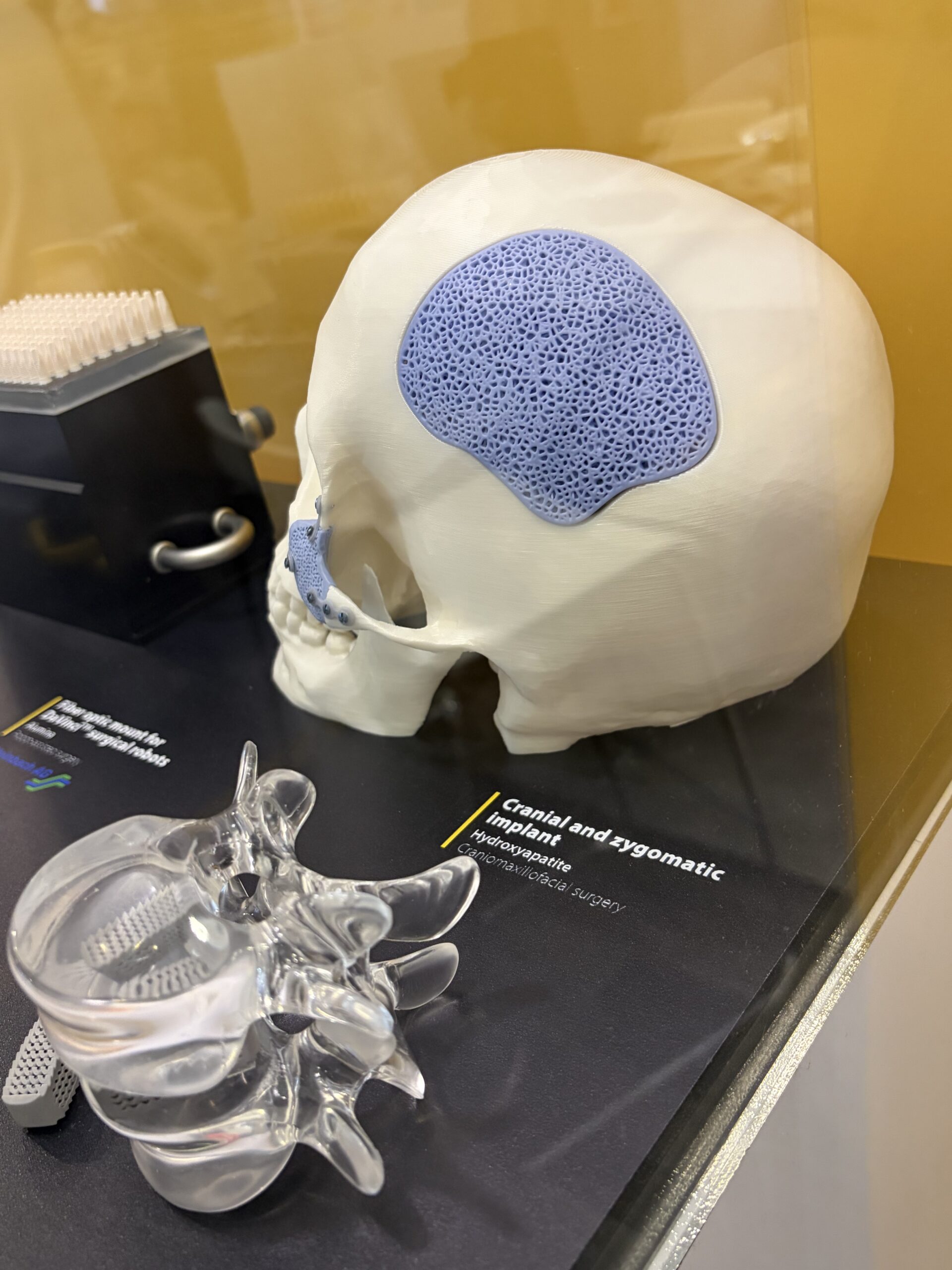
    This is “Herb,” at the Lithoz booth at RAPID+TCT 2026.

    Gall brought up longtime Lithoz customer KLS Martin, which says it has used these ceramic 3D printed implants “approximately 350 times in real patients in Europe,” and is actively working to break into the U.S. and Australian markets. He also said that “the curve of distribution of this product” for KLS Martin is “double digit growth per month,” which is pretty impressive.

    “I think it’s one of the best examples of how we can really innovate a sector, because it’s an emotional topic, and you can imagine suffering is something that everyone knows. In terms of different kinds of surgical tools and components, everyone says, ‘Yeah, it’s fascinating,’ but it doesn’t really move you, ” he said.

    I fully agree with this.

    Gall also explained that Lithoz and KLS Martin are working together to try and make bigger versions of the 3D printed cranial implant you can see on “Herb” in the above image.
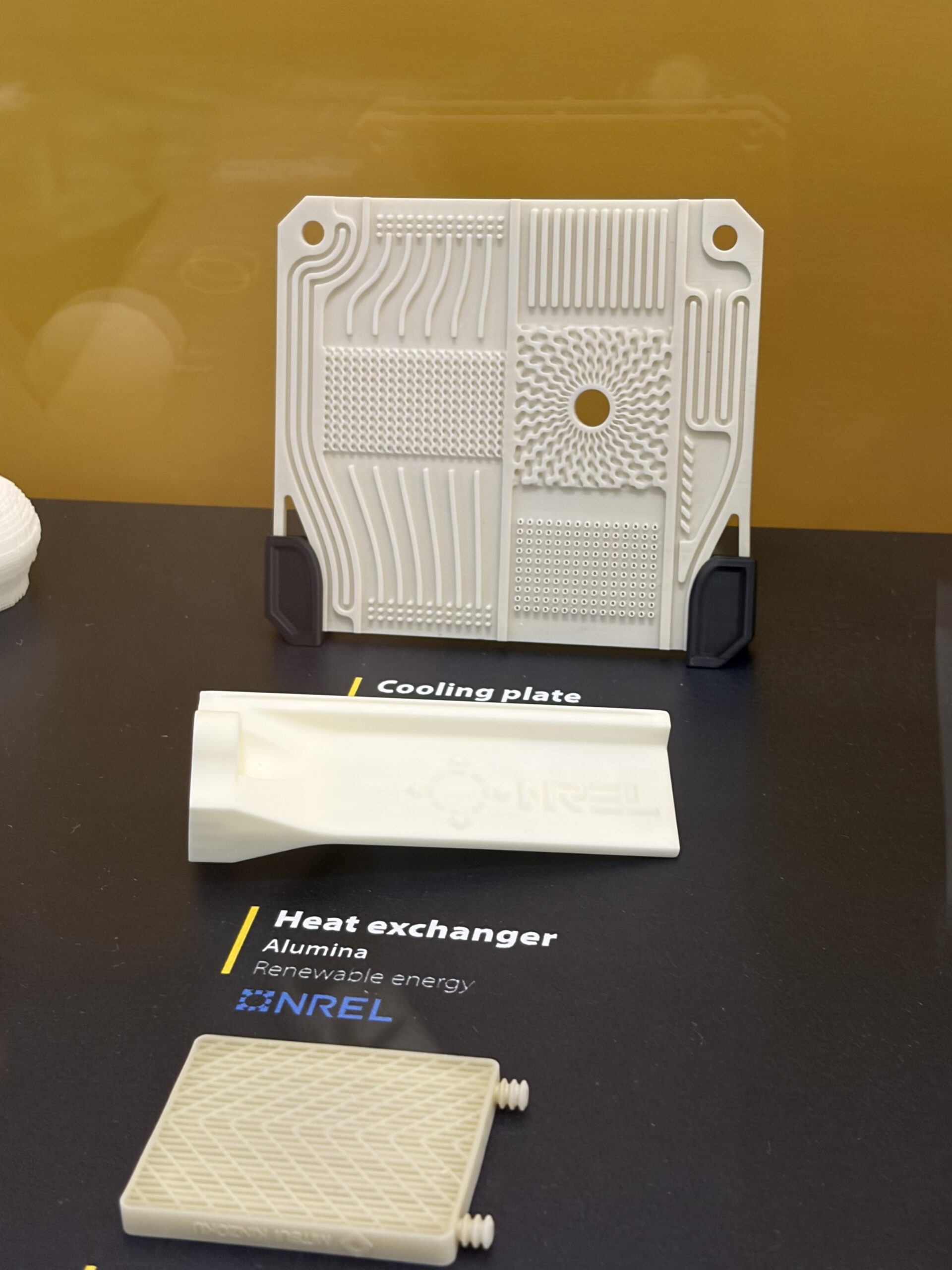
    Aluminum nitride cooling plate demonstrator at the Lithoz RAPID+TCT 2026 booth.

    Lithoz doesn’t just work in the medical sector. Gall also showed me a cooling plate for the semiconductor industry that the company 3D printed out of its aluminum nitride (AIN) material, LithaFlux. The one he showed me was a demonstrator, not a functional part, as the various patterns on the plate are not realistic for the actual application.

    Measuring 100 x 100 mm, the real cooling plate, with its precise inner channels, is the biggest AlN part printed on a Lithoz CeraFab printer.

    “It’s the biggest aluminum nitride part we have ever created,” he said. “People are really impressed by the size, combined with the magic of 3D printing.”
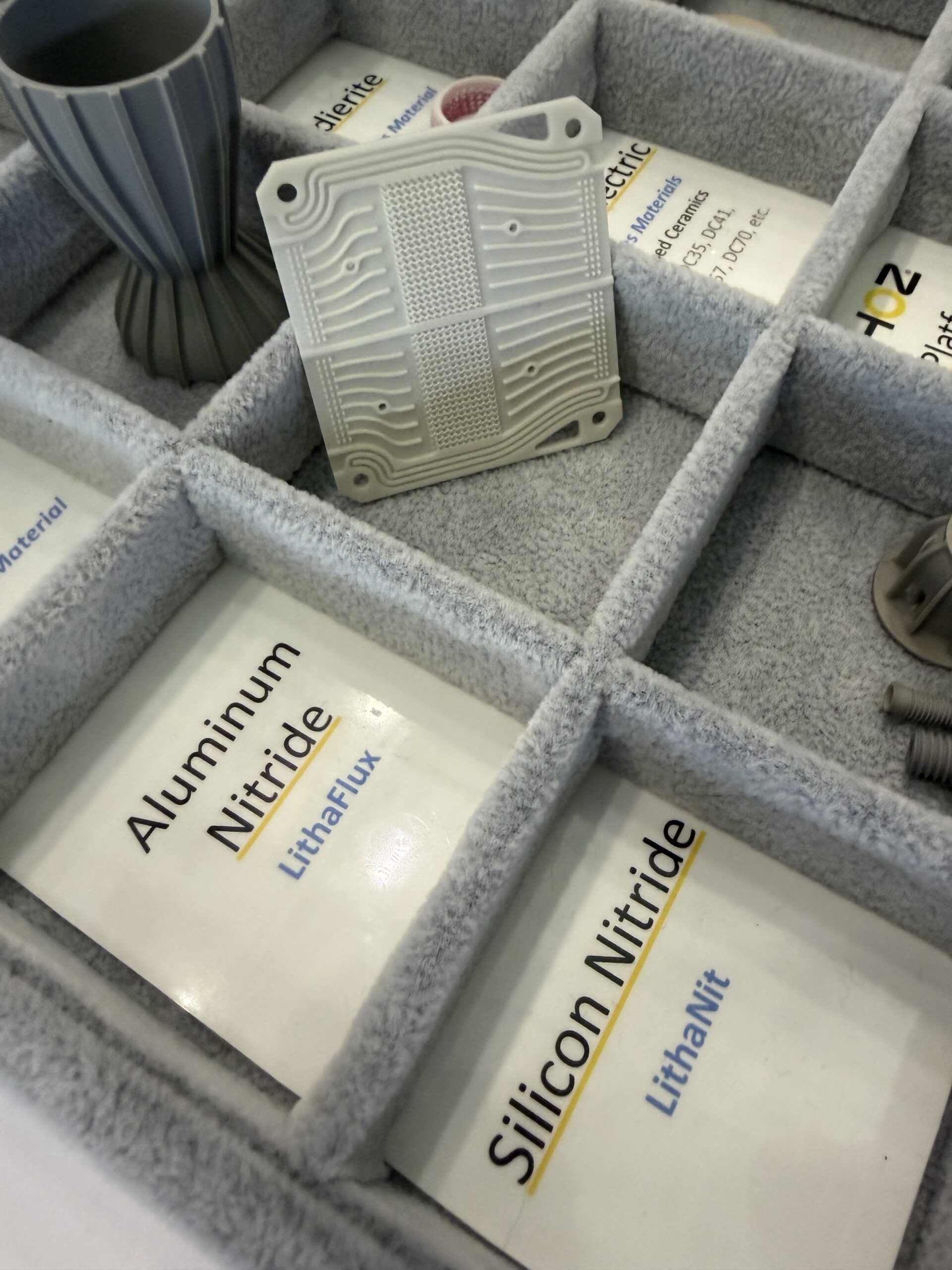
    Aluminum nitride cooling plate demonstrator at the Lithoz RAPID+TCT 2026 booth.

    Obviously, BMF and Lithoz offer very different 3D printing technologies, but the attention to detail for applications in industries that require precision is a big similarity.

    Images courtesy of Sarah Saunders unless otherwise noted.
  • Bambu Lab’s 3D Printed Drone Add-On Helps Measure Whales from the Sky

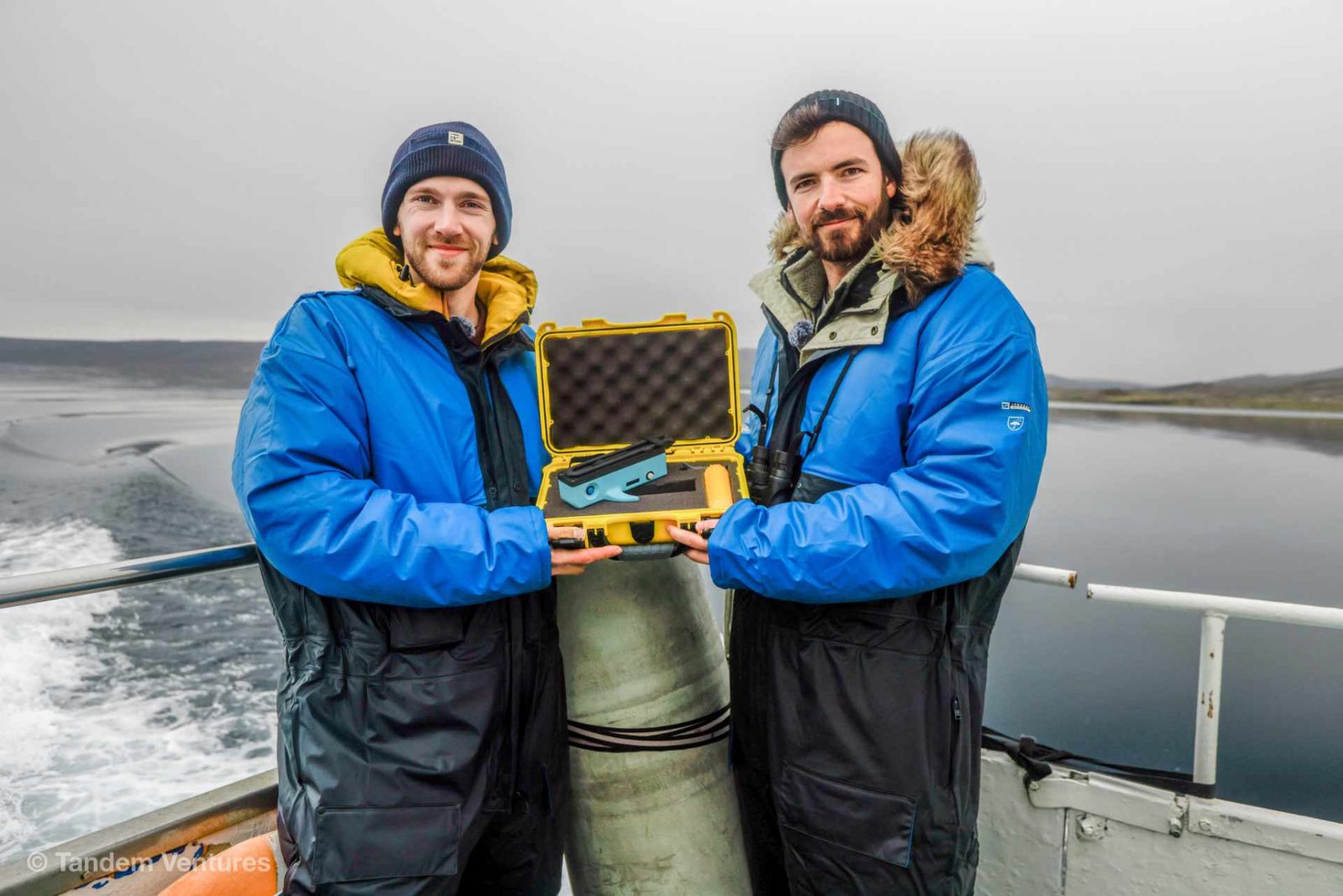
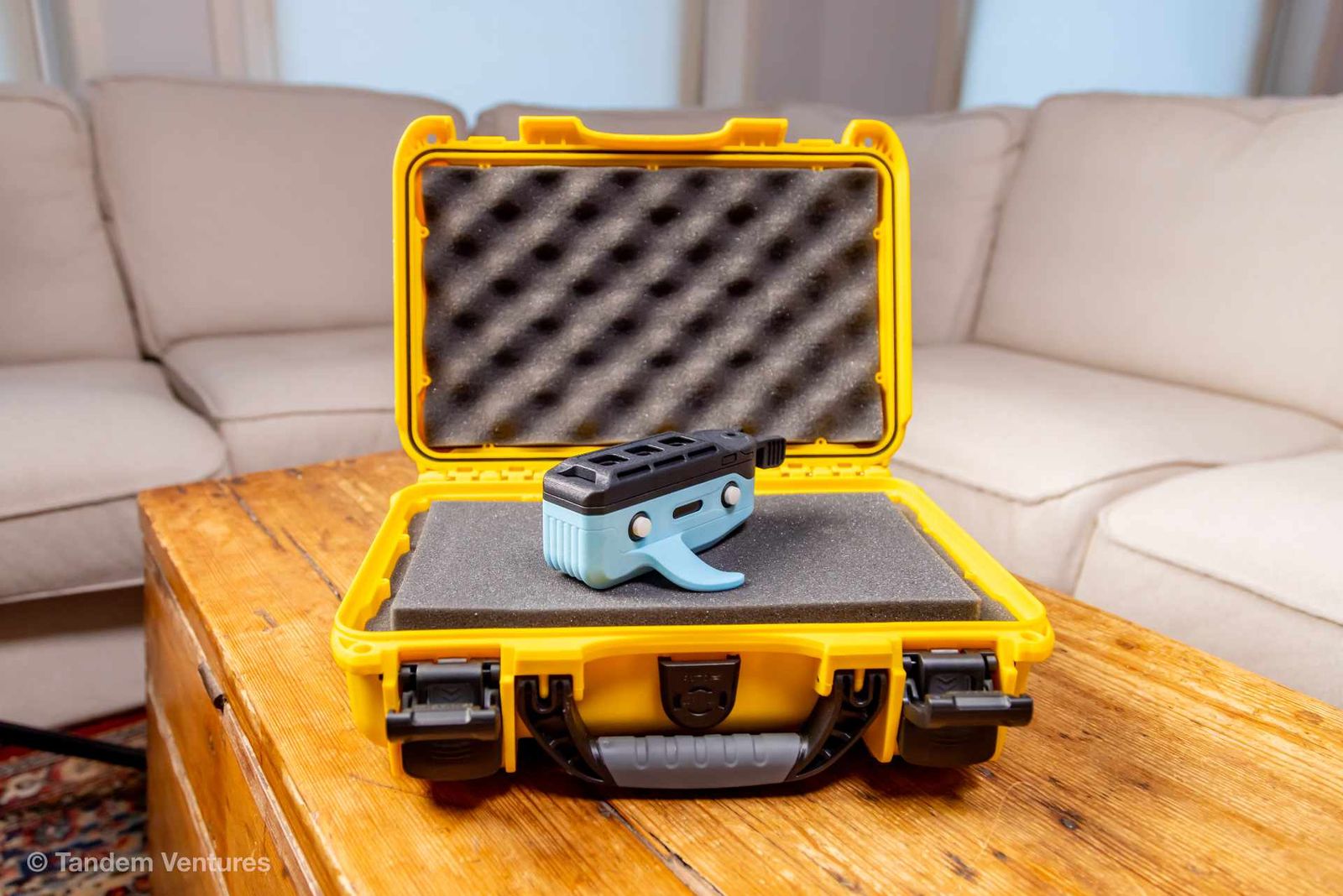
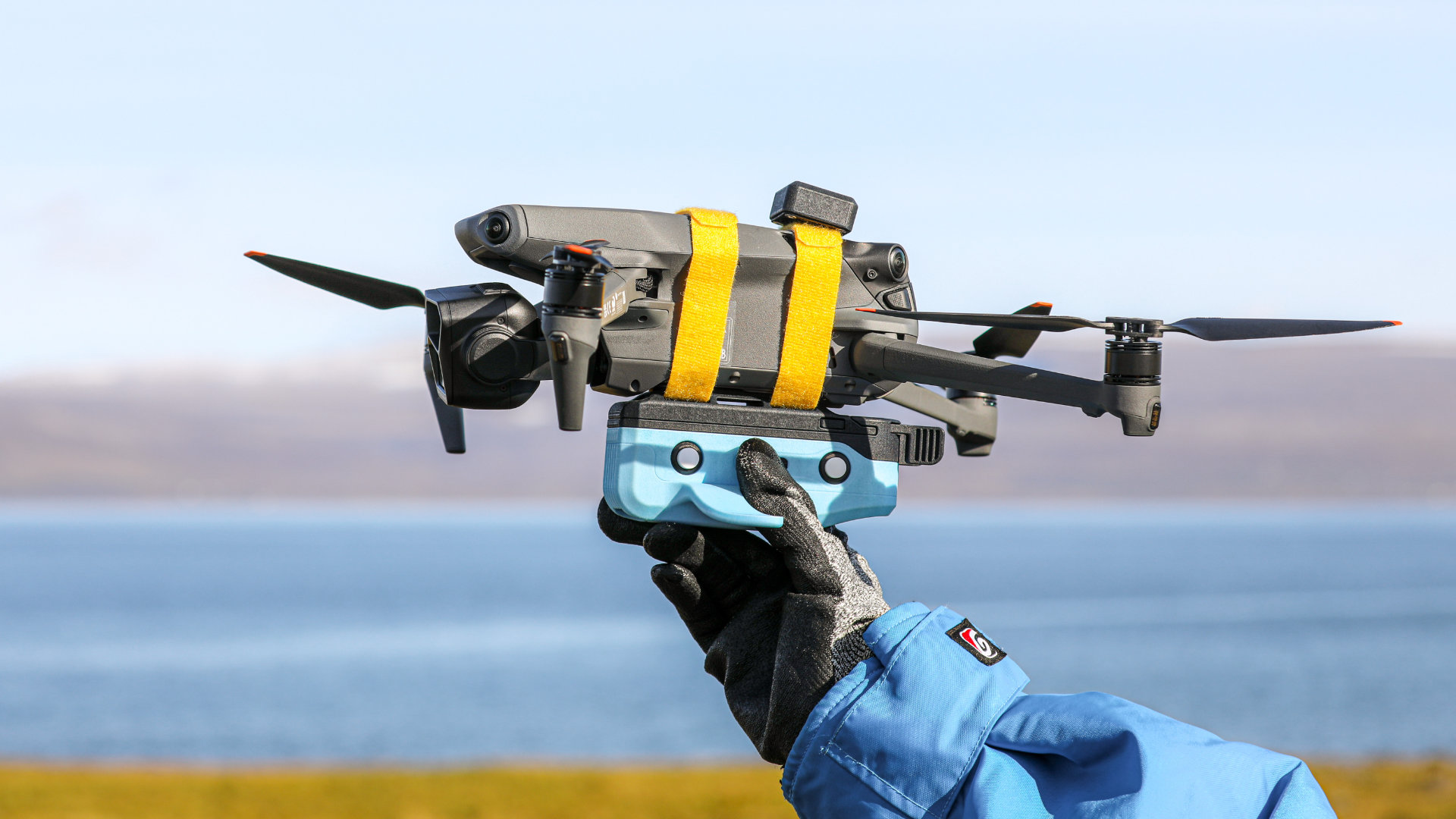
    Bambu Lab has helped Tandem Ventures develop the WHASER, a 3D printed attachment for a drone that can measure whales. This seems like a nifty tool for researchers. It is also a powerful example of drone-based 3D printing add-ons. We can expect many people in the future to use 3D printing to make assemblies that help drones to wash windows, measure pollution, measure noise, and more. Drones can be low-cost, convenient for measuring, repairing, and maintaining the world. And a lot of these drones can be, at least in part, printed. But the attachments for these are definitely going to have a lot of 3D printed parts. They will be custom, complex assemblies at low volume that benefit from weight savings, an ideal case for 3D printing.

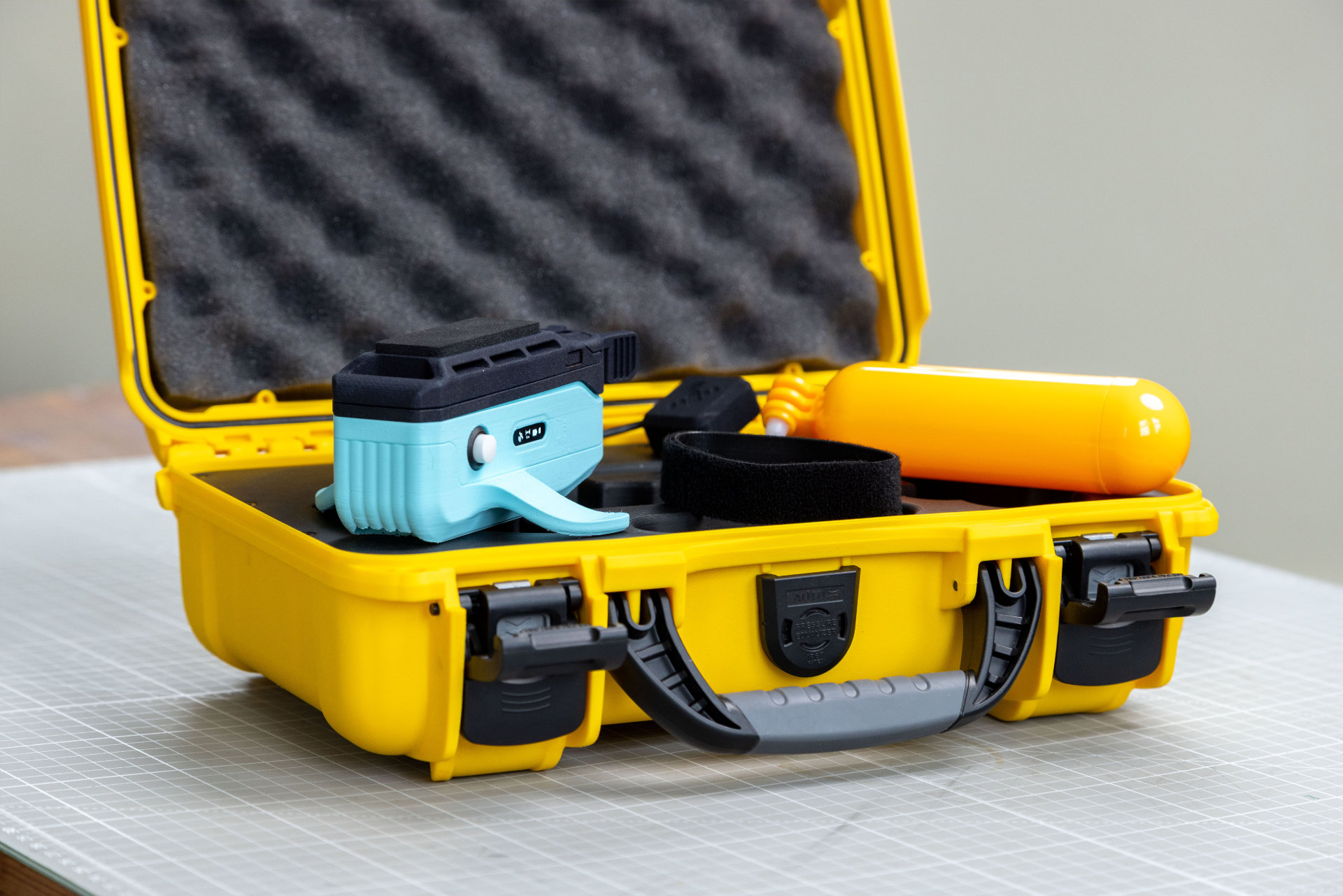
    3D printed WHASER, a drone attachment to measure whales.

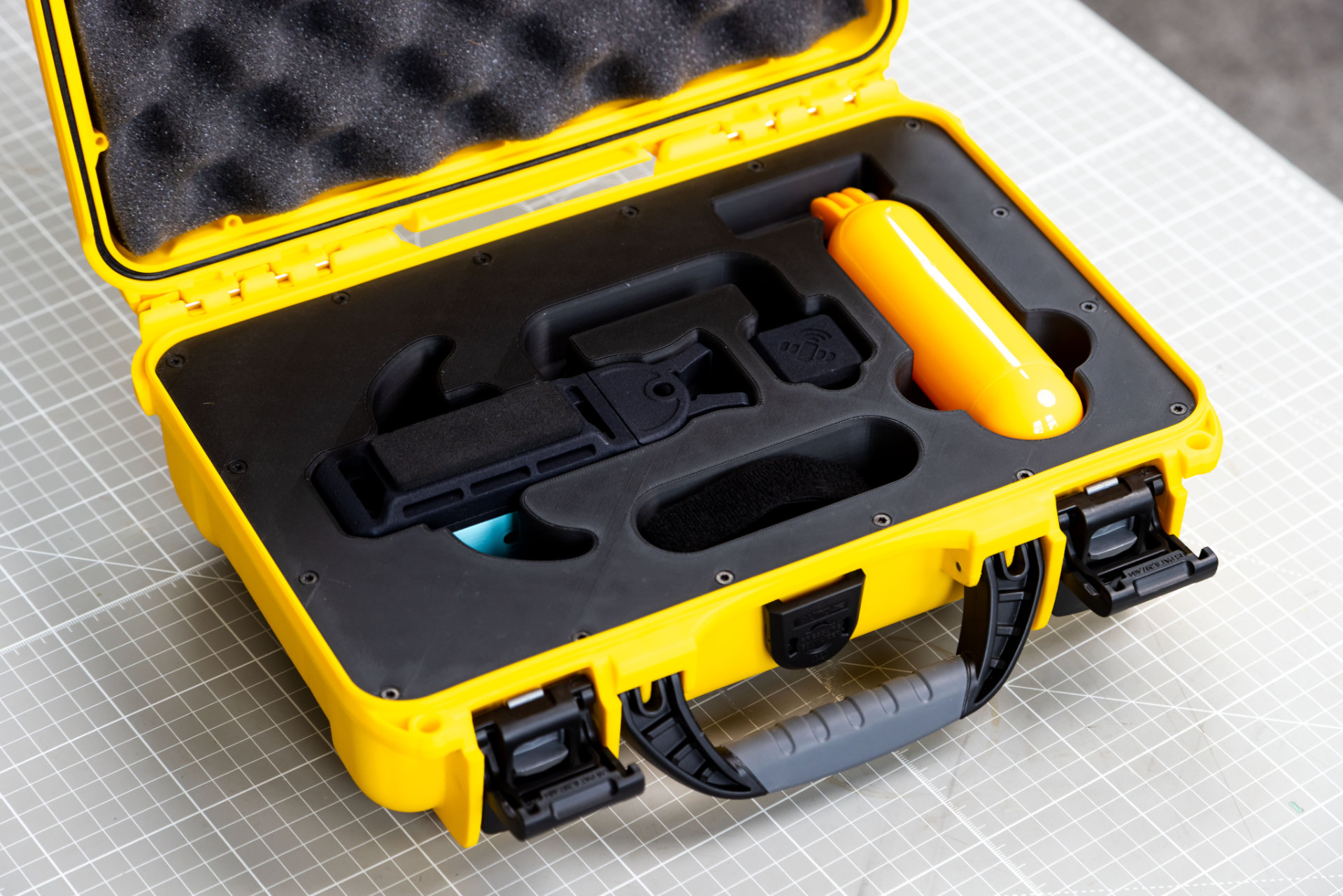
    WHASER is an Inertial Measurement Unit, GPS, and LiDAR assembly that can be flown above drones. Rather elegantly, it stitches together mapping data, GPS location data, and infrared to measure whales while the LiDAR gauges the right altitude. It’s super ingenious, really. The tool has so far been used to measure 115 Atlantic humpback whales. The researchers wanted to measure these whales to gauge their health, especially if entanglement with fishing nets could make them weak. Only an FPV (first-person-view) flown from a nearby coast or ship could let them see the whole whale from above, cost-effectively.

    Researchers test the WHASER, a drone attachment to measure whales.

    I love this idea because you can use it as a model to measure a lot of things, such as trees in a forest, oil spills, or algal blooms in the ocean. A clunky prototype was turned into a smaller 3D printed enclosure for the Arduino ESP32 Nano microcontroller, a smaller LiDAR sensor, a GPS module, an IMU, a microSD reader, a USB-C rechargeable battery, and an OLED display showing real-time battery level, LiDAR readings, memory card status, and GPS signal strength. Lighter and sleeker several iterations were tested of the housing and the mounting assembly. After the initial version was tested in Iceland’s Westfjords, other researchers expressed interest. 

    The team redesigned the WHASER once again to increase battery life, weather-seal it better, and make it easier to ship. A custom hard case was made to make it easier to set up while protecting it shipboard or during transport. I love this device because it has so much potential for studying marine life. I’m sure that someone will also use a similar device to find fish and fish them better than you can with current radar solutions, which will be quite counterproductive, perhaps for the whales and the fish. But generally, this should be a boon for researchers.


    I also love that Dr. Tao, Bambu’s CEO, was the one behind the gimbal camera and a lot of the technical work on drones at DJI, the Chinese company behind many of the world’s leading consumer and professional drones, along with camera stabilizers and flight control tech, while he worked there. In terms of telemetry, balance, vibration, wayfinding, and measurements, you’d be hard-pressed to find a better person to do this work anywhere. And of course, a bunch of the team came over with him from DJI, so I’m sure a lot of the folks were happy to pitch in here. Also, I wouldn’t be surprised if Dr. Tao got stuck in there either.

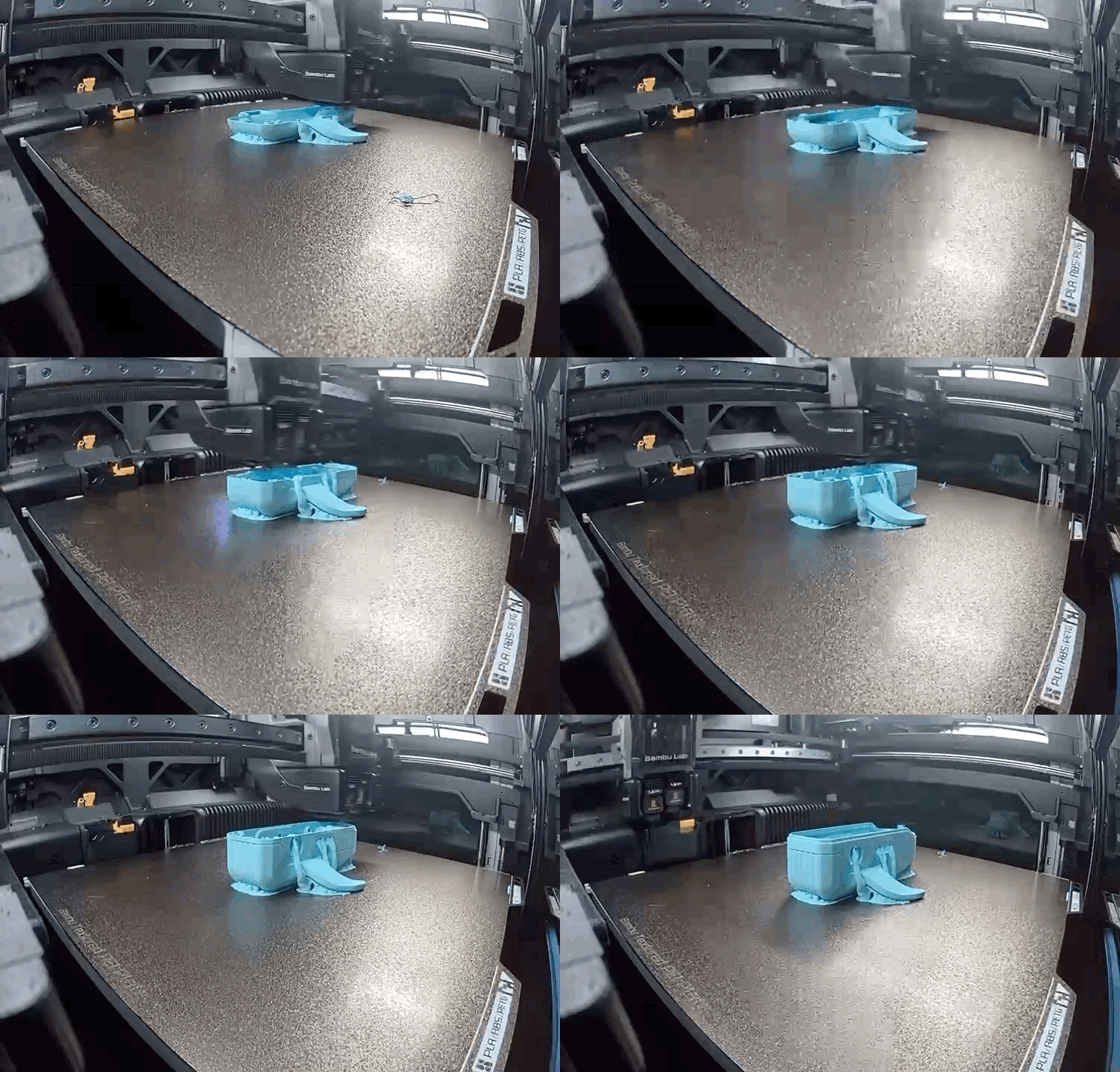
    3D printing the WHASER drone attachment to measure whales.

    I think that this is marketing done right. You’re showing off a relatively new application with a lot of potential. Complex assemblies and drones are a match made in heaven. And by seeing a drone as a platform for more than just pictures, people can start dreaming of many more businesses. Drone window washing and drone gutter cleaning are among my favorite drone-based business ideas. And these will need custom 3D printed devices to work well. But think of measuring building insulation, water temperatures, wetland health, river depth, and more. Imagine using tools to measure how dry a forest is or where forest fires are likely to spread next, or using a machine vision counter to count trees or animals in a given area? There could be a lot more done with 3D printing and drones, and this shows us what is possible.

    Images courtesy of Tandem Ventures/Bambu Lab

  • Holcim, COBOD and PERI Print 12 Unit Social Housing Project in France

    Holcim has announced that a 12-unit residential structure, ViliaSprint² in Bezannes, France, was finished in a year. Nice to see that people seem to be properly building structures rather than doing fly-by-night 24-hour demos. The structure was built by Plurial Novilia (a subsidiary of Action Logement) using TectorPrint, a binder for mortar that comes in two versions. One is ready to print while the other is mixed twice and can be used as micro mortar or concrete with strengths ranging from 15 to 90 MPa. This material was previously used by Holcim, GE Energy and Cobod for wind turbine towers. Previously, on the 3D Villaprint Project in 2018, the ink material was supplied by VICAT.

    ViliaSprint² in Bezannes.

    Other partners in this project, which will also include a follow-up phase in ViliaSprint², are PERI 3D Construction, the rather puzzlingly, and one hopes not ironically, named HOBO Architecture, and COBOD for the 3D printers. The COBOD units printed the three-story, 800 m2 structure on site. Multi-story buildings are very difficult to do with 3D printing, and the regulatory process for this can not have been much fun. So this is a great step forward toward making more dense, efficient structures using additive manufacturing. What’s really cool is that two identical buildings were built side by side, one using 3D printing, the other using traditional construction. I love this because we can now really compare the two structures, their costs, and how they are used over time. I hope we get much more data from this project, as it could be a great way to conduct research and learn more. The structure used about 10% less concrete, and the walls were completed in half the time. The team estimates that there was a CO2 reduction of around 30% as well. The company also used far less labor and less backbreaking work overall.

    Holcim 3D printed the residential structure in Bezannes.

    Johnny Huat, Managing Director of Plurial Novilia, said,

    “ViliaSprint² marks a major milestone in the exploration of new construction methods.  The project has made it possible to concretely assess the contributions of 3D printing to produce housing more quickly and sustainably.”

    Hélène Lombois-Burger, Head of Concrete and Aggregates R&D at the Holcim Innovation Center, stated,

    “3D printing in construction is about more than just using a robot. It’s a holistic ecosystem where the material takes on the role of structural autonomy. By combining the precision of TectorPrint with our mix design expertise, we are proving that high-performance housing can be both low-carbon and fast to build. We are effectively moving from construction to advanced manufacturing on the job site.”

    There is more to be done, however, since

    “By the end of the build, our 3D printing productivity increased by 35% compared to the start of the build. We’re already carrying that momentum into our next goal: an upcoming 40-unit residential development. We want to move from experimentation to a fully competitive scale, reducing costs still further and proving that we aren’t just printing walls, but a more sustainable, resilient way of living.”

    Holcim 3D printed the ViliaSprint² residential structure in Bezannes.

    This is real progress in 3D printed construction. Real regulatory work, real risk assessments, and real buildings. This is not some dictatorial dreamscape or a monument to government waste somewhere; this is work into seeing if this is a real solution. Action Logement is a uniquely French behemoth that manages over 1.1 million homes in France. It assists people in getting homes when there is an immediate need, in helping them access homes that can be financed, or in building inexpensive rental homes. It has real market power, and with housing affordability being such a big problem for many, they could see their efforts intensified. So a 40-unit building is a great step, but perhaps a step towards many more buildings in France and beyond.

    Now I’m on board with the speed, lower labor, and reduced costs, and think that this could be very important. But using 10% less concrete in a building is like using 10% less heroin. Sure, it’s good for you. Better than staying at 100% heroin use, for sure. But 10% less heroin will kill you in the end as well. So if we are to do the heavy lifting to deploy this technology more widely, surely we can do a lot better than regular old concrete?

    Images courtesy of Plurial Novella 

  • 3D Printing Could Show How Cells Respond to Shape — and Heal, New UK Research Finds

    Researchers at the University of Nottingham are using 3D printing to learn how human cells sense and react to their surroundings. The project focuses on cells involved in healing, like those in skin and bone, and looks at how tiny physical features, such as surface shape and texture, influence their behavior. The goal is to understand this process well enough to design better materials that help the body heal on its own, which could reduce our reliance on drugs in the future.

    At the center of the work is Dr. Robert Owen, who recently received a research grant from the UK’s Academy of Medical Sciences. In his lab, he and his team are studying how cells respond not only to chemical signals, but also to the physical shape of their surroundings. The funding comes through the Academy of Medical Sciences Springboard program, which supports early-stage, discovery-driven projects with monetary awards to help launch new research. That means the work is still in its early phases, with results yet to come.

    The funding is part of a broader £6.7 million investment from the Academy of Medical Sciences, awarded to 55 early-career researchers across 38 institutions in the UK. The program backs early, curiosity-driven research to improve understanding of major health challenges, like Parkinson’s disease, Alzheimer’s, infectious diseases, and chronic pain. Dr. Owen, based at the University of Nottingham’s School of Pharmacy, is one of the researchers selected for this round of funding.

    While the work is still at an early stage, in a LinkedIn post, Dr. Owen said he was “thrilled” to receive the award and highlighted support from the University of Nottingham, its School of Pharmacy, the Biodiscovery Institute, and the Centre for Additive Manufacturing (CfAM). He also noted that the funding will support a new two-year postdoctoral position, signaling that the project is now expanding.

    School of Pharmacy at the University of Nottingham. Image courtesy of the University of Nottingham.

    Why Shape Matters More Than You Think

    The researchers explained that cells live in complex environments. In the body, they’re surrounded by structures with curves, edges, and textures. These shapes and textures tell cells what to do, whether to grow, move, or start repairing damaged tissue. So the Nottingham team is recreating those “environments” using 3D printing. By building surfaces with very specific shapes, they can watch how cells react in real time. 

    This matters because most lab experiments are still done on flat surfaces, like petri dishes, which don’t reflect how cells behave inside the human body. In real tissue, cells are surrounded by complex 3D structures and interact with curves, textures, and neighboring cells all at once. Studies such as Jensen & Teng 2020 3D cell culture review and Duval et al. 2017 Modeling Physiological Events in 2D vs 3D Cell Culture, show that when you move from flat to 3D environments, cells can behave very differently, changing how they grow, move, and repair tissue.

    So this is where additive manufacturing becomes key. 3D printing allows researchers to create highly controlled, complex structures, down to microscopic details, that would be nearly impossible to make otherwise.

    In fact, UpNano said in a social media comment that its technology is being used in the research, a claim that was acknowledged by Dr. Owen. UpNano specializes in two-photon polymerization (2PP), a high-resolution 3D printing method capable of producing extremely fine micro- and nanoscale structures, and is super well-suited for studying how cells interact with surface features like curvature.

    The system is part of the University of Nottingham’s CfAM, where it sits alongside a range of other high-resolution and bioprinting technologies, including platforms like the BMF 130, RegenHU Discovery, Cellink Lumen X+, a Formlabs Form 3, plenty of Anycubic SLA printers, and even a FRESH system, supporting high-resolution work at the scale of living cells. 

    At Nottingham, this lets Dr. Owen and his team build better environments to see how cells behave. That helps them study healing and disease in a way that’s closer to the real body.

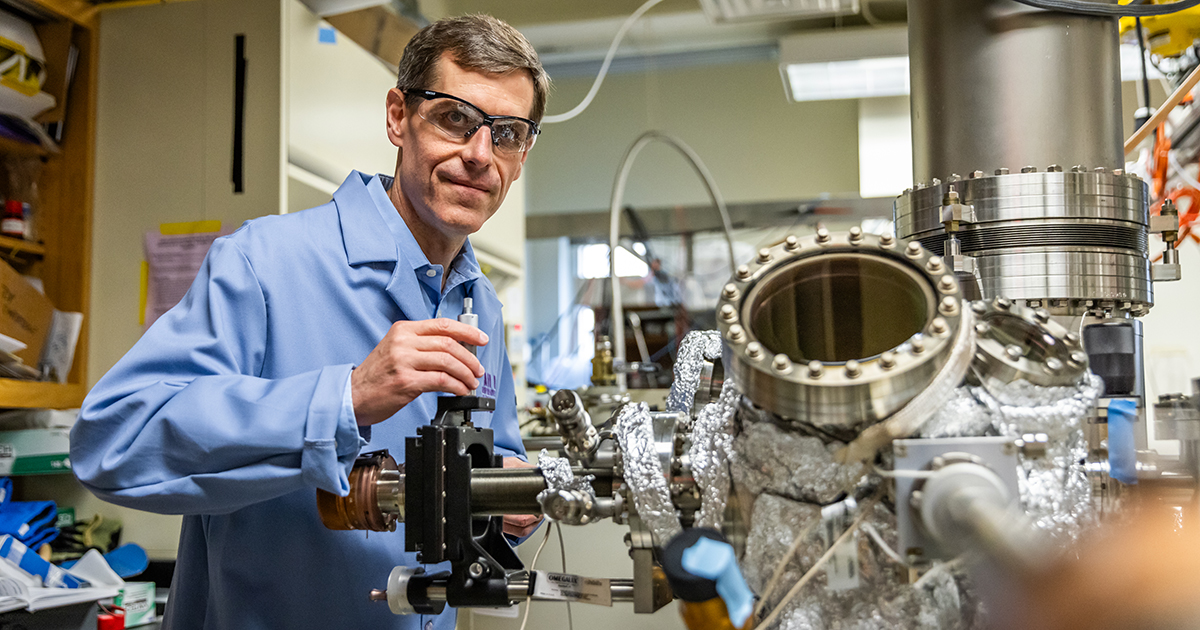
    Dr. Robert Owen at the University of Nottingham’s Centre for Additive Manufacturing. Image courtesy of the University of Nottingham.

    A Step Toward Drug-Free Healing

    Dr. Owen calls this idea “SHAPE as Medicine.” It focuses on using tiny physical features, like curves and textures, to guide how cells behave and support healing, rather than relying only on drugs.

    “This project will help me advance the concept of SHAPE as Medicine, using cell-scale physical features to direct cell behaviour and guide healing. By bringing together Nottingham’s strengths in advanced 3D printing, mechanobiology and analytical science, I hope this work will lay the foundations for a new way to design materials we implant into the body,” noted Dr. Owen.

    For now, the research is focused on understanding how cells respond to these shapes. But over time, it could help researchers design better materials for the body.

  • Post-Printing at RAPID 2026: PostProcess Technologies & Mass Finishing

    The whole 3D printing workflow was on display in Boston at RAPID+TCT last week, from design software and 3D printing hardware all the way to post-processing and finishing solutions. For years, the latter has been brushed aside, not talked about, hidden away as the industry’s “dirty little secret.”

    PostProcess Technologies

    As Jeff Mize, CEO of PostProcess Technologies, once told us, the company is working to change this narrative with its automated solutions.

    PostProcess Technologies booth at RAPID+TCT 2026.

    Stratasys & Unified Workflows

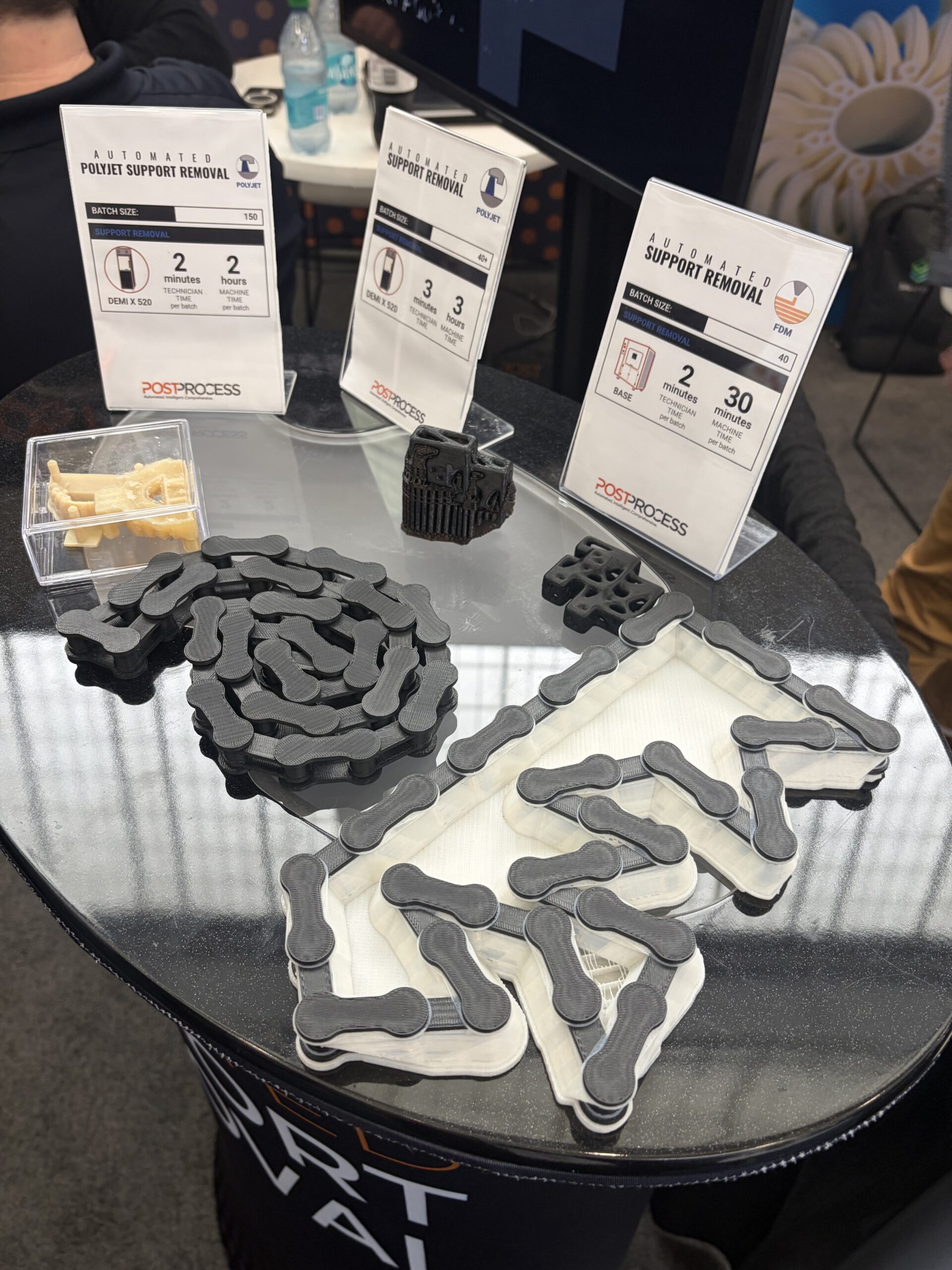
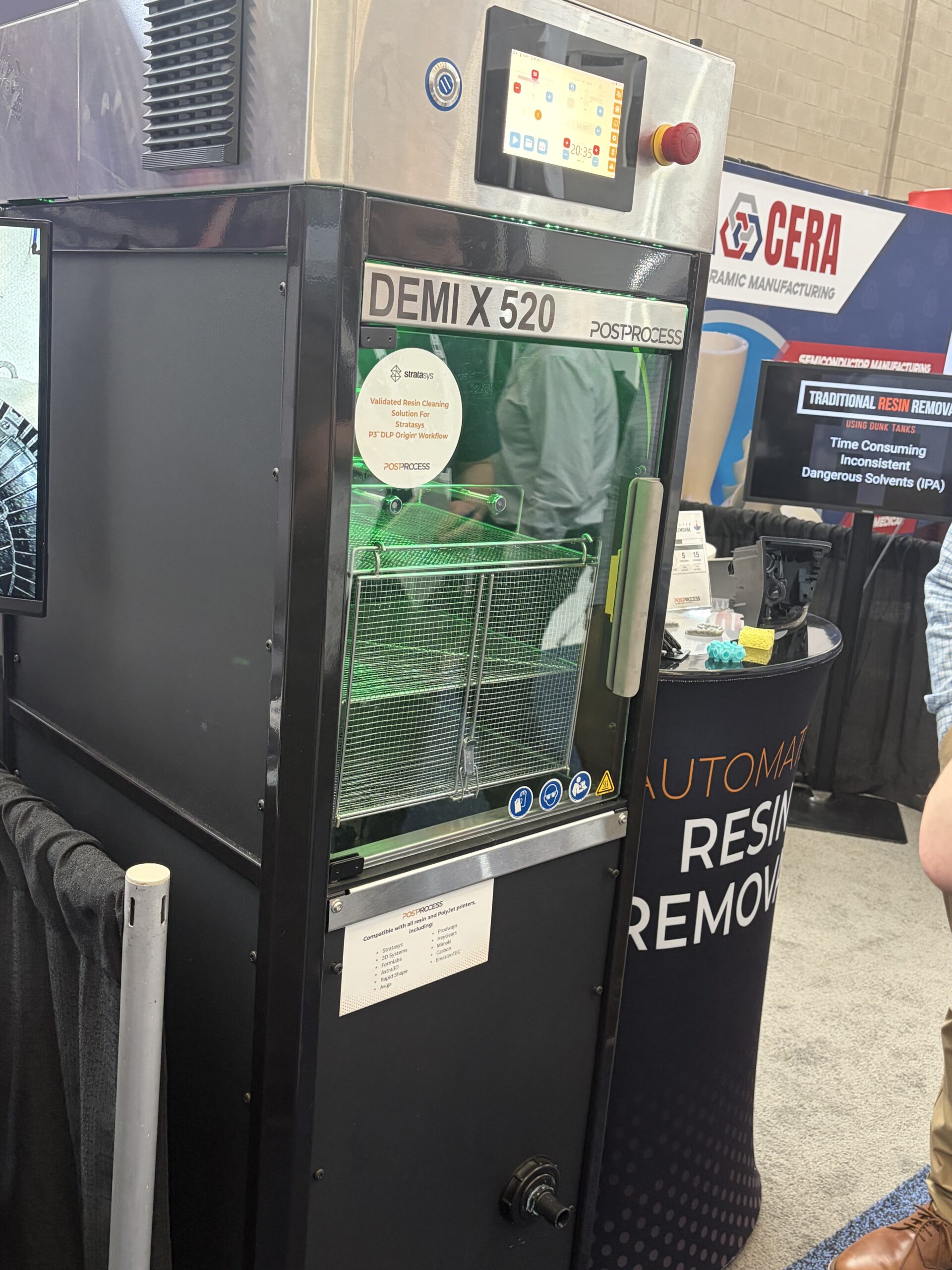
    PostProcess is most aligned with Stratasys, which Mize calls the company’s “primary partner.” Its solutions work “with four of the five core technologies” that Stratasys offers, including FDM, SLA, PolyJet, and P3. One of its newer systems is the DEMI X 5000, a large-format resin removal machine that works with the Stratasys Neo800+.

    “So the DEMI 4100 was the first generation for large-format resin removal, pairing with the Neo800+ and other large-format printers. For the DEMI X 5000, we’ve learned a lot from having the DEMI 4100 installed for a number of years, and for a number of challenging applications, including at Formula 1 teams.”

    PostProcess used feedback from the Formula 1 teams to inform its enhancements to the DEMI 5000, like “greater agitation to be able to work with convex and concave parts.”

    While PostProcess works with many 3D printer OEMs, like 3D Systems and 3DCERAM, Stratasys is definitely its number one. Their recently announced partnership, which Mize calls “a major milestone,” partially came about because the DEMI 4100 was installed at Stratasys Direct Manufacturing (SDM) in Tucson, Arizona and used “day in and day out.” Then, the BASE system for automated FDM support removal was brought to SDM.

    “So there was great success at Stratasys Direct, along with their Customer Experience Centers in Minnesota and Germany,” Mize said. “They had firsthand experience with our solutions, and as importantly, they heard from hundreds of our joint customers, that this post-processing solution drives a significant increase in consistency, much more throughput, and gives a lower cost per part.”

    More importantly, many of these customers just want a unified workflow.

    “I thought we would need to get into production applications to really be able to scale the business, but we’re seeing the need even in prototyping applications,” Mize told me. “We do see production applications on the near-term horizon. And there, automated post-printing isn’t a nice-to-have. It’s a must-have.”

    PostProcess Technologies booth at RAPID+TCT 2026.

    Partnerships like the one PostProcess has with Stratasys are also helpful because it’s simpler to have the 3D printer and post-print solution come together on one quote. Mize said that Dallas Martin, Additive Manufacturing Engineer at Toyota North America, was one of the biggest proponents for simplifying things in this way.

    “From a technology perspective, having a unified solution is critical, but also from a commercial perspective,” Mize said. “It’s easier to place one PO instead of having to work with two different companies.”

    Safety in Post-Printing

    We then moved on to safety, which Mize said “is driving probably 50% of our conversations today.”

    While he wasn’t able to name names due to NDAs, Mize did note that PostProcess is working with top companies in some of the main sectors, like aerospace, automotive, medical, and consumer goods. In fact, the company’s largest customer, a leading consumer goods company, just purchased its 25th and 26th systems from PostProcess this quarter.

    Working with such big names, safety is “a critical part of the discussion.” Mize actually said he heard from the head of safety at one of the company’s major aerospace customers that because “the next generation really cares about safe work environments,” safety is now being used as a recruiting tool.

    Some of its aerospace and automotive customers have banned the use of open chemical dunk tanks for resin removal, as Mize said they’ve resulted in accidents at some companies. He also said that medical companies are even starting to ban isopropyl alcohol (IPA).

    “Because our solutions are safer, from the design of the machines and how the software works, and then probably most importantly the chemistry, overall we’re providing a safer work environment, which is critical for everyone. But in particular, aerospace and automotive and medical are driving this.”

    PostProcess developed an alternative to IPA for resin removal called PLM-403, as well as a rinse agent called AUX-400. So the company now offers a completely IPA-free workflow.

    Solution Utilization

    The third point Mize touched on during our discussion was how customers are using PostProcess Technologies’ solutions.

    “Our recurring consumable business is growing very rapidly, and is actually ahead of plan,” he said. “Customers that have our solutions are using them on a very regular basis. So we’re seeing print volumes increasing and the post-print utilization increasing.”

    Earlier this year, the company published its 2026 Additive Post-Processing Survey Trends Report, which outlines customer concerns, and the post-processing bottleneck was high on the list. Mize said that over the years, the survey consistently shows that “customers no longer want to piecemeal the solutions together part by part.”

    “It was reinforced through our survey that customers want these unified solutions,” Mize explained. “They want a safer environment, they need more consistent parts, higher throughput at a lower total cost of ownership. And then one other caveat is don’t affect the material properties.”

    To this end, Mize quickly explained that another perk of the company’s partnership with Stratasys is working more closely with their material science teams, “so that as we’re developing next generation chemistries, we understand at a molecular level what the print materials are made of.”

    DEMI X 520 at RAPID+TCT 2026.

    In terms of specific customer applications, Mize mentioned that PostProcess Technologies has had success with several dental companies, including the Ninety! Dental Production Center in France, which is a customer of both Stratasys and PostProcess.

    “The senior leadership at Ninety! said, we want to have a unified workflow because our volumes are increasing,” Mize said. “So we’ll work closely with Stratasys on their next-generation dental solutions. It’s not just a printer offering, it’s a unified workflow offering.”

    Mass Finishing, Inc. (MFI)

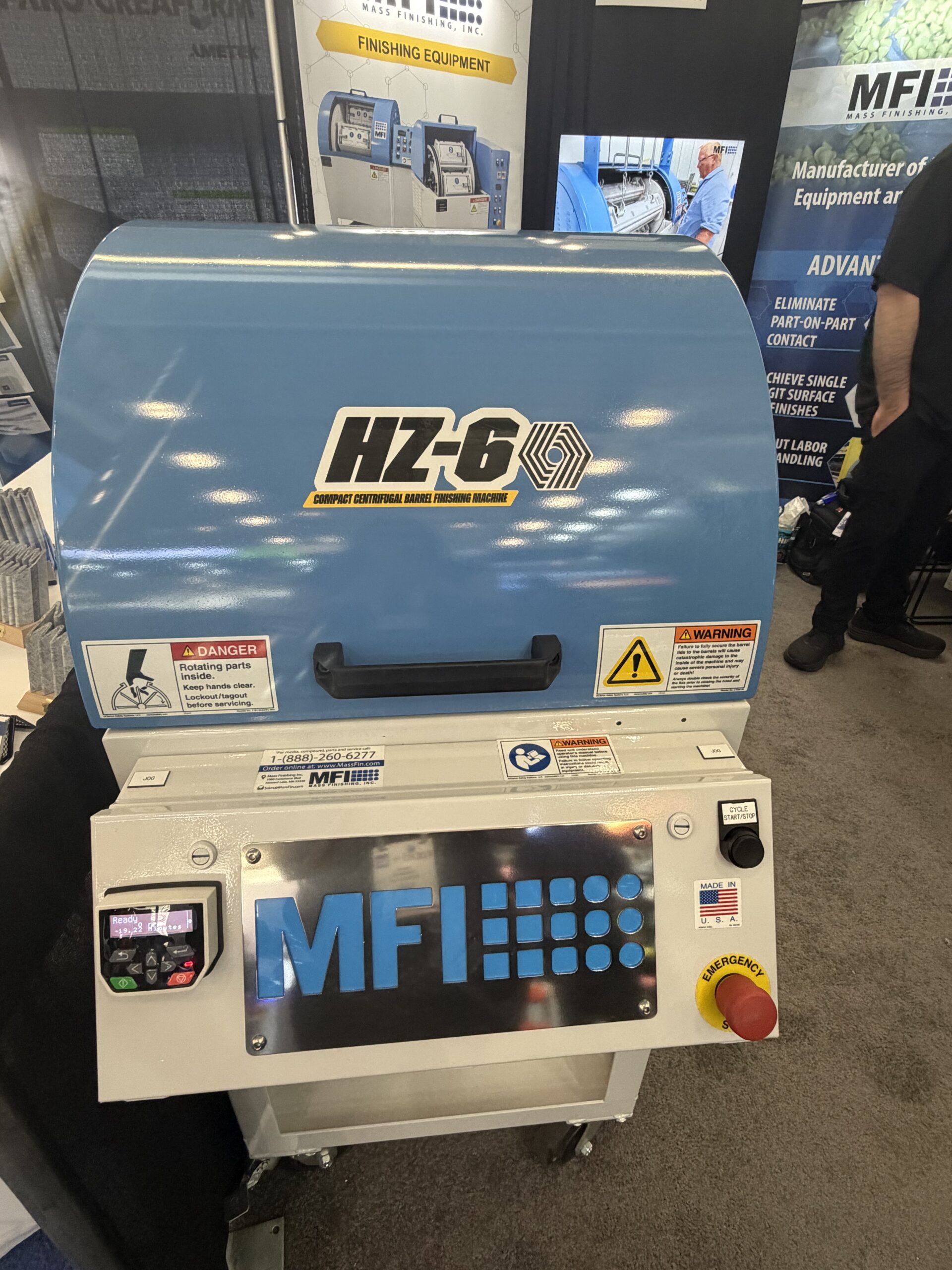
    Speaking of dental 3D printing, I noticed that this is also a specific application for the new HZ-6 centrifugal barrel finishing machine, which Mass Finishing, Inc. (MFI) debuted at RAPID. But it’s not at all similar to PostProcessing Technologies’ resin removal solutions.

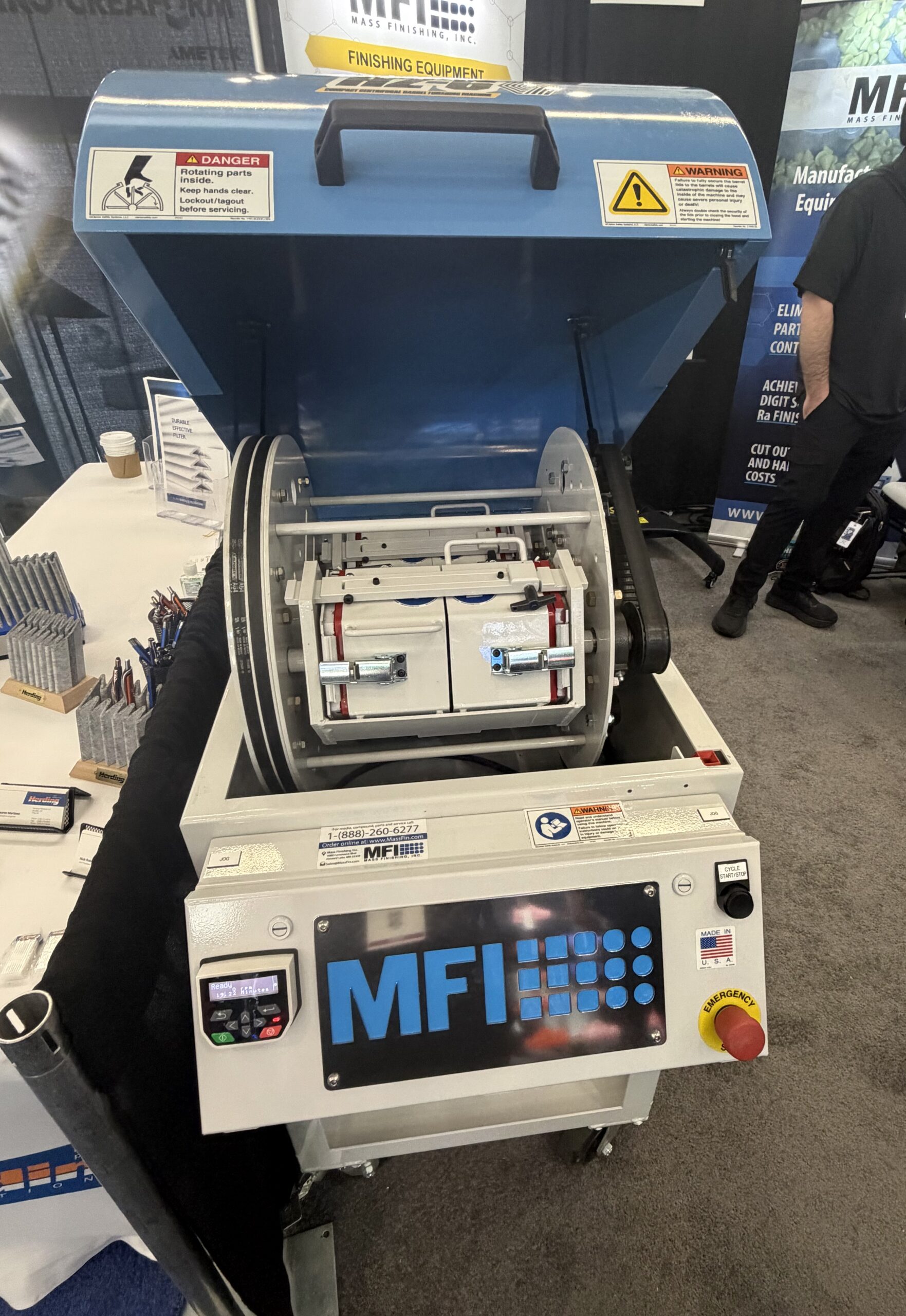
    MFI’s new HZ-6 at RAPID+TCT 2026.

    Centrifugal Barrel Finishers

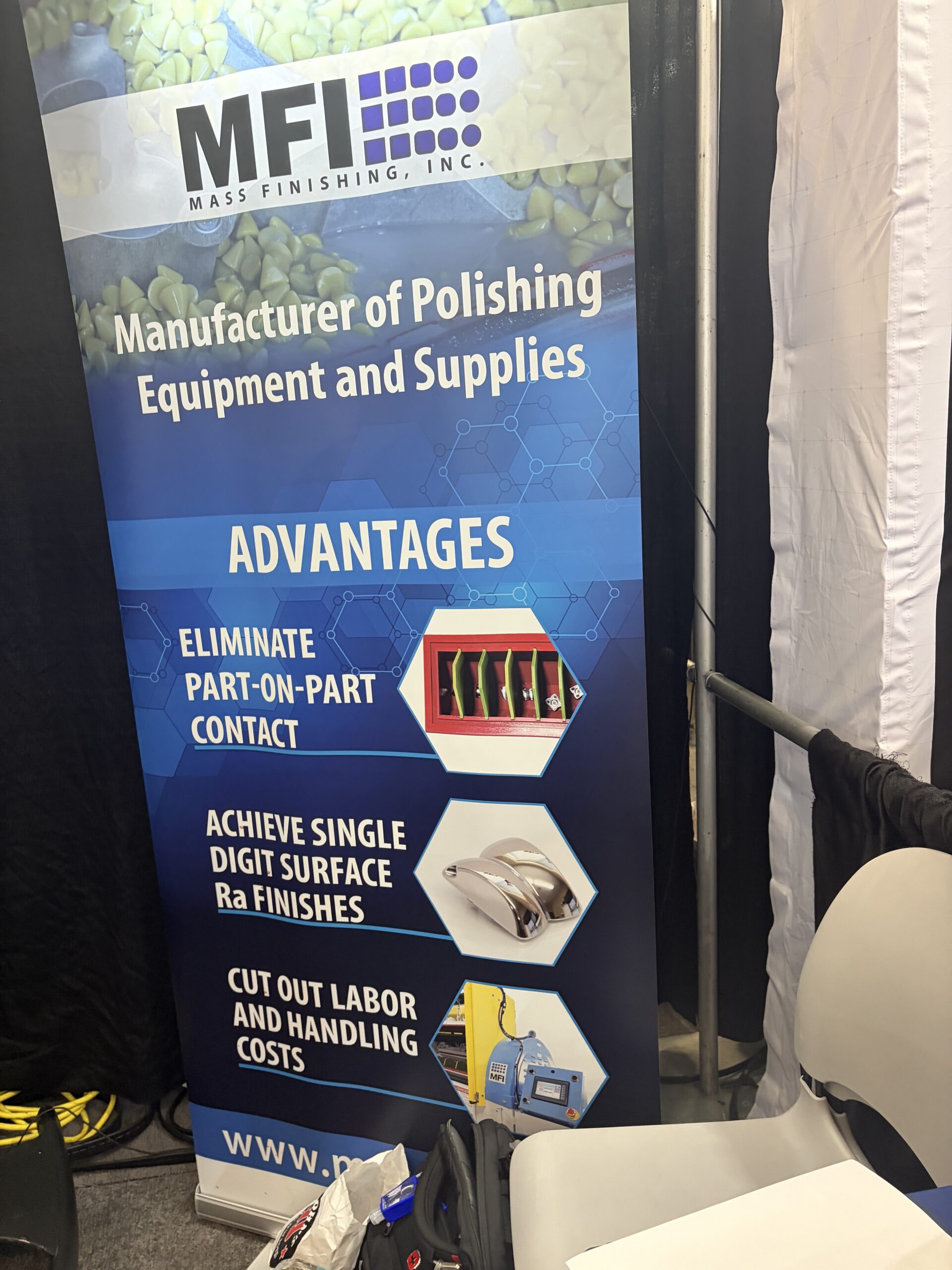
    MFI manufactures surface finishing equipment and supplies, specializing in high-energy centrifugal barrel tumblers, like the compact HZ-6, that can quickly deburr and polish 3D printed metals, plastics, and other materials.

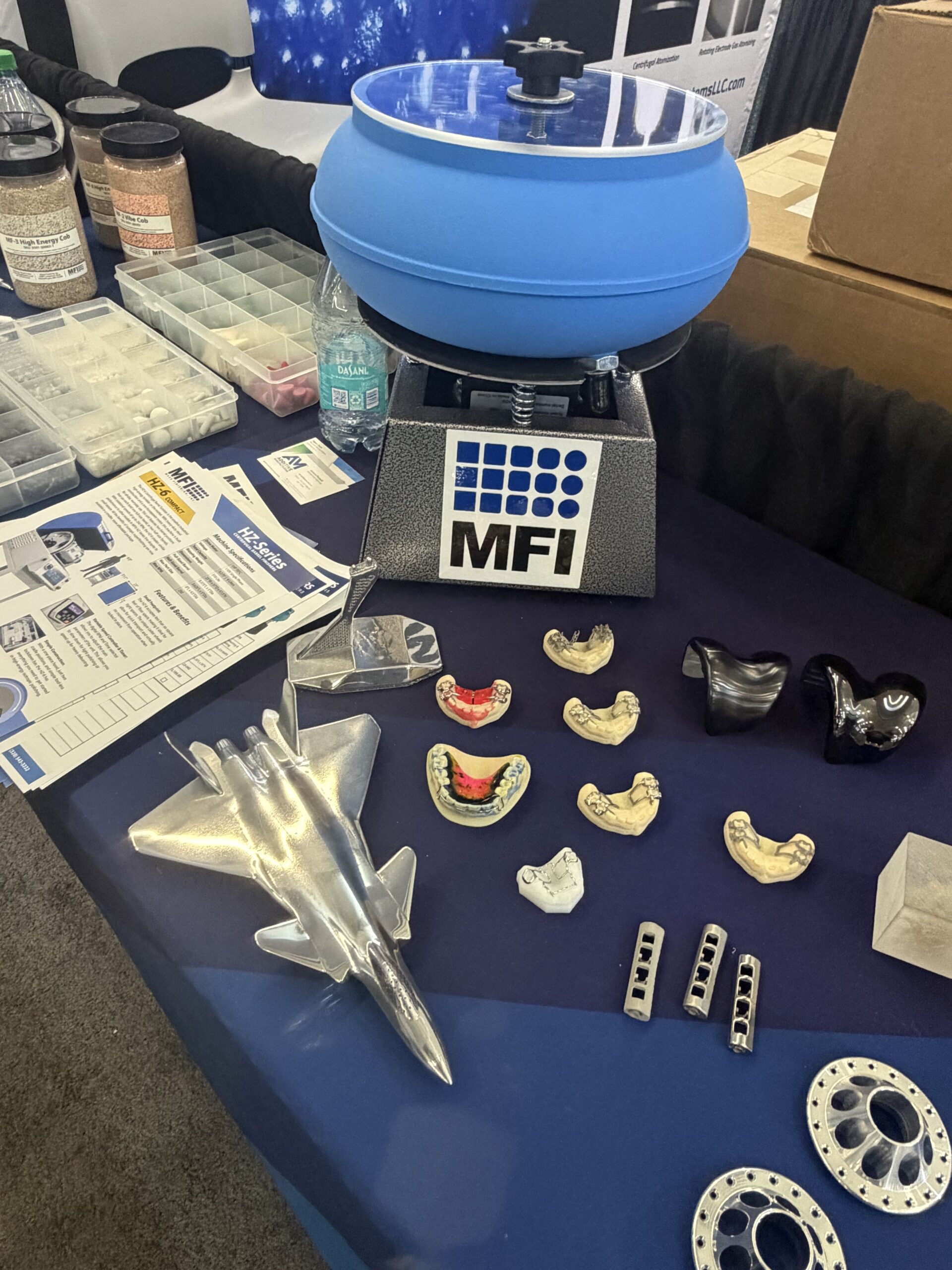
    As MFI’s Outside Sales Representative Mike Marketon explained, “Basically, we can take parts from a really rough state, and polish them and clean up.”

    This type of finishing uses centrifugal force (outward force on a mass when it’s rotated) to, as MFI’s brochure explained, “subject parts and media to pressures greater than the force of gravity.” The barrels on these machines are loaded with a combination of water, parts, media, and compound. As the machine rotates, the barrels spin on their own axis, and a sliding force is created inside the barrels, which causes everything inside to hit each other in random directions.

    MFI booth at RAPID+TCT 2026.

    There are many versions of these kinds of machines, from smaller vibratory bowls and tubs that rotate in just one direction to centrifugal barrel tumblers with four barrels. The HZ-6 is MFI’s most compact system yet, with a footprint of less than six square feet and only two barrels, which can accommodate parts up to 8″ long and 4.5″ in diameter. For comparison, Marketon said the company’s HZ-330 machine “would take up this whole booth and then some.”

    MFI’s centrifugal barrel tumblers can reach up to 12 Gs of force inside, and a urethane liner in the barrels keeps the parts from getting too beat up.

    “The turret itself is going one direction, and the barrels actually go the other direction,” Marketon explained. “So it’s doubling that force when they’re rotating different directions like that. So that’s basically what it does to generate power to go from rough surfaces to a polished surface.”

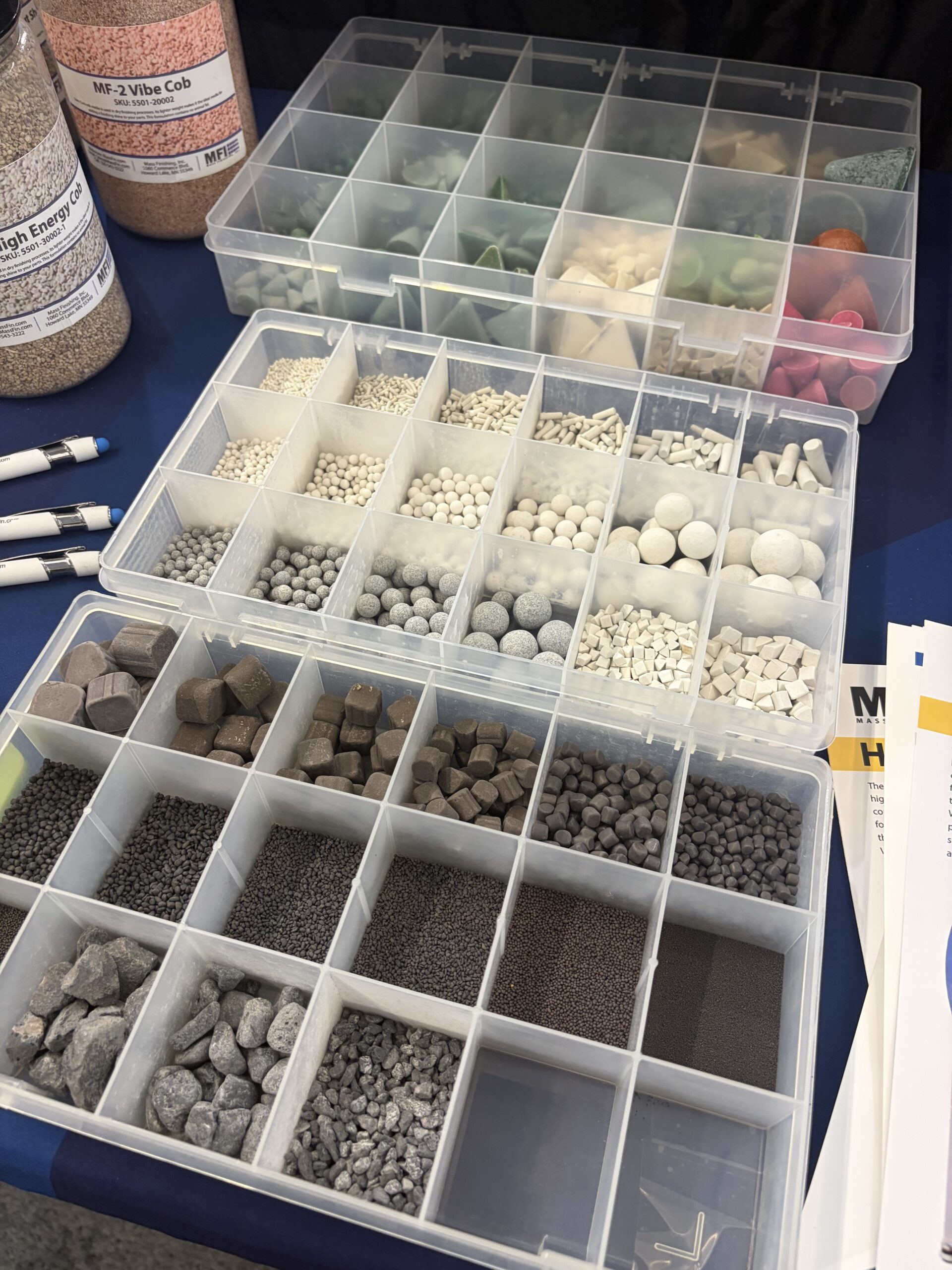
    Some of MFI’s different types of media at RAPID+TCT 2026.

    I asked about the level of automation for MFI’s centrifugal barrel tumblers, and Marketon said that while loading and unloading is manual, the rest of the process is pretty hands-off. The company develops the specific recipe for customer parts, and once these have been added, you “basically plug it in, push the button, and walk away.” You will need to unload and reload the parts when you switch media materials, like going from a pre-polish media to one for mirror-finish polishing, but it’s better than the alternative.

    “It’s a lot less time-consuming than people who have to hand-polish,” Marketon said. “Somebody’s standing there with a buffing wheel or something like that, it takes hours upon hours to get one part done. We can usually bring that down to a third or less.”

    Inside of MFI’s HZ-6 at RAPID+TCT 2026.

    Compact HZ-6

    Looking more closely at the new HZ-6, MFI states that it’s “the smallest industrial high-energy tumbler on the market.” Its caster wheels make the machine easy to transport, and I can personally attest that it’s also very quiet, operating around the same level as a dishwasher would. Marketon said it would be “an easy unit to have in a facility, dental lab, or medical lab.”

    Standing at just over three feet tall, it has two barrel positions, each of which can hold either two half-sized barrels or one full-sized barrel. The half-sized barrels are good for heavy loads, high-mix production, and larger parts, while the full-sized barrels are for long production runs, one high-volume part, or several small, lightweight parts.

    MFI booth at RAPID+TCT 2026.

    Post-processing and finishing solutions, like the ones offered by PostProcess Technologies and MFI, should be at the forefront in all of our minds. What happens to 3D printed parts once they come off the printer is just as important as designing them for the printer, and the actual printing process itself.

    Images courtesy of Sarah Saunders for 3DPrint.com

  • Scientists Create 3D Printed Neurons That Can Talk to Brain Cells

    Researchers at Northwestern University have developed 3D printed neurons that can send signals to real brain cells and get a response back. According to the team, the printed structures could “talk” to living neurons. It’s an early result, but it builds on years of progress in bioprinting and adds to ongoing efforts to make bioprinted systems more functional.

    For years, scientists have been able to 3D print materials that resemble parts of the human body. In some cases, they’ve even printed living cells into organized structures. But making those printed systems behave like real tissue, especially something as complex as the brain, has remained a major challenge.

    Beyond biology, the work is also tied to the broader goal of developing more efficient, brain-like computing systems. By mimicking how neurons signal — a key feature of the brain, which is the most energy-efficient computer known — futuristic systems could perform complex operations using far less power than today’s data-hungry technologies.

    Mark Hersam wins 2024 mid-career research award. Image courtesy of Northwestern University.

    Neurons carry signals through the brain, controlling everything from movement to memory. The question for the researchers was whether a 3D printed version could do something similar, send signals, and interact with real brain cells. 

    In their study titled Printed MoS₂ memristive nanosheet networks for spiking neurons with multi-order complexity, published in the journal Nature Nanotechnology, the team led by Mark Hersam, a materials science expert at Northwestern University focused on brain-like computing, describes how they used aerosol jet printing to build tiny, nanoscale electronic networks designed to behave like neurons. 

    The system is made using electronic inks based on soft materials like molybdenum disulfide and graphene, printed onto a flexible polymer surface rather than on traditional rigid silicon, explains Hersam. The printed neurons were placed next to living brain cells taken from mice and kept alive in the lab, not inside a live animal. Then, the printed neurons sent signals, and the real neurons responded. In other words, the two systems, one printed, one biological, were able to communicate.

    The result is part of a broader effort to create printed systems that can interact directly with real brain cells and real living tissue, mimicking natural behavior. The brain is especially difficult because it depends on constant, precise communication between neurons. Even small disruptions can change how those signals are processed. But by showing that printed neurons can trigger responses in real brain cells, the researchers are demonstrating that 3D printed systems can start to take part in that communication network. It’s still early, and the setup is controlled and limited, but it points to what could be possible.

    The work marks a step toward electronics that can communicate directly with the nervous system, with potential applications in brain-machine interfaces and neuroprosthetics, including implants for hearing, vision, and movement. These devices connect directly to the brain to send or receive signals, but today they rely on traditional electronics. If printed components can work more naturally with brain tissue, they could lead to interfaces that are easier for the body to accept and more effective.

    There are also implications for treating neurological conditions. If scientists can learn how to guide and control communication between printed and real neurons, it could eventually support efforts to repair damaged areas of the brain, including cases where neural connections are lost or disrupted.

    What’s more, there’s growing interest in building systems inspired by how the brain processes information, often referred to as neuromorphic computing. Work like this, which blends biological behavior with engineered structures, hints at new ways of thinking about how such systems could be built in the future.

    “The world we live in today is dominated by artificial intelligence (AI),” said Hersam. “The way you make AI smarter is by training it on more and more data. This data-intensive training leads to a massive power-consumption problem. Therefore, we have to come up with more efficient hardware to handle big data and AI. Because the brain is five orders of magnitude more energy efficient than a digital computer, it makes sense to look to the brain for inspiration for next-generation computing.”

    Mark Hersam elected to the National Academy of Engineering. Image courtesy of Northwestern University.

    Researchers have been moving in this direction for some time. In recent years, teams such as those at Monash University have used 3D bioprinting to create networks of living brain cells that can grow and communicate, mainly for studying disease and testing drugs. At the same time, others have developed artificial neurons using electronic components, such as memristors, to mimic how the brain processes information for computing applications. But what makes the Northwestern University work different is that it brings these two approaches closer together, so that instead of printing living cells or building traditional rigid electronics, the team created printed electronic systems that behave like neurons and can directly interact with real brain tissue.

    As advanced as this study is, it is not a fully functional artificial brain, nor is it something that can be implanted or used clinically today. The interaction demonstrated here is a first step, showing that communication is possible under controlled conditions. There is still a long way to go before this can translate into real-world applications.

  • Death Spiral (or The End of the Fairchild Republic)

    Previously, I wrote about the disruption of US military power. Since then, events have required a reassessment. The US is clearly in decline, and a death spiral is occurring that will leave the country without the means to project power overseas. The US will remain a military power, but despite its elevated spending, it will not be a meaningful one. This is not some attempt at rage bait but an analysis of what I think is happening to US military power. It all started when a plane designed in the 1970s crashed in Iran in 2026.

    Now, with the US effectively alienating Europe, no one in Europe believes that the US is a dependable ally that will, in any meaningful way, come to its aid. When the recent ceasefire in Iran led to continued attacks on the Gulf States while the US turned away from the conflict, no one in the Arab world can really believe that the US is a dependable ally, either. With oil prices soaring, despite their importance to the US economy, the US acted independently of its allies’ concerns. At the same time, no provisions were made to defend major oil and gas sites or refineries. That oversight means that many Arab nations will now look to themselves for defense. An arms race may be underway, with major Arab nations looking to acquire nuclear weapons and a sovereign defense capability. It may lead to some US equipment being acquired, but the US’s repeated denial of satellite and intelligence access to its ally Ukraine, as well as the withholding of weapons at key moments, and the eventual abandoning of Ukraine, means that no one can reasonably base their national defense on the US as a key ally or weapons supplier. It is important to note that Ukraine has a treaty with the US that guarantees Ukraine´s independence and states that the US will come to its defense. The US has not honored this treaty.

    Logically, Europe is doing what it can to move away from US defense goods. Canada is doing the same, and Japan and Korea cannot expect the US to meaningfully aid them. US arms sales overseas may decline, pushing up unit costs for taxpayers. It is important to recognize that this shift has already happened. The damage has been done. This does not mean that the Arab world, the US’s Asian allies, or Europe will distrust only the current administration. No, they will never trust the US again. Being a US ally is pointless. I’m more than a little shocked that this thinking hasn’t reached the US. But what would you do if you were in anyone else’s shoes?

    Stalemate

    Using low-cost craft. Iran has blockaded the Strait of Hormuz for over a month now. With an arsenal of 50,000 low-cost Shahed drones and thousands of low-cost missiles and boats, Iran has the US in a stalemate. Yes, precision strikes took out much of its leadership, illustrating the US’s signint, guidance, and high-tech fighter and missile prowess. Yes, somehow the US has a tool that can find someone’s heartbeat over 60 kilometers away. But a wild swing to optimism by leadership over an incredibly complex mission to rescue a single pilot illustrates the US’s plight. Probably no other country could have come close to executing that pilot rescue mission. But many countries would have never tried.

    The War on Terror cost the US $8 trillion and over 7,000 lives across the US armed services. The wars in total cost over 4.5 million lives. The US can strike anyone with impunity, but everyone knows they won’t stick around for a real war. Just hang in there ten years, and they’ll leave. The Iran-Iraq war cost 500,000 casualties among soldiers from both sides. Earlier this year, the Iranian government massacred anywhere between 3,600 and 36,000 of its own people. In 1983, 241 US personnel were killed in a barracks bombing in Beirut. The US subsequently abandoned serious involvement in the Middle East for decades. These bombings were done at the behest of Iran. It is politically unacceptable for the US to lose soldiers. It is politically acceptable for civilians overseas to lose their lives. But the US public will not be able to tolerate losses of men overseas, especially if many die at once. And any conflict will bore a US public after a while leading to a US withdrawal. 

    Drone War

    Meanwhile, Ukraine has inflicted over a million casualties on the invading Russian forces. Most are inflicted by low-cost drones, often made with 3D printing. Now, Ukraine intercepts hundreds to a thousand Shahed drones per day on some days. Ukraine is developing its drone capability faster than anything ever seen in warfare. And it’s clear that drones will be key to any new conflict.

    If we look at cost per kill, it costs Ukraine less than $500 to kill an individual Russian soldier or destroy a vehicle, and around $5,000 to down a ballistic missile or a Shahed drone. The US government couldn´t make a coffee overseas for $500. US anti-missile and vehicle defense systems are significantly more expensive. In 2013, it was estimated that the US was spending $2.1 million per year per soldier in Afghanistan. Against ballistic missiles and drones, the Ukrainian approach is a factor of 100 to 1000 cheaper than other NATO arsenal solutions. The future of War is being developed in Ukraine, and the US looks hopelessly out of step.

    US unguided munitions like the AT4 cost $3,000 & M72A7 costs $2,500, and an M3 MAAWS costs $3,000 per round. So individual rounds of unguided munitions in the US arsenal are over 15 times the cost of FPV drones made by Ukraine. Dumb US rounds cost half as much as Ukrainian interceptor drones. Meanwhile, TOW missiles cost from $50,000, and the Javelin costs over $200,000. The US Switchblade 600 is $60,000, the Spike is over $200,000, and a Hellfire is over $150,000. Clearly, the US is overpaying per unit cost and paying far too much for munitions. Meanwhile, drones are replacing all of these systems in combat. And drones replace many of the launchers and vehicles that carry these systems into battle, as well as the troops who man them.

    High Costs

    The US’s gleaming, multi-million-dollar solutions and billion-dollar programs are ineffective and too expensive. In Operation Rough Rider, the US lost 2 FA-18s and 7 Reaper drones. The costs of this operation may be over a billion in munitions. The US had a total of around 280 Reaper drones, so losing so many is significant, especially since the conflict was relatively minor. The cost of the Reapers alone is over $210 million. The unintentionally funny-named earlier 2023 anti-Houthi operation, “Prosperity Guardian,” exemplifies this inefficiency, with operational costs of approximately $1.6 billion and an additional $2.4 billion spent on munitions. This does not include soldier salaries, overall maintenance costs for all vehicles, pensions, development costs, etc. The true number will be far higher.

    The US lost two F-18s during Prosperity Guardian. Neither operation did anything to degrade the Houthis’ capabilities or their threat to shipping. Neither had any meaningful military impact. The first 100 hours of the US’s latest operation against Iran cost $3.7 billion, while daily costs are estimated at around $890 million. At that rate, total costs could easily exceed $32 billion over the course of the operation. The US has lost over 39 aircraft in Epic Fury so far. $32,040,000,000 — that’s around the estimated cost to build a permanent moon base, or roughly NASA’s annual budget, or the entire operating budget for the Department of Justice. It is also around half of Ukraine’s total annual defense spending. The idea that the US could fight a long war with China, or even sustain an intense year-long overseas conflict, is a fantasy.

    Guys in Caves

    The US lost interest in Afghanistan and Iraq and abandoned its allies. The US abandoned the Kurds in Iraq in 1991, abandoned the Kurds in Syria in 2019, and again in 2026. The US abandoning Ukraine is nothing new; it is part of a consistent pattern going back decades. For rebel forces, believing in the US is something to do at your peril. At the same time, the US could not win a long conflict against the Taliban, nor could it keep the conquered Iraq pacified or free from Iranian influence. So it can strike with precision, but it can not occupy. The Iranian leadership, therefore, knows that some of its leaders will die, but the system they have built will survive no matter what. They know they’ll always take casualties, but they will never lose. And who will rise along with the US, knowing that they will probably be abandoned by it?

    A US Air Force A-10C Thunderbolt II aircraft assigned to the 75th Expeditionary Fighter Squadron prepares to land at a base in the US Central Command area of responsibility, Jan. 29, 2026. Image courtesy of US Air Force/Staff Sgt. Tylin Rust.

    The US, meanwhile, is running out of missiles, is depleting combat drones, and bleeding cash. By failing to secure and free up a small body of water after 30 days, the US has proved itself impotent. If you have long-distance drones, subs, and surface craft, and are dug in, the US can bring its full might to bear on you and not dislodge you. Three carrier strike groups of the US’s 11 are up against Iran, and they have been unable to open the Strait, nor can they protect the Gulf States from Shaheds. Of the US’s other carriers, 5 are undergoing maintenance, and 1 is scheduled for decommissioning. It is clear that drone swarms and low cost kit is winning. It is also clear that against a technologically more advanced enemy, the US struggles to maintain air assets. China, with long-range missiles, would keep carriers out of the conflict or further away.

    Death Spiral

    The United States must rethink and rearm in a new low-cost paradigm. The US can project power and conduct precision strikes, but it cannot sustain a prolonged conflict. Politically and financially, the US would not be able to sustain a war. The current generation of US kit is simply too expensive for it to project power in any meaningful way. By abandoning its allies, it has reduced the number of places where it can fly over or use their bases. This will make it more expensive and difficult to prosecute war. What’s more, by abandoning its allies, it has increased its costs and reduced the overseas revenue from future US weapons programs. The US has essentially painted itself into a corner.

    A downward demand spiral, or death spiral, results when fixed costs and overhead are spread across a declining volume of products. Fewer items will be less cost-competitive, and eventually their volume will further reduce until they are unable to keep the company afloat. The US is a government and not a company, so this works a bit differently. But this is how the US military death spiral is happening today. More money is going to ineffective products that cannot perform their tasks. More of these products will be used to compensate for this. Bigger programs will be needed to replace these ineffectual products. These will be more complex, likelier to overrun, and cost more than intended. This will lead to more of these products or more of the ones they’re meant to be made at, increasingly at unsustainable levels. Inventories will be depleted ever more quickly. The system will innovate less quickly because each cycle will be more expensive and longer. The US is therefore spending more and more to do less and less. Simultaneously, other countries increase their capabilities until the US is unable to wage war in any meaningful way.

    A US Airman A-10C Thunderbolt II aircraft pilot assigned to the 75th Expeditionary Fighter Squadron sits in an A-10 at a base in the US Central Command area of responsibility, Feb. 1, 2026. Image courtesy of US Air Force/Staff Sgt. Tylin Rust.

    Again, I’m not saying the US won’t be powerful or able to kill a pigeon with a satellite based laser, just that it won’t be able to meaningfully threaten anyone determined to achieve long-term victory. Sure they can kill me, but my country will never lose. Guys in caves, large countries, near peers, they´ll all win. Or indeed will anyone able to suddenly inflict heavy casualties on US military personnel. This is why Chinese hypersonics and anti-ship missiles are doubly important. They are not only a threat but one that could make further war untenable.

    Imagine you’re an English lord whose Grandfather owned all of Jamaica, and you have the biggest country house in Derbyshire, with 800 acres of land. There are old masters on the wall, and you can’t pay the heating bill. This is the problem that the US has. Objectively, the Lord is more powerful and wealthier than nearly all. But practically, the cost structure he has, all the things he has, and all the things he must protect keep him practically poor. He has few options but many assets. But an accountant down the road with a cottage and good savings may have more disposable income and more agility. A captive of its cost structure, the US is unable to properly mete out any long-term power.

    Thunderbolt

    The US is quietly waking up to this reality. Those who know, know. And the US is trying to address this. But this should be a bright thunderbolt at night, not something most US citizens don’t realize. It’s surreal, but not as surreal as being an A-10 Warthog pilot flying over Iran in 2026. Developed by Fairchild Republic between 1966 and 1976. Based on lessons learned from the Vietnam War, the A-10 Warthog was first produced in 1977 and remained in production until 1984. Meant to take out Russian tanks swarming through Germany, the plane is popular with ground troops and some commanders. Heavily armored and equipped with a large munitions load, it can loiter far longer than newer jets while resisting machine-gun and other fire from below better than other aircraft. It’s also very cheap to fly per hour. I remember being a schoolkid in 1991, and my teacher’s husband, a Warthog pilot, coming to our class. He conceded that it wasn’t a modern plane, but it was useful. In 1991.

    Built around a 30 mm Gatling autocannon firing 600 gram 29 centimeter depleted Uranium shells at a rate of 2900 per minute, the plane has been effective. Remarkably few were lost in Desert Storm, with over 70 getting hit and six airframes lost out of 4,000 sorties. Some returned to base after getting hit over 150 times. In the second Iraq conflict, five were lost, and in total, 122 of 719 airframes were lost over 50 years of service. Now in Iran, one was lost, having extracted an F-15 pilot. For that mission, it’s still the best plane. What’s more, in combating low-cost Iranian surface vessels, the Warthog’s maneuverability, stall speed, and time over target enable it to perform a mission that none of America’s newer craft can. Indeed, the US is unable to clear the Strait of Hormuz because it does not have the capacity to combat small surface vessels, even though everyone knew that these vessels would be Iran´s response to the US and these same vessels have been annoying US surface vessels for decades. Indeed in 2002 the US conducted a $250 million war game, Millennium Challenge, where the US lost a conflict against a Persian Gulf adversary equipped with swarms of cheap speed boats. It is now clear to all that the US has not been able to develop a suitable response to the Millennium Challenge in 23 years and trillions of spending. If only the US had more Warthogs!

    US Air Force A-10C Thunderbolt II aircraft dispense flares over an undisclosed location within the US Central Command area of responsibility, Jan. 5, 2026. The A-10 conducts operations across the AOR to provide close air support and combat airpower as necessary. Image courtesy of US Air Force/Airman 1st Class Travis Knauss.

    37 years ago, in 1988, the US began transitioning away from the Warthog towards the CAS variant of the  F-16, only to abandon that plan after Desert Storm. The newer, flashier kit was newer and shinier but couldn’t do the mission. Now imagine you’re an aviator with two clipboards strapped to your knees, looking at analog instruments and an honest-to-god mirror flying over a country with modern SAMs and reportedly one of the world’s most extensive air defense networks in something that is probably older than you are, made during the times of Saturday Night Fever, the Bee Gees, and Jimmy Carter. You’re circling, looking for a fellow pilot downed over the world’s preeminent torture kingdom. There is bravery there that I caught a glimpse of when a pilot spoke to our class 34 years ago. But still, it defies belief to do such a thing. It beggars belief that you would send that person out there, in that situation, in that plane.

    It also beggars belief that, given the real needs of the Iran conflict, this plane has not been replaced. It’s wild that there is no other craft that can do this. It has been well known for decades that Iran, in a conflict, would menace shipping and enemies alike with inexpensive, fast attack boats, cut price ICBMs and drones. But, there has been no adequate modern solution developed in all this time. And with all the billions spent over the decades, it has not developed better capabilities for close air support or for taking or covering large areas of terrain inexpensively. With ever-diminishing relative capability, the US is confined to spending ever more in every conflict. And if the new kit can’t even adequately replace the functionality of the old stuff, alarm bells should ring because bravery alone will not be enough to face the future.

    Images courtesy of CENTCOM

  • Digital SEA: Austal USA Launches Secure 3D Printing Platform Hosted by US Navy

    So far in 2026, the most significant shift in the additive manufacturing (AM) industry is also the subtlest: after years in which various enterprises, organizations, and government agencies have trended in this direction, we’re finally starting to see the emergence of fully-fledged, digitally-enabled industrial networks that include AM as a centerpiece. This is AM in the context of a genuine industrial internet of things (IIoT) buildout.

    Given the US Navy’s exuberance for accelerating the development of digital manufacturing processes, it should probably come as no surprise that Austal USA, one of the Navy’s key partners in its industrial base efforts, is playing a leadership role in this buildout. Austal USA has just announced the official launch of the Digital SEA (Secure Exchange for Additive) software platform, which was first announced last November.

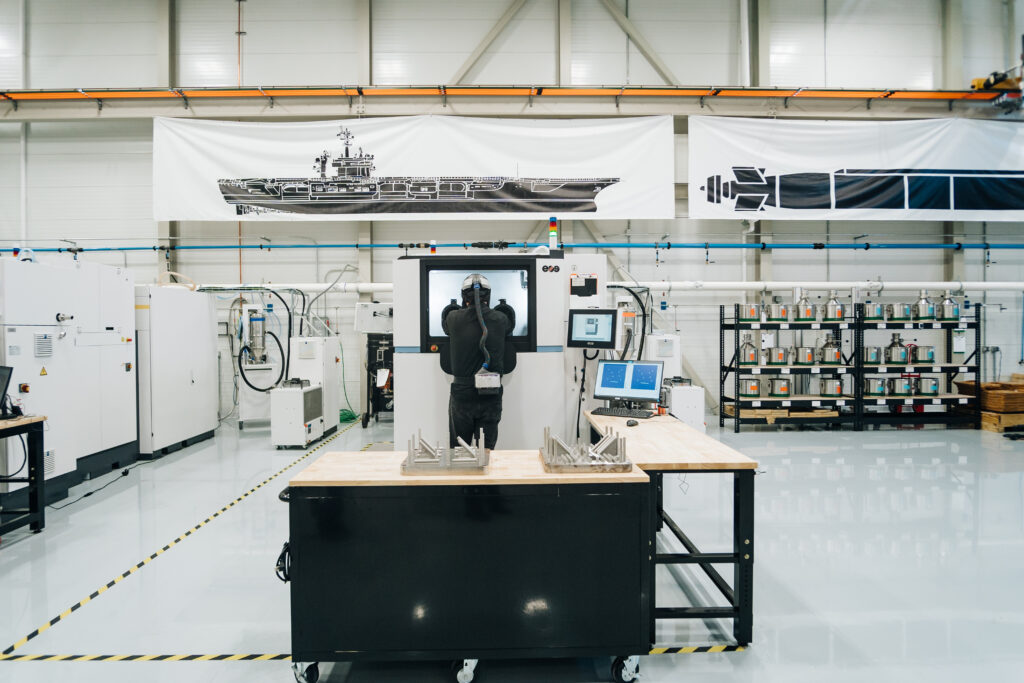
    Austal USA has approached the revamp of US domestic maritime defense manufacturing capacity from multiple directions, by forming relationships with new, untraditional suppliers, expanding its own operations, and helping the Navy build an AM CoE in Virginia that the shipbuilding giant operates. The launch of Digital SEA can be viewed as something of a finishing touch on that initial phase of activity, providing a digital clearinghouse that unifies all of the progress Austal USA and the Navy have made thus far, and enabling future additions to the Navy’s industrial base programs to benefit from that progress as well.

    According to Austal USA, the company has already helped the Navy use AM to develop over 70 parts scheduled for fleet installation, but the launch of Digital SEA should help that catalog expand even faster. Reinforcing that the platform’s launch is part of a broader shift driving the whole SaaS-for-manufacturing market, Austal USA developed Digital SEA in partnership with leading software service enterprises, including Sabel Systems, C3 AI, and EdgeTI. Attendees of Sea-Air-Space 2026 this week can learn more about the new platform at Austal USA’s booth #1717.

    In a press release about Austal USA’s launch of Digital SEA, Austal USA’s interim president, Gene Miller, said, “The development and implementation of Digital SEA is a breakthrough for the maritime industrial base’s [AM] objectives and directly supports the Navy’s submarine fleet. It reflects our commitment to advancing the submarine industrial base — not only through [AM] leadership, but also through our role in building modules for both Virginia- and Columbia-class submarines at our Mobile facility.”

    Madeleine Locke, Program Manager at Austal USA, said, “Without an efficient way to share data and collaborate across the industrial base, we lose two of [AM’s] greatest advantages — speed of delivery and a distributed, redundant production capability. By closing those gaps, and by bringing together a strong team of industry and technology partners, we can directly enhance production capacity and ensure the Navy’s submarine and surface programs are supported with greater agility and resilience.”

    Whether it’s for surface vessels or submarines, shipbuilding seems to be just about the most difficult capability for a nation to rebuild. That has presented the US Navy with a virtually unprecedented challenge in its industrial base acceleration campaign. But, if there’s one thing that the branch has gotten right, it’s its diagnosis that the problem is primarily one of achieving change management across an international ecosystem of organizations.

    Thus, while it has taken years for the Navy, Austal USA, and all the rest of the relevant players to get to the present point, the consensus that the public-private partnership has successfully cultivated means that there’s now a living, breathing example of what can happen when the majority of an entire sector is all on the same page surrounding large-format AM. The most important lessons for everyone else aren’t even technological, so much as organizational and cultural.

    At the same time, from a more purely technological perspective, Digital SEA will be an indispensable test for the feasibility of keeping supply chains secure, even as they’re being made more accessible. Demonstrating that this is a viable option in the realm of critical national security infrastructure could permanently reshape how AM is viewed by the stakeholders responsible for managing major economic pillars.

    The most exciting part is that, if the endeavor proves successful, the Navy (and Austal USA, etc.) will have created a model that can be duplicated much more easily than it was created in the first place. Companies like Austal USA could then find themselves in a position where branching out from their core areas of expertise into offering more general digital technology integration services starts to look like a realistic possibility.

    Images courtesy of Austal USA

  • Rice Researchers Use Microwaves to 3D Print Electronics

    Rice University researchers have found a way to 3D print using focused microwaves. Published in Science Advances, Professor Yong Lin Kong and his team believe the technology could be used to 3D print electronics through heating inks without damaging substrates. By focusing the heating area precisely, only the electronic ink can be heated at one particular location.

    Until now, this has been one of the biggest challenges in 3D printing electronics: the heat needed to make the ink functional often damages the material underneath it.

    Professor Kong said,

    “The ability to selectively heat the printed materials enables us to spatially program the ink’s functional properties, even when surrounded by temperature-sensitive material. This allows us to integrate freeform electronics onto a broad range of substrates, including biopolymers and living biological tissue, all within a desktop-size printer without the needs of complex facilities or labor-intensive manual processes.”

    They call their process near-field microwave 3D printing (NFP). The process builds on the Meta-NFS device developed in conjunction with National University of Singapore researcher John Ho. This is a metamaterial device that creates directed near-field microwave energy. The system can focus that energy into a heating zone as small as the width of a human hair, allowing very precise control during printing.

    Coupled with the microextrusion of nanoinks, local microstructure can be controlled, leading to programmable properties in circuits. Ceramics, thermosets, metals, or other doped inks can therefore be made either on the surface or selectively hardened within other structures. Particular sections can be annealed, and different materials can be joined selectively. Layers could also be joined more thoroughly. This also means different materials and functions can be built directly into the same structure during printing, rather than assembled later.

    The team hopes that a desktop unit will now be able to make entire circuits at scale. Unlike traditional electronics manufacturing, which often relies on centralized facilities and complex assembly, this approach could simplify how electronic devices are made.

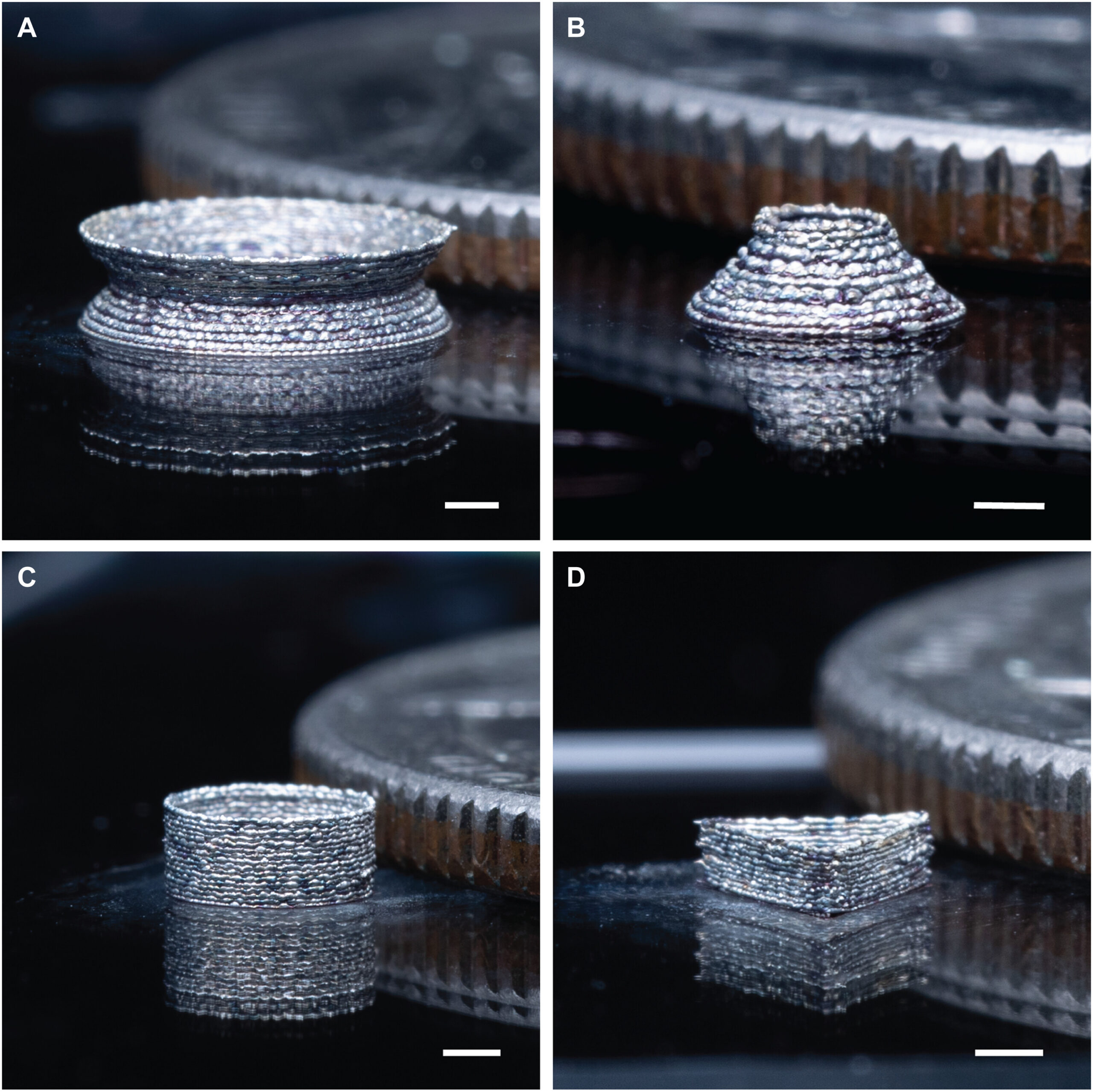
    Photograph of 3D architectures printed by the layer-by-layer deposition approach using Meta-NFS. Image courtesy of Rice University.

    As a test, strain sensors made from ultrahigh-molecular-weight polyethylene were printed to form a circuit that can be used in the body. They’re also working on sensors that can be eaten, soft robots, and complex devices. Meta-NFS 3D printing is now a core foundation for Kong’s group in developing fundamentally new classes of electronic devices for a broad range of applications that did not exist before. For instance, the group is developing ingestible electronic systems for personalized diagnostics and treatment, designing bionic devices that interface with biological organs, and creating next-generation 3D printed soft robots and drones with highly integrated electronic functionality.

    Highly selective and rapid volumetric heating of 3D printed materials with a Meta-NFS. Image courtesy of Rice University.

    Kong says that,

    “Meta-NFS 3D printing enables us to develop new classes of hybrid electronic devices that could not have been built — or even envisioned — with previous manufacturing approaches, providing us with a new capability to address unmet societal needs.”

    As this allows for volumetric heating and the volumetric construction of new structures, made of annealed inks, this gives us a truly new capability. This could be a very advantageous process for enclosed 3D printing of sensors and complex devices. The body 3D printing sensor market could be considerable. This could also be used to make compact wearables for skin use. Glucose and health monitoring alone are a significant market there. Perhaps this could be used to make circuits at scale at much lower cost than alternatives. Our houses, lamp posts, and bridges are almost all dumb; resilient, enclosed circuits could make them monitor themselves or people in general. This is therefore a notable step forward in 3D printing that could lead to the democratization of enclosed-sensor 3D printing.

  • 3D Printed Weapons Keep Showing Up in Crime

    In the past few weeks, activity around 3D printed weapons in the U.S. has increased across several fronts. States including California, Colorado, New York, and Washington are moving forward with new laws, courts are deciding how digital gun files can be regulated, and law enforcement continues to report arrests tied to 3D printed firearms and other dangerous uses. While making firearms can be legal in some cases, much of the recent activity is focused on how 3D printed guns and their files are regulated, shared, and handled by law enforcement. Because so much is happening with laws and arrests, some of the more unusual cases stand out more. 

    States Push New Laws

    Several states are trying to tighten the rules around 3D printed guns, an issue that has been building for months as lawmakers look for ways to deal with untraceable “ghost guns” made outside of the traditional channels. Officials say many of these weapons are difficult to track and have shown up in criminal cases, which is driving much of the recent push. The focus is not just on the weapons themselves, but also on the digital files that make these guns possible.

    In Colorado, lawmakers are pushing a bill to limit 3D printed ghost guns, as part of a broader effort to address untraceable firearms that officials say have become harder to track and regulate, including requirements for serialization and restrictions on how these weapons can be made and assembled. However, they are still debating how strict the proposal should be.

    In New York, Governor Kathy Hochul and Manhattan District Attorney Alvin Bragg have been pushing for stricter rules after a series of high-profile cases involving ghost guns. Their focus has been on limiting access to online files used to produce these weapons and increasing penalties that are tied to their use.

    Washington State, meanwhile, has passed a law targeting 3D printed firearms, 3D printed gun parts, and the digital files used to make them, adding restrictions on both the production of these weapons and the distribution of the files used to make them.

    California is taking a different approach, filing lawsuits against websites that host these types of files, and arguing that they make it easier to produce guns outside the existing rules and should be held responsible for their distribution.

    Glock designed its civilian-purchased pistols to be easily modified. Image courtesy of the City of Chicago.

    Courts are also starting to play a larger role. In a recent decision, a federal appeals court found that regulating the distribution of 3D printed gun files may not violate the Constitution. This could give states more room to control how these files are shared online.

    At the same time, California has filed lawsuits against websites that host 3D printed gun files, arguing that they enable unlawful manufacturing. These cases could help set boundaries for how digital designs are treated going forward.

    Federal agencies have also been paying close attention in the last few years. The Bureau of Alcohol, Tobacco, Firearms and Explosives (ATF), for one, has been warning about the danger of machine gun conversion devices (MCD) since at least 2024.  Easy to manufacture and illegal for decades, MCDs can turn a semi-automatic firearm into a fully automatic weapon—delivering hundreds of rounds with a single pull of the trigger. also known as “switches” or “auto sears,” are small components—usually made from metal or plastic—that can be easily attached to a handgun or rifle to convert it from semi-automatic to fully automatic. While possessing or manufacturing MCDs is illegal in the U.S., their production has exploded in the last two years, largely because it is very easy to create them with 3D printers, and they are often sold online or printed at home. 

    Recently, WKRN news talked to the ATF field office in Nashville about the growing use of 3D printers to create conversion devices, like Glock switches. Officials have said these items are increasingly showing up in investigations and are difficult to trace, which is driving concern, especially if they end up in the hands of violent offenders or serial shooters.

    Enforcement and Arrests Continue

    At the same time, police continue to report cases involving 3D printed guns. For example, in Massachusetts, police in Dartmouth seized ghost guns and a 3D printer after arresting a man who was not allowed to own firearms. Officers said they found rifles without serial numbers, a 3D printer used to make parts, and digital files tied to gun production. 

    Dartmouth police said they seized ghost guns and a 3D printer after a man was arrested. Image courtesy of the Dartmouth Police Department.

    In Louisiana, a man in Breaux Bridge was arrested for using a 3D printer to make illegal switches. Authorities pointed out that manufacturing or possessing devices that convert firearms into fully automatic weapons without proper federal registration is illegal under both state and federal law. However, these devices are increasingly being made and shared.

    Also, in Pennsylvania, police in Sunbury reported finding close to two dozen 3D printed gun switches along with other weapons, including grenades, during an investigation. Authorities said the case involved a mix of firearms, drugs, and equipment tied to making gun components. 

    Similar cases have been reported outside the U.S., as usual. In the U.K., police in the West Midlands made six arrests after seizing a 3D printed gun during a raid, in what they described as a serious case involving illegal firearms production. The bust was part of Operation Target, a 24/7 mission to tackle serious and organized crime across the region.

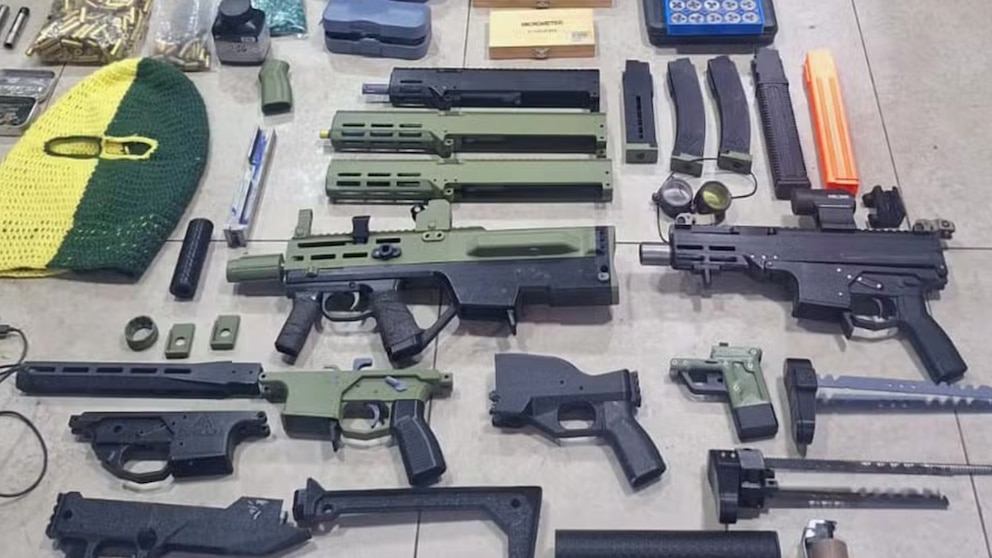
    Brazilian authorities, led by the Brazilian Federal Police, dismantled a major global 3D printed weapons network under Operation Shadowgun, arresting a figure known as “Zé Carioca,” a young engineering student who was also a key developer and distributor tied to open-source gun designs and online communities. Investigators say the group operated across borders, using encrypted platforms, VPNs, and cryptocurrencies like Monero to fund and distribute files and parts that were tied to ghost guns. The raid not only removed one of the most influential figures in the 3D printed weapons scene in South America, but also exposed how decentralized and international these networks have become, local law enforcement said. Ultimately, it led to panic now that users realized they could, in fact, be tracked.

    Material seized during Operation Shadowgun, including Zé Carioca’s balaclava. Image courtesy of the Brazilian Federal Police.

    Overall, these cases show how 3D printing is increasingly being used in illegal and criminal situations. It’s undeniable that the technology itself has countless positive and legitimate uses, but when it comes to 3D printed weapons, a lot of the attention focuses on how it can be misused to make untraceable firearms and parts that end up in the hands of criminals, being used outside the law. To law enforcement, that is becoming a real and growing problem.