• Our Industry’s Shipping Container Moment

    The additive manufacturing industry likes to think of itself as disruptive, fast-moving, and future-oriented. In many ways, that is true. The technology works. The machines are better than ever. The materials are more capable. And yet, despite all this progress, there is a persistent feeling that we are not quite where we should be. Not in scale. Not in impact.

    The question is not whether additive manufacturing can deliver value. It clearly can. The real question is why that value remains so hard to scale.

    Hardware innovation has been an important catalyst. On one end of the spectrum, we are seeing an explosion of affordable, high-quality printers that sit between hobbyist tools and full industrial systems. These machines have lowered the barrier to entry and enabled many companies to move from prototyping into small-series production. On the other end, industrial systems continue to grow in size, capability, and complexity, enabling the production of larger and more demanding parts. Access has improved, quality has improved, and production potential has expanded.

    But hardware alone will not get us where we need to go.

    Materialise CEO Brigitte de Vet-Veithen

    As the industry matures, the role of software becomes more visible — and more consequential. The additive manufacturing software landscape has grown organically, shaped by proprietary systems and vertically integrated solutions. That approach made sense in the early days, when the priority was to make individual technologies work. But as the industry matured, those same closed systems became a constraint. Data lives in silos. Workflows are stitched together manually. Engineers spend more time moving files between tools than improving processes. Scaling across machines, sites, or applications multiplies complexity instead of reducing it.

    To understand where this leads, it helps to look outside our own industry.

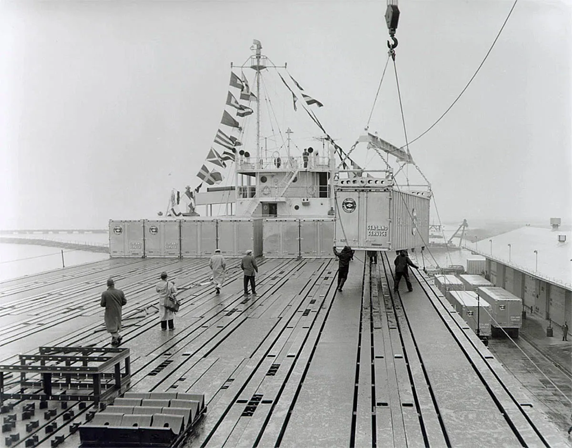
    In the middle of the 20th century, global shipping faced a similar problem. Ships, trains, trucks, and ports all worked, but they worked in isolation. Cargo had to be unpacked and repacked at every step. There was no shared system, no common language. Ports were slow, expensive bottlenecks. The breakthrough did not come from faster ships or bigger cranes, but from something deceptively simple: the standardized shipping container.

    What followed was not just standardization, but transformation. Once the industry spoke a shared “container language,” it suddenly made sense to invest in automation, tracking, route planning, and integrated logistics systems. Shipping evolved from fragmented local operations into a global, interconnected network. That change did not just optimize ports; it reshaped manufacturing, retail, and global trade itself.
    Additive manufacturing today looks a lot like shipping did back then. Powerful, but fragmented. A typical AM workflow relies on a patchwork of tools, each with its own data format and logic. The problem is not getting from design to part. The problem is making that journey repeatable, automated, and scalable across technologies and organizations. What we are missing is a way to move our “digital cargo” smoothly from one step to the next, without friction.

    This is why the industry’s next phase is not about individual tools, but about ecosystems.

    The first step is a shared language — much like the universal shipping container once provided a common language for global trade. Today, different companies often use different terms for the same concepts, slowing collaboration and integration. Initiatives like the Leading Minds consortium exist to address exactly this problem: reducing confusion, aligning terminology, and creating a common foundation on which the industry can build.

    But, as the shipping analogy shows, language alone is not enough.

    The second step is an open software ecosystem where tools, partners, and workflows can connect without forcing manufacturers to give up control over their data, processes, or intellectual property. This is the thinking behind platforms like CO-AM: not as a single solution that replaces everything else, but as a foundation for a connected manufacturing environment. By making automation accessible and allowing recurring processes to be configured without deep programming expertise, such platforms aim to remove the manual glue that currently holds AM workflows together.

    This brings us to the first call to action.

    If we truly want to scale the impact of additive manufacturing, we need to look beyond our own industry bubble. Too often, the conversation is dominated by machine builders, software developers, and service providers talking among themselves. What is missing are the industries we exist to serve. The real measure of success is not how elegant our internal ecosystems become, but how profoundly we can impact these industries. That requires active engagement, clearer storytelling, and a willingness to meet customers where they are.

    The second call to action is about the kind of ecosystem we choose to build.

    An open ecosystem is not always comfortable. Openness does not mean that every participant benefits equally at every moment, or that established business models remain untouched. In the short term, it can feel risky to give up control. But ecosystems do not scale through control; they scale through openness. Global logistics works not because one player dominates, but because many specialized players operate within a shared framework.

    Additive manufacturing now faces the same choice. We can continue to optimize locally, around individual machines, materials, or platforms. Or we can optimize globally, around the ecosystem as a whole. The first may protect short-term advantages for some. The second is what enables long-term growth for all.

    A rising tide lifts all boats. The real test is whether we are willing to build the conditions that allow that tide to rise.

    Brigitte de Vet-Veithen, CEO of Materialise, participated earlier this year at the Additive Manufacturing Strategies conference in New York City and spoke on this topic. 
  • Beehive Gets $29.7 Million Contract

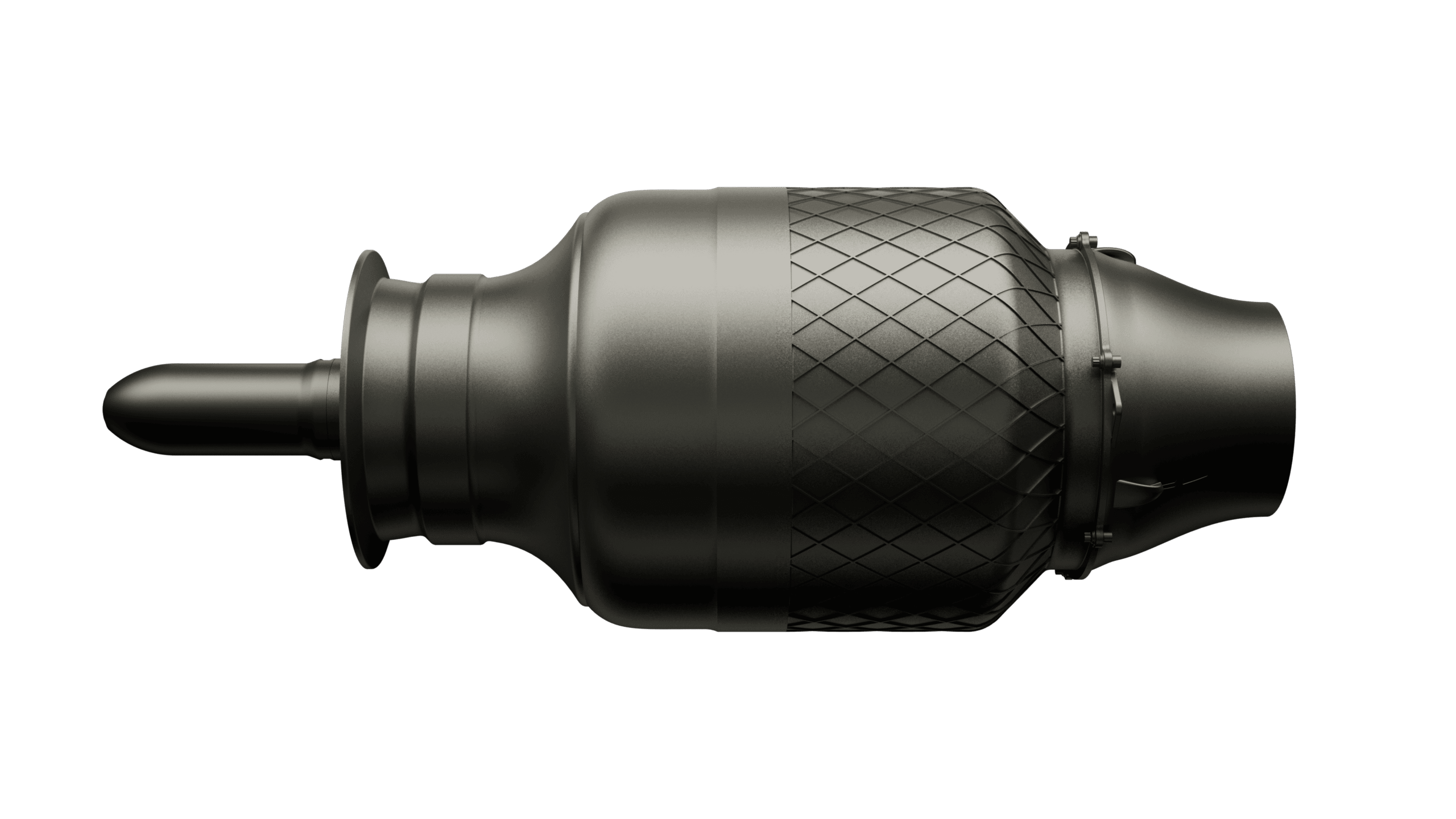
    The US military is pivoting from a world where it fields a few exquisite craft to one where it can manufacture swarms of vehicles. Additive manufacturing at scale, along with a new class of digital forges, is emerging to make this possible. Beehive has been eyeing this opportunity for a while. Now the firm has gotten a $29.7 million SOSSEC consortium contract to make lots of 200- and 125-lpf pound engines, the Frenzy 8 and Frenzy 6. A manufacturing surge is underway, turning billions into 3D printed devices.

    The company says it can make engines faster and at 60% lower cost with additive manufacturing than with conventional manufacturing. The production-ready engine family was developed across twelve months and is part of the Family of Affordable Mass Munitions (FAMM). The Pentagon’s initiative, from our family to yours, hopes to move from 100k missiles to more affordable drones and other craft. A budget priority only since 2026,  the FAMM hopes to lead to the “integration and flight demonstrations of affordable and highly manufacturable small turbine engines, seekers/sensors, networked datalinks, collaborative autonomy behaviors, and ordnance (warhead/fuse).” Essentially, this program is meant to plug the current gap in US capabilities. It is clear now that the US can not fight any war, and even brief conflicts exhaust or strain the current inventory. The FAMM and a bevy of other programs are not just idle future building, but a real need this day, this week. I could say that the future of the US’s defensive capability depends on FAMM, and it would sound melodramatic, but it would still be true.

    Frenzy Engine.

    A part of the work will advance the Frenzy 6 engine toward the development of a First Engine to Test (FETT). FETT is a milestone in advance of flight testing, going from full assembly to the Chicken Gun. This step demonstrates the engine as a working system. The Frenzy 8 is moving forward with “complete vehicle integration, flight testing, and qualification.” The key here is the Small Expendable Turbine (SET) concept, intended to power missiles, collaborative combat drones, and drones generally. Whereas FAMM targets a very immediate gap, SET more broadly addresses a broader US capability gap: a dearth of affordable microturbines. The smart use of additive manufacturing comes in when you not only make this easier to assemble and lighter, but also easier to produce at scale. At the same time, it’s easier to develop a family that can serve many platforms in one go. For too long, engine programs have been seen as decades-long, industry-landmark heirloom projects. Building the plane around the engine means building your entire Air Force around these three engines. A scalable family (and indeed a few companies making such families) of engines would let more platforms be made by more people more quickly. And these platforms wouldn’t have to be built around the engine but around the need.

    The Air Force Life Cycle Management Center (AFLCMC) and both the SET and FAMM programs are coming along at a very high speed.
    Gordie Follin, Chief Product Officer at Beehive Industries, said,

    “Beehive is honored to partner with the U.S. Air Force in redefining the speed of defense. By harnessing additive manufacturing to collapse complex supply chains into scalable, 3D-printed propulsion, we are providing the ‘affordable mass’ essential to modern deterrence. This collaboration ensures our warfighters willhave the high-volume, mission-ready capabilities they need to maintain a competitive edge in any theater.”

    Other companies associated with this and similar OTA’s are the Southwest Research Institute,  HII Mission Technologies, and Aerocorex. Decryptor has the best website ever, with just a plain text email and a logo of the site of this firm, while the only search results are SBIR awards and the like. The company is working on an automated way to protect airbases against drones. AerocoreX makes components for the B2, F-15, and the like. And this is the kind of stuff that SOSSEC can do, fast, concrete battlefield-centric problems and real capabilities. On their coattails, Beehive has really taken flight.

    Now, the company will have to scale operations and quickly manufacture working engines. If the company establishes itself as an engine provider for drones and wingman-like expendable aircraft, it could be pressed into service very quickly. A company development cycle that could take a decade is now taking months. This accelerated timeline will put a lot of pressure on the firm, but also offer it huge opportunities. There are precious few aero engine manufacturers worldwide. If Beehive could specialize in microturbines and develop a cost-effective, well-performing family of these engines, it could be sitting on a multi-billion-dollar opportunity in one of the fastest-growing segments of the defense market.

    Images courtesy of Beehive

  • How Decibel Landed the Brands Everyone Wants

    The first thing Adam Hecht will tell you is that 3D printing already has the technology. The harder part has been finding applications people actually want. That’s the gap Decibel Made is trying to fill.

    “At Decibel, we had this mindset: let’s make this mainstream. Let’s not keep it in the back lab as something untouchable. You always hear about applications in defense and aerospace, but they’re usually projects you can’t really see or talk about publicly. Instead, we wanted to bring this kind of work into design, build a community around it, and get people genuinely excited.”

    The Cloud Chair. Image courtesy of Decibel Made.

    Decibel didn’t start as a furniture company. It traces back to DIVE, an earlier design studio working inside the 3D printing industry, helping materials companies, machine makers, and software platforms create applications they could actually show.

    “We realized all these companies had really cool technology,” Hecht said. “But a lot of people didn’t know about it, and the companies actually using it often couldn’t talk about it. It was all kind of top secret.”

    So Decibel stepped in as a “translator of sorts,” building projects that were meant to be visible.

    That approach eventually evolved into something bigger. And today, the company focuses on the “built environment,” as Hecht described, including retail installations, architectural elements, and large-scale furniture designed for public spaces.

    The Cloud Chair.

    The Early Break

    Before working with major retail brands, Decibel Made built its early visibility through a different kind of project.

    The team first gained attention through 3DPets, a brand focused on 3D printed prosthetics for animals, which showcased how the technology could be used in real, functional products. That work eventually led to a global campaign with Apple for the iPhone 14, where the project was featured at scale, helping bring broader visibility to the team’s work across its early brands.

    “That was the first big break, Hecht said. “From there, the focus shifted. Instead of working mainly with technology companies, we began applying that experience to more visible, design-driven projects.”

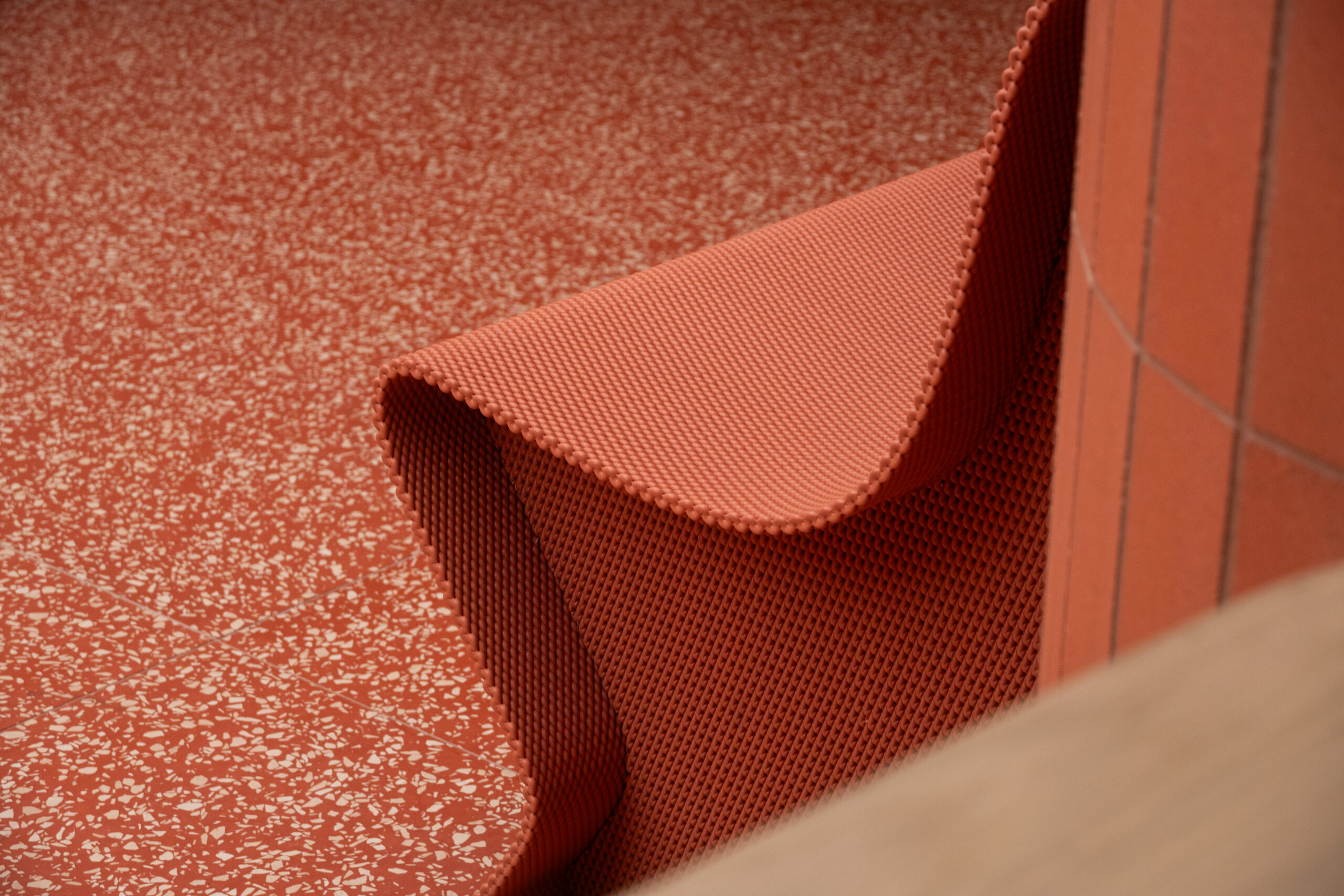
    That’s where projects like the 3D printed benches Decibel created for a Lululemon store in New York come in, not as the starting point, but as a sign that brands were starting to see how this could work for them.

    A 3D printed bench for Lululemon’s flagship store in NY, up close.

    “It showed brands this is something they could actually see in their stores,” he indicated. “Our company’s momentum had been building for some time, but this move showed brands that this could actually fit into their world. Since then, we have expanded into other retail environments, working with major fashion brands, and now moving into entertainment spaces.”

    https://www.linkedin.com/posts/3dprint-com_after-watching-caracol-am-present-at-endeavor-activity-7402491037690245121-kY6r?utm_source=share&utm_medium=member_desktop&rcm=ACoAAAJvbTMBHtNwXKodZzGdOV9PlNgk6Nzzbpg

    Is This a Real Business?

    The bigger question isn’t whether the technology works. It’s whether it holds up as a business, because for years, 3D printed furniture has often felt more like a showcase than a scalable business. The difference now, argues Hecht, is “intent.”

    “We’re not just giving brands access to the technology. We’re combining that with real design. And that combination matters. Many early examples of 3D printed furniture were driven by engineering constraints rather than usability or aesthetics. The result was often pieces that were technically impressive, but not something a brand would actually use,” he went on. “You’ve seen 3D printed chairs at every trade show, and usually they’re not comfortable. They’re not designed. Decibel’s approach flips that.”

    In fact, the company collaborates with experienced designers who are used to working on airports, large-scale interiors, and commercial spaces, and then adapts those ideas to what’s actually printable.

    And one of the biggest advantages of 3D printing isn’t just design freedom. It’s iteration.

    Traditional furniture making often requires expensive tooling before a final design is locked in. That makes it harder to refine things like comfort or structure. With 3D printing, the process is very different.

    “We’re delivering pre-production samples in the final material,” Hecht remarked. “Not foam models. Not approximations. That means each version is closer to the final product and easier to improve.”

    For large, custom projects, that iteration happens fast. Hecht told 3DPrint.com that Decibel can print a new version every day, refining and adjusting the design as it goes.

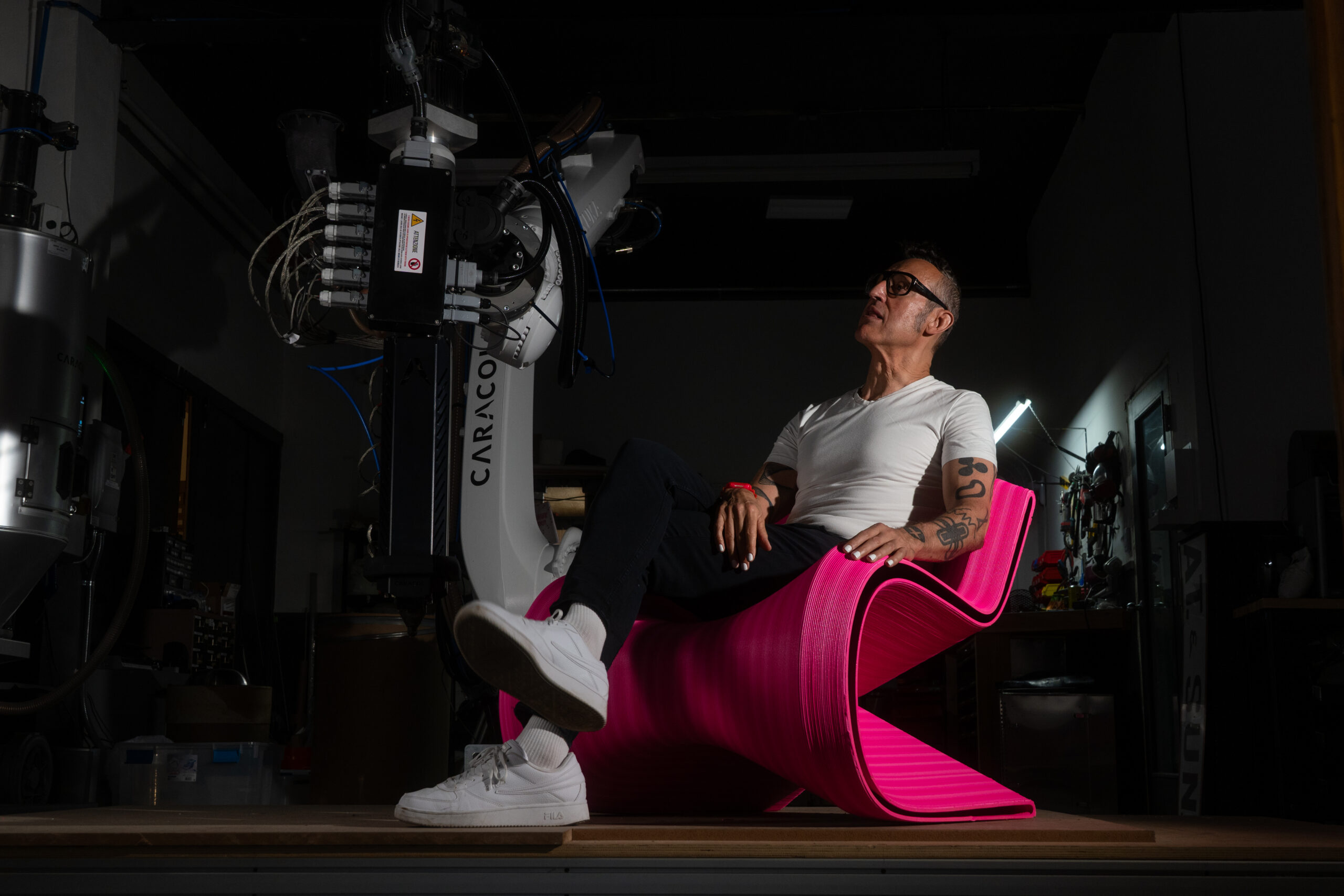
    Monark Karim Rashid at Decibel Made’s factory.

    The Real Bottleneck: Scale

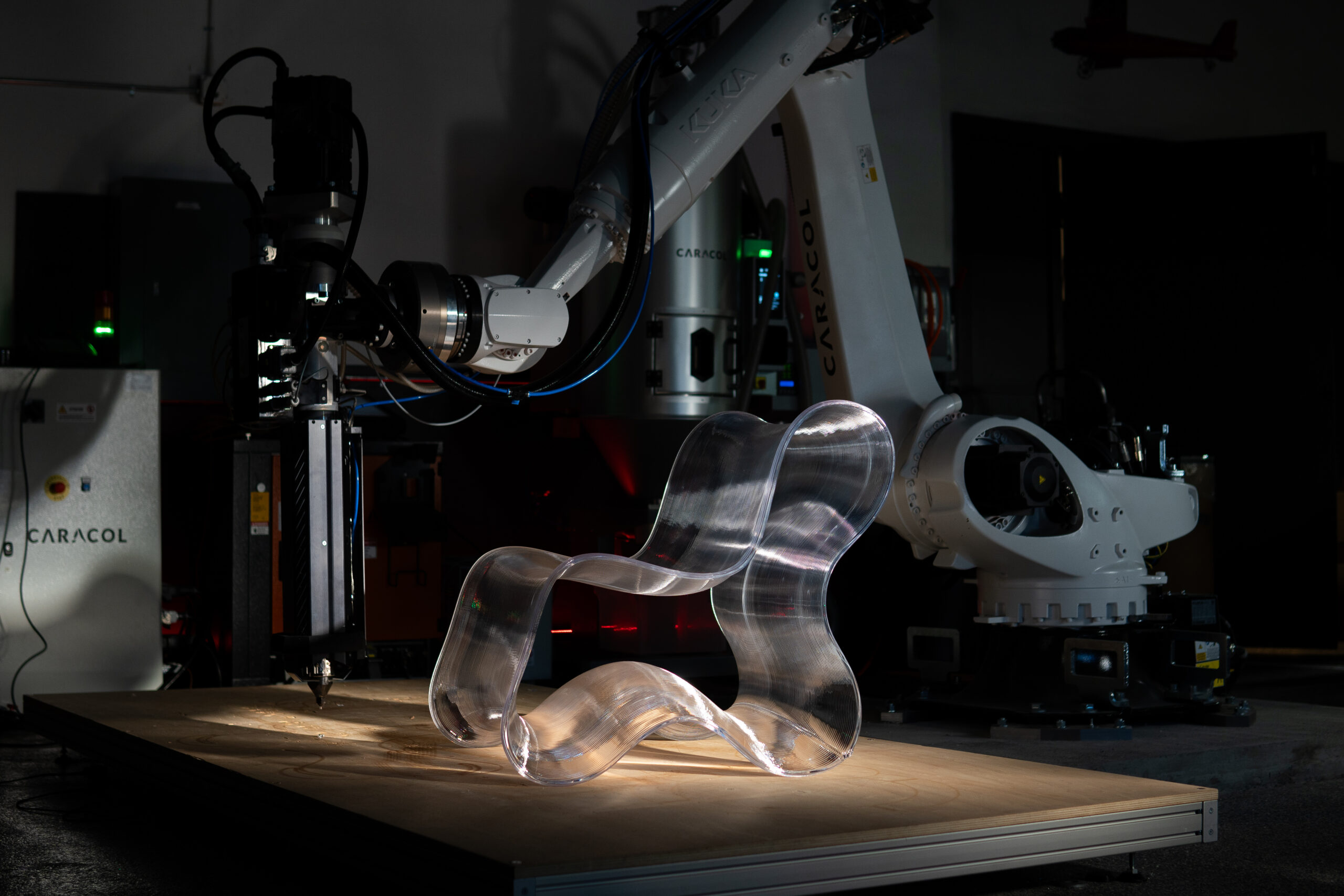
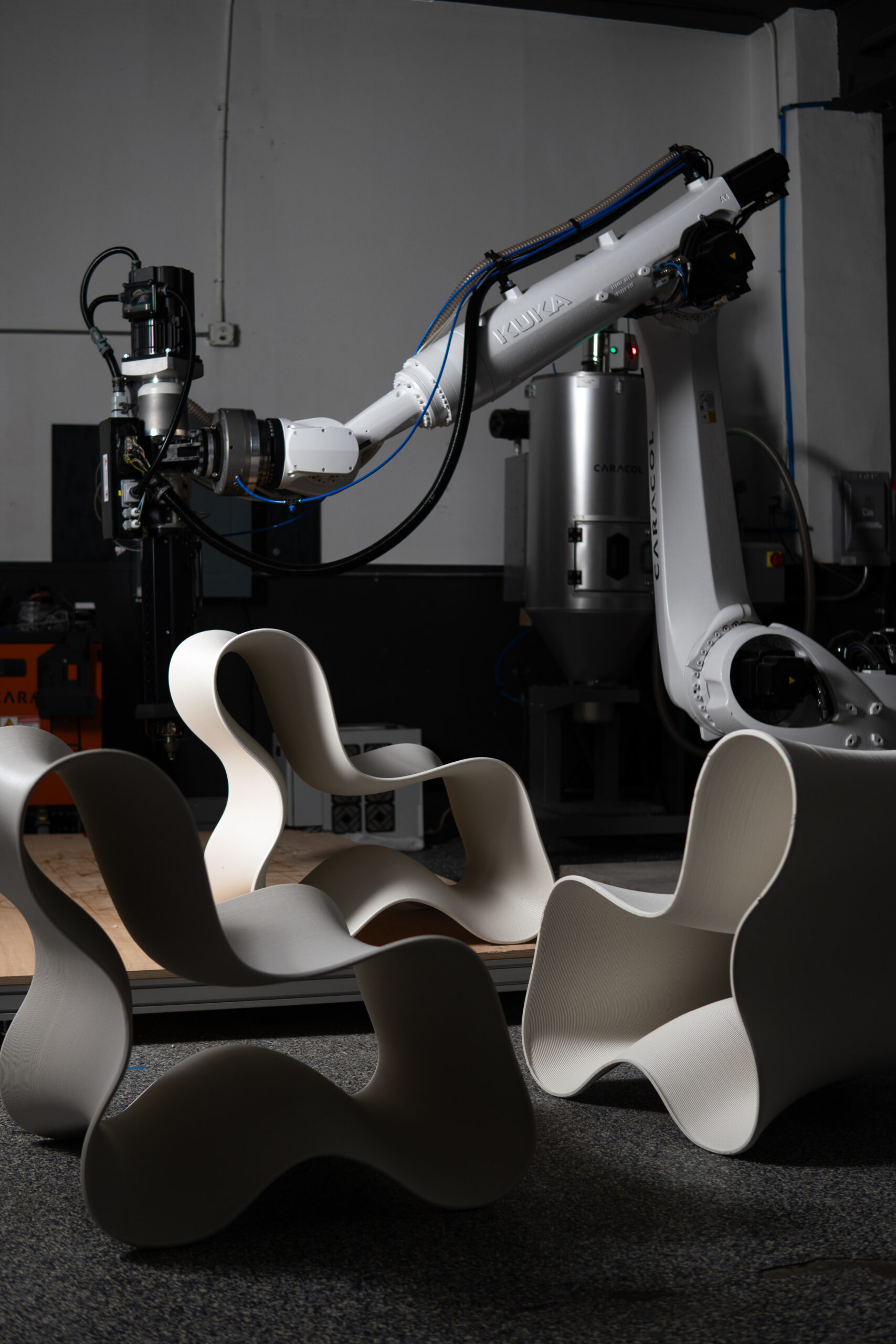
    If there’s one place where 3D printed furniture still struggles, it’s scale. Right now, Decibel is intentionally limiting itself. The company operates with a small number of systems, including a robotic large-format printer from Caracol, smaller pellet printers, and a traditional print farm. But that limitation is strategic.

    “We’d rather not have enough printers than have too many and not know what to do with them,” Hecht said. “Instead of building capacity first, we are focusing on demand, working on high-design, high-visibility projects that create interest before expanding production.”

    The Curva poolside chair.

    So is this furniture? Architecture? Manufacturing? Hecht tells me the answer is: all of the above.

    Hecht sees it this way: “It has to be a hybrid. Each project sits at the intersection of design, engineering, installation, and environment. It’s not just about making an object, it’s about how that object fits into a space, a brand, and a user experience.”

    That’s why the company sees its future not just in furniture, but also in broader categories such as retail infrastructure, interiors, and architectural elements.

    Chair collection at PORTAL Exhibit.

    What Still Needs to Change

    Even though things have improved, Hecht is clear that the space is still evolving. One of the biggest challenges is education.

    “A lot of companies come to us with designs for completely different processes. They assume 3D printing can just do anything, but it can’t. Like any manufacturing method, it has its own constraints, and designing for it requires a different mindset.”

    If Decibel’s approach works, 3D printing won’t replace traditional manufacturing. It will carve out its own category, one where speed, customization, and design flexibility matter more than mass production, and where the goal isn’t just to make something faster or cheaper, but to make something that wouldn’t exist otherwise.

    Decibel has already begun teasing one of its latest collaborations, sharing a preview on Instagram of a Coachella installation tied to Justin Bieber’s brand Skylrk.

    Images courtesy of Decibel Made

  • 3DPOD 298: Dental 3D Printing with Amir Mansouri, SprintRay

    Amir Mansouri started SprintRay to make an accurate Vat Polymerization system. Through conversations with customers, SprintRay became a $100 million revenue dental 3D printing company instead. Now, Mansouri tells us he is closer to making more products for dental than to expanding into other verticals. We delve into SprintRay’s success, talk about Nespresso cups, resins, dentures, and teeth.

    This episode of the 3DPOD is brought to you by Alexander Daniels Global, specialists in talent solutions for the additive manufacturing and advanced engineering sectors. From the production line to the C-suite, ADG delivers confidential hiring, supports rapid scale-up phases, and secures critical leadership appointments, helping industry 4.0 businesses build teams that need to perform, innovate, and lead.


  • Harvard Engineering Students 3D Print VTOL Drone to Improve Marine Biology Research

    With all the current focus on the boom in drones used for national security, it’s easy to forget that the civilian drone market is growing, too. In addition to the struggling but persistent attempt by logistics giants to scale drone delivery services, drones have also revolutionized photography and videography and have become fixtures in the workflow of infrastructure inspection operations.

    They’re also increasingly used for environmental monitoring, an application that certainly has great opportunity for growth in an era of mounting ecological crises. The same factors that have given additive manufacturing (AM) life in the defense sector are also driving its heightened relevance to the production of drones for all other applications. That explains how two Harvard students graduating this spring were able to create a Vertical Take-Off and Landing (VTOL) drone concept that has the potential to improve upon existing methods for tracking sperm whale populations.

    The two students, Kuma McCraw and Mikaya Parente, both mechanical engineering majors, explained the rationale behind the project in an interview for the Harvard John A. Paulson School of Engineering and Applied Sciences (SEAS):

    “Our project addressed the difficulty of accurately locating sperm whales tagged with VHF transmitters,” they said. “Unlike GPS-enabled systems, these tags only provide signal strength, meaning researchers must collect measurements from multiple positions to estimate a whale’s location. Current solutions rely on quadcopter drones, which are limited by short flight times, low energy efficiency, and suboptimal antenna configurations. These limitations reduce the amount of area that can be surveyed and make it difficult to maintain sufficient antenna separation for accurate signal triangulation.”

    According to McCraw and Parente, they first got the idea for the project in 2025, when they collaborated on a quadcopter for the annual MakeHarvard hardware design competition. That gave them their introductory experience in making drones with 3D printers, which they were inspired to take to the next level in their senior project.

    Quadcopters are generally cheaper and easier to use than VTOLs, but, as McCraw and Parente note, they’re meant to fly for short periods of time — about 15-30 minutes — whereas VTOLs can achieve long-range flights lasting 1-6 hours. After a month of planning out the project, over a period of around five months, they used 3D printing and other manufacturing techniques, including hot-wire foam cutting, to rapidly iterate towards a final design. Then, they engaged in live flight testing and CFD simulations for final refinement of the concept.

    Ultimately, in well under a year, the two undergrads taught themselves how to design and build a working long-range drone concept that, in a real-world setting, could outperform typical data-collecting methods.

    As I’ve repeatedly written about over the last year, there is a major investment cycle happening right now supporting the manufacturing R&D capabilities available at US universities. This story isn’t even the product of that trajectory, but it perfectly exemplifies why the US manufacturing R&D landscape is such a worthwhile recipient of investment dollars.

    McCraw and Parente haven’t even launched a business based on their idea, and they may have no intention to do so. But what they did for their senior project had all the elements of the necessary steps on the path to starting a successful business, and there are plenty of cases of 3D printing leading to successful enterprises born in university startup accelerators.

    AM, of course, isn’t the only piece of the puzzle in those success stories, but anyone would have to agree that cheaper manufacturing processes that students can teach themselves are making it easier than ever, at least in a technical sense, to start a hardware business. Like I’ve mentioned before on this topic, I think that the most logical future for US education lies in giving students as many tools as possible to nurture their entrepreneurial creativity.

    One of the few positive angles to the current state of affairs, in which all societal norms and institutions seem to be being leveled simultaneously, is that a space could be opening up to rethink how we do things like higher education. Younger generations are coming up with the kinds of ideas that their elders have been too complacent to see or allow. That should be given all the encouragement in the world.

    Images courtesy of Harvard SEAS

  • 3D Printing News Briefs, April 11, 2026: Energy Targets, DoW Contracts, Nike Air Max, & More

    We’re starting with 3D printing for energy applications in this weekend’s 3D Printing News Briefs, and then moving on to military and defense 3D printing. Finally, Nike Sportswear is focusing on the future of Air Max with the help of designers in its new Air Works Program.

    Multiple Nanoscribe Quantum X Orders for IFE Target Fabrication

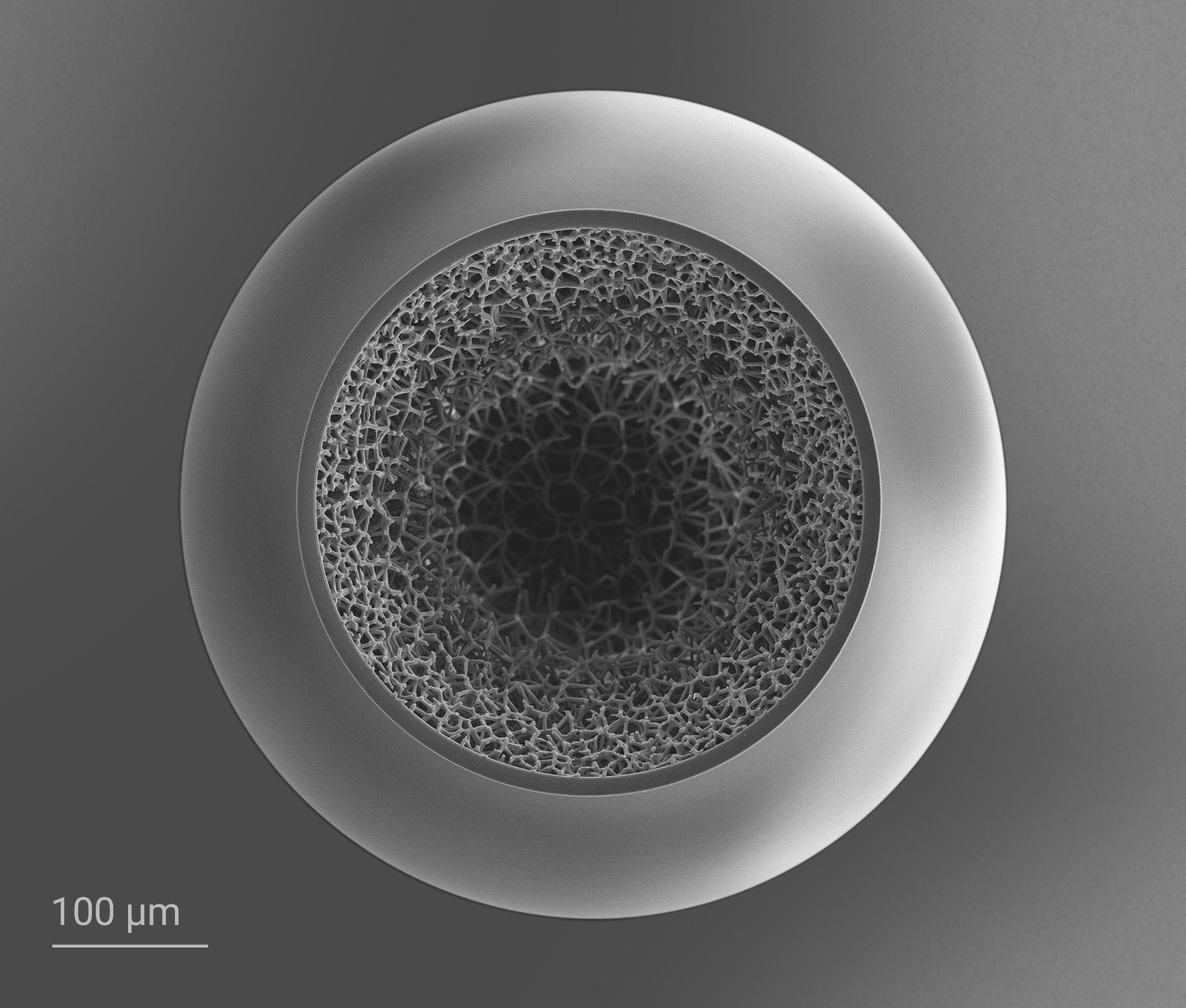
    Voronoi gradient density foam enclosed by a solid outer shell with a diameter of 550 µm. This inertial confinement fusion target was printed using Nanoscribe Quantum X shape.

    3D microfabrication company Nanoscribe announced that in Q1 2026, it had secured several orders for its Quantum X two-photon polymerization (2PP) 3D printing system. The orders are for three international organizations in North America and Asia at the forefront of Inertial Fusion Energy (IFE), and they will use the Quantum X systems to print IFE targets. IFE is regarded by many as a pathway with a lot of promise for clean energy in abundance, but a necessity of the process is fabricating complex targets with high precision, and at increasing scale, all the way from early research to operational power plant volumes. Nanoscribe’s technology, centered around its patented Two-Photon Grayscale Lithography (2GL) technique, can help achieve this by pairing scalable throughput and sub-micrometer accuracy. The company says its 2GL offers more than 4,000 gray levels, which enables ultra-smooth surfaces with nanometer-scale roughness—perfect for rapid printing of highly filigree struts in the interior of the IFE target shells.

    “The strong market demand for our Quantum X systems in the field of IFE target manufacturing underscores the rapid technological advances we have achieved. Since our founding in 2007, print rates have increased by a factor of 1.9 per year, equivalent to an improvement of five orders of magnitude,” said Martin Hermatschweiler, Nanoscribe CEO and Co-Founder. “We are committed to driving 2PP throughput along this trajectory in the years ahead. We are leading 2PP into its most transformative era, laying the groundwork for IFE-based power plants expected to go online commercially in the mid-2040s.”

    Stratasys Direct Chosen for DLA’s Multi-Million Additive Manufacturing Program


    Stratasys is a Program of Record for the U.S. Air Force and Naval Air Systems Command (NAVAIR), and has been continuing to grow its role in offering advanced manufacturing services in aerospace and defense production environments. As demand for AM in defense applications continues to rise, the company announced that Stratasys Direct, its parts-on-demand contract manufacturing division, was chosen to participate in the Defense Logistics Agency (DLA) Joint Additive Manufacturing Acceptability (JAMA) IV Pilot Parts Program. The multimillion-dollar initiative is meant to speed up qualification and deployment of 3D printed parts across military systems and platforms, something in which Stratasys Direct has plenty of experience. For example, the U.S. Air Force already uses Stratasys technology to print microvanes for its C-17 fleet, which have helped improve aerodynamic efficiency and save roughly $14 million in annual fuel costs

    “In 2025, Stratasys saw double-digit annual revenue growth from aerospace and defense, demonstrating that additive manufacturing is becoming a key capability for defense sustainment and supply chain resilience. Stratasys Direct already ships over 100,000 parts annually to the defense industry, and programs like JAMA will accelerate qualification of parts so organizations can deploy them faster across operational platforms,” said Foster Ferguson, Vice President, Industrial Business Unit, Stratasys.

    “Through Stratasys Direct, we combine Stratasys technology with production-scale additive manufacturing services and deep engineering expertise to help defense organizations validate and produce components that keep mission-critical systems operational.”

    Velo3D Also Awarded DLA Contract for Additive Manufacturing Program

    Velo3D Sapphire 3D printer. Image courtesy of Velo3D.

    Another AM company working with the DLA on its JAMA Pilot Parts Program is Velo3D, which recently received a $9.8 million, five-year Indefinite Delivery Indefinite Quantity (IDIQ) contract supporting the initiative. The contract with Velo3D sets up an acquisition pathway for DLA to acquire qualified 3D printed parts to support readiness requirements across multiple branches of the U.S. military. Per the award, Velo3D will use its Rapid Production Solution (RPS) framework and industrial-scale metal laser powder bed fusion (LPBF) technology to print components that often face diminished manufacturing sources, long lead times, and limited availability from domestic suppliers. The company’s RPS integrates application engineering expertise, distributed production capacity, and its advanced Sapphire printers, all of which are assembled in the U.S.

    “Additive manufacturing provides the Department of War with a powerful tool to improve supply chain responsiveness and reduce sustainment risk. Through this contract, Velo3D worldclass technology is supporting DLA’s efforts to expand qualified additive manufacturing capacity and transition advanced manufacturing technologies into operational sustainment environments,” said Dr. Arun Jeldi, CEO of Velo3D.

    AML3D’s ARCEMY X Commissioned and Installed at FasTech

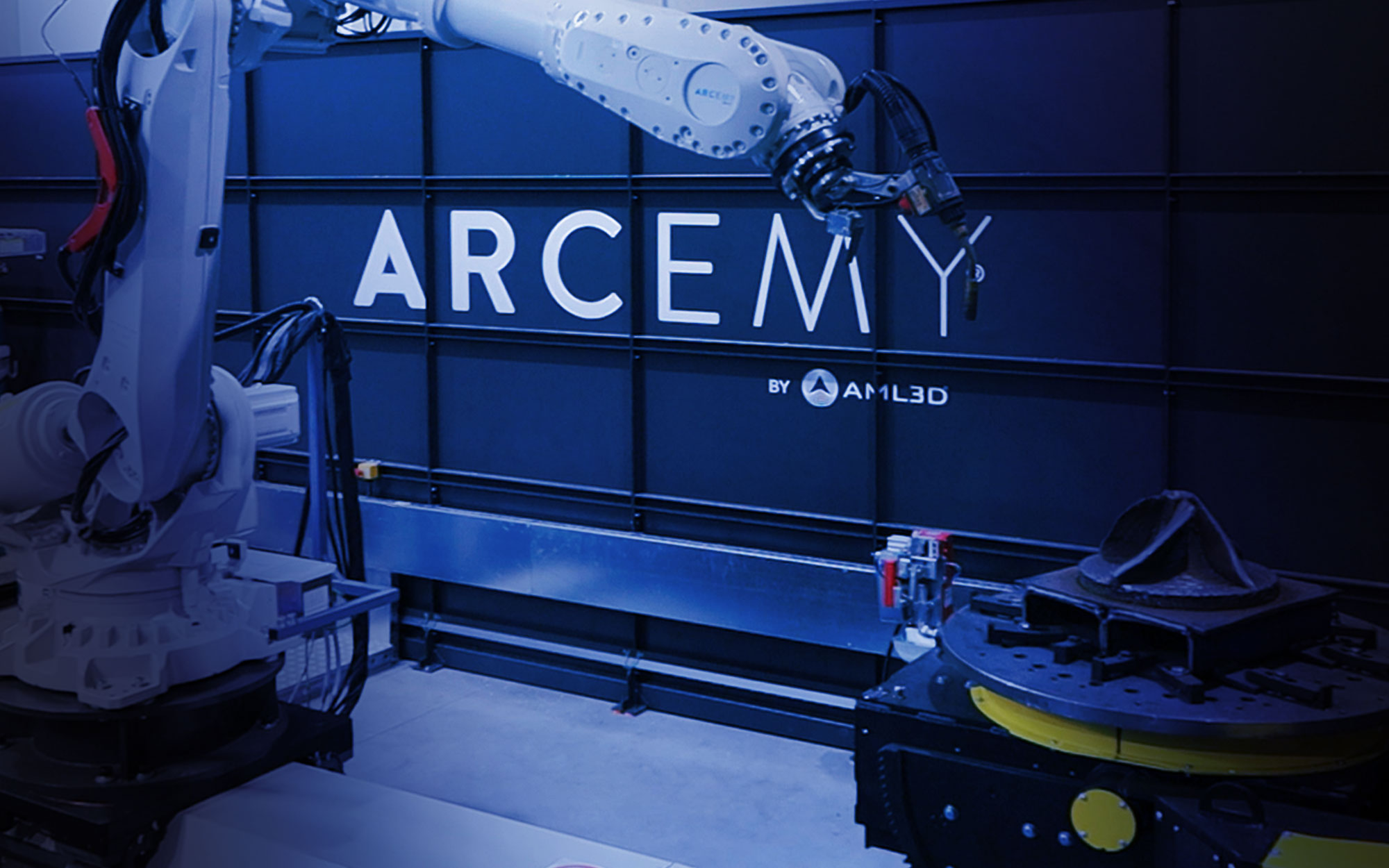
    Late last year, aerospace and defense, energy, and industry supplier FasTech LLC placed a $1.7 million order with AML3D for its large-scale ARCEMY X 6700 system. The Wire Additive Manufacturing (WAM) printer was recently installed and commissioned on time at FasTech, and is fully operational, thus completing the order. The large-scale system will help FasTech, located near the U.S. Navy’s Additive Manufacturing Center of Excellence (AMCOE) in Danville, Virginia, enhance its metal AM capabilities, and also boost AML3D’s U.S. defense profile. The ARCEMY X 6700 was supplied to FasTech from AML3D’s U.S. Technology Centre in Stow, Ohio, where the company is working to double its manufacturing capacity to meet the continued demand from the country’s defense sector, and emerging demand in industrial manufacturing.

    “AML3D is seeing US demand for ARCEMY® systems that deliver high quality parts and components with significantly shorter lead times, using less energy and creating less waste continue to grow. Delivery of the FasTech ARCEMY® X order further demonstrates application of AML3D’s industrial metal 3D printing technology to solve for manufacturing and supply chain challenges beyond Defence and into new industrial manufacturing sectors. The FasTech order follows our entry into the US energy and utilities sector with a custom ARCEMY® X coming online at the Tennessee Valley Authority, the 6th largest energy supplier and largest public utility in the US, last August,” said AML3D’s CEO Sean Ebert.

    “The completion of the FasTech order enhances AML3D’s position as an indispensable industrial manufacturing solution in the US market. To ensure we continue to meet the strong and growing Defence and industrial demand for our advanced manufacturing technology we are currently executing on our plans to invest A$12 million to double capacity at our manufacturing and technology centre in Stow, Ohio.”

    Nike Welcomes Designers to Join Air Works & Create the Future of Air Max

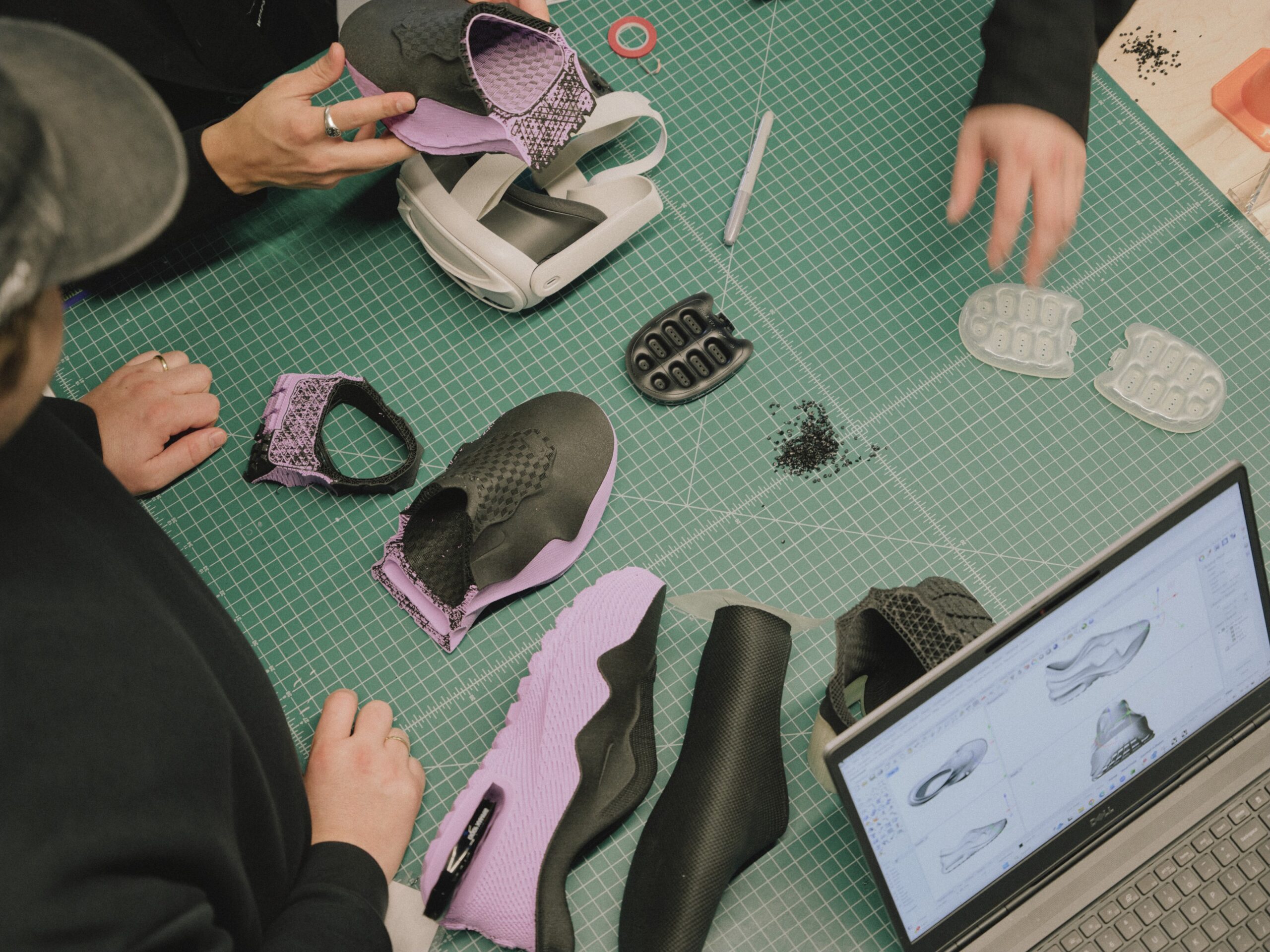
    Nike Sportswear is launching its inaugural Air Works R&D and design program, welcoming eight individual designers from Beijing, Los Angeles, London, New York, Mumbai, Shanghai, Paris, and Tokyo to its Beaverton, Oregon headquarters next month to make sure that the future of Air Max is designed by the people who wear it. From May 11-14, these designers will work alongside Nike engineers and designers to come up with new, distinctive 3D printed Air Max styles that reflect their communities and individuality. These shoes, created in partnership with Zellerfeld, will build upon the brand’s 40-year heritage of Air innovation, and make sure the shoe has a place in the future. During the process, the Air Works designers will work with their Nike mentors and visit places like Blue Ribbon Studio, Nike’s Air Manufacturing Innovation facility, the Department of Nike Archives, the Nike Sport Research Lab, and the Bowerman Footwear Lab. Finally, each designer will get to launch a limited-run version of their shoe style, which will be celebrated in their communities all the way to Air Max Day 2027.

    “Air Works is about celebrating the cultural impact of Air Max and inviting a core group of global creatives to imagine what its future could look like. It’s also a chance to deliver a deep dive in Air Max history, innovation and inspiration, and to unite outside perspectives with Nike-only tools, talent and capabilities to redefine what Air Max means to this generation,” said Andy Caine, VP, Creative Director, Nike Sportswear.

  • Benelli Looks to 3D Printing for Gun Chassis

    There’s a lot happening in the world of 3D printing guns. There is the ever-present danger of some people trying to print guns at home. Suppressors are one of the largest 3D Printing applications, while on the Ukrainian battlefield, modifications are improving weapons. Firms are also using additive to make gun accessories such as cable covers, mounts, and the like. Whereas now most of the major gun manufacturers are making or selling 3D printed suppressors, they have been rather aloof toward 3D printing. This also aligns with recent Additive Manufacturing Research findings, which point to suppressors as one of the most commercially significant applications for metal AM, with demand driven by regulatory changes and broader adoption. The lion’s share of 3D printing innovation has instead come from small startups. This is something we see in cycling as well. In consumer-facing industries that traditionally handle most of their own subtractive manufacturing, we typically see greater hesitation to adopt 3D printing than elsewhere.

    This may be about to change. In golf, we can see how, years ago, every major golf firm toyed with ultra-high-end 3D printed clubs. These supercars (or superclubs) were meant to slather the brand with an engineering halo. It then took years for one of them, Cobra, to take this further and make more accessible clubs. As a path to adoption, I like it a lot. Rather than fighting in the trenches for years inside firms to secure adoption and overcome institutional resistance, we test it out in a limited production run, in a manageable, outsourced capacity. No one loses their job, and we all get pats on the back.

    It seems Benelli is on the same path, which could indicate that many major gun manufacturers may follow suit. Benelli is an Italian gun manufacturer that is particularly strong in shotguns. Benelli is part of Beretta Holding, a $1.4 billion firm that owns the storied Finnish gun manufacturer Sako and the optics firm Steiner.

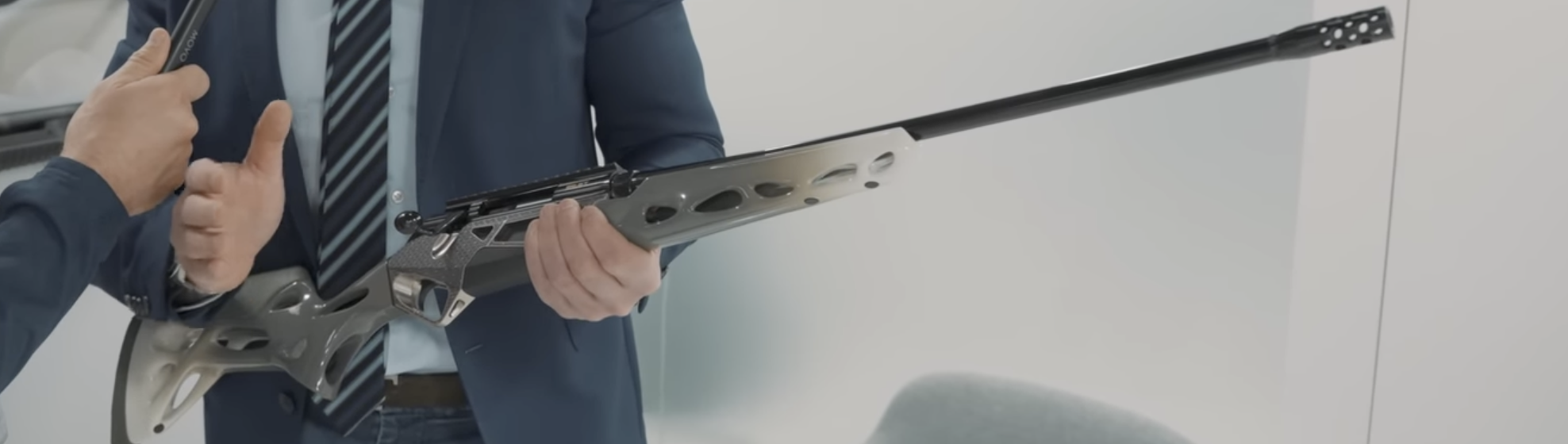
    Beretta Lupo Alpha LE rifle featuring a lightweight, lattice-style stock design and 3D printed parts.

    Last year, the company released a Lupo Alpha rifle with 3D printed components. Now, an updated Lupo Alpha Limited Edition is said to be an ultralight, limited-edition rifle chambered in .308 Winchester, retailing for €10,000. A previous 3D printed version sold 1,000 units. At that point, the gun is squarely aimed at collectors. Most collectors collect elaborately embellished, traditionally made shotguns, including the ones from Beretta-owned Holland & Holland. These rarefied weapons are steeped in tradition and presented as heirlooms. But there is a new tech-savvy collector who wants something else.

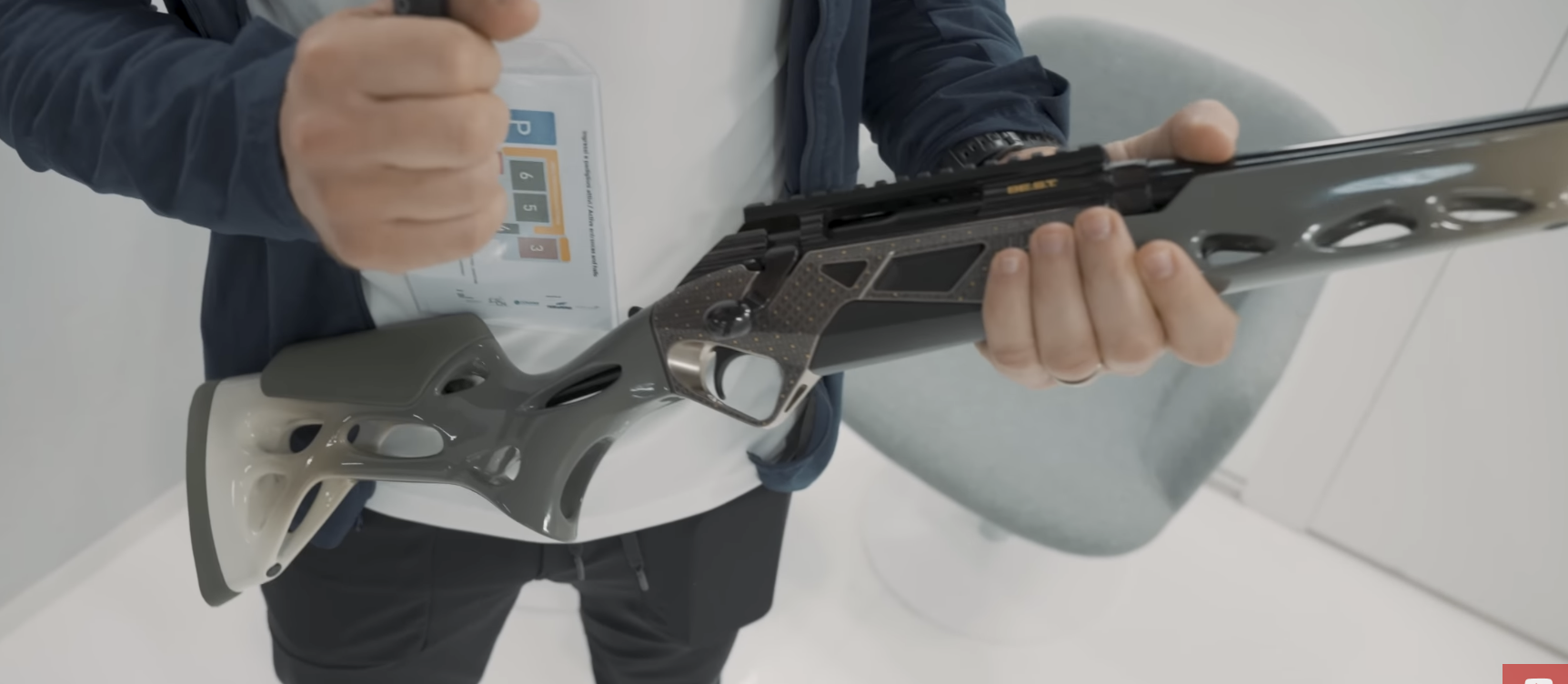
    In this case, it’s super-light 3D printed furniture. The gun’s chassis is 3D printed. Removing weight while maintaining rigidity is the main driver here. The stock has also been designed using FEA and other digital tools to be optimized for specific stresses that the rifle will go through. The rifle barrel has been made with Electrochemical Machining. This is something we’re hearing more about, and rifle makers are pointing to this manufacturing method as a way to make better barrels as opposed to hammer forging and other traditional methods.

    In this case, the firm goes further and says it has its own electrochemical rifling process as well as BE.S.T. (Benelli Surface Treatment). BE.S.T. is an in-house Benelli-developed surface treatment that combines Physical Vapor Deposition (PVD) and Plasma Enhanced Chemical Vapor Deposition (PECVD) to make a super-hard, corrosion and abrasion-resistant coating for triggers, barrels, and more components. Barrels are also placed in a vacuum furnace and cryogenically treated. This kind of tech sell is especially useful for Benelli, which has only been making rifles for a few years and primarily makes shotguns. Being the new kid on the block, embracing technology and newness really is a way to position yourself as the challenger brand that rewrites the rules. That can be very effective marketing in a sector dominated by stalwarts; you substitute “tried and trusted” for boring and old.

    Roberto Massarotto, Marketing, Communications, and Product Director of Benelli, said that,

    “Additive manufacturing is something very important for us, we have some machines in the company, and we’re the only company that are able to produce in a massive quantity, these kinds of components, usually most companies use 3D printing for prototypes, we’re using it for production, its a different approach, 100%. This kind of shape, is impossible to get with any other kind of machining.”

    It’s interesting to see Benelli move ahead with polymer 3D printed stocks and chassis components. The firm got an Additive Manufacturing department in 2023, then consisting of Ultimaker and Stratasys machines. We’re unsure which technology or printers the company is currently using for production. Something like 3NTR would make a lot of sense. The fellow Italian firm is a few hours away by car and makes solid Material Extrusion machines. Some high-performance PPA GF type materials could really work as rifle barrels. With the right finishing process, this could work and would lead to a wider material range.

    Handling of the Beretta Lupo Alpha LE rifle featuring 3D printed parts.

    On the other hand, parent Beretta uses Powder Bed Fusion, running metal and polymer machines from EOS at its site. Beretta uses PA GF powders. Vat Polymerization has traditionally been used a lot in prototypes for stocks and the likes, but I’m guessing that we’re not there yet, performance-wise. The initial 3D printed version of the Lupo Alpha (the image at the top of the post) rifle looks like it is Powder Bed Fusion GF, but this one of the Lupo Alpha Limited Edition looks distinctly like vapor-smoothed Material Extrusion.

    Up close of the Beretta Lupo Alpha LE rifle with 3D printed parts.

    Given that the firm first sold a run of 1,000 3D printed guns and now sells 100, we can see that these small, profitable series are going ahead apace. But will this lead to 3D printed stocks & chassis becoming more common? Eventually, it might. I personally believe more in 3D printed custom cheek pieces and buttstocks. You could get a real improvement here in comfort and precision if you customized these to anatomy and behavior. If we look at Magpul’s success, an independent 3D printed stock or other component provider could also do well. We would expect more companies to look at polymer 3D printed accessories and stock them in the future.

    Images courtesy of Beretta

  • ExOne + voxeljet Are Trying to Do the One Thing Customers Need Right Now: Keep Machines Running, and Rebuild Confidence

    For years, ExOne and voxeljet were two of the best-known names in binder jet 3D printing, especially in sand printing for foundries. But in recent years, ExOne “got buried” inside Desktop Metal, as ExOne CEO Eric Bader put it, and customers started to worry about the basics: Who do I call? Will I get spare parts? Will service disappear?

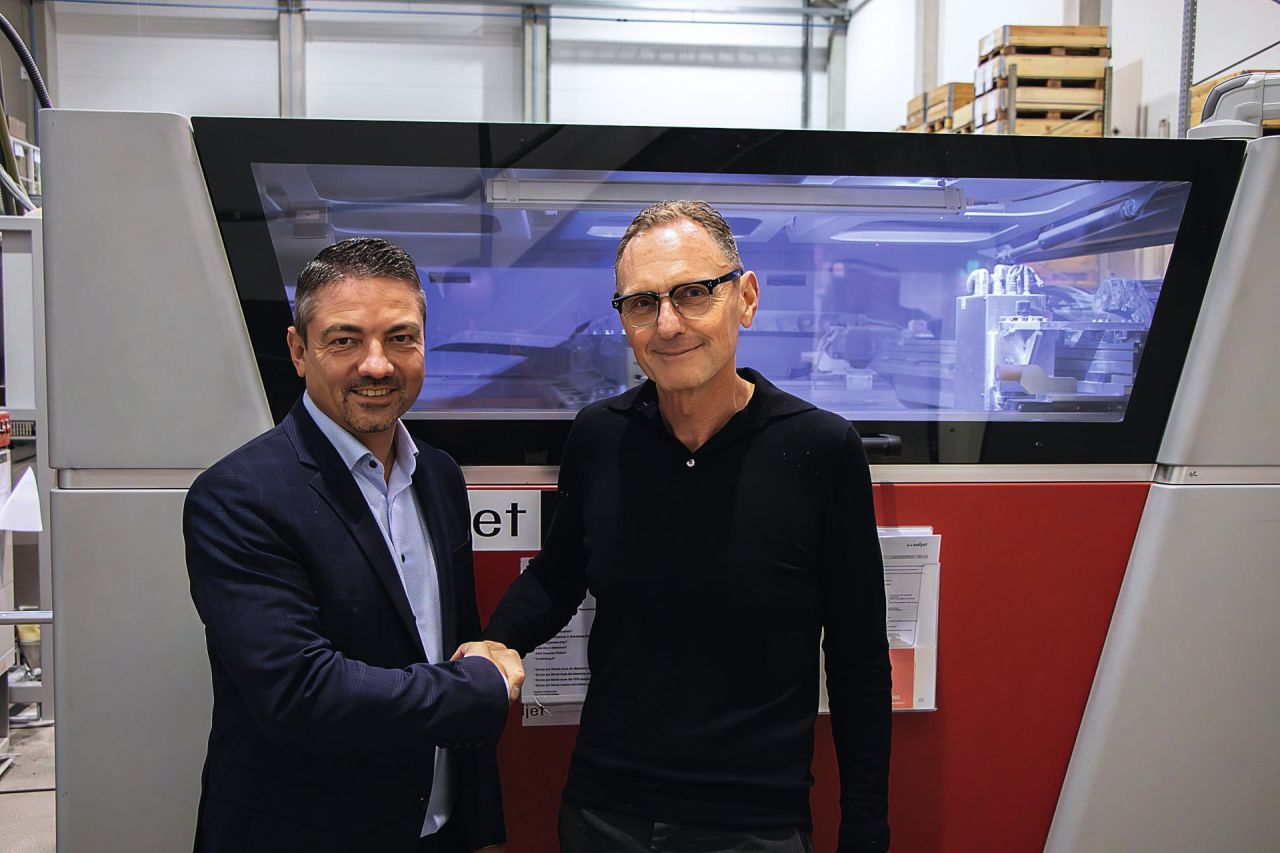
    In an interview with Bader and co-founding Managing Partner at Anzu Partners, Whitney Haring-Smith, the message was that the companies are being brought together in a way that makes support stronger, and this is meant to be the start of a more public, more active ExOne again.

    Stabilizing Support

    The clearest “news” is that ExOne and voxeljet are now combining their aftermarket service and support operations into one coordinated global network, and they are making that the priority of the integration.

    Bader said, “The decision was urgent because there are close to 500 installed machines in the field, and customers need to know there will be no disruption.”

    Haring-Smith described the combined service team as an immediate upgrade for customers: “They now get roughly double the technician coverage, and those technicians are not new hires. Many have deep experience. Service technicians in general, on average, have a decade of experience, and some of them have more than two decades.”

    Just as important, Haring-Smith said they kept the service technicians they wanted to keep during the integration. That’s a big signal to customers that “the support structure isn’t being hollowed out.”

    ExOne facility in Gersthofen. Image courtesy of Ehret+Klein AG/ExOne.

    A “fresh air” moment after a chaotic year

    During our conversation, the executives addressed a concern many customers have raised this year: whether their machines will continue to be supported as the companies merge and restructure.

    “With so much consolidation, customers have been nervous about uptime, service, and parts. The Americas were especially urgent because many ExOne customers had been dealing with the turmoil around Desktop Metal,” stated Bader. “voxeljet already had a functioning service base outside Detroit (Canton/Detroit area), and ExOne can now ‘hook on’ to that structure to restore consistency. We can start spare parts once again, we can make service calls from there.”

    That’s the core theme for the consolidated company: stability first.

    How Anzu fits in and why that matters

    The duo also clarified how the company is organized following this year’s acquisitions. According to Haring-Smith, Anzu is now the investment firm behind ExOne. He described Anzu as a firm with about $1 billion in assets and 40–50 portfolio companies, and said ExOne is one of those holdings.

    He also highlighted a question customers often ask: “How long are you going to be here?” To which Haring-Smith answers, “Anzu holds ExOne in a fund with a long runway. We hold this in a fund that stretches into the 2030s, so we’re focused on building a company that is an enduring partner for our customers.”

    Basically, they want the market to understand this is not a “short-term flip” and not a “keep it quiet” asset like it felt under Desktop Metal.

    R&D is staying, and it’s getting bigger

    Beyond service, both executives also pointed to “innovation as a second pillar of the combined company.” They said the R&D leaders from both organizations will continue in the new structure: Andy Vardaman, who leads R&D at ExOne, and Alfred Breer, head of R&D at voxeljet. Haring-Smith described technology innovation as “at the heart of both companies.”

    Meanwhile, Bader added that the real opportunity is the knowledge built up over more than 20 years, and the best part is that now the teams can actually share what they know: “You see them now exchanging, seeing the opportunities, one can use what the other department developed and vice versa. More importantly, the combined R&D group will be larger than either company’s R&D team was on its own.”

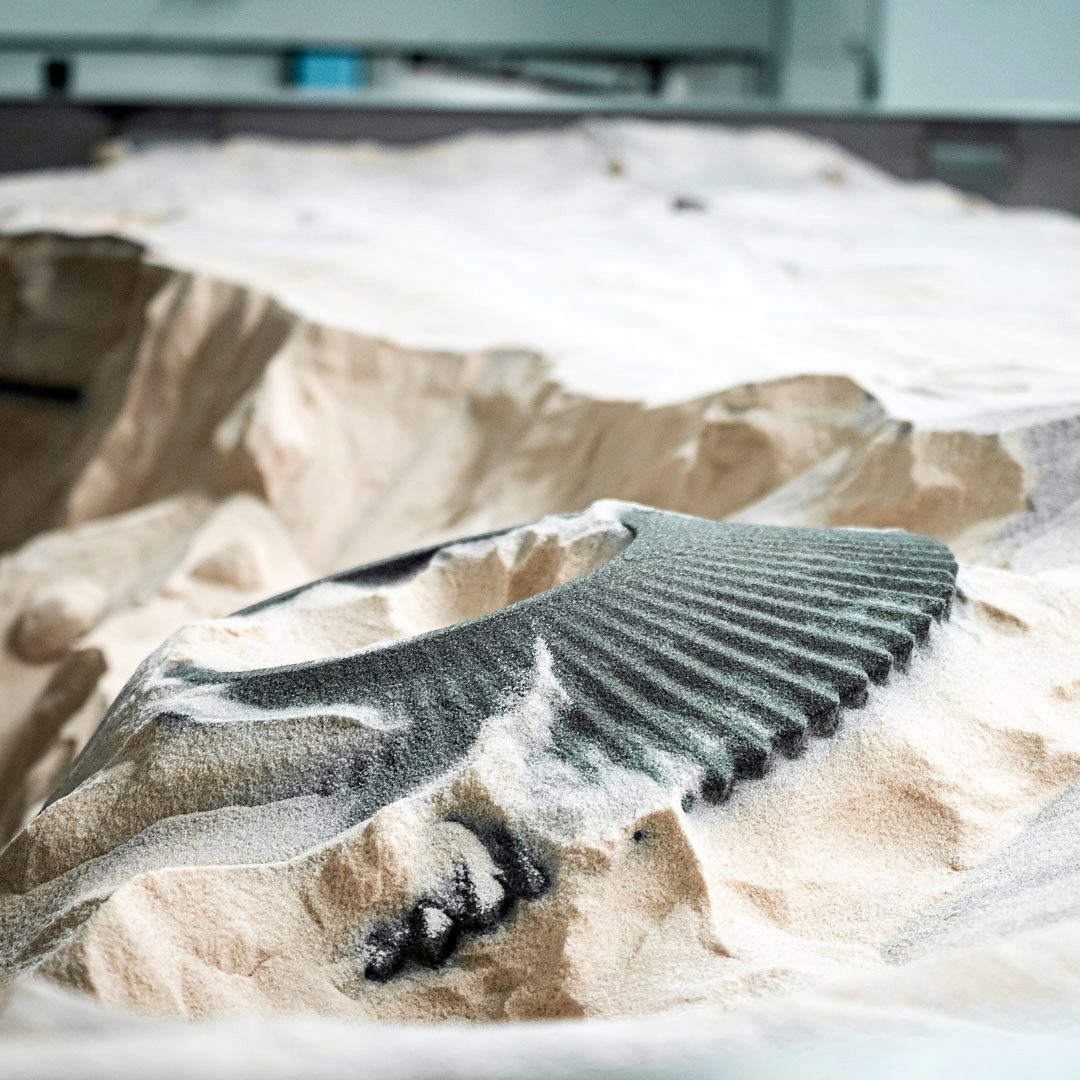
    ExOne's sand 3D printing process.

    ExOne’s sand 3D printing process. Image courtesy of ExOne

    Looking ahead to 2026, Haring-Smith said the company is focusing on three main areas. The first is speed, both in terms of machine performance and how quickly customers can get service and spare parts. The second is local support. The goal, he explained, is to make sure customers can get help in their own region, whether they are in Asia, Europe, or the United States.

    The third focus is to continue pushing binder jet technology forward. Both companies have long histories in the space, and the combined R&D teams are expected to play a major role in developing the next generation of the technology. More details about that roadmap, they said, will come in future announcements.

    Bader added that the integration work is still underway internally. For now, the focus is on aligning teams and priorities so the company can move forward with a clear strategy. More specifics about the plan, he said, should emerge in the coming weeks.

    Where they think binder jet still wins

    Bader also pointed to where binder jet is already widely used today, noting that many of its strongest applications are not the high-profile metal stories that often dominate the conversation.

    He pointed in particular to binder jet printing for sand molds and cores used in casting. He said the technology has already been widely used in production for many years, especially in the foundry industry, where it is used to make parts in real manufacturing environments rather than just prototypes.

    He also noted that new opportunities are emerging beyond traditional automotive applications. Industries such as aerospace, energy, pumps, and defense are increasingly exploring the technology, especially for lightweight parts and efficiency improvements. Even a small improvement in something like a pump, he explained, can lead to significant energy savings over the lifetime of the equipment.

    The “preview” they teased but didn’t fully reveal yet

    The executives also suggested that more updates are coming very soon. Haring-Smith said the company plans to share additional announcements in the near future as the integration progresses.

    For now, the focus is on bringing the two organizations together and stabilizing operations. More details about the company’s structure and technology roadmap are expected in the coming weeks.

    Eric Bader will take on the position of CEO of ExOne Global Holdings and Rudolf Franz will join the supervisory board going forward. Image courtesy of voxeljet via LinkedIn.

    For ExOne and voxeljet, the immediate priority is to rebuild confidence with customers and strengthen support for the machines already running in the field.

    After a turbulent year across the AM sector, the companies are trying to make customers know that the service teams are in place, the global network is expanding, and the focus is now on moving the technology forward together.

    As Bader and Haring-Smith summed it up, the success in 2026 will come down to delivering for customers, which means faster service, faster machines, and stronger value overall.

  • CNC Kitchen Vibe-Coded a Texture Tool, then Gave It Away for Free

    Stefan Hermann, the creator behind the popular CNC Kitchen YouTube channel, wanted a better way to add custom textures to his 3D models. Although fluent in CAD, he found Blender, the software best at redesigning a mesh, too frustrating to learn quickly.

    “My mind was trained on parametric CAD, and I find it really hard to get into,” he admits. “I opened it, watched half a UV unwrapping tutorial, got completely lost, and closed it again.”

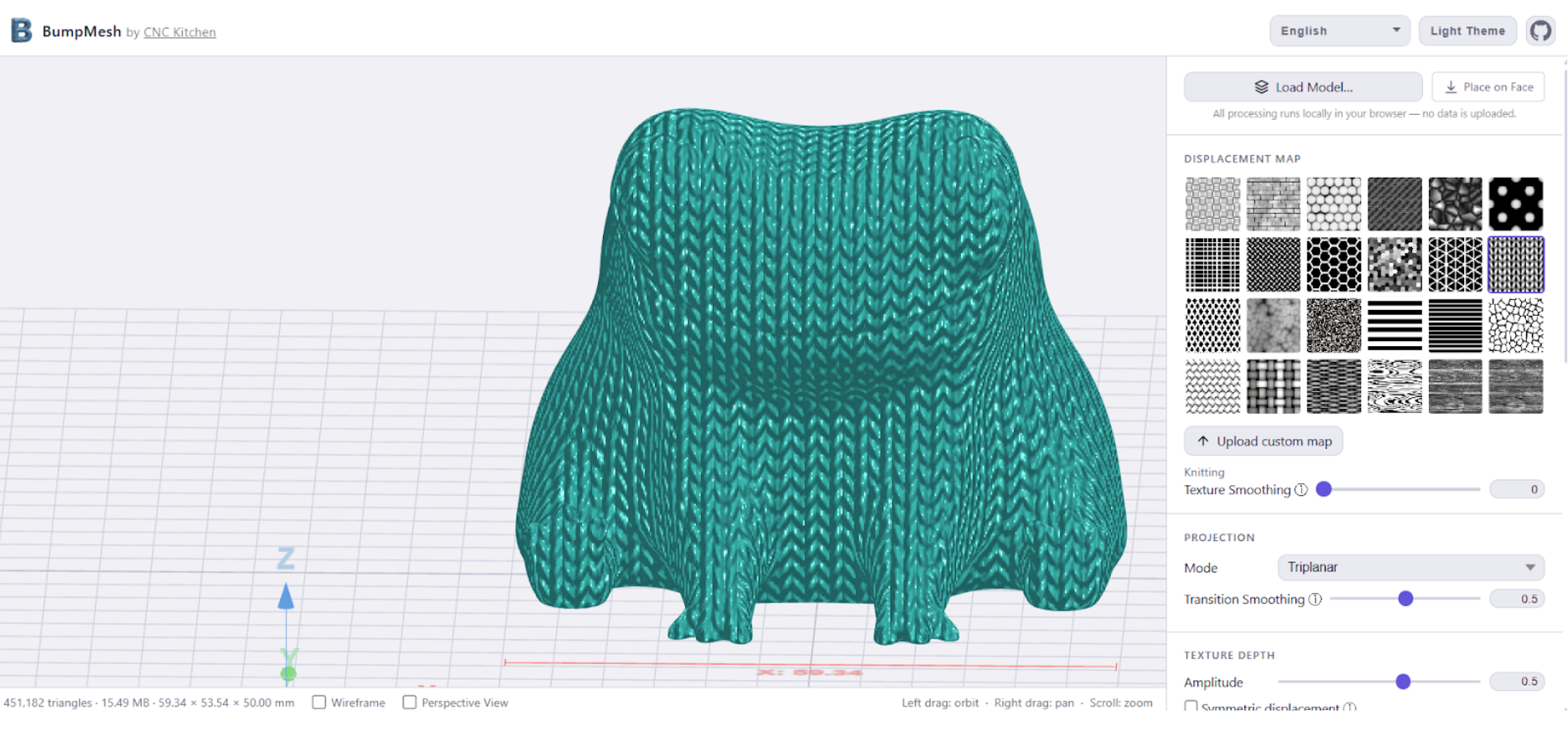
    So Hermann did what any resourceful engineer does these days: he vibe-coded his own solution. The resulting app is called “BumpMesh” and is a surprisingly powerful web-based tool specifically for applying displacement textures to 3D prints.

    Go Beyond Fuzzy Skin

    Adding textures to your 3D print isn’t just about the aesthetics. Though it can be useful for hiding seams and layer lines, strategically placed textures can add a grippy surface to things like printed handles. Textures aren’t normally available in CAD software, which leaves engineers who don’t master artistic tools stuck with only one option: adding “fuzzy skin” in the slicer.

    BumpMesh addresses the problem by allowing users to upload any model as an STL, OBJ, or 3MF file, then apply textures derived from grayscale images. The tool offers several patterns to start, plus you can upload your own custom textures.

    We Tested BumpMesh

    I uploaded a simple frog model from Thingiverse to BumpMesh. I wanted to dress him in a sweater, but I wanted something different from the default knit pattern.

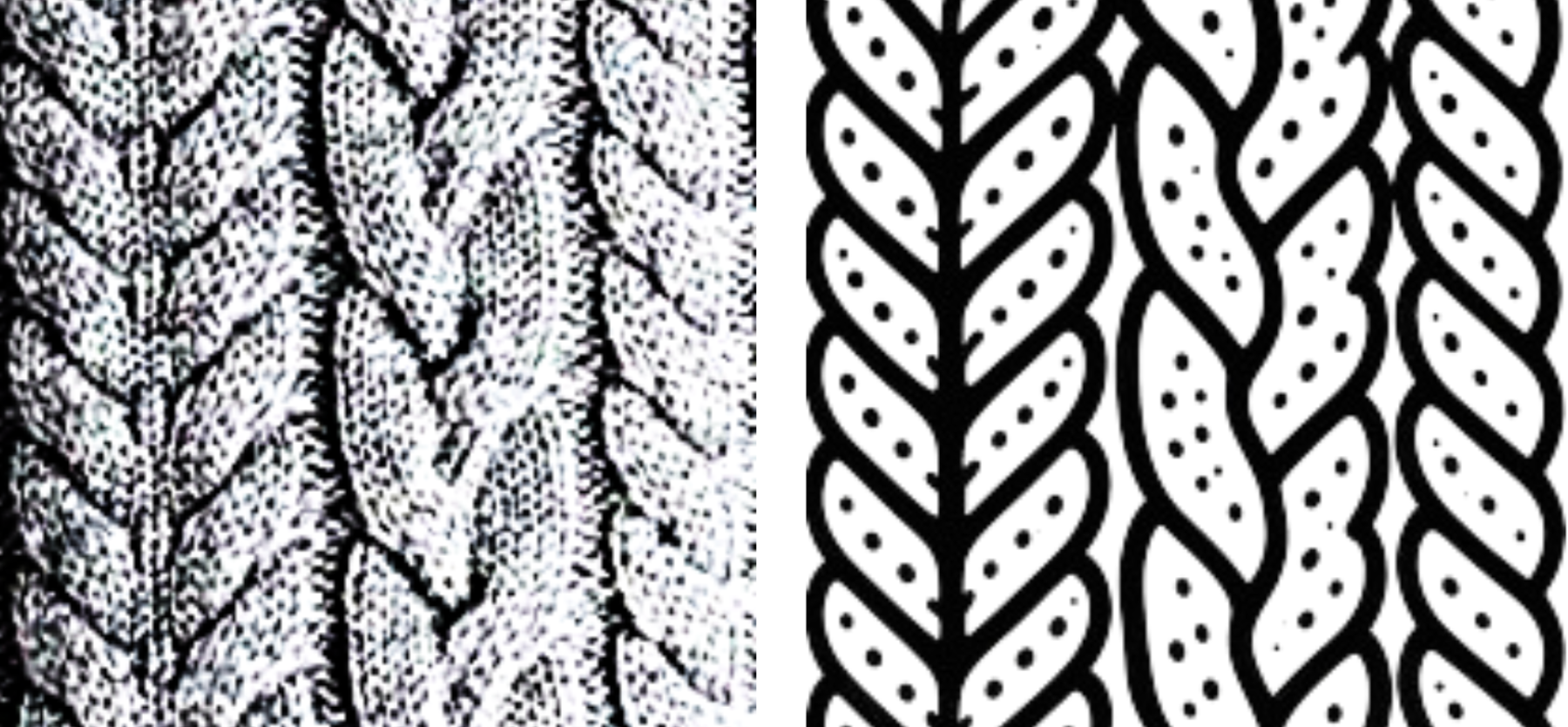
    Creating a custom texture only requires a tiny bit of graphic arts skill. I used a screen grab of a sweater pulled from a shopping site, cropped in tight on a few inches of the pattern, then removed the color and made it high contrast. This pattern looked good on the screen, but after printing out on a Bambu Lab H2D using a .16 layer height, the results were blurred and indistinct.

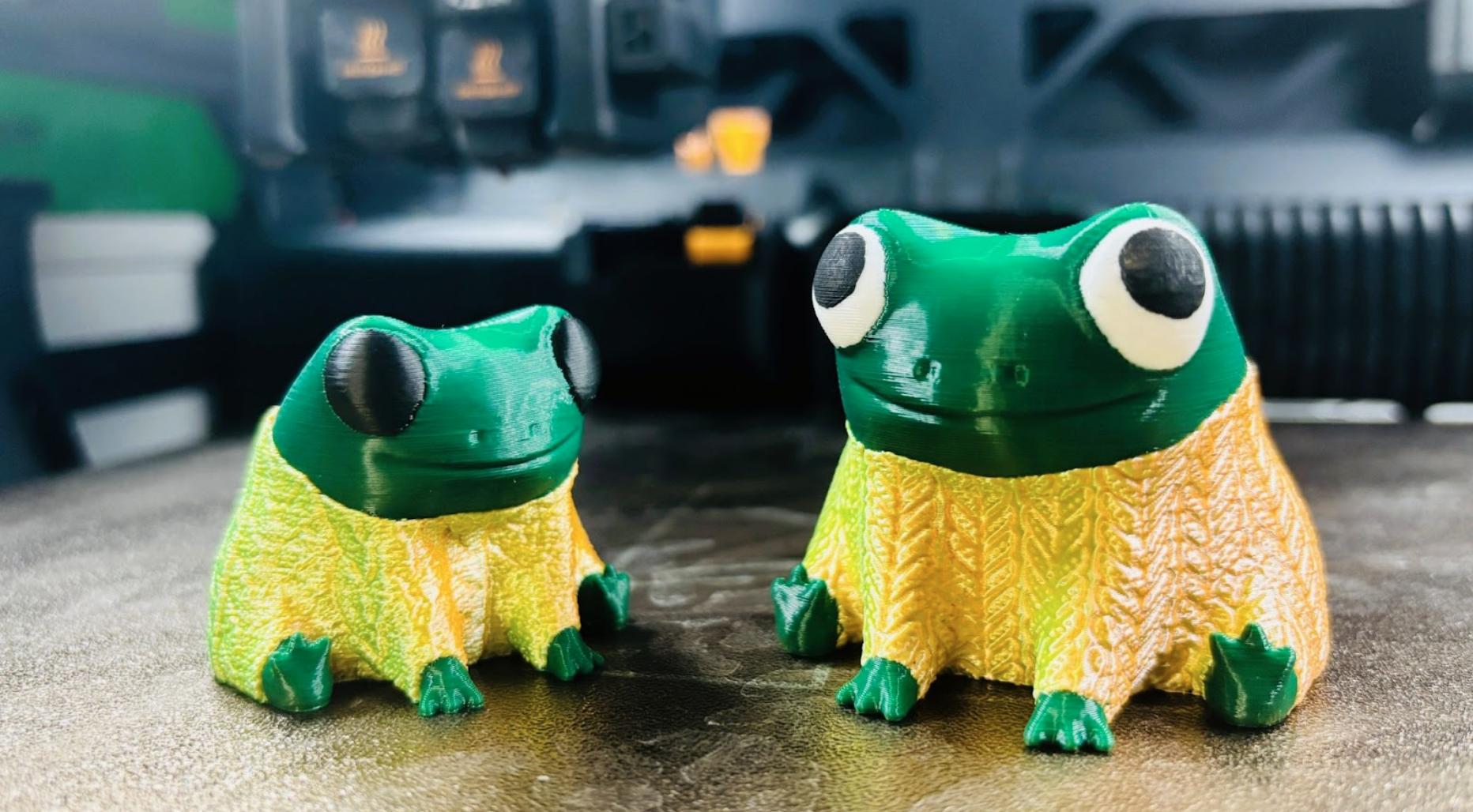
    I was able to solve this by converting the image to a line drawing, which I touched up in Photoshop. This second frog had a much crisper faux sweater.

    Line drawings are better for creating new textures.

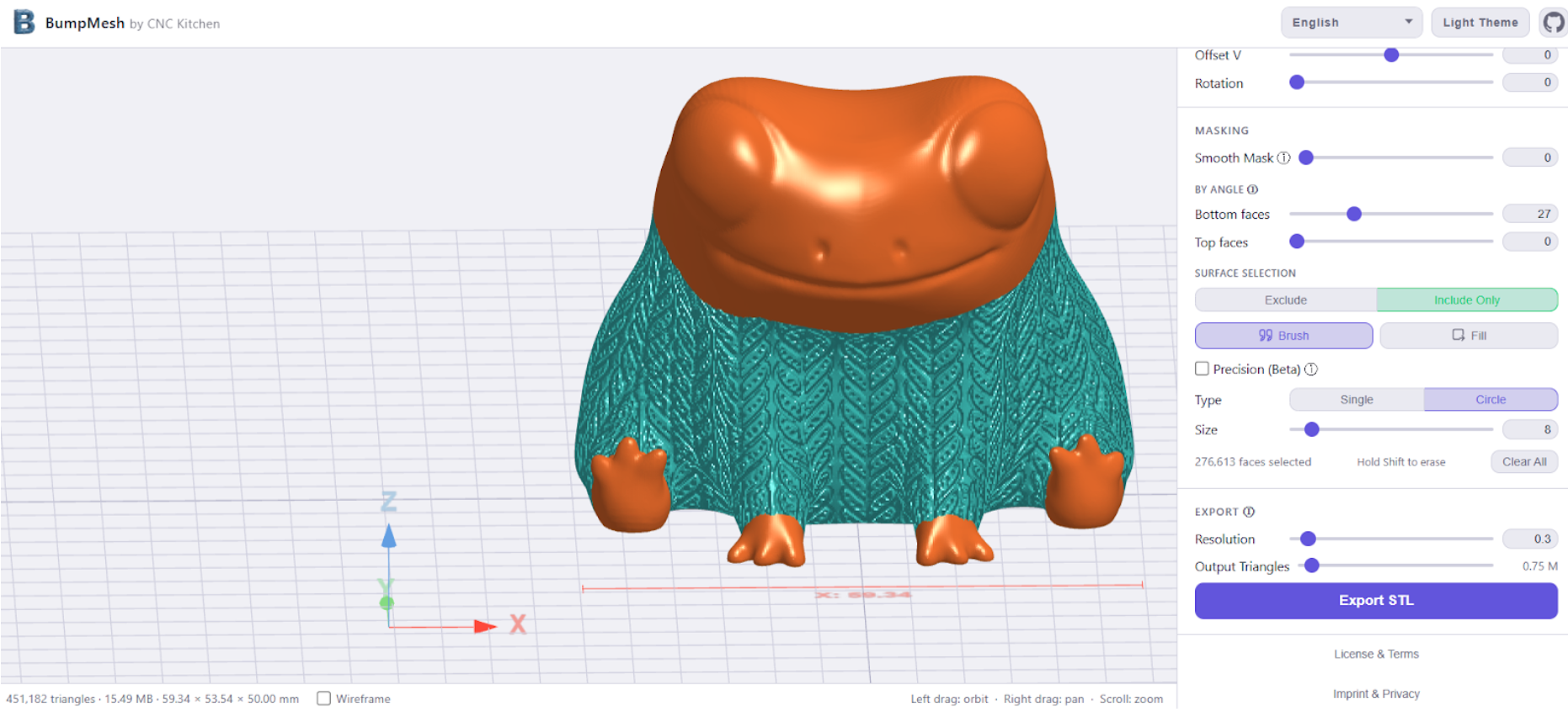
    The tool allowed me to paint the new knit texture onto Fred the frog, freeing his head and feet from the pattern to create a faux sweater. The paint tools are rudimentary, but pretty good considering this was coded in a week with AI.

    BumpMesh gives the user sliders to scale the pattern, rotate it, smooth it, change the projection mode, and adjust the texture’s depth. Want the texture to go inward or outward? A quick toggle for “symmetric displacement” handles that. The app gives real time feedback to assess your results.

    BumpMesh offers several powerful features that set it apart from simple slicer tools:

    • Multiple Projection Modes: Whether you’re texturing a cube (Triplanar), a bottle (Cylindrical), or a flat surface (Planar), BumpMesh ensures the texture wraps accurately around your geometry. 
    • Angle Masking: Automatically prevents textures from being applied to surfaces at a specific angle, which is crucial for maintaining a flat bottom face for better print bed adhesion or for ensuring shallow overhangs print cleanly.
    • Surface Masking (Paint-on): This is where BumpMesh truly shines. You can use a digital brush or bucket fill tool to precisely select areas you want to texture—or, even more powerful, areas you want to exclude (like the handle area of a microphone while leaving the top clear).

    Vibe Coding a Solution

    Vibe coding has become a popular way for novice programmers to fill in their knowledge gap with an AI assistant to create programming quickly. As Stefan explains, “Even though I can code reasonably well, building something like BumpMesh would have taken weeks of work at my own skill level…Vibe coding simply gives me the ability to go from an idea to a working custom solution in only a few hours.” He estimated it took only about a week of his time and $20 in subscription fees to Copilot.

    Privacy and Accessibility

    The core philosophy behind BumpMesh is simplicity and accessibility. It’s completely free, open-source, and best of all, runs locally in your web browser. There are no accounts to create, no license fees, and no tracking. Your files are processed right on your own computer, ensuring your designs stay yours.

    Still a Work in Progress

    While Hermann is realistic that the tool “isn’t perfect yet”, currently requiring multiple passes to apply multiple textures and having some limitations with extremely complex geometry, it’s an incredible start, especially considering it was developed in just a week. He’s already actively encouraging feedback and feature requests through platforms like Printables, Maker World, and GitHub.

    Fred the Frog with texture. Image courtesy of Denise Bertacchi.

  • EIT Manufacturing Liquidation Fracas Leaves 3D Printing Startup Out in the Cold

    EIT Manufacturing ASBL was a public-private partnership between the European Institute of Innovation and Technology (EIT) and a network of industrial and research partners. EIT is a European Union (EU) body, and European citizens can expect it to deliver on its promises. EIT Manufacturing, however, was a separate non-governmental body that helped disburse the EU’s money. By devolving responsibility and power to this supposedly faster and more efficient body, the EU gave up a teeny tiny sliver of its sovereignty to an external organization. We’re seeing this trend replicate itself worldwide. And yes, this may make government bodies more responsive, but it also carries risks.

    The EU’s anti-corruption body, OLAF, found irregularities and fraud at EIT Manufacturing on May 25. Subsequent to this, EIT stopped funding EIT Manufacturing, and the firm collapsed. Compared to the rampant and pervasive corruption in countries such as the United States, this is, of course, nothing, and proves that the system works. But at the same time, it suggests that public-private partnerships should be reexamined.

    Reportedly, over 200 startups are waiting for funding. This could be very nerve-wracking for them because it’s unclear if the money intended for them is gone or if there is just a delay due to EIT needing a new way to continue paying them. The truth is somewhere in the middle. In this case, some maintain that the entire paper chain needed to get grants is too time-consuming and complex, and the whole system needs an overhaul. There is also some worry about the fact that the first OLAF report stems from 2024; there was a reorganization, then new money was disbursed, only for OLAF to step in again much later.

    From LinkedIn and this startup blog, we can learn how one Maltese company, ELM, was affected.

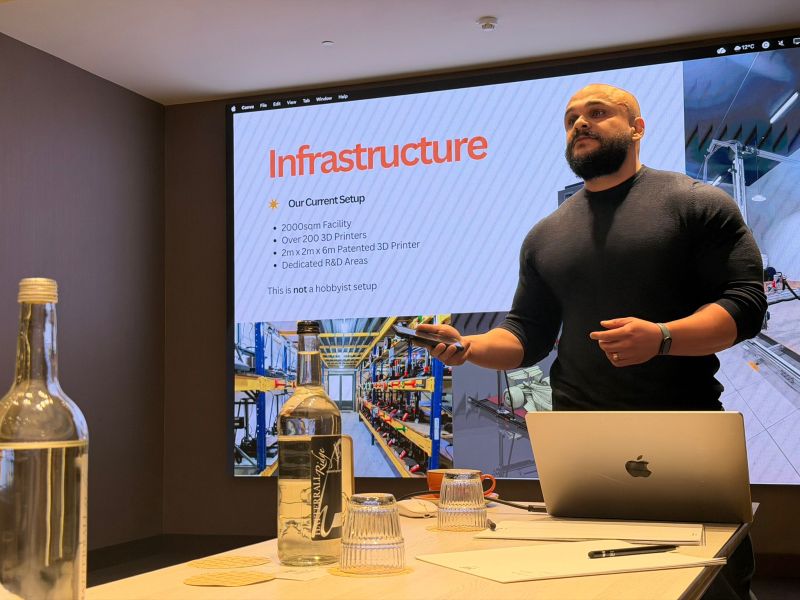
    “ELM Fabrication Ltd, founded by engineers David Sciberras and Nicholas Borg Calleja, has developed a 2m x 2m x 6m model capable of 3D printing everything from boats to furniture out of recycled plastic…they secured an initial €217,000 in funding (70 per cent of the cost) from EIT Manufacturing (EITM) to bring the technology to market.”

    After green-lighting the project, the company never got the money. Worse still, they continued on the work using their own money and were promised reimbursement, which never materialized. Happily, the bootstrapped founders survived the ordeal,

    “However, we kept our operations lean. We didn’t give ourselves a salary or hire loads of people, although unfortunately we did lose people we were going to hire. It’s just good practice not to spend excessively before a product starts generating money.”

    It is, however, unclear when, if at all, the firm will receive its €217,000. ELM’s founders were indeed very frugal and careful, and this seems to have paid off for them. Thinking back, a few companies that I’ve advised would have been in serious trouble or gone under should government funding have dried up unexpectedly.

    David Sciberras gives an overview of what Invent 3D is up to at a joint chapter BNI Verdala Malta & BNI De Paule – Malta meeting. Image courtesy of David Sciberras via LinkedIn.

    On his LinkedIn, ELM Co-Founder David Sciberras explains that,

    “We always built to make money as quickly as possible. With ELM, the process was different as we’re building something new…. so we built things much more cautiously. Until the funds were in the account, we worked as if they weren’t there. Even after approval letters, promise of income, etc….until the money hit the account, we didn’t have funding. That helped us build a super lean setup, with zero waste. We built from Xjenza fund to TOSFA fund, putting in our own wages, late nights and expertise to make it happen. When we saw that EIT didn’t even send a signed grant agreement, alarm bells started ringing, so we pumped the breaks even harder on spending. This essentially slowed our path to market, by a year. Now that we opened up to a round of equity investment, we’re in a much happier place with our first investor on-board.”

    A few things here really stand out as excellent advice. “Until the funds were in the account, we worked as if they weren’t there,” feels like it should be standard practice anywhere. Promises are just that — promises. Also, I think many people wouldn’t have worried if the grant agreement hadn’t arrived. Many would have continued as normal, expecting some bureaucratic issue to resolve itself. Being as cautious and frugal as the ELM team seems to be is the new way of doing business. Slower, perhaps, but it gives you more control and helps move toward profitability more quickly.

    This collapse is significant because worldwide, more and more power is being given to public-private partnerships. Private firms are responsible for billions in government funding. The opportunities for corruption and lack of oversight are significant. We need to be ever-vigilant when applying for grants and, in a more uncertain world, even more frugal and careful.