• 3D PRINT 2026: The Leading Additive Manufacturing Trade Show in France with 150+ Exhibitors

    From June 2 to 4, 2026, Lyon will host 3D PRINT, an event exclusively dedicated to additive manufacturing. As the only professional trade show in France fully focused on 3D printing, it has become a catalyst for innovation, business development, and strategic vision across the entire industry.

    By bringing together major industrial groups, SMEs, start-ups, and research centers, 3D PRINT is now recognized as a national leader, ranking among the three most influential additive manufacturing events in Europe. The show offers a unique platform to showcase technological advances and practical industrial applications of additive manufacturing across all key sectors.

    Bringing leaders and new players together

    This edition will gather industry leaders and new market entrants, including: 3D Consommables, 3D Newshape, 3D Prod, 3DPmolds, A.M.P.E.R.E., AddUp, Altair Consulting SA, AM Solutions, Ardiak, Atlix – Industrial Additive Manufacturing, Atome3D, Avenco, Axis, BigRep, Bureau Veritas, Institut Carnot Chimie Balard Cirimat, CoreTechnologie, Cylaos, Decip, EKZO BV, eMotion Tech, EOS SAS Electro Optical Systems, Eplus3D Tech GmbH, Erpro Group, Flow-3D AM, GMP ADDITIV, HP, Incus 3D, Initial, Jean Brel, Joke Technology, Kreos, La Nouvelle École, Linde AMT, Linde France, Multistation, NANOVAL GmbH, Novacad, Onshape by PTC, Philtec Système, Politechno, RBSystem, Renishaw, Replicad 3D, Reptis, SEIDO Systèmes, Simaform SA, SuNPe Prototype, Technologie Services, UpNano GmbH, Volumic 3D/La Ferme 3D.

    A tailored, free-to-access congress

    At the heart of the event, the 3D PRINT Congress offers over 50 conferences and workshops, all free and open to attendees. Visitors can create a tailored schedule based on their business priorities.

    French and international speakers are hand-picked for their expertise and invited to share exclusive insights and unique case studies. For international visitors, a live translation system ensures full accessibility and smooth participation across all sessions.

    The Creality booth at 3D PRINT 2025.

    An optimized, business-oriented visit

    To maximize the value of your visit, 3D PRINT 2026 offers:

    • Thematic visit routes, organized by France Additive, covering five strategic sectors: aerospace, automotive, medical, defense, and luxury. These visitor tours guide attendees to the most relevant solutions and connect them with key industry experts.
    • Business Connect, developed in partnership with France Additive, providing personalized support to project leaders in identifying the most suitable technological and industrial partners.

    Winning synergies

    With your 3D PRINT badge, you also gain access to France Innovation Plasturgie (FIP), the major event for the plastics, composites, and rubber sectors, which will welcome over 800 exhibitors.

    Attendees can also join two exclusive EPMA seminars focused on sectors where additive manufacturing plays a key strategic role: automotive and energy.

    How to Participate:

    Images courtesy of 3D PRINT Lyon
  • BigRep Launches ONE.5X 3D Printer, Announces New Massive Dimension Partnership at RAPID + TCT 2026

    As the whole world is starting to realize, the Hormuz supply chain fallout is only just beginning to filter into the global economy, and the rising cost of plastics should be a centerpiece of that story for some time. Under these conditions, large-format polymer additive manufacturing (AM) should get a boost, and pellet-extrusion systems, which are optimal for use with recycled materials, might benefit most of all.

    BigRep, then, the German-US original equipment manufacturer (OEM) of large-format polymer 3D printers, has perfectly timed two major announcements for RAPID + TCT 2026 in Boston: first, the company is releasing the BigRep ONE.5X, which the company is calling “a fully automated evolution” of the BigRep ONE.5 that it originally launched at Formnext 2024. Secondly, the OEM is providing further details on a previously announced partnership with Massive Dimension, the Vermont-based manufacturer of pellet head extruders.

    Through the partnership, the two companies will integrate the new Massive Dimension MDX extruder with the BigRep ONE platform, with the two companies aiming to make the combined solution available by the end of 2026.

    The connecting threads between the launch of the ONE.5X and the MDX integration with the ONE platform are ease-of-use and flexibility: the two offerings are designed to simplify the setup and maintenance experiences and to support a broad range of materials. BigRep leaned into that messaging with its presentation of the ONE.5 at Formnext 2025 — where the company also first announced the Massive Dimension partnership —and is making it even more prominent in its sales pitch for the ONE.5X.

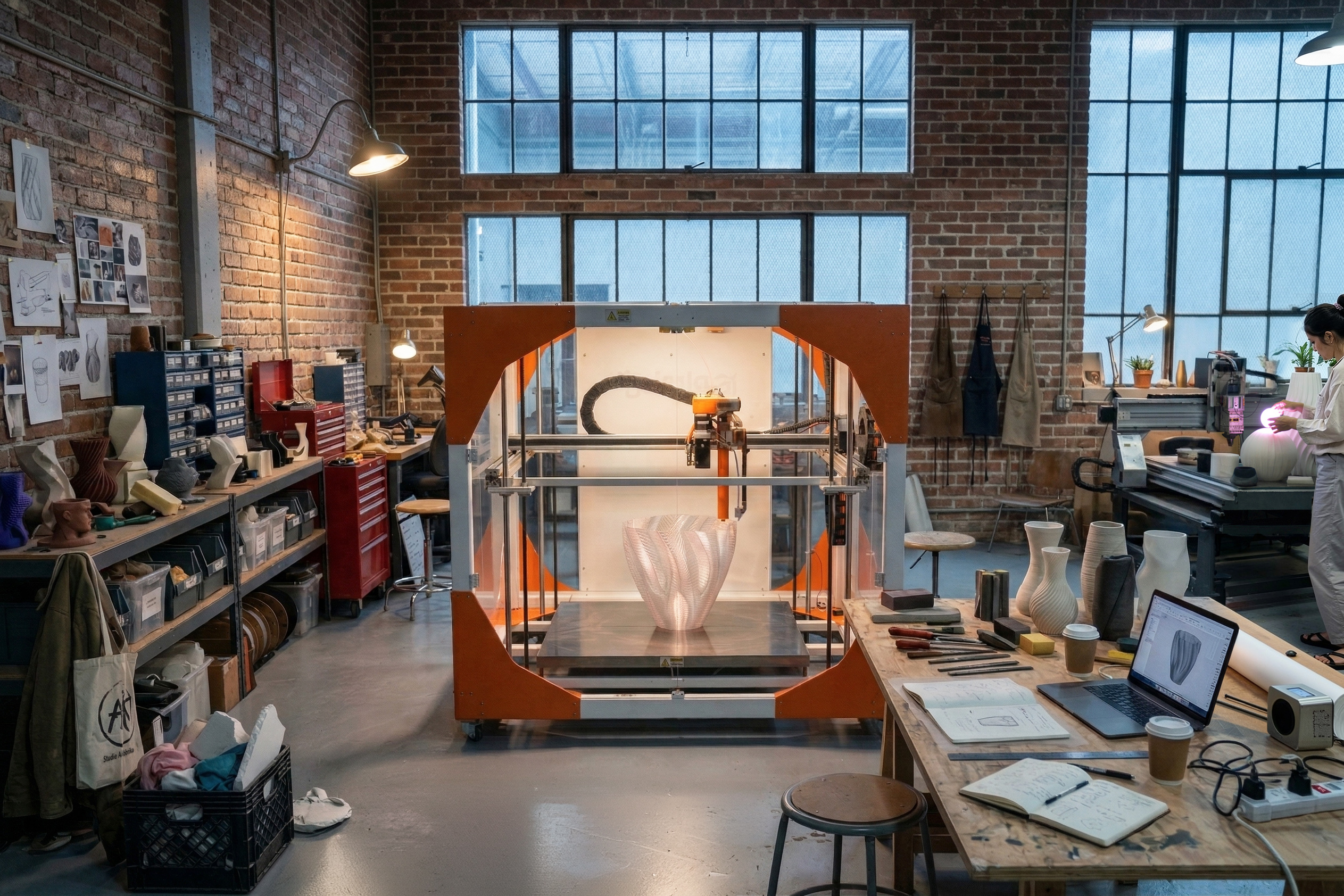
    ONE.5 pellet system at a creative workshop. 

    Attendees of RAPID + TCT 2026 can learn more about the ONE.5X and the Massive Dimension MDX at Booth #2355.

    In a press release about BigRep’s launch of the ONE.5X and the integration of Massive Dimension’s MDX extruder with the BigRep ONE platform, Jeff Olson, President of BigRep America, said, “The ONE.5X represents everything we’ve learned from over a decade of industrial large-format 3D printing, as well as global customer feedback. All of that is distilled into a machine that delivers consistent results, regardless of an end-user’s experience level.”

    Meanwhile, Tyler McNaney, Massive Dimension’s founder and CTO, noted, “The MDX is not just an iteration. It’s a reset. We removed complexity and reduced weight to create a more capable and more adaptable extrusion system, built for where the market is going.”

    The best thing OEMs in the AM industry can do right now to help themselves is focus on making their machines as easy to use as possible. You don’t necessarily have to do this through the design of the machine itself; you can also focus on less direct solutions, such as creating standardized workforce development programs that could also serve as a source of revenue.

    ONE.5 at work. 

    But for companies where it’s a realistic option, tailoring the machine itself to maximize user-friendliness is only going to become an even stronger selling point in the years ahead, as the manufacturing sector becomes increasingly reliant on workers with no prior manufacturing experience. Aside from that, demand for automated systems is also likely to increase, as even inexperienced workers will be difficult to come by.

    Those aren’t exclusively technological considerations, of course, but also carry cost-of-ownership implications. Less experienced workers command lower salaries, and higher levels of automation limit the number of necessary hires altogether. This way of thinking isn’t meant to eliminate human thought from the process: in a country like the US, at this point, it’s likely the only approach that will ensure that the next generation of manufacturing is sufficiently staffed.

    Both of these moves also bode well for BigRep’s targeting of the tooling market for the defense sector, which the company signaled as a key priority last summer in its announcement of a sales partnership with Phillips Federal. Large-format tooling is a perfect use-case for pellet extrusion, and BigRep has very effectively synergized its market reach through both the Phillips Federal and the Massive Dimension partnerships.

    Images courtesy of BigRep

  • 3D Printing’s Chicken-and-Egg Problem: No Demand Without Scale, No Scale Without Demand

    There’s a simple problem at the center of the 3D printing industry, and it hasn’t really gone away.

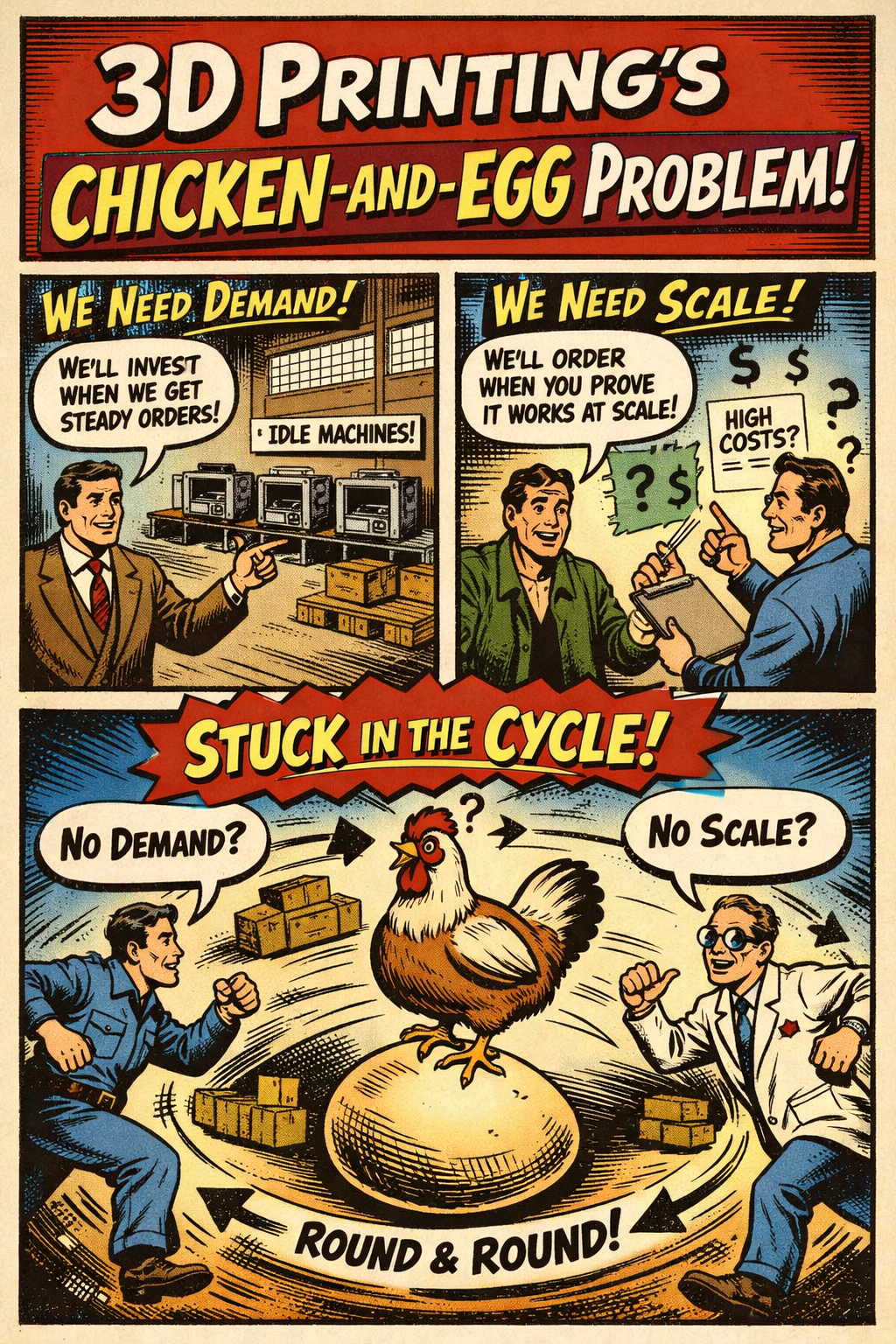
    Companies say they will invest in additive manufacturing when there is steady demand. Customers say they will commit when it’s proven at scale. And so both sides wait.

    This is 3D printing’s version of the classic chicken-and-egg problem. And perhaps, it helps explain why, after years of innovation, the technology still isn’t widely used at a scale the way it was originally expected to.

    Visualization courtesy of 3DPrint.com.

    Waiting for Proof

    For many manufacturers, it’s not about whether 3D printing works. It clearly does. The challenge is making it reliable, cost-effective, and consistent at scale.

    If a company is going to switch part of its production to additive manufacturing, it needs to know that parts will meet the same standards every time, production can run without disruption, and costs will stay predictable.

    That kind of confidence usually comes from seeing the technology already being used at scale. But that’s exactly the problem.

    Waiting for Demand

    On the other side, 3D printing companies often need committed customers before they can scale up.

    Running machines at full capacity, investing in more equipment, and building out production workflows all depend on having enough demand to justify it.

    Without that demand, it’s hard to lower costs, improve efficiency, and prove long-term reliability. So suppliers wait as well.

    Where This Shows Up

    You can see this dynamic across the industry.

    In aerospace, for example, companies like Boeing and Airbus have adopted 3D printing, but mostly for specific parts rather than full production lines. The technology works, but scaling it across entire systems takes time, certification, and long-term proof.

    In defense, there is a strong interest in using 3D printing for spare parts and field production. But large-scale deployment still depends on qualification, repeatability, and trust in the process.

    Even in consumer products, where 3D printing offers clear advantages in customization, companies are often cautious. They may test the technology in limited runs before committing to larger volumes.

    But at the same time, there are signs that this is starting to change.

    Some of the largest manufacturers are beginning to move beyond isolated use cases. BMW, for instance, is integrating 3D printed parts across multiple vehicle brands, and not just for prototyping, but also for actual production components. Apple is also reportedly exploring 3D printing for aluminum components in future devices, which would mark a significant step toward scaling the technology for high-volume consumer products.

    These are still early moves, but they point in the same direction. As more companies begin to use 3D printing in real production environments, even in limited ways, it starts to build the confidence needed to expand further.

    In other words, the balance may slowly be shifting in favor of adoption.

    But the underlying pattern is still there: no scale without demand, and no demand without scale.

    BMW 3D printed robot gripper. Image courtesy of BMW.

    The Cost Loop

    Cost plays a big role in this cycle.

    3D printing becomes more competitive as production increases. More volume means better machine utilization, lower cost per part, and more refined workflows. But to reach that point, companies need enough demand in the first place. This creates a loop that is hard to break.

    There are signs that this is starting to shift. In some areas, demand is becoming strong enough to push past the hesitation. For example, large-format parts in both metals and polymers are gaining traction, reshoring efforts are driving interest in more flexible manufacturing, and industries like defense and energy are looking for faster, more adaptable production methods.

    At the same time, the technology itself is improving. Machines are becoming more reliable, materials are expanding, and post-processing is getting more automated. All of this helps reduce risk. And reducing risk is what breaks the cycle.

    Onward

    The industry is finding ways around the chicken-and-egg problem. In some cases, it starts with a single application. A company identifies one part where 3D printing clearly makes sense, proves it out, and then expands from there.

    In other cases, it comes from external pressure. Supply chain disruptions, geopolitical shifts, or the need for faster production can push companies to adopt additive manufacturing sooner than they otherwise would.

    What’s becoming clearer now is that this shift may already be underway.

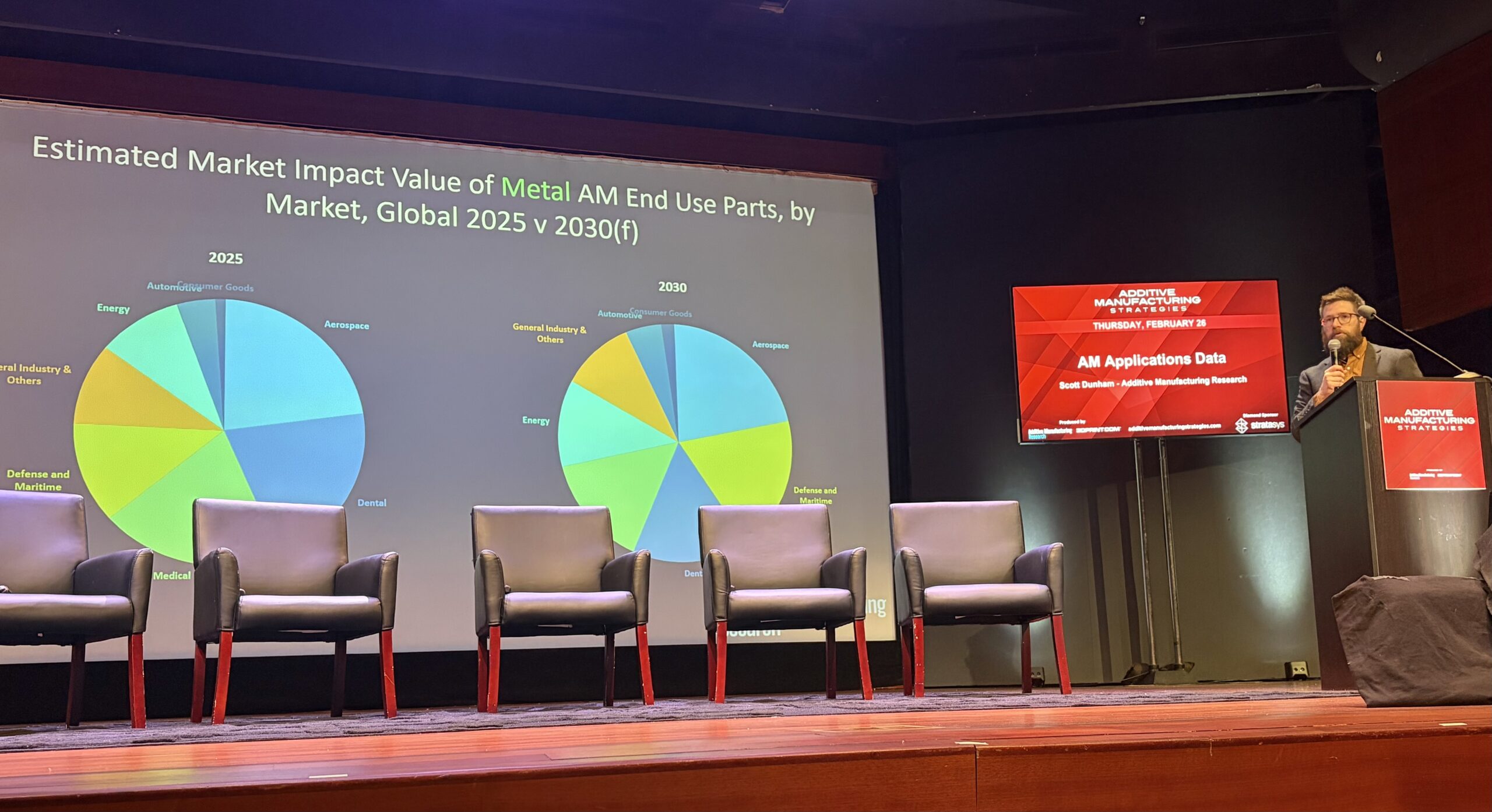
    Recent data from Additive Manufacturing Research (AMR), also covered by analyst Scott Dunham in his latest webinar, looks at where real growth is actually happening in 3D printing. Instead of treating the industry as one single trend, it breaks the market down by segment, showing which areas, such as specific applications or technologies, are gaining traction. If you want to see how that shift is playing out in detail, the full webinar is still available to watch and offers a clear, data-driven look at where the industry is gaining traction.

    Scott Dunham during the AMS 2026 AM Applications Data presentation. Image courtesy of 3DPrint.com.

    That matters because it starts to break the cycle. When certain parts of the industry begin to grow, companies gain more confidence to invest in production. As production increases, costs can come down, and the process becomes more reliable, making it easier for new customers to adopt the technology.

    Once a few strong use cases are proven and the data starts to support them, the rest tends to follow.

    A Familiar Problem

    In many ways, this is not unique to 3D printing. Most new manufacturing technologies go through a similar phase. But in additive manufacturing, the cycle has lasted longer than many expected.

    The technology is ready in many ways. The machines work. The materials are there. The applications exist. What’s still catching up is the confidence to scale. And until that gap closes, the industry will keep running into the same question: What comes first, demand or scale?

  • Orano Federal Services & UNC Charlotte Show How AM Could Cut Costs in Nuclear Energy Resurgence

    Outside of the defense sector, few industries have been impacted by Russia’s ongoing occupation of Ukraine more than nuclear energy. The same appears to already be happening in response to the US-Israel attacks on Iran.

    Nations, including the US, that have seen a resurgent interest in nuclear energy since 2022 have learned that revitalizing a nuclear energy supply chain is anything but a short-term process. The long-term nature of nuclear energy buildup could work in favor of using additive manufacturing (AM) to aid in that buildup, and there has been notable growth in AM R&D for nuclear power applications over the last several years. A new case study from the University of North Carolina (UNC) Charlotte and nuclear cleanup specialist Orano Federal Services demonstrates how AM might be used not only to help make a US nuclear energy renaissance possible, but also to make such a scenario cheaper.

    The key to understanding how lies in spent nuclear fuel (SNF): these are the uranium oxide pellets used in fuel rods, which US nuclear facilities recycle at a rate of 2,000 metric tons a year. As the case study explains, the current recycling protocol in the US leaves individual operators in charge of their own disposal processes, but that’s expected to change over the next 10-15 years, the timeline that the Department of Energy (DOE) is targeting for the construction of a central repository for SNF. This creates demand for the production of the hardware required for transporting SNF, most notably transportation casks.

    These are giant structures, with typical casks used for truck transport weighing 50,000 pounds and those used for rail transport weighing as much as 250,000 pounds (in both cases, the weight includes the fuel). The Orano and UNC Charlotte case study involves using AM to produce impact limiters for casks: circular components that sit at both ends of a cask, designed to protect its contents in the event of an accident.

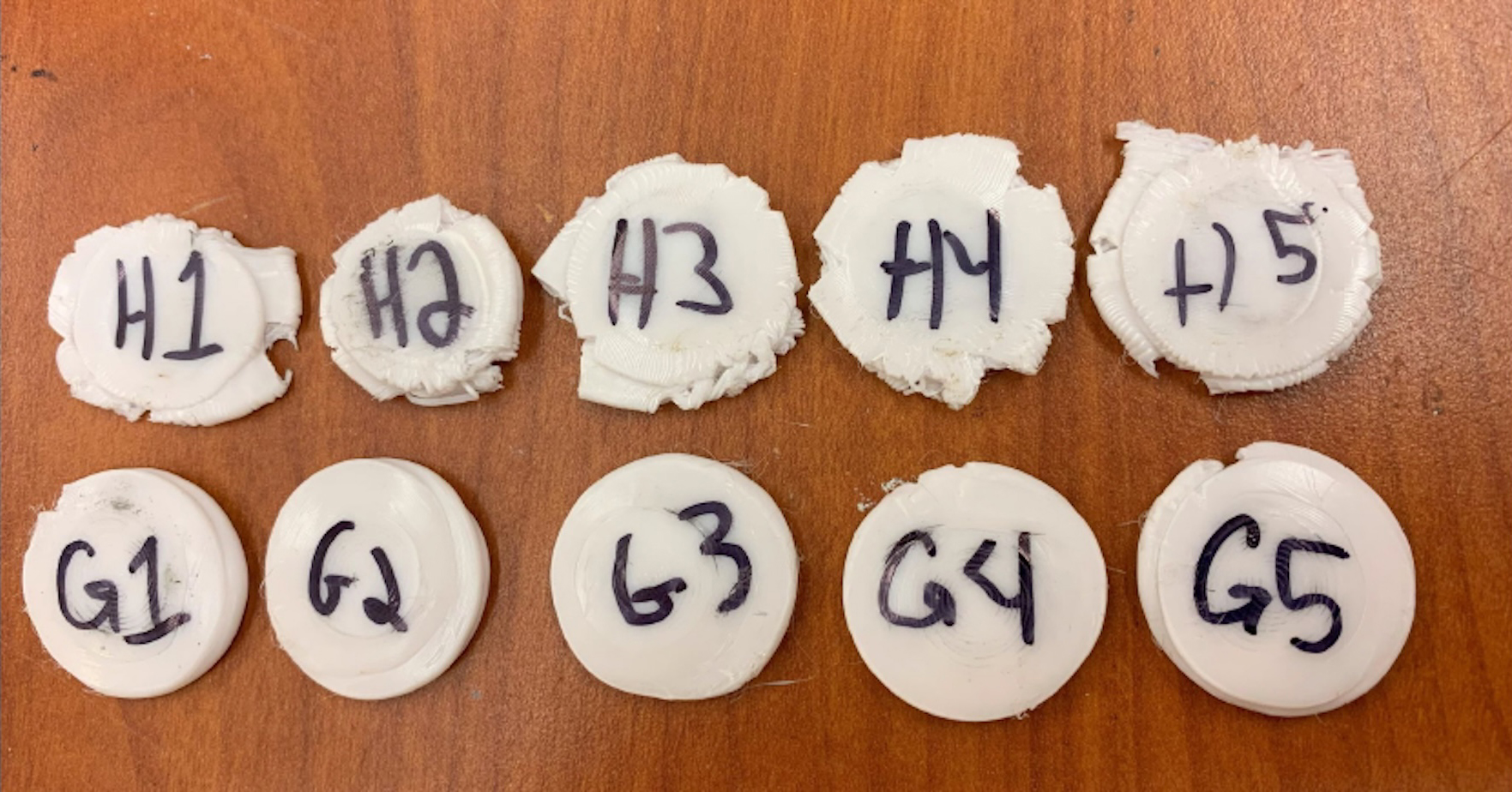
    For the case study, researchers tested both fused filament fabrication (FFF) and powder bed fusion (PBF) methods, substituting stainless steel for the conventionally-used materials, which are most often redwood or balsa-wood, or aluminum. Using both simulations and real-world compression testing, the Orano and UNC Charlotte team determined that a 5 percent gyroid infill design, for FFF as well as PBF, “produce[d] acceptable results for drop events”. Assuming a cost of up to $1 million per impact limiter when produced conventionally and 2 impact limiters per cask, the researchers found that using AM could result in up to $1 million in savings per cask with FFF and up to $1.7 million with PBF.

    Results of compression testing: honeycomb design (top row) vs gyroid design (bottom row).

    Of course, the caveat, as usual with AM components, is that the lack of existing relevant standards stands in the way of pivoting to AM at scale:

    As the case study notes in its conclusion, “However, the lack of codes and standards to support the use and verify the efficacy of AM components makes the proposed new impact limiter design an exercise in need of justification, likely beyond single component testing and numerical modeling of the composite design and most likely in need of actual drop testing data. Therefore, although this work shows the promise of AM, the path forward is focused on the development of codes and standards for AM components, which will require test data to complete.”

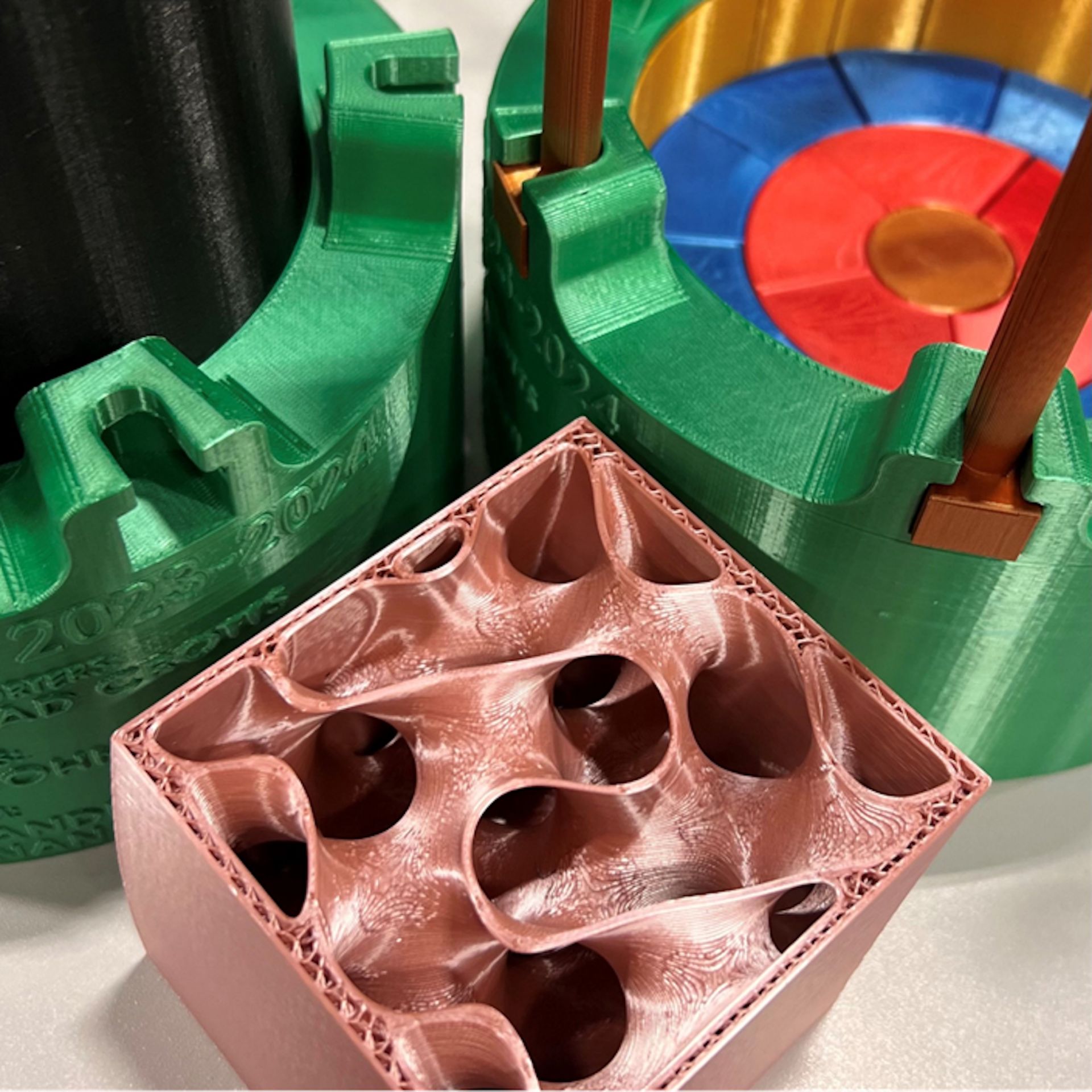
    AM PLA plastic scaled replica of an impact limiter (1/12 scale) with 36 bricks (red, blue, and gold) and stainless steel cladding (green) and gyroid infill pattern in foreground (pink).

    On the other hand, the qualification process should be made easier precisely because the R&D is related to a DOE objective. As Vanesa Listek described in her excellent article on the many ways 3D printing contributed to the Artemis II launch, AM tends to prove most viable when its use is supported by the combination of public and private funding to solve a complex of technological problems over a lengthy timeframe.

    Nuclear energy can be thought of as a space program that doesn’t leave orbit. It’s one of those quintessential technological arenas that has never existed, and probably can’t/shouldn’t exist, without heavy government involvement. That’s exactly the sort of context that calls for a publicly funded qualification accelerator program.

    That is the case, especially given the value inherent in recycling SNF. In addition to its potential viability as a future fuel source, the material can also be used for a growing number of applications, including medical treatment. That provides an additional incentive for the government to expedite the process, enabling the use of new manufacturing techniques for SNF transportation.

    Finally, as the entire AM industry has benefited from the knock-on effects of federal funding for accelerated standardization in the defense sector, the entire industry would benefit from a concentrated effort to expand AM use in nuclear energy. Given all the government money already spent on R&D for nuclear submarines, there’s even greater potential to combine those two goals.

    Images courtesy of Radwaste Solutions/ American Nuclear Society

  • 3D Printing News Briefs, April 8, 2026: LiDAR Scanning, Vapor Smoothing, FDM Optimization, & More

    We’ll kick off today’s 3D Printing News Briefs with some 3D scanning news from Artec 3D, and then move on to new America Makes Project Calls. Then, Raise3D and AMT are partnering for post-processing, and amsight launched a new website. Finally, we’ll end with a new tool that offers AI-generated optimization reports for FDM 3D printers.

    Artec 3D Debuts SLAM-Powered LiDAR Scanner at Manufacturing World Nagoya

    Artec Jet

    At Manufacturing World Nagoya, which kicked off in Japan today, Artec 3D is launching its newest scanner, the Artec Jet: a powerful, survey-grade, SLAM-based LiDAR system for autonomous and precise 3D data capture at scale. The company says this fast, versatile scanner pairs high-density LiDAR sensors with SLAM positioning algorithms to capture large areas with an accuracy of ±10 mm indoors and underground, including in GPS-denied environments that traditional 3D mapping technologies can’t handle. Weighing in at just 1.57 kg, it’s said to offer a 360° x 290° field of view, a companion app for real-time feedback, IP65 dust and water protection, and autonomous flight control. In fact, one of the best-sounding features is the Artec Jet’s ability to scan fully autonomously, without human input, onboard a drone—independently mapping its own flight paths, maintaining stable positioning, and avoiding very small obstacles. The scanner is deployable by hand, vehicle, and drone, and used with Artec 3D’s new Artec Twins software, the company’s ecosystem can capture accurate digital twins on any scale.

    “With Artec Jet, we’re entering an exciting new chapter. Our mission has always been to make 3D scanning as fast, accurate, and intuitive as possible. Artec Jet expands this approach into larger environments, empowering our customers to capture infrastructure with the same level of confidence and ease,” said Art Yukhin, President and CEO of Artec 3D. “This incredibly versatile device brings unprecedented speed, precision, and autonomy to reality capture at scale.”

    Come hear more about the Artec Jet at the Data Design Booth 15-103, Hall 1. 3DPrint.com is a proud Media Partner of Manufacturing World Nagoya.

    America Makes and NCDMM Announces Two Project Calls

    Last week, America Makes and the National Center for Defense Manufacturing and Machining (NCDMM) launched their latest two Project Calls. Both are funded by the Office of the Under Secretary of Defense, Manufacturing Technology Office (OSD ManTech), and are worth a combined $14.5 million in funding. The first is the $9 million Delta Qual 2.0, which is focused on addressing key AM qualification challenges across the Defense Industrial Base to support Department of War (DoW) objectives for advanced manufacturing solutions. This will happen by streamlining the requirements for testing, increasing processing parameters flexibility, and making machine installation standards stronger. There will be three topic areas for Delta Qual 2.0, and participants are expected to deliver outcomes that can provide mutual value to the DoW and Organic Industrial Base (OIB), as well as “actionable insights” that can decrease both industrial and technical risk.

    The second Project Call, worth $5.5 million in funding and consisting of two phases, is Generation Of Technical-data for High-strength Aluminum Alloy Material, or GOTHAAM. The focus is developing material allowables, over three classes of laser powder bed fusion (LPBF), for a high-strength 7075-T73-equivalent aluminum alloy. By coming up with an aerospace-grade, corrosion-resistant alloy with both commercial and defense applications, this will enable scalable production of all sizes of 3D printers, and could generate a strong ROI for OEMs and the OIB as the material transitions into qualified production. Main priorities include characterizing the alloy’s environmental durability, stress-corrosion cracking behavior, and fatigue-crack growth performance, to make sure the aluminum alloy is able to support high-strength, long-life structural applications. Proposals for both Delta Qual 2.0 and GOTHAAM are due by 5 pm ET on June 2, 2026.

    Raise3D & AMT Bringing Post-Processing to RMS220 Customers in Europe

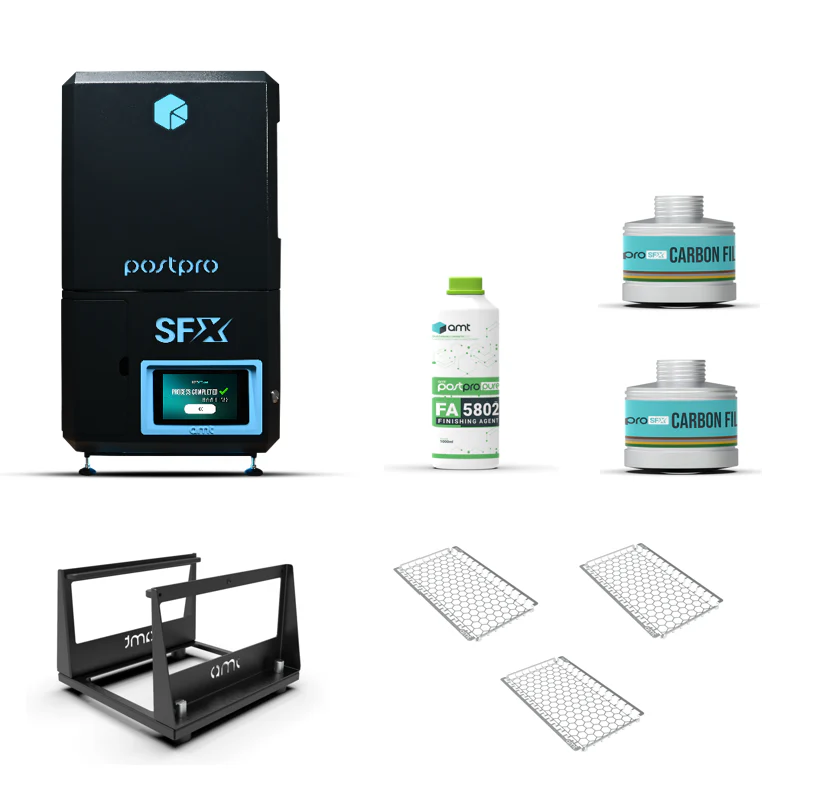
    Raise3D AMT PostPro SFX Starter Bundle

    3D printer manufacturer Raise3D announced that it’s partnering with Additive Manufacturing Technologies (AMT) to enable production-ready SLS workflows. As part of their agreement, Raise3D will offer AMT’s vapor smoothing solutions, including the current SFX and upcoming SF2X systems, to its clients in Europe. This will bring professional post-processing abilities to Raise3D’s RMS220 SLS 3D printer, and allow customers to efficiently print functional end-use parts with high-quality surface finishes. Raise3D’s AMT PostPro SFX Starter Bundle offers pre-configured AMT systems that are compatible with Raise3D powder materials. The €17,999.00 bundle includes a one-year warranty, one PostPro SFX—providing improved capacity for processing large builds—with PostPro Pure solvent cartridges, one storage stand, three processing racks, one cartridge of FA5802 finishing agent, and two air filters.

    “Our partnership with Additive Manufacturing Technologies (AMT) completes our additive manufacturing workflow with advanced post-processing capabilities. AMT’s powerful yet user-friendly systems deliver industry-leading surface finishing and perfectly complement the large build volume of our RMS220,” said Fernando Hernandez, SLS Product Marketing Manager – Europe at Raise3D.

    “This collaboration represents another step toward our goal of delivering a complete, end-to-end additive manufacturing solution.”

    As Quality Management for AM Matures, amsight Launches New Website

    As its production-level quality management system (QMS) continues to mature, Fraunhofer spin-out amsight has launched a new website that reflects its evolution as a company. amsight is focused on data-driven quality management for additive, and developed production-level QM software for AM. Instead of presenting its offering as a generic platform, the new site structures content by use case, including traceable production data and automated documentation; proving part conformity with standardized, audit-ready reports; and process/machine qualification supported by SPC and IQ/OQ/PQ evidence. The homepage helps guide visitors to solutions, showcasing real-world use cases and quantified results, and an integrated ROI calculator helps them estimate the impact of switching to amsight’s QM software. The site’s Resources section was also revamped, and separates lengthy whitepapers and guides from shorter insights.

    “Our customers aren’t looking for another dashboard. They need a reliable way to link powder, builds, post-processing, and inspection into one quality backbone that connects to their machines, MES, and ERP systems. The new website is our way of showing, in concrete terms, how amsight fills that gap,” explained amsight CEO and Co-Founder Tim Wischeropp.

    “With this site, we wanted to make two things obvious. First, that amsight is an AM-specific quality management software, not a replacement for ERP or MES. Second, that data-driven quality isn’t a future vision, it’s already working today in space, aerospace, and semiconductor supply chains.”

    BambuTune’s AI-Generated FDM Printer Optimization Reports

    Screenshot of BambuTune sample report

    On its website, BambuTune, an autonomous AI company powered by NanoCorp, claims to offer “AI-powered print optimization for every FDM 3D printer.” This tool generates personalized optimization reports for a variety of FDM printer brands, from consumer to professional. The website says BambuTune supports over 70 printers across more than 16 brands, including Elegoo, Creality, Bambu Lab, Snapmaker, Prusa, Flashforge, Qidi Tech, AnkerMake, Longer, and more. It sounds simple enough: users select their printer model, filament type, and settings, and describe the issue they’re having. Then, the AI-driven tool compares your settings to community-validated recommendations, and spits out a detailed report that includes specific recommendations, covering things like retraction tuning, temperature optimization, speed settings, flow rate precision, and more. You can see a sample report for a Bambu P1S here.

    “Our AI optimization engine draws on community-validated settings and expert knowledge across the entire FDM ecosystem — from budget Ender-3s to premium Bambu Lab X1Cs. We know what works for every printer,” the website states.

    It costs $4.99 for one report, or an Early Bird rate of $14.99 a month for unlimited reports. BambuTune also orders a “100% Money-Back Guarantee,” no questions asked, “if our tips don’t save you filament.”

  • When Creativity Has Meaning: How Young Makers Create Real Impact

    Some children discover the world early. Others discover how to reshape it.

    Across communities, a growing number of young creators are using technology not just to develop skills or earn money, but also to support families, care for friends, and address real emotional needs. This shift from making for profit to making for meaning is at the center of When Young Minds Create, a youth-focused maker program supported by Creality.

    Positioned as a community‑centric youth movement rather than a traditional education or business program, the initiative encourages children to treat creativity as a form of responsibility, empathy, and social contribution. Technology is a tool, and human impact is the goal.

    Within weeks of launch, the program attracted nearly 200 young participants worldwide. While their projects varied widely, a common pattern quickly emerged: most were designed with specific people and needs in mind. Through in-depth conversations with more than 40 young makers, the program revealed how creativity is shaping people’s real lives.

    Many participants have already taken their work beyond their homes, setting up booths at local markets, sharing creations with classmates, and offering customized designs within their communities. In these settings, technology becomes a means of connection and expression rather than an end in itself.

    Ealan and Taleah: Learning Responsibility Through Making

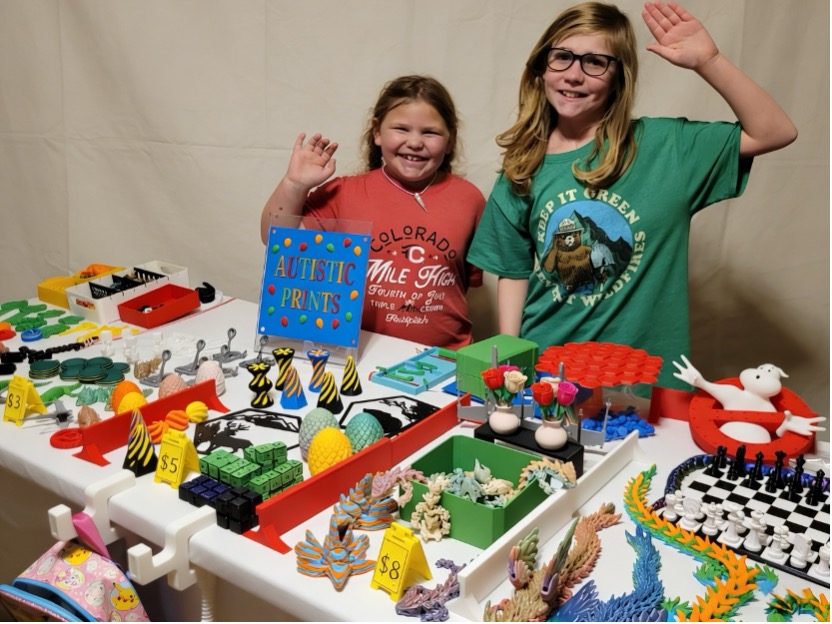
    Ealan and Taleah with their Autistic Prints.

    When Ealan and his sister Taleah first started selling their 3D printed items, their goal was simple and familiar to many kids their age: save enough money for a new game console.

    That plan changed quickly. After their father unexpectedly lost his job, the siblings made a quiet but meaningful decision. Instead of saving money for themselves, they chose to use their earnings to help support their family.

    What began as a hobby suddenly carried a deeper purpose.

    The two siblings soon discovered how naturally their strengths complemented each other. Ealan enjoys designing and experimenting with new models, while Taleah thrives when interacting with customers and explaining their creations.

    Running their booth also helped Ealan overcome challenges beyond design. Living with autism, ADHD, and a rare skin condition that makes him prone to overheating, he often finds new environments and social interactions difficult. But when visitors ask about the designs, he enjoys explaining how the ideas came together, and those conversations are gradually building his confidence.

    Taleah continues to design customized pieces, often creating small gifts for friends and classmates. Her encouragement has helped her brother grow more comfortable sharing his ideas.

    Together, their experience shows how creativity can become more than a hobby. It can become a way for young people to support the people who matter most to them.

    HUGO: Engineering Solutions on the Track

    Hugo is participating in the Kart Race.

    A karting track is never only about speed. For Hugo, a young karting racer who spends much of his time around the track and paddock, it is also a place full of problems waiting to be solved.

    While watching mechanics and racers prepare their karts, he began noticing small inefficiencies that others often overlooked — tools that were difficult to reach, tangled cables, and components that wore down quickly.

    To most people, these details were simply part of racing life. To Hugo, they were opportunities for better design.

    Using 3D printing, Hugo started transforming his ideas into practical solutions. By designing and producing parts such as invented brake covers and battery-box components for wet conditions, he has been able to test improvements directly on the track.

    The ability to prototype quickly has allowed him to refine his designs and share them with other racers and mechanics, turning simple observations into usable engineering solutions.

    Dahlia: Creating for Calm, Care, and Emotional Well-Being

    Dahlia with her Doodles and Daydreams Studio.

    Dahlia’s project began with someone very close to her heart. Her best friend, Everly, had spent more than five months in a children’s hospital nearly five hours away from home.

    Wanting to help in some way, Dahlia began designing small tactile objects to comfort children experiencing anxiety or stress. Her creations include finger fidgets, spiral puzzles, calming stones, and simple classroom tools designed to support emotional regulation.

    Her empathy comes from personal experience: her brother also faces sensory challenges, and she has seen firsthand how such tools can support focus and emotional well-being.

    Through these designs, Dahlia aims to create small but meaningful tools that children can turn to whenever they need comfort, focus, or reassurance, demonstrating how creativity can translate empathy into tangible support.

    Technology as a Means, Not the Message

    Within When Young Minds Create, success is not measured by output volume or technical complexity. Instead, attention is placed on confidence gained, empathy expressed, and responsibility assumed.

    As more stories emerge, the program reveals a simple truth: when creativity carries purpose, its impact extends far beyond what is printed.

    Images courtesy of Creality

  • HADDY’s Large-Format Robotic 3D Printing to Power Red Cat’s Drone Boat Production

    In May 2025, Joris Peels, as is his custom, wrote a prescient article about Unmanned Surface Vehicles (USVs) and Unmanned Underwater Vehicles (UUVs), i.e., drone boats. Listing a multifaceted range of cost advantages that maritime drones could yield compared with conventional maritime defense systems, Joris concluded that autonomous systems presented genuine potential to disrupt the world’s existing balance of naval power.

    In 2026, of course, the US Navy is using drone boats in active conflict for the first time as part of operations in the war in Iran, and Iran’s success at maintaining an effective blockade in the Strait of Hormuz depends in no small part on kamikaze drone boats. Meanwhile, the US Navy recently announced it is setting up a marketplace for medium USVs.

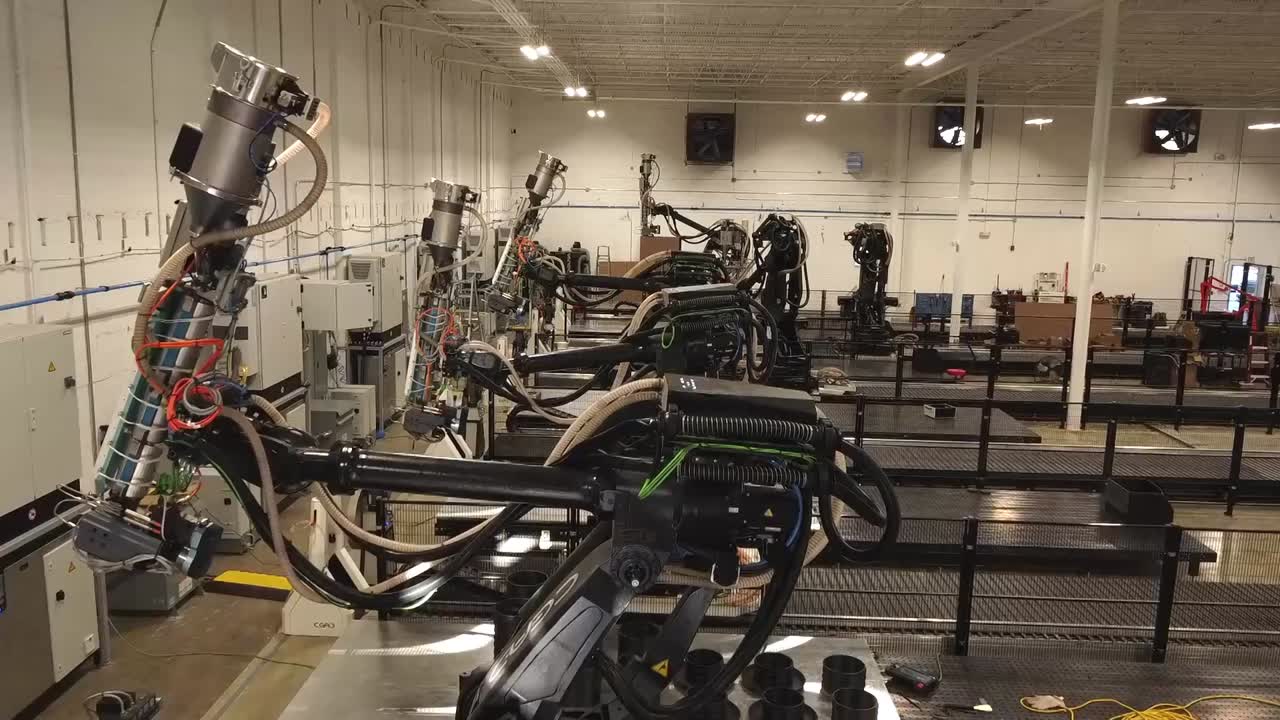
    This is the context behind Red Cat Holdings, the Salt Lake City-based manufacturer of autonomous defense systems, forming a partnership between its maritime division, Blue Ops, and Florida’s HADDY, a contract manufacturer leveraging robotic-arm 3D printers to produce large-format components. Under the deal, HADDY will equip Blue Ops’ Valdosta, Georgia, production site with its robotic additive manufacturing (AM) systems enhanced with Agentic AI.

    According to Red Cat, the move will double Blue Ops’ existing manufacturing capacity, while HADDY will also give the division the option to continue to scale production through the contract manufacturer’s own network. In addition to enabling faster production timelines and the performance improvement associated with quicker iteration cycles, Blue Ops aims to provide on-demand order fulfillment for its customers.

    HADDY is one of a number of companies that have benefited over the last couple of years from the growing viability of, and resultant increasing market interest in, the combination of robotic arms and extrusion printheads. In July of last year, HADDY was one of four startups chosen to participate in the Disney Accelerator program.

    In a press release about the partnership between Red Cat’s Blue Ops maritime division and HADDY, Barry Hinckley, the president of Blue Ops, said, “This partnership advances our ability to iterate at the speed of modern conflict. This also underscores a shift in how boats are built. The industry has seen moments like this when fiberglass replaced wood, and we’re seeing a similar transition now with large-scale 3D printing. This fundamentally changes how quickly we can move from concept to deployment and gives us the ability to meet demand at scale in ways the industry hasn’t seen before.”

    Jay Rogers, HADDY’s co-founder and CEO, said, “Manufacturing is moving toward a more distributed and scalable model, and large-scale robotic 3D printing is a key part of that shift. By combining production technology with a global microfactory network, we can build complex systems more efficiently and closer to where they are needed. Blue Ops is early in applying this approach to maritime systems, and it has the potential to reshape how these platforms are produced and deployed.”

    HADDY’s St. Petersburg facility. Image courtesy of HADDY

    In the press release, Blue Ops’ president also noted that cybersecurity was a factor in the company’s decision to select HADDY as a partner. It is inevitable that IP protection and overall OpSec will play an increasingly primary role in how companies leveraging AM choose their partners.

    With that in mind, it has probably gone under-appreciated, the extent to which cybersecurity considerations may, on their own, accelerate interest in reshoring. Even as all stages of contemporary manufacturing workflow become more digitalized — on the one hand, opening up the potential for more far-flung supplier relationships than ever before — on the other hand, manufacturers are obviously going to want to establish close-knit relationships with any partner that has comprehensive access to their data.

    Thus, in the early phases of distributed manufacturing, it’s probable that we’ll see more and more partnerships like the one between HADDY and Red Cat/Blue Ops, where manufacturing relationships become both more localized and more distributed simultaneously. This is particularly likely given that the sectors most responsible for driving reshoring interest are already the most strategically critical.

    In the same vein, the next five years of demand drivers for manufactured goods in a nation like the US will go a long way towards defining the interests of the next generation of US manufacturing personnel. That is, in the same way that a nation experiencing an automotive boom in the 1950s had a broader manufacturing sector for the rest of the 20th century that was disproportionately shaped by the auto sector, the minds currently getting started in manufacturing by making drones with 3D printers could shape US manufacturing for the rest of the 21st century.

    Featured image courtesy of Red Cat

  • Metal Base & Scrap Labs Usher in A Ultra Low Cost Sub-$10,000 Metal LPBF Evolution

    Dutch firm Metal Base started a low-cost metal LPBF revolution last month. An ultra-low-cost metal laser powder bed fusion system was engineered by Tom Bakker. With a direct path to the powder bed and superior airflow, the value-engineered system debuted at under $10,000. Many were incredulous, but engineer Tom had already sold six systems to beta customers, and they had been running for months at customer sites and maybe even more surprisingly, homes. Since then, Metal Base has raised €93,870. The initial goal was €51,000, and now the firm is 42,870 over that. This means that rather than being a fanciful dream, the Metal Base LPBF system has six units up and running with customers and now has a funded Kickstarter that will see 23 more being built. Tom wanted 20 systems initially, so this is exactly the success he wanted. This will let him take the next step in refining the system.

    Now, US-based Scrap Labs wants to join the fray. Boulder-based Scrap Labs plans to debut its system at the Rocky Mountain RepRap Festival (RMRRF) in mid-April this year. That team wants to offer a pre-order for a kit at $14,990, with a fully assembled 3D printer at $17,990. The company wants to ship systems in 2027. Their Scrap 1 3D printer will go on sale in 2027.


    The system is reported to have a 100 x 100 x 100 mm a 200W laser at 915 nm and be able to make layers between 20-100 um. There’s a HEPA filter, and it’s built on top of Klipper, while the slicers are PrusaSlicer, OrcaSlicer, and their own flavor, ScrapSlicer. The company wants to offer stainless steel, tool steel, copper, nickel alloys, and cobalt-chrome (CoCr). Now I’m intensely skeptical about the copper. Also, you should know that leftover powder can trigger thermite reactions with other powders and cause metal fume fever. I’m thinking that this will be dangerous to do. Furthermore, there is an oxidation risk. Nickel is a 2B carcinogen.

    CobaltChrome LPBF Powder is a Presumed Human Carcinogen

    But the idea of 3D printing cobalt chrome (CoCr) on a home machine is one of the stupidest things I’ve ever heard. Cobalt Chrome powder is a skin irritant, leads to skin sensitization, causes allergic contact dermatitis, is a carcinogen, and causes respiratory disease. Cobalt chrome powder has been known to cause lung cancer. A study specifically on the “Dermal exposure and surface contamination associated with the use of a cobalt-chrome alloy during additive manufacturing” concluded that,

    “These metals were also detected on the skin of AM operators and on surfaces within the AM and non-AM areas of the facility. Dermal exposure occurred on all of the anatomical areas, with the highest total metal concentration detected on the index finger during the post-processing phase of AM. Surface contamination occurred on all AM and non-AM sampling areas after a full shift.”

    Cobalt chrome is a presumed human carcinogen, classified as a 1B carcinogen, and is known to be reprotoxic. In case of a fire or explosion, the oxide fumes are carcinogenic.

    Since we know that cobalt-chrome in dental restorations and implants releases ions that provoke “cytotoxic, oxidative, and inflammatory responses at both cellular and systemic levels.” So the question arises, why would you use it? If it’s not for dental, then why? And if you are using it for dental, is that a good idea? Why not use stainless steel or another material instead? Usually, this kind of thing would make me completely not write about the firm. This is irresponsible and unnecessary. But one of the founders is Matt Woods, who co-founded Xact Metal. His experience there gives him a unique insight into working with sub-$100,000 systems, a category that Xact pioneered. I really hope that Scrap Labs becomes more safety-conscious. Some of the other safer materials, coupled with a $15,000 printer, should be exciting enough. There’s no need to kill people to flesh out your pitch.

    Why is this happening?

    With Scrap Labs and Metal Base, the ultra-low cost category of LPBF metal systems now has two entrants. Rather surprisingly, none of them is Chinese. Whereas several Chinese firms are active in the $25,000 to $100K category, the entry-level category now consists of a European and US-based player. To me, this is very exciting. Hardware innovation was becoming a Chinese-only affair; it would be good to see it become more of a global competition.

    The cross-fertilization from the desktop market is also notable. Klipper, OrcaSlicer, and a motion stage derived from material extrusion seem to be driving both participants’ efforts. This could mean more people who are used to working with these tools could join the fray. It also makes it more likely that established Material Extrusion firms may consider this someday. The Material Extrusion volume is unlocking opportunities in hardware platforms. Importantly, however, we can see that open-source software packages are driving innovation. Without Klipper and Orca, these teams would need to do lots more work.

    An increase in the capabilities of low-cost lasers and new diode laser forms are the real forces behind the throne here. And I’m going on a limb here, guessing the lasers will probably be Chinese. That is the real wave that is pushing this forward, the same wave that previously made it possible for Sinterit, Sintratec, and Formlabs to make accessible polymer LPBF systems.

    What is significant here?

    These are both companies that seem engineering-driven. Small headcounts and crowdfunding are used to get the printer off the ground. This isn’t a 40X, growthacker, raise 200 million world. Times have changed, and founders have too. Both firms, for now, seem focused on the product and getting it out there. If these systems work and more people will become interested, then improved, value-engineered, more stable future systems from companies like these are likely to drive growth in metal laser powder bed fusion.

    But it’s not going to compete with the existing LPBF market; instead, it will enable a whole new market of users to join the additive space and drive up system numbers. It would be very good for existing powder bed firms to look at this. Heck, I’d love it if they developed $100,000 systems. These segments will be where the growth is, where the huge number of businesses that want metal things can be found. This will enable thousands of applications we cannot touch now: fasteners, connectors, inventions, aftermarket car parts, and more. The larger firms will not be interested, but what about the even larger ones?

    Imagine you’re Formlabs? I’d get a couple of people to try to make me a bodged-up one to see if we could do it if I were them. Formlabs’ eventual entry into this space would accelerate adoption significantly. Bambu could do this as a side project, too. These firms are much more agile and experimental than the established LPBF firms. I’m sure that we will see more startups like this. This could be a momentous development and one of the most significant things to happen in additive manufacturing.

  • Resetting the Role of AM in Defense, and the Role of Defense in the Economy

    The Trump administration recently revealed that it is requesting a $1.5 trillion defense budget for FY2027, confirming Trump’s initial announcement of that topline number at the beginning of 2026. So far, only the broad strokes are publicly available, but there’s enough there to get the gist of what the administration wants.

    One would think that the additive manufacturing (AM) industry is in a better position than ever to make the case that policymakers should continue to increase prioritization of AM, but nothing involving the defense budget is ever straightforward. Before the $1.5 trillion was ever officially announced, Matt Vallone, a defense market intelligence analyst who has experience working in the US Congress, wrote an article, “Why a $1.5 Trillion Defense Budget Request Might Slow the Pentagon’s Reform Efforts”, which highlights the maddening amount of complexity underlying the process.

    First off, it should be noted that, according to Vallone, the roughly 50 percent year-over-year increase in the defense budget that the Trump administration is requesting “would be the largest increase in defense spending since the Korean War…” All of the difficulties involved in getting the bill passed, as well as in trying to determine how the bill might affect relevant industries like AM, largely stem from this historic increase, alongside the fact that it’s being requested during a war that, so far, gets more unpopular with Americans by the day.

    Then, there are also the realities that the US is spending more on servicing the debt than ever before — since 2024, the US has indeed spent more on debt interest payments than it has on defense — and the Congress is more divided along partisan lines than ever before, which has already made passing a budget on time virtually impossible for the US government. Vallone points out that, under these sorts of conditions, it is the disruptors who are likely to suffer the most:

    “It would be reasonable to expect that the FY2027 request will put significant funding into the priority areas and would seek to make these programs as accessible as possible to non-traditional defense providers. …

    …However, submitting a request that will likely be subject to such significant cuts will play to the advantage of traditional defense suppliers. In what will almost certainly be epic lobbying battles across the FY2027 National Defense Authorization Act and the defense appropriations bill, programs that have hot production lines, employees who are actual constituents, and established Congressional relationships will be much better positioned. …New startups and novel solutions would be back-footed relative to incumbents as they lack the on-the-ground support of existing, rather than potential, workforces.”

    Essentially, Vallone is arguing that by asking for such a large increase upfront, the Trump administration will likely end up seeing a good chunk of that number cut. That’s not a problem on its own, but because it would leave members of Congress in control of deciding which parts of the budget request fall by the wayside, the companies with existing Congressional relationships — generally those who prefer the status quo — will disproportionately benefit. Vallone draws a comparison to the Obama administration’s second term:

    “…a high budget number followed by much lower appropriations can impact the capital flow into the sector. …in 2013, a sharp drop in contracting relative to expectations led to deep uncertainty and investors pulling back. Small businesses that staff up under the impression that they are in the budgetary program of record, only to see their line item slashed to sustainment levels, will face difficulties paying bills and justifying future rounds of investment.”

    Of course, this is exactly the kind of difficulty that has long plagued AM companies working with the US military. It is especially frustrating under current circumstances because it threatens to stifle one of the rare publicly available instances of good planning by the US military in the lead-up to Iran: its pivot towards incorporating lower-cost weapons systems enabled by advanced manufacturing techniques, including AM.

    Image courtesy of Frankenburg Technologies, via Chosun Daily.

    A recent article in Korea’s Chosun Daily describes how the Trump administration has built on the Biden administration’s focus on developing the capabilities to produce cheaper drones, as well as developing lower-cost missiles for countering cheap enemy drones, in large part via 3D printing:

    “Estonia-based startup Frankenburg Technologies, observing Russia sending Iran’s Shahed drones during the Ukraine war, is developing a missile capable of speeds over 600 miles per hour (approximately 965 km/h). While its range is short at up to 1 mile (approximately 1.6 km), it has the advantage of costing tens of thousands of dollars in the low range and taking only a few hours to manufacture. European missile companies MBDA, Sweden’s Saab, and Cambridge Aerospace have also joined the competition. They simplify manufacturing by using 3D printing and AI design instead of complex manual labor, reducing costs by using commercial components found in smartphones and home appliances instead of expensive missile-specific parts.”

    The article cites a 2024 Axios article that quotes Bill LaPlante, Under Secretary of Defense for Acquisition and Sustainment in the Biden Administration, testifying to a Senate subcommittee about the Houthis drone capabilities:

    “If we’re shooting down a $50,000 one-way drone with a $3 million missile, that’s not a good cost equation. The technology is changing every couple of weeks, and the tactics are changing, and it’s going to be a constant fight.”

    Obviously, LaPlante’s comment could’ve just as easily been a direct response to what’s happening on the ground in the Middle East right now.

    Testing the SPARTA drone. Screenshot from ARL/YouTube, via NextGenDefense.

    Meanwhile, beyond private enterprise, the US military’s own manufacturing strategies have also benefited from incorporating AM as a core philosophical principle rather than simply as a new production technique. All throughout last year, the US Army was steadily building up its AM capacity, but it was also simultaneously refining that capacity into the cornerstone of a holistic framework for lowering the costs of workforce training. The Army has succeeded in leveraging that framework to respond more quickly to organizational needs as they arise, to the extent that the branch can factor feedback from soldiers on the frontline into the design process. That’s the story behind the SPARTA (Soldier Portable Autonomous Reconnaissance Transitioning Aircraft) drone that was unveiled recently at Alabama’s Best Drone Warfighter Competition.

    The SPARTA weighs a little over two pounds and, with a frame that can be 3D printed overnight, it’s around $1000 per unit:

    “Our team at ARL has been working on new types of small unmanned aerial system designs for several years,” Army Research Laboratory (ARL) Mechanical Engineer Dr. John Hrynuk said in an Army press release. “When soldiers visited ARL last spring, they expressed the need for a lightweight, modular drone that could be easily assembled, repaired, and adapted in the field.”

    Whatever ends up happening with the FY2027 budget, the Army’s AM-enabled innovation boost has already been enhanced in 2026 by the opening of a new Additive Makerspace at Picatinny Arsenal in New Jersey. Similar facilities, including the II Marine Expeditionary Force (MEF) Campus at Camp Lejeune, have yielded numerous examples of real cost savings for the military, while also harnessing and encouraging innovation within Army ranks.

    Image courtesy of the US Army.

    The Iran conflict is already demonstrating that the US should be moving further in the direction of cost reduction that supports long-term agility, and away from locking the budget in on commitments to questionable behemoths like the F-35, which is everyone’s favorite punching bag for good reason, but is also far from the only example of the Pentagon sticking with an outdated spending strategy. It should also be pointed out that, due to successive generations of endless drift and unabashed bloat, the US defense budget has effectively become a threat to US national security, not only by spending on the wrong things when it comes to defense, but equally, because the US is having trouble affording everything else that a government should be providing for its taxpayers.

    Trump did an excellent job highlighting this himself when he made a comment that already seems likely to define his second term: “We can’t take care of day care. We’re a big country. We have 50 states. We have all these other people. We’re fighting wars. ..We have to take care of one thing. Military protection. We have to guard the country.”

    The moment Netanyahu and Trump decided to start a war with Iran, the decision about whether the war would end was no longer in their hands. Similarly, once Trump’s comments at a White House luncheon about the military budget were leaked to the press, the debate over the budget was no longer in the hands of the executive branch. This gives the disruptors, including the AM industry, a crucial opening they wouldn’t have had otherwise. As may be expected, Democrats, who are currently anticipated to take control of Congress after this year’s midterm elections, have pushed back hard on the White House’s budget request, but so have Republicans. If the AM industry can organize and campaign members of Congress with the legitimate argument that AM can and should be used as a spending reduction tool, the status quo might not steamroll its opposition as it has in the past.

    At the same time, AM companies should treat the morass of the process as an opportunity to rethink their dependence on the defense sector. A primary point to consider is that you don’t even have to forego targeting government money as a pillar of your business strategy: you can simply refocus on sectors like energy, medical, semiconductors, etc., instead. Something along the lines of, “If we can quantify all the savings AM yields in the defense budget, that money should be set aside for AM spending by other agencies, which could lead to additional savings,” has the makings of an argument that could actually win in 2026.

    Disruptors don’t get an opening at the public policy level like the one that looks to be on the horizon for the next few years. If such an opening does appear, don’t waste it.

    Featured image: Groundbreaking of the Additive Makerspace at Picatinny Arsenal, Courtesy of the US Army

  • DTU 3D Prints New Fuel Cell Design With 5x Power Boost

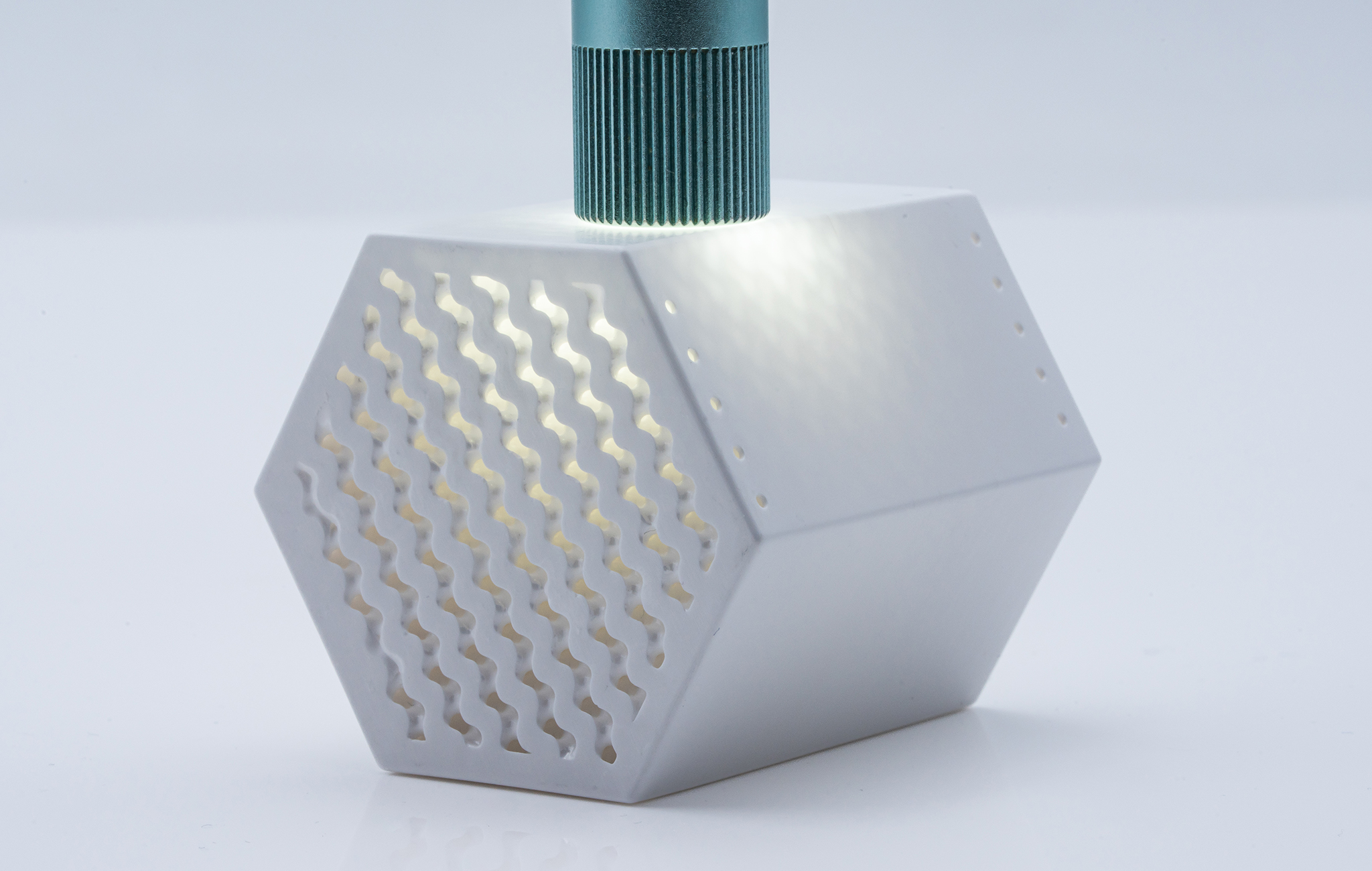
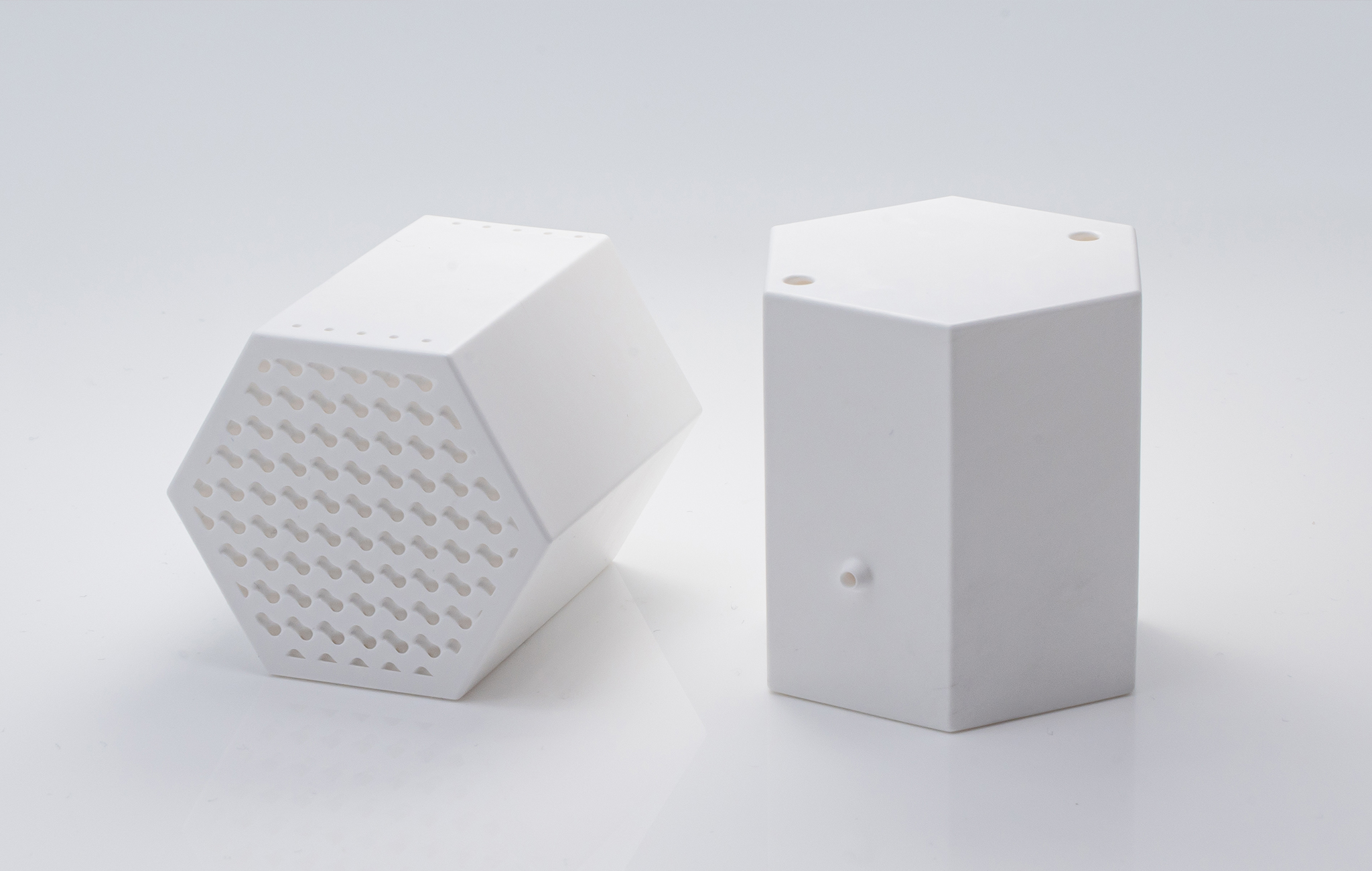
    Technical University of Denmark (DTU) researchers have used Lithoz ceramics 3D printing to make more efficient hydrogen fuel cells. With a part made from Lithoz Yttria Fully Stabilized Zirconia (8YSZ), a thin-walled component saw a 500% increase in power-to-weight ratio. The part in question is a Solid Oxide Fuel Cell. Conveniently hobbled by the wondrously easy-to-pronounce acronym SOFC (because we’re sofc’ed if we don’t do this?), turn hydrogen into electricity. SOFC typically has multiple layers, including a porous cathode and a dense electrolyte. When heated to temperatures above 500 °C, oxygen ions are created and migrate through the electrolyte. At the anode, the fuel is oxidized, giving off water and electrons. Given the immense amount of heat and stress, ceramics are the go-to materials for these devices.

    DTU SOFC.

    Porosity, geometry, and flow are critical in this application, making it ideal for additive manufacturing. In this case, the team used LCM, Lithoz’s DLP-based doped resin 3D printing technology.was used to make the units. Used in home and industrial heating, with potential applications in future transport, this could be an important milestone for Lithoz and the DTU.

    The research project by the Department of Energy Conversion and Storage at DTU Energy, led by Professor Vincenzo Esposito, is called “Escape Flatland.” Instead of the usual stacked setup, a single monolithic fuel cell was made. The team wishes to scale up production for this gyroid-shaped cell, saying that the unit “demonstrates power-to-weight ratios approaching around 1 W g−1, compared to around 0.2 W g−1 typical of conventional planar SOFC architectures.”

    Professor Esposito says that,

    “This innovation is a real paradigm shift from planar stacking to monolithic architectures.”

    The design allows for a far more efficient shape, with the “combination of thin inner walls and elimination of interconnects and sealants resulting in a drastic loss of weight, reduced thermal mismatch and mechanical stress, all while significantly improving the utilization of the available volume.”

    This is essentially the same case as we have seen in thermal management applications such as heat exchangers. With better performance, this could be a viable application. The team thinks that this type of SOFC will most likely be used in transport applications.

    DTU SOFC.

    Esposito continues,

    “Our motto, ‘Escaping Flatland, ‘ sounds like a logical step, but it has long been impossible to achieve. The particular arrangement of materials and microstructures requires a significantly elevated level of complexity – but until recently, we simply lacked the tool to make this concept a reality. 8YSZ remains one of the most widely used and technologically mature electrolyte materials for SOFCs. With its mature precision and scalability, Lithoz LCM technology has demonstrated the highest repeatability for these bio-inspired TPMS geometries with the thinnest possible inner walls, which inherently meet the gas supply requirements. The monolithic concept could only be achieved by precisely replicating those gyroid units and adding a sealed shell frame to maintain gastight conditions.”

    While Lithoz CEO Johannes Homa states

    “By realizing 8YSZ monolithic fuel cells with intricate gyroid geometries on their Lithoz CeraFab printer, DTU was able to reduce the dependence on conventional interconnect and sealing architectures inherent to stacked flat items. These elements have traditionally been the Achilles heel in the search for better power density in commercial planar SOFC stacks and, therefore, the traditional focus of attention in the quest for a more advantageous power-to-weight ratio. With their revolutionary monolithic concept, these elements eliminate the need to gradually optimize exit points, paving the way for a complete rethinking of fuel cell design. Of course, we are extremely excited about the impact this will have on the worldwide hydrogen-based industry.”

    This seems like a great step forward, and it could become a sizable application in a possible future hydrogen economy. How prevalent hydrogen will become in the energy mix is not known for certain. Currently, geopolitical events in the Gulf make a hydrogen economy seem like a very investable thing indeed. With higher oil prices and instability, more governments will look to alternatives and ways to diversify their energy mix. Using hydrogen is kind of like using one battery technology, so this is perhaps limiting. But more broadly, there could be additional electrochemical processes that could benefit from more efficient, lightweight structures like this one.

    Images courtesy of Lithoz