• Analysis: Nano Dimension Sells Additive Manufactured Electronics Business

    Nano Dimension has sold its Additively Manufactured Electronics business to Inspira. The sale ¨includes intellectual property, proprietary high-precision 3D electronic printing systems, patented software, engineering know-how, manufacturing equipment, inventory, customer-related assets, and fully equipped facilities, including physics and chemistry laboratories and an ink manufacturing plant. Inspira has assumed control of the acquired assets and operations effective immediately.¨

    Inspira is paying $2 million now and may pay another $10.5 million in deferred performance related fees over the next year. The AME business is the core of the Nano Dimension offering and includes the Dragon Fly 3D printer, the Conductive Ink Dielectric Ink and other ink formulations, the dielectric and other polymer build materials, including all the software and the Fabrica product line. This means that Nano Dimension currently consists of the Essemtec SMT equipment, the Global Inkjet Systems inkjet business, holdings in MarkForged and binder jet firm Digital Metal.

    Inspira is a firm that makes ECMO equipment for oxygenation, especially in bypass and other surgical procedures. The firm also makes blood sensors. That medical division will be moved to a subsidiary.

    Inspira CEO Dagi Ben-Noon stated,

    “From my in-depth knowledge of the AME technology, this acquisition gives Inspira immediate control over a highly specialized advanced-manufacturing platform with proven infrastructure, engineering depth and production capabilities already in place. These assets can now be directed toward high-value applications that align with the next stage of the Company’s strategy.”

    Nano Dimension CEO David Stehlin said,

     “Today’s announcement marks the first of a series of steps to maximize shareholder value and builds on the cost reduction actions initiated in the third quarter of 2025. The sale of the AME and Fabrica product lines will lower our operating costs and cash burn while reinforcing financial flexibility, and the deferred consideration structure allows us to participate in potential upside as the product lines perform under Inspira’s ownership.”

    Is this a good deal for Inspira?

    It’s a bit of a leap to consider this an obvious deal for the medical device firm. DragonFly and 3D Printing technology is very complementary for ECMO. For ECMO thin walled, precision hole barrier systems are the key differentiator. The company could very well use Additive Electronics to make these better than others. At the same time it could leverage the business to make more electronic sensors for in the body.

    The obvious thing for them to do here is to become a platform for other firms to develop their technology on. You could use a DragonFly into the lab and then scale it with their services and infrastructure to make electronic biological hybrid medical devices. These could be small, well integrated and conformal. Another option would be to do something similar and be a  kind of a Amnovis, Tangible Solutions, kind of business. Someone could walk in the door with an invention and you could commercialize it completely. Each of these paths look potentially viable. Having said that, the extremely low purchase price here may have just made this an irresistible deal for them. If they ever sell a dozen systems it will make sense. Even if they would be planning on themselves buying a lot of systems the discount would also make this useful for them.

    What about for Nano Dimension?

    The deal is an absolute steal. Fabrica itself was acquired for $54 million in 2021 while theoretically the development of the technology was aided by subsequent investments. The other part of the AME platform is the core Nano Dimension technology which again was worth over a $1 billion at one point. It however looks ever more likely that Fabrica was a lot of the underpinnings of the Nano Dimension technology later on. Given that and Nano´s leading position in Additively Manufactured electronics, this looks like a cheap deal for Inspira. It is to me unclear what Nano Dimension wants to do now, unless they completely want to strip the company of all assets and return cash to investors. Or perhaps they could focus only on inkjet? This seems strange and a path to returning all the cash to investors seems more likely. Even then this seems like a particularly low price for Inspira.

    With reshoring a company focusing on SMT, inkjet systems and reshoring manufacturing could make a lot of sense. But, then I would have always kept the AME business.

    What about Markforged and Digital Metal?

    The parts not sold (inkjet and SMT business) make more sense as a unit with the AME business than the rest of Nano Dimension does. So it should be clear now to all that Markforged and Digital Metal are for sale. If you took Margforged and turned it into the US based ruggedized 3D printer manufacturer for energy & defense the business could grow. Through doing Material Extrusion well, through making bound ceramics and metal components for defense and through maybe adding more direct write there could be a booming business to be had. If the firm then leveraged its software to become a workflow for the individual warfighter it could really grow to be good business.

    The P100 metal binder jet system from Markforged via its Digital Metal acquisition. Image courtesy of Markforged.

    Defense spending on Additive is set to boom and exigent, austere or point of need manufacturing is set to boom as well. You´d have the formidable Prusa Research to contend with, they now make systems in the US, but there would be a lucrative, albeit limited space, for the two of you and then some.

    As for Digital Metal, their binder jet technology centers around a high value machine. But, the results are unparalleled with high volume production being done on these systems for decades now. If they were selling this asset then heck, I´d buy it at these prices. The combination with the MarkForged business still makes sense if they leverage their defense approach together and offer parts at scale there.

    What about DeepCube & AdditiveFlow?

    It’s hard to think of products that were as prescient as DeepCube and AdditiveFlow. Deep learning for manufacturing is something that you can currently raise tens of millions for. DeepCube´s $70 million acquisition price would be more than covered if a kind of AI for manufacturing product emerged. The company came up with locally running neural networks at the edge. The company had a brain in a box, automated model training and an inference engine for the edge as well as machine sensor monitoring.

    Give the right someone PowerPoint and that now and you can walk out of the meeting with a $300m valuation and $10 million. Acquired in 2021 that company was effectively closed in 2025. No DeepCube products are on offer and we are to expect that the magic sauce of DeepCube has permeated everything marinating the firm in AI. Additionally, the FLIGHT design suite along with simulation and optimization in and of itself was very viable indeed but this seems to be squarely in Inspira´s hands now.

    What does this mean for the industry?

    For additive in general this is another lesson in having the right management at the right time. It’s easy to get hopping to the rhythm of musical chairs and much more difficult to sit down at the right time. This is yet another reckoning. Another Alka Seltzer after the heady bacchanal that was a time of more than free money. It should not affect our course much but may retard growth in Additive Electronics specifically. investors may be more hesitant to back AME firms in light of this deal.

    But, AME´s potential is still huge while revues are slowly building. With the right technology & attitude very solid businesses in medical devices, research, defense and beyond can by built in AME right now. What’s more ancillary 3D printing capabilities in micro printing, complex devices and nano level developments could be unlocked as well. In a more sensor driven world where your phone is ever more crammed with technology AME applications are set to grow as well. For the patient this is a good opportunity. For Additive as a whole, I don´t think that this will impact everyone much. It’s also counter to the building investment we see in AME capabilities by governments worldwide.

    Conclusion

    Initially Nano Dimension was inflated by too much imagination. The dream told could probably never be fulfilled, and Cathy Wood fueled a bonfire. The sheer amount of money evaporated by the Nano Dimension sleigh ride is astounding. Now however I think that the firm does not have enough imagination.

    If it wants to stay in Additive then a split into a leader in Additive Electronics powered by AI and a Global inkjet, SMT & Markforged business should have netted them much more money than this. Just for an AI powered electronics 3D printing platform at a time of near limitless investment from semiconductor companies you could have gotten more. Also, in a time of increased sensors and huge anxiety around supply chains a spin out of a Global Inkjet, SMT & AME business should have been able to net you much more as well. A defense focused electronics, metal and polymer 3D printing business should also be able to find a home.

    But, even beyond this a supply chain focused electronics 3D printing, inkjet and polymer 3D printing business could win itself significant contracts right now. With some kind of magic the stars have aligned and fanciful investments in AI, electronics 3D printing and other technologies have lead to a perfectly plausible firm, in today’s age. With Hormuz closed, 3D printed drones dominating the battlefield, the US military might humbled and everyone scrambling for manufacturing sovereignty the formerly unwieldy Nano Dimension kind of looks like the right play.

    But, currently through not marketing well enough its capabilities and vision the company is doing itself a disservice. In a fractious world AI powered manufacturing assets providing independence should be able to find more capital and revenue. If Nano wants to sell everything and return cash, it can do so with more aplomb.
  • BLT & Tianqiong Partners Flex on West with Consortium-Enabled, 3D Printed Upgrade for OPPO Find N6 Hinge

    Due to a combination of historical, ideological, and economic reasons, companies originating in East and Southeast Asian nations have proven far more adept than their Western counterparts at leveraging organization via consortiums to achieve competitive advantages. Metal additive manufacturing (AM) original equipment manufacturer (OEM) Xi’an Bright Laser Technologies (BLT) has just demonstrated the power of consortiums with the announcement of its work on the hinge for the foldable Find N6 from Chinese smartphone manufacturer OPPO.

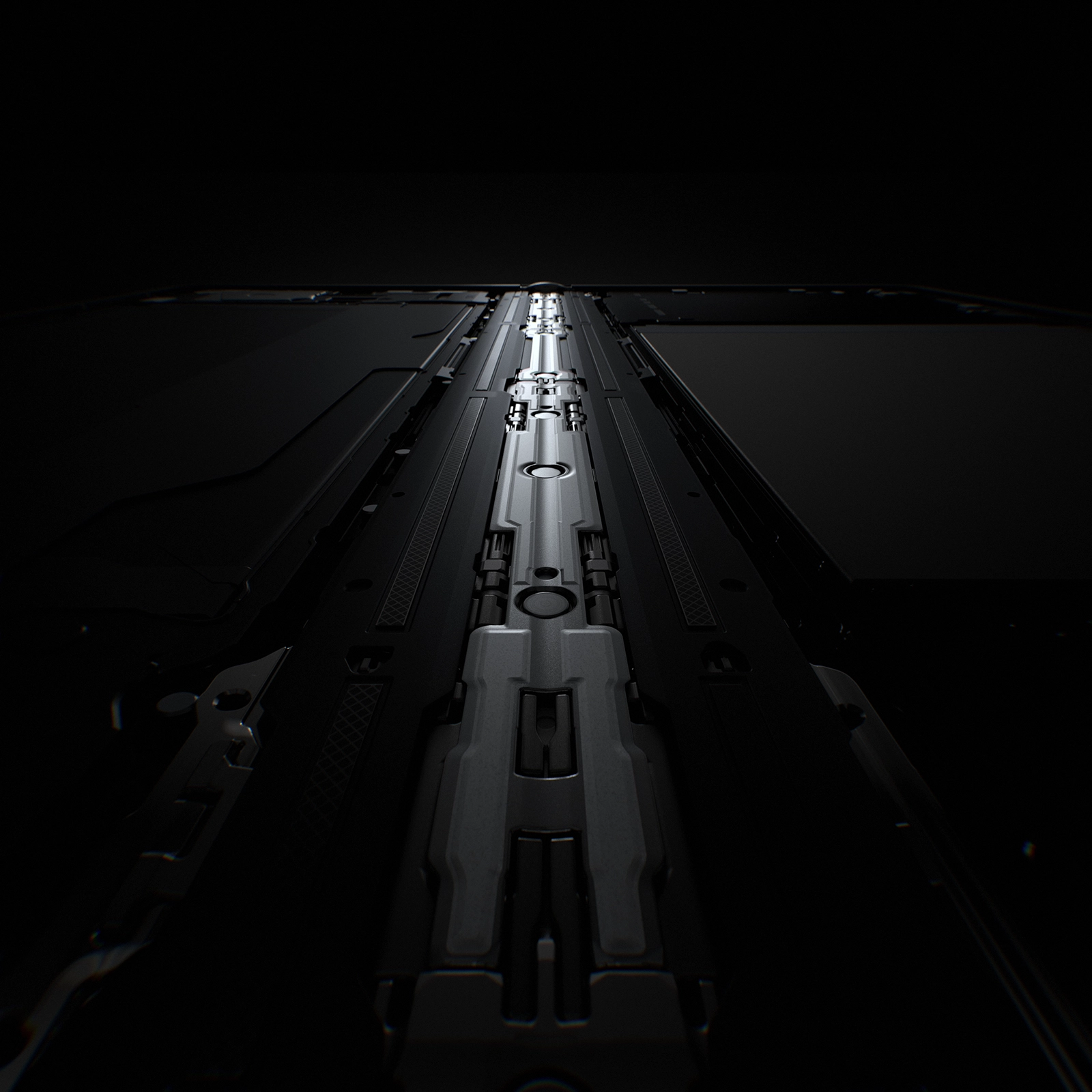
    According to BLT, the upgrade over the hinge that the company delivered last year for the Find N5 was the result of its collaboration with “the Tianqiong Partners industrial alliance,” which helped BLT develop what the company is calling “industry-first 3D Liquid Printing,” a solution to optimize minimization of the crease in foldable electronics. OPPO describes the process as high-resolution UV printing that uses 20+ cycles of finishing with “custom photopolymer droplets” to nearly eliminate height variance in the 3D printed titanium hinge, yielding what OPPO is referring to as the ‘Zero-Feel Crease’.

    BLT and OPPO have four partners in the Tianqiong Partners consortium, including Shanghai Jiao Tong University and Samsung Display, which market intelligence site UBIResearchNet notes were responsible for advanced materials/structural engineering research and flexible display technology, respectively. The consortium is rounded out by electronics manufacturer Amphenol Phoenix, which provided design and manufacturing of the hinge, and LEAD Intelligent, which provided automation equipment.

    BLT’s and Tianqiong Partners’ participation in the hinge design and manufacturing for the OPPO Find N6 was announced in the middle of March, around two weeks before rumors came out that Apple is planning to use 3D printing for the foldable iPhone that the tech giant may release by the end of 2026. Apple is reportedly a BLT customer, using titanium parts printed on BLT machines for the Apple Watch.

    In a press release about BLT’s work with the Tianqiong Partners on the 3D Liquid Printing process for the OPPO Find N6 hinge, Vincent Yang, GM at BLT, said, “The supporting surface flatness of the OPPO Find N6 wing plate has improved by 50% compared to last year. Achieving this level of precision once seemed extremely difficult — even unattainable — but through continuous iteration and rigorous testing, our team was able to meet and even exceed expectations.”

    Liu Chang, OPPO’s President of Hardware Engineering, said, “Achieving a crease-free and durable foldable display depends not only on advanced technologies such as the next generation Tianqiong hinge and Tianqiong memory glass, but also on the collective efforts of the engineers within the Tianqiong Partners ecosystem. The Find N6 represents a significant step forward in foldable display technology, as well as a meaningful improvement in user experience.”

    OPPO’s announcement of an improvement upon its first generation 3D printed hinge long before Apple has even released its first foldable phone illustrates just how far ahead of the West China is in capturing the future of consumer electronics. The gap shouldn’t come as a surprise. In the decades prior to AM’s emergence as a routine part of industrial workflow, nations across East and Southeast Asia built up their globally-leading electronics manufacturing capabilities by mastering a balance between competition and collaboration through cultivation of consortium-based ecosystems, as detailed in the book Tiger Technology.

    At the same time as this highlights the distance between the manufacturing landscape in the West and in Asia, it also illustrates that this distance isn’t the product of some intangible, magical quality that’s only achievable in one region. Western nations, including the US, have done the same thing many times in the past, and there are plenty of examples of emerging technology companies—including many companies in the AM industry—currently leveraging the consortium model.

    The main problem with translating those initial steps into accumulated momentum is simply that the manufacturing sector in the US domestic economy lacks the vibrancy that exists in China, South Korea, Taiwan, and even a comparably mature industrial power like Japan. The US still needs a macro-level whole-of-society push that centers the health of the manufacturing sector as a primary cultural objective, in order for the ground to be fertile enough for consortium-driven progress to truly take root.

    There are certainly enough signals out there that increasing the number of manufacturing workers in the US isn’t just a selfish motive for the manufacturing sector, but would serve a real social need for younger generations that will otherwise find difficulty entering a turbulently shifting employment environment. The hard part is figuring out how to come up with a winning message backed by genuine paths to solid careers, but Americans have demonstrated the ability to solve much more difficult social problems in the past.

    Images courtesy of OPPO

  • Most 3D Printing Metals Are Adapted. This One Was Designed with AI

    A research team from the University of South China and Purdue University developed a new type of steel designed specifically for 3D printing, using machine learning to guide the process. The result is a strong, corrosion-resistant material that is also easier to produce.

    This is important because materials are still one of the limits in 3D printing. A lot of the metals used in 3D printing today weren’t made for it. They were developed for things like casting or forging, and then adapted later. That can lead to issues like uneven strength, internal defects, or parts that don’t come out the same every time. More recently, though, companies and researchers have started to create materials specifically for 3D printing. This work follows that approach by designing a material from the ground up for 3D printing.

    A New Approach to Designing Materials

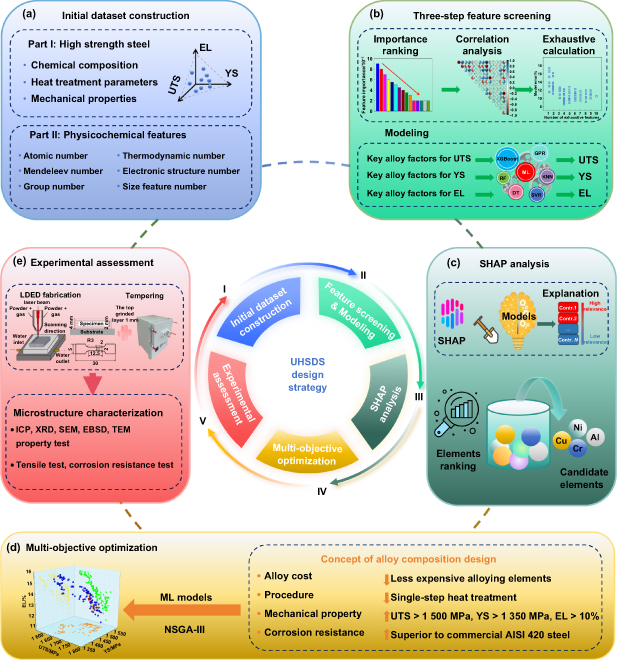
    In this case, the team used machine learning to analyze how different elements and processing conditions affect steel performance. Instead of relying on trial and error, they trained a model using dozens of physical and chemical parameters. This allowed them to predict which combination of elements would deliver the best results.

    In total, the system evaluated more than 80 variables, including how different elements behave and how they affect the metal during printing. It used this data to predict a composition that balances strength, ductility, corrosion resistance, and cost. The researchers then 3D printed the alloy and tested it to confirm the results. The material was not just simulated. It was actually printed using laser powder bed fusion (LPBF) and then tested through mechanical and corrosion evaluations to confirm the results.

    This is a key part of their research, which is detailed in the paper “Interpretable machine learning integrated with physicochemical feature for developing additively manufactured ultra-high strength and ductility steel,” published in the International Journal of Extreme Manufacturing. The work was led by Yating Luo, Cunliang Pan, Xu Ben, Xudong An, and Hongmei Zhu at the University of South China, with Xiaoming Wang contributing from Purdue University, and supported by the National Natural Science Foundation of China.

    The team also produced the material using laser powder bed fusion (LPBF) and tested it, showing that the approach works in practice.

    Designed for 3D Printing with Strong, Durable Performance

    Most metals used in AM today were originally developed for traditional processes like casting or forging and later adapted for 3D printing, which involves very different conditions. For example, widely used alloys such as stainless steel 316L, titanium Ti-6Al-4V, and nickel-based Inconel 718 were all created decades ago for conventional manufacturing. While these materials can be used in 3D printing, the rapid heating and cooling during processes like LPBF can affect their internal structure, leading to defects or reduced strength.

    The new steel was designed with these conditions in mind. The machine learning model accounted for how the material behaves during the printing process, not just its final properties, making it better suited to additive manufacturing from the start.

    According to the researchers, the new steel stands out for its performance. The material is both very strong and able to bend without breaking, which is a difficult balance to achieve. This means it can handle heavy loads without failing suddenly. It also resists corrosion so that it can perform better over time in harsh environments. This is especially important for industries like aerospace, energy, and marine, where parts are exposed to stress, heat, and moisture.”

    How the team used machine learning to design and test the new steel. Image courtesy of Yating Luo, Tao Zhu, Cunliang Pan, Xu Ben, Xudong An, Xiaoming Wang, and Hongmei Zhu.

    Another big advantage is cost. Many high-performance steels used in 3D printing use expensive elements like cobalt or high amounts of nickel. They also go through complex heat treatment steps after printing. This new alloy uses fewer of those costly elements and only needs one heat treatment step, which takes about 6 hours. That makes the process much simpler. Overall, this could make the material easier and more affordable to use at a larger scale.

    Why This Matters for 3D Printing

    More researchers and companies are starting to design materials specifically for the process. This could help expand where 3D printing can be used.

    Industries like aerospace and defense need materials that can handle stress, heat, and long-term use. If new alloys can meet those needs while also lowering cost and simplifying production, adoption could grow. Machine learning also plays a key role here. Instead of testing many options over time, it helps narrow down the right material much faster.

    The new steel is still at the research stage. It has only been tested on printed samples, and more work is needed before it can be used in real parts.

    At the same time, this is part of a growing effort to design materials specifically for 3D printing, instead of adapting existing ones. That approach could make metal 3D printing more practical over time.

  • 6K Wins $1.95M DLA Award to Recycle Defense Metals

    6K will receive $1.95 million from the Defense Logistics Agency under the Recovering Strategic Value project. The Phase II award aims to reduce the US’ dependence on Nickel, Titanium, Tungsten, and Niobium powders from overseas. This is a significant win for 6K because it puts them on a path to being a key supplier in these high-value 3D printing powders for years to come. We expect demand for niobium to see an especially precipitous rise over the coming years, while there will be much more interest in tungsten and sustained growth in nickel alloys and titanium. Tungsten is a key material for missile components and munitions, and the market is dominated by Chinese producers. Likewise, niobium is entirely imported currently and will be a key material going forward in hypersonics and also as an alloying material for many of the cutting-edge materials being created at the moment for additive manufacturing. Rather famously, the US surreptitiously bought titanium from the Soviet Union for use on the SR-71 Blackbird spy plane. This rather colorful example showcases how important such self-reliance can be.

    Most titanium comes from Ukraine, Russia, China, Mozambique, Canada, and Australia. Notably, neighboring Canada is a leading nickel producer while also supplying titanium and niobium. Australia is inconveniently far away, but it also supplies nickel and titanium, while niobium supplies could be realized from there in a few years. This policy, therefore, goes beyond moving away from reliance on difficult or unstable countries and extends to moving away from supplies from America’s erstwhile closest allies.

    6K Additive CEO Frank Roberts stated,

    “The U.S. Government has made it clear that to advance our defense readiness we cannot rely on geopolitically sensitive regions for the materials essential to our most advanced weapon systems. By upcycling domestic scrap from DoD stockpiles and maintenance centers, we are creating a circular, secure, and sustainable supply chain for the US defense sector. This Award enables us and the DoD to further identify end-of-life parts and scrap to convert back into high-value powder ultimately leading to strategic components for the military.”

    The company said the scope of work will include identifying and collecting material from DLA depots, to use DoD scrap as a source for domestic critical metals; developing a proof of concept for a robotic system to automate scrap identification and sorting; converting end-of-life parts made from nickel, titanium, tungsten, and C103 (a niobium alloy) into high-value powder; and conducting cold spray trials to investigate the mechanical properties of upcycled nickel and titanium for use in repair applications.

    6Ks UniMelt. Image courtesy of 3DPrint.com.

    There’s a lot to unpack there, but some significant things seem like they could point to breakthroughs. I’ve been telling people for years to buy aircraft boneyards, please do this now, this could be an amazing source of revenue in the future, especially if energy costs rise. Then scrap could, for a time, be a cheaper way to obtain some materials in powder form. Given the DLA Depot’s focus, this seems like a sound idea. There are many of these worldwide; two dozen or so are immense and significant centers for US military logistics. These depots are located worldwide and handle millions of parts and millions of tonnes of goods. One depot, the Defense Distribution Depot Tracy, is 448 acres in size, employs 1,500 people, and handles the logistics for the Western US. One large site ships 350 seavans and nearly 150 air pallets to 4,000 sites per month. Seavan is another term for a shipping container. Napoleon famously said that an Army marches on its stomach, so the DLA and its depots are integral to the US military.

    The idea of using scrap that the US already has in its possession is convenient, cost-effective, and easier to trace. We would expect less contamination if the material comes from known sources. Also, the US military is big on labels, serial numbers, and things. Many items may have a unique item identifier (UII), a national stock number, or a contract number. This will make tracing what’s in these items and making sure that there are no nasty surprises much easier.

    6K says that 60,000 pounds of scrap come from certain aviation depots. So this could be very sustainable as well, but I’m thinking that not many niobium-containing turbine parts are being thrown away every week. Some artillery barrels contain titanium, so this could be useful, while tungsten could perhaps be collected from firing ranges, as it is used in some munitions. It’s unclear whether the DLA will reverse scrap from many other sites or actively collect firing range materials.

    By using a robotic scrap sorting and ID system, 6K can gain a real advantage over rivals here. If it could do this well, then the company could really build a significant business just off the back of this. The mention of cold spray for Nickel and Titanium is sure to make the folks at Titomic and Spee3D happy. Cold spray is cheap, fast, and could be used for repair. DED machines already repair thousands of turbine blisks. So an alternative, perhaps locally deployable cold spray, could be a very welcome addition.

    The project will last 18 months, and the company hopes to produce a tested, certified powder at the end. Given the US’s isolationism and its growing rift with its allies, this seems like an especially timely move. If the US is to rely on additive manufacturing for missile defense, hypersonics, and key aerospace components, then establishing its own supply chain is a very good idea indeed.

  • 3D Printing Market Hits $16B in 2025 as Growth Picks Up Again

    The global 3D printing market reached $16 billion in 2025, growing just over 10% year over year, according to new data from Additive Manufacturing Research (AM Research). After a slower period in recent years, the second half of 2025 showed signs of recovery, with growth returning across key parts of the industry. The firm now expects the market to reach $57 billion by 2034, pointing to steady long-term expansion.

    The data comes from AM Research’s latest quarterly update and its 3DP/AM Market Insights: Q4 2025 report, which breaks down the market across metals, polymers, services, and applications.

    A Market That Is Starting to Move Again

    According to AM Research, 2025 was split into two very different periods. The first half looked similar to the slower growth seen in 2023 and 2024. But in the second half of the year, activity picked up.

    AM Research EVP Scott Dunham stated, “2025 was a story of two markets, with the first half of the year largely in line with the tougher times of the last two years, but in the second half of 2025, we saw what we believe is the start of a significant turnaround for AM. The industry is still carrying too much weight competitively, and a number of companies exited in 2025 — this won’t stop in 2026. But it’s become clear we’re at a point where growth is flowing back into the market.”

    That change shows up in the numbers. The total market grew from $4 billion in Q3 to $4.26 billion in Q4, pointing to stronger momentum toward the end of the year. At the same time, the industry is still going through a period of consolidation. As Dunham said, several companies exited the market in 2025, and AM Research expects that trend to continue into 2026.

    Where the Market Stands Today

    According to the report, metal AM reached $6.27 billion in 2025, polymer AM reached $9.79 billion, and AM services reached $8.53 billion. Together, these segments make up a market that is still growing, but also changing in structure.

    One of the most important takeaways is the role of services. AM Research expects services to become the largest segment over time, as more companies rely on external providers rather than building everything in-house.

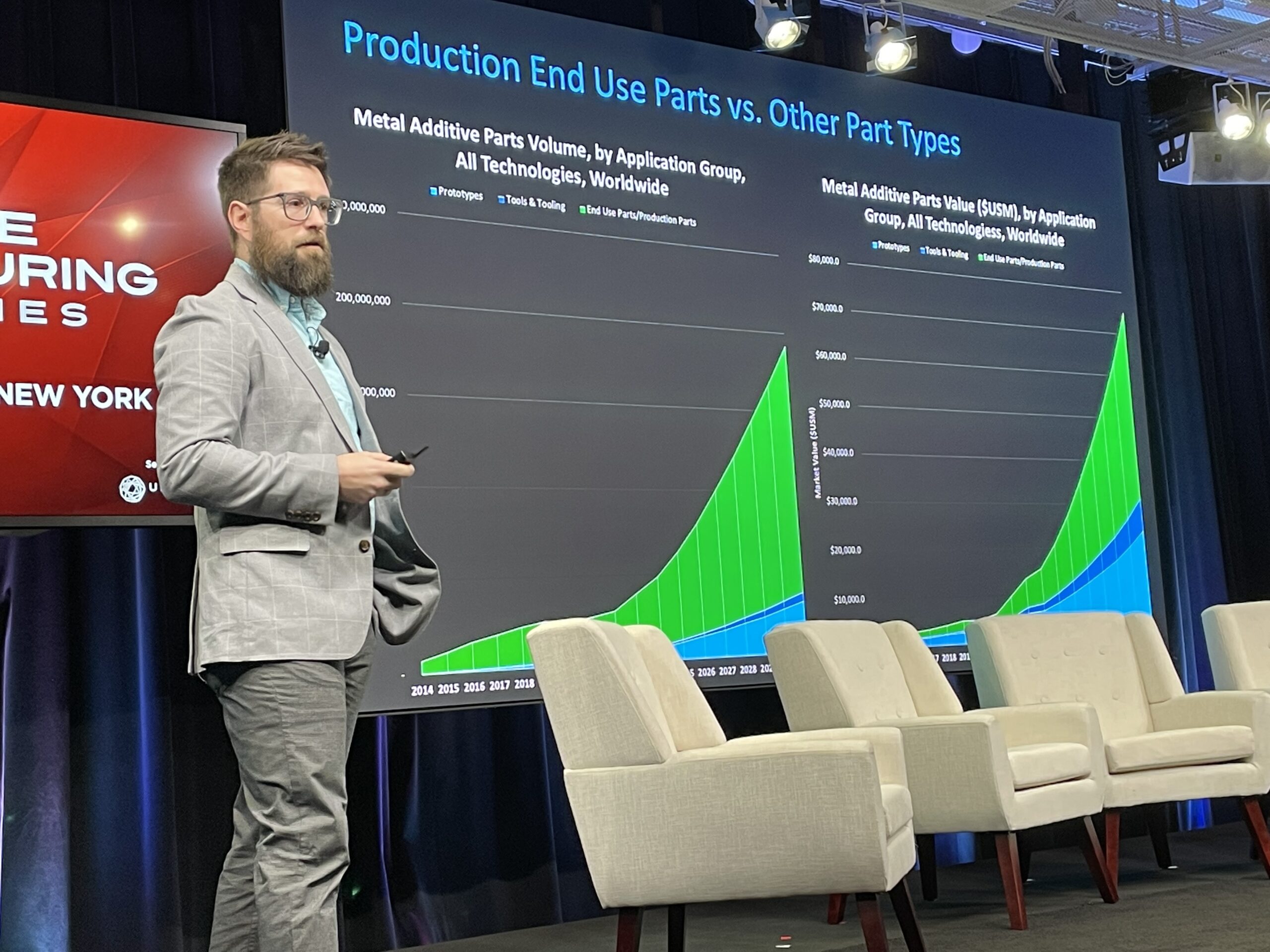
    Scott Dunham during the AMS 2026 Market Data Outlook presentation. Image courtesy of 3DPrint.com.

    Not all parts of the market are growing at the same pace. In metal 3D printing, three sectors stand out: medical, space, and defense and maritime. Among these, space applications (especially rocket engines) are expected to become one of the biggest drivers of value over the next decade. This matches what we’re seeing across the industry, where aerospace and defense are leading adoption.

    At the same time, AM Research’s latest report shows that growth is starting to pick up again after a slower period. But the market is still figuring itself out. There are still a lot of companies in the space, and not all of them are keeping up. So it’s likely we’ll continue to see consolidation. Also, there are plenty of signs that demand is there, but the real question now is whether companies can turn that into steady production and real revenue

    How This Compares to Other Market Data

    AM Research is not the only firm tracking the 3D printing market. Recent reports from Wohlers Associates, AMPOWER, and CONTEXT point in a similar direction, but use different methods and cover different parts of the market.

    In February 2026, Wohlers reported that the global AM industry reached $24.2 billion in 2025, higher than AM Research’s $16 billion estimate. This is partly because Wohlers uses a broader definition of the market, including hardware, materials, services, and software, and takes a more top-down approach, focusing more on the total market and how it changes over time.

    AM Research also tracks the global market, but uses a more detailed and structured approach. It relies on bottom-up data, focuses on core AM revenue, and tracks the market quarter by quarter, breaking it down by vendor, technology, geography, and application.

    On the other hand, AMPOWER’s latest market report estimates the industrial metal and polymer AM market at about €11.3 billion in 2025, with a 5.7% growth. Its approach is based on more than 300 interviews and over 50,000 data points from companies across the supply chain, and it explicitly covers equipment, materials, parts, and manufacturing suppliers.

    Meanwhile, CONTEXT looks mainly at hardware sales and shipments. Its latest data shows modest growth, including about 5% growth in Q3 2025. The data also shows a split market, with strong demand for entry-level systems and improving demand for metal platforms, while higher-end industrial systems continue to face slower investment.

    AM Research takes a different approach by tracking the market quarter by quarter and breaking it down by vendor, technology, geography, and application. It also includes printers, materials, and services, which helps explain why its total market number differs from other firms.

    Across all four firms, the data shows the market is growing again, but not evenly, and some segments are still under pressure.

    Scott Dunham, AM Research’s EVP, at AMS 2023. Image courtesy of 3DPrint.com.

    Overall, AM Research shows that the industry is moving forward again, but it’s still in transition. Activity shows there is real demand, especially in areas like aerospace, defense, and medical. At the same time, the market is shifting, with services playing a bigger role and some companies falling behind. So, this new report shows that growth is back, but the focus now is on turning that into stable production and long-term business.

    Learn More with AM Research’s Webinar

    AM Research breaks this down in more detail in its webinar, 3DP/AM Market Insights: 2025 Review and 2026 Preview, led by Dunham.

    The session walks through what happened in 2025, why the second half of the year started to turn around, and what to expect going into 2026. It also looks at where growth is coming from, how different parts of the market are performing, and what companies need to focus on next.

    The webinar is still available to watch on demand at this link.

  • 3DPOD 297: 3D Printed Static Mixer Nozzles with Eric Ronning, Re Mixers

    Eric Ronning started ReMixers when he and his team discovered a new way to more efficiently mix fluids, pastes, and other materials. Multiple materials could be more thoroughly mixed with new geometry. The ReMixers team then found that they could reduce waste in static mixer use. This led them to industrialize the production of millions of mixers using their own print farm. The team now uses several 3D printing technologies to produce 2K and other mixers at scale.

    This episode of the 3DPOD is brought to you by Siemens. With AI-enabled technologies, deep-domain expertise, and trusted partnerships, Siemens is converting today’s technological leaps into measurable benefits for customers, partners, and society. AI is no longer a feature; it’s a force that will reshape the next century.

  • 3D Printing Prosthetic Nests to Help Endangered Birds Stretch Their Wings

    On the grounds of Blenheim Palace, a UNESCO World Heritage Site near Oxford, England surrounded by roughly 12,000 acres of forest and gardens, researchers from Australia and the UK are using 3D printed prosthetics to help save endangered birds. But, rather than prosthetics beaks or limbs, they’ve engineered 3D printed prosthetic nests out of biodegradable plastic and mushrooms.

    The experiment, led by designer Dan Parker, a researcher with University of Oxford and the Deep Design Lab at University of Melbourne, is meant to help improve typical bird boxes. These are used worldwide as nesting shelters but don’t often attract large species of endangered birds, and can even end up killing chicks due to poor conditions inside.

    Innovative artificial hollows made from mycelium (top-left), 3D printed wood (top-middle), and hempcrete (bottom/right) at test sites in south Australia. Image: Deep Design Lab.

    People make bird houses all the time, building them with kits and sometimes even 3D printing them. I’m pretty sure there’s even a Girl Scout badge you can earn for building a bird house. However, these are often more decorative than useful. Bird boxes are more functional, designed specifically for cavity-nesting birds to raise their young, but even these avian shelters can have issues. Research has shown that the temperatures in these boxes can fluctuate much more than in natural hollows. If it was built poorly out of cheap materials, cold air and rain can blow in the bird box, and kill the young birds inside before they even have a chance to stretch their wings.

    Since the 1970s, the population of rare marsh tits in England has dropped by half, and other common songbirds, like nuthatches and sparrows, have also been in population decline. This is widely due to the fact that agricultural intensification has caused their natural habitat of ancient, hollowed trees to nearly vanish. Conservationists have tried to help by building nesting shelters, but they haven’t been attracting many birds.

    Prosthetic Nests for the Powerful Owl: Excerpt from video showing installation of prototype in System Garden at the University of Melbourne in Melbourne, Australia. Video by Dan Parker and Dr Stanislav Roudavski, Deep Design Lab.

    A few years ago, Parker and his team used 3D scanners to map the hollowed-out old trees in which endangered powerful owls often reside. They used tools like generative algorithms and VR goggles to build nesting boxes for the owls that better fit their needs. They’re trying something similar at Blenheim Palace now with the 3D printed nests, which Parker referred to as prosthetic hollows.

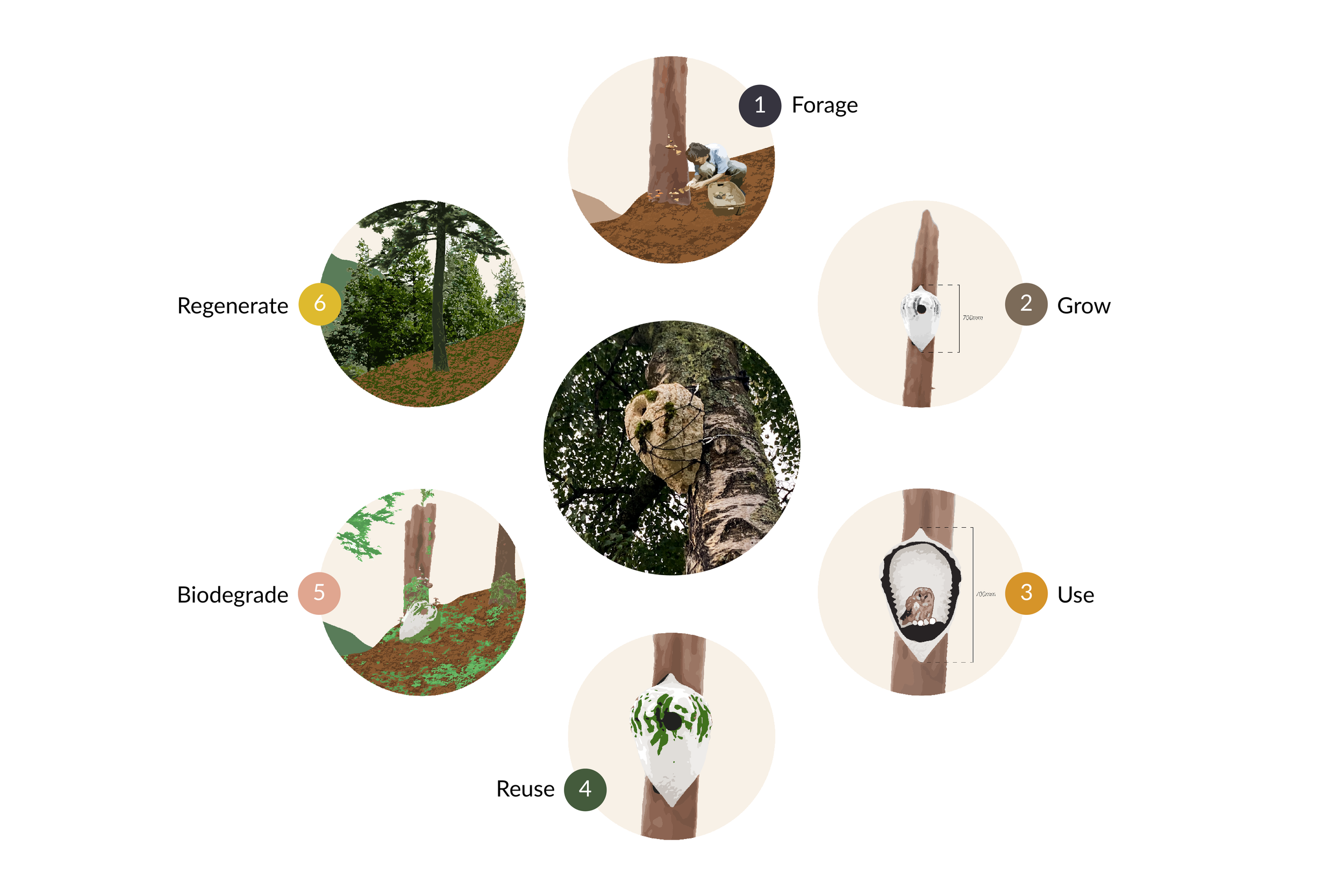
    Reishi is a type of mushroom that grows in this particular region of England. Parker 3D printed the basic bird box shape out of sawdust and plant-based biodegradable plastic. Then, he cultivated the rootlike structure of fungi, called mycelium, to slowly grow over the sides of the boxes, giving them a ripple effect. This material is carbon-neutral, lightweight yet insulating, biodegradable, and easy to shape so that it mimics natural tree hollows, like the ones in which marsh tits prefer to nest.

    Design for a complete lifecycle of a mycelium hollow in Italy. Image by Deep Design Lab in Conservation Science in Practice.

    The experiment, which is being funded by the Birds on the Brink charity, will compare 10 mycelium 3D printed prosthetic nests against 10 conventional bird boxes; the control is a popular box certified by the Royal Society for the Protection of Birds (RSPB) charity. All 20 boxes have been hung in trees around Blenheim Palace, and over the 2026 breeding season, researchers will track which design birds like better, which species are visiting them, and how many chicks grow and fledge (grow their feathers for flight).

    Other researchers working on this experiment with Park include Dr Stanislav Roudavski, University of Melbourne and Deep Design Lab; and Dr Joanna Bagniewska, Dr Thomas Hesselberg, Filipe Salbany, and Dr Ada Grabowska-Zhang, University of Oxford.

    Prosthetic Nests for the Powerful Owl: Prototype installed at System Garden, Melbourne, Australia. Image by Dan Parker and Dr Stanislav Roudavski, Deep Design Lab.

  • 3D Printing News Briefs, April 4, 2026: 3D Printed Food, Cocoa Press, & More

    We’re starting off with 3D printed food in this weekend’s 3D Printing News Briefs, followed by some business news about Cocoa Press. Then we’ll move onto a metal additive manufacturing business partnership, and conclude with a 3D printing service by Formlabs. Read on for all the details!

    FSA Says Emerging Technologies, Like 3D Printing, Could Transform Food in Britain

    UMAMI Bioworks and Steakholder Foods’ 3D printed fish. Image courtesy of UMAMI Bioworks.

    According to a recent report from the British food safety watchdog Food Standards Agency (FSA), several emerging technologies could transform the country’s food system in the very near future. It should come as no surprise that one of those technologies is 3D printing; others include precision fermentation and molecular farming. 3D printing is especially helpful in creating personalized foods with custom textures, shapes, and nutritional profiles, and there are already pilot programs around the world investigating foods made specifically for patients with dysphagia, or difficulty swallowing. While the technology is still at an early stage, interest is growing within the NHS and care catering sectors in the UK, and the FSA watchlist classifies 3D printing as a “tier-three” technology. This means it’s not expected to be sold commercially until after 2035, though lab-cultivated meat and fish should be available much sooner. A lot of the success of 3D printed food could come down to the willingness of people who are willing to try it and get past their neophobia (fear of the new).

    “Emerging technologies are reshaping how our food is produced and sourced. This report gives industry and government clear sight of what is coming, and what is required to ensure these products meet the UK’s high standards,” said Dr Thomas Vincent, Deputy Director of Innovation, FSA. “The FSA and FSS’s remit is central to delivering these ambitions and by working early with innovators, we can support safe, responsible growth and build consumer confidence in the foods of the future.”

    New CEO of Cocoa Press is Former Prusa & Printed Solid Executive

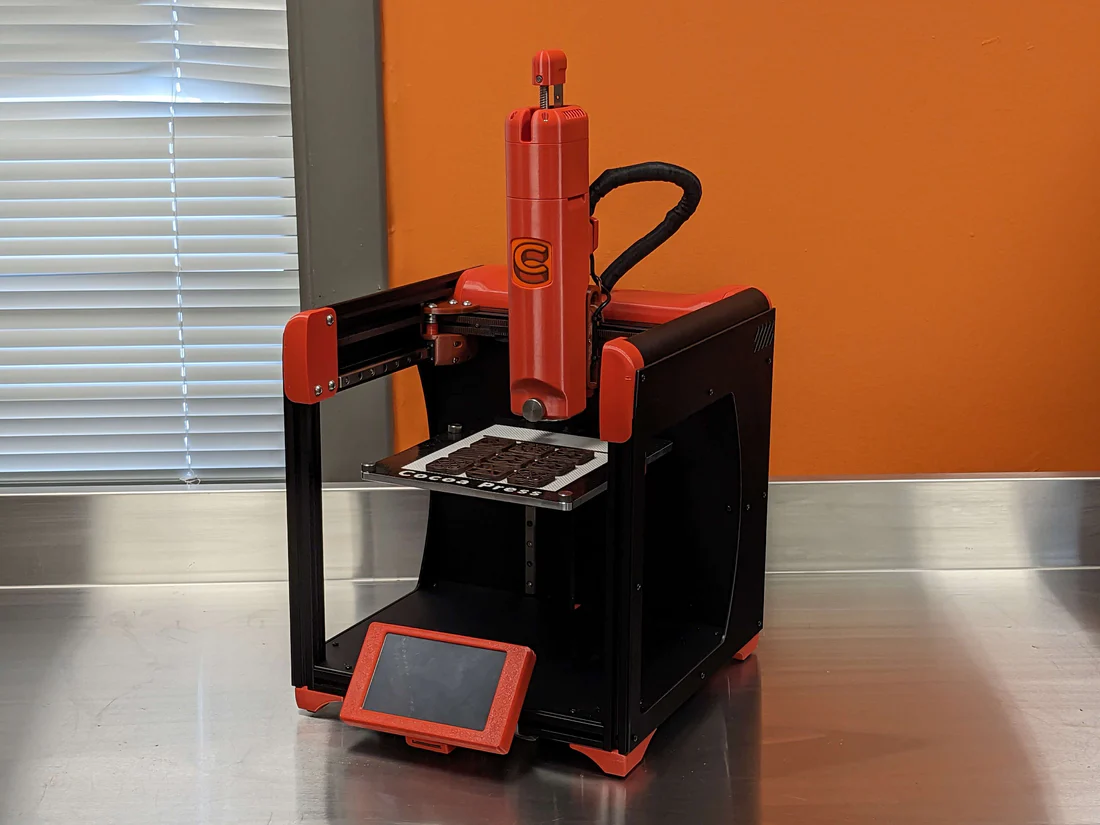
    One type of 3D printed food that’s already enjoyed early success is chocolate, and who knows better about that than Cocoa Press, the startup behind the first consumer 3D printer for chocolate? It’s not all fun and games, either—Cocoa Press has been working to build out its leadership team, like bringing on Caleb Kraft, the former editor of Make Magazine, as Box Manager of the Print Kits subscription service. Its most recent appointment is naming David Randolph, former head of the Prusa Research U.S. manufacturing arm Printed Solid, as its new CEO. Randolph has nearly a decade of leadership experience in scaling 3D print manufacturing operations, including transforming Printed Solid from a filament supplier to a major U.S. manufacturing operation. He will now oversee both Cocoa Press and subscription-based DIY 3D printing service Print Kits, which Cocoa Press acquired from Alien3D two years ago. This signals a major shift for the startup, as its works to position itself towards mainstream adoption and a more established consumer 3D printing market category.

    “David has an uncanny ability to take an idea to market that expresses a personal experience for not only the consumers but for the DIY and maker communities at large,” said Cocoa Press Founder Ellie Rose, who will remain Chief Technology Officer for both Cocoa Press and Print Kits. “As we scale Cocoa Press and expand our ecosystem, David’s experience in domestic manufacturing and customer-first leadership is exactly what we need to bring 3D chocolate printing to kitchens, education, and makerspaces everywhere.”

    EPlus3D & infoTRON Partner to Grow Industrial Metal AM in Türkiye

    Chinese metal powder bed fusion (PBF) solutions provider Eplus3D has been working to strengthen its global partner network, and recently announced that it is collaborating with Türkiye-based engineering technology provider infoTRON to expand its industrial technology in that country. Headquartered in Istanbul, with a European presence in Eindhoven, infoTRON provides industrial customers with digital manufacturing solutions and engineering technologies. Through this new partnership, it will support the application and promotion of Eplus3D’s metal AM systems in the Turkish market and surrounding Middle Eastern regions, helping to bring industrial PBF solutions closer to the users. Local manufacturers, particularly in the aerospace, tooling, automotive, and energy sectors, are now able to take advantage of experienced regional technology partners, like infoTRON, to evaluate and adopt the advanced, large-format, high-efficiency metal PBF systems that Eplus3D offers.

    “We are delighted to partner with infoTRON as we continue expanding Eplus3D’s global presence. infoTRON’s deep connection with local industries and its experience in digital engineering technologies make it an ideal partner to support the growing demand for metal additive manufacturing in Türkiye,” said Raymond Zhang, Sales Director APAC at Eplus3D. “Together, we aim to help manufacturers explore new possibilities in advanced production through reliable and scalable metal AM solutions.”

    Formlabs Officially Launches Form Now 3D Printing Service

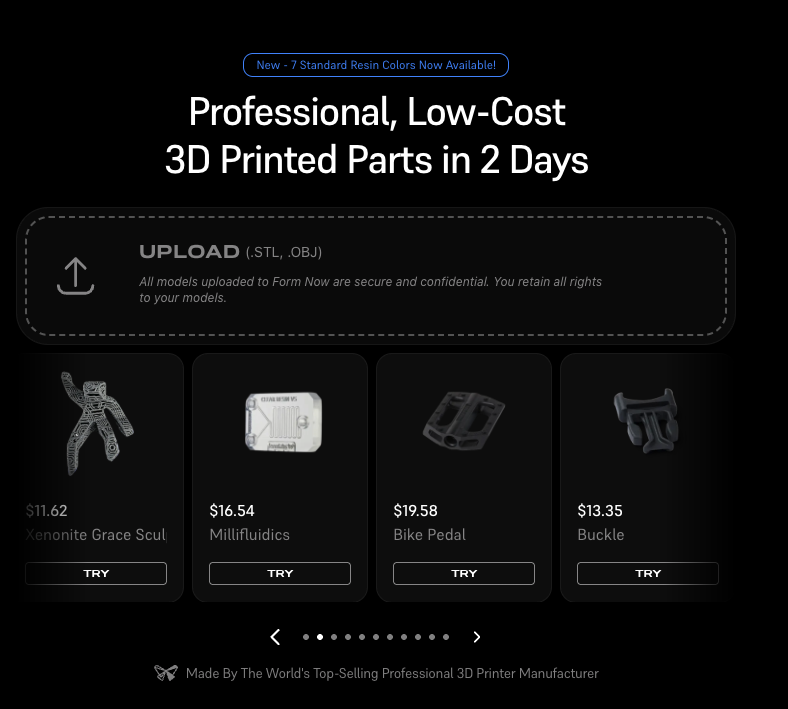
    Finally, Formlabs has entered the service bureau market with the launch of its Form Now on-demand 3D printing service. The platform is meant to give users access to professional SLS and SLA 3D printing without having to purchase their own systems, and is said to offer two-day delivery of industrial parts across the U.S. It sounds like a fairly standard operation: using a streamlined online ordering process, users upload STL or OBJ files (.form and .3MF to come), select their desired quantities and materials, and get a quote. Maximum part dimensions are 35.3 x 19.6 x 35 cm. The parts are then printed at Formlabs in Massachusetts, and shipped out to the customer. Bulk file uploads are supported, which allows users to submit files for multiple components in one order. 15 materials are available in the Form Now service, including standard resins in V5 formulations and Elastic 50A for SLA, and Nylon 11, Nylon 12 GF, and TPU 90A for SLS. The company says that 90% of orders are delivered within five days, and pricing starts at about $20 per part. This will make its technology much more accessible for prototyping and small-batch production.

    “We know that sometimes you need the part, not the printer. Form Now gives you instant access to our fleet of industrial SLA and SLS machines for unblocking a prototype, testing a new material, or scaling up production,” Form Now stated in a LinkedIn post.

  • Divergent & GA-ASI: How Connecting at AMUG Led to an Important Industry Partnership

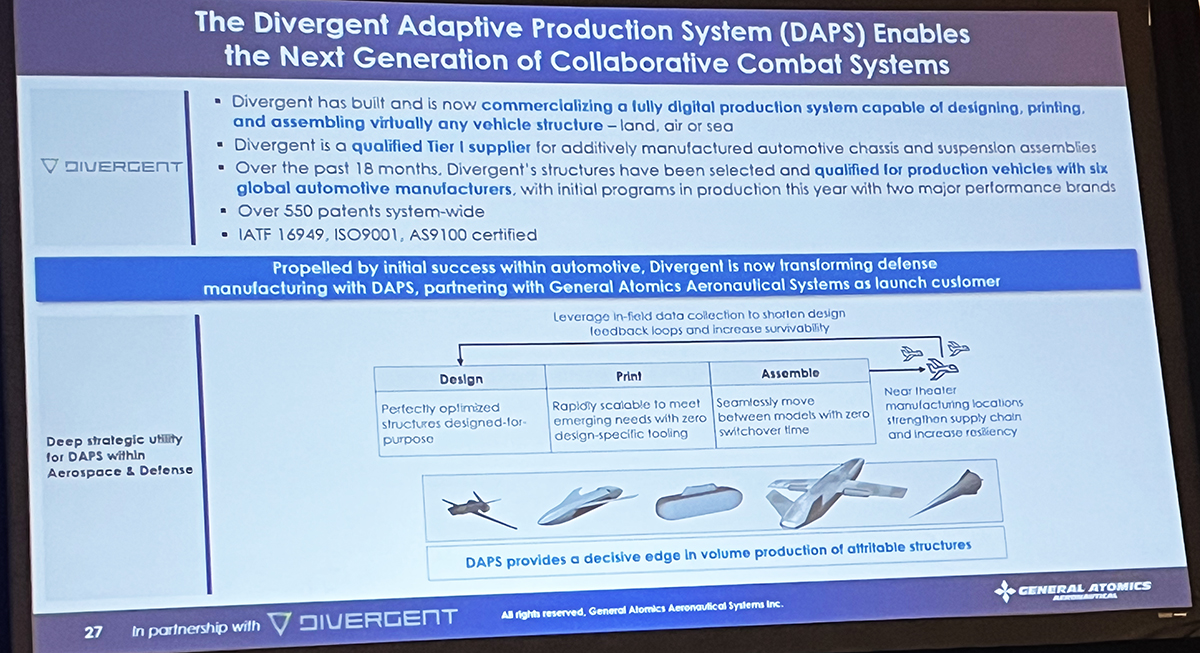
    As I mentioned in my AMUG 2026 overview, I had a lot of delays traveling to Reno, Nevada to attend the conference. So unfortunately, I missed “From Hypercars to Defense Drones: How Two Major Industry Innovators Started their Partnership Journey at AMUG,” the Tuesday morning keynote by Steve Fournier, Senior Manager – Additive Manufacturing at General Atomics Aeronautical Systems (GA-ASI), and Scott Sawyer, Director of Programs – Aerospace and Defense, at Divergent.

    Luckily, later that day, I had the chance to speak with both Fournier and Sawyer, and asked them to fill me in on what I’d missed during their joint presentation. It’s a story that proves just how important it is to make industry connections with people in different fields and disciplines than your own, and share your experiences with each other.

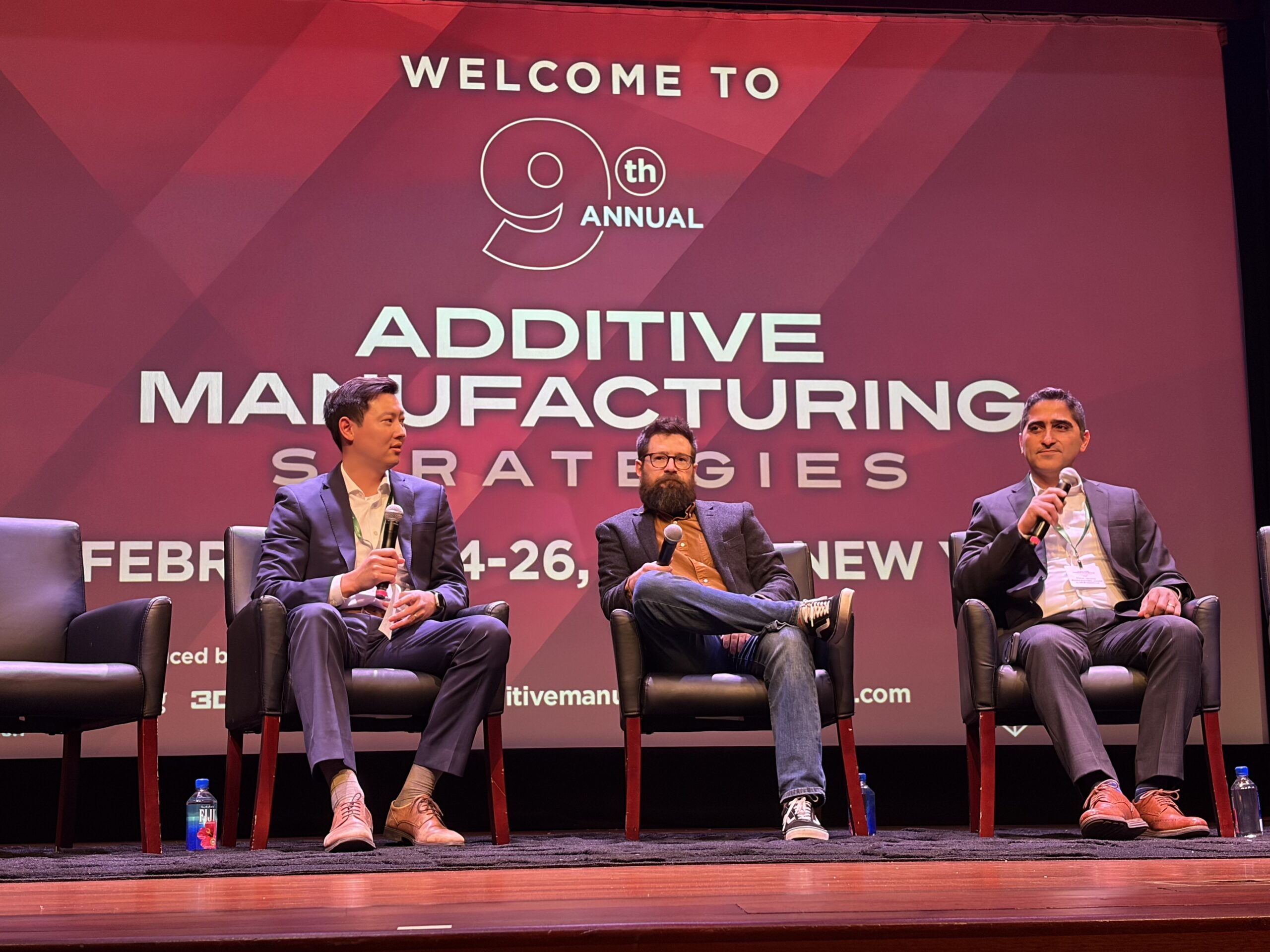
    Steve Fournier, General Atomics Aeronautical Systems (GA-ASI), and Scott Sawyer, Divergent, onstage at AMUG 2026.

    At AMUG 2022, Kevin Czinger, the founder and Executive Chairman of Divergent, presented a keynote. One of the people in the audience that day was Fournier. Divergent was primarily focused on automotive applications at the time, and GA-ASI works in aerospace and defense. But after the presentation, the two companies met up for a conversation.

    “We met and basically we asked a simple question, which is, how can your technology stack be applied to a different industry, such as aerospace and defense, unmanned systems specifically?” Fournier told me. “And that started a journey of four years, which impacted us as a drone manufacturer in the way we make drones. It also impacted Divergent in the way they look at different markets besides automotive.”

    Sawyer concurred with Fournier’s assessment of that initial conversation with Czinger.

    Scott Sawyer, Divergent

    “After Steve and Kevin connected, Divergent got set out on the path, via efforts with GA-ASI at the time, of seeing how that technology can transition into aerospace and defense, specifically with unmanned aircraft systems working with GA-ASI, and understanding what carryover is there for the technology, what tech development needs to occur, and even what is the process day-to-day of engineering teams working together, sharing data, doing collaborative design and analysis.”

    Interestingly, Sawyer actually used to work with GA-ASI before moving to Divergent, where he’s been employed for a little less than two years. He spent 15 years focused on aerospace and defense applications, but went to Divergent after he saw “the technology from the end user standpoint of working at GA-ASI and saw its applications.”

    “Back in 2022, Divergent was very much commercially automotive, both from design and delivery of products to automotive OEMs, but then of course as well, designing and manufacturing Czinger vehicles,” Sawyer said.

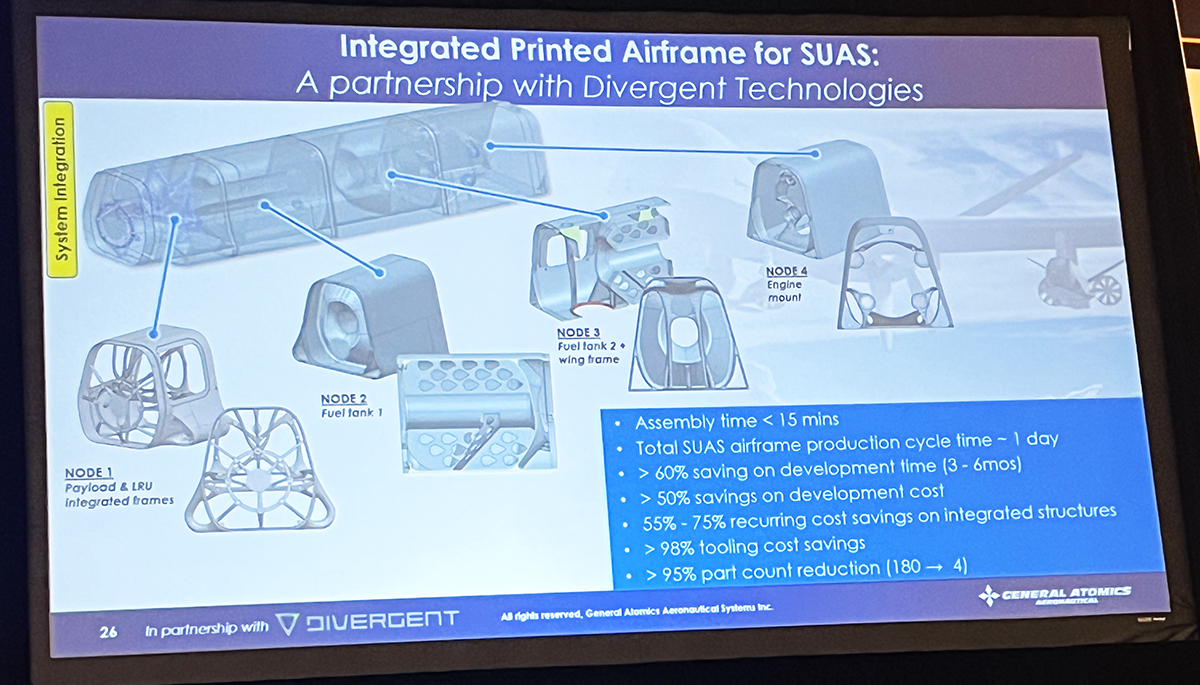
    Since that initial connection at AMUG, Divergent has significantly expanded its portfolio beyond automotive applications and into “the air domain,” as Sawyer said. The company now also works to produce unmanned aircraft systems (UAS), like the 3D printed drone it worked with GA-ASI to create; at AMUG 2023, Fournier actually took the stage with Divergent’s CTO to share about the design, 3D printing, and robotic assembly of the drone.

    AMUG 2023 presentation by Divergent and GA-ASI. Image courtesy of 3DPrint.com

    Sawyer also said that Divergent is continuing to grow its horizons and work on “subsurface applications,” like unmanned underwater vehicles, and is even working on space applications.

    Bringing the conversation back to their joint presentation at AMUG 2026, Sawyer explained that what they shared with the audience was how “the initial efforts that Steve and Kevin spearheaded between the companies” helped define what entry into the AM space looks like.

    “What are the hurdles that we’re gonna have to overcome, all the way down to the material qualification, environmental qualification, customer engagement. Where does this technology make sense? Where does it not make sense?”

    In Sawyer’s words, Divergent used that initial collaboration with GA-ASI as “kind of a stepping stone” to expand more broadly into aerospace and defense markets as well.

    Fournier said, “When I reflect back on how the GA-ASI and Divergent partnership emerged, I think one of the key messages that we tried to send out is that we live in bubbles of egocentric areas of interest, and events like AMUG are representative of this. The additive community is a bubble in itself. Sometimes, when we step back and peek at other such bubbles or industries, we realize that sometimes we have more things in common than we think, or that we can learn new things from others. This is the big lesson here. Even within the ‘additive bubble of AMUG,’ which has grown tremendously over its history, there are multiple ‘sub-bubbles.’”

    Indeed, he also noted that there are multiple “sub-bubbles” in the AM industry, like oil and gas, medical, defense, aerospace, and space, and that we naturally converse within our own small bubbles, because that’s where we’re comfortable.

    “We don’t necessarily spend enough time to value some other fields that may have a piece of information that could be applied and transfer to what your application space is.”

    This is why AMUG is so different from other conferences, and so very important. I had heard about the event’s tradition of having people draw table numbers out of a bowl, and that’s where you had to sit for lunch, and I was honestly dreading it; as I told a colleague, I normally find a quiet corner table at industry events and just work while I eat alone. But I ended up really enjoying the opportunity to enjoy a full meal and conversations with people from different countries and parts of the industry, and hearing what they had to say.

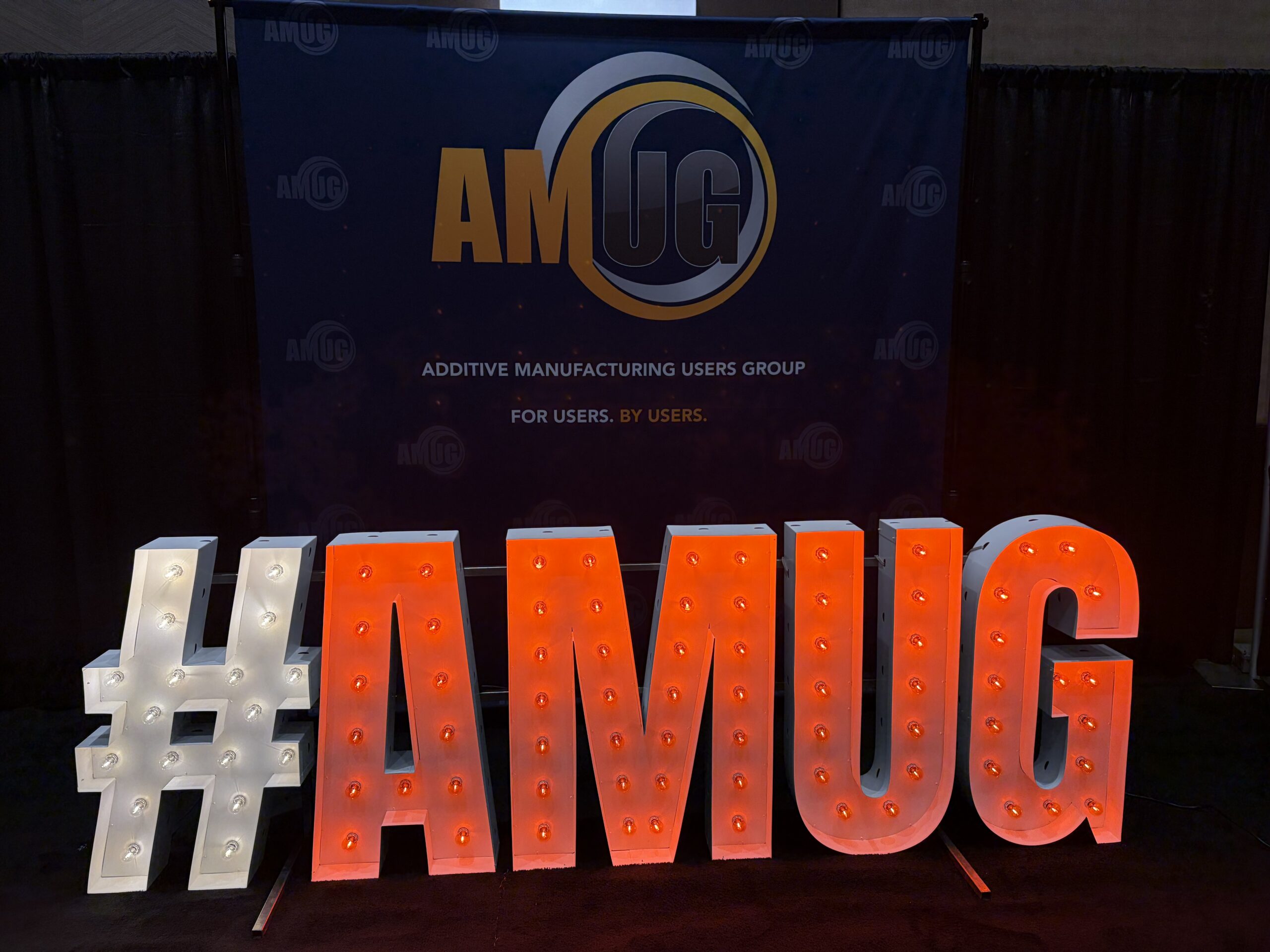
    AMUG 2026. Image courtesy of 3DPrint.com

    As Fournier explained, even if there are two types of vehicles that are not at all the same on the outside, if you break them down to the subsystems, they could have more in common than we may think.

    “You can make a correlation between product types,” he said. “And if you start doing that, you start finding much more commonalities that can be transferred. That’s conceptual.”

    He noted that it is human nature to not want to change up how we do things, and said that breaking those barriers in the Divergent and GA-ASI collaboration “was kind of what we wanted to bring to the audience” at AMUG.

    “How do we get through that, and what’s the success on the other side?” Fournier said. “It’s not like it’s been ten years, it’s four years, and look at all the things that happened since then.”

    In terms of what Fournier said about the additive bubble, I referenced our recent AMS 2026 event, where Josef Prusa, CEO and Founder of Prusa Research, told attendees that the AM industry is “living in a huge bubble and we very rarely go outside that bubble and speak to the people and make them excited about 3D printing.” Many still think that 3D printing is only good for toys and prototyping. Fournier said that their presentation made it very obvious “that additive is here to stay, and it can be beneficial commercially.”

    “When Apple comes up with a million Apple watch cases, that is commercial application at scale,” he said. “That is a topic we talked about. With the volume that we bring in terms of number of aircraft a year…it’s not a transitional technology anymore. It’s a production technology.”

    He brought up DAPS technology—short for Divergent Adaptive Production System—and said this is where it “really shines, because you design for DAPS and then you produce with DAPS.”

    AMUG 2023 presentation by Divergent and GA-ASI. Image courtesy of 3DPrint.com

    Sawyer jumped in here, explaining that while DAPS “is additive manufacturing-based, it’s also the design and robotic assembly of complex structural solutions.”

    “So to Steve’s point, especially as we’ve grown in aerospace and defense…delivering a capability and prototype demonstration environment is great. It’s required for aerospace applications. But the end vision, you still need to be able to go manufacture at rate. Working with our customers and primes and government, it’s critical that we don’t lose sight of that.

    “Let’s prototype, let’s learn, let’s iterate. But at the end of the day, let’s make sure that we can scale and deliver capabilities at rate today.”

    We also talked a little bit about AMUG itself, as Sawyer and I were both first-timers.

    “I go to a lot of conferences, but they’re all very commercially focused, right? Business strategy and business growth, details of the commercial application. And this has been cool,” Sawyer said. “The talk was cool because it’s more engineering-centric. What have you demonstrated, what capabilities? Seeing the openness of companies, at the engineering level and technical level, to share ideas and see how we can grow, it’s very different than other conferences.”

    Fournier said that’s exactly why he thought their presentation would work well at AMUG.

    Steve Fournier, GA-ASI

    “It is specifically a user base,” he said. “At trade shows, you’ve got OEMs of materials, machine, software. They’re trying to map out the market and each other. They have showcases and they have talks, but the talks are supplemental. Then you have the other extreme, where you have a lot of scientific, academia, research type stuff, which is great. Then users are kind of in the middle. The machines, the material, the academia, the theory, the software, we’re applying that on a daily basis for applications.”

    There’s a greater willingness to share with each other at AMUG, from your opinions on various OEMs to qualification challenges you’re having.

    “All that together makes this event specifically interesting and especially relevant for this type of discussion,” Fournier said. “The point of our discussion was not to sell anything, but to really entice people to do similar types of endeavors, whether or not it’s with Divergent, or with another technology provider, or another user that wants to share and partner. There’s that process of looking over the fence, having a visionary moment, and having a strategy to go execute that vision towards onboarding it into your own operation. That’s really what we’ve done and I think that’s what Divergent is good at doing.”

    Sawyer wholeheartedly agreed, noting that their intent was to offer their connection and resulting partnership as “an example to encourage others to hopefully find similar collaborations.”

    “I think across the board, the more adoption you can get, no matter who that is pushed by, is extremely important.”

    In closing, Fournier said that he believes additive will grow when the applications grow.

    “Divergent wasn’t here to sell materials or machines, but applications, and specifically my application, which brings a benefit to my customers,” he said. “By making that application work, using additive, is the best demonstration that additive works. You can write papers, you can have a dissertation, a PowerPoint presentation on how you qualify and statistically prove that additive is working and is worth it. You can build a cost model, you can present at AMUG. But if you can show up with hardware that is in full production, there’s no better demonstration that additive works.”

    Images courtesy of AMUG unless otherwise noted.

  • Canada Backs Aspect Biosystems With $280M to Scale Bioprinted Tissue Therapies

    The Government of Canada is supporting bioprinting company Aspect Biosystems with a new $280 million project to help develop and manufacture its bioengineered cellular medicines. The project will run over multiple years and is intended to move the company’s therapies closer to clinical use while expanding its production capabilities in Canada. The partnership was announced at Aspect Biosystems’ headquarters in Vancouver, British Columbia, with the Minister of Industry and Minister responsible for Canada Economic Development for Quebec, Mélanie Joly, present.

    The announcement builds on an existing relationship between Aspect and the Canadian government. As part of the project, the Government of Canada is committing $79 million, with additional support from the Province of British Columbia and other partners contributing to the broader $280 million effort. The funding will be provided over time as the project progresses and is designed to accelerate the company’s work in regenerative medicine while strengthening the country’s position in biomanufacturing.

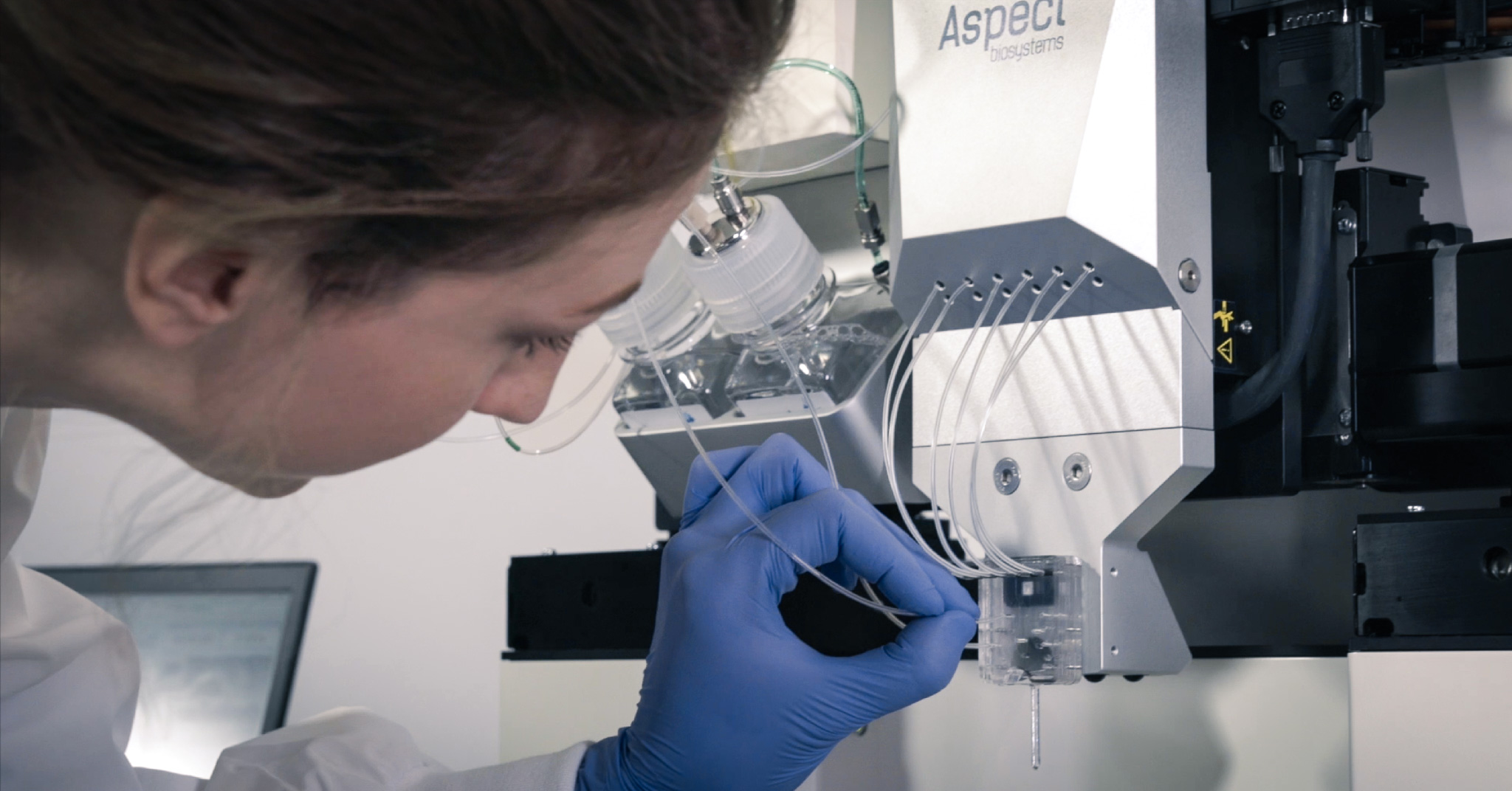
    Bioprinter close up. Image courtesy of Aspect Biosystems.

    The investment is part of a broader push by the federal government to expand life sciences and biomanufacturing capacity in British Columbia (B.C.). Ottawa has earmarked more than $125 million for projects in the region to support biotech companies, create jobs, and build domestic manufacturing capabilities. Canada is effectively building a life sciences hub in B.C., with companies like Aspect positioned as key players within that effort.

    The event also brought together a broader group from Canada’s life sciences ecosystem, including investors, researchers, and commercialization groups. Representatives from InBC Investment Corp, a government-backed fund that has invested in Aspect Biosystems, were present alongside academic leaders from the University of British Columbia and organizations such as Praxis Spinal Cord Institute. The mix of government, research, and investment groups highlights how projects like this are being supported across multiple levels.

    P3D Scaffolds produced using Ossiform’s technology to 3D print bioceramics made of beta-tricalcium phosphate. Image courtesy of Aspect Biosystems.

    Aspect is developing a new type of therapy that uses living cells to restore or replace biological functions in the body. These treatments are being designed for serious conditions such as diabetes and other metabolic and endocrine diseases. Today, these conditions are typically managed with drugs, such as insulin, or in some cases, organ or cell transplants. Instead, the goal is to create therapies that can directly perform the function of damaged or missing tissue.

    Over the last few years, the company has focused on building small, functional tissue structures using its bioprinting technology. These include early-stage programs aimed at creating insulin-producing tissue for diabetes and other cell-based therapies designed to replace or support damaged tissue. The work is still in development, but it reflects a shift from printing simple structures to building tissues that can perform specific functions in the body.

    The company is considered one of the more established ones in bioprinting, a field where many startups have struggled to scale or have shut down. The company has focused on developing complete tissue-based therapies rather than just printing hardware, and has built partnerships with larger healthcare players, including a collaboration with Novo Nordisk on diabetes treatments. This combination of platform development, partnerships, and a focus on clinical applications has helped it continue advancing while others in the space have faced challenges.

    “This investment from the Government of Canada is a powerful vote of confidence and adds to the significant momentum at Aspect as we advance our bioengineered cellular medicines towards patient impact,” said Tamer Mohamed, Chief Executive Officer, Aspect Biosystems.

    Tamer Mohamed with Dr. Mona Nemer, Canada’s Chief Science Advisor, at Aspect Biosystems headquarters in B.C. Image courtesy of Aspect Biosystems.

    The new $280 million project focuses on two main areas: advancing these therapies toward the clinic and building the infrastructure needed to produce them at scale. That includes expanding clinical development capabilities and strengthening manufacturing systems that can support larger volumes of these complex treatments.

    This is an important step for companies working in this field. Developing therapies in the lab is one challenge, but producing them consistently and in larger volumes is another. Governments are increasingly investing in this stage, where research moves from the lab into production.

    “By investing in the development and commercialization of cutting-edge cellular medicines, our government is helping to create high-quality jobs, drive economic growth, and position Canada as a leader in biotechnology. This partnership will accelerate life-changing therapies for patients, strengthen our economy, and ensure Canadian talent continues to thrive in the innovation sector,” said Joly.

    In fact, the project is also expected to create hundreds of jobs and expand training opportunities in the Vancouver region, adding to Canada’s growing life sciences workforce.

    These therapies are still in development and have not yet been used in patients. Further testing and clinical trials will be required before they can reach the market.