• Cobra’s 3D Printed Golf Clubs Reveal What the Technology Can Do for Sports

    When 3DPrint.com attended the PGA Show in Orlando this January, one booth stood out for a reason that had nothing to do with marketing hype or big-name tour pros — though Cobra has plenty of those, too. At the stand of Cobra Golf, the story was about something far more unusual in the golf world: fully 3D printed metal golf clubs.
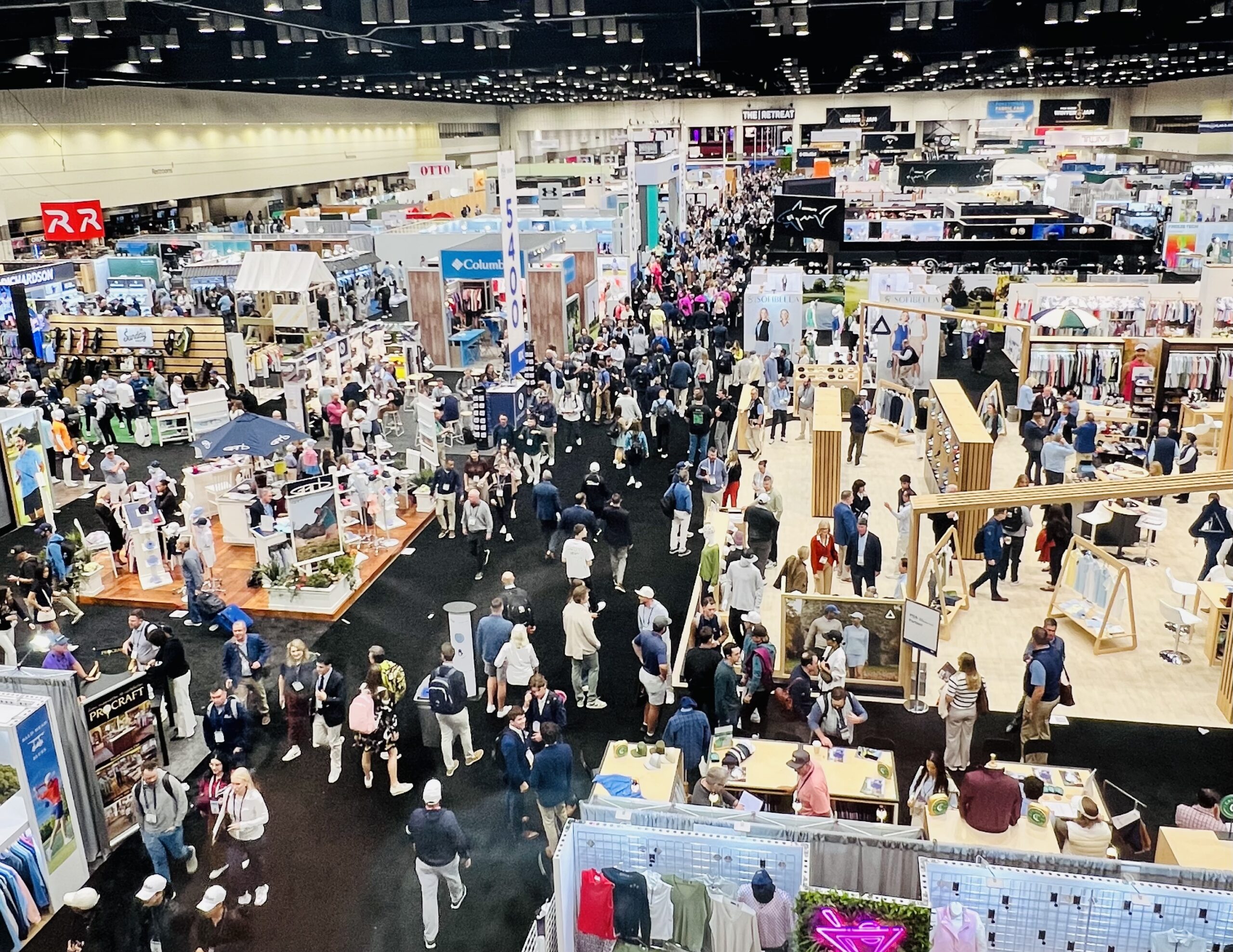
    The PGA Show 2026. Image courtesy of 3DPrint.com.

    Even after covering a large part of the massive PGA Show floor, 3D printing didn’t come up often. Companies like Callaway use it mostly for prototyping in R&D, and others like Avoda Golf experimented with printed clubs, but no one is pushing it into production quite like Cobra.

    In fact, the company has been leaning into additive manufacturing in mainstream golf equipment. At the PGA Show, we spoke with Cobra’s Director of Innovation, Ryan Roach, about how technology is changing the way clubs are designed and why golfers are starting to notice.

    “We launched the LIMIT3D Iron back in June of 2024,” Roach explained while showing the club’s internal structure. “Then we turned that into what is now the 3DP Tour iron. It did quite well for us, and because of that success, we’re growing the number of models we’re using 3D printing with.”
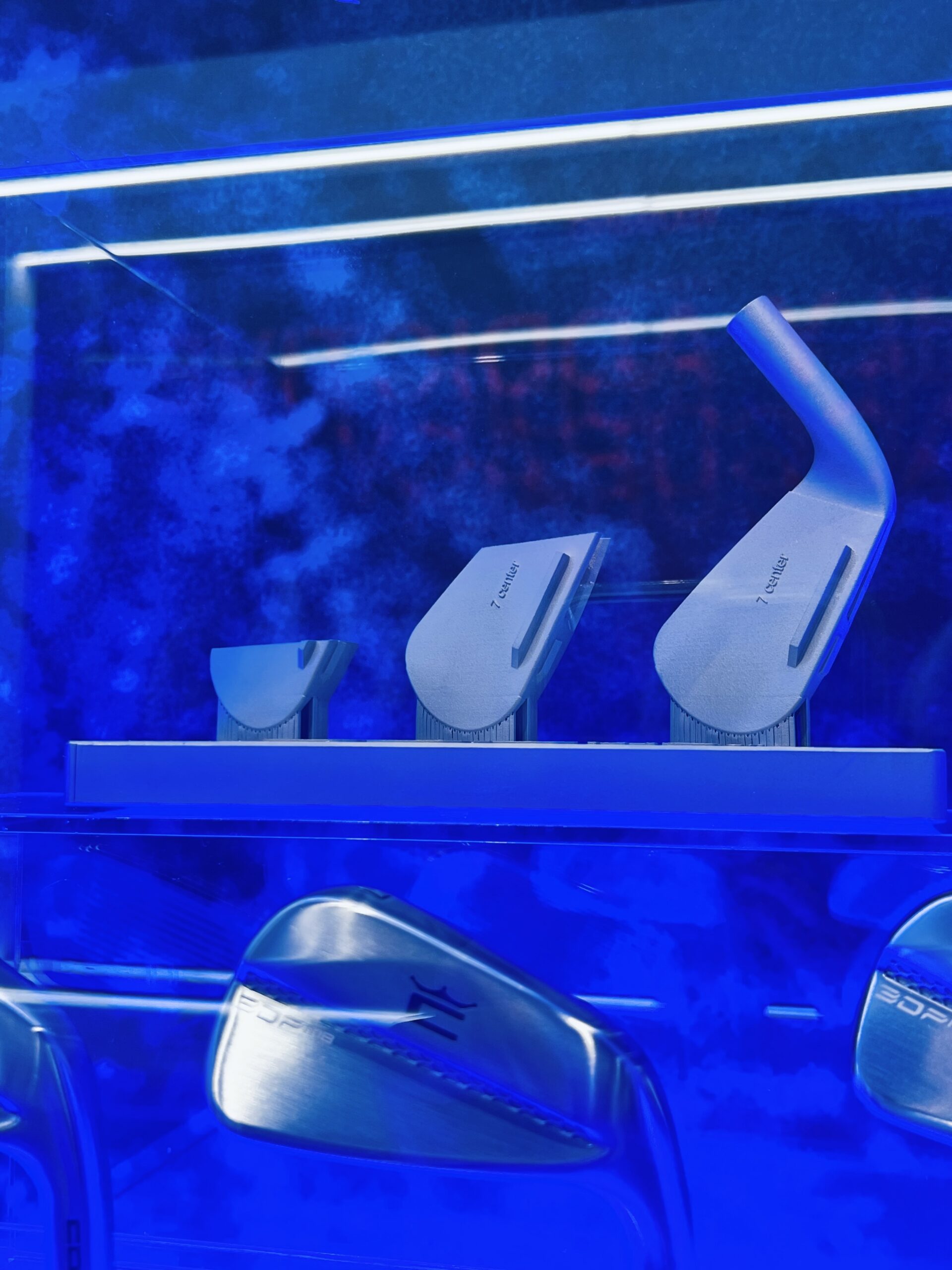
    Cobra Golf’s 3D printed clubs at the PGA Golf Show 2026.

    The atmosphere at the Cobra stand made it clear that the curiosity over the technology drew people in. The booth was packed, with people stopping to examine the clubs and ask questions about how they were made. Finding a quiet moment to look closely at the 3D printed irons was not easy. The clubs were displayed under glowing blue lights, alongside cutaway models that revealed the intricate lattice structures inside, something that can only be achieved with additive. Above a display of clubs, a large panel declared the booth the “home of 3D printing,” reinforcing the message that Cobra is leaning heavily into additive manufacturing as part of its future.
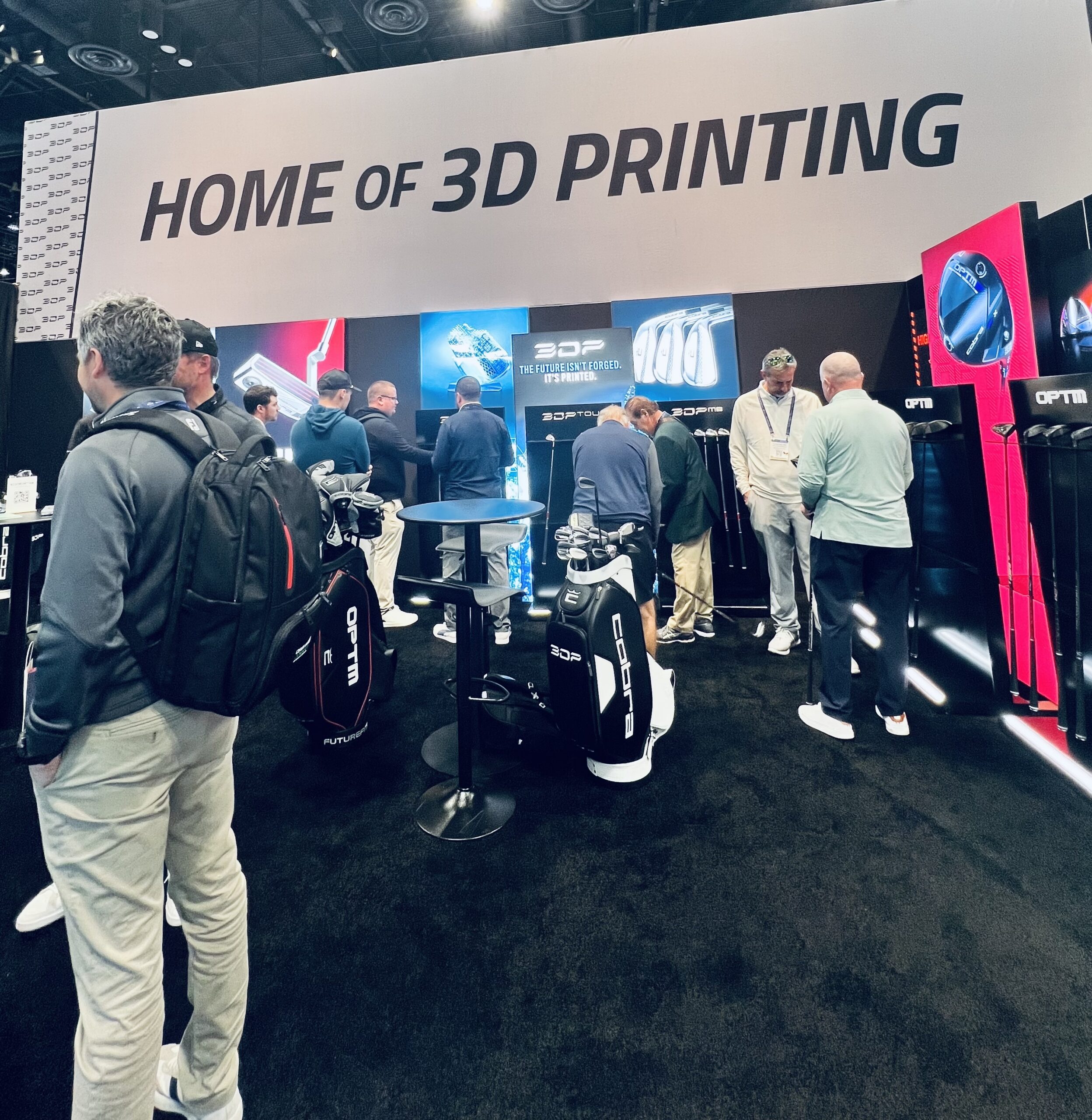
    Cobra Golf’s stand at the PGA Golf Show 2026.

    A Golf Club Built Around a Lattice

    The key to Cobra’s approach is inside the club head. Instead of a solid interior, the company uses a complex 3D printed lattice structure that changes how weight is distributed.

    “With us, we’re taking weight out of the inside and replacing it with that steel lattice,” Roach explained. “Then we reposition that weight while keeping the head size where we want it. This allows engineers to improve performance without increasing the club’s size. Normally, if you want something to be more forgiving, you make it bigger. But with the lattice structure, it’s more forgiving than it looks. It’s like a wolf in sheep’s clothing.”
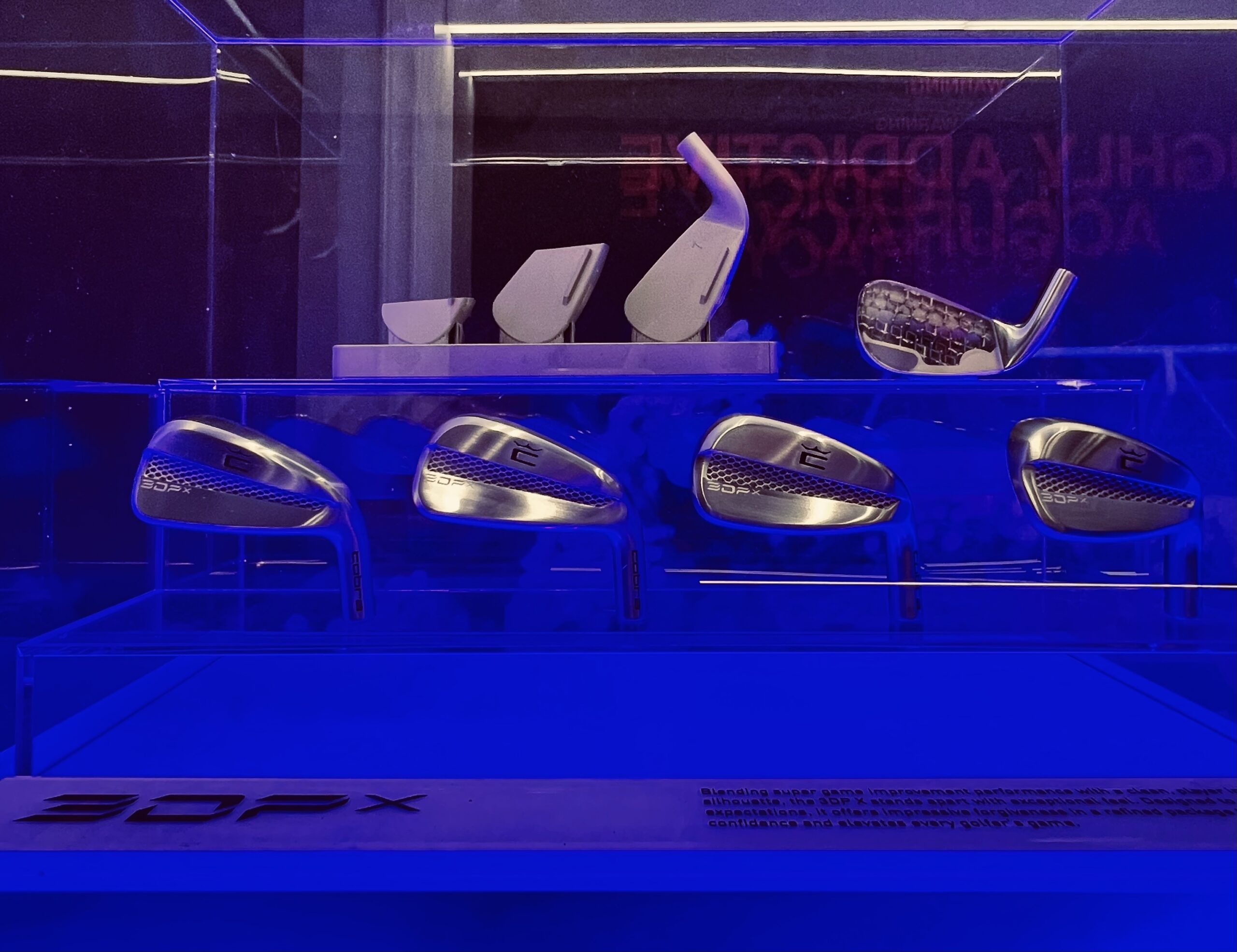
    Cobra Golf’s 3D printed clubs at the PGA Golf Show 2026.

    The clubs are printed in 316L stainless steel using laser powder bed fusion, a process that builds the part layer by layer from metal powder.

    Each club head contains around 2,500 to 2,600 printed layers, and Cobra can produce 32 heads in about 24 hours using two build plates.

    For a technology often associated with prototypes or hobby machines, the scale and precision are striking.

    Faster Development, More Freedom

    For Cobra’s engineers, one of the biggest advantages of additive manufacturing is the design freedom it offers.

    Traditional golf club production relies on casting or forging, both of which require expensive tooling and long lead times. With 3D printing, that barrier disappears.

    “The cool thing about 3D printing is there’s no tooling involved. The ability to go from design to part is so much faster. That speed also allows the company to experiment with customization for professional players. We can adjust a CAD model and just print it,” he explained. “That’s opened up new ways we can help our tour players.”
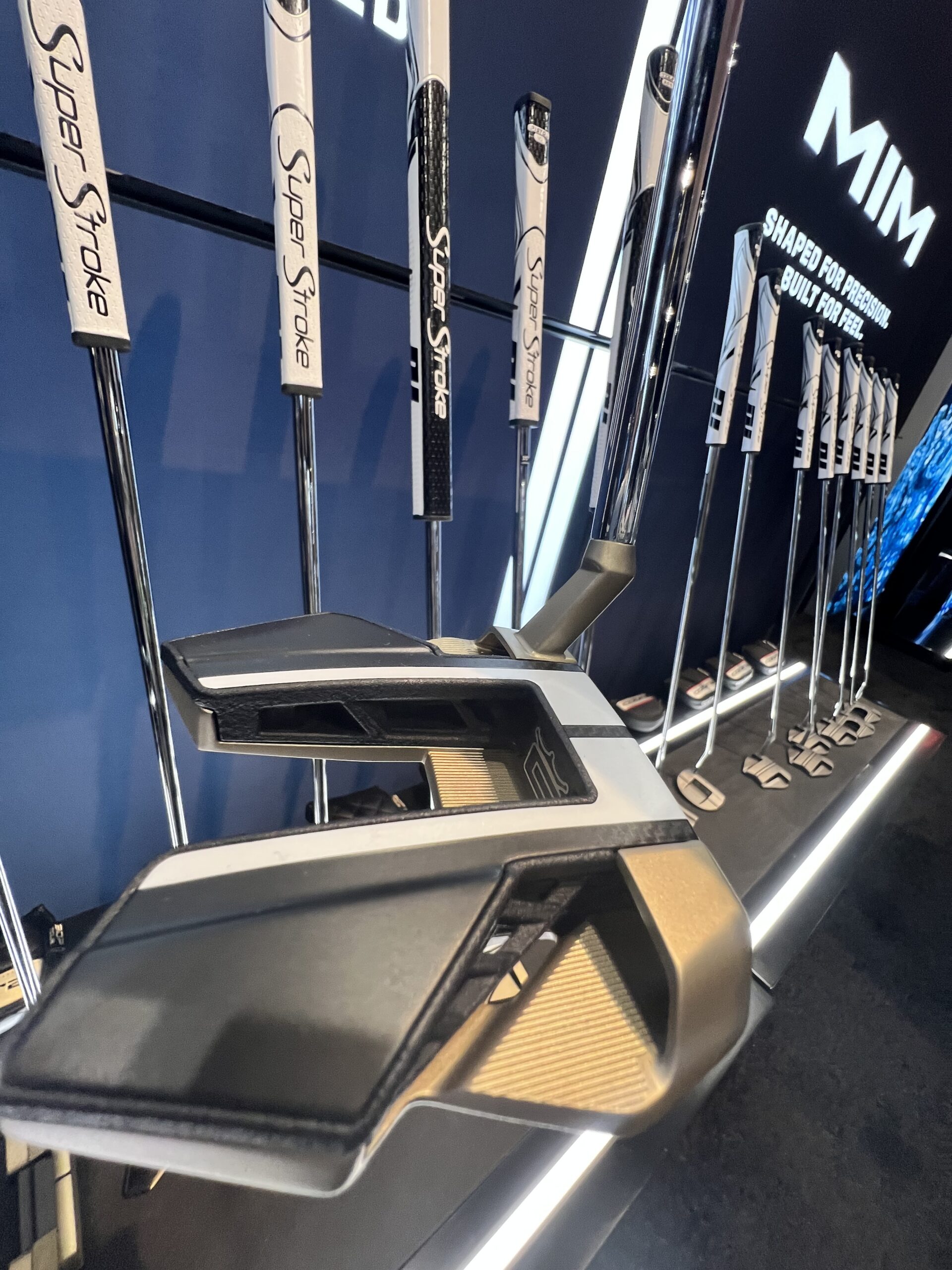
    Cobra Golf’s clubs at the PGA Golf Show 2026.

    The technology is not just experimental. Cobra says professional golfers have already begun adopting the clubs.

    “When we first launched the LIMIT3D Iron, one of our European Tour players, Ángel Hidalgo, immediately put them in the bag,” Roach said. “A few months later, he won the Spanish Open. Other players have followed. Max Homa loved them so much that it helped convince him to join Cobra,” Roach said. “And Rickie Fowler recently put a set of 3D-printed irons into play as well. That kind of validation matters in a sport where equipment changes are often slow and cautious.”

    Cobra Golf’s 3D printed clubs at the PGA Golf Show 2026.

    The lattice inside the club head does more than just look futuristic and quite beautiful; it fundamentally changes how the club performs. Because the structure removes material from the center, engineers can move that saved weight to more strategic locations, such as tungsten inserts in the sole and toe.

    “The difference in weight between a solid head and the lightweight lattice structure is what we are able to reposition in the head to drive performance. The structure also allows Cobra to create thinner club faces, while still maintaining strength and feel. We can make a pretty thin face, but the lattice supports it,” he noted. “That helps keep it stiff and gives it a solid feel.”

    Expanding the Technology

    Cobra first tested the market in June 2024 with a limited run of 500 sets of its LIMIT3D irons, one of the earliest commercially available metal 3D printed iron sets in golf. The positive response surprised even the company. But what began as a limited experiment quickly turned into a broader product strategy, explained Roach. The success of the LIMIT3D helped pave the way for Cobra’s KING 3DP Tour irons, which turned the concept into a full product line and brought it to more golfers.

    “We started with that limited offering, and it went very well. So we’re making more and increasing the distribution so more golfers can experience them. Today, we offer multiple models using the technology, ranging from clubs aimed at elite players to designs for more everyday golfers.”
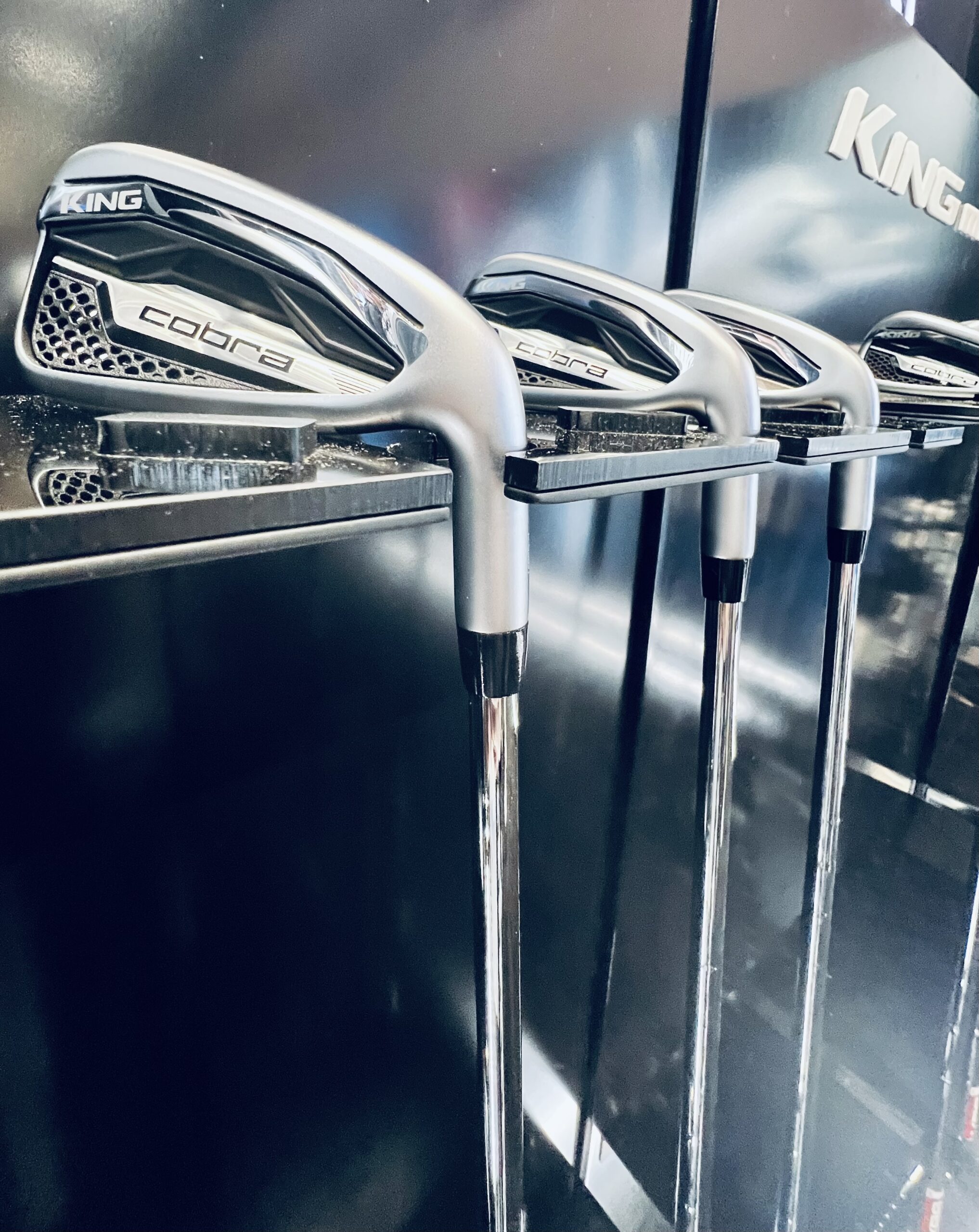
    Cobra Golf’s clubs at the PGA Golf Show 2026. Image courtesy of 3DPrint.com.

    Despite the impressive engineering, Roach says part of the challenge has simply been educating golfers about what modern additive manufacturing can do: “When people think of 3D printing, sometimes they think of a hobby printer. But this is industrial-grade manufacturing. It’s used in aerospace, in medical, in high-performance parts.”

    In golf, the product’s visibility helps tell that story. Unlike many industrial applications of AM, these clubs are something players hold in their hands, look at before every shot, and talk to other golfers about.

    “This isn’t a part inside an aircraft that no one ever sees,” Roach said. “This is something you hold in your hand every weekend.”
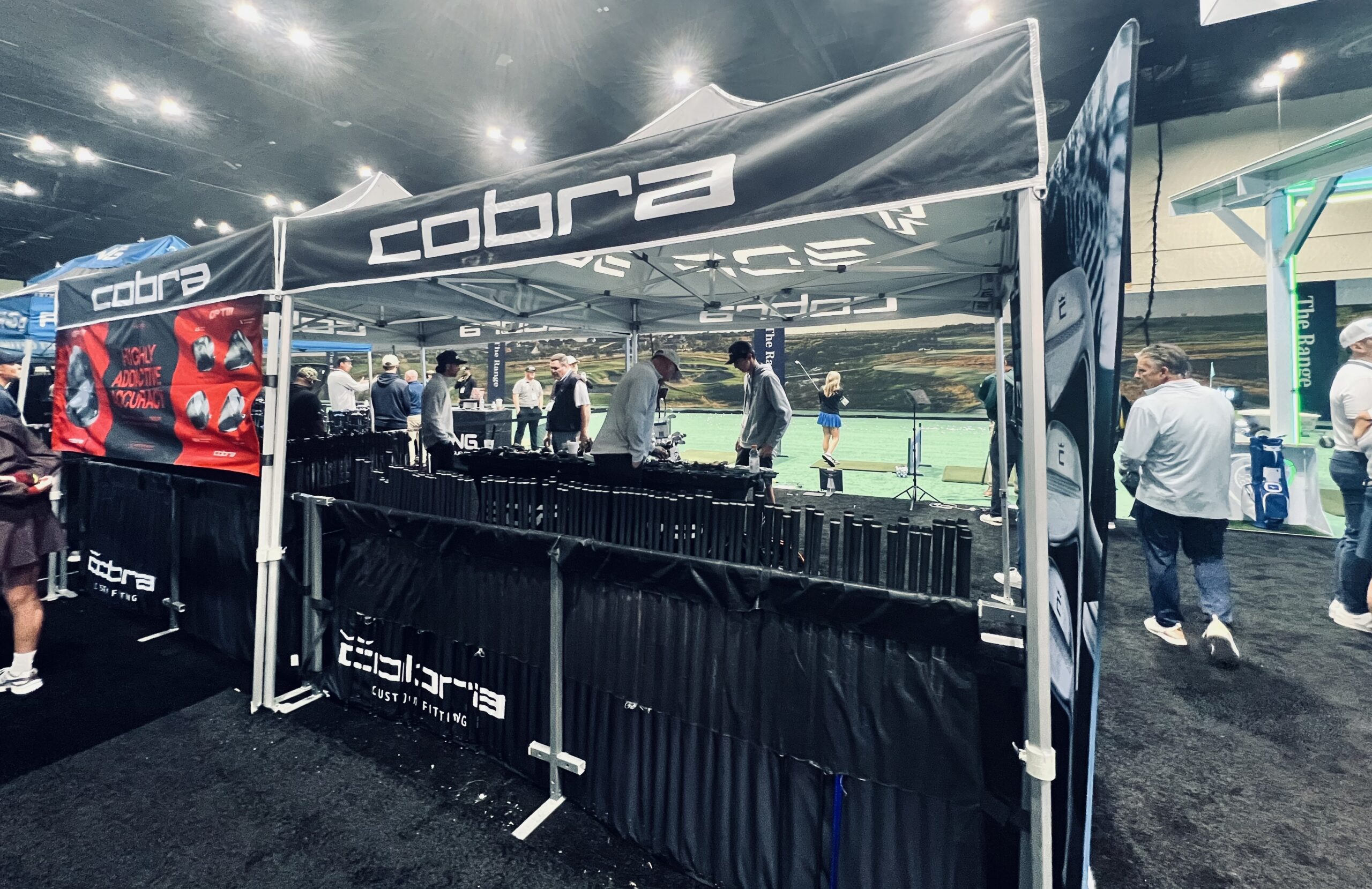
    Cobra Golf at the driving range at the PGA Show 2026.

    Cobra believes additive manufacturing could eventually influence every club in a golfer’s bag.

    A typical golf set contains 14 clubs, from driver to putter. Roach says the company sees opportunities across the entire lineup.

    “Our vision is that this technology could have a place in every club in the bag. For now, we continue to expand the line while working to reduce costs and bring the technology to more players. But after seeing the response at the PGA Show, it’s clear that 3D printing is no longer just a prototype tool in golf; it’s becoming part of the game itself. We just have to keep telling the story,” Roach concluded. “The golfing world is still discovering it.”

    The Cobra Golf stand at the PGA Show 2026. Image courtesy of 3DPrint.com.

    Images courtesy of 3DPrint.com

  • MetalBase: An Engineer’s €10,000 LPBF Machine

    Slowly, we’re coming to grips with low-cost LPBF. Companies like Xact Metal and One Click are making machines available for under a $100,000. Easy to use, these are expanding the market. Meanwhile, Chinese firms are working on machines priced at $50,000 and even $25,000. But, what about a €10,000 (around $12.000) LPBF machine? Frankly, I would not have thought it possible. That is, until I interviewed Tom Bakker of Metal Base.

    Tom is the founder of MetalBase, a company that wants to completely redefine what low-cost LPBF is. 

    Before this, Tom worked as a System Integrator at the well-regarded specialty mechatronics and machinery builder MTA. MTA makes things like microsurgery robots, nonporous thin-layer manufacturing machines, the AM Flow sorting and AI detection line, and a robot that replaces nurses in drawing blood. Before this, he worked for four years for Additive Industries as a mechatronics design engineer. I initially thought that Tom was naive, but he is not. And I assumed that he didn’t know what he was doing. But he does know what he’s doing. Indeed, given his career, he is highly qualified to engineer an LPBF machine. But, still, €10,000? Twelve grand? I didn’t even think it was possible.

    Tom loved his work at VDL, which he described as taking place at the intersection of precision, hard work, and creativity. Because of his love for mechatronics and LPBF, he started experimenting at home with a 30W laser to print metal. Initially, Tom was his own recoater, manually recoating layers. But it worked… kind of. Then he experimented with a 60W laser. When he’d finished the prototype, he saw real potential. He iterated and improved his initial designs. Now Tom has sold five machines to five different customers. Tom’s goal is not to make a M290 that’s as cheap as possible; he wants to reimagine LPBF. He wants to make the process as accessible as possible.

    Tom thinks that a 100,000 is simply too much for an LPBF machine. He told us, “There are too many out there that wish to print metal but can’t spend that kind of money.” He’s not aiming to equal what other machines do. He freely admits that the path he’s chosen won’t deliver the results other systems do. He says, “This is not for space companies but for industries that do not have access to technology. This is for handlebars, not rocket engines.” The way he has engineered his machine, from first principles, makes it much more radically low-cost than others. And… It’s a kit.

    The machine plugs into a standard wall outlet and uses Klipper as well as Orcaslicer  The printer does not print titanium  Instead, he’s optimized it for 316L stainless steel, bronze, and Inconel  The densities and tensile strengths he can get are comparable to those of industrial machines for Inconel and 316L  For bronze, he’s at 94% density; copper is at 80% density  Build volume is 128 by 100 mm, and build speed is 1.5 cm³/h.

    You can see a video of how it prints Inconel below.

    Here you can see a thermal and tensile test of a printed part.

    Here is a year-old video of parts of the machine.

    A Nitrogen generator is an extra option. The laser is a 445 nm, 60 W diode laser on an XY gantry. Making this work is key to the machine’s success, but Tom thinks that too many people making LPBF machines are focusing on the laser.

    He says, “focus needs to happen, how the light I send hits powder, is important. But it’s not the most important thing. having a short optical path close to the melt pool, good gas circulation, good airflow, not getting the optics not dirty and the actual laser power on your bed…are more important.”

    Now, to me, this is worrying because he’s starting to make sense. I’m going from thinking this is unbelievable to thinking that I may have to buy one  In his setup, he’s currently getting 20 to 30 joules per cubic mm in a controlled way  This is compared with industrial fiber laser machines, which typically use around 80 to 100 joules per cubic mm  In his low-cost LPBF system, efficiency is key  Tom has used input shaping to reduce damping effects  Most of his engineering time was spent on flow dynamics. 

    The system is incredibly simple  But it has a HEPA filter and additional filtration  The printer also includes laser, oxygen, and door monitoring, as well as CE  There is also a powder overflow system  The systems in customers’ hands are doing well  A fabled, an LPBF expert, a manufacturing firm, and a 3D printing service are among his first customers  He’s taken feedback from them between May and December of 2025 and pumped this into his new machine  He’s now doing the Kickstarter, hoping to sell around 10 to 20 systems  He wants to spend the Kickstarter money and time on documentation  Tom is “not looking for a unicorn startup…just to make metal printing more accessible.” He suggests that a well-outfitted workshop is needed to assemble and operate the machine, and stresses that everyone should always wear PPE  The cost of the system  It’s €8,500 (excluding VAT)  It will require 30 hours of assembly  A Nitrogen generator costs €1,200  Welcome to the future, folks, it’s going to be a wild ride  Here you can see the Kickstarter, the website is here.

  • Apple To Further Scale Up Additive Manufacturing?

    Apple’s Apple Watch implementation is a shining example of additive manufacturing at scale. Apple now makes two watch cases and a port using additive. Now Bloomberg’s Mark Gurman has stated that,

    “The company’s manufacturing design team along with its operations department is working on ways to 3D-print aluminum, which would bring more efficiency to the production of Apple Watch casings and potentially one day iPhone enclosures.”

    That kind of move by Apple would be sensible if it wants to reduce material usage. Reportedly, this is the goal of the engagement. Summed up, the advantages may include “reduced waste, lower manufacturing costs, improved design flexibility, better structural bonding, and thinner components.” At this current juncture, these goals are, of course, hilarious. Despite adventurous forays into dreamland by current stage suppliers, the economics of Apple’s current 3D printing efforts don’t make sense, right now. But, if we look into a probable future, they may become true and give the company a lasting advantage.

    Far Off Logic

    Apple makes around 40 million watches, over 220 million phones, and over 20 million MacBooks a year. The scale at which the company operates is unsurpassed. At the same time, the firm commands a premium. Not only is Apple selling premium devices, but it also offers a premium experience overall. Committed to excellence and innovation, Apple has to deploy both at scale. This is incredibly difficult to do. Apple is additionally remarkable at how seamless the overall experience is, with objects looking exactly how they feel, for example, and feeling exactly as the tactile response to them. Design at Apple is not skin deep, and the firm has pioneered a total design that is difficult to replicate. With revenues of $416 billion in 2025, Apple dwarfs not only other firms but many sectors and whole economies. So Apple is difficult to compare to other companies; it’s a bit like comparing a galaxy to a planet. So Apple’s logic is not the same as the logic that makes sense for other firms, even very large ones with which it directly competes.

    For Apple to industrialize 3D printing across several metals for handset and wearable production was not an easy decision. At the same time, when Apple industrializes a new material, process, or device, it is the production system that makes the parts (and costs) add up. Apple can’t really place an order at a contract manufacturer or just turn on some machines. Its scale needs to be replicated; there are multiple vendors, and there is an interplay of systems. At the same time, for any effort to make sense, the firm can’t just introduce a new color for a new color’s sake, but rather it needs to make meaningful change happen in its supply chain in order to derive lasting advantage from this change. Pursuant to the effort at the scale and precision that the company demands, changes must be meaningful.

    In the long run, reducing material use is a lasting change that can give the company a lasting advantage. Apple will be able to use metals that others cannot because of cost. This will make Apple products feel more premium while lasting longer. If someone tries to best them in using metals, Apple will have a better-feeling part, which simultaneously would have less material in it. This, in and of itself, explains the firm’s attraction to aluminum. Aluminum’s ubiquity, familiarity, and high production costs, but high reusability make it an ideal material. If Apple can sufficiently elevate this material, it could produce a better experience at comparably lower cost. If it masters this material, then it can make better devices overall. If its production system investment further optimizes its use, then it will reap economies of scale.

    Thinner

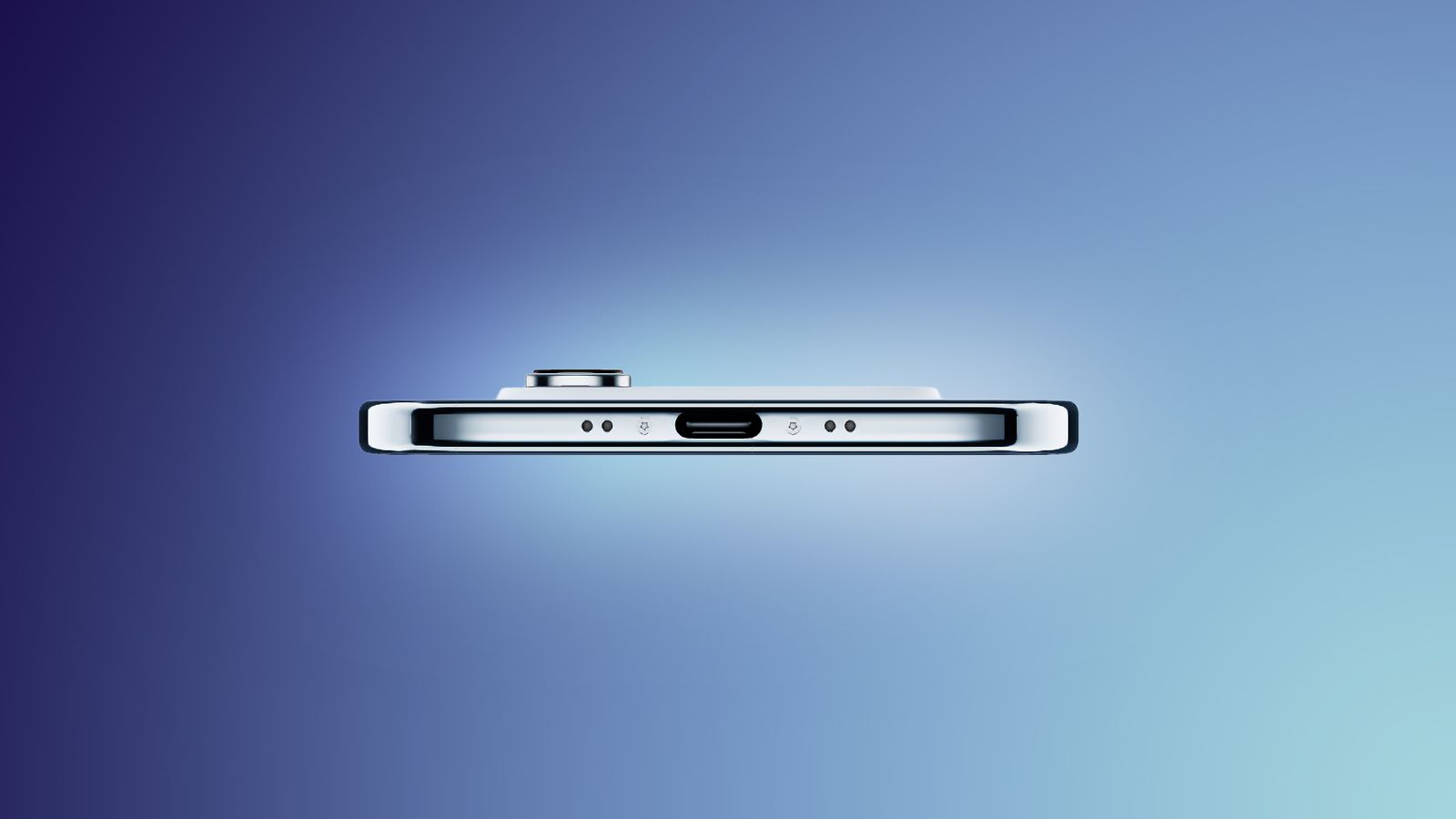
    iPhone Air 3D printed USB-C feature. Image courtesy of Apple.

    Hand in glove with this is the idea of thinner components, which could add up to additional weight savings. Thinner components make for lighter devices that use less material. But, especially in the crowded space of a phone or anything with an antenna, really, more antenna and battery space lead to better devices. With battery life and connectivity being of paramount importance to consumers, thinner other components mean more space for Apple to cram in more functionality. At the same time, by integrating functionality, Apple will reap greater rewards from components made with additive manufacturing. On top of this, making these components conformal or fit into very specific spaces will also bring more benefits to the firm. This can cumulatively add up to huge savings and durable advantages for Apple.

    What’s more, Apple could apply IP to making certain components thinner that could let it gain an advantage over rivals. It could patent certain geometries that would be the most compact battery shape, or the most accordion-like USB-C plug, or the best way to shape a sensor. This would be an IP advantage that the firm could not get with CNC, for example. Thinner is also interesting in that, if it could use metal more efficiently and make devices thinner, it could make it harder for competitors to match devices that contain more polymers.

    Bonding

    One of the advantages of “better structural bonding,” an article explains, is that different textures “create textured internal surfaces that improve bonding between plastic and metal around the antenna housing.” Better bonding is nice, and it may add up to benefits for users and longevity. But if Apple could just change a texture and then use a few drops less of glue or solder, the cost savings would be immense. To me, the material savings are more compelling. But, additionally, there are more things to consider here. Imagine if we could reduce a few soldering or assembly steps by making things easier to join together. Or imagine if we could include a texture that would let a screen drop into place more securely, saving a second on an assembly step? Or could we add a texture that would reduce error rates when placing said screens? Now that would be a huge cost and time saving for Foxconn and Apple. Again, at Apple scale, something like better textures can have profound advantages. To me, however, cycle time and material savings will be meaningful here.

    Improved Flexibility

    So when we look at the idea of “improved design flexibility,” it is not exactly like the geometric flexibility or design freedom that we normally associate with additive. In an Apple context, the big win here is not simply the ability to make a “better” design. What this creates is the ability to optimize overall performance in the cramped interior and, at the same time, create areas of outperformance within the total production system. And we may be able to create a better device. More freedom to create a new shape for an antenna may therefore not only improve the reception of a phone model’s Wifi but also could free up more space for further battery life, translating into lower battery acquisition costs and more margin while allowing for the reduction of several hundred million fasteners because we eliminated one through the new design, which will make the phone thinner. For an Additive application to make sense, we often look for cumulative advantages. In this sense, the total production system that Apple will deploy will reap rewards from multiple effects through seemingly infinitesimal improvements. Combine this with the firm’s waste reduction strategy, and we can see this in the light of remaining competitive at scale.

    Lower Costs

    Now, of course, the lower costs thing is hilarious, especially given the high scrap rates we’re currently seeing. But let’s do a thought experiment. What could Apple do to cost out the process? How would it work?

    If we stick to LPBF, we can see that the case part is problematic, with support needing to be removed and walls and some features being in peril at the time of build plate removal and later. Ports, slots, and the like will continue to be problematic, and we can see why the company has worked hard to eliminate these from its designs. Yes, it’s silly to buy a $900 laptop with one USB port, but it saves a few hundred millionths of an operation. So fewer holes would be nice. Thinner walls would be especially desirable, as they could deliver a better buy-to-fly ratio. At the same time, the case or internal components could become heatsinks, “fasteners,” or be further optimized.

    But if we look at the sheer volume of cases for ports, plugs, speakers, rare-earth magnets, and fasteners, we can see that we could be freeing up a lot of internal real estate. And we could do this with lower-cost components that have big impacts. Again, binder jet or MIM would be the way to go here, but Apple seems to love lasers more than Scan Lab, so who knows. The quicker, easier, and more fundamental win would be to optimize these components over the case, in my opinion. Imagine just removing two screws through an optimized assembly so that the screw fits onto a lower layer! I’d focus on this before working more on larger cases for phones, since the win could be easier and lead to a bigger performance improvement. Also, then maybe I can make a smaller phone?

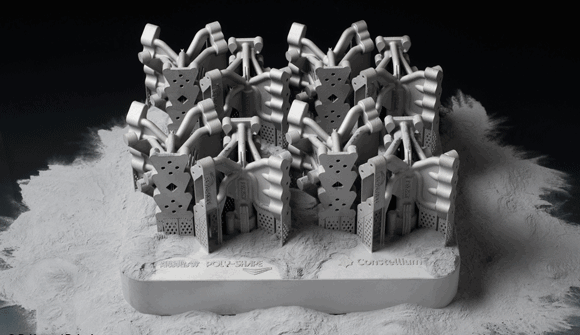
    Constellium’s Aheadd CP1 aluminium powder. Image courtesy of Constellium.

    Assuming that we’d then take this to another level and then tackle phone cases, we’d be dealing with a huge increase in build times, part volume, number of parts, object size, and post-processing time. And risk, risk too. Failure too. Let’s ignore for a second that we would need 2,400 machines. Breathe, let’s talk about the volume, talking 146mm by 72mm to 166mm by 76mm. Depending on the metric, the phone case is three to four times bigger than the watch case. Binder jet would be more limited here; weirdly, e-beam may make more sense than LPBF, given you could pack better and may have less support removal and residual stress. Of course, ebeam sucks for aluminum, so we’d assume that LPBF would win. Personally, I’d use bound filament material extrusion and then mill the ever-living everything out of it for a while. But maybe we want it to have a thin wall thickness and for the case to be a heatsink with hollow parts? Maybe we can make some recessed 3D printed buttons and mount them on some walls to snap the Taptic Engine and other parts into place? There are over 100 fasteners in the latest iPhones. Eliminating some of these through dovetails and other smart ways to slide things into snap-fit elements on the 3D printed case could maybe work?

    Let’s assume we’d do everything with three vendors, each replicating each other’s efforts. We would need completely automated part removal, depowdering, distressing, hipping, all that jazz, including automated build plate resurfacing, CNC milling, and laser marking for recesses/ports. We’d need automated filling with an Azo or similar system and a quite automated build removal process. This is straight out of some German mid-2010 Industrie 4.0 fever dream and seems well within the bounds of what Apple could do and what key suppliers could do. Had they had a laser-based QA system at every major step, maybe to save time? Glidewell implemented a Micro-CT scanning workflow for itself so that Apple could do this too. Just given the turnings Apple already produces and the amount of support and scrap that will be created, even if they are efficient, I’d get a couple of Eigas. Or maybe a Metalworks or two? If they could use residual heat from the factory or some kind of efficient power source to locally make and recycle powder, they could have some interesting gains.

    If I was them I would have bought Incodema3D and told them about a world beyond Inconel, then I’d buy Metal Powder Works for my turnings, a system to recycle aluminum generally into smaller components, Metalysis to make powder more efficiently than anyone else, some kind of solar/waste energy system to power it and made my own Aheadd CP1 kind of thing to save on heat treatment steps. I’d focus on something that could anodize really nicely, so I can give my phones some nice colors quickly. Then they’d need a pulsed-current anodizing process that provides a superior surface finish while anodizing more quickly. Ideally, I could do all of this to achieve thinner wall thicknesses. I’d engineer an aluminum that fits my process, my goals, and the process steps I can eliminate. I’d probably develop my own alloy, what the hell, I’m Apple.

    Alternatively, I’d develop an LPBF machine that could run on MIM powder. Or I’d come up with a process that uses HIP powder in a kind of new-fangled powdered-metallurgy way, letting me make more delicate shapes. Generally, I’d turn to green or blue lasers over regular old fiber. Green lasers would really speed up build times, and this would also go far in explaining why it’s so hard to get powerful green lasers that work well now. On the whole, a standard machine could suffice, but one thing that Apple would really want was paths to create thinner walls and features than are usually possible.

    Now Apple has an interesting patent, this is a kind of dual case comprising two metal materials, one perhaps being preformed and the other an additive part that has a lot of the features that we described above, including “preformed recesses” and also some interesting things like, “micro-features on the scale of 10’s of microns or less to form hydrophobic surfaces, surfaces that feel like glass, or other surface micro-features that promote chemical etching of the surface.” Other parts of the patent talk about adding electrical components or building the part within the volume. Helpfully, I found the patent after writing this article, but you can see that there are different roads, all leading to Rome.

    Unexpectedly, perhaps we can conclude that whereas Apple’s initial foray into 3D printing has not been economically viable (for its suppliers mainly), a further path deeper into 3D printing does make a lot of sense. Also, if we look at the challenges to be overcome here, there is a lot of hard work, engineering, automation, and process control. But there’s no magic leap needed in physics or technology. Apple could do this with current-stage technology optimized for this purpose. And it could, at Apple’s scale, make sense for the company to do so.

  • MIT’s Enterprise Additive Manufacturing Program Heads to RAPID + TCT 2026

    MIT will offer the class Enterprise Additive Manufacturing over the course of five days. Three and a half days will take place at MIT, while two half days will see the students bounce between MIT and RAPID + TCT. The focus is on teaching business leaders how to implement additive at scale and “identify, evaluate, and deploy innovative applications of AM are essential to greater and more effective adoption.” The course covers “strategy, operations, technology selection, and real-world case studies” and will take place in Boston between April 13 and 17.
    The curriculum will cover both the direct manufacturing of 3D printed components and things such as jigs and fixtures. The team believes that “the frontiers of AM are defined by new materials, advanced automation and software, and the use of artificial intelligence for design optimization and production control.” The team at MIT says it has taught 3D printing classes to over 10,000 students to date. Which is actually amazing if you think of it.
    The teams will look at how to assess whether 3D printing could meet their needs while also evaluating it against conventional manufacturing technologies. Cost, volume, and performance will be judged. Not only the additive step, but also design and post-processing will be looked at. Participants will also get to see and work with 3D printers at MIT and get to work with CAD and other 3D printing software.
    Through lectures and discussions, teams of students will learn and apply their knowledge to business cases. Teams will create a vision, business case, design, and strategy. In so doing, they’ll learn how to implement and apply additive to their own business lives. They say that, “We hope you arrive at MIT with an open mind, and leave the course with a clear idea of how to use AM and, more importantly, practical experience in doing so.” The course will be presented through the lens of an actual 3D printed part. Through the business case, design, and costing, they will learn which processes (or if at all), this part will work. At RAPID, the students will see and interact with the parts, machines, technologies, and suppliers they may need for their business case. Teams will be led across the show floor to meet people and see parts. Around 40% of the course will be lectures and 40% will be working in groups. They estimate that 40% of the course will cover additive manufacturing as a technology, 30% will focus on the latest developments, and 30% will cover applying the technology.
    You could be new to 3D printing or have some experience. Engineers, design engineers, managers, doctors, and more have done similar classes at MIT. The team thinks that the sectors “aerospace and defense, medical devices, thermo-electrical components, automotive, fluid handling devices, semiconductors, art, design and architecture, consumer products, and other general manufacturing of physical goods” are the most relevant.
    I really like the work that MIT is doing in educating a broad swathe of interested people. The path towards understanding has traditionally been difficult and long. By making it easier for people to get their bearings, they’re accelerating industry adoption. For over 15 years, I’ve given tours of 3D printing trade shows to investors, business partners, and prospective clients. It’s so much more efficient to show them the machines and parts in person. Showing people the limitations in size, smoothness, materials, and finishes is much faster. Seeing the machines and the build volumes, but also all of the post-processing equipment, really helps people understand where we are. It’s one thing to describe a part, but to hold it and understand is much better. I really think that this kind of thing is very valuable, and I hope we see many more courses include trade show experiences in the future.
  • Singapore 3D Prints Childcare Center Walls in Two Days

    The exterior walls of a childcare center were 3D printed in two days in Singapore. The first story was made with additive while the second was made with conventional methods. This comes amid a push by Singapore to increase the number of early child care places available and to use 3D printed construction. The building is a part of a 348-apartment condominium project in Singapore’s northern Woodlands neighborhood. Woodlands is home to the excellent Marsiling Mall Hawker Centre, known for Ye Lai Xiang Laksa, the excellent Yan Ji Seafood soup, and nearby Nur’s Malay Food. Woodlands is residential, a high-rise kind of place replete with Housing and Development Board (HDB) apartments and their recognizable boxy style. With mangrove, a pair of parks, and sandwiched between Malaysia, a wetland, and the Zoo, it’s a nice place. There’s an Uniqlo, you’re very close to the cheap things and good food of Malaysia, but for Singapore, the place is relatively remote.

    The structure was 3D printed by construction firm Woh Hup. Won Hup isn’t just any construction firm; started in 1927, it is one of the largest local firms and has worked on some of the most iconic and challenging local projects, such as Jewel Changi Airport, the Expo center, and the Gardens by the Bay. The company is now working on around 20 projects across Singapore, including a 63-story residential building, and another twin 62-story residential building with a third 36-story building next to it. Won Hup builds subway stations, golf courses, giant malls, and government buildings. The scope for additive is therefore considerable. As well as Won Hup, the National University of Singapore (NUS), the Building and Construction Authority (BCA), and the National Additive Manufacturing Innovation Cluster (NAMIC) worked on the project.

    The Straits Times quoted Du Hongjian of the NUS College of Design and Engineering saying that,

    “(It) needs to be set up one day before casting, and can only be removed one to two days after concrete is cast. 3D concrete printing can reduce the amount of manpower involved, and offer a higher degree of design freedom for architects and structural consultants.”

    He also stated that it is cheaper than formwork, the Straits Times said: “The walls on the first level of the centre were printed in two days, and required a team of around six construction workers tasked with responsibilities such as monitoring the sensors that track the quality of the concrete mixed on-site. Three additional checkers were also deployed to ensure that the novel process went smoothly. The work took a total of 170 manhours, whereas manual building would have required nearly 400 manhours and a larger team of 11.”

    Now used as a structural element, concrete is advancing in Singapore. Compression, load-bearing, bending, and shear-bending were tested on the structure. One thing that was pointed out is that construction could take place later in the evening, resulting in less noise pollution, a benefit that I had not previously heard about. The 3D printed concrete also needed more cement and therefore a higher emissions overall concrete mix than regular concrete. Still, the team is trying to resolve this by using 60% glass powder in the mix. The Co2 emissions would be reduced by half, and their calculations show that it would retain the same strength.

    The higher Co2 emissions are something that needs to be talked about more by the 3D printed concrete community. Just saying that it is more sustainable because it uses less material is not enough. And using glass powder in this way, readily available globally, could be a great boon to the 3D printing construction industry.

  • ICON Opens Sales of Its Titan Construction 3D Printer, Promises Walls for $20 per Square Foot

    Construction 3D printing company ICON has taken a major step toward commercializing its technology. The Austin-based firm announced the launch of the Titan program, which will allow builders to directly purchase and operate ICON’s large-scale robotic construction systems for the first time.

    Until now, ICON’s construction printers were mostly deployed through partnerships or projects managed by the company itself. But now, with Titan, builders can acquire the entire system, including robotics, software, materials, training, and ongoing service, to construct buildings using ICON’s technology.

    3D printed walls.

    The company says the system could reduce the cost of building wall systems by up to 40%, bringing costs down to roughly $20 per square foot, compared to typical industry costs of roughly $30–$35 per square foot for conventional wall systems.

    For an industry struggling with labor shortages, rising costs, and housing shortages, ICON believes robotic construction could become a critical tool. Workforce shortages are still today one of the sector’s biggest challenges, with 92% of construction firms reporting difficulty finding workers, and industry forecasts suggesting the sector will need about 349,000 additional workers in 2026 just to meet demand.

    At the same time, the U.S. housing market faces a supply gap of more than 4 million homes, the result of years of underbuilding. Rising material prices and labor shortages have further pushed up construction costs, creating pressure across the industry and prompting builders to look for technologies that could deliver housing faster and with fewer workers.

    “I don’t think it will be news to most people that the cost, speed, and quality of conventional construction is simply not delivering what the world needs from the industry right now,” said ICON co-founder and CEO Jason Ballard. “After nearly a decade of research, development, and field operations, we believe it’s time to put these technologies directly into the hands of other builders.”

    ICON’s Titan.

    From Experimental Projects to Builder-Owned Systems

    ICON has spent years demonstrating construction-scale additive manufacturing in real projects. The company has printed more than 245 homes and structures across the United States and Mexico, spanning affordable housing, military housing, commercial buildings, and experimental architecture.

    Multi-story home development designed by BIG.

    Now the company is moving toward a model where builders themselves can own the robotic construction systems.

    “The Titan program is for builders who don’t want to choose between high quality, higher speed, and lower cost. These are tools for builders who are tired of the status quo, and want to be part of the solution,” continued Ballard.

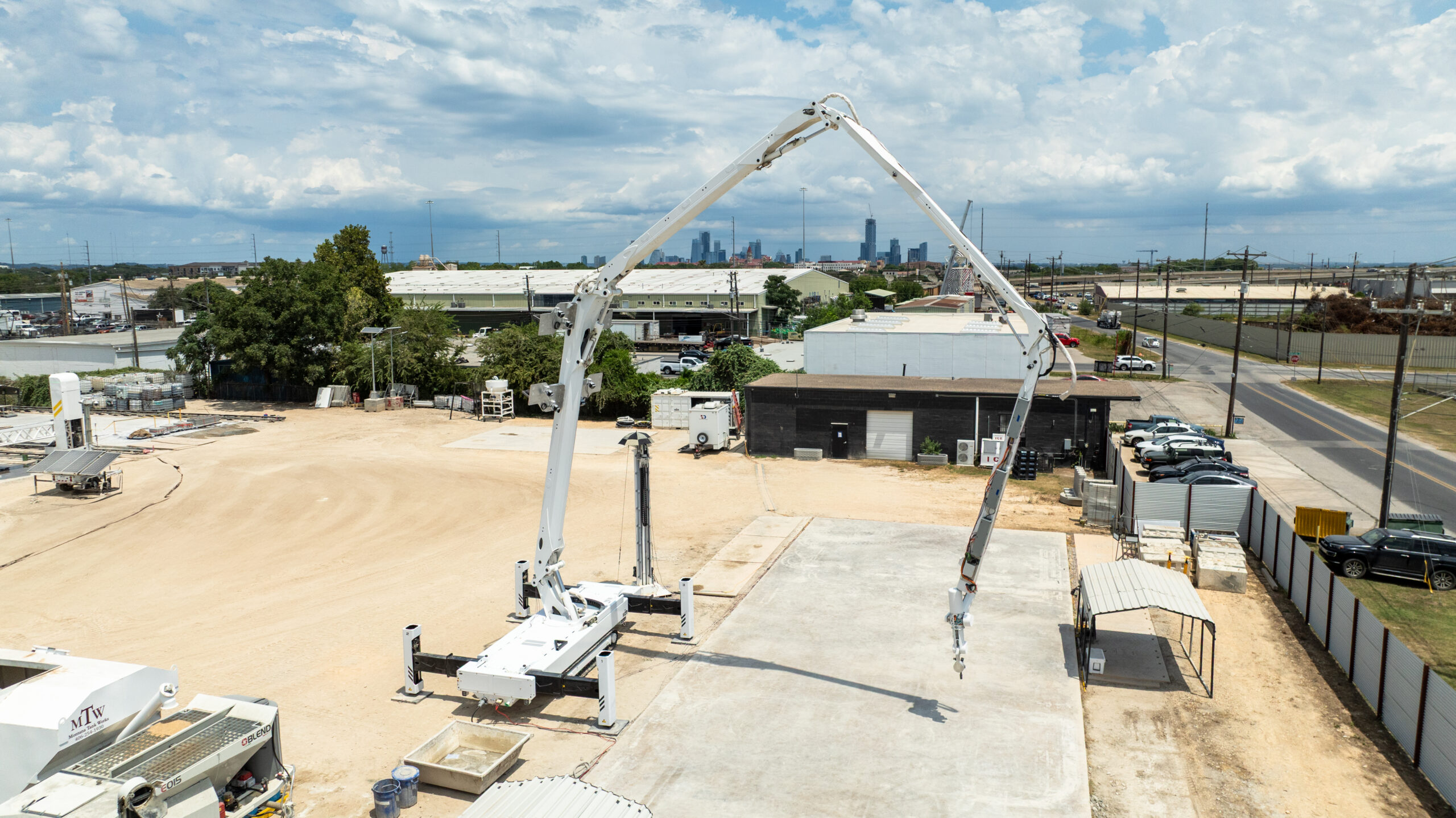
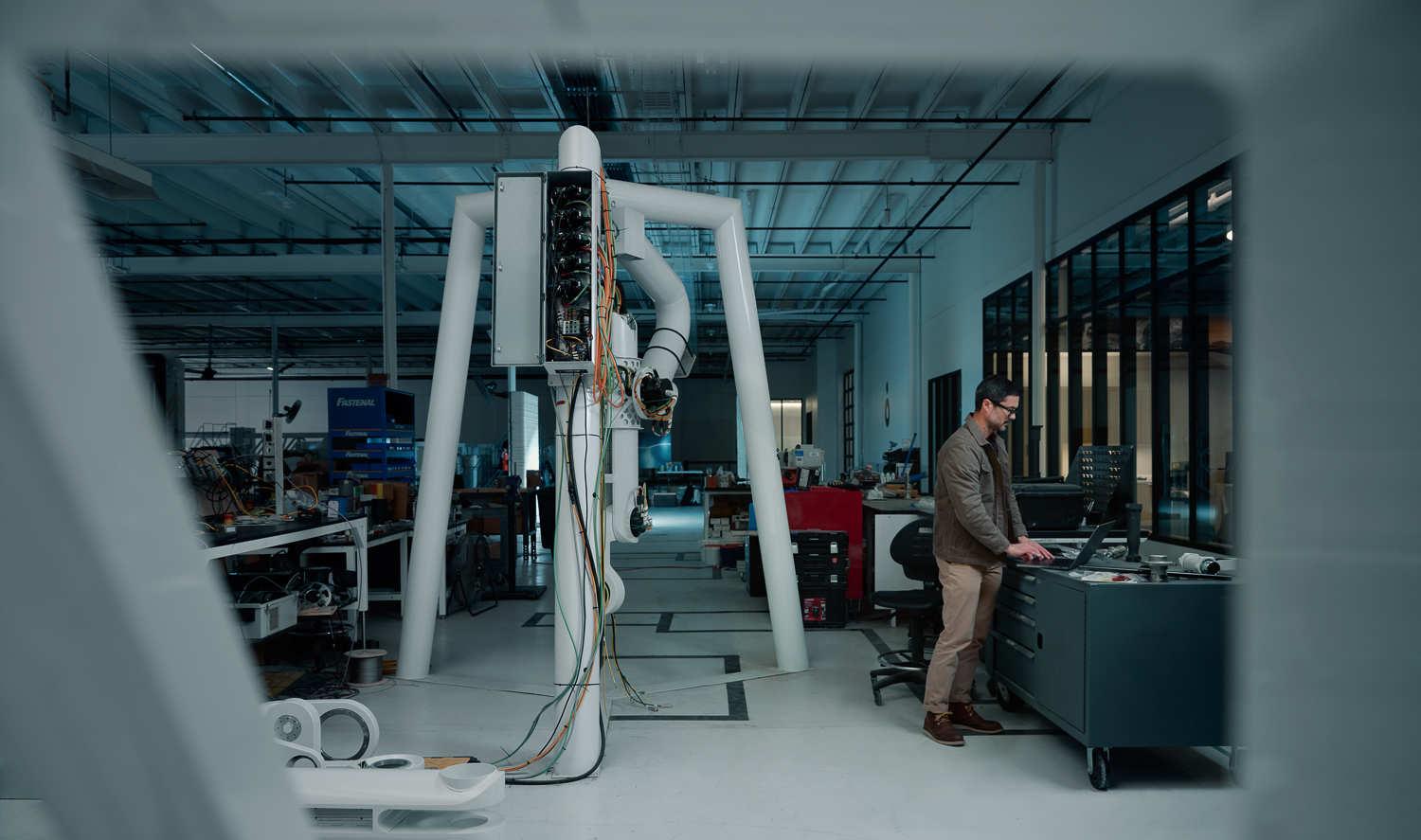
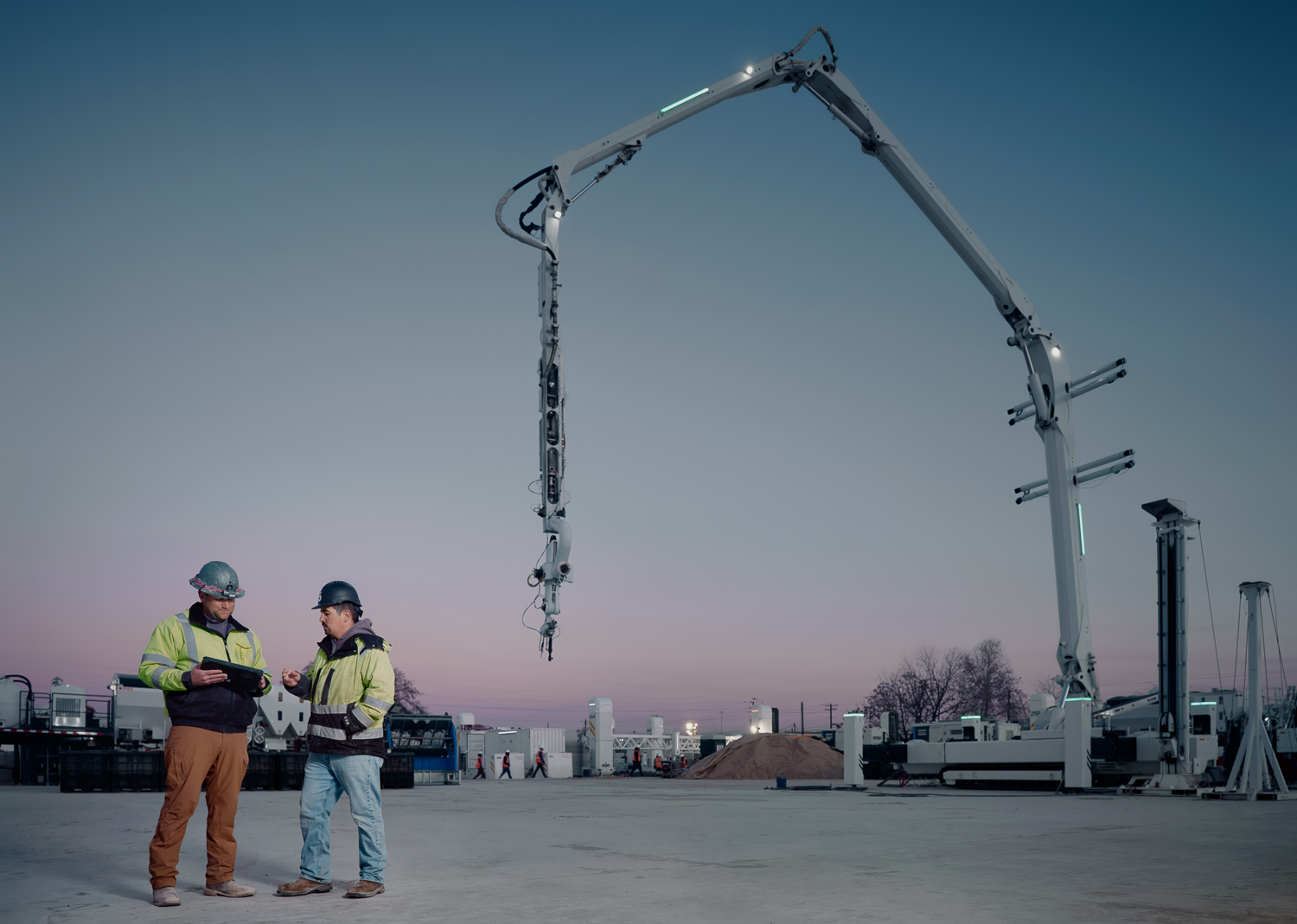
    The Titan system is designed to print multi-story wall systems using large robotic equipment that extrudes specialized construction materials layer by layer. Alongside the machine, ICON is offering a broader ecosystem that includes architectural design tools, project logistics support, permitting guidance, and workforce training.

    Building Titan.

    Reservations for Titan are now open with a $5,000 deposit, and the company expects customer training to begin in the third quarter of 2026, with the first systems delivered in early 2027.

    Early reservation customers will receive priority access, preferred pricing, and support services, including architectural plans from ICON’s digital design catalog.

    Early Customers Already Planning Projects

    Several early adopters are already planning projects using Titan. One of them is Ghost Factory, a housing platform company that aims to scale residential construction across multiple states. According to Ghost Factory co-founder Spencer Padgett, Titan could help builders better control supply chains and stabilize construction costs.

    “By integrating Titan machines into our building platform, we gain the ability to stabilize structural costs, strengthen control over our supply chain, and move faster than traditional builders when conditions change,” Padgett said.

    Multi-story home development designed by BIG.

    Other early reservation holders are exploring projects ranging from rebuilding homes destroyed by California wildfires to expanding housing supply in major U.S. cities.

    ICON also plans to deploy Titan internally for several high-profile projects, including housing at Community First! Village, a 35-foot-tall 3D printed church designed by Overland Partners, and a 60-home multi-story development in Austin designed by Bjarke Ingels Group (BIG).

    3D printed church by Overland Partners.

    A Bigger Vision for Robotic Construction

    For ICON, Titan is much more than just a new machine. It’s a sign that robotics and automation may soon change the construction industry. In fact, Ballard believes that over time, robots and artificial intelligence will fundamentally transform how buildings are designed and built.

    “In the future, I believe nearly all construction will be done by robots, and nearly all construction-related information will be processed and managed by AI systems,” he said.

    According to Ballard, that combination could reduce both the cost and time required to build homes while improving quality and design flexibility.

    Operating Titan. Image courtesy of ICON.

    If ICON succeeds, construction-scale 3D printing may no longer be limited to experimental projects run by tech companies. Instead, it could become another tool for builders, promising faster construction, lower costs, and an entirely different way to build homes.

    Images courtesy of ICON

  • AM Forum Berlin 2026: Tough Love From BMW’s Timo

    We’re once again in the lovely city of Berlin, at the absolutely immense Estrel Center. The congress center, a musical and theater venue, towers over the easternmost reaches of the Neukölln neighborhood. The angular glass of the, undoubtedly ugly, building houses over 1,100 hotel rooms. The AM Forum venue within is lovely, well-appointed, and somehow intimate in such a huge building. Here we have one conference room with about 500 or so atendees. 

    Most people are from Germany or the immediately surrounding countries. AM Forum is a great show. It’s a wonderful opportunity to interface with the German Additive Manufacturing community as well. It’s a serious AM practitioner show where you can have good discussions with a good group of people. It’s always extremely well organized and managed. Every year, we find new speakers that we love interviewing or learning more about. The show is great at finding people who are managing the technical and managerial aspects of implementing AM and letting them tell their stories. The show also gets you people that other shows never find.

    This year, we hear from Piotr Motyka, the Head of AM at pharma giant Roche; Dr. Steffen Beyer, Manager of Cold Spray Additive Manufacturing (CSAM) at European rocket launch company ArianeGroup (equally owned by Airbus and Safran); and Dr. Jürgen Kraus, Director of Additive Manufacturing at MTU Aero Engines. Pharma people don’t usually come to 3D printing shows. And rocket people? Sure, we’ve heard from lots of them, but not many Ariane people. And a rocket person talking about cold spray? Never. And MTU is an early pioneer in additive manufacturing, doing amazing things. AM Forum is great at finding folks like that, people you really learn from.

    The networking event is always super good as well, putting the region in one very nice room. This year, it was in a sky bar overlooking all of Berlin. There we had drinks, met people, while Franziska Giffey, Mayor of Berlin and Senator for Economic Affairs, Energy and Public Enterprises, together with David Hampel, Head of Unit Manufacturing Industries, Berlin Partner für Wirtschaft und Technologie, opened the event while they spoke from a DJ booth that was raised into the bar.

    The show was opened by Daniel Wäldchen, a member of IPM’s executive board. After this, Dr. Onur Yüce Gün turned to footwear, showing what New Balance has been doing. He spoke of simulation-driven design, telling us that “simulation is never reality,” before discussing the creatures, meshes, and structures he and his teams have created. He also shared some of the expectations around AI and design. He zoomed in on making just parts or the whole shoe. He showed us a heel part of a shoe. Should we look at this as an integrated whole or a set of discrete parts? He makes the excellent point that, “How you draw the shoe, changes what it becomes.” He then went to face normals and the inside and outside of a part. His point is that we don’t understand, and AI doesn’t understand. His last point is that, amidst all of the exciting developments, the search is for meaning. 

    Then, Materialise‘s Brigitte De Vet-Viethen spoke about smart software and partnerships. Brigitte really believes that partners working together is the infrastructure for making 3D printing a reality. When she looks at scaling, she says that hardware innovation has been one of the key factors enabling the industry’s scaling so far. She believes that we need both affordable machines and high-end machines capable of making large, complex parts. She spoke of interchanging information, standardization, and working together. She then mentioned their aim to enable people to work together more efficiently. 

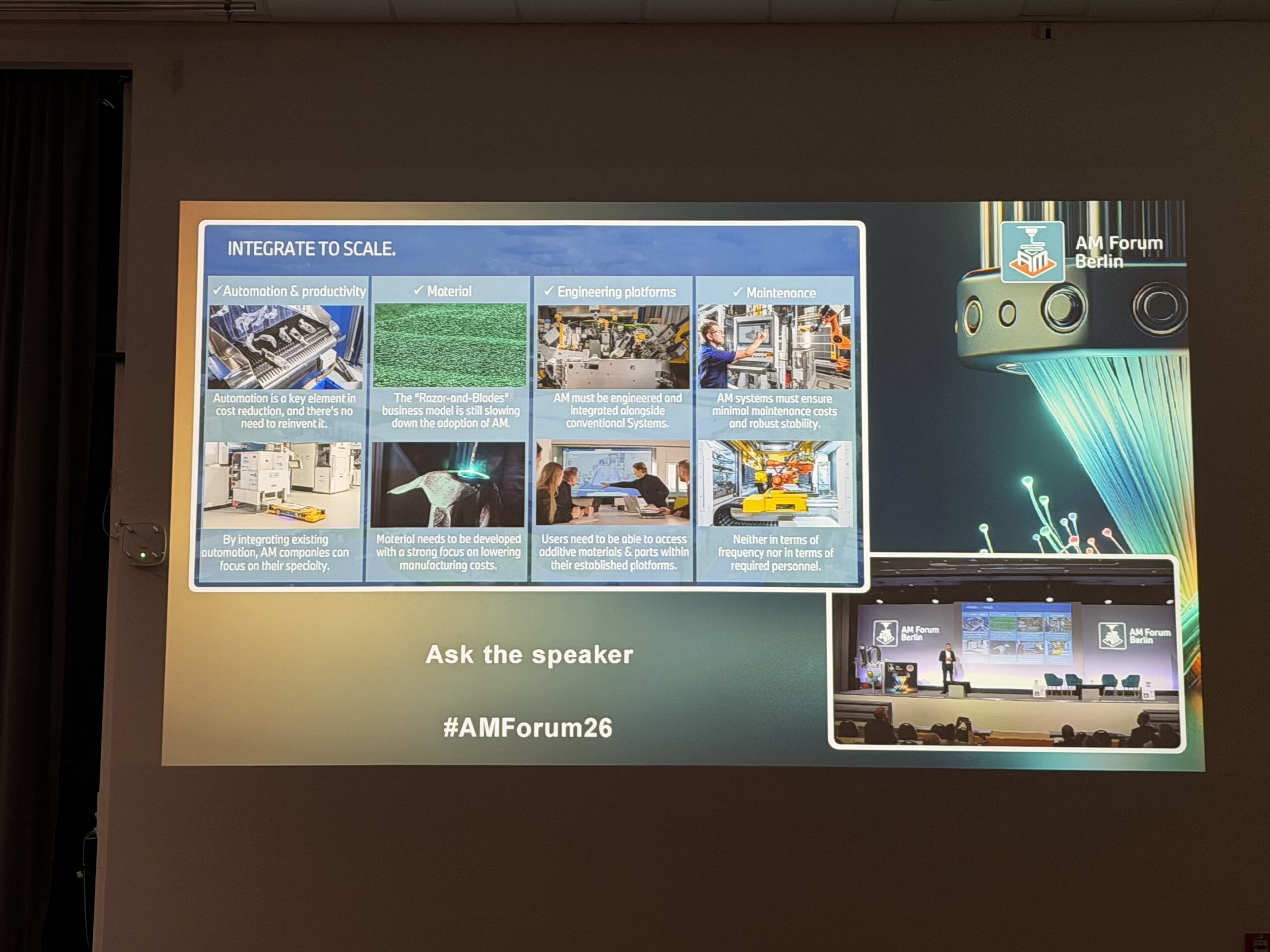
    Then we heard from Timo Göbel, the General Manager of Additive Manufacturing at the BMW Group. He talked about additive manufacturing reducing millions of euros in tooling costs. He said that the new i3 has two 3D printed parts in it, but only during the ramp-up. For mass production, 3D printing did not make it into the new car. The next stage at BWM is about industrializing AM to the next level. He shared that in 2012 they produced their first series of polymer 3D printed parts, and in 2017 they produced their first series of metal 3D printed parts. He talked about BMW using 3D printing in the Rolls-Royce Phantom, pioneering the use there. At Rolls-Royce, every car has at least 10 3D printed parts, he told us. He looked at their automated sand core 3D printing, which produced 4,500 sand cores each day. He explained that 3D printing companies will no longer use the razor-and-blades business model. Pointing out that “you need to move away from razor and blades…you need an open material model for production.” This is an excellent point.

    Timo also said that we do not need to reinvent automation; there are plenty of firms that can do this. We should integrate into existing automation systems or with companies. He also told us to reduce maintenance costs. We should also integrate with existing software systems. In just two minutes, Timo made the most succinct plea to really industrialize AM. If you take nothing away from this meeting, please just keep the above image as your desktop background. Timo went on to explain how they’re growing, in WAAM and MJF as well. He said, “No one will pay more to use AM because it is nice.” And stated that BMW can quickly integrate and scale technologies. But he needs “open materials systems with a focus on low costs.” The executive added that we need automation, high productivity, robust operational reliability and costs at scale.

    I believe this is the most important presentation I’ve seen in the past 5 years. This is exactly what we need to do in order to grow. I’m sure that the rest of the AM Forum will be great, but for me, Timo’s presentation more than made my trip to Berlin worthwhile. This is the kind of tough love and growth path that we need for the future.

    Images courtesy of 3DPrint.com

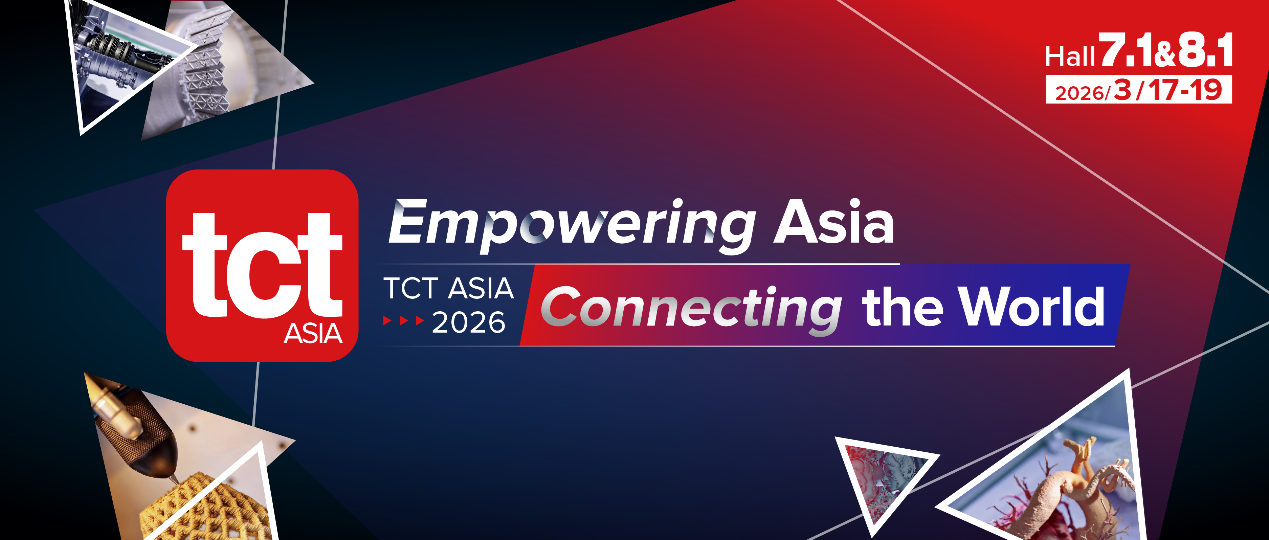
  • TCT Asia 2026: Empowering Asia · Connecting the World

    TCT Asia, now in its 12th year, is more than just a 3D printing exhibition — it embodies its original concept: Time Compression Technology, a vision of making the entire design-to-manufacturing process faster, smarter, and more efficient.

    In 2026, under the theme “Empowering Asia · Connecting the World”, the event will set new records, spanning over 55,000+ sqm and hosting 550 exhibitors, making it the largest gathering of the Asia-Pacific region.

    Setting a New Benchmark in Asia-Pacific Additive Manufacturing

    TCT Asia is not just about technology on display; it is a mirror of the region’s manufacturing strength and innovation potential. The exhibition gathers the full spectrum of industry players: 3D printing equipment manufacturers, material suppliers, technology service providers, professional buyers, and media from across the globe. Established industry leaders stand alongside rising innovators, providing a stage for high-potential solutions to be seen, discussed, and adopted.

    Asia-Pacific has rapidly become one of the world’s most dynamic markets for 3D printing. With government support, growing industrial adoption, and a highly engaged maker and designer community, the region is driving innovation in industrial manufacturing, healthcare, aerospace, and consumer products. TCT Asia provides the platform to experience this momentum firsthand—connecting global players with Asia’s market opportunities.

    Expanding the Exhibition Experience

    Beyond its record-breaking scale, TCT Asia 2026 continues to expand the boundaries of engagement. Programs such as the World Premier Selection give new products dedicated exhibition space, targeted buyer outreach, and extensive media coverage. On-site activities — including design showcases, cross-industry talks, and interactive exhibits — enable exhibitors to present their solutions in multi-dimensional, highly engaging ways, while giving designers, engineers, and creators a participatory stage to explore the future of manufacturing.

    At TCT Asia 2026, a “link” means a clear, actionable pathway for growth. With its dual-engine system, the event offers companies a strategic roadmap for international expansion. Enter mature western markets with ease: the TCT Global Match program connects exhibitors directly with top buyers and partners from Europe, the U.S., Japan, and South Korea—helping companies tap international demand and accelerate their global footprint.

    3D Genius Hub is an innovation lab where designers, engineers, brands, and end-users collaborate in real time.

    Forums and Conferences: From Insight to Action

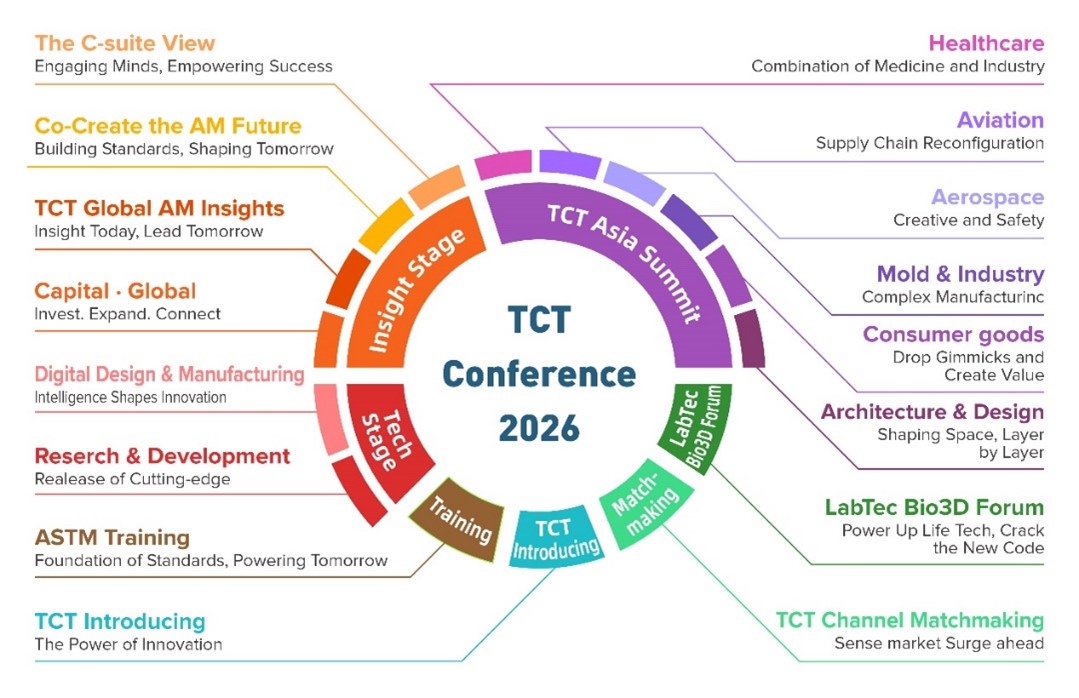
    Complementing the exhibition, TCT Asia 2026 offers over 100 conferences and forums, structured to translate industry insights into actionable strategies:

    • TCT Asia Summit: Covering healthcare, industrial manufacturing, consumer goods, and aerospace, these forums share case studies, technology trends, and market opportunities.
    • Insight Stage Series: High-level discussions on global additive manufacturing trends, international expansion strategies, and ecosystem collaboration.
    • LabTec Bio3D Forum: In partnership with the Chinese Society for Biomaterials, exploring the journey from lab research to clinical and industrial applications.
    • Tech Stage: Universities, research institutes, and industry experts present cutting-edge research and practical applications.
    • TCT Introducing: A dedicated zone for new product launches, featuring 20+ exhibitors including BLT, Polymaker, Formlabs, Farsoon, etc.
    • ASTM Certificate Course: Offering companies aiming at high-barrier sectors such as aerospace and healthcare a clear path to industry standards.

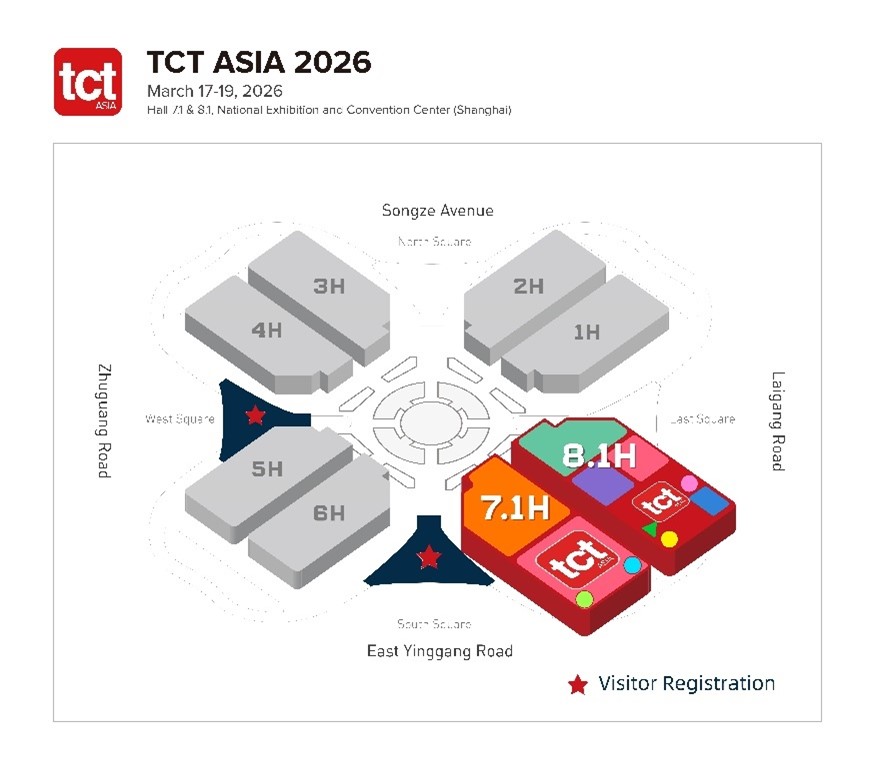
    TCT Asia 2026 is more than an exhibition; it is a platform that empowers Asia’s manufacturing power and connects it to the world. Join us in Shanghai to witness, participate in, and shape the emerging global industrial landscape. Click here to register for your visit to TCT Asia 2026

  • Shocking! America Makes Wants to Give You Money Again

    With two new project calls, America Makes would like to give you $35 million. Powered by the Office of the Under Secretary of Defense, Manufacturing Technology Office (OSD ManTech). OSD ManTech is tasked with continuing US technological leadership in quantum, hypersonics, materials, and more. It’s one of the most critical parts of the US government in developing and bringing to the warfighter essential technologies.

    One project is called the 2026 Department of Defense (DoD) Organic Industrial Base (OIB) Modernization Challenge, while the other is the Joint Additive Qualification for Sustainment Supplier Qualification (JAQS-SQ) Groups 2 and 3. The latter will receive up to 30 awards totaling $10.5 million. Meanwhile, the other will see earnings of $10 to $15 million.

    The OIB project is broad, covering digital operations technology, AI robotic process planning, in-situ quality checks, reducing operational exposure to hazards, lowering operational costs, pilot lines for emerging military products, and mobile/large surface automation.

    Additive Manufacturing Research Director at America Makes, John Martin, noted,

    “Modernizing the organic industrial base is a readiness imperative. Through this project, we’re hardwiring shopfloor improvements and additive manufacturing into daily production to drive measurable reductions in cost per pound of material, while boosting throughput, quality, and resilience. By making AM a core requirement for submissions, we turn fragmented innovation into award-winning capabilities that scale across depots and arsenals.”

    The project will be awarded in the areas of: Digital Operations Technology, Real-Time Manufacturing Sensors for Robotics, AI Robotic Process Planning, In-Situ Quality Checks, Reduced Operator Exposure, Reduced Cost of Operations, Pilot Line of Non-Traditional OIB Products, Mobile and Large Surface Automation, and Other AM Technology or Process.

    We can see that America Makes and Mantech are moving ahead here. Where a few years ago it was characterizing everything and 3D printing a lot of coupons, we are going up in the world. As with industry, much of the focus is on in situ QA, process planning, and on using software and sensors to improve additive manufacturing. Reducing operator exposure is also a wonderfully mature and operationally important thing to be thinking about. Reduced costs and production lines are very exciting as well.

    I really think that the US military should be creating and buying actual production lines for itself to make what it needs when it needs them. This will also let them iteratively improve things quickly according to the findings, circumstances, and situation. This would unlock the true value and ability of additive to win battles. Ukraine is not using 3D printers to print ancient designs; it’s using 3D printing to be agile, quick, proactive, and responsive. It is making part-sized solutions to the problems of the day and looking to outperform the enemy with better kit. And it’s making a huge difference for them. In the brittle, super-expensive US procurement quagmire, the advantages could be even greater.

    The other project is already underway. The JAQS‑SQ is meant to make onboarding, training, audit, and control more applicable to additive. This is one of the most important things underway at the moment, along with that one thing that sounds like a Japanese role-playing computer game. The sustainment and supplier qualification framework being created here could become the default way your service, machine, or material is evaluated in the future. What they’re building here is not just a project but connective tissue. How they define things, what they value, and the procedures laid out here will affect everyone forever. Based around DED and LPBF, it will see a training being implemented by Wichita State University – National Institute for Aviation Research (WSU‑NIAR).

    The training will let you learn how to become a qualified additive manufacturing partner for the government. Please take it.

    America Makes Technology Transition Director, Ben DiMarco, said,

    “The Defense Industrial Base needs more qualified additive manufacturing suppliers — and JAQS is scaling to deliver them. Preparing these suppliers now strengthens the U.S. Defense Industrial Base and builds the advanced manufacturing capacity our warfighters will depend on for decades. A year from now, we expect more than 30 qualified suppliers. The AM community, especially parts producers, should lean in.”

    If you are a US-based supplier of materials, machines, or manufacturing services, please join this if you can, take the relevant training if you’re able, and be a part of this. This is a significant opportunity to work for the government, and they’re actively helping companies engage with the government and get work done.

  • 3D Printing Financials: Healthcare and Aerospace Drive Growth at 3D Systems

    3D Systems (NYSE: DDD) closed out 2025 with stronger performance in the final quarter, helped by growing demand for 3D printing in healthcare, dental, and aerospace applications. The company said new printer sales and higher materials use helped raise results late in the year, while cost-cutting programs reduced expenses and improved its financial position. At the same time, the bigger picture for the full year was tough with revenue still lower than the year before despite growth in some key markets. The company now expects to build on its momentum in 2026 as more industries adopt additive manufacturing (AM).

    The company reported fourth-quarter revenue of $106.3 million. That was a 16% increase compared with the previous quarter, a stronger result than the company had expected. Management said the increase was mainly driven by higher sales of printer systems and increased materials consumption as more installed machines began operating.

    However, compared with the same quarter a year earlier, revenue declined by 4%. Part of that drop is related to the company’s sale of its Geomagic software business in April 2025. Because Geomagic contributed revenue in the prior year but is no longer included in the company’s results, the numbers are not directly comparable. After adjusting for Geomagic, 3D Systems said revenue actually increased by about 3% year over year.

    3D Systems creates implantable medical devices. Image courtesy of 3D Systems.

    Much of the company’s growth came from its healthcare business. Revenue in the Healthcare Solutions segment rose to $50.5 million in the fourth quarter, increasing 25% from the same period in 2024. Much of that growth came from the company’s personalized health services business, which includes patient-specific medical devices and surgical planning services.

    CEO Jeffrey Graves said, “Within med tech, our personalized health services business delivered strong double-digit year-over-year growth in the fourth quarter and for the full 2025 fiscal year, and has become the largest segment within our healthcare business. This growth is being fueled by our expansion into the trauma market, enabled by shorter cycle times for surgical planning and execution. In addition, our point-of-care centers, now expanding to even more leading research hospitals, are at the cutting edge of complex orthopedic procedures, in many cases related to oncology treatment. Our ability to offer solutions printed in titanium or medical-grade PEEK is of significant value to surgeons as they work to treat patients and restore their quality of life.”

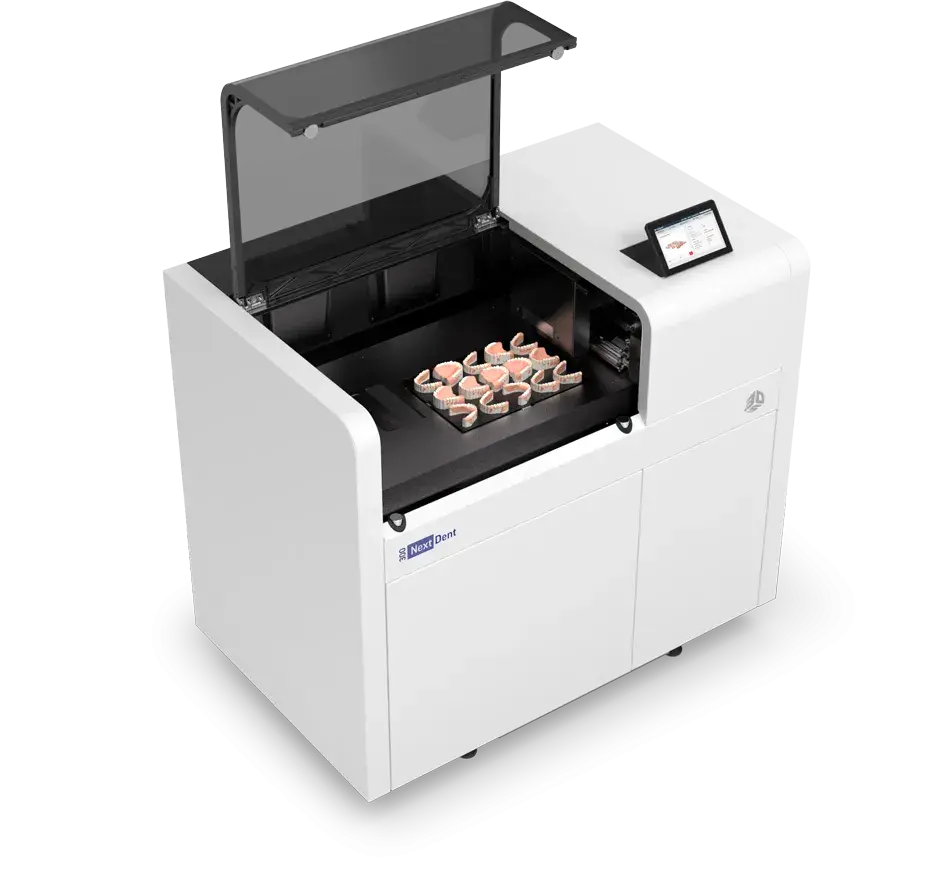
    NextDent Jetted Denture Solution. Image courtesy of 3D Systems.

    Dental applications were another area of growth. The company said its dental business increased at a strong double-digit rate compared with the previous quarter. This growth was helped by a recovery in the aligner market and the launch of new denture manufacturing technology, including its NextDent Jetted Denture Solution, which produces full dentures in a single print.

    Industrial markets showed a more mixed performance. Industrial Solutions revenue declined 21% year over year in the fourth quarter to $55.8 million. When excluding the Geomagic divestiture, the decline was closer to 11%.

    Despite that decline, the company highlighted aerospace and defense as a major opportunity. Revenue in this sector grew 16% for the full year, slightly exceeding the company’s internal target of 15% growth.

    Graves said aerospace and defense customers are increasingly using AM as a production method rather than just for prototyping. The company expects revenue from this sector to grow roughly 20% in 2026.

    The company also said that strong printer sales during the quarter slightly reduced profit margins. This is common in the 3D printing industry because printer systems usually generate lower margins than materials and services. However, once printers are installed at customer sites, they often lead to ongoing sales of materials, spare parts, and service contracts, creating recurring revenue over time.

    Gross profit margin for the fourth quarter was 30.8%, slightly below the 31% reported in the same period last year.

    Moreover, 3D Systems continued to focus heavily on reducing costs during the year. The company said its restructuring and efficiency programs produced about $55 million in annualized savings in 2025.

    These efforts helped improve profitability compared with earlier periods. Net loss for the fourth quarter was $19.5 million, an improvement of $14.2 million compared with the previous year. Adjusted EBITDA also improved significantly, reaching a loss of $5.3 million, compared with a much larger loss a year earlier.

    The company also improved its balance sheet by restructuring its debt and eliminating most of the 2026 debt. At the end of the year, it held $97.1 million in cash, compared with about $171 million at the end of 2024.

    “We remain intensely focused on reducing overall spending, while prioritizing strategic investments that drive growth in our priority markets,” noted Phyllis Nordstrom, Interim Chief Financial Officer of 3D Systems.

    Lightweight brackets for satellites made with 3D Systems’ Direct Metal Printing (DMP) technology. Image courtesy of 3D Systems.

    For the full year, revenue totaled $386.9 million. That was a 12% decline from 2024, although part of the decrease was related to the Geomagic divestiture. After adjusting for that sale, revenue declined about 7% year over year.

    More specifically, Healthcare Solutions’ revenue for the year reached $179.6 million, while Industrial Solutions generated $207.3 million.

    Net income for the full year was $29.9 million. The improvement was largely due to gains from the sale of businesses, including the Geomagic divestiture, along with lower operating expenses and fewer asset impairment charges compared with the previous year. Adjusted EBITDA for the full year remained negative at $45.4 million, though that still represented a significant improvement from the previous year.

    Looking ahead, the company expects first-quarter 2026 revenue to be between $91 million and $94 million. Adjusted EBITDA for the quarter is expected to range between a loss of $3 million and $5 million.

    Even though revenue was mixed, the company says the long-term outlook is still positive. Growth in healthcare, dental applications, and aerospace manufacturing continues to drive the adoption of AM technologies. And Graves said these industries are increasingly turning to 3D printing as a core manufacturing tool rather than an experimental technology.

    “Three markets were particularly noteworthy: med tech, dental, and aerospace and defense, which are rapidly adopting 3D printing as a core manufacturing method. These three markets have been a particular focus for our new product development over the last several years, and we believe they offer sustained growth opportunities over the next decade,” he said.

    For 3D Systems, the strategy moving forward is to expand its presence in these high-value industries while continuing to control costs and improve profitability.